5 B2B Demand Generation Case Studies: Full Walkthroughs
Five walkthroughs beat fifty summaries. If one of these constraint profiles looks like yours, let's talk through the system behind it.
Book a CallMost published demand generation case studies follow the same three-act script. A challenge, a solution, and a results banner, with no budget, no timeline, no failures, and no word on how anyone measured anything.
Part of The Complete Guide to B2B Demand Generation Strategy.
The people producing them know it. When UserEvidence surveyed B2B buyers, sellers, and marketers for its Evidence Gap report, nine out of ten sellers and marketers admitted they wish they gave buyers higher-quality, more diverse proof.
The stakes of that gap are bigger than most teams assume. In 6sense's 2025 Buyer Experience Report, a study of 4,510 recent B2B buyers, 94% of buying groups ranked their vendor shortlist in order of preference before speaking to a single seller, and buyers purchased from their Day One shortlist 95% of the time.
The sharpest number in that study sits one layer deeper. Buyers who pre-ranked their shortlist bought from the first vendor they contacted 84% of the time; buyers who had not pre-ranked did so only 57% of the time.
By the time the first sales conversation happens, the evidence a buyer read months earlier has already made the decision.
Our own cross-industry research shows how few companies act on this. Even in mature verticals, only about one in four active B2B sites publishes case studies at all, and in the least mature it falls under one in eighteen.
So this piece does the thing we keep wishing vendors would do. Five real demand generation programs, walked through properly, and each one covers the same anatomy:
- The starting conditions, including sales motion, sales cycle, and the constraint that hurt
- The diagnosis and the system we built against it
- The results, with the measurement method named
- What transfers to your situation, and what breaks
The flat months stay in. So do the parts we would design differently today. If you would rather browse the mechanisms than the clients, our demand generation examples and our demand generation ideas with the numbers each one produced cover the same systems from a different angle.
The five case studies at a glance
Each case ran a different demand mechanism against a different sales motion. Find the row that looks like your constraints and start there.
Client | Market and motion | Core constraint | System built | Headline results | Timeframe |
K-12 EdTech, district-led, long trust cycle | Rebrand wiped 80%+ of organic traffic | Rebuilt inbound content engine wired to lead scoring | +4,500% traffic, +514% inbound leads | ~18 months | |
EdTech services, district-led, multi-stakeholder | Conference CPL of $500-600, CAC $2,500+ | Tool-paired content library plus automated enrichment | CPL $10, CAC $600, 300 MQLs/month | Feb 2025 onward | |
B2B SaaS, SMB founder buyers | Outbound replies stuck at 3-4% | One flagship original-data report operationalised for outbound | Replies 14-18%, $2-2.5M pipeline | 6 months | |
Clean energy deep tech, relationship-led | Cold replies under 1%, no funnel structure | Webinar engine with hyper-personalized outreach | 1,023 MQLs, replies 12%+, $2M+ pipeline | 6 months | |
EdTech AI SaaS, self-serve, no sales touch | $150 CPL on paid, shrinking runway | Programmatic SEO fused with the product | CPL ~$45, +609% traffic, $15k MRR | 12 weeks |
One note on scope before we start. Demand generation here means the whole system that creates and captures qualified demand, so you will see inbound engines, an outbound asset, a webinar program, and a product-led build. Anyone who tells you demand generation equals one channel is selling that channel, a point we make at length in how demand generation and content marketing work together.
Case 1. Ori Learning, rebuilding inbound demand after a rebrand collapse
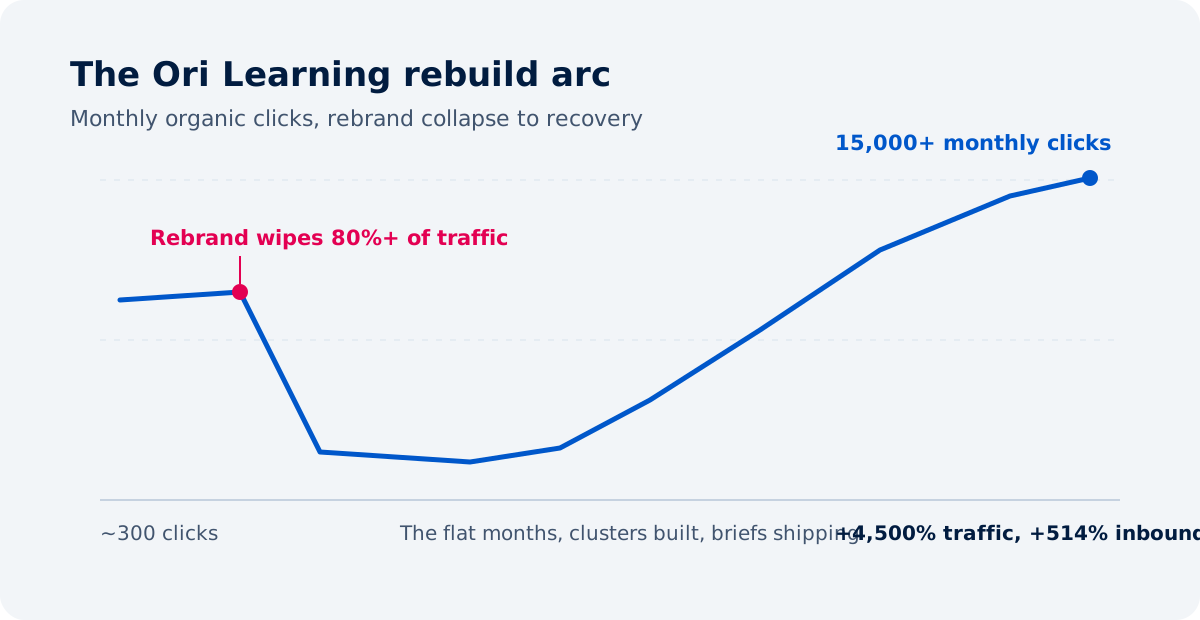
Ori Learning sells special education and social-emotional learning software into US school districts. In 2023 the company rebranded and moved to a new domain, and the migration erased the organic footprint that fed its pipeline.
Where they started
Traffic fell more than 80%. Inbound demo requests dropped to near zero.
The market made that loss expensive. District buyers read for months, lean on peers, and move on procurement timelines measured in quarters, so paid and outbound are punishing substitutes for the trust that organic content had been building.
The engagement started narrow, as SEO content support with one subject-matter expert attached. With no other marketer on the team, it grew into the de facto marketing function.
What we built
The rebuild started with interviews, and the founder, CEO, and COO are all former practitioners. We asked one question repeatedly, where are district and school leaders actually stuck, then ran their answers through keyword research to find the demand behind each bottleneck.
That produced two clusters matching the two lines of business, special education and social-emotional learning, full of underserved topics like IEP goal writing. The depth came from academic literature and field research that generic AI content has not digested, which is why the pages could win.
Production ran as a disciplined human-plus-AI pipeline rather than a content mill:
- An automation pulled competitor articles for each target keyword and flagged their weaknesses
- Every piece got a detailed brief covering length, headings, keywords, purpose, and preliminary research
- A writer expanded each section with deep research, and a human edited the fat back out
The biggest traffic engine was programmatic. The SME wrote one definitive piece on a set of IEP goals, we handed his framework to the AI, and close to 100 templated articles followed, pulling more than 20,000 visitors a month at peak.
A repurposing automation turned every article into social briefs and email copy, saving roughly 20 hours a week. That is the only reason one operator could ship blogs, social, email, and webinars at once.
How readers became pipeline
The most-read pages fed a free IEP goal tracker built by a former SPED director. It gathered thousands of downloads and became the highest-leverage asset in the funnel.
Sales never touched a fresh download. Reps engaged only once a contact crossed a lead score of 25 or viewed the demo page without booking, and the CRM handed them the district, the role, and exactly what the person had read. That reader-to-rep wiring is the same lead capture and qualification and handover logic we build into every program.
Because many readers were teachers rather than decision-makers, a referral program bridged the gap. Refer your admin or coordinator, receive the full lesson-plan bundle free, and each referral told sales precisely which district lacked content.
The numbers, and how we measured them
All results come from Search Console, SEMrush, and HubSpot dashboards, reported monthly to the CEO and COO.
- Organic traffic grew 4,500%, from roughly 300 to more than 15,000 monthly clicks
- Inbound leads grew 514% on a sustained monthly basis, starting from 21 a month and peaking at 164
- The system produced 32 SQLs in its first month of full operation
- Baseline contribution ran at least 30 MQLs a month, with strong months at 150 to 200
What transfers, and what breaks
This shape works where buyers research heavily before talking to anyone and where genuine subject-matter depth exists in-house. Practitioner knowledge was the moat.
It breaks without that moat. A team with no SME access producing generic articles would have rebuilt traffic, and no pipeline.
Case 2. Behavior Advantage, from $600 conference leads to a $10 inbound engine
Behavior Advantage is a behavior planning platform and consultancy run by three Board Certified Behavior Analysts. When we started in February 2025, conferences carried the entire pipeline. That starting point, a pipeline resting on events rather than on anything buyers find on their own, is the situation behind our list of demand generation agencies for companies not generating enough inbound.
Where they started
The event math was brutal. Cost per lead sat between $500 and $600, customer acquisition cost ran past $2,500, and lead flow spiked around events then went silent.
The expertise was real and the credibility was earned. Outside a conference booth, both were invisible.
What we built
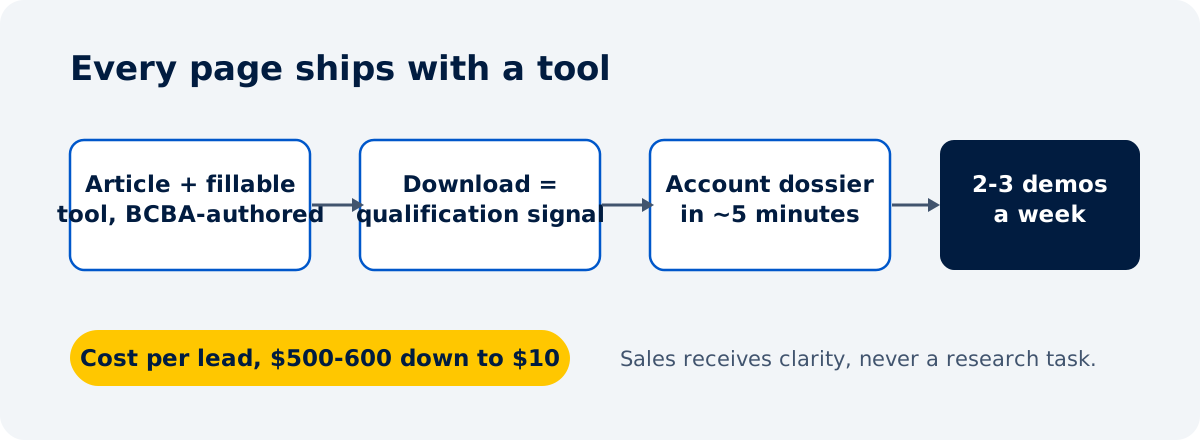
The system turns on one sharp idea, every page ships with a tool.
Hundreds of articles target high-search, low-difficulty queries that only the ideal buyer would type. Each one pairs with a fillable, printable resource authored by the BCBAs, a behavior plan template, a functional behavior assessment, and an IEP goal bank among them.
That pairing makes the library a product rather than a blog. A school team reads the page, then downloads something they use in a classroom that afternoon.
Production stays deliberately human-led, because the authorship is the moat. The BCBAs write the majority of each piece from field experience, and we edit, structure, and design the tools.
The same pairing became an AI discovery advantage. An answer engine cannot reproduce a fillable template or a platform-generated example set, so it cites the page that has one. Behavior Advantage now holds roughly 35% share of voice and around 40% of the AI Overviews across its terms, with pages cited 20 to 30 times a week by answer engines. Building that kind of citable, extractable page is exactly how we help you show up in AI search.
How downloads became demos
Every download is a qualification signal, because every resource maps to a specific failure mode. A behavior-plan template download says the district's planning process is strained, and a small set of these download-to-pain mappings runs on simple if-this-then-that logic.
Behind the download, an automation enriches the lead within about five minutes:
- District data covering enrollment, per-student budget, and program usage
- The buying-committee picture, roles, and contact details from public sources
- A formatted account dossier with a drafted, personalized first email
The rep who receives it is one of the founding clinicians, with no sales training at all. Reading a dossier instead of doing research, she books two to three demos every week by email, while download pages and nurture sequences convert more demos without anyone in the loop. That enrichment-and-dossier layer is the automation architecture underneath the engine.
The numbers, and how we measured them
Reporting runs monthly against revenue metrics, assembled from Search Console, GA4, form captures, Mailchimp, and Calendly.
- Monthly clicks grew from 473 to 5,284 between February and November 2025
- MQLs grew from 39 to 300 a month, with 10+ inbound leads a day and 25% of leads converting to demos
- Cost per lead fell from $500-600 to $10, and acquisition cost from $2,500+ to $600
Content-market fit announced itself in the first weeks as a flood of resource downloads and demos self-labeled as "Google search". The enrichment and handover layer came after that signal, and the order matters; build the wiring first and you automate a funnel nobody has proven wants to convert.
What transfers, and what breaks
This transfers to any expertise-rich team selling to practitioner-adjacent buyers, and the tool-paired page is a durable retrieval advantage in AI search on top of the conversion win.
It breaks if nobody in-house can author tools worth using. The templates convert because practitioners with credentials wrote them, and a designer cannot fake that.
Case 3. Lucid, one data report that took outbound replies from 3% to 18%
Lucid sells into SMBs and founder-led teams, a segment with limited attention and zero tolerance for generic outreach. This case has no content hub and no SEO play at all.
Where they started
A large SDR team pushed high outbound volume against reply rates stuck at 3 to 4%. Founder buyers showed a flicker of interest, then disappeared, and older deals stalled with no credible way back into the conversation.
The diagnosis was leverage, not discoverability. Outreach had no reason to exist beyond asking for time. Enough teams arrive in that exact state that we built a shortlist for it, screening more than 160 agencies and keeping 14 in demand generation agencies for when cold outbound has stalled.
What we built
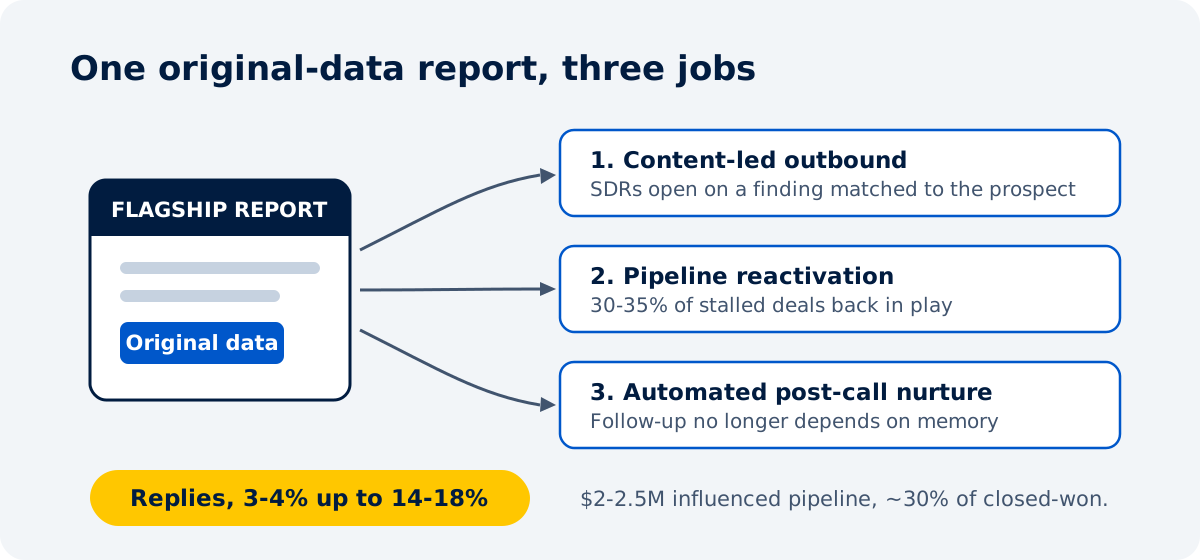
We concentrated the entire effort into one flagship industry data report. It combined Lucid's proprietary product and usage data with a targeted survey of their ICP, which produced benchmarked findings that existed nowhere else. That concentrate-everything-into-one-asset move is how we build a flagship content product.
Original data was the point. A founder ignores another thought-leadership piece, and answers a specific, surprising statistic about their own world.
The pattern holds beyond outbound too. In our analysis of 4,864 AI-cited pages, 47.1% carried original data, which makes proprietary numbers the closest thing to a moat in a world of synthesized answers.
The report then went to work on three jobs:
- Content-led outbound, with SDRs opening on a specific finding matched to each prospect
- Pipeline reactivation, a credible, non-salesy reason to reopen deals that had gone dark
- Automated post-call nurture, sequences delivering the report sections closest to each conversation
AI-assisted personalization matched the right statistic to each prospect's context, so the opener read as relevant rather than templated. The full mechanics of that motion live in the content-led outreach system that outperforms 99% of cold email. And because nurture fired automatically after every call, follow-up stopped depending on a busy rep's memory, the same lead nurture and database reactivation layer we wire into every program.
The numbers, and how we measured them
We measured the asset on outbound performance and revenue, never downloads. Across the first six months:
- Reply rates climbed from 3-4% to 14-18%, and positive responses more than quadrupled
- Reactivation brought 30-35% of stalled deals back into active pipeline and drove roughly 25% of all new meetings
- Meetings rose about 65% and close rates about 40%, with no added headcount
- The average sales cycle shortened around 22%, and the report influenced $2-2.5M in pipeline, roughly 30% of closed-won revenue
Post-call nurture was the hidden bottleneck. Deals had been dying in the silence between conversations, and automating that gap contributed as much as the louder outbound win.
What transfers, and what breaks
This transfers wherever buyers ignore vendors but respect evidence about their own market, and it is the fastest path on this list, showing results inside a quarter.
It breaks without genuinely original data. A report assembled from other people's statistics gives outreach nothing to open with, because the prospect has seen the numbers before.
Case 4. Heliogen, a webinar engine that took cold replies from under 1% to over 12%
Heliogen builds AI-enabled concentrated solar and energy storage for industrial decarbonization. Pipeline depended on individual reps working personal networks, and cold outreach replied below 1%.
Where they started
Deep-tech markets run on trust, and Heliogen's version of it lived in a few calendars. Product interest was real, but there was no structured way to generate, capture, or nurture demand, so leads that showed interest died from lack of follow-up.
The founder arrived with the idea of a webinar series. We built it as a revenue program with commercial goals rather than a series of events, which is how we build webinar funnels.
What we built
Two decisions did most of the work.
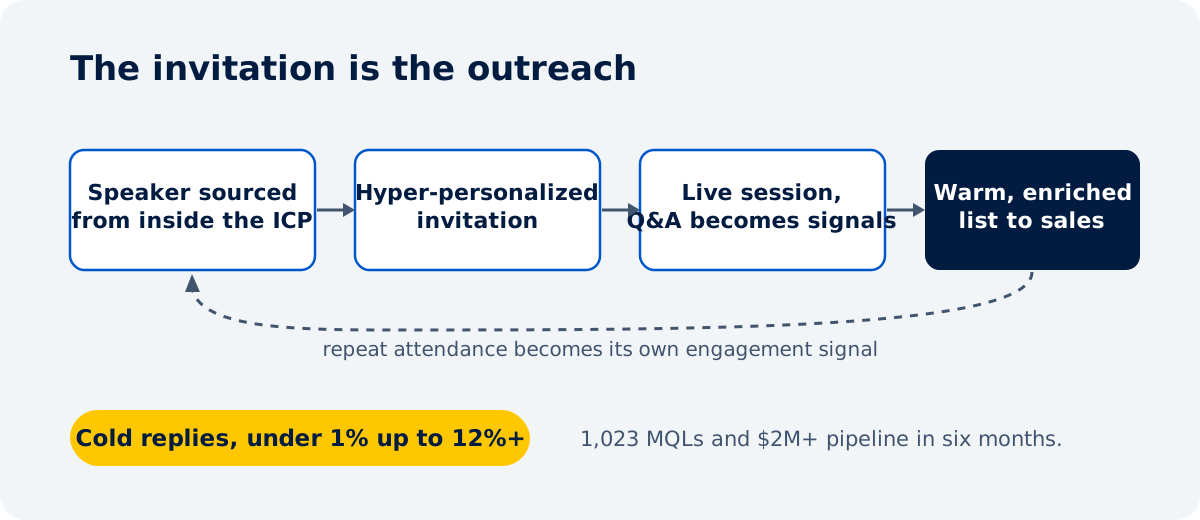
First, speakers came from inside the ideal customer profile. A relationship with a speaker opened an account, which meant the invitation itself became the outreach, and speaker-aimed invites pulled response rates in the high 30s to 40%.
Second, topics came from a listening station rather than a brainstorm. A set of feeds and scrapers monitored the industry's journals and creators, clustered what it found into monthly trends, and we validated those against search data before committing an event to them.
Around the events, an outreach engine did the heavy lifting. An automation enriched every registration before anyone followed up, and net-new prospects received hyper-personalized invitations sent from the founder's own profile, with subject lines stitched from oddly specific details about the recipient.
Cold replies lifted from under 1% to over 12%.
The way we think about webinars is as a content product, and a good one produces registrations, MQLs, follow-up conversations, repurposable content, and partnership opportunities at once. Without the follow-up system it is a burst, and with it the same hour of expertise works for weeks. Our complete guide to webinar production lays out the full run-of-show.
The numbers, and how we measured them
Attribution stayed deliberately simple, which is what made it credible on a long, multi-stakeholder cycle:
- A registration fitting the ICP counted as an MQL, which produced 1,023 MQLs in six months
- Attendance cross-referenced against the deals reps opened counted as influenced pipeline, which tied the program to $2M+ in projected pipeline
- The first webinar drew 500+ attendees, and repeat attendance became its own engagement signal
No black-box model, just a clean line from attendance to opportunity. The program built a repeatable go-to-market motion the company had lacked, which contributed to Heliogen's acquisition in 2025.
What transfers, and what breaks
This transfers to trust-led categories where expertise is abundant but access is scarce, and it suits small sales teams because the engine hands them context instead of contact lists.
It breaks the moment a product pitch takes the stage. The events earned attendance because the guest's expertise carried each session, and the audience can smell the other kind.
Case 5. Radius, programmatic SEO that cut cost per lead 70% in twelve weeks
Radius is an AI app that generates worksheets and lesson plans for educators. The company was young, self-serve, and growing almost entirely on paid ads at roughly $150 per lead, which was burning its runway.
Where they started
When ads ran, leads came, and when spend paused, growth stalled. The scope was tight, activate SEO in three months, and the build was two people, us and the technical co-founder.
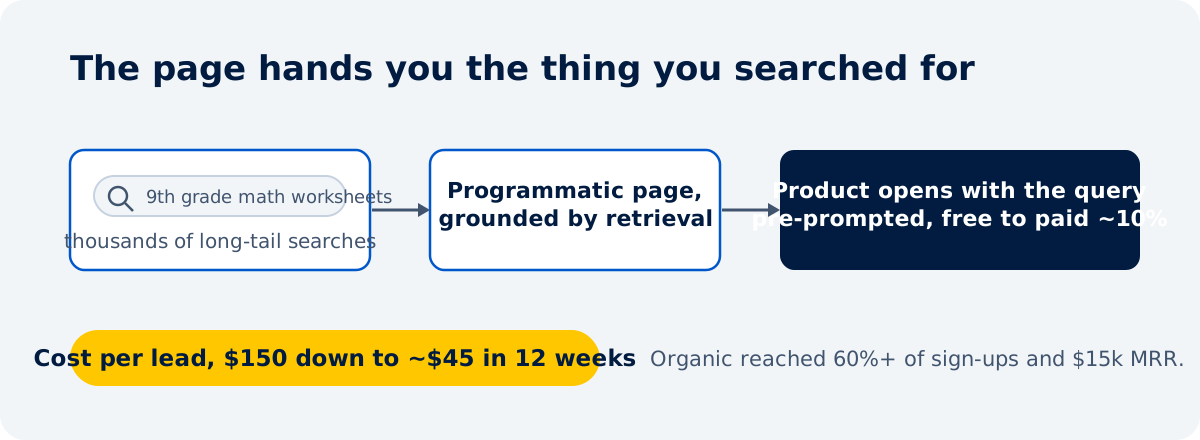
The strategic insight came early. Teachers search for worksheets and lesson plans in their thousands, and the product generates exactly those on demand, so the search demand and the product were the same shape. That product-led shape is the heart of what still works in SaaS demand generation in 2026.
What we built
Every page became a working product demonstration. A custom workflow drove modular pages through the CMS, drafting each section with AI, pulling People Also Ask questions in programmatically, and assembling title tags and structure automatically.
The detail that kept thousands of pages from going thin was retrieval. A light RAG layer pulled real material for each topic, videos and pre-selected sources, and the AI varied every page off that grounding, which is the difference between programmatic pages that rank and doorway pages that get filtered out.
Conversion was engineered into the page architecture:
- One clear call to action per page
- A click created a free account and landed on the generation screen with the original query already prompted in
- The page about ninth grade math worksheets did not describe the tool, it handed you a ninth grade math worksheet
A behavior-triggered lifecycle engine did the selling from there, since no human ever touched the funnel. Low-engagement users received win-back offers, high-engagement users received credits and referral bonuses, and the strongest offer fired after a user had generated four or five resources, the point of maximum dependence.
Free users converted to paid at roughly 10%.
The numbers, and how we measured them
We instrumented attribution before scaling. Analytics events separated organic sign-ups from paid, with dedicated landing pages and UTMs, so the numbers isolate organic revenue cleanly:
- Organic traffic grew 609%, from 409 to 2,900 monthly visitors, and search impressions from 13k to 109k
- Cost per lead fell 70%, from $150 to roughly $45, while we cut paid spend in half
- Organic reached 60%+ of new sign-ups and $15k in new monthly recurring revenue
The engagement ended with the founder taking the engine over and running it himself. A system productized enough to hand over is the real test of whether you built an engine or ran a campaign.
What transfers, and what breaks
This transfers to product-led companies whose product directly fulfils what people search for, where a page can hand over the outcome instead of describing it. If you would hand that build to an outside team, ask whether it has grown a self-serve product before, which is the screen behind our list of demand generation agencies for product-led companies.
It breaks for considered, multi-stakeholder purchases, where nobody signs up self-serve from a landing page. That is exactly why the other four cases on this list exist.
What five working demand generation programs have in common
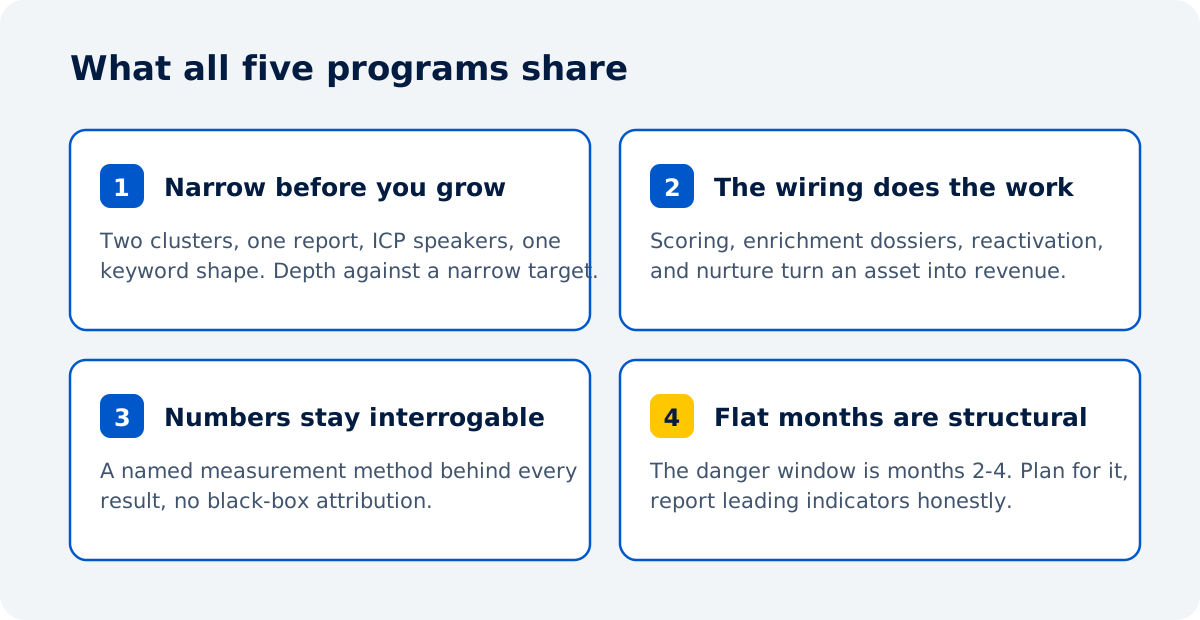
Five different mechanisms, five different sales motions, and the same four patterns underneath.
Every program narrowed before it grew
Ori built two clusters from practitioner interviews instead of chasing a keyword dump. Behavior Advantage targeted queries only its ideal buyer would type, Lucid aimed one report at one ICP, Heliogen picked speakers from inside its target accounts, and Radius bounded itself to the exact searches its product fulfils.
The pattern is the same decision made five ways. Depth against a narrow target beat breadth every time, and the narrowing happened before production started, not after results disappointed.
The wiring did the work the asset gets credit for
Each headline asset only produced revenue because of the system around it, the lead scoring, the enrichment dossiers, the reactivation plays, and the automated nurture.
We think the funnel has to be designed before the content, with a tight MQL definition and a mapped path from reader to conversation. Content built without that operating logic becomes traffic with nowhere to go, which is the exact failure the demand generation framework most teams build backwards is built to avoid, and the leak points are visible stage by stage in how the demand generation funnel works by the numbers.
Most companies have this exactly backwards. In our cross-industry analysis, roughly 70% of firms in some verticals lack the integrated CRM and automation backbone to capture, score, route, or nurture at all, and you cannot compound what you cannot capture.
Every number stayed interrogable
Each case named its measurement method, ICP-fit registrations as MQLs, GA4 events splitting organic from paid, and attendance cross-referenced with opened deals. None of it needed a black-box attribution model, and that simplicity is what let founders, sales leaders, and boards trust the numbers enough to keep investing. Which metrics actually deserve that trust is the subject of what demand generation metrics to track and not to track.
Independent data points the same direction. Cognism's documented shift from lead generation to demand generation found gated-content leads closing at 0.2% against roughly 4% for declared-intent inbound, the same gap we unpack in demand generation vs lead generation.
HockeyStack's telemetry across 87 B2B SaaS companies tells the same story at scale. Demand-generation MQLs converted to SQLs at 21.55% against 4.93% for lead-gen motions, at half the cost per SQL despite a more expensive cost per lead.
The flat months are structural, and the teams that quit at month three never see month six
Ori's programmatic spikes came months into the rebuild. Behavior Advantage saw downloads flood in early but built its enrichment layer only after the signal appeared. Radius compressed the curve to twelve weeks only because the product closed the loop itself, and Lucid moved inside a quarter only because outbound needs no ranking.
Independent studies document the structural reason. Ahrefs' study of over a million pages found only 1.74% of new pages reach Google's top 10 within a year, and the average page holding position one is five years old. Cognism's transition account puts the danger window at months two to four, when lead volume has dropped and compounding has not started.
Plan for that window before it arrives. The programs above survived it because we reported the leading indicators, downloads, engagement signals, and reply rates honestly while the pipeline number was still flat.
How to read a demand generation case study before you copy it
Any case study, ours included, should survive four questions before you borrow its playbook:
- Match on constraint, not on tactic, meaning sales cycle, deal size, buyer trust posture, and team capacity
- Demand the measurement method, because a result without a stated method is an advertisement
- Ask what failed or ran flat, since a program with no flat months got lucky or edited its history
- Discount anything without a timeline, as results divorced from timeframes cannot be planned against
The constraint match matters most. Radius's twelve-week engine is irrelevant to a district sales motion, and Ori's cluster build is wrong for a self-serve product, however impressive either number set looks.
One more reason we publish walkthroughs at this level of detail, and ungated. Buyers now run most of their evaluation through machines as well as peers.
In G2's 2026 survey of 1,076 B2B decision-makers, 71% rely on AI chatbots for software research and rank them the top influence on their shortlists. In Semrush's survey of 600+ B2B professionals, only 7% notice a vendor in an AI answer because they recognize the brand.
What earns the mention is a precise, specific match to the buyer's situation. A detailed, published case study provides exactly that, and a gated PDF never will.
If one of these five constraint profiles looks like yours, the full case studies carry more detail than we could fit here, and we are happy to walk you through the system behind any of them. You can browse them all on our demand generation examples page.
Your market is one of these five.
District-led trust cycles, founder buyers, relationship-led deep tech, or self-serve product-led growth, we have built the demand system for each. Let's design yours, with the measurement method named up front.
Frequently Asked Questions
About the Author

Founder & CEO, Content RevOps
Stefan Kalpachev is the founder and CEO of Content RevOps, where he helps B2B SaaS companies transform their content into predictable pipeline. With a background in content marketing and revenue operations, Stefan has developed a unique methodology that bridges the gap between content creation and revenue generation.
Connect on LinkedIn