The best demand generation agencies for CROs and heads of sales in 2026
A CRO or head of sales owns the number, not the campaign. You care whether the pipeline is real, whether the leads marketing sends can actually be worked, and whether deals keep moving through a long, committee-led cycle. A lot of demand help stops at clicks and form fills, then hands sales a list that goes nowhere. Plenty of agencies say they build pipeline. Many just run ads or book random meetings and call it demand. We reviewed more than 120 agencies that work with revenue leaders and kept the ones that tie their work to pipeline and closed deals. Below we explain each one in plain words, so you can pick the right fit.

How we chose this list
We used the same checks on every agency, including our own. Here is what earns a spot and how we ordered them.
Who makes the list
Every agency runs real demand generation, sales development, or revenue operations, and has proof of its own work. We left out pure lead-list sellers and ads-only shops with nothing to show.
How we rank them, in order
- Real pipeline fit for a revenue leader, not just brand work
- Whether they run marketing for themselves, and it works
- Review proof, counting how many reviews back the score
- Whether they show prices and name their team
- Fit to your size, stage, and sales motion
What we promise on every entry
Every claim can be traced to a source. Ratings always show how many reviews they come from. Prices are shown, or marked not shown. We do not give any agency a made-up score, and we hold our own entry to the same checks.
The shortlist at a glance
All 13 entries, ranked by the criteria above. Full detail in the cards below.
| # | Name | Pros | Cons | Best for | Pricing |
|---|---|---|---|---|---|
| 1 | Content RevOps |
|
| Revenue teams, from SMB to mid-market, that run long committee cycles and want content wired into the sales motion and the CRM, so pipeline is provable, not another set of campaigns to reconcile. | $4.1-8.5k/mo |
| 2 | RevPartners |
|
| Revenue teams on HubSpot that need demand, the CRM, and reporting rebuilt and run as one system. | $1-5k/mo |
| 3 | memoryBlue |
|
| Sales teams that need booked meetings from an outsourced SDR team, not content or inbound. | $5-10k/mo |
| 4 | INFUSE |
|
| Large revenue teams that want buying-group demand and account-based programs run at global scale. | Not disclosed |
| 5 | Martal Group |
|
| Teams that want a ready-built outbound team of SDRs and closers rather than hiring one. | Not disclosed |
| 6 | Clarify |
|
| Enterprise teams chasing named accounts that want ABM and outsourced SDR from one partner. | $10-25k/mo |
| 7 | align.me |
|
| Teams where sales and marketing do not agree on the plan or the definition of a lead. | $5-10k/mo |
| 8 | Colony Spark |
|
| Founder-led industrial vendors stuck on referrals that want one connected system at a flat price. | $4,000/mo flat |
| 9 | CS2 |
|
| SaaS revenue teams buried in MQLs that never convert, that need lead scoring and routing fixed. | Not disclosed |
| 10 | The Mx Group |
|
| Mid-market and enterprise teams that want demand, ABM, and sales enablement run as one program. | Not disclosed |
| 11 | Orange Marketing |
|
| Teams that own HubSpot but underuse it and want the revenue system built and then run. | $5-10k/mo |
| 12 | Revnew |
|
| Teams with long sales cycles that want booked meetings from outbound, syndication, and intent data. | $10-25k/mo |
| 13 | Closed Loop |
|
| SaaS revenue teams that run serious paid budgets and want media, creative, and data in one team. | Not disclosed |
The list
What they doContent RevOps is a content marketing and demand generation firm built for revenue teams. We work with B2B SaaS and professional services companies where marketing, the CRM, and sales enablement each run in their own lane, and nobody can prove what content actually returns. That gap is what a CRO or head of sales lives with: marketing reports MQLs, sales works deals, and the two numbers never reconcile. Most companies already own a pile of content. It sits on a blog, earns a few clicks, and never helps a rep move a deal. We give that content a job. We map your buying committee and your sales motion, then build the decision-stage material your buyers and your reps actually need, and place it where those buyers look, including AI answers. Then we wire it into the CRM. Leads are enriched, scored, and segmented, follow-up is automated, and every piece is tied back to pipeline and revenue in HubSpot and Looker, so you can show which content produced which deal. That is the part a revenue leader cares about most: not more activity, but pipeline you can measure, trust, and forecast. We publish our method and our prices, from 4,100 to 8,500 US dollars a month, so you know what you are buying before the first call.
Best forRevenue teams, from SMB to mid-market, that run long committee cycles and want content wired into the sales motion and the CRM, so pipeline is provable, not another set of campaigns to reconcile.
Pros
- Runs one connected system from first search to closed revenue, instead of campaigns that never touch the pipeline.
- Wires content into the CRM with enrichment, lead scoring, and attribution, so pipeline is provable rather than guessed. how we work ↗
- Has named case studies with real pipeline numbers, from a fintech resource hub that influenced 3 to 4 million dollars to a webinar system behind a 2 million dollar-plus pipeline. case studies ↗
- Publishes its method and its prices, from 4,100 to 8,500 dollars a month. Most agencies here hide both. how we work ↗
- Built for careful B2B buyers and for AI answers, measured on pipeline and revenue rather than clicks.
Cons
- Young and small, so it fits building a content-led revenue system better than running large outbound SDR teams or big paid-media budgets.
- Newer to the market than the established agencies and sales-development firms on this list.
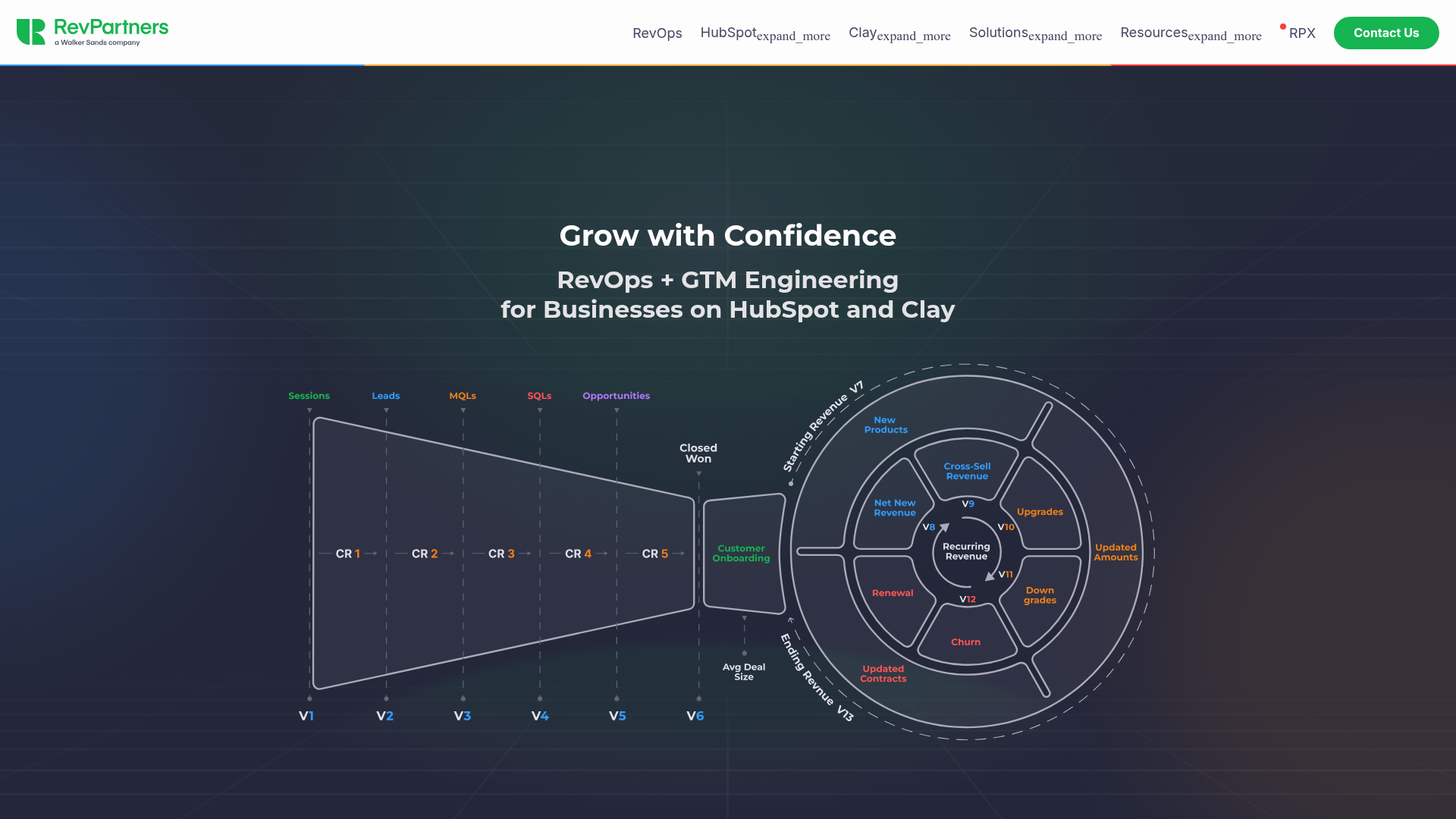
What they doRevPartners is a RevOps and go-to-market engineering firm, not a campaign agency. It builds and runs the HubSpot engine behind demand: CRM setup, lead routing, reporting, and the automation that connects marketing activity to a pipeline number a CRO can trust. The team says it serves the people behind the number, and it works as a managed service rather than a one-off project. RevPartners is an Elite HubSpot Solutions Partner with more than 1,000 CRM and RevOps deployments and several HubSpot accreditations, and it ranks on its own site for terms like revops and intent providers, which is rare proof that it runs the play it sells. It fits revenue teams whose demand and sales data live in different places and never quite add up.
Best forRevenue teams on HubSpot that need demand, the CRM, and reporting rebuilt and run as one system.
Pros
- Builds and runs the full HubSpot revenue engine, so pipeline data lives in one place.
- Elite HubSpot partner with more than 1,000 CRM and RevOps deployments.
- Ranks on its own site for its category, not just its brand name.
- Rated 5.0 across 488 HubSpot reviews, one of the largest review bases on this list.
Cons
- Its work is built around HubSpot, so teams on a different CRM will get much less from it.
- Most of its public proof sits inside the HubSpot ecosystem, with only a single review on Clutch.
What they domemoryBlue is a sales development company. It builds and runs outsourced SDR teams that book qualified meetings for B2B technology vendors, so a head of sales can add pipeline without hiring and ramping reps in-house. Founded in 2002, it has grown to a few hundred sales professionals and supports both startups and blue-chip vendors. It is one of the few firms here that runs its own play well: its blog ranks near the top of search for the vocabulary of sales development, and it publishes an ROI calculator and an alumni survey rather than only case studies. That focus is the trade-off too. memoryBlue is about outbound meetings, so it pairs best with a content and demand engine that warms accounts before the reps call them.
Best forSales teams that need booked meetings from an outsourced SDR team, not content or inbound.
Pros
- A dedicated sales development firm, running for more than 20 years.
- Rated 4.7 from 23 reviews on Clutch, a real review base for its category.
- Ranks for the vocabulary of its own service, so it practices what it sells.
Cons
- Focused on outbound meetings, so it does the top of the funnel and leaves demand and content to someone else.
- Does not publish pricing on its site.
What they doINFUSE is a global demand and revenue marketing company that works at enterprise scale. Its model is a data-driven demand engine: first-party buying-group data, intent signals, and account intelligence used to find in-market buyers, then multichannel programs to engage them. For a CRO, the draw is reach and precision across whole buying committees rather than single leads. INFUSE publishes original buyer research, including its Voice of the Buyer reports, and names clients such as DeepL, Veeam, ZEISS, Alation, and West Monroe. It also ranks on its own site for category terms like lead generation and thought leadership, so it practices what it sells. The size cuts both ways: it suits large programs and enterprise budgets more than a lean team that wants a small, hands-on partner.
Best forLarge revenue teams that want buying-group demand and account-based programs run at global scale.
Pros
- Finds and engages whole buying groups, not single leads, which fits committee-led deals.
- Publishes its own buyer research, so it runs the play it sells.
- Names enterprise clients including DeepL, Veeam, and ZEISS.
Cons
- Does not publish pricing.
- Built for large, enterprise-grade programs, so it fits a small or founder-led team less well.
What they doMartal Group is an outsourced sales and lead generation firm. It provides ready-built teams of SDRs and closers, wrapped around its own AI outreach system, so a head of sales can stand up pipeline generation without recruiting and training a team. Martal has run outbound for B2B technology and services companies since 2009 and fields a large onshore sales team across time zones. It is a genuine dogfooder: its own site ranks in the top spots for terms like sales strategist and outsourced BPO, driven by a large content library rather than its brand name. The trade-off is focus. Martal serves many industries at once, so it reads as a broad outbound partner rather than a specialist, and it does not publish pricing, so buyers should confirm real depth in their own market.
Best forTeams that want a ready-built outbound team of SDRs and closers rather than hiring one.
Pros
- Provides a ready-built outbound sales team, running since 2009.
- Ranks for its own category terms, so its own marketing works.
Cons
- Serves many industries at once, so confirm real depth in your specific market.
- Does not publish pricing.

What they doClarify is a B2B growth partner built for enterprise sales. It combines account-based marketing with outsourced sales development and account data to create and accelerate pipeline inside large, hard-to-reach accounts. For a head of sales chasing named enterprise logos, that ABM-plus-SDR mix is the point: it targets the specific accounts you sell to rather than casting wide. Clarify works across North America and EMEA and shows blue-chip technology clients including Adobe, SAP, VMware, Palo Alto Networks, and Vodafone. It also runs a sales academy and a recruitment arm, so it can staff as well as run programs. Its own content footprint is thin, so it leans on client proof rather than its own search visibility, and its minimum sits higher than most at 10,000 to 25,000 dollars a month.
Best forEnterprise teams chasing named accounts that want ABM and outsourced SDR from one partner.
Pros
- Combines ABM, outsourced SDR, and data for enterprise pipeline.
- Names blue-chip clients including Adobe, SAP, and VMware.
- Rated 4.8 from 5 reviews on Clutch.
Cons
- Its own content footprint is thin, so proof leans on client names rather than its own visibility.
- Its minimum is higher than most here, so it fits enterprise budgets more than small teams.
What they doalign.me works on the seam a head of sales cares about most: the gap between sales and marketing. Its Funnel Plan method builds one shared plan and one funnel that both teams commit to, so a lead is defined the same way on both sides and the handoff stops leaking. The firm has done this for more than 25 years across SaaS, professional services, industrial, and manufacturing companies, and it publishes its methodology and ranks for its own terms like pain funnel and funnel management. That makes it a fit when the real problem is not a lack of activity but two teams working from different numbers. Because align.me is a planning and alignment specialist that spans many sectors, it is less of a fit if you want a done-for-you team to execute campaigns at volume.
Best forTeams where sales and marketing do not agree on the plan or the definition of a lead.
Pros
- Specialises in the sales-marketing alignment that a revenue leader has to own.
- Publishes a documented method, the Funnel Plan, refined over 25 years.
Cons
- Its public rating rests on a single review.
- Focused on planning and alignment rather than doing high-volume execution for you.
What they doColony Spark installs and then runs a full go-to-market engine for a flat 4,000 dollars a month, and it lets clients leave at any time. That pricing is unusual on this list: most firms hide their numbers, and Colony Spark prints one on its homepage. Its focus is the industrial economy, NetSuite partners, managed service providers, and warehouse and IoT vendors, that sell through long, referral-heavy cycles and want inbound to finally work. The team runs its own content engine in production before installing it for a client, and it ranks on its own blog for terms like PPC benefits and pipeline velocity, so the dogfooding is real. The trade-offs are size and fit: it is a very small shop, and the flat model and industrial focus suit founder-led vendors more than a large or fast-moving enterprise sales org.
Best forFounder-led industrial vendors stuck on referrals that want one connected system at a flat price.
Pros
- Publishes a flat 4,000 dollars a month price with no lock-in, which almost no one here does.
- Runs its own content engine in production before installing it for a client.
- Focused on industrial vendors, NetSuite partners, and MSPs.
Cons
- A very small team, so capacity and range are limited.
- Its flat model and industrial focus fit founder-led vendors more than large enterprise sales orgs.
What they doCS2 is a go-to-market and revenue operations firm for B2B SaaS. It sits between marketing and sales, tuning the demand programs, marketing automation, and reporting so leads are scored and routed properly and the pipeline number both teams see is the same one. For a revenue leader drowning in MQLs that never convert, that operational focus is the draw. CS2 carries strong outside proof, a 4.9 rating from 93 reviews on G2 under revenue operations services, which is one of the higher review counts on this list. It names a senior team and documents its method. The main caution is practical: the firm recently moved its website to a new domain, so its own search footprint has reset, and it does not publish pricing.
Best forSaaS revenue teams buried in MQLs that never convert, that need lead scoring and routing fixed.
Pros
- Focused on the revenue operations that connect marketing to a shared pipeline number.
- Rated 4.9 from 93 reviews on G2, one of the higher review counts here.
- Names a senior team and documents its method.
Cons
- Does not publish pricing.
- A recent move to a new domain has reset its own search footprint.
What they doThe Mx Group is a full-service B2B agency that ties brand, demand, ABM, content, and sales enablement into one program it calls the Market Experience. Founded in 1989, it is one of the longest-running and most decorated B2B shops here, named B2B Marketing Agency of the Year at the 2022 Elevation Awards and repeatedly listed among the top-10 US B2B agencies. For a head of sales, the sales-enablement piece matters: it builds the material reps use inside deals, not just top-of-funnel leads. The honest gap is its own marketing. For a firm that sells demand and content, its own organic footprint is thin and mostly branded, so its proof rests on awards and named clients rather than search visibility it earned itself.
Best forMid-market and enterprise teams that want demand, ABM, and sales enablement run as one program.
Pros
- Ties demand, ABM, content, and sales enablement into one program.
- Running since 1989, and named B2B Marketing Agency of the Year at the 2022 Elevation Awards.
Cons
- For a firm that sells demand and content, its own search footprint is thin, so proof leans on awards and client names.
- Does not publish pricing.

What they doOrange Marketing builds revenue systems in HubSpot and then runs them. It handles the CRM setup, demand programs, and marketing automation that connect a lead to a closed deal, aimed at teams that bought HubSpot but never got full value from it. For a revenue leader, the appeal is a single operator across marketing, sales, and service in one platform. Orange is a HubSpot Diamond Solutions Partner with a 5-star rating across more than 150 HubSpot reviews and 250-plus clients over eight years, and it ranks on its own site for category terms like answer engine optimization and HubSpot consultant, so it runs the play it sells. It is a women-owned, WBENC-certified firm. Like RevPartners, its work is tied to HubSpot, so it fits teams on that platform much better than teams on a different CRM.
Best forTeams that own HubSpot but underuse it and want the revenue system built and then run.
Pros
- Builds the HubSpot revenue system and then operates it.
- Rated 5.0 across more than 150 HubSpot reviews, and a HubSpot Diamond partner.
- Ranks for its own category terms, so its own marketing works.
Cons
- Its work is built around HubSpot, so teams on a different CRM will get less from it.
- A smaller team than the enterprise shops here, better suited to SMB and mid-market.
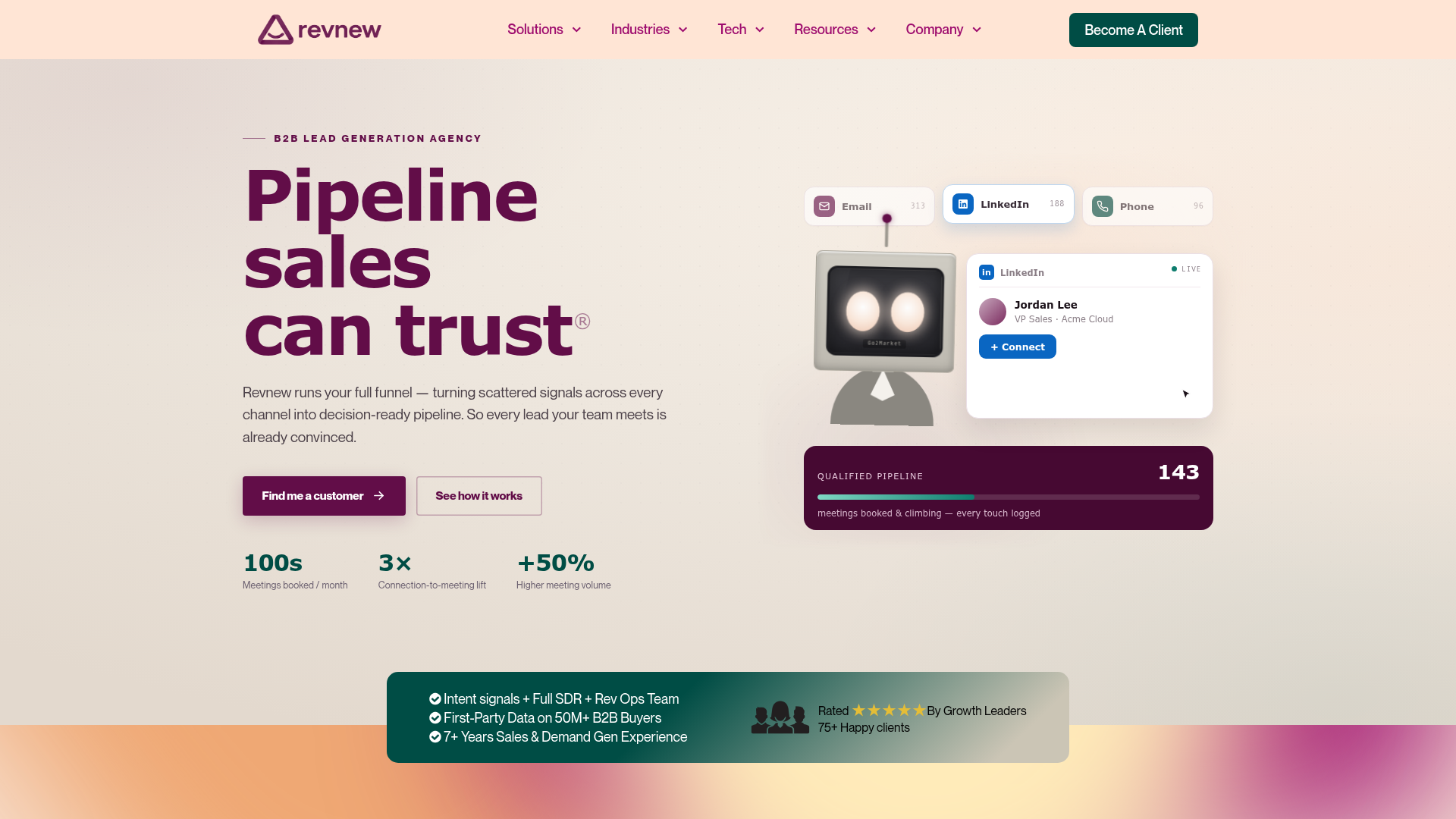
What they doRevnew is an outbound and account-based lead generation agency. Its model, which it calls Triple ABM, combines SDR outreach, content syndication, and intent data to book meetings and feed pipeline for teams with long sales cycles. For a head of sales, it is a multichannel way to get qualified conversations without building the machine in-house. Revnew works across several industries and holds a 4.6 rating from 10 reviews on Clutch, and its own blog ranks for category and appointment-setting terms, so it has a real content base of its own. Its floor is on the higher side at 10,000 to 25,000 dollars a month, and because it spreads across many verticals and channels, buyers should check how deep its experience runs in their specific market.
Best forTeams with long sales cycles that want booked meetings from outbound, syndication, and intent data.
Pros
- Combines SDR outreach, content syndication, and intent data in one program.
- Rated 4.6 from 10 reviews on Clutch, with a real content base of its own.
Cons
- Its minimum is on the higher side for a lead-gen program.
- Works across many industries, so confirm real depth in your specific market.
What they doClosed Loop is a paid media agency for B2B SaaS. It runs full-funnel advertising joined to in-house creative and data, so the spend, the ads, and the measurement sit with one team rather than three. For a revenue leader, it is the pick when paid is a real pipeline channel and you want it run by senior practitioners instead of a rotating account crew. The firm has been around since 2001, works with well-known SaaS brands, and has won seven straight Ad Age Best Places to Work awards. Its own blog earns rankings on advertising topics rather than just its brand, which shows it can do the work. Two cautions: it is paid-media first, so it does not cover the organic and content side, and it neither names its senior team nor publishes pricing.
Best forSaaS revenue teams that run serious paid budgets and want media, creative, and data in one team.
Pros
- Keeps paid media, creative, and data in one team of senior practitioners.
- Running since 2001, with seven straight Ad Age Best Places to Work awards.
Cons
- Paid-media first, so it does not cover the organic and content side of demand.
- Neither names its senior team nor publishes pricing.
Is your content bringing in pipeline you can forecast?
Get a free Content RevOps audit. We show where your content leaks revenue and what a connected system, wired into your CRM, would change for your pipeline.
Frequently asked questions
What does a demand generation agency do for a CRO or head of sales?
It builds pipeline you can work and forecast. For a revenue leader that means demand and content aimed at the accounts you sell to, meetings with real buyers, and every touch tied back to the CRM, so you can see which work produced which deal, not just how many clicks it earned.
How much do these agencies charge?
Most do not publish prices. Where a floor is public it tends to sit between about 1,000 and 25,000 US dollars a month, depending on scope and whether an SDR team is included. We mark pricing as not disclosed when an agency does not share it.
How did we choose and rank these agencies?
We reviewed more than 120 agencies that work with revenue leaders, then kept the ones with real proof. We ranked them on pipeline fit, whether they run marketing for themselves, review evidence, transparency, and fit to your sales motion. The same checks apply to our own entry.