How We Help You Show Up in AI Search

When a buyer wants to solve a problem today, they often ask an AI assistant before they ever open a search results page.
ChatGPT, Perplexity, Gemini, and Google's AI Overviews answer the question directly, name a few companies, and cite a handful of sources.
When you are one of the names, you inherit a level of trust that a blue link never carried; the AI is effectively recommending you.
When you are not, the conversation moves on without you, and nothing in your analytics tells you it happened.
We work on this problem every week, inside our content marketing engagements and on our own site. This page explains how we approach it: what the problem is, how it shows up, and the system we use to fix it.
The research behind it all, the studies, the platform mechanics, and the third-party numbers, lives in our ultimate guide to AI search. This page is about the method.
What does AI-search invisibility look like?
It comes in three forms, and the difference matters because each needs a different fix.
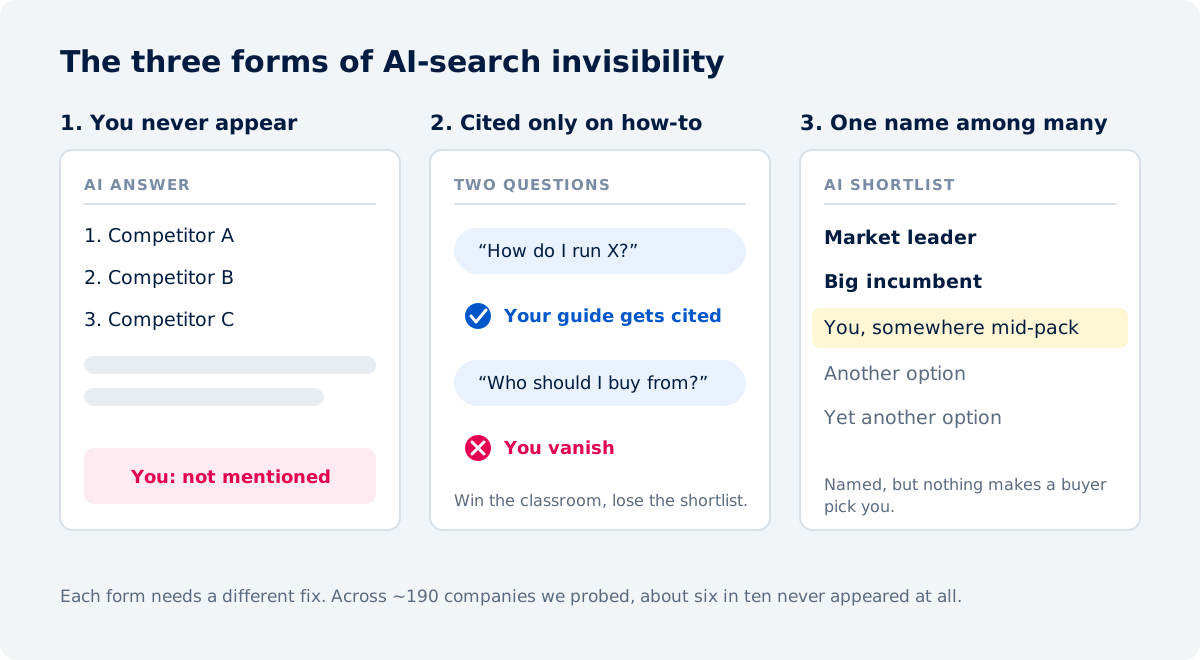
You never appear
The AI answers your buyer's question, names three or four competitors, and builds its answer from sources that do not mention you.
You appear on the teaching questions but not the buying one
Ask "how do I run X" and your guide gets cited. Ask "who should I buy X from" and you vanish.
You win the classroom and lose the shortlist.
You appear as one name among many
The AI lists you somewhere in the middle of the pack, usually behind the biggest brands in the category, with nothing that would make a buyer pick you.
We run this check as a standard part of our audits: ask the exact question your buyer would ask, live, across several engines, and record who gets named, in what order, and whose pages the answer cites.
Across roughly 190 companies we have checked this year, about six in ten never appeared at all on their own buying question. Only a handful were the first name in the answer.
The part that surprises people most is how little protection existing Google rankings offer.
We have probed a company that ranks first in Google for its own product category and watched the AI recommend suppliers of exactly that product without naming them. We have seen a century-old training brand, ranking for thousands of keywords, get passed over while the answer leaned on job boards and community threads.
Ranking and being cited are related, but they are different games with different rules.
Why do AI answers skip you?
AI assistants build answers from sources they consider trustworthy and easy to lift from, and most company websites give them neither.
Four things drive the gap.
The engines lean on third-party sources
Community threads, encyclopedic pages, review sites, and comparison listicles dominate the citations. In the education and training categories we indexed this year, Reddit sat among the top cited sources in roughly eight out of ten cases.
Your homepage is competing with the entire internet's conversation about your category.
Decision content gets cited, descriptive content does not
Most product and service pages describe. They rarely compare options, state criteria, or help someone choose.
The engines prefer material that already looks like an answer: criteria, trade-offs, numbers, and named options.
Incumbent gravity is real
Ask about operations consulting and the answer names McKinsey, BCG, and Bain, whatever the niche behind the question.
Unless a source gives the engine a specific reason to name a specialist, it defaults to the safest, biggest names.
Some sites are technically invisible
Many AI crawlers do not run JavaScript.
If your site only renders in the browser, an AI crawler may receive a nearly empty page, and nothing you publish will ever reach it.
There is genuinely good news inside this. The research says the citation game is winnable by smaller companies in a way classic SEO rarely was.
A single well-placed comparison piece or community mention can carry a small firm into every engine; we watched one regional staffing firm get named by all four engines we tested on the strength of a single local listicle.
The pattern holds at scale: when sources optimize for AI answers, lower-authority sites gain the most.
How do we make you a source worth citing?
We start from a simple standard: publish things an engine cannot get anywhere else.
Generic how-to content is exactly what AI assistants replaced, and republishing it earns nothing. Two kinds of material clear the bar.
Original data
Numbers that exist nowhere else force citation; an engine that wants to use them has to credit where they came from.
We manufacture those numbers deliberately:
Published studies. We build first-party datasets and publish the findings. As one example, we measured the marketing stacks of 478 high-growth B2B companies to see which tools they actually run, and that study now does citation work no rewritten blog post could.
Client benchmarks. Surveys, measured comparisons, and industry benchmarks built inside an engagement, designed around a question your buyers already argue about.
Your own operating data. Most companies sit on reportable numbers, from usage patterns to project outcomes, that would earn citations tomorrow if they were published with a clear method.
Lived experience
The other input nobody can copy is what you learn doing the work: real client situations, decisions, failures, and results.
Most companies let this evaporate. We capture it systematically:
A weekly harvest. We mine our client calls and our own delivery work for stories worth telling, every week, so the material accumulates instead of evaporating.
Structured expert interviews. For client programs, we pull the expertise out of the people who hold it through short, structured conversations. Raw asset extraction is the fuller write-up of how that works.
Proof attached. Every story goes into the bank with the number or the outcome that makes it credible, so publishing never depends on a scramble for evidence.
The format layer
Substance earns the citation; format makes it liftable. We shape everything the way engines like to quote it:
Clear criteria and honest comparisons that include your alternatives.
Stated numbers instead of vague claims.
Answers that stand on their own, paragraph by paragraph.
How does one asset end up in many answers?
Engines trust an argument more when they meet it in more than one place, from more than one source.
So we treat every core asset as raw material for several genuinely distinct surfaces, never one page plus copies. From one core asset, a typical rollout produces five of them.
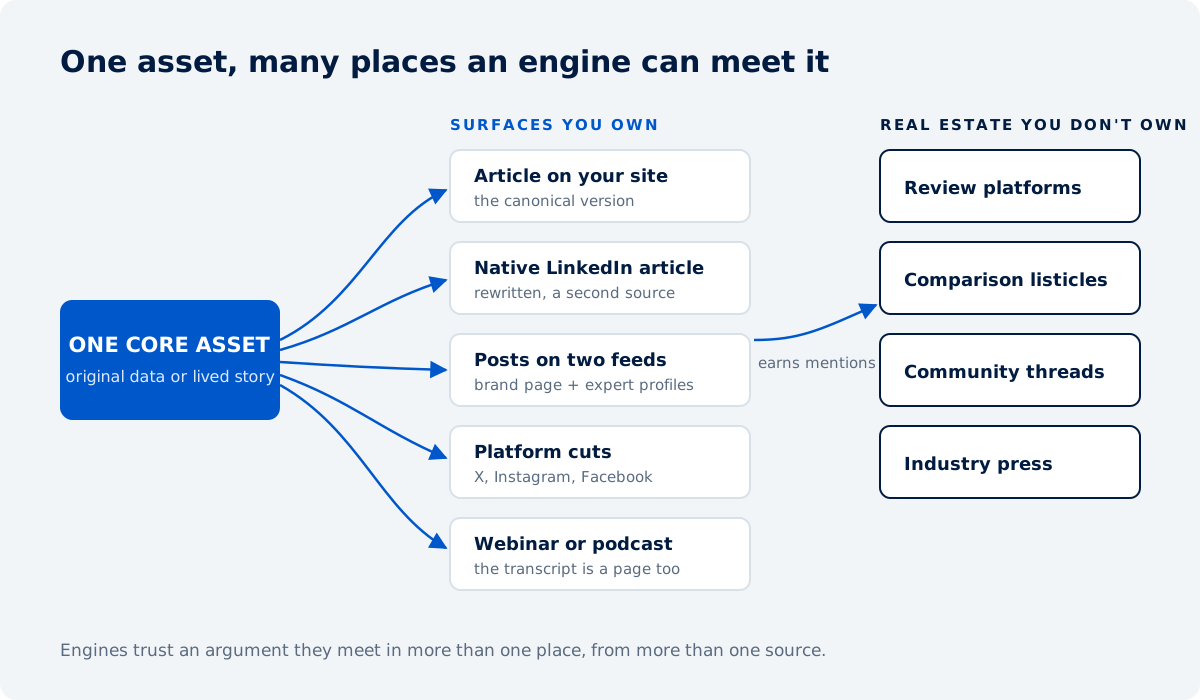
The canonical piece on your site
The full argument with the data, the schema markup, and internal links to and from the pages that matter.
A native LinkedIn article
Rewritten from scratch, not pasted.
The engines treat a native article as a separate source in its own right, so the same argument now has two independent homes that corroborate each other.
A month of social posts across two feeds
The company page carries the findings; your experts' personal profiles carry the opinions and the stories behind them. Each post takes one angle: one number, one story, one objection answered.
Two feeds saying complementary things reads as consensus; two feeds posting the same caption reads as syndication.
Platform variations
Shorter cuts for X, link-in-comments versions for Instagram and Facebook, so each platform gets a native-feeling version instead of a cross-post.
A spoken surface where it fits
A webinar or a podcast appearance gives the argument a third independent home, and the transcript becomes one more page an engine can read.
Our approach to content distribution covers the full map.
The citation real estate you do not own
Alongside the surfaces you own, we work the places the engines already pull from:
Surface | Why it feeds AI answers | What we do |
Review platforms | G2, Capterra, Clutch, and their industry equivalents feed buying answers directly | Keep profiles current; a thin or stale profile costs you citations |
Comparison listicles | The engines love a ranked list with criteria | Get you into the lists that already rank, or publish an honest one that includes the alternatives |
Communities | The engines quote the threads where your buyers ask questions, and the companies named there get named in the answers | Genuine, useful answers, never drive-by promotion |
Industry press | A quoted expert or a covered data point carries more citation weight than most owned pages | Pitch your data and your experts where coverage compounds |
Getting named in the places the AI already reads is often faster than convincing it to read you.
The assembly line behind it
Producing all of this used to be the bottleneck, so we run it as an assembly line with a clear split.
Automation does the heavy lifting. Research pulls, first drafts built from the banked stories and data, per-platform formatting, scheduling, and publication tracking.
People do the judgment. The monthly plan gets approved before production starts, every article and caption gets reviewed before it ships, and the expertise inside the content stays human, because that is the part worth citing.
That split is what lets a small team, ours or yours, sustain this many surfaces without the quality collapsing.
What about the technical side?
None of the above matters if the engines cannot read your site.
AI crawlers are less forgiving than Googlebot, so before any content work we verify the floor. Three questions decide it.
Can the crawlers read your pages at all?
Many AI crawlers, including the ones behind ChatGPT, Claude, and Perplexity, do not run JavaScript.
If your site renders in the browser, what an AI crawler receives depends entirely on your prerendering setup, and prerender allowlists routinely miss newer bots.
We test every relevant user agent, GPTBot, ClaudeBot, PerplexityBot, CCBot, and the rest, against your live pages and compare what each one receives with what a reader sees.
The failures we find are rarely subtle:
Full pages served to Googlebot while an AI crawler gets a near-empty shell.
robots.txt rules blocking AI bots that nobody remembers adding.
Key numbers or whole sections that render as blanks to everything that is not a browser.
Can they lift what they read?
Engines quote content that already looks like an answer, so we structure for that:
A direct answer in the first sentences under each question-shaped heading.
FAQ content printed visibly on the page, not mounted only in code.
Schema markup (Article, FAQ, and breadcrumbs) that matches the visible content.
Genuine lists and tables where the content really is a list or a comparison; they lift cleanly into answers.
Can they find everything?
Discovery breaks in ways nobody notices from a browser:
What breaks | Why it hurts | What we do |
Sitemaps drift out of date | New pages never get discovered | Reconcile against the content database and automate regeneration |
Hub pages built as JavaScript tabs | Most of the library has no real links, so crawlers never see it | Expose every article through plain crawlable links |
Dead URLs return empty pages with a success code | Engines index blanks and trust the site less | Return honest status codes |
llms.txt missing or covering a fraction of the site | AI crawlers get no map of what matters | Maintain one that points at the content worth reading |
Most sites we audit fail at least one of these checks without anyone knowing, because everything looks fine in a browser.
These are unglamorous fixes, and they routinely move visibility more than any single piece of content.
How do we know it is working?
We measure AI visibility directly instead of inferring it.
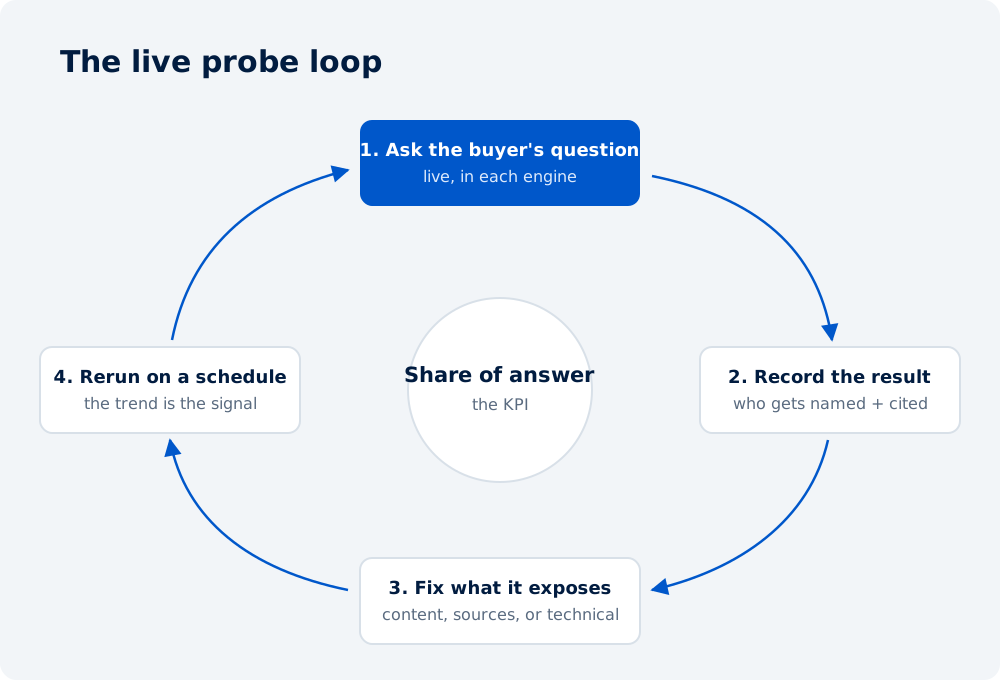
The core instrument is the same probe we run in audits: ask the buyer's question live in each engine, record who gets named, in what order, and whose pages get cited, then rerun it on a schedule.
Named or not named is the baseline; the order and the cited sources tell us what to fix next.
Alongside the probes we track AI referral traffic and what it does after it arrives. The volume is still small for almost everyone; the intent is unusually high, because a buyer who arrives from an AI recommendation shows up with the shortlist already formed.
We treat share of answer as the KPI and referral conversion as the proof it matters.
What results should you expect?
Honest expectations first: this compounds over months, not days, and it arrives in a predictable order.
The first weeks
The technical fixes register.
The crawlers start receiving full pages, questions about your brand start citing your own site instead of whoever wrote about you, and your pages begin appearing in the engines' source lists.
The first few months
Informational citations arrive.
The engines start quoting your guides and your data on the teaching questions, and a trickle of AI referral traffic shows up in analytics.
From there
Presence on the buying questions builds.
This is the slowest layer and the most durable one, because it rests on original data and third-party mentions that competitors cannot take back cheaply.
Judge the program by share of answer and by what AI-referred visitors do once they land, never by raw session counts. The sessions will look small next to organic search; the buyers behind them arrive with the shortlist already formed.
When it compounds, it looks like this:
For Behavior Advantage, a specialist training company we work with, a program built on expert authorship and original data reached roughly 35% share of voice in its category's AI answers and around 40% of its AI Overviews, with content cited 20 to 30 times per week. Demo bookings there self-report content as the reason on the booking form.
For Banking Crowded, a content hub structured for answer engines grew AI and LLM referrals to roughly a fifth of inbound traffic, and those leads converted at several times the site baseline, because an AI recommendation arrives pre-trusted.
We see the same shape in narrower categories: when a company becomes the source that explains an unfamiliar space, it wins the search results and the AI answers together.
How do you find out where you stand?
The probe we described above is the first stage of our free content revenue audit.
We ask your buyers' questions live across the engines, show you exactly who gets named and whose pages get cited, check whether the AI crawlers can read your site at all, and put a number on what the gap costs you.
From there, you will know which of the three invisibility problems you have and what fixing it involves.
Request the free audit or book a discovery call and we will run your buyer's question live on the call.
Frequently asked questions
How do I check if AI tools recommend my company?
Ask the exact question your buyer would ask, live, in ChatGPT, Perplexity, and Gemini, and search it in Google to see the AI Overview. Record who gets named, in what order, and which sites the answer cites.
Repeat it monthly; a single probe is a snapshot, the trend is the signal. This is the first check we run in our free audit.
Does ranking well in Google mean AI assistants will cite me?
No. We regularly probe companies that rank on page one, sometimes first, for their own category and never get named in the AI answer.
The engines build answers from third-party sources such as communities, review sites, and comparison pages, so rankings and citations move separately.
How long does it take to show up in AI answers?
Technical fixes, such as letting AI crawlers read your pages, can register within weeks.
Citations on buying questions typically build over months, as your original data and third-party mentions accumulate. Informational citations usually arrive first.
What is answer engine optimization (AEO)?
AEO is the practice of making your company visible and citable in AI-generated answers, the way SEO made you visible in search results.
It spans the content the engines want to cite, the third-party sources they pull from, and the technical access they need. Our ultimate AEO guide covers the research in depth.
Will AI search replace my organic traffic?
Not yet, and possibly never fully.
AI referral volume is still small for almost every site, but it grows fast, and in our experience those visitors convert at several times the baseline because they arrive pre-sold on a recommendation. Plan for both channels.