Mapping the Funnel

As a final piece of the strategy development process, you need to become clear on how someone moves from first touch to MQL.
If we don’t know how the lead is supposed to move, we can’t design the right content.
The funnel isn’t something we report on later. It’s what tells us what each piece of content is supposed to do.
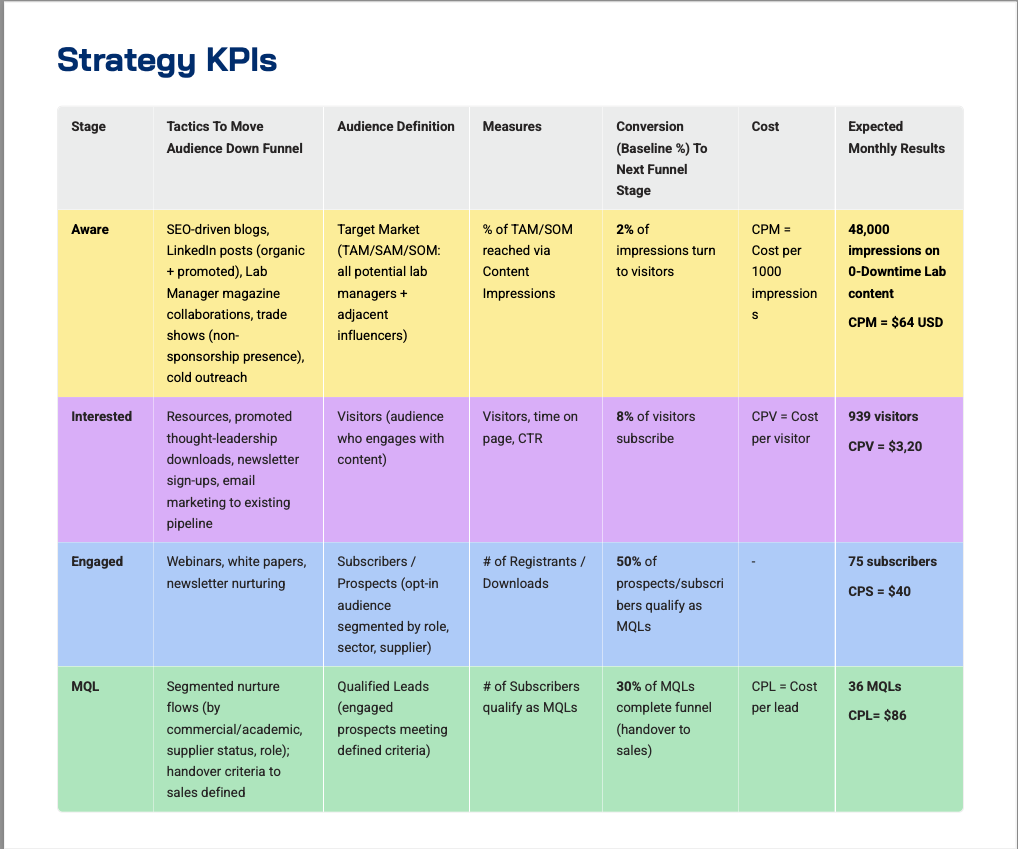
The default funnel we use
Unless there’s a strong reason to change it, we keep this structure:
Aware
The prospect comes across you for the first time.
This might be through:
search (SEO/AEO)
LinkedIn or other social
outreach
paid promotion
At this point, they may only see the content. They don’t need to click yet.
Interested
They show initial interest by engaging more directly.
This usually means:
visiting a blog or page
exploring the resource hub
spending time on a piece of content
Engaged
They opt in or take a meaningful action.
Examples:
downloading a resource
signing up to a newsletter
registering for an event
This is where value is exchanged for attention or data.
MQL
They show clear commercial intent and are ready for sales.
This includes:
demo or quote requests
contact form submissions
direct outreach
qualified handover based on behaviour and fit
Plan for people who skip the journey
Not everyone moves step by step.
Some people will go straight from awareness to action.
We always allow for:
demo requests
quote requests
direct contact
If intent is already there, we don’t force a longer journey.
What each stage needs from content
Each stage has a different job. Content needs to reflect that.
Aware
The job here is to get noticed and feel relevant.
Content needs:
strong topic-market fit
clear relevance
low friction
Typical formats:
blogs
social posts
search-led pages
promoted assets
Interested
Now we deepen understanding and build trust.
Content needs:
clearer problem framing
signals that we understand their world
a reason to keep exploring
Typical formats:
deeper articles
hub or platform pages
comparison or explainer content
Engaged
This is where we capture intent.
Content needs:
a clear value exchange
something practical or useful
a way to segment the lead
Typical formats:
guides
white papers
checklists
webinars
tools
newsletter sign-ups
MQL
Now it’s about clarity and handover.
Content needs:
direct calls to action
clear next steps
enough context for sales to act
Typical formats:
demo pages
quote pages
contact forms
follow-up content aligned to sales
Build the funnel before production
We define this in two ways.
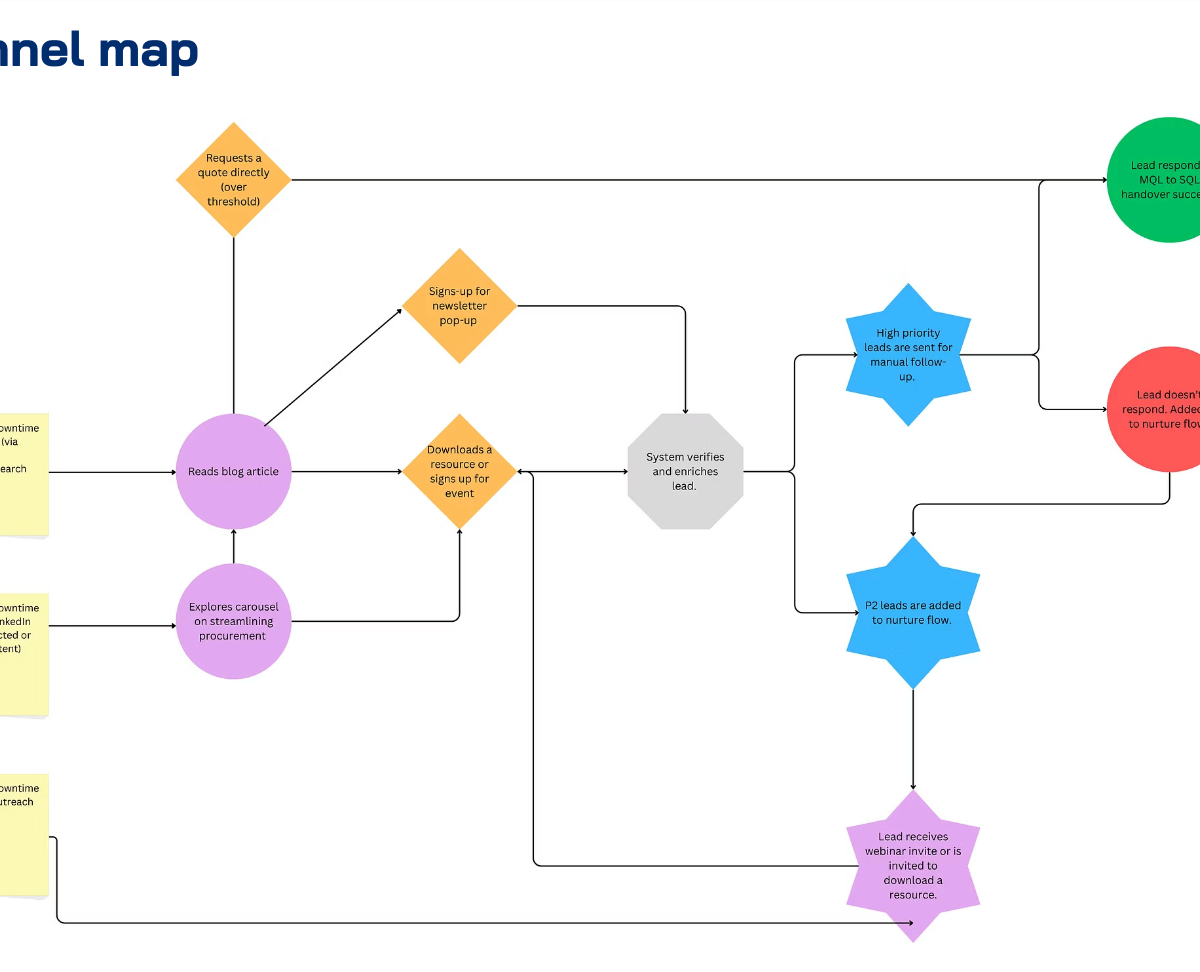
1. A simple flow
We map:
where people enter
how they move between stages
where they can skip ahead
where sales takes over
This makes the journey visible.
2. A working funnel table
We then break it down into something practical.
For each stage, we define:
Tactics
What actually moves people forward (e.g. blog, LinkedIn, webinar, outreach)Audience
Who is in this stage (e.g. cold ICP, visitors, subscribers, engaged leads)Measures
What we track (e.g. impressions, visits, downloads, sign-ups, handovers)Conversion
Expected movement to the next stage (rough estimates are fine to start)Cost
What it takes to run the activityExpected volume
What we expect to generate each month
This doesn’t need to be perfect. It needs to be explicit.
Define MQL properly
Before any content is created, we make MQL concrete.
We define:
which roles or job titles qualify
what behaviours count as intent
what fit criteria matter
what context sales needs to receive
what counts as a clean handover
We are responsible for everything up to that point.
If MQL is vague, the whole system becomes hard to manage:
content won’t align
measurement won’t mean much
sales handover becomes inconsistent
So we lock this in early.
What we end up with
a clear view of how someone moves from first touch to MQL
defined stages with a job for each
content mapped to each stage
a visible flow from entry to sales handover
a working funnel model with expected movement and volume
a precise definition of what counts as an MQL
Once this is in place, content production becomes much more deliberate.