Top 10 Demand generation mistakes costing you pipeline
Want to stop leaking pipeline from demand gen? Let’s build a system that compounds.
Book a CallMany B2B SMBs are spending more on demand generation than ever. More ads. More events. More outbound. More content. Yet pipeline still feels stalled, uneven, or hard to forecast.
When this happens, leaders often blame a channel or tactic. Ads stopped working. Events are not worth it. Email performance is down. SDRs are not following up fast enough. Those things may be true, but they are usually symptoms, not the root problem.
Most underperforming demand generation programs fail because the system behind them does not match how modern B2B buyers actually buy. Buyers move in groups, research quietly, compare options over time, and often form opinions long before they speak to sales.
This article breaks down 10 common demand generation mistakes that quietly drain pipeline. Some are obvious, like unclear ICPs or weak follow-up. Others are harder to spot, like disconnected campaigns, vanity-metric reporting, or treating content as a side activity.
The common thread is simple: demand generation works best when content, data, channels, sales, and customer insight operate as one system.
Strategy and Lead Generation Mistakes
Demand generation usually breaks before the first campaign goes live. The issue is not one bad ad, one weak webinar, or one missed follow-up. It is often a vague demand generation strategy built on an outdated view of how B2B buyers behave, with teams defaulting to a narrow lead generation strategy instead of a broader demand approach.
At any given time, only 5% of your target market is ready to buy, so getting specific about the target audience and validating the audience matters from the start.
Mistake #1: Treating the funnel as linear in a non-linear buyer journey
Many teams still run demand generation like an MQL factory: show an ad, drive a form fill, push a demo, expect a deal within 30 to 60 days. That form-fill-first mindset narrows lead generation to short-term capture and creates the same structural problems that hurt B2B lead generation. It looks clean on a dashboard, but it does not match how most B2B buying works. If the factory is already running and sales has stopped working what it produces, our list of demand generation agencies for MQL overload narrows 368 agencies to the 14 that build pipeline instead of lead counts.
Real buyers loop. They research quietly. They ask peers. They compare vendors before they ever speak to sales. Most prospects are not ready to buy immediately, and the buying process stretches across different stages before a decision is made. Multiple people influence the decision, and some of them may never fill out a form.
The pipeline cost is easy to miss:
Early clicks get too much credit.
Mid- and late-stage education gets underfunded.
Forecasts depend on form fills, not real buying progress.
Sales receives “leads” that are interested, but not ready.
Lead nurturing keeps your brand visible, delivers relevant content, supports trust building, and can improve conversion rates over time; research also shows that 80% of buyers will not purchase from a vendor they had not heard of before they began searching.
A better approach is to think in buying stages, not funnel steps: aware, problem-aware, solution-aware, and ready to talk. Each stage needs its own content, channels, and success signals so potential customers and prospects can move through different stages of the buying process with less confusion. A CFO, technical evaluator, and day-to-day user may all need different proof before the account moves forward.
Mistake #2: Unclear ICPs and buying-committee blindness
A vague ideal customer profile (ICP) creates vague demand. If your target market is “mid-market SaaS companies” or “HR leaders,” your messaging will likely sound like everyone else’s and reach the wrong audience instead of the right audience.
This leads to generic campaigns, low-quality inbound, and high disqualification rates. It also slows sales cycles because your team spends time educating people who were never the best fit, or misses the people who can block the deal.
A stronger ICP should be narrowed by fit criteria like company size, job title, and tech stack, as well as:
The market you can realistically reach.
The accounts with urgent, expensive pain.
The channels where those buyers actually pay attention.
The segments with strong win rates, retention, and expansion potential.
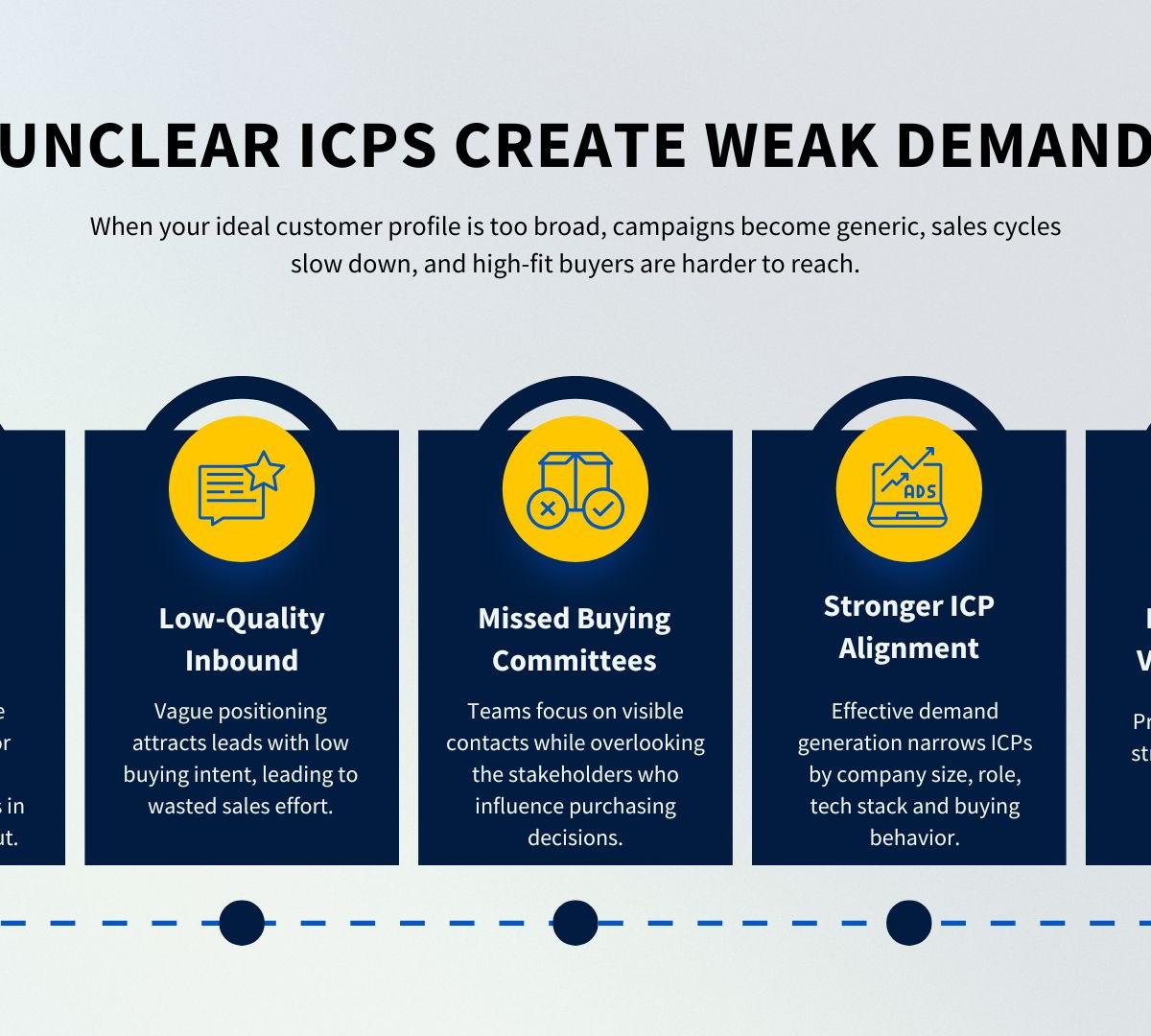
Companies with a well-defined ideal customer profile see 68% higher win rates than those taking a broad approach.
Then map the buying committee. Define the main persona around your ideal customers, but also the co-personas who influence how customers buy and evaluate pain points: finance, IT, operations, legal, end users, and executives. Understand their risks, objections, and success criteria. In many categories, effective targeting depends on seeing the full decision-making panel, not just individual contacts.
Good demand generation uses buyer language from search data, communities, customer calls, sales notes, and support conversations. It mirrors the buyer’s world instead of forcing them into yours. To keep the ICP current, use behavioral data, intent data, and new insights from those sources, and remember that 82% of marketers say high-quality customer data matters, but only 42% know their audience’s demographic information.
Mistake #3: No system-level view of the funnel
Siloed demand programs create disjointed buyer experiences. Disconnected systems often create poor quality leads and obscure whether activity is turning into a qualified pipeline. Paid runs one message. Content runs another. SDRs use different language. Events create leads that enter a generic nurture track. Each team optimizes its own metric, such as CTR, registrations, or email opens.
But buyers experience it as one brand.
Content and campaigns should operate as a shared layer across the funnel, not as isolated tactics. Every asset needs a clear job: create awareness, deepen interest, build trust, support evaluation, or help sales move an opportunity forward. Running ads, emails, webinars, and sales outreach as one orchestrated campaign system is what keeps demand generation from becoming a stack of disconnected plays.
Shared definitions, including what counts as a sales qualified lead, handoffs, and stage-based content turn demand generation into lead gen programs that function like an operating system for pipeline.
Channel and Execution Mistakes
Demand generation breaks when channels are managed as separate activities. Each webinar, ad, event, or ebook tells a different story, reaches buyers once, and then disappears.
Mistake #4: Disconnected campaigns and channel myopia
A common pattern is a busy calendar: one webinar, one guide, a paid push, then an event booth. Each asset may be useful, but without a clear content strategy, none ladders up to a core commercial narrative, and disconnected execution is not fixed by launching more campaigns.
Pipeline impact is fragmentation. Buyers see pieces of your message, but not often or consistently enough to remember it. Recall stays weak, and sales has to rebuild context in every conversation. One-size-fits-all messaging also misses buyer pain points and disengages the audience. This gets worse when teams plan around a neat, linear funnel instead of the multi-stage, multi-stakeholder way B2B buyers actually move.
Channel myopia adds risk. If most pipeline depends on one channel, often paid social, search, or events, the system becomes fragile. When costs rise, targeting weakens, or attendance drops, pipeline stalls. Referrals carry the same risk: when the network goes quiet, so does new business. For firms in that position we keep a separate list of demand generation agencies for referral-dependent companies.
Fix this by choosing one commercial theme per period, tied to a real ICP pain point. Then adapt it across owned content, paid media, outbound, nurture, sales enablement, follow-up, and post content for organic or paid social distribution. The story should travel across channels, not reset in each one.
Mistake #5: Overreliance on unscalable or fragile channels
Many SMBs lean too hard on channels that can work, but do not compound well: high-volume SDR outbound, trade shows, partner events, or one ad platform carrying the number. Channel selection should support long-term business resilience, not just short-term campaign performance.
These channels are not bad. The mistake is making a single channel the engine instead of an accelerant. Outbound lists get burned. Events create spikes but little continuity. Paid platforms become more expensive, opaque, or volatile. Costs rise, targeting weakens, or attendance drops when market changes affect performance, and many companies chase volume over lead quality, which fills the funnel with unqualified prospects. Many B2B teams also fail to define their target market clearly, so messaging misses potential buyers and wastes spend. If outbound is the channel that has stopped carrying your number, our list of demand generation agencies for when cold outbound has stalled screens more than 160 firms on whether they build inbound demand rather than send more cold messages, and keeps 14.
A healthier mix spreads risk and builds owned momentum:
Paid and events create reach and urgency.
Owned content, search, email, and community create compounding demand.
Outbound works better when it points to useful ideas, not just meetings.
Invest in repeatable programs: evergreen content hubs, recurring webinars, research reports, practical frameworks, or original shows. These assets give buyers reasons to return and give sales material that keeps working after the campaign ends.
.jpg?width=1200&quality=75)
Mistake #6: Treating content as collateral, not infrastructure
In many teams, content exists to “support” something else. Sales asks for a deck. Demand gen needs an ebook. Product marketing wants a one-pager. Many marketing teams treat it as support work instead of core infrastructure, so the result is a pile of useful but disconnected assets.
The pipeline cost is quiet but real. Buyers do not get a steady education path. Sales creates its own ad-hoc materials. Messaging drifts, and weak connections across marketing efforts make strong ideas easy to use once, then forget.
Content RevOps treats content as infrastructure: a product and operating system for revenue. Content is designed for reuse, mapped to funnel stages, connected to CRM and nurture, and wired into outbound and sales workflows. Over time, that shift compounds into brand authority. It matters because ads, content, and sales touches only work as demand generation when they are one part of an orchestrated campaign, not isolated plays.
Start with cornerstone assets: research, guides, frameworks, or benchmark reports. Atomize them into social posts, emails, sales talk tracks, retargeting, nurture, and follow-up so they also support sales conversations and sharpen the sales pitch. Content stops supporting campaigns and starts carrying demand across the system.
Measurement, Alignment, and Operations Mistakes
Mistake #7: Chasing vanity metrics and broken attribution
Vanity metrics are numbers that look positive but do not prove revenue impact: impressions, clicks, opens, attendees, and MQL volume with no pipeline link. Teams often see activity in campaign dashboards or rising pipeline numbers and assume performance is strong, even when revenue tells a different story. They are easy to track, so teams start optimizing for them.
Overemphasis on top-of-funnel metrics can create bloated pipelines full of unqualified prospects.
That creates two problems. First, marketing is pushed to produce more “leads,” even when quality is low. Second, budget follows last-touch reports, not the programs and content that shaped the whole buying journey.
Fix this by standardizing stage definitions and conversion events, then tying reporting to revenue attribution and qualified pipeline:
Aware, interested, engaged, MQL, SQL, opportunity.
Clear rules for what moves a person or account forward.
Reporting that connects programs to opportunities, velocity, win rates, and revenue.
Ignoring data or relying on outdated data and the wrong KPIs leads to misallocated spend and repeated mistakes; 64% of B2B marketing leaders do not trust their organization’s marketing measurement when making decisions that matter.
Pair dashboards with sales, customer, and closed-lost feedback.
Only 12% of marketing-generated leads convert to revenue, which is why quality matters more than volume.
Mistake #8: Misalignment between sales and marketing, and success
Misalignment shows up in familiar ways across sales and marketing teams. Marketing celebrates lead volume. The sales team says the leads are not ready. Follow-up is slow or inconsistent. Customer success has retention and expansion insight, but it rarely reaches the demand plan.
Misalignment also creates confusion over lead ownership, which causes lost leads and frustration for both teams.
The pipeline impact is simple: intent decays. A buyer who raised their hand today may be cold next week if no one responds with context, because the moment after the lead often determines whether interest turns into pipeline. Expansion also suffers when education stops after the deal, and when teams are not aligned on goals and definitions, it hurts lead quality and conversion rates, not just speed.
The fix is operational, not just cultural:
Shared definitions for MQL, SQL, and opportunity.
SLAs for follow-up, handoff, and feedback so you align sales with marketing around clear next steps for sales reps.
Regular communication, shared metrics, and joint reviews keep the whole team aligned on qualification and follow-up.
Lifecycle content for net-new, onboarding, expansion, and advocacy.
Content should be the common language across teams: the same narrative, adjusted by depth, format, and timing, to produce more desirable results.
Mistake #9: Misallocated budgets and resource models
Many B2B teams, like most teams, overspend on paid media and events while underfunding content, distribution, analytics, and operations. Others hire for every gap before they have a repeatable system for those people to run.
This creates a fragile model. When budgets tighten, pipeline drops because the company has not built owned assets, first-party insight from existing customers, or reusable content.
Rebalance the model. Protect a distribution budget for important assets. Invest in research, planning, activation, and reporting so each asset keeps working after launch. Keep strategy and customer knowledge in-house, then use external specialists where speed or flexibility matters.
Mistake #10: Underestimating brand, creativity, and distinctiveness
B2B teams often choose safe creative and generic thought leadership. It may feel lower risk internally, but it makes the brand harder to remember.
That costs pipeline. Buyers default to familiar names when options look the same, and many B2B brands still sound and act the same in the eyes of buyers. Strong content also underperforms when it is packaged in a forgettable way, which weakens trust building with unfamiliar buyers before they are in-market.
Treat brand and creativity as demand multipliers. Build distinctive narratives, recurring content properties, research series tied to industry trends, webinars, or creator-led formats buyers can recognize over time. Root the creative idea in ICP pain and jobs to be done, not internal preference. Aim for clear, useful, memorable.
Conclusion
Demand generation usually does not fail because one channel underperformed or one campaign missed target. It fails when the whole system is fragmented: strategy, content, channels, measurement, and teams are not wired around how buyers actually research, compare, build trust, and decide.
The 10 mistakes above are connected symptoms of the same problem: linear-funnel thinking, vague ICPs, campaign silos, over-dependence on rented or unscalable channels, weak handoffs, and reporting that rewards activity instead of pipeline.
Fixing the system means getting the basics right:
Define a precise ICP, buying committee, and stage signals.
Build content as reusable infrastructure for every revenue team.
Orchestrate channels around one commercial narrative, with clear roles and feedback loops.
Measure progress in pipeline, MQL movement, conversion, and revenue quality.
This is where our Content RevOps approach fits. We start with research-led ICP and narrative work, then design content as a reusable campaign system connected to CRM, nurture, outbound, and sales. Operating rhythms and reporting keep the system accountable to pipeline.
When SMBs treat demand as one coherent system, growth becomes less reactive, pipeline becomes more predictable, and content moves from cost center to core growth engine.
Is your demand gen engine built to create pipeline - or just activity?
Turn content into revenue infrastructure: ICP-led, stage-mapped, CRM-connected, and measurable in pipeline velocity and conversion. Let’s design your Content RevOps system.
Frequently Asked Questions
About the Author

Founder & CEO, Content RevOps
Stefan Kalpachev is the founder and CEO of Content RevOps, where he helps B2B SaaS companies transform their content into predictable pipeline. With a background in content marketing and revenue operations, Stefan has developed a unique methodology that bridges the gap between content creation and revenue generation.
Connect on LinkedIn