ABM vs Demand Generation: Are They Really That Different?
Stop choosing “ABM or demand gen.” Build one engine with the right constraints—talk to us.
Book a CallABM is “laser-targeted.” Demand generation is “broad reach.” That’s the story most teams hear—and it creates a false pressure to pick a lane. The result is predictable: ABM pilots built on thin content and heavy outbound, and demand gen programs scaled on volume without a clear ICP, relevance, or a real point of view.
Part of The Complete Guide to B2B Demand Generation Strategy.
But ABM and demand generation aren’t rival strategies. They’re different applications of the same underlying principle: create and capture demand through valuable, relevant content and interactions that help buyers make decisions. What changes is the level of focus.
Here’s the framing we’ll use throughout this article:
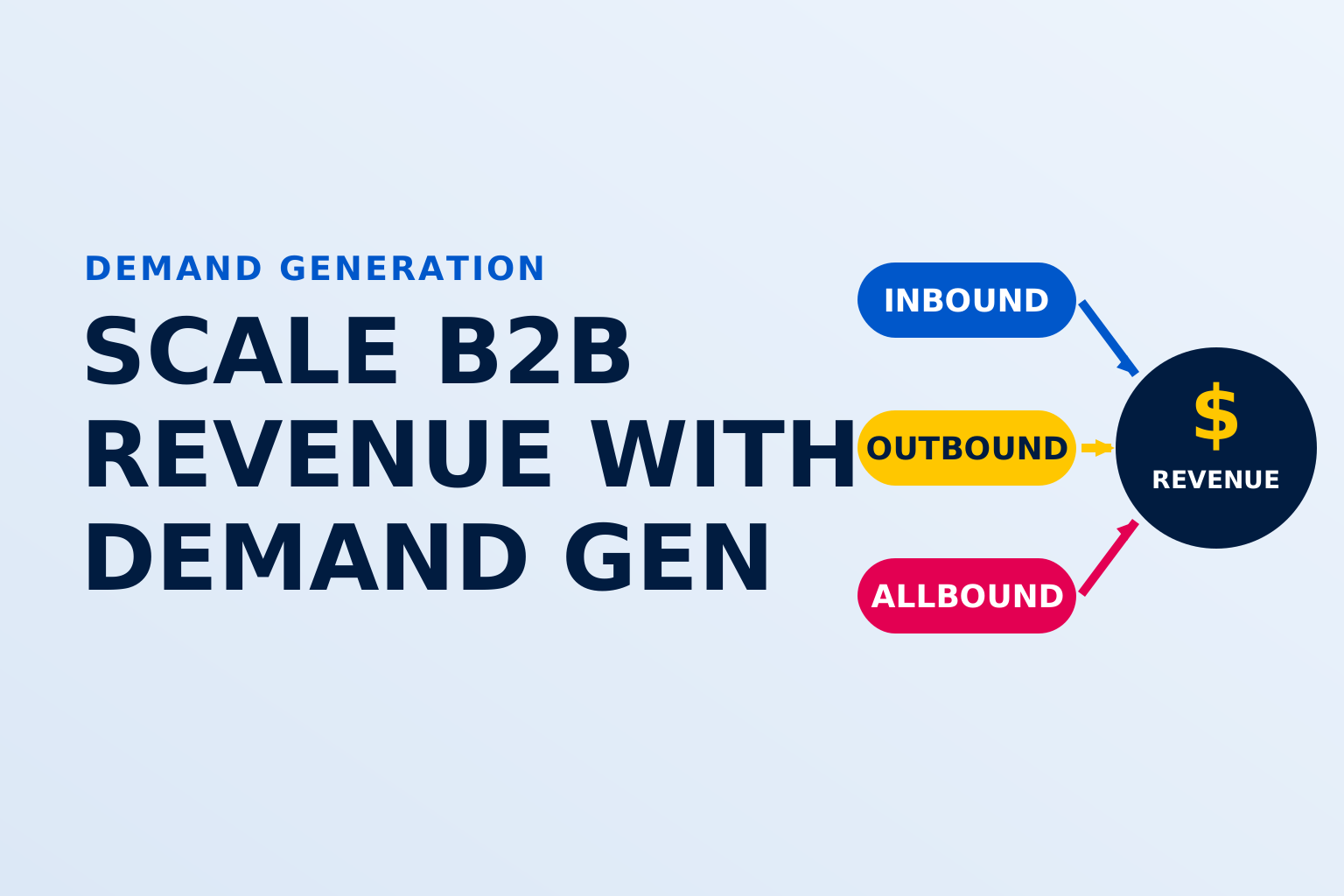
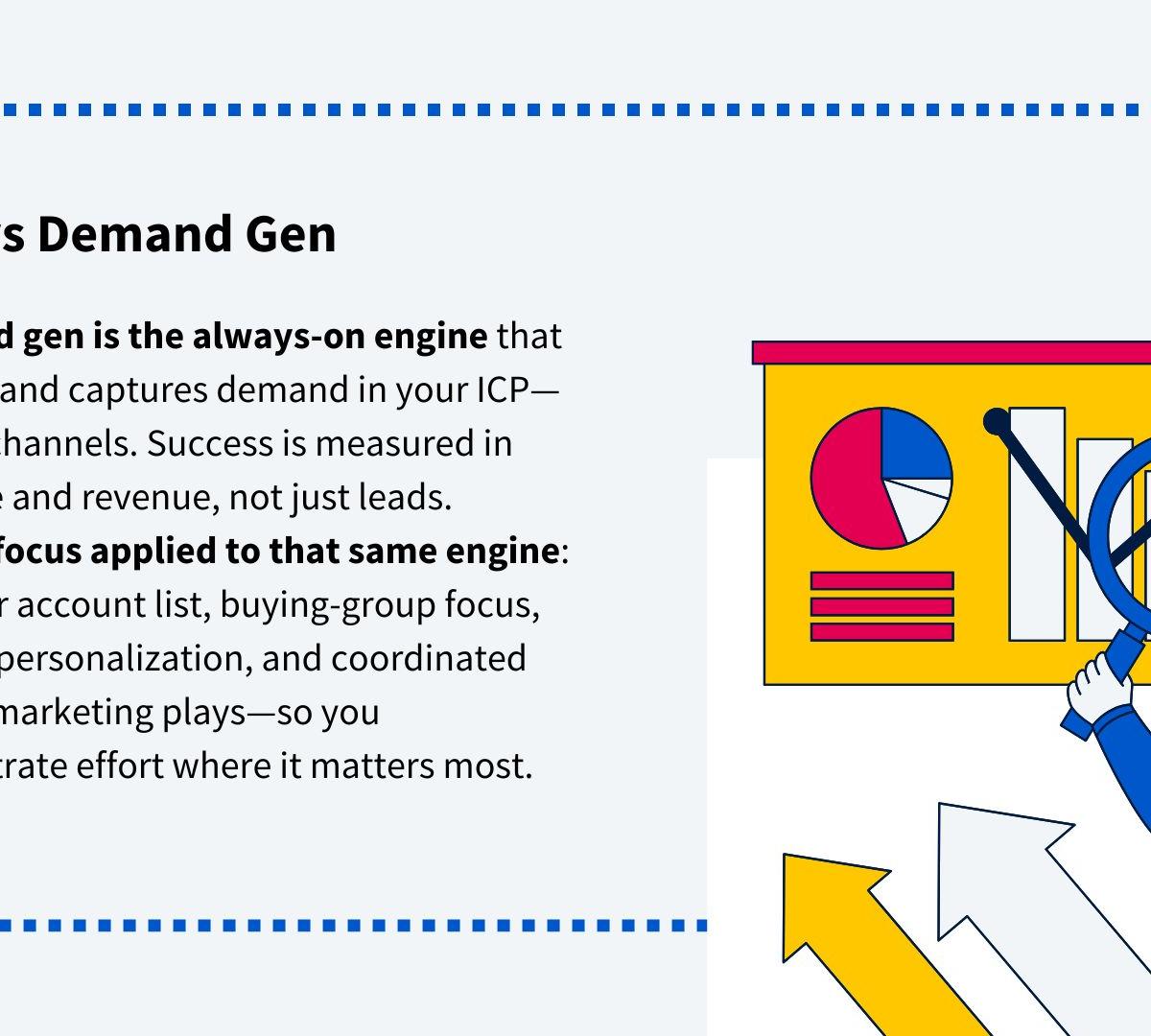
Demand generation = the engine: an always-on, content-led system that builds trust, captures intent, and converts attention into pipeline.
ABM = the constraint layer: narrower ICP and account lists, deeper personalization for buying groups, and more focused distribution—often co-owned with sales.
This matters because most “ABM” fails when there’s no demand engine behind it (just ads and outreach, with no reason to care). And broad demand gen fails when it lacks ABM-like constraints (too much reach, not enough relevance). Next, we’ll dismantle the “broad vs. targeted” myth, show why content is the bridge between both, and map what a unified, content-led GTM system looks like from 1:many to 1:1.
Why “ABM vs Demand Gen” Is the Wrong Question
Clear, simple definitions (without the baggage)
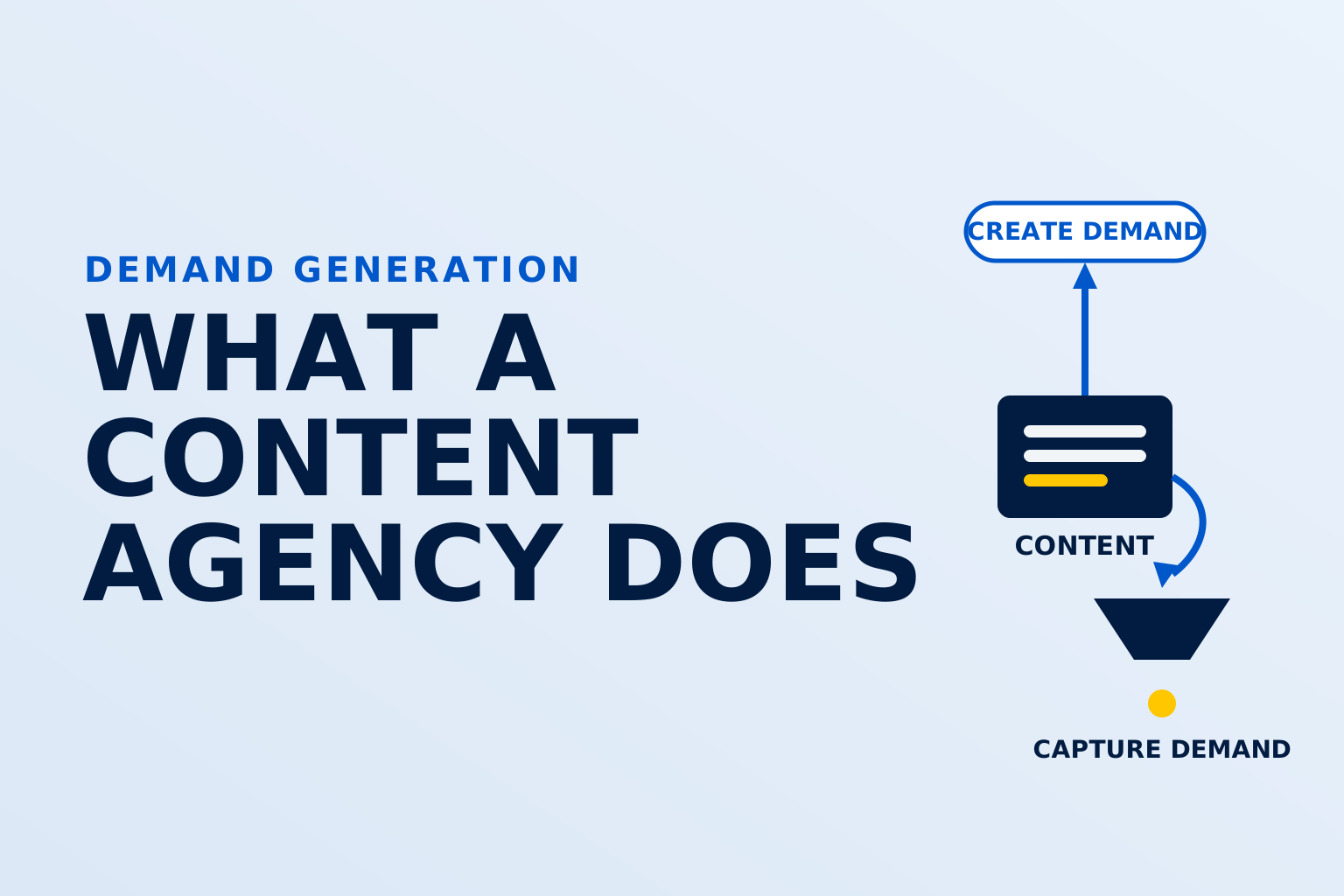
Demand generation is an always-on system designed to create and capture demand within your ICP. It blends brand, content, and activation across channels (organic, paid, events, partners, outbound, and more). Done right, it’s measured in pipeline, opportunities, and revenue—not just lead volume—and typically spans the full journey from awareness through post-sale “wow” moments in a single demand engine, not a set of disconnected campaigns.
Account-Based Marketing (ABM) isn’t a separate universe. It’s a way of applying constraints and focus to that same demand system: a tighter account list, buying-group orientation, deeper personalization, and coordinated sales + marketing plays. Mature teams use ABM to narrow in on the subset of accounts where they can make the biggest commercial impact, then orchestrate content, channels, and sales interactions around those accounts over the entire lifecycle.
If demand gen is the engine, ABM is the precision layer that tells the engine where to concentrate and how much intensity each account or segment merits. In sectors where the named account list already exists before the marketing does, that layer starts from a different place, as in account-based marketing for life sciences.
Why “broad vs. targeted” breaks down
The usual framing collapses under real-world scrutiny:
“1:many ABM” often ends up being well-targeted demand gen with an account list attached—essentially account-filtered campaigns that use the same channels, tech, and tactics as traditional demand gen.
“Broad” demand gen, done properly, is still constrained by ICP, personas, segments, and tiering; high performers invest heavily in customer research and differentiation so they can scale relevance, not spray-and-pray.
True ABM is typically 1:1 or 1:few, co-owned with sales, and supported by tailored content and outreach—not just ads aimed at named accounts or tech-led “account-based” retargeting.
Where teams get stuck is treating ABM like “outbound plus a platform.” Without a real demand engine (credible points of view, useful assets, and reasons to care), ABM becomes expensive motion with thin impact—what many programs experience when they confuse ABM with narrowly targeted demand gen and then wonder why win rates or deal sizes don’t move. Meanwhile, demand gen fails when it chases reach without relevance and ends up with generic messaging that convinces no one, a pattern that shows up consistently in research on underperforming B2B campaigns.
How practitioners are already converging
Mature teams are increasingly running one demand plan with variable focus:
1:many: brand-led demand creation across the full ICP, often using the same content and martech stack that later fuels ABM motions.
1:few: clustered plays by segment, industry, or use case, where messaging and offers are tuned to a tighter slice of the market or buying group.
1:1: high-touch ABM for top accounts and buying groups, with account-specific value narratives and orchestrated experiences across marketing, sales, and customer success.
And ABM is judged less by isolated attribution and more by deal quality, win rates, sales confidence, and expansion—the outcomes the revenue team actually feels—mirroring the shift from lead-centric to account-centric metrics many B2B organizations are making as their ABM programs mature.
The real question
Once you see ABM as a constraint layer and demand gen as the engine, the better question becomes: How strong is your engine—and where should you apply constraints for maximum leverage?
ABM as a Constraint Layer, Demand Gen as the Engine
What a healthy demand engine looks like
A demand engine isn’t a set of launches—it’s an always-on system built around how buyers actually move from “I’m not sure” to “we’re confident.” That means designing for real jobs-to-be-done and buying stages (aware → interested → engaged → qualified), not a quarterly campaign calendar. Modern demand programs recognize that most of the B2B journey happens before a prospect ever talks to Sales, so the engine has to be built around buyer behavior, not internal timelines.
The key shift: content is infrastructure, not output. It should educate, build trust, and support revenue teams before, during, and after deals—because buyers don’t experience your funnel in a straight line, and sales conversations rarely start from scratch. Strong engines lean on content that attracts, engages, sells, and “wows” across the full journey, not just one-off lead magnets.
In practice, a healthy engine has:
Buyer-led journeys: content mapped to questions buyers ask at each stage, across roles in the buying group, grounded in real customer research rather than assumed personas
Connected systems: assets wired into CRM, scoring, nurture, outbound sequences, and sales enablement so that the same content can be reused from 1:many campaigns down to 1:1 interactions
Commercial measurement: prioritized around MQAs/MQLs, pipeline influence, conversion rates, deal velocity, and ACV—not impressions alone, and not just early-funnel volume
When this engine is working, it creates baseline demand and captures intent consistently, even when your team isn’t “in market” with a new campaign. It becomes the shared backbone that product, brand, demand, and ABM teams all pull from, rather than separate sets of disconnected tactics.
How ABM applies constraints to that engine
ABM isn’t a separate motion—it’s what happens when you apply constraints to the same engine to concentrate effort where the upside is highest. In many B2B orgs, ABM simply tightens how you use the same data, channels, and content that power your broader demand programs, instead of introducing a completely different playbook.
ABM typically tightens three dials:
Narrow the ICP: prioritize accounts using firmographic, technographic, and behavioral signals, then tier them (Tier 1 = 1:1, Tier 2 = 1:few, Tier 3 = 1:many). High-maturity teams treat account selection as a shared, strategic exercise with Sales, not just a filtered list pulled from the database.
Increase personalization: move from generic persona copy to role- and account-specific narratives, using the same core content system adapted to context (initiatives, triggers, stack, buying group dynamics). The unit of design shifts from “lead” to “account and buying committee,” but the underlying content engine stays the same.
Focus distribution and orchestration: align SDRs, AEs, marketing, and customer success around shared plays across channels (targeted content, outbound, events, partners, exec touchpoints), with clear rules for when an account gets 1:many demand, 1:few ABM, or 1:1 strategic attention.
Notice what doesn’t change: you’re still creating and capturing demand. You’re just doing it with tighter targeting and higher relevance, using ABM as a precision layer on top of your existing demand infrastructure rather than as a wholesale replacement.
Why most ABM programs stall
ABM breaks down when it’s treated like “ads + outreach against a list.” Without a real demand engine, you’re asking senior buyers for time without giving them a reason to care, and ABM devolves into targeted demand gen in disguise—more touches, same thin value.
Common failure modes:
Outbound and tech lead the strategy while content stays thin or generic, so “ABM” is really just retargeting plus sequences with an account filter
Success is measured by activity (touches, impressions) instead of impact (meetings, stage progression, win rates, deal size, sales cycle time)
Ownership is fuzzy between sales and marketing, so account-level goals are unclear and teams default to their own local metrics (MQL volume vs. closed revenue)
The result is a high-effort overlay that’s expensive to run and hard to tie to revenue outcomes. Teams end up “doing ABM” in the sense of running tools and campaigns, but not practicing ABM as a business strategy that improves how they win, grow, and retain high-value accounts.
Why “broad” demand gen fails too
Broad demand gen fails for the opposite reason: no meaningful constraints. A vague ICP produces the “peanut butter effect”—budget spread thin across audiences, with content optimized for clicks instead of commercial relevance. Assets don’t map to buying committees or stages, so sales can’t use them in live deals—and they die where they’re published.
Under the hood, the problems are the same ones that drag down ABM: shallow customer research, weak positioning, and a fragmented strategy that isn’t anchored in clear business priorities. You get scale without focus, just as tech-led ABM often delivers focus without substance.
Transition
Once you see demand gen as the engine and ABM as the constraint layer, the unifying requirement becomes obvious: quality and relevance at every touchpoint. That’s why content—built as a system, not a feed—is the bridge that lets your GTM scale from 1:many to 1:1 without changing the underlying strategy, only how tightly you apply it to specific accounts and buying groups.
Content as infrastructure for the whole GTM
The real bridge between ABM and demand generation is a content-led operating model: one system that creates value, captures intent, and supports revenue conversations—then gets constrained differently based on where you’re aiming it.
Treat content like infrastructure, not output. That means building around a single commercial narrative tied to a real ICP pain (not a rotating calendar of “topics”), and producing modular assets you can reuse across 1:1, 1:few, and 1:many motions. In practice, that looks a lot closer to a full-funnel, content-led demand engine than a string of disconnected campaigns.
Most importantly, content has to be aligned to revenue outcomes, not vanity. Every asset should have a defined job, such as:
Qualify demand (help the right buyers self-select in or out, and filter toward the right accounts and buying groups)
Create trust (prove you understand the problem better than alternatives and earn a place on shortlists in a world where ~80% of the journey is self-directed, always-on research)
Unblock objections (answer the “yes, but…” that stalls deals, with assets mapped to specific roles and stages in a buying group)
Move pipeline forward (enable the next conversation with a buying group, measured at the account/opportunity level rather than just lead volume)
When content is treated as shared infrastructure, it becomes the common backbone for brand, demand, and ABM—one system with integrated brand, demand, and account focus, rather than three competing motions.
How the same content system serves demand gen (1:many)
In 1:many demand gen, the content system is the engine. You invest in flagship, scalable assets—reports, webinars, podcasts, guides—designed for the broader ICP and rooted in how buyers actually describe their problems. That’s where SEO and social work best: not as distribution tricks, but as demand capture for already-existing questions, consistent with what mature demand teams describe as “always-on,” buyer-led demand generation.
Mechanically, this looks like a mapped system: a content hub, clear lead capture, and nurture flows that move someone from anonymous to engaged—and eventually to a qualified conversation. Each piece should be intentionally tied to channel, persona, funnel stage, and an activation plan so it compounds instead of resetting every quarter. High-performing teams do this with a single narrative and strategy flowing from the business strategy, rather than one set of stories for “brand,” another for “demand,” and yet another for “ABM.”
How the same system powers ABM (1:few and 1:1)
ABM doesn’t require a separate “ABM content strategy.” It requires deeper application of the same assets.
For 1:few and 1:1, you adapt the flagship work into account-relevant formats: semi-custom research briefs, executive memos, benchmarks, or verticalized versions for clusters of similar accounts. This is how you avoid ABM becoming “ads plus outreach” with nothing meaningful behind it—an all-too-common pattern when ABM is treated as “more targeted demand gen/digital advertising” driven by tech, rather than strategy.
Webinars and small events also become ABM levers when they’re built around roles and industries your target accounts care about—paired with tailored sequences: curated invites, post-event summaries, and a “here’s what this means for you” breakdown per account. Mature programs increasingly extend this into full account-based experiences, orchestrating content, events, and sales touchpoints across the whole journey rather than just running “targeted campaigns to a list”.
Content-led outreach as connective tissue
Outbound works best when content is the reason to reach out, not a script. SDRs and AEs can pull relevant angles from existing assets using enriched account data—personalizing without collapsing into fully bespoke production. That’s the difference between “can we get 30 minutes?” and “we just published a breakdown of the exact challenge your team is facing.”
This is also where buying-group-aware content matters: economic buyers, technical evaluators, champions, and users need different proof and different narratives. A modular system lets marketing run nurture while sales uses the same building blocks for 1:1 deal support—without reinventing the wheel. Teams that do this well treat ABM and demand gen as “different zoom levels” on one shared engine, using the same channels and content but at different levels of constraint.
How a unified content system addresses common ABM concerns
When ABM is anchored in the same content system as demand gen, it stops being jargon and becomes an operating model shift: one plan, variable depth.
Modularity solves resourcing and scalability (true 1:few, selective 1:1), while shared CRM and engagement data gives you one view of what themes and assets actually move accounts forward—whether they enter via inbound, outbound, or targeted plays. That’s also how you avoid the “peanut butter” effect where teams spread messages too thin across tactics; instead, you’re applying a single, differentiated story more intensely to the accounts that matter most.
Transition
Next, we’ll look at what this unified, content-led GTM actually looks like day-to-day—how teams plan, build, distribute, and measure when ABM and demand gen are fully integrated.
Designing a Unified GTM That Scales from 1:1 to 1:Many
One plan, tiered focus
Stop running “ABM” and “demand gen” as competing programs. Run one GTM plan with different levels of constraint based on where focus will actually pay back—treating ABM as a precision layer on top of the same demand engine, not a separate universe.
Start with a rigorous ICP and segmentation using criteria like:
Market size and obtainable opportunity
LTV and expansion potential
Urgency of need
Reachability (channels, access to buying groups, sales coverage)
Most teams think they do this, but very few actually ground it in real buyer research; one large effectiveness study found only 18% of marketers regularly research buyers to create ICPs and personas, which directly undermines both ABM and demand programs (source).
Then tier your approach:
Tier 1 (1:1): a small set of highest-value accounts, co-owned by marketing and sales with bespoke plays. This is where you apply true ABM fundamentals—tight account selection, shared account plans, and joint ownership of revenue outcomes—rather than just “targeted demand gen” (framing, lead-management contrast).
Tier 2 (1:few): clusters (verticals, use cases) with shared pains and a shared narrative.
Tier 3 (1:many): the broader ICP, served by scalable demand gen and brand-led content. Think of this as the “engine” that creates awareness, interest, and data that your ABM tiers then intensify (demand gen as engine).
As ABM programs mature on top of this structure, they tend to report stronger sales–marketing alignment, better account relationships, and faster sales cycles—evidence that the tiering and constraints amplify, rather than replace, the core demand system (benchmark data).
Build a structured content and campaign system
A unified system needs one commercial narrative as the backbone: a theme tied to core pains and outcomes, validated by audience and keyword research—not just persona guesswork. High performers are far more likely to have a differentiated position that’s been tested with customers, which then lifts both lead and demand performance across the board (evidence).
Create a content hierarchy that can be reassembled by tier:
Cornerstone assets (flagship POV, report, or “content product”)
Interactive/event assets (webinars, workshops, briefings)
Supporting assets (articles, sequences, enablement, outbound scripts)
This is the shared engine that powers both broad demand and account-specific plays. In practice, effective ABM programs reuse these same assets, but constrain and personalize them by account list, buying group, and stage rather than inventing completely separate tracks (shared-engine view).
Tag each asset by persona, buying stage, channel, and tier, so “1:1” becomes a deeper cut of the same system, not a separate universe. That’s how you avoid the “peanut butter” problem of spreading one generic message thinly across every contact in every account (buying-group critique).
Connect channels and teams around content
Match distribution to tier (precision increases as the list narrows):
1:1: executive outreach, co-created content, tailored workshops/briefings
1:few: vertical webinars, segment reports, targeted social and communities
1:many: SEO, paid, email, partners, broad events
Both ABM and demand teams should be working from one plan and one commercial story; practitioners who do this well talk about “one demand plan” that different teams feed into, rather than parallel funnels vying for credit (GTM framing). As ABM becomes mainstream, this kind of integration is what separates mature programs from “ABM in name only” (adoption and maturity context).
Run a quarterly operating rhythm and shared dashboards that track engagement depth, meetings created, stage progression, win rates, ACV, and expansion. Experienced ABM teams increasingly emphasize account-level engagement, pipeline acceleration, and win rates as their core metrics—essentially demand metrics, but interpreted through an account lens rather than lead volume (metric shift).
Treat content as decision infrastructure
Design content around real buying steps: what buyers research, what they share internally, and what they need to sign off. That means mapping to the full journey—Attract → Engage → Sell → Wow—and then tightening how that journey is expressed for specific accounts and buying groups (journey framing).
Performance insights should refine both the demand engine (topics, channels, offers) and the ABM constraints (which accounts justify deeper plays). When ABM is treated as a business strategy, not just a tech-led tactic stack, the focus shifts from early-funnel volume to revenue fundamentals like win rate, deal size, and sales velocity across priority accounts (strategy-first perspective).
Transition
Once ABM and demand gen are treated as layers of one content-led system, the question stops being which one to choose—and becomes how to orchestrate both for revenue. In practice, that looks like a single “branded demand” engine that integrates brand, demand, and account focus, then dials from 1:many to 1:few to 1:1 based on opportunity and fit (integrated brand–demand model).
Conclusion
ABM and demand generation aren’t competing philosophies. They’re two applications of the same job: creating and capturing demand through relevant content and interactions. The difference is not intent, but constraints. Demand gen is the always-on engine that builds awareness, trust, and buying intent across your ICP, the way many demand generation guides describe the role of attracting and educating the market at scale. ABM is the precision layer that narrows the ICP, deepens personalization, and coordinates distribution around specific accounts and buying groups where focus pays back, mirroring how advanced programs shift from lead volume to account-level outcomes and buying groups.
Most teams run into predictable failure modes:
ABM without a demand engine becomes outreach plus tooling—busy, measurable, and easy to ignore. You see this when ABM is reduced to “targeted ads to a list,” essentially more targeted demand gen with no strategic content system underneath.
Demand gen without constraints becomes “peanut butter” messaging—lots of reach, little resonance, the same pattern called out when teams spread one message across every segment and account instead of aligning to specific buying groups and roles.
The bridge is treating content as the operating layer, not a quarterly campaign. When content is researched, modular, and connected to CRM, nurture, outbound, and sales workflows, you can scale the same narrative from 1:many to 1:few to 1:1 without changing your strategy—only the level of depth and distribution. That’s how mature teams turn a single demand engine into both broad programs and focused ABM plays, instead of maintaining separate, competing tracks for “brand,” “demand,” and “account-based”.
That’s the lens we use: content as revenue-facing infrastructure that unifies inbound, events, nurture, and outbound into one GTM system—so “ABM vs demand gen” stops being a choice and becomes a design problem you can solve. In practice, that means one shared narrative, one martech and data backbone, and variable constraints by segment and account, the same structural approach seen in high-performing ABM benchmarks and in brands treating ABM as a focus layer on a full-funnel demand overhaul, not a replacement for it.
Is your ABM actually powered by a demand engine—or just a list and a tool?
Let’s design content as revenue infrastructure: one narrative, one system, 1:many to 1:1—measured in pipeline, win rates, and velocity.
Frequently Asked Questions
About the Author

Founder & CEO, Content RevOps
Stefan Kalpachev is the founder and CEO of Content RevOps, where he helps B2B SaaS companies transform their content into predictable pipeline. With a background in content marketing and revenue operations, Stefan has developed a unique methodology that bridges the gap between content creation and revenue generation.
Connect on LinkedIn