When Should You Hire Demand Generation Consultants?
If demand gen feels busy but pipeline isn’t moving, let’s build the system behind growth - book a Demand Gen Operating Model review.
Book a CallDemand generation is no longer just a push for more leads. Buyers research earlier, compare quietly, and often form a preference before they ever speak to sales. Under tighter budgets, teams also need to show how demand efforts influence pipeline, conversion, and revenue, not just traffic or form fills.
That creates a hard timing question. Should you hire a full-time demand gen lead, buy another tool, rebuild your content engine, or bring in outside help? The answer depends less on ambition and more on where your current operating model is breaking down.
Demand generation consulting, at its best, helps you design the system behind growth. That includes behavior-led buyer journeys, content and owned channels as the engine, automation and data plumbing, sales and marketing coordination, and measurement tied to revenue outcomes.
You should not hire consultants because competitors are doing it or because “growth” feels vague and urgent. You hire when clear signals show your team has hit its limit: the funnel is leaking, attribution is unclear, sales and marketing are misaligned, or campaigns are producing activity without enough qualified pipeline. When the person reading those signals is also the one who answers to the board for pipeline, our list of demand generation agencies for CMOs and heads of marketing runs the same checks across the field.
This article looks at those signals, how to spot a real strategic partner, and what you need in place to make the engagement pay off.
When Leads Are Up, But Pipeline and Revenue Aren’t
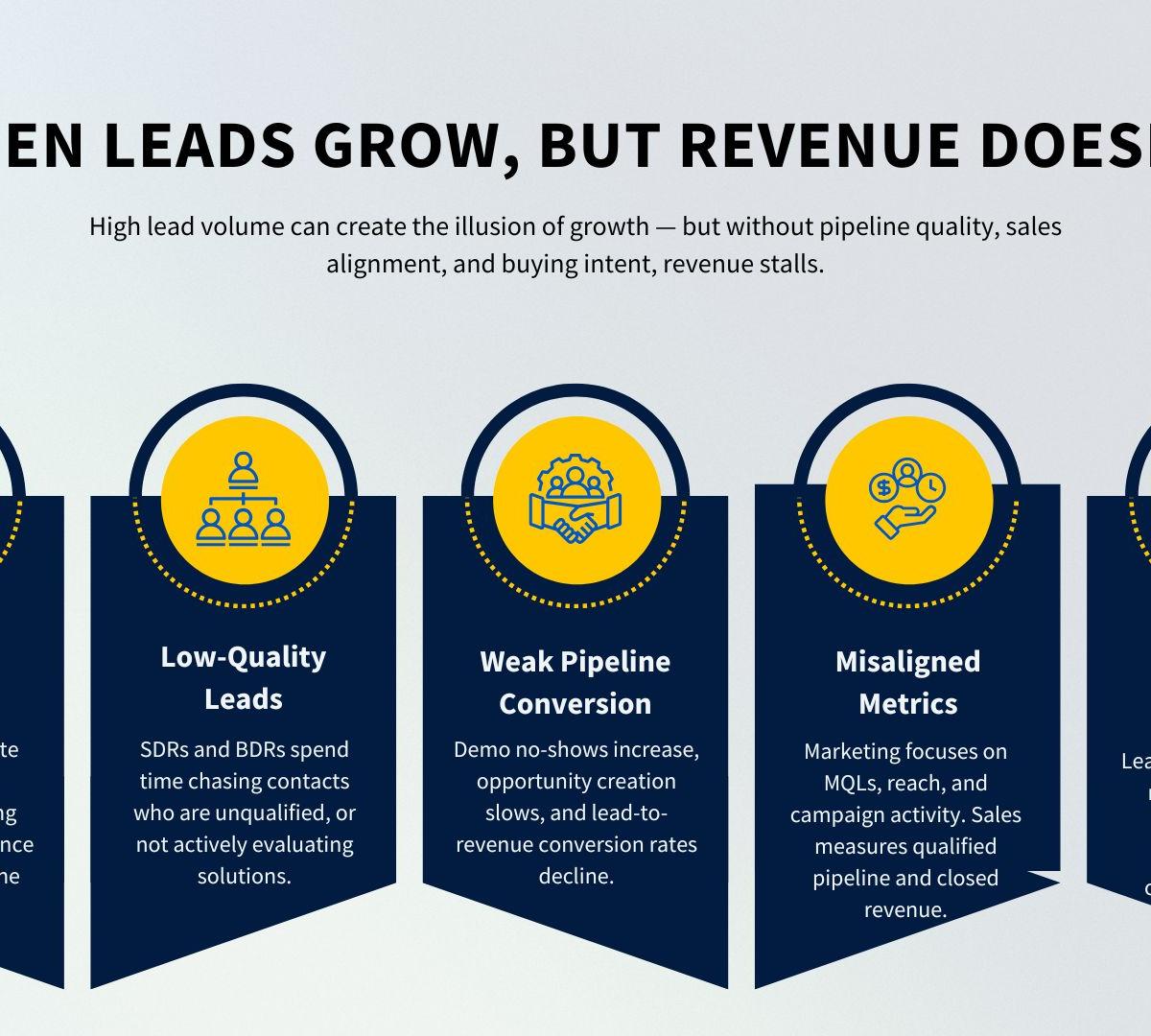
This is one of the clearest signs that you may need demand generation consultants. On paper, marketing looks busy and productive. Lead volume is rising. Campaign dashboards show clicks, form fills, impressions, and MQLs. When rising lead counts sit next to flat pipeline, that is the exact problem behind our list of demand generation agencies for teams facing MQL overload, which checked 368 firms and kept 14.
But sales is not seeing the same progress. Opportunities are flat. Revenue is not moving. Reps are spending time on people who downloaded an ebook but have no real buying intent. If you would rather bring in an agency to fix that than a consultant to diagnose it, our list of demand generation agencies for busy teams with flat pipeline names 15 that work on why the activity is not turning into pipeline.
Symptoms you’ll see
The pattern usually looks like this:
Lead volume is growing, but opportunities and revenue are flat or falling.
SDRs or BDRs complain that leads are not ready, not a fit, or not responsive.
Demo no-shows are high, and demo-to-qualified-opportunity rates are low.
Marketing depends heavily on gated ebooks, paid campaigns, and generic nurture flows.
Marketing reports on MQLs and reach, while sales reports on closed-won revenue, with little shared view of what happens between them.
This creates a quiet but costly gap. Marketing thinks it is creating demand. Sales thinks marketing is sending noise. Leadership sees spend, but not enough pipeline.
What this really means for revenue operations
In most cases, this is not a simple lead quality problem. It is a demand problem, because demand generation services are meant to create awareness and interest before capture happens, ultimately leading to more sales opportunities.
You are likely capturing people who are already researching, but not doing enough demand creation to build real interest, trust, or urgency. Many B2B buyers form strong vendor preferences before they ever speak to sales, which means demand has to be shaped long before demand capture through a form fill or demo request. If that is the gap you want outside help to close, our review of agencies that build net-new demand separates them from the ones that mostly run more ads.
The content engine is built around forms and offers, a pattern we see most often in technical categories like manufacturing and industrial, not around the questions buyers ask before they are ready to talk. That matters because early-stage content is often where buyers get the most value, even if it does not convert immediately.
The middle of the funnel may be overbuilt with lead magnets and automated emails. But early-stage education and late-stage decision support are thin. Buyers may learn about you, but they do not gain enough confidence to choose you.
How strong consultants help here
Good demand generation consultants look beyond campaign volume. They study how buyers actually make decisions.
They may help you:
Run win/loss research, call listening, and buyer interviews.
Map the real journey before a “talk to sales” request.
Build content around buyer questions, risks, triggers, and objections, often through ungated, value-driven content that builds trust and authority before prospects enter the sales funnel.
Replace generic nurture with behavior-led journeys.
Shift reporting from MQL volume to declared intent, opportunity quality, and pipeline velocity.
The goal is not more leads. It is a predictable, scalable system that attracts qualified prospects and nurtures relationships before they are ready to buy, so sales can turn better demand into revenue.
When you’re not ready yet
You may not be ready if you have not closed enough customers to learn from real buying behavior.
You are also not ready if you will not change lead definitions, sales follow-up rules, or reporting. A consultant can improve the system, but they cannot fix incentives your team refuses to change. Marketing automation and nurture programs are not plug-and-play fixes; they only work when the process, data, content, and sales alignment are ready to support them.
When Your Owned Channels Aren’t Compounding
Owned channels should support sustainable growth and make growth more durable over time. Your site, email list, content library, webinars, and customer stories should create useful signals, warmer conversations, and lower-cost opportunities. If they do not, outside help may be needed.
Symptoms you’ll see
The clearest sign is over-reliance on paid search or social. Paid still produces pipeline, but costs rise, returns flatten, and every new audience requires fresh spend.
You may also see:
An email list that is not segmented by role, stage, account, behavior, or product interest.
New subscribers receiving only newsletters or one-off announcements.
Blog posts, webinars, and PDFs sitting alone, with no reuse or distribution path.
Healthy traffic, but low repeat visits to pricing, comparison, demo, case study, or integration pages.
Bottom-of-funnel content that does not capture intent or alert sales when interest rises.
What this really means for your demand generation strategy
This usually means content, content marketing, and email are treated as assets, not infrastructure. The team is producing things, but those things are not tied to buyer journeys, CRM data, sales plays, or a clear commercial narrative. That gap is what separates an agency that fills a calendar from one that runs content as a system, and it is the test we applied in our list of demand generation agencies for heads of content.
It also points to a weak first-party data strategy. That matters more as privacy rules tighten, AI search changes discovery, ad costs keep rising, and buyers form preferences before they speak to sales. If you do not build owned audiences and learn from their behavior, you stay dependent on rented channels and miss the chance to create lasting relationships.
This is especially risky when early-stage content often delivers the most demand generation value, but only if it is connected to a broader system for capture, nurture, and follow-up.
How strong consultants help here
Good consultants do not just add more content to the calendar. They build a stronger content strategy around it, creating valuable, relevant content for the target audience that addresses real needs and pain points across funnel stages and guides buyers through the journey, because marketing automation is rarely plug-and-play without the right process, data, content, and sales alignment.
They can help build:
A list strategy covering growth, segmentation, warming, hygiene, and reactivation.
Lead magnets, welcome flows, sales sequences, and nurture tied to buyer jobs and funnel stages.
CRM-connected workflows where high-intent visits, multi-person account activity, or event engagement trigger tailored follow-up.
Repurposing playbooks so one major asset becomes social, nurture, sales enablement, community, and webinar material.
When you’re not ready yet
Wait if you lack basic marketing automation or a CRM sales uses. Also wait if content still means “publishing” to you, not an operating layer tied to pipeline, CAC, and sales efficiency.
When Tools and Automation Outgrow Your In-House B2B Demand Generation Experience
Symptoms you’ll see
This moment often arrives quietly. You have invested in a CRM, marketing automation platform, analytics tools, and intent data. But the work still looks basic: email blasts, static forms, simple lists, and manual follow-up.
Common signs include:
Reports show activity, but not what creates qualified pipeline.
Attribution is debated more than it is trusted.
Different teams own different tools, with no shared view of the buyer journey.
Lead scoring, routing rules, and sales SLAs stay stuck in meetings.
Content exists, but it is not tied to lifecycle stages, nurture, or sales follow-up.
The stack is bigger than the operating model around it.
What this really means
Automation has been treated like a switch, not a system.
The platform may support segmentation, scoring, dynamic nurture, progressive profiling, and revenue reporting. But those features need “batteries”: clean data, clear journeys, useful content, and agreed rules between marketing and sales. In practice, marketing automation is not a plug-and-play switch; it depends on the process, content, and data around it.
This does not mean your team is weak. Many in-house teams are strong in brand, product messaging, or campaign execution. The gap is usually process design: how behavior triggers the next step, when sales engages, what content supports each stage, and how feedback improves the system.
Without that design, expensive tools become email senders, contact databases, or dashboards no one fully believes. When the dashboard nobody believes is the attribution report, our list of demand generation agencies for companies with no attribution covers the outside partners that tie marketing back to pipeline.
How strong consultants help here
A good demand generation consultant builds a repeatable, data-driven framework and demand generation strategy that can adapt to new product launches or market changes, rather than treating tool operation as revenue process design. They do not start with “what can the platform do?” They start with how buyers research, compare, and decide before they ever speak to sales.
They can help you:
Map the full flow from first touch to MQL, opportunity, customer, and expansion.
Define scoring, routing, lifecycle stages, and follow-up cadences.
Refactor nurture around real behavior, not arbitrary time delays.
Connect content to CRM, sales motion, and attribution.
Build reporting around pipeline contribution, win rates, CAC, and LTV:CAC, not just MQL volume.
This turns automation into infrastructure, not campaign output.
When you’re not ready yet
Do not hire a consultant if you only want a one-time setup and then plan to ignore the system. Automation needs governance, testing, and iteration.
If sales will not co-own handoffs, SLAs, account plays, and feedback, wait. The strongest programs depend on sales and marketing operating as a coordinated, multitouch system, not as separate teams handing leads back and forth.
When Sales–Marketing Alignment Is Blocking Growth
Sales and marketing issues often show up as lead complaints, but the deeper problem is usually the operating model. If both teams define “good demand” differently, more campaigns will not fix it.
Symptoms you’ll see
The most common sign is a familiar standoff: sales says the leads are weak, while marketing says sales is not following up properly.
Other signals include:
No shared ICP, so teams chase different segments, industries, or deal sizes.
ABM exists, but only as scattered campaigns with unclear success criteria.
Content is created without sales input, so reps do not use it in real deals.
Lead definitions are vague, and routing rules depend on habit rather than intent.
These issues create wasted spend, slow follow-up, and weak buyer experiences.
.jpg?width=1200&quality=75)
What this really means
This is not just a content problem or a channel problem. It is a go-to-market system problem tied to your go to market strategy. Consultants audit and remove disconnects between sales and marketing departments to keep messaging consistent throughout the buyer journey.
Modern B2B buying involves multiple stakeholders, long consideration cycles, and a lot of self-education before a buyer ever talks to sales. In many cases, buyers are already narrowing the field before they engage directly; research has found that around two-thirds of B2B buyers choose a preferred vendor before speaking to sales. If your planning does not reflect that, both teams end up working from incomplete assumptions.
Marketing may optimize for lead volume. Sales may focus only on accounts already showing clear intent. Stronger demand generation outcomes depend on both teams working toward common goals, not separate definitions of success.
That gap is sharpest in a sales-led motion, where a rep carries the deal and the cycle runs long, so the handoff has to work every time. We reviewed more than 100 agencies against that motion in our list of demand generation agencies for sales-led companies.
How strong consultants help here
A good demand generation consultant acts as a neutral, system-minded partner. They help both teams agree on the basics first by researching buyer challenges and intent to define the ICP more precisely, alongside buying groups, value messages, funnel stages, and the right mix of inbound, outbound, partner, and ABM motions.
They also clarify:
Lead scoring and routing rules
ABM plays that combine content, ads, and human outreach
Test plans for messaging, offers, and channels
Most importantly, they treat content as shared revenue infrastructure. The same assets should attract prospects, educate stakeholders, handle objections, and nurture buyers through the sales funnel so sales can move deals forward. That requires sales and marketing to operate as a coordinated multitouch system with integrated strategies, not as separate teams handing assets and leads back and forth.
When you’re not ready yet
Do not hire a consultant if leadership still wants team-specific vanity metrics to win over shared revenue metrics.
You are also not ready if the goal is to “fix marketing” without involving sales in the design, testing, and adoption of new plays.
When You Need to Scale Efficiently, Not Just Faster
Symptoms you’ll see
At this stage, growth is still possible, but each extra dollar works less hard. CAC starts rising faster than LTV. The board is no longer asking only for more pipeline; it wants proof that growth can be sustained by building for complex sales cycles rather than using quick-turn consumer frameworks. That is where most teams land in the year after a growth round, and we reviewed 112 agencies working with Series B and venture-backed teams against the same checks.
You may also see:
Paid search, broad LinkedIn, or content syndication producing weaker returns.
New regions, segments, or products stretching one nurture model too far.
Sales asking for more specific proof, comparison, and objection-handling content.
Existing accounts showing expansion potential, but without a clear priority model.
What this really means
You have outgrown scrappy, channel-first demand generation. The problem is usually not that you need “more content” or “more spend.” It is that content, channels, data, and sales follow-up are not working as one coordinated system.
At this point, content has to act like revenue infrastructure. It should help buyers compare options, build confidence, trigger intent, and support expansion after the first deal. That matters even more when B2B buyers often choose a preferred vendor before speaking to sales. Efficiency comes from improving conversion and win rates, not just increasing volume, with targeted marketing efforts designed to build healthier sales pipelines by attracting potential customers and turning them into loyal clients.
How strong consultants help here
Good demand generation consultants focus on the levers that reduce waste. They may rebuild the engine around BOFU SEO, conversion rate optimization, review sites, intent signals, lifecycle nurture, and buyer persona research based on interviews and data analysis to map customer pain points and behaviors before tailoring the buyer journey.
They also bring structure:
Multi-quarter roadmaps tied to CAC, LTV, pipeline, and win rate.
Regular optimization cadences built for continuous improvement, with ongoing content testing and refinement rather than one-off campaign reviews.
Better use of benchmarks to set realistic targets.
A focus on effective CAC, not the lowest possible CPL.
Conclusion
You do not hire demand generation consultants because demand gen is popular. You hire them when the same problems keep showing up in different forms:
Leads are coming in, but pipeline is not moving.
Owned channels are active, but not compounding.
Automation exists, but does not reflect real buyer behavior.
Sales, marketing, and GTM priorities are out of sync.
CAC is rising faster than conversion quality.
In each case, the issue is usually not one weak tactic. It is an operating model problem. Content, channels, data, and tools are not yet working as one system around how buyers research, compare, trust, and decide.
A good partner brings structure to that system. That means buyer research, journey maps, stage-specific content, email and nurture programs, behavior-based automation, shared sales and marketing plays, and measurement tied to pipeline, efficiency, and revenue.
This is why we treat content as infrastructure: a GTM operating layer that supports inbound, outbound, nurture, and sales enablement. The better question is not whether you could do more demand gen. It is whether your current model can become a true demand engine without outside help. When the gap is that almost nothing arrives on its own, we reviewed more than 60 agencies on that question and kept 14 in our list of demand generation agencies for companies not generating enough inbound.
Is your demand gen system creating revenue—or just activity?
Turn content, automation, and sales alignment into durable GTM infrastructure that compounds pipeline and lowers CAC.
Frequently Asked Questions
About the Author

Founder & CEO, Content RevOps
Stefan Kalpachev is the founder and CEO of Content RevOps, where he helps B2B SaaS companies transform their content into predictable pipeline. With a background in content marketing and revenue operations, Stefan has developed a unique methodology that bridges the gap between content creation and revenue generation.
Connect on LinkedIn