Demand Generation Best Practices
Tired of best-practice lists that describe a healthy engine but skip the part where most teams cannot run one? Let's build yours.
Book a CallEvery demand generation best-practices article reads the same. Define your ICP, build content for every funnel stage, score leads, align with sales, layer in ABM, track the metrics matrix. The lists are not wrong; they describe a healthy demand engine. They just leave the most important question untouched: why most B2B teams cannot build one even with the playbook in hand. That gap is where our demand generation agency work actually lives.
Part of The Complete Guide to B2B Demand Generation Strategy.
The ten practices below come out of Content RevOps engagements. They are the calls we make inside programs where the standard advice would ship the wrong thing. Where they line up with the common view, we say so. Where they break ranks, we explain why. The throughline is that pipeline conversion, not lead volume, is the bottleneck almost no list will name. Our engagements consistently take cost per lead from the hundreds to the tens, compress sales cycles by 20 to 35%, and turn content into a third of pipeline. None of it comes from adding more leads at the top.
Ten practices, written as judgments, with the thinking behind them.
1. The pipeline doesn't have a top-of-funnel problem
Most demand engines die in the gaps. When we come into an engagement with a "lead quality" complaint, it almost always turns out to be a lifecycle problem. The pipeline behaves as if nothing leaks; the data shows the opposite. So we rebuild the post-download motion before adding any new lead volume. The shape is usually three connected journeys, a broad reintroduction for the dormant database, a persona-specific conversion track that addresses different roles in their own language, and an always-on nurture sitting under every download. Internally we call it building a wall so no buying intent leaks between touches. The wall matters more than the funnel mouth.
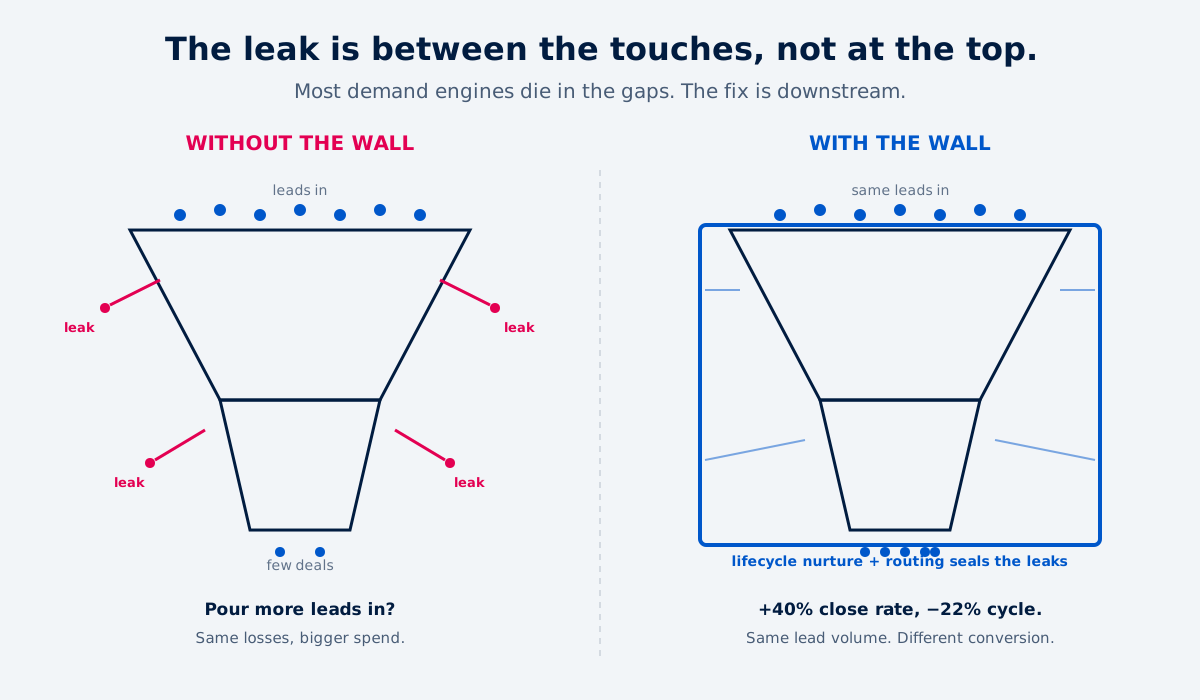
The same pattern shows up downstream. Most teams have a post-call follow-up motion that depends on rep diligence. Replace that with structured sequences that fire automatically and deliver only the report or case study sections that map to what the prospect actually asked about, and the sales cycle compresses fast. In a recent B2B SaaS engagement that change cut average cycle length by about 22% and lifted close rates roughly 40%, no new leads added.
This is not just our pattern. Artemis GTM's 2026 State of Go-to-Market Benchmark Study found that 62% of qualified leads fail to progress at the MQL to SQL handoff, and that 73% of audited companies lack defined SLAs, automated routing, and required follow-up cadences in that handoff. Their framing is the punchline. It is not a lead quality problem, it is a process problem. The full-funnel rate across B2B SaaS dropped from 5.2% in 2024 to 4.3% in 2026, and the decline traces to the same place.
Before adding inputs to a leaky system, build the wall. Most teams cannot face the conversation because the lead number is already on the dashboard and the conversion number is not. See how to develop your demand generation program for the longer version, how the demand generation funnel works for where the leaks actually hide, and the wider list of demand generation mistakes costing you pipeline.
2. Why your lead score is a vanity metric
Scoring fails because most companies use it to count, not to route. Sales engages on personal hunches because the score in the CRM does nothing useful. We rebuild scoring as a routing mechanism. Cross a threshold, fire a workflow that creates a sales task with the district, the role, the exact engagement history attached, and remove the contact from nurture so the next thing they hear is from a human. In one education-tech engagement that change took monthly MQLs from a 30 baseline to 150 to 200 in strong months while total volume held steady. Quality and routing carried the lift.
The same architecture works at the content-engagement layer. When the score lives in the CRM and a workflow pushes ready accounts to the right SDR with context attached, content stops being a top-of-funnel tactic and starts being a demand channel. In one facilities SaaS engagement the resource hub now generates 12 to 15 MQLs per day and content sits at roughly one-third of pipeline. The trick is not the score. The trick is that scoring fires a workflow, removes the contact from nurture, and creates a sales task with everything the rep needs to open a relevant conversation in under a minute.
A recent thread in r/b2bmarketing put the principle bluntly. "Behavioural scoring connected to an actual sales trigger. Not scoring as a reporting metric, but scoring as a routing mechanism." Most teams have the data. They have not connected it to a workflow that does anything.
A useful diagnostic. Pull the last ninety days of MQLs. Filter to those that became opportunities. If you cannot tell from the CRM record exactly which behaviours triggered routing and which rep got the task, your score is reporting, not routing. This is the distinction we draw out in what demand generation metrics to track and not to track in 2026.
3. Twenty-two people read every email you send
The unit of work in B2B is the buying group, not the lead. We design enrichment workflows that resolve a single download into a full account dossier inside five minutes. District or company data from public sources, the buying committee from Perplexity and Apify, formatted through a GPT module, and dropped into the rep's drive alongside a drafted personalised email. The rep starts the conversation knowing the principal, the special-education director, the relevant clinician roles, and the procurement decision-maker. They write to the buying group from the first touch, not to the lead.
The same logic applies to live engagement. A webinar engages a whole committee at once. When we invite into a founder's existing network and into target accounts rather than to a broad list, roughly 90% of new leads sit inside the ICP, and about one in five attendees books a demo. The room becomes the unit of work; the cost per qualified attendee drops well below what email-only or paid-social routes deliver.
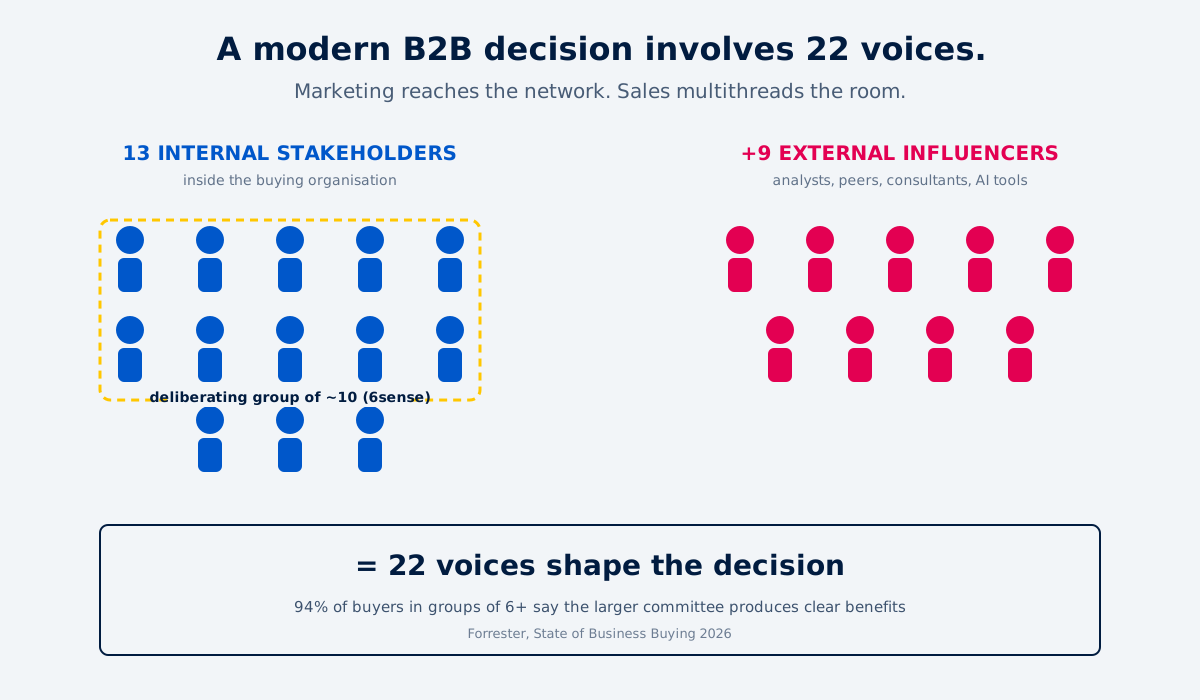
The buying-group math is getting bigger, not smaller. Forrester's 2026 State of Business Buying, based on the Buyers' Journey Survey 2025, found that the typical decision now involves 13 internal stakeholders and nine external influencers. Twenty-two voices, with 94% of buyers in groups of six or more reporting that the larger committee produces clear benefits including broader perspective, easier validation, and better budget approval. 6sense's 2025 Buyer Experience Report puts the operational, deliberating group at 10.1 people. Forrester counts the influence network. 6sense counts the org chart. Marketing's job is to reach the network of 22. Sales's job is to multithread the deliberating 10.
The tactic that follows is not "personalise harder." It is build for the room. Content has to make sense lifted into a Slack channel and read by a procurement person who has never visited your site.
4. What if every article shipped a tool with it
The most defensible content moat we have built belongs to Behavior Advantage. Every article on the site pairs with a usable tool the practitioners themselves author. A BIP template, an FBA worksheet, an IEP goal bank. The article teaches; the tool gets used. The combination ranks first against thin competitor content, earns a flood of resource downloads, and is the reason the brand now owns about 35% share of voice and 40% of the AI Overviews for its terms, cited 20 to 30 times a week. Search and AI both reward the page they cannot reproduce.
The same posture works inside a product. When the content is the product, the CTA can drop a new free-account user straight onto the relevant screen with their query pre-filled, one click from the resource. Free-to-paid in that kind of engagement runs around 10%. The content does not advertise the product; it is the product, in one click.
The mechanic this implies is uncomfortable for most content teams. If the page can be reproduced by a model in thirty seconds, the model will reproduce it. The defensible move is to attach something that takes work to build and value to use. A tool the practitioners maintain. An interactive calculator scoped to the buyer's actual job. A template that has visibly been used in real engagements. The brochure version of content (paragraph, paragraph, CTA) is a category that is closing, which is exactly why demand generation and content marketing have to work as one motion. Ship a working artefact alongside the prose and the page earns its place in both the search index and the AI answer.
5. One in three buyers chose a vendor they had never heard of
Inside one of our most data-confident engagements, Banking Crowded, roughly 22% of inbound now comes from LLM referrals, and those leads convert at about five times the rate of other sources. The mechanic was deliberate. As executives in the category began asking ChatGPT, Perplexity, and Gemini before they ever opened Google, the hub we built became a source those models cited. We did not optimise for AI later. We structured the hub for answer engines from day one, with extractable answers, schema, real statistics, and clearly attributed authorship. The search rankings followed.
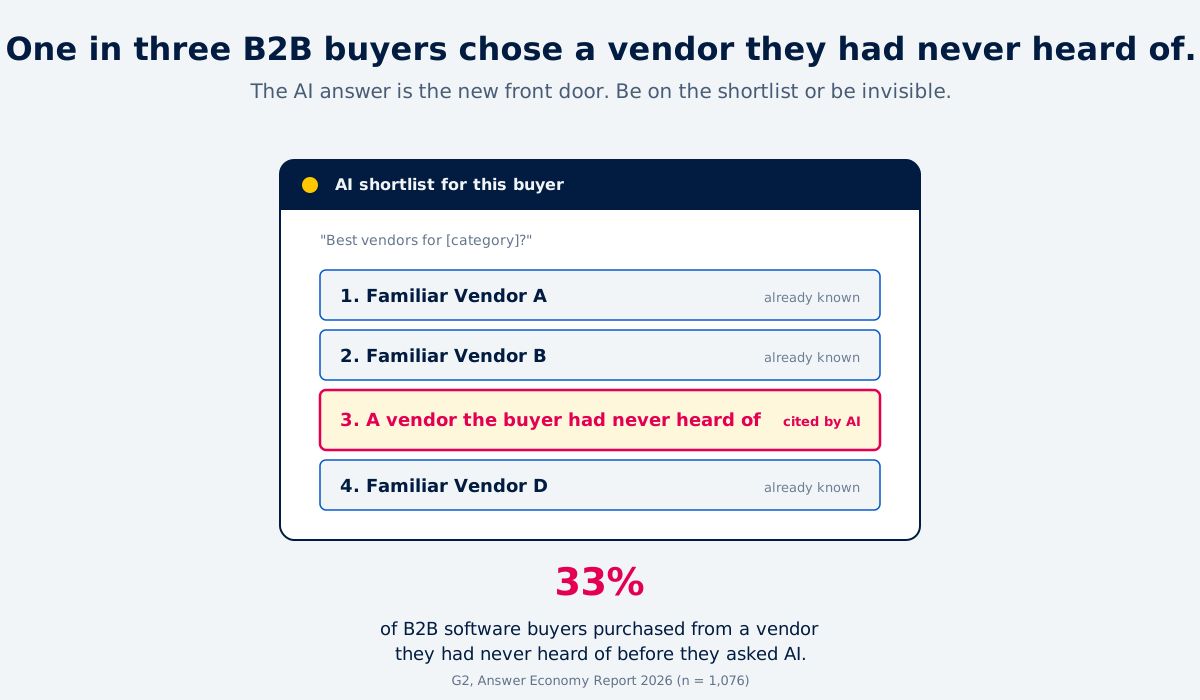
The market shift behind this is genuinely fast. G2's March 2026 Answer Economy report, based on a survey of 1,076 B2B software buyers, found that 51% now start research in an AI chatbot more often than Google, up from 29% in April 2025; almost doubling in eleven months. Sixty-nine percent chose a different vendor than they initially planned based on chatbot guidance. One in three purchased from a vendor they had never previously heard of. Loganix and Averi's 2026 analysis of 680 million AI citations found that AI search traffic converts at 14.2% against 2.8% for Google organic, a 5.1x advantage that maps almost exactly onto the internal number from that engagement. The same study found that only 22% of marketers track AI visibility at all.
The funnel did not get shorter. 6sense's data shows buyers still take roughly 16 interactions with the winning vendor, statistically identical to 2023. The funnel just routes differently now. AI decides which vendor walks it. Get cited and you get the deal. Don't and you do not learn the opportunity existed. It is the single biggest reason AI is changing top of funnel demand generation.
6. Ungate the asset, gate the next step
The pattern that converts now is to give the asset away and gate the moment of highest interest immediately after. Our preferred shape is to email the resource to the prospect and reroute them, in the same click, to a custom demo-on-demand video page with an embedded Calendly. The download is free. The next step has friction. Conversion stays high because the gate finally sits where the intent is actually peaking. This is demand creation feeding straight into demand capture, without the form in between.
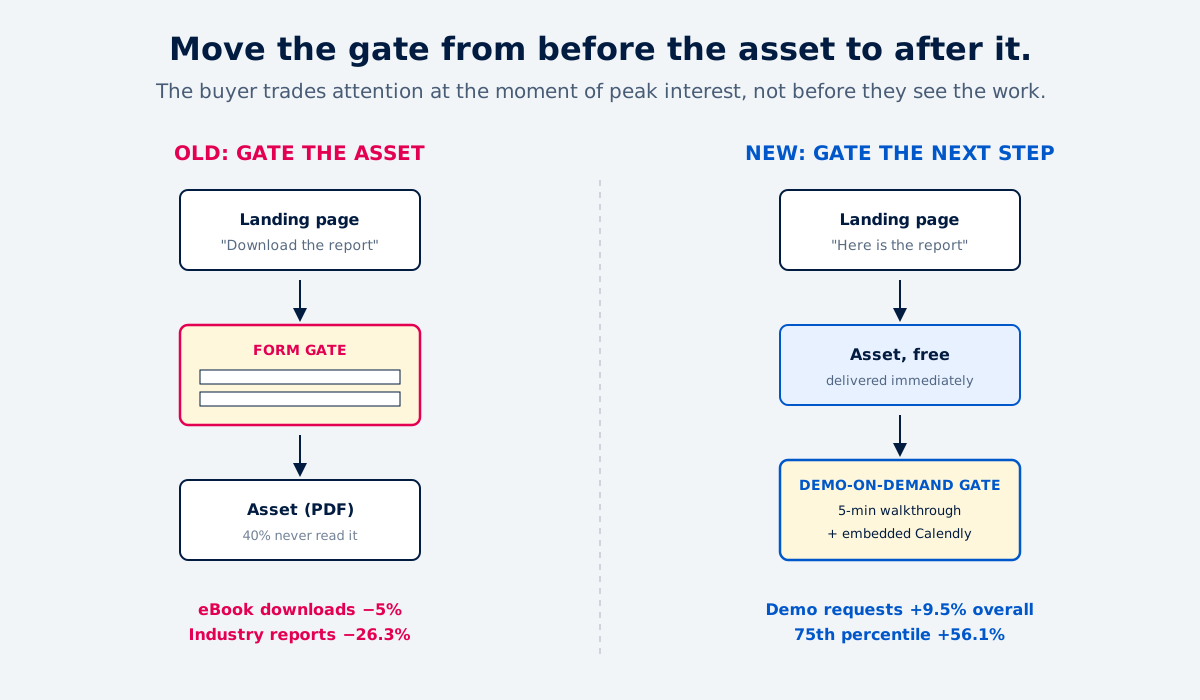
A variation we run on the same idea is the in-context redirect during download. The buyer hits the resource page, the file generates and goes to the inbox, and a five-minute walkthrough plays on screen with a booking link beneath it. No form between the buyer and the file; an immediate, in-context offer to keep going. Demos book at the moment the buyer is most engaged with the work.
The market is confirming the move at the format level. A recent analysis of more than 100 B2B teams by Factors.ai found that industry report requests fell 26.3% year over year, eBook downloads 5%, and webinar registrations 12.7%. Demo requests over the same window grew 9.5% overall, with the median company up 17.4% and the seventy-fifth percentile up 56.1%. The buyer is still trading attention for value; they have stopped trading email for a PDF. A BokkaGroup test cited by ZipTie found that 66% of prospects who download gated content are not ready to purchase for more than a year, and roughly 40% of leads captured this way never read the material at all. That is why eBook and report MQLs stopped predicting pipeline.
Gating vendors sometimes report different numbers; NetLine's 2025 State of B2B Content Report shows registrations on their syndication network growing 27% year over year. Worth treating as a different measurement (paid-syndication network registrations) than how a buyer behaves on your own property.
A clean test. Strip the form from any gated asset on your site, redirect to a demo-on-demand page, and measure the rate at which downloaders book within 14 days. We have rarely seen that number go down.
7. Pick one channel and go deep
The honest version of the channel-mix question is that almost every five-channel demand engine is one channel doing the work and four channels reporting at the standup. We have run programs where one channel was effectively the entire pipeline source. In a water-infrastructure engagement the program was seven webinars across six months, 70 to 90 ICP attendees each, 400 to 540 qualified leads in total, and an estimated 30 to 40% of all sales-ready conversations traceable to the series. About $2.5M in influenced pipeline. The founder ran every session as the subject-matter expert. Email and outbound supported, but they supported one motion.
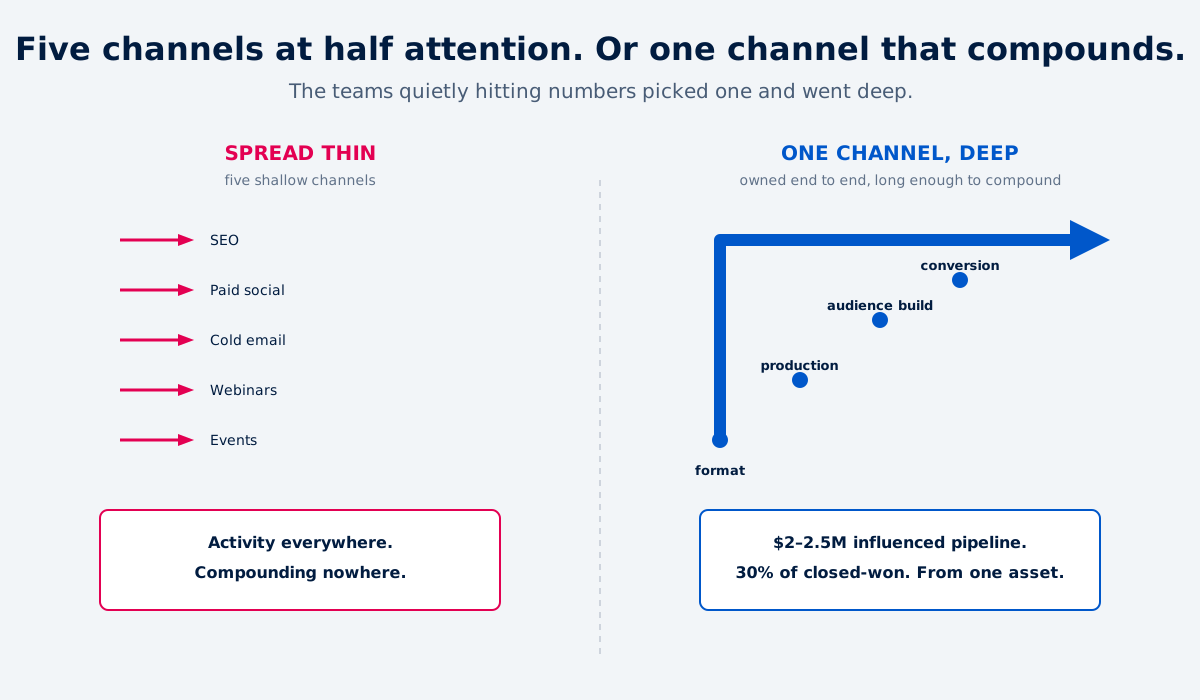
The same shape works on a different surface. Lucid was a single original-data report, built from proprietary product data plus a targeted ICP survey. It drove $2 to $2.5M in influenced pipeline and roughly 30% of closed-won revenue. SDR reply rates moved from 3 to 4% up to 14 to 18%. Meeting bookings rose around 65% without adding headcount. The asset was the program. There are more of these in our demand generation examples.
The same posture lands in content too. A purpose-built resource hub, treated as a long-term product rather than a campaign, can become the dominant source of site traffic and the cheapest acquisition channel at the same time. In a fintech-intelligence engagement that hub drove 65% of all site traffic and ran at under $15 cost per lead, down from $180 to $220 on the prior outbound-led motion.
A recent r/b2bmarketing thread on what is actually working put the same point directly. "The teams booking solid demos consistently are the ones who've picked one or two channels and gone deep rather than spreading thin across six." Going deep means owning the channel end to end, the format, the production pipeline, the audience-build, the conversion mechanic, for long enough to compound. It is the same logic behind the top B2B demand generation tactics in 2026. The cost of running one channel that way is high. The cost of running six at half attention is higher and harder to see.
8. Sales calls beat keyword tools
The cleanest topic engines we run start from sales-call transcripts, not from keyword tools. We mine recorded calls, win-loss notes, and direct operator interviews for the exact phrasing buyers use when they describe a problem, and the keyword research happens later, to validate volume on topics the calls have already surfaced. This is the same raw-asset extraction that anchors every program we build. In a facilities-management engagement that approach grew the resource hub to 12 to 15 MQLs per day and content sits at roughly one-third of pipeline. The topics that mattered were the ones operators raised on the phone, not the ones SEMrush flagged.
We run a more aggressive version in B2B intelligence categories where the senior buyer is already on the phone with sales. The conversation a senior banker had with the team last week becomes next week's article. In one fintech engagement that motion grew inbound from roughly 15 leads a month to 120 to 150. The substance of the content is identical to the substance of a working sales call; we just put it on the open web. That is the core of how demand generation and content marketing work together.
When the practitioners themselves write, we structure the process around their input rather than around a brief. Each piece starts with a live working session, competitor analysis on the topic, structured interview for stories and insights, then survey data layered in. The differentiation is built before the writing starts. It is how we keep expert content authentic at volume without letting it drift into generic.
This pattern works outside our portfolio too. Skio's one-person marketing team published a case in which mining sales-call transcripts produced about 5,000 content concepts. The first 28 days of publishing five posts a week lifted search impressions 50% and clicks 46%. The BDRs use the posts to multi-thread accounts mid-cycle. Calls give you what people actually want to solve. Keyword tools give you what gets typed. Both are useful; only one teaches you what closes.
9. Use AI for ranking and synthesis, not for fake personalisation
The AI work that earns lift sits one layer underneath the message. In our production stacks a Make workflow pulls competitor articles via DataForSEO and a SERP API, builds an H2 skeleton, and flags the structural weaknesses to address before a writer touches the page. A separate workflow auto-generates a carousel brief, a static-post brief, and email copy for every article published. Roughly twenty hours of human time saved a week, and one operator can run blog, social, email, webinars, and downloadables alone. The plumbing behind that is the automation architecture we set up early in every engagement.
The same posture works in outbound. Make orchestrates across Instantly and PhantomBuster, pulling Crunchbase and Sales Navigator signals from the account down to the individual stakeholder; Perplexity and Apify gather context and draft personal openers; a human edits and sends. In one renewables-tech engagement cold reply rates moved from under 1% to over 12%, and speaker-invite responses ran at 30 to 40%. AI did the research at a depth the human writer could not afford to do alone, and the message itself stayed human.
The published practice is "use AI for personalisation at scale." The market just rejected it. Reddit threads on what is working in B2B in 2026 are full of the same complaint. "You can tell when someone uses AI to write a 'personalised' opener based on your LinkedIn headline. It feels hollow." The trick falls apart because it bolts AI onto the surface layer, generating the message, where humans should still be. Get the layers right and the same model produces meaningfully different outputs, which is the whole argument in how AI is changing top of funnel demand generation. AI handles ranking, synthesis, enrichment, and routing, the work that does not scale with people. Humans handle the writing that goes to a human.
10. Measure against revenue, not MQLs
The last practice is the one that makes the other nine survive contact with the dashboard. We design attribution to influenced pipeline first, not lead counts. In one webinar-led engagement we cross-referenced the registered attendee list against the opportunities reps opened over the following months. The number reported up was not MQL count but influenced pipeline, which crossed $2M and contributed to the company's acquisition. The reporting choice forced the program choice. With MQLs as the headline, we would have optimised for registration volume and never built a panel format that prioritises sales-ready attendees over total attendance.
The same discipline reshapes content. When content reports against revenue, the content choices change. Topics that influence late-stage deals get more investment; topics that drive traffic but no conversion get cut even when they rank. In a fintech engagement the resource hub reported through influenced pipeline of $3 to $4 million and sales cycles compressed by 30 to 35%, not through monthly lead counts. The composition of the publishing calendar shifted within a quarter.
We default to monthly board reporting on MQLs, SQLs, conversion rates, organic-sourced deals, and keyword growth, in that order, assembled across Looker Studio, HubSpot, and SEMrush. The structure exists because revenue is the only number that survives a board-level recession conversation. Everything else, including total leads, is colour. The full argument is in what demand generation metrics to track and not to track in 2026, and the build sequence is in how to develop your demand generation program.
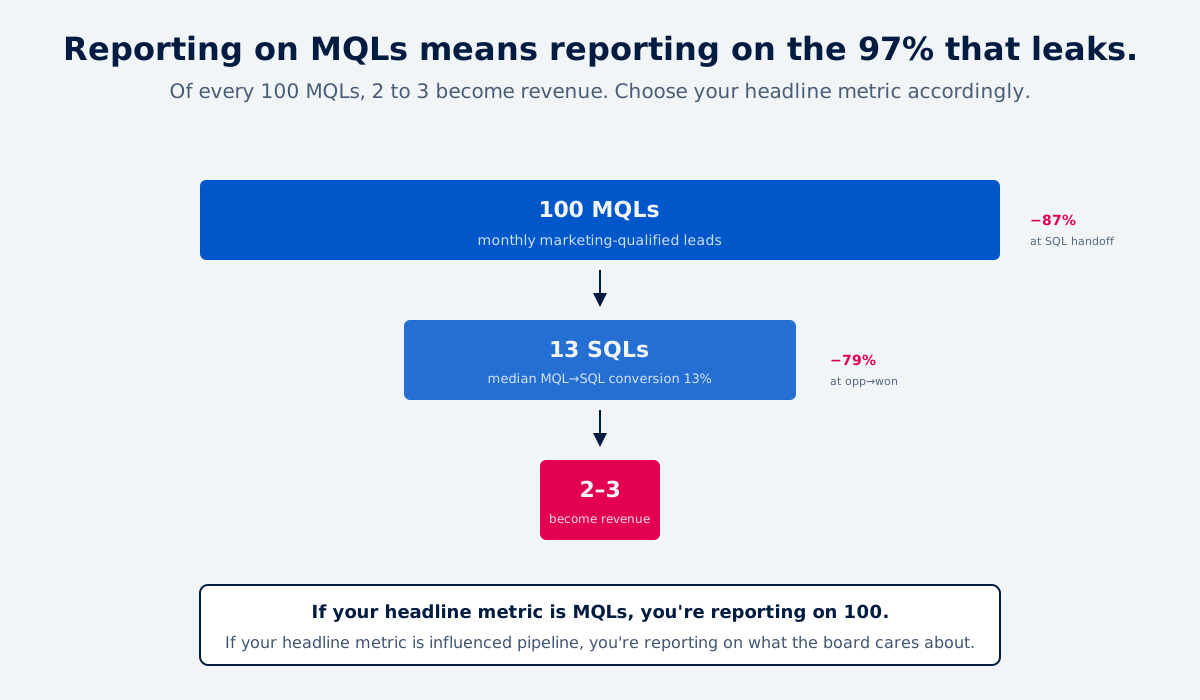
Starr Conspiracy's benchmark hub notes that the median B2B MQL-to-SQL conversion sits around 13% and median opportunity-to-closed-won around 21%, which means roughly 2 to 3% of MQLs ever become revenue. If your reporting headline is the number with the 97% leakage rate, you are reporting on something other than the program's job. Report on the 2 to 3% and watch what shifts.
Reading the list as judgments
Ten practices, ten choices that move in the same direction. The teams whose pipelines actually grow have made them all. Each on its own is a defensible position; held together, they describe a demand engine that is built around conversion mechanics, buying-group reality, and the AI-first information environment buyers actually use. The usual lists describe an engine. We are describing the calls inside it.
If you want to see how this looks in the wild, the case studies for Behavior Advantage, Banking Crowded, and Lucid are the long version. For five of these programs walked through end to end in one place, see our B2B demand generation case studies. Or start with the framework most teams build backwards and work back toward the complete guide to B2B demand generation strategy.
Reading the playbook is not the same as running the program.
We build demand engines around the ten practices in this piece -conversion mechanics, buying-group reality, AI-first information environments, and a measurement model that survives the board. Let's design your Content RevOps system.
Frequently Asked Questions
About the Author

Founder & CEO, Content RevOps
Stefan Kalpachev is the founder and CEO of Content RevOps, where he helps B2B SaaS companies transform their content into predictable pipeline. With a background in content marketing and revenue operations, Stefan has developed a unique methodology that bridges the gap between content creation and revenue generation.
Connect on LinkedIn