Demand Generation vs Demand Capture: What's The Difference?
Capturing demand you never created? Let's build the demand-generation engine underneath it.
Book a CallThere's a comment in an r/marketing thread that's more honest than most of the articles ranking for this term. A marketer, trying to reconcile the demand-creation-versus-capture idea with the funnel he'd always used, gets this reply: "From my perspective there is no demand creation — you can't create demand if people aren't ready to buy. Just brand awareness and demand capture."
Part of The Complete Guide to B2B Demand Generation Strategy.
He's wrong, but he's wrong in a useful way. The confusion he's voicing — is "creating demand" even a real thing, or just a fancy name for awareness? — is the exact confusion that makes "demand generation vs demand capture" worth writing about at all. Search the phrase and you'll get a dozen near-identical tables: gen builds awareness, capture converts intent, you need both, here are two lists of channels. All technically correct. None of it helps you make the one decision that matters — where the next dollar goes — and some of it is quietly defining the terms wrong.
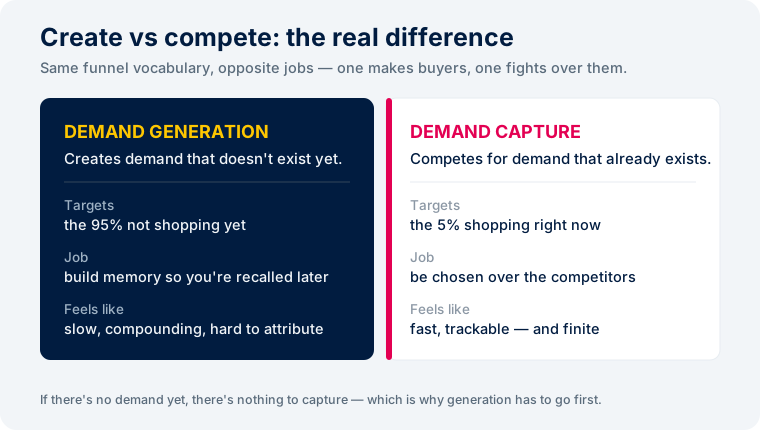
So let's do this properly. The short version: demand capture competes for demand that already exists. Demand generation manufactures the demand that doesn't exist yet. The "vs" framing is the problem, because it makes them sound like rival strategies you pick between, when they're really two different jobs that fail in completely different ways.
The key differences, in one line
Picture the entire universe of companies who could one day buy what you sell. At any given moment, only a sliver of them are actually shopping. The Ehrenberg-Bass Institute and Professor John Dawes put a number on that sliver — the 95:5 rule: roughly 5% of B2B buyers are in-market at any time, and 95% are not.
That single split defines the key differences between both functions:
Demand capture goes after the 5%. It intercepts people who already know they have the problem and are actively evaluating solutions; demand capture targets prospects at that stage and tries to make them choose you. Paid search, bottom-of-funnel SEO, review sites like G2 and Capterra, retargeting, comparison pages. You are not creating the want; you're catching it.
Demand generation goes after the 95%. Demand generation focuses on building awareness and trust with a specific target audience before they are ready to buy, while keeping the existing contrast with the in-market 5%, and demand generation expands the pool of future customers so that when their circumstances change and they enter the 5%, you're already the name they remember.
These are two strategies within one marketing strategy, and combining generation and demand capture creates a complete go-to-market strategy; demand capture ensures high-intent buyers are converted once they enter market.
The reason "vs" misleads: these aren't two ways to solve the same problem. Capture solves "existing demand isn't reaching us." Generation solves "there isn't enough demand in the world for us yet." If you have the second problem, no amount of capture fixes it — there's nothing there to capture. That's the kernel of truth in the Reddit skeptic's complaint, and also exactly where he goes wrong.
First, untangle the words
Half the disagreement about demand gen versus demand capture is really a vocabulary problem. Four terms get used interchangeably and shouldn't be.
Demand generation is the broad discipline of creating and growing demand for your category and your brand. Confusingly, a lot of teams use "demand gen" to mean "the team that runs paid ads and fills the CRM" — i.e., capture wearing a nicer title. You'll even see it on Reddit: one lead-gen practitioner describes "demand generation" as doing research before you send cold outreach, versus "boiling the ocean to catch a few fish." Useful instinct, wrong label. That's still capture — just less wasteful capture.
Demand capture refers to capturing demand by converting existing interest from buyers in the in-market 5% who are actively seeking or actively searching for a solution. Sometimes you'll see it called demand harvesting (same thing — you planted nothing, you're harvesting what grew) or demand fulfilment (the demand exists, you're fulfilling it). These demand capture tactics, or demand capture strategies, are built for interested prospects, immediate sales, and efficiently converting warm leads.
Lead generation is a different axis entirely. It's the mechanism — forms, gated content, demo requests — by which any interested person, from either group, raises their hand. You can generate leads off demand you created and off demand you captured. It describes how someone converts, not whether the want was already there.
Here's the most common and most expensive mistake: defining demand capture as lead nurturing and qualification. Plenty of otherwise-fine explainers describe "demand capture" as lead scoring, CRM workflows, and moving prospects down the funnel. That's lead capture and qualification — a real and necessary thing, and in our own methodology it's a distinct conversion-layer step — but it is not demand capture. Demand capture is about where the demand comes from (the in-market 5%), not about what you do with a lead once you have it. Blur those two and you'll measure the wrong things and conclude demand gen "doesn't convert," which brings us to the part everyone gets wrong — unlike demand generation, demand capture focuses on converting existing demand rather than building future demand.
Demand capture, precisely — and its ceiling
Demand capture is the easier of the two to love. It's measurable, it's fast, and it looks ruthlessly efficient. Someone searches "best [your category] software," clicks your ad, books a demo — you can draw a straight line from spend to pipeline, qualified leads, and sales opportunities. Channels are well-understood: high-intent paid search like Google Ads, BOFU SEO and comparison content for buyers using a search engine to evaluate solutions, G2/Capterra presence, retargeting the people already on your site. It's built to generate revenue from in-market demand.
It works. But it has a hard ceiling, and the 95:5 rule is what sets it. When you only market to buyers who are already in-market, every competitor is fishing the same tiny pond. You're all bidding on the same keywords, all chasing the same G2 category, all retargeting the same visitors. That competition is exactly what drives up cost-per-click and cost-per-acquisition over time, and it's why a capture-only program tends to get more expensive and less differentiated the longer you run it. Ehrenberg-Bass puts the consequence bluntly: if a buyer "has never heard of your brand before their buying process begins, your chances of making a sale are slim to none."
And the pond doesn't refill itself. The 5% who are in-market today close, drop out, or pick someone else — and the only thing replenishing that pool is the slow drift of the 95% becoming ready. If nobody is doing the work of staying in those people's memory and building preference before they're in-market, demand generation creates demand, supports future demand, and drives long term growth. It feels like a growth engine. It's often a harvesting machine running on inventory someone else created. That upstream work helps build a future sales pipeline and supports sustainable growth over time, but the captured demand still has to be handed off to the sales team.
Demand generation, precisely — and the mechanism nobody explains
The weakest part of every "demand gen vs capture" article is the demand-gen half, because it gets waved away as "building awareness" — soft, fuzzy, unmeasurable, brand stuff. That framing is why finance teams cut it first. It also misses what demand generation is actually doing mechanically, especially across the full buyer's journey rather than just the last branded-search click.
Demand generation builds mental availability: the probability that your brand comes to mind in a buying situation. The science here is well-established and worth borrowing. Jenni Romaniuk and the Ehrenberg-Bass tradition show that brands grow by getting linked, in buyers' memories, to category entry points — the cues and situations that trigger a purchase ("our contract's expiring," "we just lost a deal to a competitor's feature," "the board asked why pipeline is down"), with demand generation tactics often using informative and engaging content distributed across social media platforms. The more entry points your brand is attached to, the more often you're recalled when one of them fires, with social media marketing serving as one channel to reinforce those links.
Crucially, this work lands hardest on the people capture can't touch. A study by Vaughan, Corsi and Beal measuring advertising's effect on mental availability found the effect was larger among non-buyers than buyers — precisely the out-of-market 95% that no paid-search campaign will ever reach. And when brands stop doing it, the bill comes due slowly but reliably: Hartnett and colleagues, tracking brands that went dark on broad-reach advertising, found sales decline began within the first year, and that bottom-funnel "activation" couldn't compensate for the lost mental availability — especially for smaller brands. There's even a natural-monopoly effect: the biggest brands quietly monopolise the category entry points, which is how they stay big. Demand generation is the work of taking some of those entry points back, guided in part by industry trends.
So demand generation isn't "awareness" in the vanity sense. Demand generation efforts are about deliberately constructing memory links before buyers enter market, so that the 5% — when each buyer crosses into it — already has you on the shortlist. That's not fluffy. It's just slow, and slowness is what makes it easy to defund, especially when attribution logic pushes too many marketing investments into capture instead of balancing generation and demand capture.
The attribution trap: why capture looks better than it is
Here's why this comparison is so consistently miscalled. Capture doesn't just feel more efficient than generation — your reporting actively conspires to make it look that way.
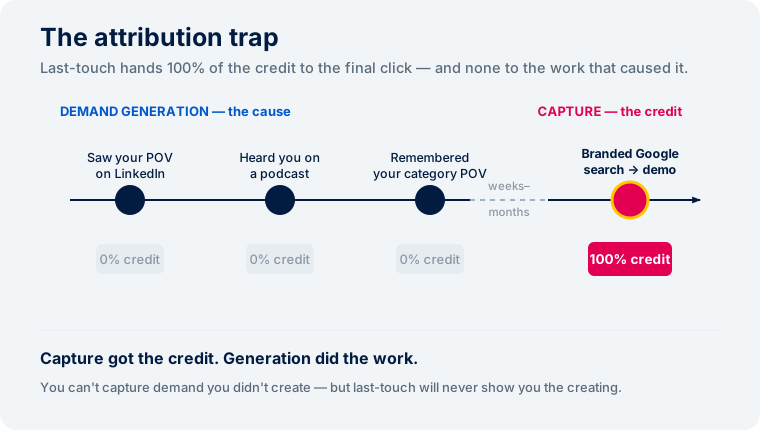
Most B2B teams attribute on last touch. The buyer clicks a branded ad on a search engine, books a demo, and the CRM hands 100% of the credit to "paid search." Clean, satisfying, and wrong. It says nothing about why that person searched your brand by name in the first place — the LinkedIn post they saw last quarter, the podcast they half-remember, the category POV that made you the obvious thing to Google, all of it filling the sales funnel before capture converts the demand. Capture got the credit; generation did the work. You can't capture demand you didn't create — but last-touch attribution will never show you the creating.
This isn't abstract. In our own analysis of content across one industry, 75% of the search value the sector captures is bottom-of-funnel — high-intent terms from buyers already looking — while only about 16% is the top-of-funnel, educational kind that creates new demand, often through upstream channels like search engine optimization before capture gets the credit. Read alongside the 95:5 rule, that's an industry harvesting demand it never created and calling it a content strategy. The capture metrics look fantastic right up until you ask where the demand came from — and find you've been living off a reservoir filled by review sites, word of mouth, and whatever brand-building you did years ago.
The practical danger is a doom loop. Capture reports a great CPA, so it gets more budget. Generation can't prove its contribution under last-touch, so it gets cut. The reservoir stops refilling. Six to twelve months later capture CPAs climb — fewer warm buyers, same competitors — and the instinct is to double down on capture, because that's the channel the dashboard rewards. Refine Labs' Chris Walker built a whole framework on this exact failure: companies say they want to create demand, but their measurement only rewards capturing it, so that's all they ever fund.
So how should you actually split it?
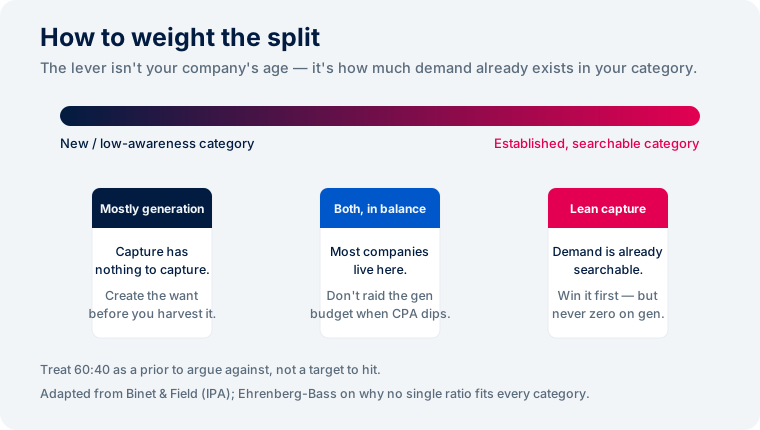
The honest answer is that there's no universal number — and you should be suspicious of anyone who hands you one without conditions. The most-cited starting point is Binet and Field's 60:40 rule: roughly 60% of budget to long-term brand building, 40% to short-term activation, with their B2B work shifting the optimum toward about 46% brand / 54% activation because B2B cycles are longer and committee-driven. Worth knowing. But also worth the caveat that Ehrenberg-Bass — no opponents of brand building — argue there's no magic ratio that survives contact with a specific category structure, budget, and industry trends. Treat 60:40 as a prior to argue against, not a target to hit.
The variable that should actually move your split is how much demand already exists in your category:
Established, searchable category — buyers know they have the problem and are Googling solutions. Capture is cheaper and faster than manufacturing new demand, so your first dollar belongs to capture and conversion: win the high-intent queries, get on the review sites, tighten the funnel, and use optimized landing pages as part of demand capture strategies to lift conversion rates and lower customer acquisition cost, often through Google Ads and other high-intent channels. Lean toward capture, but never to zero on generation, or you'll be renting that demand forever.
New or low-awareness category — you're launching project management software into a market where buyers don't yet recognize the need. Capture has nothing to capture. Almost everything goes to generation first; you have to create the want before you can harvest it. That is a specific brief to hand an outside team, and our shortlist of demand generation agencies that create new-category demand is filtered on it.
Most companies, in the messy middle — you need both, and the real failure mode isn't picking the wrong split. It's funding capture out of the demand-gen budget every time CPAs wobble, until the reservoir runs dry.
One more number from our data to make the trade-off concrete: in the industry we studied, paid search ran 20–30% of the typical marketing budget — money spent on rented demand that's only efficient when your own content is doing the creating underneath it. Pay rent forever, or build the asset. Capture is rent; generation is ownership, so measure generation with engagement metrics because it aims to create future customers while capture monetizes current intent. A healthy split is really a decision about how much rent you're willing to keep paying, and whether both loops are balanced in a way that supports sustainable business growth.
Measuring the half everyone calls unmeasurable
The reason generation loses budget fights is that it's "unmeasurable" — which isn't true, it's just measured on a delay and with different instruments. Capture you measure the obvious way: conversion rate, CPA, cost-per-lead, pipeline sourced, sales-cycle length. Fine.
For generation, stop trying to force it through a last-touch conversion model it will always fail, and use leading indicators instead. The most useful one is share of search — your brand's share of total category search volume, free to pull from Google Trends. Les Binet's work found it's a genuine predictor of market share, moving six to twelve months ahead of it. When your demand gen is working, share of search rises before pipeline does — which is exactly the early signal you need to defend the budget before the revenue lands. Pair it with the brand-health metrics Dawes points to: unaided recall, the percentage of your total addressable market you've actually reached, and how many category entry points you're linked to.
The trap to avoid: holding both functions to the same KPI. Make demand gen hit this-quarter's CPA and you'll kill it, because it's not built to convert this quarter — it's built so that next year's capture is cheap. Give each loop its own honest metric, wire both into one definition of qualified pipeline, and the false choice between them mostly dissolves.
That's the real answer to "what's the difference." Demand capture wins you a bigger share of the buyers who exist today. Demand generation manufactures the buyers you'll capture tomorrow. One is rent, one is ownership, and the only reason the comparison feels close is that your attribution model has been quietly paying generation's wages into capture's account.
Is your pipeline harvesting demand — or creating it?
Turn content into a demand engine that fills the reservoir capture draws from: one narrative, one lifecycle system, and leading indicators you can actually defend a budget with.
Frequently Asked Questions
About the Author

Founder & CEO, Content RevOps
Stefan Kalpachev is the founder and CEO of Content RevOps, where he helps B2B SaaS companies transform their content into predictable pipeline. With a background in content marketing and revenue operations, Stefan has developed a unique methodology that bridges the gap between content creation and revenue generation.
Connect on LinkedIn