Demand Generation Agency vs PR Agency - Which One Do You Need?
Want to know how often AI answers actually mention you? We check exactly that, and price the gap, in our content revenue audit.
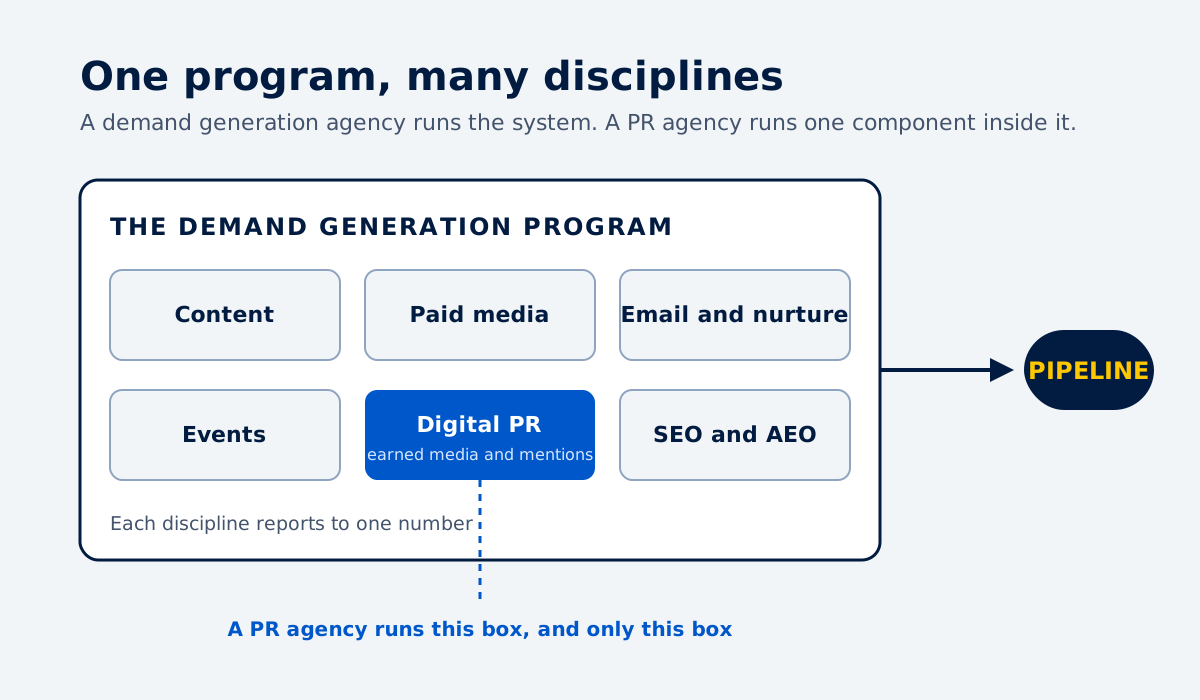
Book a CallThe comparison feels like a coin flip, and it is anything but. A demand generation agency runs a revenue program; a PR agency runs one discipline that can live inside that program. You are comparing a system to a component.
Part of The Complete Guide to B2B Demand Generation Strategy.
The confusion is real, though, and it usually starts in the leadership room. The CEO wants brand presence, the CRO wants pipeline, and most agencies pick a lane and defend it. Where one person holds both jobs, that argument happens in their own head, which is why we screened the 454 agencies that name founders and chief executives as their buyer into a separate list of demand generation agencies for founders and CEOs. Where those two jobs sit with different people, the pipeline half of that argument belongs to the revenue leader, so we cut the same research into a separate list of demand generation agencies for CROs and heads of sales.
So the practical question is worth answering properly. What does each one actually do, when do you need which, and why has AI search made the answer more interesting than it used to be?
What does a demand generation agency actually do?
A demand generation agency builds and runs the system that turns unknown buyers into qualified pipeline. That means creating demand with people who are not yet looking, capturing demand from people who are, and converting that attention into sales conversations.
The word that matters is program. Demand generation answers to a revenue number, and everything inside it, content, paid, email, events, earned media, exists to move that number.
The market defines the job the same way. In our analysis of 1,000 demand generation leadership postings, 52% of director roles name revenue as the mandate and 37% name pipeline, while channel skills barely register.
Companies hire the function to own a number. They hire agencies on the same terms.
We believe the funnel is the operating logic of that program, designed before any content or channel gets briefed. If you cannot say how a stranger becomes aware, engages, and becomes a qualified lead, with fast-track exits for buyers who are already convinced, no channel mix will save the program.
A demand generation agency, at minimum, should own:
- The funnel design and the definition of a qualified lead
- Demand creation in channels where your buyers pay attention
- Demand capture where intent already exists, search, AI answers, and paid
- Nurture and conversion paths that move buyers between stages
- Reporting that connects all of it to pipeline
If you want that scope written out in plain terms, we lay it out in demand generation services: what you actually need, and what you don't.
What does a PR agency actually do?
A PR agency manages how the world talks about you. The craft covers earned media, press relationships, story placement, reputation management, and communications.
PR people themselves describe its commercial role as air cover; it makes every other motion easier without being the motion itself. That is a real discipline with real value, and it operates at a different altitude than a revenue program.
PR's own measurement history proves the point.
Why PR was never built to carry a pipeline number
The profession has fought a measurement civil war for fifteen years. AMEC's Barcelona Principles declared in 2010 that advertising value equivalents are not the value of communication, and the industry has updated those principles three times since.
Practice has barely moved. The ICCO World PR Report found 61% of organisations globally still use AVEs.
In Muck Rack's survey of 397 PR professionals, 86% say measurement matters, yet the top metric remains number of stories placed and only 19% connect PR to sales metrics.
A discipline that measures itself in placed stories cannot carry a pipeline number, and the profession's own surveys keep saying so.
The relabelled comms department
There is a second reason the two get confused, and we see it in the data constantly. In our seven-vertical study of B2B content, press releases lead the content mix in five of seven industries; life sciences companies run 85% press-release-heavy libraries.
Most B2B teams inherited their content marketing from the communications department and relabelled it, never redesigning it around a buyer's journey. When that is your starting point, a PR agency looks like a content partner, and the program you actually need never gets built.
So which one do you need?
Hire for the problem, not the label. The fastest way to decide is to name the constraint you are actually funding an agency to remove:
Your actual problem | What you need |
Pipeline is thin or unpredictable | A demand generation agency running the full program |
Buyers reach sales unconvinced and unaware of you | A demand generation program with earned authority built into it |
Reputation risk, a crisis, or sensitive comms | A PR agency, hired for the discipline |
A launch or milestone that needs tier-1 media | A PR agency, or PR running inside the program |
The CEO wants brand and the CRO wants pipeline | One program with one owner, where brand work feeds the funnel |
When the problem is a number, buy the system. When the problem is a story, buy the discipline.
If the answer is the system, we cover the timing question in when to hire a demand generation agency, and the shortlist itself in our roundup of the top B2B demand generation agencies.
What happens when you cross the wires
Marketers who have hired a PR firm for lead generation describe the result in the same words: a peanut-butter engagement, an inch deep and a mile wide.
The moment a PR agency starts running paid, nurture, and funnel work, it competes outside its craft, and the buyers who tried it carry the scar tissue.
The tenure data is consistent with that scoping logic. The ANA and 4As client-agency study puts average agency-of-record tenure at 6.78 years, with PR agencies among the longest-tenured types.
A PR engagement scoped to the discipline has a clear deliverable and a clear judge, which is exactly what long relationships need. The engagements that fray are the ones where the scope was fuzzy on day one.
Why is digital PR suddenly a demand generation problem?
Because AI assistants build their answers out of other people's coverage of you.
When a buyer asks ChatGPT or Perplexity who to shortlist, the engine assembles its answer mostly from earned, third-party sources. A brand that only exists on its own website barely exists in that answer at all, which is why so many teams find their brand missing from ChatGPT and Perplexity even when they rank on Google.
That moves digital PR out of the reputation column. Earning coverage, data citations, and mentions on the sources engines trust has become part of the demand generation program's infrastructure, sitting next to SEO rather than next to the crisis plan.
84% of AI citations come from earned media
Muck Rack's What Is AI Reading? study analyzed more than 25 million links cited by ChatGPT, Claude, and Gemini. The split has held steady across every edition since July 2025:
Source type | Share of AI citations |
Earned media overall | 84% |
Journalism alone | 27% |
Press releases | 1.1% |
Paid and advertorial | 0.3% |
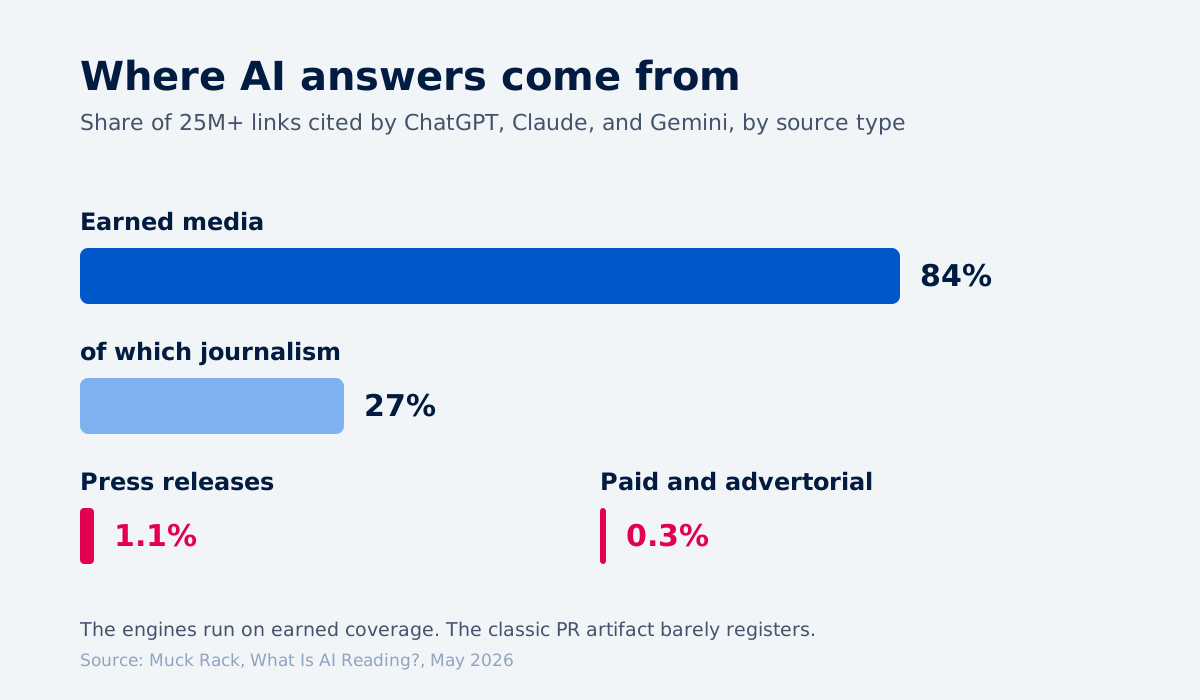
Read the top and bottom of that table together. The classic PR artifact, the press release, is nearly worthless to the engines, while the classic PR outcome, earned editorial coverage, is most of the citation graph.
Digital PR aimed at AI visibility means placing stories and data journalists want to cover, and it means retiring the wire release as the unit of output.
The same study shows why this matters for buyers specifically. Industry-trend questions cite journalism in 46% of responses, roughly double the rate of how-to questions; the category questions your buyers ask while forming a shortlist are exactly where earned coverage dominates.
Mentions now outrank links
For a decade, off-site authority meant backlinks. Ahrefs studied 75,000 brands and found branded web mentions correlate with AI Overview visibility at 0.664, three times more strongly than backlinks at 0.218.
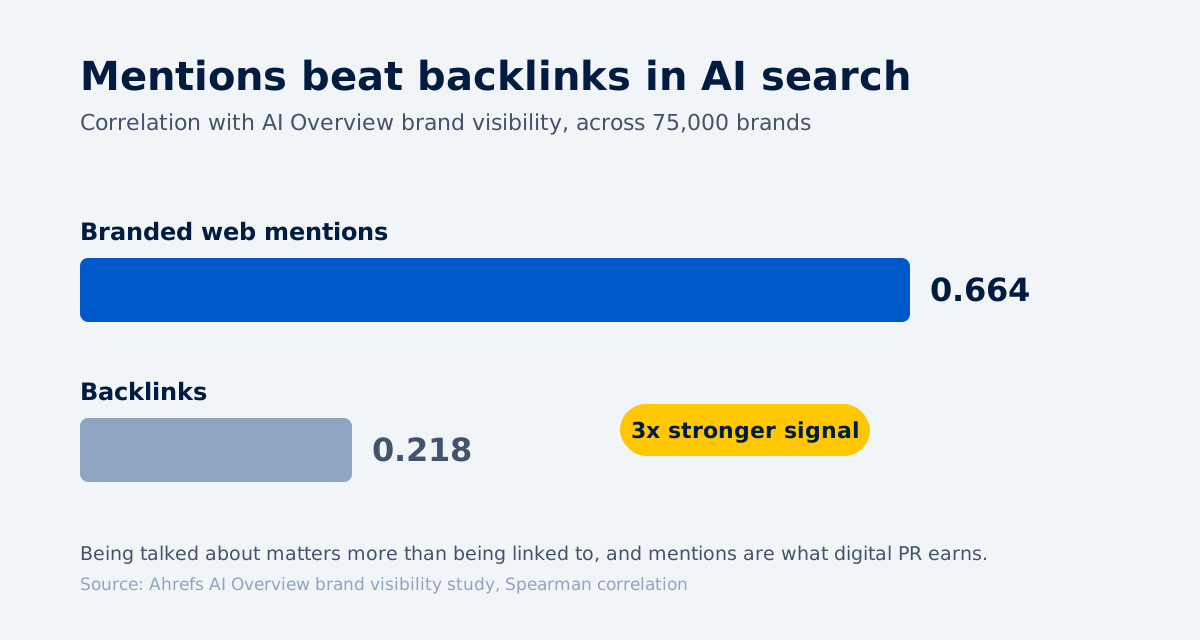
The mechanism makes sense once you picture how an answer gets assembled. An engine deciding who belongs in a recommendation reads repeated, independent naming across the web as evidence that a brand is real, relevant, and safe to suggest; a backlink is only one narrow form of that naming.
The spread between brands is wide. The top quartile of mention earners collects up to 10x more AI answer visibility than the next quartile down, and 26% of brands have no AI Overview presence at all.
Mentions are the currency digital PR trades in, which hands the discipline the strongest lever in the dataset. This is a big part of why one brand gets cited in AI answers while a better-known competitor gets ignored.
Does earned placement actually cause the lift?
The strongest evidence so far comes from a controlled test by Stacker, an earned-media distribution platform measuring its own channel; read it with that in mind.
The study tracked 87 stories from 30 brands across roughly 2,600 prompts on 8 AI platforms. Each story existed in two versions, one on the brand's own site and one distributed through third-party publishers, so the host was the variable being tested.
Distribution produced a median 239% lift in AI citations, and cross-platform coverage nearly tripled, from 5.4% to 17.9%. 97% of distributed stories earned at least one citation, against 82% for owned-only versions.
The sharpest finding sits under the headline number. Distributed versions were 5.3x more likely to be the sole reason a story appeared in an AI answer at all; without the third-party placement, the engines often never surfaced the story.
The honest caveat
Query type decides who gets cited. Geonimo's dataset of 2.1 million citations found brand-owned pages taking 60.6% of citations across its brand-tracking prompts; when someone asks about you by name, engines cite you directly.
Even there, the direction of travel is unambiguous. Within Geonimo's six-month window, corporate citation share fell from 62.3% to 52.5% while user-generated and community sources quadrupled.
We see the same split in our own work. Across six of the seven verticals we studied, company sites are largely absent from AI answers.
The exception is fintech, where roughly 60% of established brands surface, and the driver is earned coverage on the review and reference sites the engines trust rather than the brands' own blogs.
Owned content wins the questions about you. Earned coverage wins the questions that build a shortlist.
How does a demand gen program make PR measurable?
Inside a demand generation program, PR's unit of output changes from a story placed to a presence earned in the answers buyers actually see.
That single reframe resolves the measurement stand-off, because you can track answer presence, benchmark it against competitors, and connect it to pipeline. It is the same shift we describe in how we help you show up in AI search.
What the new output looks like
The work stops at coverage only if nobody defines the next step. In a demand program, earned media has three measurable jobs:
- Coverage breadth, how consistently the brand surfaces across AI platforms for the category questions that matter
- Citable assets, original data and research placed where engines look; in our analysis of 5,761 AI citations, nearly half of cited pages carry original data
- Downstream demand, branded search lift, direct traffic, and the AI-referred visitors who arrive pre-convinced
The pipeline at the end of the answer
AI-referred traffic is small and unusually decided. Ahrefs reported that visitors from AI search made up 0.5% of its traffic but 12.1% of its signups, converting at 23x the rate of traditional organic visitors.
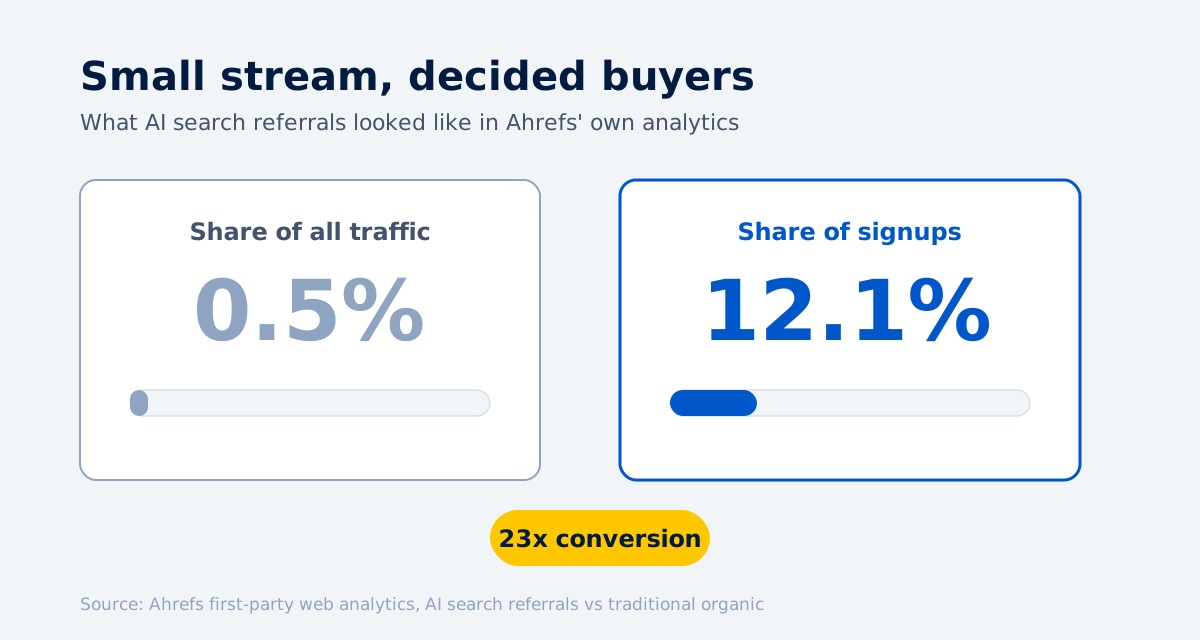
Seer Interactive saw the same shape in client data, with ChatGPT referrals converting at 15.9% against 1.76% for Google organic.
Buyers finish their comparison inside the conversation, then click through ready to act. That is why presence in the answer is worth pipeline money even at low volumes. It is a big part of how AI is changing top of funnel demand generation.
Pricing the gap
In our content revenue audits, we treat AI-search invisibility as a priced leakage line: the share of category questions where the brand is absent from the answer, run through the same funnel math as any other gap.
We show the assumptions so a buyer can argue with the inputs. Once invisibility carries a dollar figure, earned coverage stops being a faith purchase.
The capability is scarce on both sides of the fence. Answer-engine optimisation shows up in fewer than 1 in 50 marketing job postings, while 67% of PR professionals expect LLM visibility to become a core PR metric.
The profession sees where its own scoreboard is heading. Very few teams can run it yet.
When is a PR agency still the right call?
Some jobs belong to the discipline, and a demand generation agency should tell you so. Hire a PR agency directly when the work is:
- Crisis and reputation repair, where speed, media relationships, and message control decide outcomes
- Executive and financial communications, funding announcements, M&A, leadership changes
- Regulated-industry comms, where a wrong sentence carries legal weight
- Tier-1 media access, when a launch genuinely needs national press and the relationships that unlock it
Each of these is a communications outcome, judged on its own terms.
What should you check before hiring either?
The failure stories follow one script: a persuasive pitch, then juniors running the account, then a quarter of activity nobody can connect to a number.
Marketers hunting for agencies describe project leads who turn out to be rebranded sales managers, and engagements sold as strategy that arrive as ads.
Before signing with either type, get answers to five questions:
- Who does the work day to day? Names and seniority, not the pitch team.
- What number are you accountable for? A demand gen agency should say pipeline; a PR agency should name coverage and visibility outcomes. Get it in writing.
- Which channel is genuinely your strongest? Most agencies excel at one or two things; you want the one whose strength matches your constraint.
- How do you treat earned media and AI visibility? A modern demand gen agency should talk citations and coverage breadth; a modern PR agency should measure beyond placements.
- What happens if the first quarter underdelivers? The diagnostic process matters more than the promise.
The scoreboard question deserves the most weight. Clients end agency relationships over delivery and value far more often than agencies believe, so agree on how success gets judged before the first invoice. Our own checklist for that sits in how to choose a demand generation agency.
In the AI-search era, digital PR has become one of the disciplines a serious demand generation program can no longer skip. Hire accordingly.
Absent from the answers your buyers read?
We price AI-search invisibility as a revenue number, assumptions shown, in our content revenue audit. See what the gap is worth before you hire either agency.
Frequently Asked Questions
About the Author

Founder & CEO, Content RevOps
Stefan Kalpachev is the founder and CEO of Content RevOps, where he helps B2B SaaS companies transform their content into predictable pipeline. With a background in content marketing and revenue operations, Stefan has developed a unique methodology that bridges the gap between content creation and revenue generation.
Connect on LinkedIn