Account-based marketing for life sciences
Account-based marketing appears in under 1% of life science marketing hiring. Want to know what your accounts are actually seeing?
Book a CallMost life science companies already run an account-based go-to-market motion. They keep a named list of hospital systems, sponsors, or labs that matter. They staff key account managers and field teams against it. They plan the year around three or four congresses where those accounts show up.
Part of The Complete Guide to B2B Demand Generation Strategy.
What almost none of them have built is the marketing half: the demand generation layer that keeps reaching those accounts when nobody from sales is in the building.
In our analysis of life science marketing job postings for the 2026 State of Content Marketing for Life Sciences, account-based marketing appeared as a named discipline in under 1% of them. The work exists. The function that would scale it does not. It is one instance of a wider pattern in what the sector commits to for 2026, where omnichannel coordination sits at about 13% of postings and still gets called the year's defining trend. What that coordination costs to run, and when a company is better off keeping its channels separate, is worked through in multichannel and omnichannel marketing in life sciences.
The usual advice starts by telling you to define your ideal account profile. Life sciences is the one industry that already has that. Positioning and ideal-customer clarity scores 3.66 out of 4 in our life sciences data, the highest maturity score in that dataset, and about 88% of companies show high ICP clarity. The science forces specificity. You know exactly who you sell to, which is the part most teams elsewhere spend a year getting to.
The problem is coverage. Nothing except a rep ever reaches those accounts, and a rep can only be in one building at a time.
What is account-based marketing in life sciences?
Account-based marketing treats a named organization as a market in its own right. Instead of running campaigns at a segment and waiting to see which companies respond, you decide in advance which specific organizations you need to win, then build marketing designed to reach the people inside them. If you want the head-to-head, we have written up how ABM and demand generation actually differ in practice.
The term is not vague or new. ITSMA coined it in 2003 and still defines it as a strategic approach to designing and executing highly targeted and personalized marketing programs to drive business growth and impact with specific, named accounts. One of its stated core principles is worth keeping: if it is only about lead generation, it is not ABM. That line matters more than it looks, because the difference between generating demand and harvesting leads is exactly what most programs collapse.
The three types, and how many accounts each holds
ITSMA's framework splits the discipline three ways, and it attaches account counts to each. Those counts matter more than the labels, because they tell you what you can actually staff.
Type | Also called | Typical scope |
One-to-one | Strategic ABM | 5 to 50 top strategic accounts |
One-to-few | ABM lite | 5 to 15 accounts per cluster |
One-to-many | Programmatic ABM | Hundreds or more named accounts |
Those figures come from the annual benchmark study that Momentum ITSMA, now part of Accenture Song, runs jointly with the ABM Leadership Alliance. Worth knowing who sits in that Alliance: its members are ABM software vendors, including Demandbase, LeanData, PathFactory, and ON24. Companies that sell the tooling co-sponsor the research. The definitions remain the best-sourced ones available, and we use them throughout.
Nobody has benchmarked this in life sciences
A bigger caveat sits on that research, and it shapes everything below.
Every edition of that benchmark draws its sample from marketers at B2B technology and business services companies. Not life sciences. Somebody gathered the discipline's canonical evidence base somewhere else entirely.
So the frameworks transfer and the benchmarks do not. Useful reasoning in this industry starts from how life science organizations actually work rather than from what worked at a software company. That is the same reason life science marketing reads differently from generic B2B marketing at almost every step.
How many people sit on a buying committee
Confident numbers circulate here. Six to ten, eight to twelve, five to sixteen. They contradict each other and none of them cites a study.
We could not find a credible, life-science-specific figure, and we would rather say so than pick one.
The academic literature that measured buying-group size directly is older and cross-industry. A 1992 study in Industrial Marketing Management sent 440 questionnaires to purchasing agents across 18 firms, drew 231 usable responses, and found a grand mean of roughly four people, ranging from three to five depending on the purchase situation.
One finding inside it beats the number itself. Group size varied by phase, and the supplier-selection phase involved a smaller group than the identification-of-need phase. The room reaches its widest while the organization still works out what it needs, then narrows by the time anyone chooses between vendors.
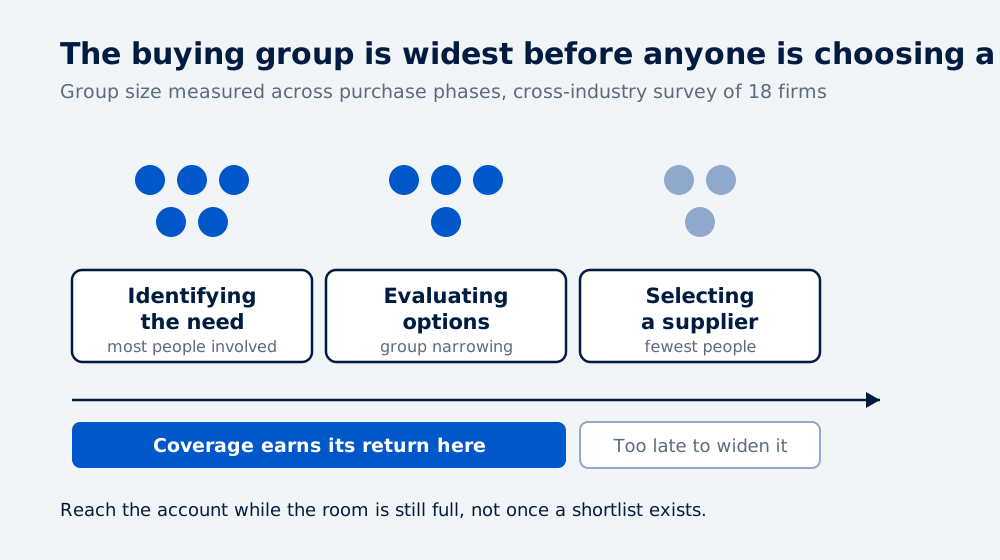
Coverage therefore pays earliest, while the most people are still forming an opinion, rather than at the decision stage when the group has already contracted. It is the same asymmetry that makes the top of the demand generation funnel worth more attention than the bottom, and the reason mapping the funnel before building anything is not an optional step.
How is ABM different from the key account management you already run?
Key account management is what a rep does inside an account. Account-based marketing is what reaches the people that rep never meets, and it keeps running in the weeks nobody is in the building.
That distinction is the entire gap in this industry.
The work is funded and the marketing layer is not
Set the hiring data side by side and the shape becomes clear.
- Field marketing appears in about 9%, roughly 1 in 11, of pharma marketing job posts. Equipping the field is a named, budgeted discipline with its own career path.
- Relationship work appears even more often. Around 46% of life science marketing postings ask for KOL, HCP, or patient engagement.
- Account-based marketing appears in under 1%.
Companies hire people to support named accounts and manage named relationships. They hire nobody to run marketing programs against those same accounts. That is a team structure problem before it is a strategy problem.
The websites show the consequence. Only about 3%, roughly 1 in 35, of pharma and biotech sites run an industry or audience segment page. A segment page is the simplest account-shaped asset there is, and thirty-four out of thirty-five companies have not built one.
Sales owning the list is normal, and it explains the failure mode
In the October 2025 account-based marketing benchmark from Demand Gen Report, seven out of ten respondents said sales teams drive the data and the plan behind the target account list.
Practitioners describe what follows. One put it this way in a B2B marketing forum: "ABM is a trap! It should be account based sales. What will happen is you'll agree to do ABM and then realize it's mainly a sales motion with marketing support."
That is one person's view rather than evidence, and it describes the failure mode accurately. Marketing signs up to a program sales already owns, contributes some collateral, and never builds the thing that would change the coverage math. It sits close to the top of the demand generation mistakes that quietly cost pipeline.
We saw the pre-ABM version of this at Westlab, a life science manufacturer selling to labs. Growth ran on manual research, cold calling, conferences, and lab visits. Every one of those is account work. All of it depended on a person doing it one account at a time, which made the motion expensive and capped it at the size of the team.
How do you define an account when the buyer is a hospital system or a large pharma?
An account is the organization that can actually sign, and in life sciences that is often not the organization in your CRM. Get this wrong and everything built on top of it, the tiering, the coverage plan, and the measurement, points at something that cannot buy.
In B2B software an account behaves like one unit. Here it does not.
With a health system, the contract draws the boundary for you
This case rewards understanding properly, because the purchasing contracts settle the answer rather than leaving it to interpretation.
Medical supply contracts usually tier on market share instead of volume, and vendors define those tiers at either the individual facility level or the integrated delivery network level. Research published in Production and Operations Management in 2025 states the constraint precisely: to qualify for an IDN-level share, all facilities within the IDN must forgo facility-level tiers.
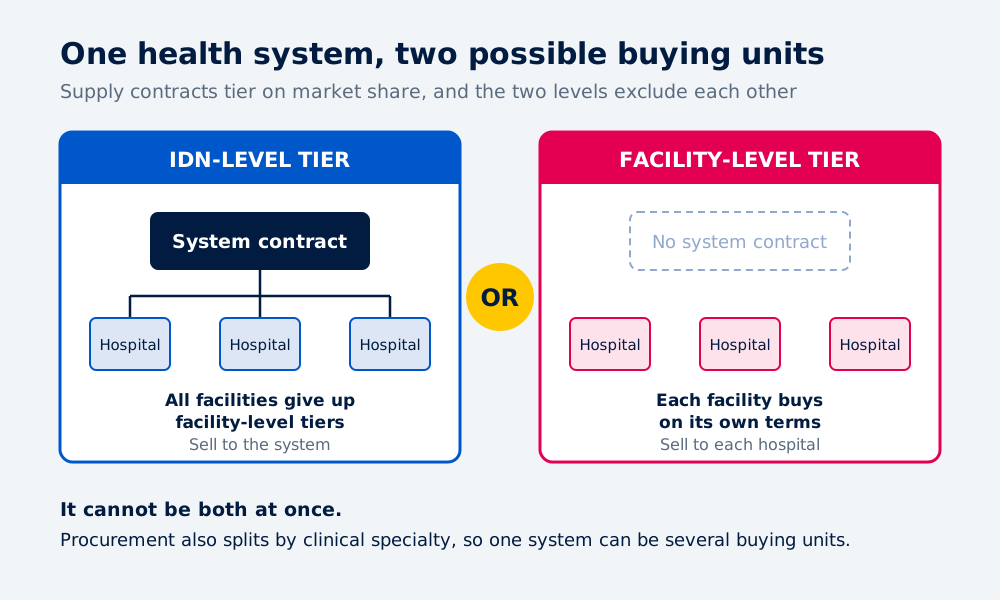
The two exclude each other. Either the system is the buying unit or the member hospital is, and it cannot be both at once.
The same research notes two more things that change how you target:
- Procurement runs by product category aligned to a clinical specialty, such as cardiology, oncology, or orthopedics, rather than as one undifferentiated relationship.
- A single vendor in one clinical category commonly offers more than a dozen tiers.
So one hospital system can be several buying units at once, split by specialty, and the level any given decision sits at depends on a contract structure you can ask about directly. That research also notes that hospitals already inside a group purchasing agreement sometimes contract directly with suppliers anyway, so the central agreement does not always decide it. If you sell into these buildings, the same structural reading drives medical device marketing as a whole.
With academic research, a dollar threshold decides it
In universities and academic medical centers, the line between "the principal investigator is the buyer" and "the institution is the buyer" is a published number.
Federal grant purchases follow the Uniform Guidance at 2 CFR 200.320. Below the micro-purchase threshold, a purchase needs no competitive quotes at all. Above it, the buyer must obtain quotes. Above the simplified acquisition threshold, formal competitive solicitation applies. Following the inflation adjustment effective 1 October 2025, the federal defaults are $15,000 and $350,000, raised from $10,000 and $250,000.
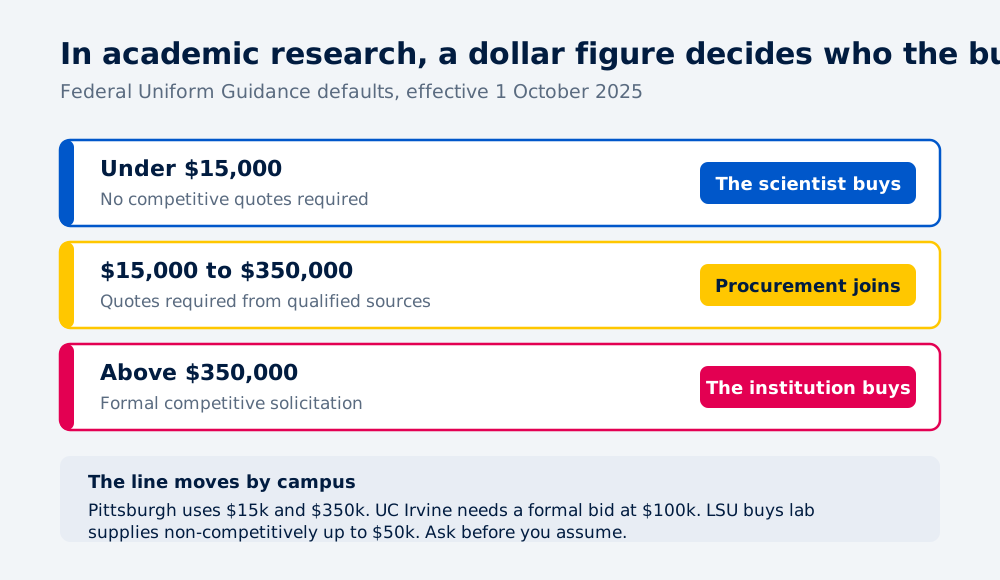
Institutions then set their own line within those rules, so it moves by campus:
- The University of Pittsburgh uses $15,000 and $350,000, and notes its RFP process above the top threshold takes 8 to 12 weeks.
- UC Irvine requires three informal quotes above $15,000 and a formal bid at $100,000.
- Louisiana's higher education code carries an explicit research carve-out, letting LSU buy scientific and laboratory supplies, equipment, and services non-competitively up to $50,000 per transaction.
For a consumables or small-instrument business, that threshold is your entire account definition. Below it you sell to a scientist. Above it you sell to a procurement office on a timeline measured in weeks, and the content that wins differs in both cases.
With large pharma, establish it rather than assume it
People frequently describe large pharmaceutical companies as therapeutic-area silos with independent budgets. We did not find evidence solid enough to state that as fact, so we will not.
Treat it as the first question to answer per account instead. Ask which entity holds the budget, whether a franchise can select a vendor without a corporate agreement, and whether an existing master services agreement already sets the terms. The answer varies by company and by category, and guessing it wrong wastes a year. It is the question that should sit at the front of any pharma marketing strategy, and the same discipline applies when the counterparty is a CDMO or CRO.
How do you choose which accounts to target?
Start from where you can prove you win, not from who you would most like to sell to. In life sciences the pool of buyable organizations is small enough that your dream list and your competitors' dream list are the same document.
That is arithmetic rather than a figure of speech.
The account universe is smaller than most teams assume
Count the organizations that can actually buy, and the numbers land in the hundreds rather than the tens of thousands.
- Health systems. The AHRQ Compendium of U.S. Health Systems identified 639 health systems in 2023. A 2023 review in JAMA identified 580 and found they accounted for 84% of general acute care hospital beds and 40% of physicians.
- Consolidation is still running. The share of US community hospitals inside systems rose from 10% in 1970 to 67% in 2019, leaving 3,436 hospitals inside 368 systems.
- Academic medicine. The AAMC represents 163 accredited US medical schools and nearly 500 academic health systems and teaching hospitals.
- Pharma R&D budgets. Across 268 drug developers, the top 20 firms accounted for 74.4% of R&D spending and 80.8% of total patient-months in 2019. Hardman & Co, analyzing 46 companies, puts the top 20 at 85.6% of total R&D spend in 2025, averaging $8.62 billion each.
- Clinical research services. The Association of Clinical Research Professionals reports the top 10 CROs generating roughly $34 billion in 2022, an estimated 69% of global spend on contract clinical services.
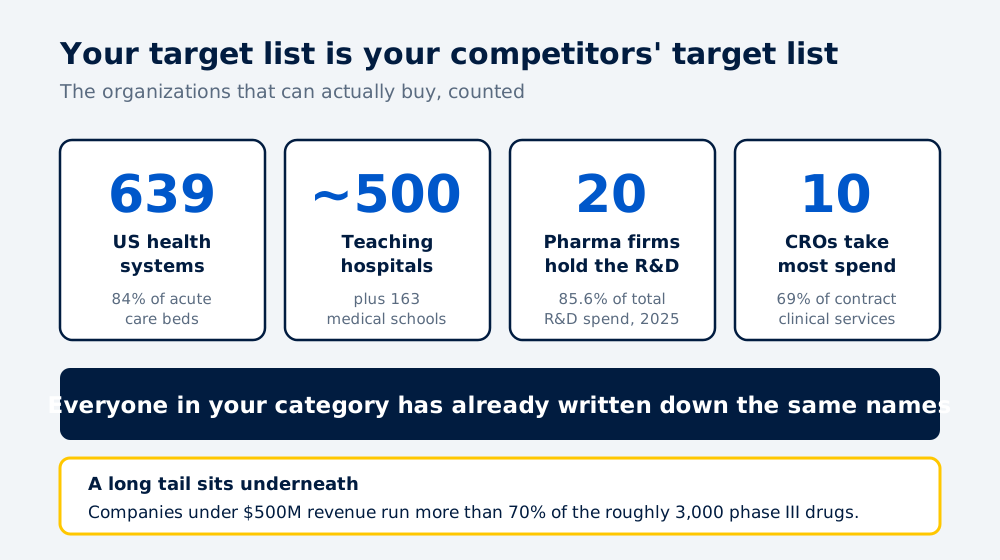
When 20 companies hold most of the R&D money and 10 CROs hold most of the outsourced spend, every competitor in your category has already written down the same names.
One caveat keeps this honest. A long tail sits underneath the concentration. The Congressional Budget Office found that small companies with revenues under $500 million account for more than 70% of the roughly 3,000 drugs in phase III trials. Concentration at the top does not mean the market is only the top, and which end you sell into changes whether an account program suits you at all. For an emerging developer at that end of the curve, biotech marketing answers a different question than an account program does.
Selection is a competitive question rather than a scoring exercise
Since the list is common property, the differentiator lies in where you can demonstrate an advantage a competitor cannot match.
A practitioner in a B2B marketing community put the test well: "Not a list of dream accounts but a list of accounts where you actually have a strong provable competitive advantage against competitors to win said account. Because remember whoever is on your account list is the same for almost all your competitors."
When we build an account list, we pressure-test it against actual won and lost deals rather than against instinct. Which accounts closed, which stalled, and what was true about the ones that moved fastest. We also make the one-to-one versus one-to-many call before anything gets briefed, because that decision sets the cost of everything downstream. It is the same sequencing that a life science marketing strategy lives or dies on.
Four questions separate a real list from a wish list:
- Where have we won a comparable account, and what specifically did we prove there?
- Where does an incumbent relationship make us the second vendor no matter what we publish?
- Which accounts have a documented problem we can evidence against, rather than a general fit?
- Where does our field team already have a relationship worth amplifying instead of starting cold?
How many accounts should you target?
Fewer than you want to. The sourced ranges are 5 to 50 for one-to-one, 5 to 15 per cluster for one-to-few, and hundreds or more for programmatic, using the same vendor-co-sponsored ITSMA framework described earlier.
Most programs go past that, and it is the most common way they fail.
Over-scoping is the documented failure mode
The advisory firm Forrester surveyed 155 B2B marketing professionals across North America, Europe, and Asia Pacific for its 2022 State of ABM research. It found that 26% were only loosely practising ABM, if at all, and labelled those programs "non-ABM initiatives".
The diagnostic detail matters more than the headline. Forrester describes those programs as attempting to cover an unrealistically high number of accounts, despite not having the budget, human resources, or technology to do so.
A list of 300 accounts with resourcing for 20 leaves 280 accounts receiving nothing. That is a budget allocation decision disguised as an ambition problem.
In life sciences, review capacity sets the ceiling
One constraint here belongs to this industry specifically, and budget is not it.
Bespoke, account-specific assets define one-to-one ABM. Medical, legal, and regulatory review exists to clear a fixed library of approved material. Those two pull directly against each other, so the binding question becomes what your reviewers can clear rather than what you can afford to make.
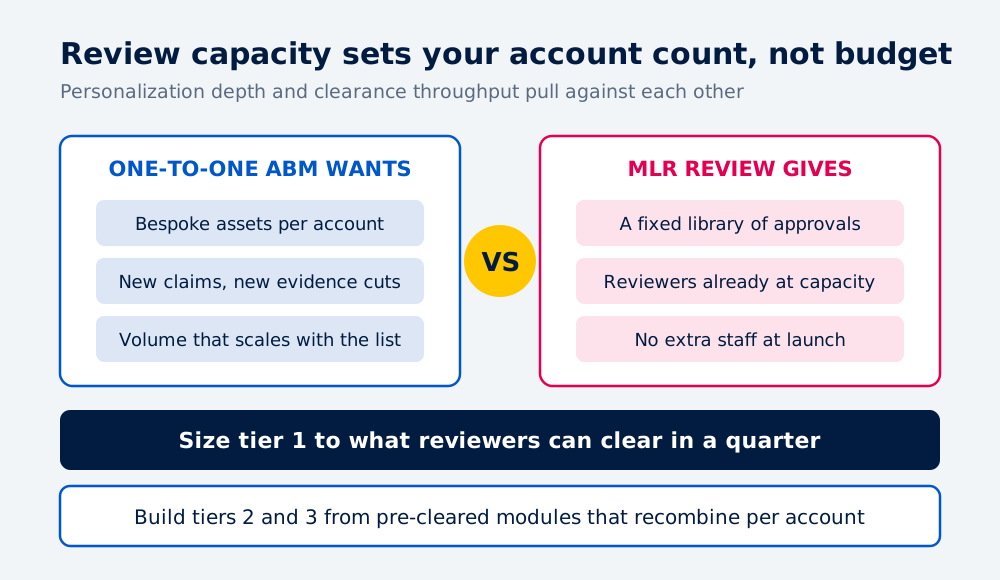
That capacity does not flex. In a survey of medical affairs professionals published by the Regulatory Affairs Professionals Society, 69% reported that resources supporting promotional material review are not added during a launch. The same survey found roughly a third of non-dedicated reviewers already spending 25% or more of each working week on material review, and nearly two thirds spending 15% or more. That study went to 556 US pharmaceutical and medical device companies and drew a 7.6% response rate, so the sample is small at 42 respondents. Read it as directional evidence of a ceiling rather than a precise measurement.
Compliance also grows as a job requirement with company size, appearing in 11% of marketing roles at the smallest life science firms and 49% at the largest.
Two practical consequences follow:
- Set the tier 1 count from clearance capacity. Work out how many bespoke assets your reviewers can absorb in a quarter alongside their existing load, then size the top tier to that number.
- Build tiers 2 and 3 from pre-cleared modules. Approved claims, approved data figures, and approved evidence summaries that recombine per account without re-entering full review.
That modular approach is not an ABM invention. It is how content marketing for life sciences survives review at any scale, and how core assets are meant to be built in the first place.
Do you need an ABM platform to get started?
No, and in most life science companies the platform would have nothing to run on.
Intent-data and account-advertising tools work by resolving signals to accounts in your CRM. That assumes a populated CRM exists. In this industry it frequently does not.
The foundation is missing more often than the software
Our analysis of pharma and biotech websites found:
- Under 9%, fewer than 1 in 12, run a detectable CRM.
- Even at $500 million or more in revenue, CRM adoption reaches only about 29%, roughly 3 in 10.
- Under 10%, fewer than 1 in 10, run marketing automation.
Seven in ten companies at half a billion dollars in revenue have no system for an intent signal to resolve into. Buying the signal layer first means paying for data you cannot action. The cheaper first move is the one most of these companies skip, which is building and using the owned email list those accounts already opted into.
Even the vendors report that teams run on spreadsheets
The most interesting evidence here comes from a company with every reason to say otherwise. 6sense sells ABM software, and its 2024 Account-Based Marketing Benchmark reports that the top tools among account-based teams are spreadsheets, CRM systems, and sales engagement platforms, each used by roughly half, with 53% of ABM teams using spreadsheets.
The same research found CRM data is the least-used source for contact identification, with neither CRM nor customer data platforms used by more than 30% of marketers to identify contacts.
An ABM platform vendor reporting that the most common ABM tool is a spreadsheet deserves attention. It matches what we found when we measured the stack directly: the demand gen tools B2B companies actually use are far plainer than the category's marketing suggests.
What actually breaks programs
BCG studied what it calls account-based engagement, its own broader term covering marketing, sales, and service working against named accounts. It found more than 50% of the programs it identified failed initially. The overwhelming stated reason was lack of sales support and alignment with marketing. Data issues and poor measurement also affected 50% of the failed strategic programs, and lack of clarity around strategy affected almost 60% of the failed scaled programs.
BCG is a consultancy with a commercial interest in the answer, so weigh it accordingly. Two of its findings survive that discount, because they cut against the tooling story it could have told. Companies fail by treating the work as a set of tools rather than a strategy, and by scaling to too many accounts instead of running controlled pilots.
The recovery rate encourages. BCG reports 67% of strategic programs and 75% of scaled programs eventually succeeding once companies regrouped and addressed those problems.
The order that works
Practitioners reach the same conclusion from experience. One summarized starting out as: rule one, do not buy a platform. Another described joining an ABM program as "an expensive ride just with the tech stack alone."
Build in this order:
- A named account list both sales and marketing agree on.
- Content coverage per influencing role, so every function in the buying group has something addressed to its actual concern.
- A record of what each account has seen, even if that record starts in a spreadsheet.
- Paid signals and account advertising, only once the first three work.
That sequence is the account-shaped version of building a demand generation engine from scratch, where the same rule holds: the asset comes before the automation.
With Westlab we shipped content as go-to-market collateral from day one, activated the CRM contacts that already existed, and used search, email, and targeted outreach as discovery surfaces rather than waiting for a platform. We also enriched each lead before it reached a rep, which turned a bare contact into context the rep could act on.
How do you measure account-based marketing in a long sales cycle?
Measure how much of each account you have reached, and whether the account is moving. Lead counts tell you almost nothing when the target universe is 40 organizations and the cycle runs for a year.
Most teams know this and still report the old numbers.
The metrics did not change, even where the strategy did
6sense's benchmark, from the same ABM software vendor described above, found account-based teams just as likely as non-account-based organizations to measure lead-centric metrics such as MQLs and leads produced, and to place comparable importance on them. Measurement practice lags strategy adoption, which is the recurring theme in what demand generation metrics are worth tracking at all.
The industry keeps naming this as its hardest problem. The 2022 edition of the Momentum ITSMA benchmark, run with the vendor-backed ABM Leadership Alliance, named tracking and measuring results the top ABM challenge, ahead of customizing content and educating sales, and found fewer than 20% of programs fully embedded in the business. Demand Gen Report's October 2025 survey found proving ROI and attribution the single biggest challenge at 47%, ahead of sales and marketing alignment at 43%. In this sector that argument has a specific shape, which we covered in how life science companies justify and measure marketing spend.
A floor also limits what you can measure at all. Only about 30%, roughly 3 in 10, of pharma sites run even a detectable analytics platform. Sophisticated account scoring is not the first problem to solve when basic instrumentation is missing.
What to track instead
Four measures work early, before any specialist tooling exists:
- Stakeholder breadth. How many distinct roles inside the account have engaged with anything, ever.
- Coverage gaps. Which influencing functions have received nothing addressed to their concern.
- Account progression. Whether an account moved between stages this quarter, regardless of lead volume.
- Influenced pipeline. The value of opportunities inside the named list that marketing touched.
Breadth deserves the emphasis, for the reason the buying-group research gives. The group is widest while the organization still defines what it needs, so coverage is a leading indicator and reading it early is the point. By the time a shortlist exists, breadth has stopped being something you can influence.
Engagement signals also improve the handover. At Westlab, readiness signals from the resource hub told sales which leads were genuinely serious rather than browsing, which changed who got called first, the same mechanic as a working lead handover process. Within three months the program had influenced $120,000 in quoted pipeline, an account-level number rather than a traffic number, and that distinction is the one worth defending internally.
The clearest description of what the marketing layer does: it took over the pre-sales trust-building that reps used to do one lab at a time, and cycles shortened as a result. That is coverage doing its job. Other B2B demand generation case studies show the same pattern outside this sector.
When is account-based marketing not worth it?
When the deal size will not carry the program, when your addressable universe is large enough that segment targeting is cheaper, when the field already covers every account and the gap sits elsewhere, or when the real problem is that nobody has heard of you.
That last one is the most common misdiagnosis.
The four disqualifiers
Your deal size does not carry it. Practitioners disagree sharply on where the floor sits. One argues against one-to-few or one-to-one below $500,000 in contract value; another runs it happily above $20,000. Neither number is sourced, and the disagreement is the honest answer. Bespoke account programs cost real headcount, so the arithmetic has to work at your average deal size before the strategy does.
Your universe is too large. If thousands of organizations can buy from you, segment-level targeting reaches more of them per dollar. Account programs earn their cost when the list is short and each name is worth a lot. With a universe that size the leverage usually sits in inbound marketing for life sciences instead, where the buyers who are already searching arrive on their own and the work is routing them to a decision.
The field already covers it. If ten reps cover forty accounts and every stakeholder already knows you, the constraint sits somewhere else. Find the actual gap before building a program against the wrong one.
It is an awareness problem, not a coverage problem. A pharma marketer asking a marketing community how to start with ABM described the goal as getting the word out about what the company does. The sharpest reply pushed back on the premise: if that is the goal, why take an account-based approach, and would a brand awareness play solve it instead? That is the right challenge, and it is the whole substance of demand generation versus brand awareness. Account programs concentrate effort on organizations that already know they have the problem. They make poor tools for creating that awareness in the first place.
What the answer depends on most
Company size changes what ABM is even for, which is the cleanest fit test available.
In the 2023 Momentum ITSMA benchmark, run with the vendor-backed ABM Leadership Alliance, companies under $100 million in revenue rated selling to new accounts 4.6 out of 5 as an objective, and growing business with existing accounts 3.6. Companies at $1 billion or more rated the same two objectives 3.3 and 4.5. The smaller group also rated "we position ABM primarily as a smarter way of doing lead generation" at 4.0, against 3.1 for the largest.
The same activity serves opposite purposes at different scales. Smaller companies use it to win accounts. Large ones use it to grow the ones they have.
If you sit at the larger end, the expansion case deserves particular attention. Only about 3% of pharma content assets sit in the post-purchase stage, which leaves adherence, expansion, and customer success almost entirely unbuilt. An account program aimed at customers you already have will usually find returns faster than one chasing new logos, because the relationships exist and nobody is currently serving them.
Who inside your target accounts has heard from you this year?
Get a Content RevOps audit, your account coverage, per-role content gaps, and AI-search visibility benchmarked against the life sciences 2026 data, with every gap priced in numbers your CFO can argue with.
Frequently Asked Questions
About the Author

Founder & CEO, Content RevOps
Stefan Kalpachev is the founder and CEO of Content RevOps, where he helps B2B SaaS companies transform their content into predictable pipeline. With a background in content marketing and revenue operations, Stefan has developed a unique methodology that bridges the gap between content creation and revenue generation.
Connect on LinkedInRelated Articles
What Does a Demand Generation Content Marketing Agency Do?
Sep 23, 2026
Demand Generation Agency Total Cost of Ownership Estimated for 2026
Sep 22, 2026
Should you run paid ads in life sciences? A buyer's guide to PPC
Aug 24, 2026