Multichannel and omnichannel marketing in life sciences, and which one to run
Only 14.5% of life science companies with an active content presence adapt anything to a returning visitor. Want to know what yours does?
Book a CallMost explanations of multichannel and omnichannel marketing in life sciences describe what the buyer experiences. Channels that run separately, or channels that join up. That is accurate, and it is only half the picture. It tells you nothing about what each one costs you to run, which is the part that decides whether you can actually do it, and it is the part our content marketing work starts from.
Part of Content marketing for life sciences, the complete guide.
This page answers the difference, then the question underneath it. Which of the two should a life science company commit to, given what its content operation can sustain.
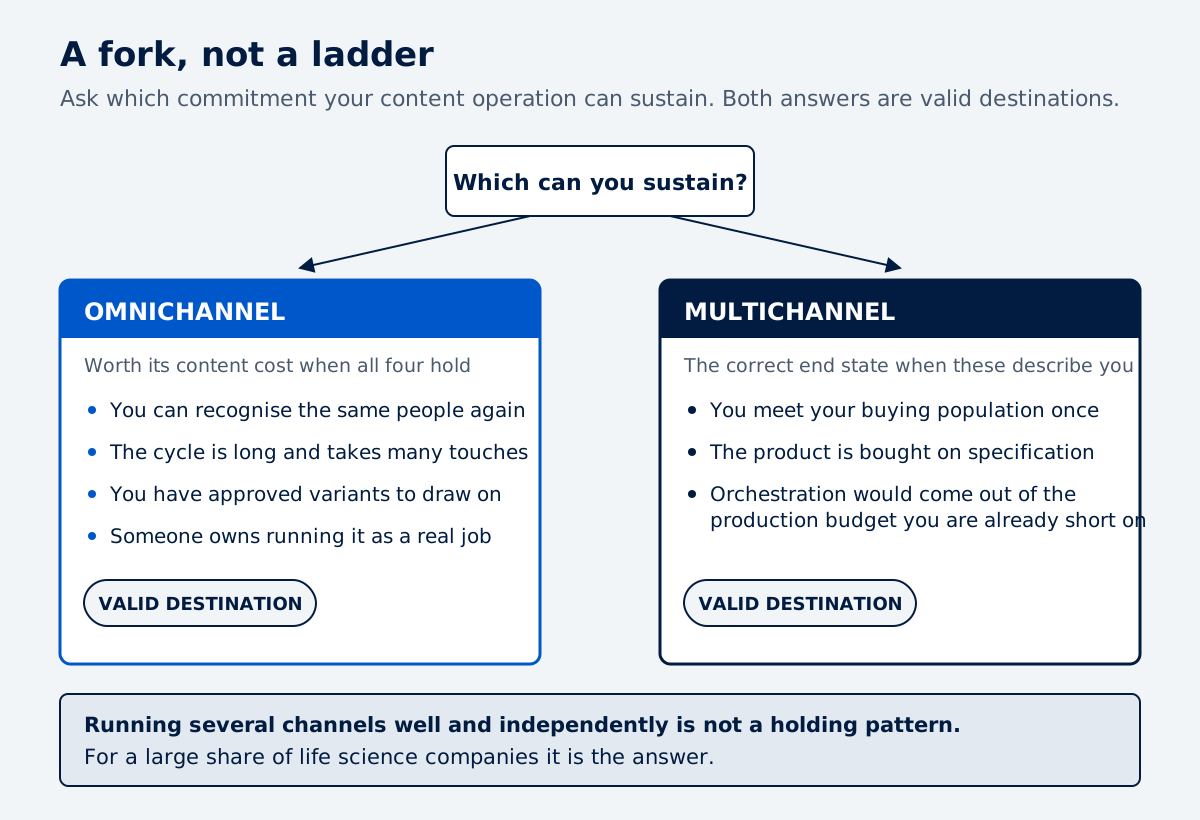
These are not two rungs of a ladder. They are a fork, and for a large share of life science companies the multichannel branch is the right place to stay.
What is the difference between multichannel and omnichannel marketing in life sciences?
In life sciences, multichannel means running several channels that work independently. Omnichannel means running channels that share data, so a scientist, clinician, or procurement lead moves from one to the next without starting over. If the vocabulary itself is what you are trying to pin down, what life science marketing actually covers sets the wider frame.
Neither term originated in this sector, and the academic definitions are more precise than the working ones.
Neslin and colleagues defined multichannel customer management in 2006 as "the design, deployment, coordination, and evaluation of channels through which firms and customers interact, with the goal of enhancing customer value through effective customer acquisition, retention, and development." A channel, in the same tradition, is "a customer contact point or a medium through which the company and the customer interact."
Verhoef, Kannan, and Inman defined the other half in 2015, in the Journal of Retailing. Omni-channel management is "the synergetic management of the numerous available channels and customer touchpoints, in such a way that the customer experience across channels and the performance over channels is optimized."
An example of each in a life science company
Multichannel. You send a product email to your whole list, publish the same application note on your website, and take the same story to your booth at a scientific congress. Three channels, three separate efforts, no connection between them. Each one works or fails on its own. Those are the same channels covered in our digital marketing for life sciences work.
Omnichannel. A scientist downloads a protocol, and the next email they get is about that protocol rather than your newsletter. They return to the site and see the follow-up resource instead of the same homepage banner. Their sales contact opens the conversation already knowing which method they were reading about.
The second one is harder, and what makes it harder is what it demands of your content.
Integrated marketing is what life sciences usually calls it
In life sciences and healthcare the term the sector uses for this is integrated marketing. It describes the same commitment, which is a single coordinated message across channels rather than a set of independent campaigns.
Treat the two words as interchangeable. Nothing in this page changes depending on which one your organisation uses.
Where the term came from, and why it matters in life sciences
Omnichannel is a retail concept, and a fairly recent one. It entered the management literature in December 2011, when Darrell Rigby, a partner at Bain and Company, wrote in Harvard Business Review that digital retailing "is quickly morphing into something so different that it requires a new name: omnichannel retailing." He described it as a mashup of digital and physical experiences.
Four years later, Beck and Rygl built a formal taxonomy of the field, and their footnote on the vocabulary is unusually blunt. The prefixes "cross" or "omni" are "buzzwords" whose use is "largely due to business experts that report on particular integrated retailing solutions or future retail solutions."
Their literature search found the same thing quantitatively. The combined terms "omni", "channel", and "retail" "yielded 151 articles, but only one academic article."
The word arrived from consultants and solution vendors, and the research caught up afterwards.
Beck and Rygl were also candid about the destination. A seamless purchase decision process across multiple channels, they wrote, "remains a distant future goal rather than current reality, as retailers face constraints such as channel integration difficulties, or challenges such as decentralized organization structures."
They were describing shops. The first constraint they named, integration difficulty, is the one this page returns to below, where the identity, CRM, and automation layer turns out to be missing across most of this sector.
A definition you can test against your own channels
Beck and Rygl's taxonomy sorts channel strategies on two axes. Whether channel interaction is triggered by the customer or controlled by the company, and how many channels are in scope.
The second axis decides the cost. Omnichannel, in their taxonomy, is reserved for full interaction and integration across all channels widespread at the time.
So omnichannel is not a posture you adopt on your best channel. It is a commitment across every channel you are currently in.
What does omnichannel require in life sciences that multichannel does not?
In life sciences it requires a different kind of content, not just a different kind of software.
Multichannel consumes content per channel. One asset goes to one destination. Production scales in a straight line with the number of channels you run.
Omnichannel consumes content per person. For a system to show someone the right thing, the right thing has to already exist, in enough variants that one of them fits. That means content built as modules and approved before it is needed, rather than approved each time it is used, which is the approach our pharma marketing strategy work sets out.
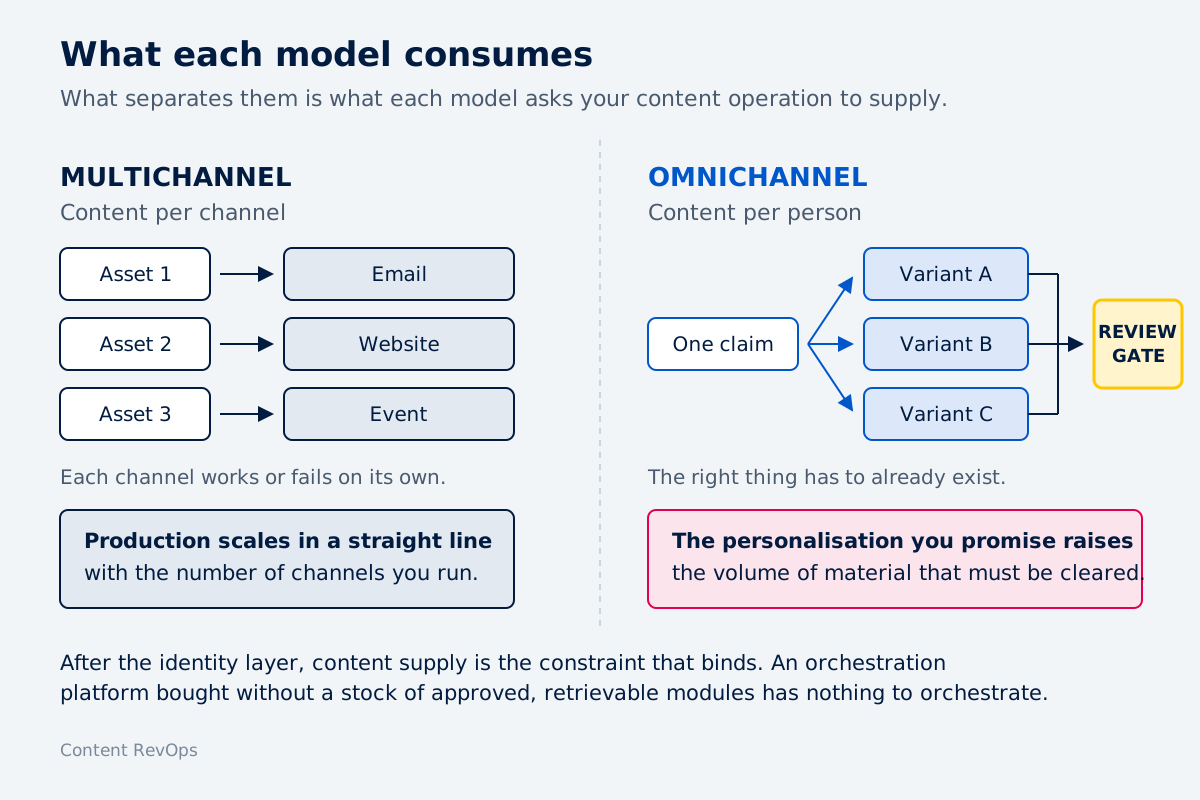
In life sciences, every one of those variants clears medical, legal, and regulatory review. So the personalisation you promise raises the volume of material that has to be cleared before any of it can ship.
What the review constraint actually is in life sciences
Two things are true about review capacity in this sector at once, and they are easy to confuse.
Headcount does not flex on the timescale of a launch, so the number of bespoke assets you can clear is effectively fixed in a given quarter. We work that constraint through in our piece on account-based marketing for life sciences.
Cycle time is different, and it varies a great deal with tooling and process. Our life science email marketing work covers why the same regulatory obligation produces very different turnaround times at different companies, and review capacity sits among the biggest life sciences marketing challenges we see repeatedly.
The ceiling is real, and it is not immovable.
Modular content is the life sciences answer, and it is young
The Medical Affairs Professional Society published a white paper on modular content in 2023, written by a mixed group of pharma and medical communications agency authors. It defines modular content as "pre-approved blocks of content" assembled into finished assets, which "reduces the need for numerous, in-depth legal and regulatory reviews."
The prerequisites it names are unglamorous. A digital asset management system, a central repository, and "a standard approach, a clear taxonomy, and standard metadata fields" so that modules can be found again.
Retrievability is a named requirement in the paper, not an implementation detail. A module nobody can locate is not reusable, it is just an old file.
The same paper is candid about how early the practice is. It advises teams to build the internal business case on "hypothetical models in advance of having a use case or pilot study data", and notes that "there is currently no integrated development platform that meets the broad Medical Affairs need for creating modular content", while adding that "the aspiration exists and is gathering momentum" as vendors move to fill the gap.
Every published figure we could find for what modular content saves comes from the software vendors selling the tooling, or from their customer stories. We found no independent measurement.
What this looks like in our life sciences data
Among life science companies with an active content presence, about 58% match a call to action to the topic of the page. Every figure here comes from that active cohort, just under half of the companies in the study at about 48%, so read them as describing the companies already publishing rather than the sector as a whole.
About 19.3% of that cohort change the ask depending on where the reader sits in their buying process.
Only 14.5% of it adapt what they show to a returning visitor.
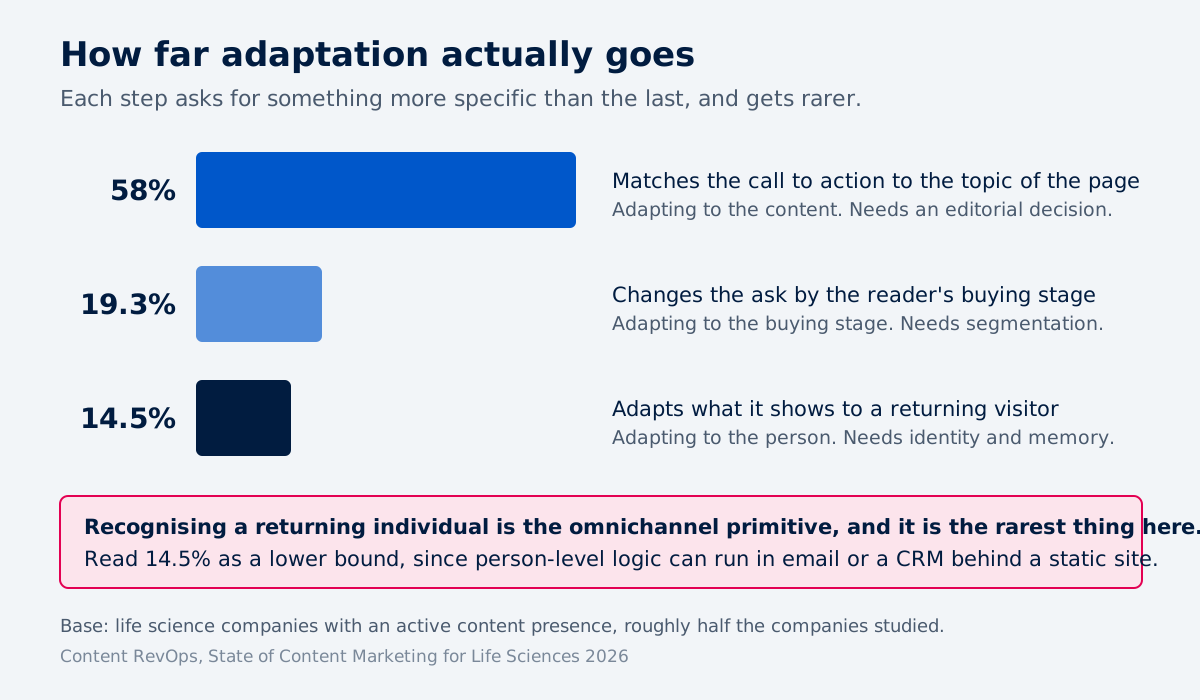
Each step asks for something more specific than the last. Matching a page needs an editorial decision. Matching a buying stage needs segmentation. Recognising a returning individual needs identity, memory, and something ready to show them.
That last one is the omnichannel primitive, on the single channel we can observe directly from outside. Treat 14.5% as a lower bound, because a company could run person-level logic in email or a CRM behind a website that looks static to us. The wider set of numbers sits in our life science marketing statistics for 2026.
The prerequisite most life science companies have not met
An identity layer, a CRM, and marketing automation underneath are genuine prerequisites, and most of the sector does not have them. Our content marketing for pharmaceutical companies work covers that gap and what it costs. For pharma specifically, we set out which of those layers to build first, and in what order.
Content supply is the constraint that binds after that one. An orchestration platform bought without a stock of approved, retrievable modules has nothing to orchestrate.
Which one should a life science company be doing?
Ask which commitment your content operation can sustain, not whether you are ready to graduate. Both answers are respectable in life sciences, and one is more common than it is given credit for. This is one of the decisions our life science marketing strategy work forces teams to make explicitly.
When omnichannel earns its cost in life sciences
Four conditions tend to hold together when omnichannel pays.
- You can recognise the same people again. Your buyers return, and you have a legitimate way to know it.
- The cycle is long and takes many touches. Continuity compounds when a decision runs over months.
- You already have approved variants to draw on, or a realistic plan to build that stock.
- Someone owns running it, as an actual job rather than an addition to five other jobs.
When multichannel is the right end state for a life science company
Three conditions point the other way, and they describe a large part of life sciences.
- You meet most of your buying population once. There is no returning individual to recognise.
- The product is bought on specification. Buyers compare documented performance, not continuity of experience.
- Orchestration would come out of your production budget, which is already the binding constraint.
If those describe you, running several channels well and independently is not a holding pattern. It is the correct answer, and the money saved belongs in better content on the channels you already have. How that money gets defended is the subject of our work on how life science companies justify and measure marketing spend.
The split runs along your life science business model
Whether you have a recognisable, returning buyer is largely decided by what you sell.
A company selling consumables to a lab has a buyer who reorders, and that repeat relationship is real enough to be studied commercially in its own right. Science and Medicine Group runs a recurring customer loyalty and switching study on qPCR reagents for exactly that reason. A company selling a capital instrument bought once every several years has a long, infrequent decision, made largely by people it will never identify individually.
That is why the answer differs across the sub-verticals we work in, from biotech and medical devices to diagnostics and CDMOs and CROs, and why we treat it as a starting question across our life sciences practice.
We are reasoning that split out structurally rather than measuring it, and it is worth saying so. Most life science businesses sit clearly on one side, and the sort of buyer you have should decide this before any platform does. Our how to market a life science product work goes deeper on how proof behaves in each case, and the five decisions that make a life science marketing strategy put this one first.
The other explanation life science teams give, and why both are true
Practitioners who have already bought the full stack describe a different constraint from the one this page argues for, and it is worth answering directly.
In a Reddit thread on CRM in pharma, one commenter who says they work in pharma put the problem as "data liquidity and operability rather than the monolithic tools pharma is buying". The same commenter described an enterprise platform as a bazooka to kill a fly, because what their team could actually run was much smaller than what it had bought.
A vendor-side voice in the same thread, who discloses working at a company selling agentic tools to pharma commercial teams, put it most sharply. The constraint, in their reading, is change management capacity and how many people can operate the thing on a Tuesday.
They are describing operating capacity. This page describes content supply. Both are real, and they arrive in order.
A team that cannot operate its platform never reaches the point where variant supply is the limit. A team that can operate it hits the content constraint next, and finds the orchestration engine idling for want of anything approved to send. Where that leaves the sector next year is the subject of our life science marketing trends for 2026.
The published evidence that omnichannel outperforms multichannel in life sciences comes from parties that sell the software, so the decision above should rest on your own buyers and your own review capacity rather than on a benchmark.
Can your content operation actually sustain the model you are being sold?
Get a Content RevOps audit, your channel coverage, content supply and reuse readiness, and AI-search visibility benchmarked against the life sciences 2026 data, with every gap priced in numbers your CFO can argue with.
Frequently Asked Questions
About the Author

Founder & CEO, Content RevOps
Stefan Kalpachev is the founder and CEO of Content RevOps, where he helps B2B SaaS companies transform their content into predictable pipeline. With a background in content marketing and revenue operations, Stefan has developed a unique methodology that bridges the gap between content creation and revenue generation.
Connect on LinkedIn