The 6 biggest life sciences marketing challenges
Four of six articles on this topic tell you regulation is your biggest problem. Does it actually apply to your company?
Book a CallAsk what makes life science marketing hard and you get the same answer everywhere. The science is complex. The audience is technical and sceptical. The regulations are strict. The buying cycle is long. We hear those four in almost every content marketing conversation we have with a life science team.
Part of the complete guide to content marketing for life sciences.
All of that is true, and none of it is a challenge.
Those are conditions. They describe the terrain you work in, they were true last year, and they will be true next year. A plan built around them becomes a list of things to feel resigned about.
The six below are the points where life science marketing actually loses money, and each one is a decision somebody made or failed to make. They run in the order the buyer meets them, starting with the one the category names most often, because it needs correcting before the rest make sense. It is the pattern we see across every life sciences engagement we run.
One note on the numbers. The figures here come from several separate studies with different populations and different bars for what counts, so each carries its source inline. Our own maturity scores describe companies that already run an active content programme, not the whole industry. Where a source is funded or published by a vendor with something to sell, it says so.
1. Regulation, and whether it actually applies to you
Many of the companies reading this are not bound by the promotional rules they think they are bound by.
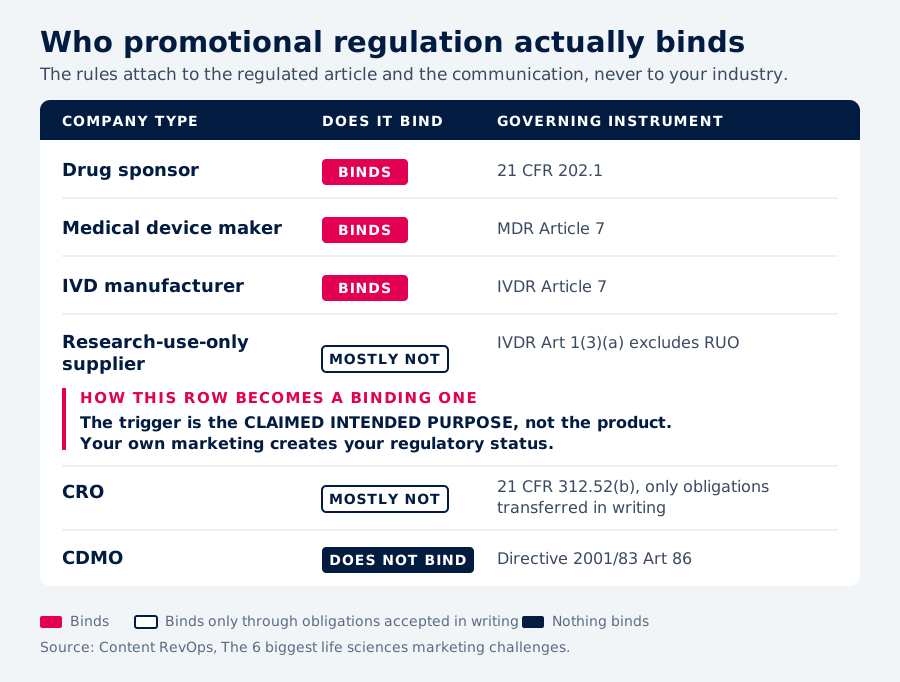
The rules attach to two things, and neither of them is your industry. They attach to whether your product is a regulated article, and to whether the communication counts as labeling or advertising.
Who is genuinely bound
If you sell a prescription drug, a medical device, or an in vitro diagnostic, promotional regulation is real and specific.
In the EU, MDR and IVDR Article 7 carry an identical claims rule. It prohibits misleading text, names, trade marks, and pictures in "labelling, instructions for use, making available, putting into service and advertising", including anything "suggesting uses for the device other than those stated to form part of the intended purpose for which the conformity assessment was carried out."
That last clause catches marketers. Your intended purpose is fixed at conformity assessment, so copy drifting past it creates a regulatory problem. It is one of the reasons medical device marketing and diagnostics marketing behave differently from the rest of the sector.
Who is mostly not
Three company types spend real energy on rules that do not reach them.
- Research-use-only suppliers. IVDR Article 1(3)(a) excludes research-use and general-laboratory products, and the Commission's guidance is blunt that RUO products fall outside MDR and IVDR. The trigger is the claimed intended purpose, so your own marketing creates your regulatory status.
- CROs. No FDA promotional rule attaches to a CRO marketing its own services. The only reach is derivative. 21 CFR 312.7(a) catches "any person acting on behalf of a sponsor", and 21 CFR 312.52(b) makes a CRO liable as a sponsor only for obligations transferred in writing, with anything not covered "deemed not to have been transferred."
- CDMOs. Nothing binds. Directive 2001/83 Article 86 defines advertising as promotion aimed at the "prescription, supply, sale or consumption of medicinal products." Fill-finish capacity is none of those.
If you are one of these three, the industry's most-cited marketing challenge belongs to somebody else. What you have instead is a habit of asking permission you do not need, which is where most CDMO and CRO marketing programmes lose their speed advantage.
What actually costs time
For companies that are bound, the constraint is usually the review process built on top of the law.
No law makes you wait. 21 CFR 314.81(b)(3)(i) requires promotional material to reach FDA on Form 2253 "at the time of initial dissemination", so you publish and submit together. The only mandated waiting period in US promotional regulation is 21 CFR 314.550, which applies to accelerated-approval products for 30 days, unless FDA has told you otherwise.
Everything beyond that is your company's policy.
Review still earns its place, because the misbranding exposure under 21 CFR 202.1 and the labeling provisions of the Food, Drug and Cosmetic Act is genuine, and managing it is exactly what review is for. The narrower point is the useful one. If your content takes weeks to clear, no regulation is producing those weeks. Your process is, and a process is something you can redesign.
Enforcement moved, so read none of this as relaxation
FDA issued 74 letters to pharmaceutical and biologic manufacturers over promotional communications in 2025, split between 10 Warning Letters and 64 Untitled Letters, according to a law-firm tally of public FDA postings. Five landed before 9 September and 69 on or after it.
Before anyone reads that as a collapse in standards, the 40 letters released on 9 September covered 29 unique drugs and appear to have been signed inside a fifteen-minute window, which looks like one coordinated action.
For treatment by company type, see our guides to pharma content marketing and medical device content marketing.
2. The audience is already built and nobody routes anything to it
Distribution scores 1.72 out of 4 in our life sciences study.
What makes that reading strange is the audience sitting beside it. About two in three of life science companies hold more than 5,000 LinkedIn followers. Somebody built that reach, usually over years, and it is standing there.
So publishing and routing are two different jobs, and only one of them is being done.
Posting is not distribution
The per-post data explains why a publish does not count as a distribution decision.
Metricool's 2026 LinkedIn study, covering 673,658 posts across 63,108 accounts, found company pages average 831.96 impressions per post against 817.67 for personal profiles. That is near parity on reach.
Engagement separates them. Company pages run 1.60% against 2.60% for personal profiles, so a company page converts attention at about six-tenths the rate an individual does, and only 6.89% of company pages grew a follower tier over the year. Metricool sells social scheduling software, and this is the only dataset of its kind we found at this scale. We work through what it means for owned reach in life science social media and LinkedIn marketing.
Two things follow.
- A post front-loads half its lifetime impressions into two days. Anything depending on a single publish has a short window and no second one.
- A follower count is not an audience. Reach converting at six-tenths the rate of a personal account needs routing, not broadcasting.
Routing means deciding, before publishing, which people should see a piece and through which owned path they will get it. That decision is the substance of a real content distribution strategy. Email and CRM appear in around 15% of life sciences marketing job postings in our study, a thin hiring signal for the layer that does that work.
We go deeper on owned channels in our guide to life science email marketing.
3. AI answers your category without naming you
When a buyer asks an AI assistant about your category, the answer arrives with citations. In our life sciences study, the number of analysed companies earning one of those citations rounded to approximately zero.
The discovery layer your buyers increasingly start with is a layer your company does not occupy. We unpack the mechanics in why your brand is not showing up in ChatGPT or Perplexity answers.
Ranking no longer gets you cited
The instinct is to treat this as an SEO problem that resolves itself once rankings improve. The two have come apart.
A peer-reviewed WebSci study of 900 consumer health queries found the overlap between organic results and AI citations sits at 46.2%, so fewer than half of the sources an AI cites also rank for the query.
A separate preprint analysis of 615 ChatGPT-cited consumer health sources, sampling one model on one day through a single account, found the top ten organisations account for 52.8% of all citations. Half the available slots go to ten organisations. No corporate domain appears in either study, which is itself the point, though that is an inference from their absence.
What moves citation, and what does not
The most rigorous work we found is Lee's 2026 "SEO Floor" study, pre-registered with public data and, unusually, a comparison pool instead of a sample of only-cited pages. Its author sells answer-engine consulting, though pre-registration and a comparison design are exactly what normally goes missing in vendor research.
Ranking position dominates everything else, worth roughly 34x between rank tiers. Among page features, measured as odds ratios per standard deviation:
Page feature | Citation odds |
Schema markup | 1.31 |
Primary-source presence | 1.12 |
Answer-first coverage | 1.09 |
Heading density | 0.94, a negative |
Lee reads the schema figure as a proxy for site resourcing and rendering quality, not a lever you can pull.
More subheadings made citation slightly less likely, cutting against standard advice. The structural evidence also disagrees with itself, since a separate 480-query test found FAQ markup made no measurable difference.
Nobody has run an interventional test, so none of this establishes cause. Rank is the strongest thing measured here by a wide margin, and the confident structural playbook being sold around AI visibility rests on thinner ground than its confidence suggests. Our working position is set out in the ultimate AEO guide and in what makes one brand get cited while a better-known competitor gets ignored.
Our fuller treatment is in how AI is changing top-of-funnel demand generation.
4. Buyers check you somewhere your content does not reach
Before a scientist buys your product, they run a verification process, and it runs through people and papers first.
The Science Advisory Board, surveying more than 900 of its members in 2019, found scientists identify products using their personal networks, publications, and the internet most often. The panel is operated by a market research firm serving this industry, and it reports the finding as a ranking, without percentages.
Then comes the part vendor marketing rarely accounts for. In the same survey, just under a quarter of scientists said they face no restrictions on which vendors they may buy from. For the other three quarters, the choice runs through an approved-vendor list negotiated between their institution and its suppliers. Getting onto those lists is account work, not campaign work, which is why account-based marketing for life sciences tends to outperform broad-reach programmes here.
One scientist, posting on r/labrats in September 2025, described the experience from the other side:
"This works okay, but it feels a bit shallow — sometimes I worry I'm just going with whichever vendor has the best SEO, not the best antibody."
One person's impression, and a useful one, because it describes someone who knows their verification route is imperfect and uses it anyway.
The comparison happens in writing, without you
For capital equipment the comparison is a funded requirement. NIH shared-instrumentation programmes require applicants to "Compare performance of the requested model with other similar equipment available on the market", and a study section adjudicates the result.
Your product gets written up against its competitors by people you will never speak to, in a document you will never see.
A quote request is paperwork rather than intent
Those same programmes require "An itemized quote from the vendor" in the application, then state that "Execution of a purchase order... prior to award will automatically eliminate an applicant from eligibility for an award."
The buyer must obtain a quote from you, and the funder prohibits you from closing on it.
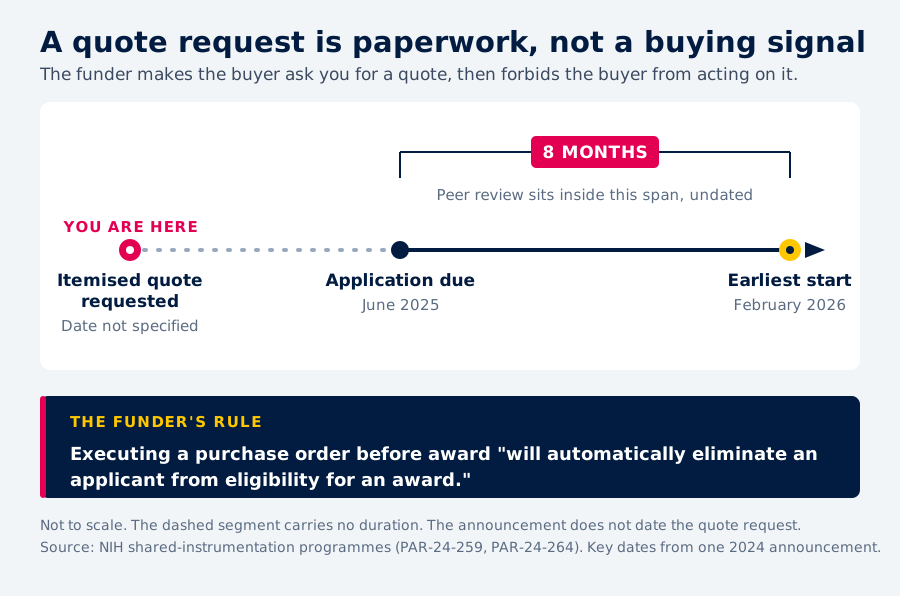
Timing makes it starker. Working from the key dates published in one 2024 announcement, applications due in June 2025 carry an earliest project start of February 2026, an eight-month gap between the quote request and any possibility of a purchase.
Most of those quotes lead nowhere. Programme staff reporting on four decades of one NIH instrumentation programme describe more than 17,000 applications reviewed against approximately 5,500 awards, roughly a third on the source's own rounded figures.
A lead-scoring model treating a quote request as buying intent will misread most of them, and marketing then gets held responsible for lead quality that was never there.
Vendor content still matters to this process. Respondents in that same survey contact suppliers directly. The argument is about sequence. People and papers come first, an institutional gate comes second, and your material meets the buyer inside that. We took a lab supplier through exactly this sequence in our Westlab case study.
For the product-level version, see how to market a life science product.
5. Content gets read and offers nowhere to go next
The conversion gap in life sciences is an architecture problem.
CTA architecture scores 1.89 out of 4 among the active cohort in our life sciences study.
Across industries, between one in six and one in five content pages we assess in our cross-industry study offer no next step of any kind. The reader finishes and the page ends. It is the same failure we diagnose in why a blog gets traffic but fails to generate demos.
What that costs, in money
Almost nobody prices this, so here is a way to.
The method is paid-media equivalence, which Ahrefs documents as a standard calculation. Take the organic clicks a page earns for a given query, multiply by that query's cost per click in paid search, and sum across queries, using query-level costs. It tells you what you would have paid to buy attention you already earned.
We pulled current cost-per-click data for twenty life science search terms in August 2026. Sixteen returned pricing, with a median of $16.10 and a range that tells the real story.
Search term | Cost per click |
Cell culture media | $5.49 |
Clinical trial management software | $37.25 |
Next generation sequencing services | $48.88 |
Cell line development | $49.01 |
Antibody production services | $118.04 |
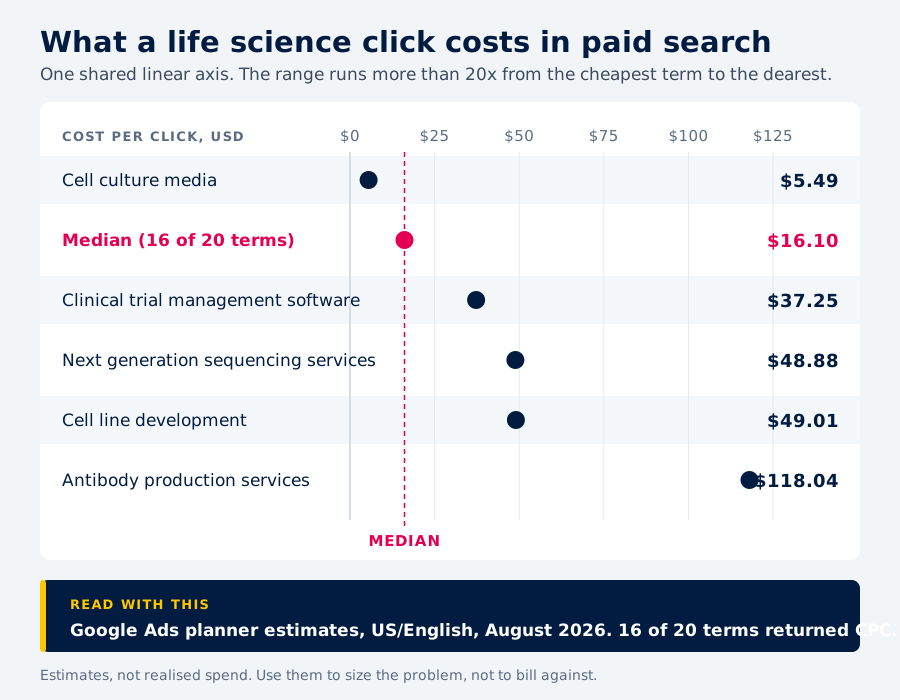
Run that on your own library. A technical page earning 400 organic visits a month against a $48.88 term holds roughly $20,000 a month of paid-equivalent attention. If the page has no next step, you earn that attention every month and discard it.
These are planner estimates, not realised spend, so use them to size the problem. Turning that number into a budget argument is the subject of how life science companies justify and measure marketing spend.
This is where content you already paid for either does a job or sits as cost. Our deeper treatment is in inbound marketing for life sciences and the content marketing for life sciences guide.
6. The buyer has to get the purchase approved and your content does not help
Your champion's real task is getting the purchase approved by people who have never heard of you.
In our life sciences study, about one in four companies map any content to the buyer's compliance or approval workflow, and around 9% maintain a dedicated compliance section in their resource hub. The rest say nothing about the process standing between a convinced reader and a signed order.
The document your buyer has to write
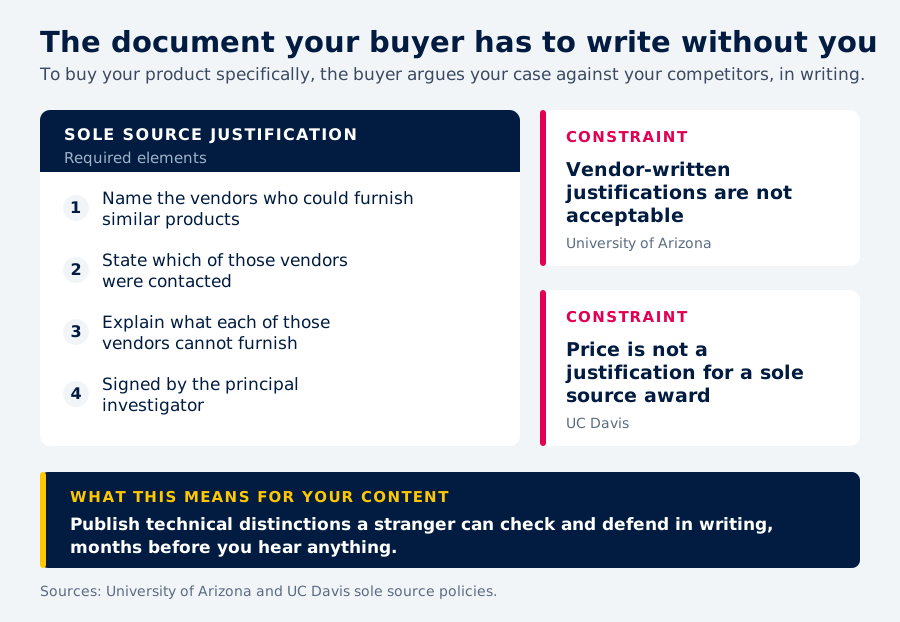
When a buyer wants your product specifically, most institutions require a sole source justification, and the requirements are unusually explicit about authorship.
The University of Arizona states that sole source justifications "written by the vendor / manufacturer, are not acceptable." The principal investigator writes and signs it, and must name the vendors who could furnish similar products, which of them were contacted, and what each cannot furnish.
UC Davis adds a constraint that catches a lot of positioning. Price is not a justification for a sole source award. Being cheaper does not qualify as a reason to skip competition.
In the UK, the University of York asks buyers who believe fewer than three capable suppliers exist to explain that in writing, inside the grant's justification of resources.
Read those together and the task is clear. Your buyer writes a technical differentiation argument, names your competitors, and explains what those competitors cannot do, usually from memory and a datasheet.
Some institutions formally exclude you from helping. Cold Spring Harbor Laboratory bars contractors from drafting "specifications, requirements, Statements of Work, RFP's, Sole Source Justification, or any other document" while competing for its business.
So the content deciding these deals is material that makes a genuine technical distinction checkable by someone defending it in writing, to a committee, months before you hear anything. Building that material deliberately is one of the five decisions in a real life science marketing strategy.
We work through the services version in content marketing for CDMOs and CROs.
Six challenges, six decisions. The sector-wide numbers behind them sit in our life science marketing statistics for 2026.
Which of these six is actually costing you money?
Get a Content RevOps audit, scored on the same dimensions we scored across the sector, with your conversion architecture, distribution routing, and AI visibility priced in numbers you can take to the board.
Frequently Asked Questions
About the Author

Founder & CEO, Content RevOps
Stefan Kalpachev is the founder and CEO of Content RevOps, where he helps B2B SaaS companies transform their content into predictable pipeline. With a background in content marketing and revenue operations, Stefan has developed a unique methodology that bridges the gap between content creation and revenue generation.
Connect on LinkedIn