Life science social media and LinkedIn marketing
Built the audience and never gave it a job? See what your LinkedIn is currently worth, and what it is leaking.
Book a CallMost life science companies have already won the hard part of social media. The audience exists, it is reachable, and it sits on one platform. What happens next is a content marketing problem rather than a channel problem.
Part of Content marketing for life sciences, the complete guide.
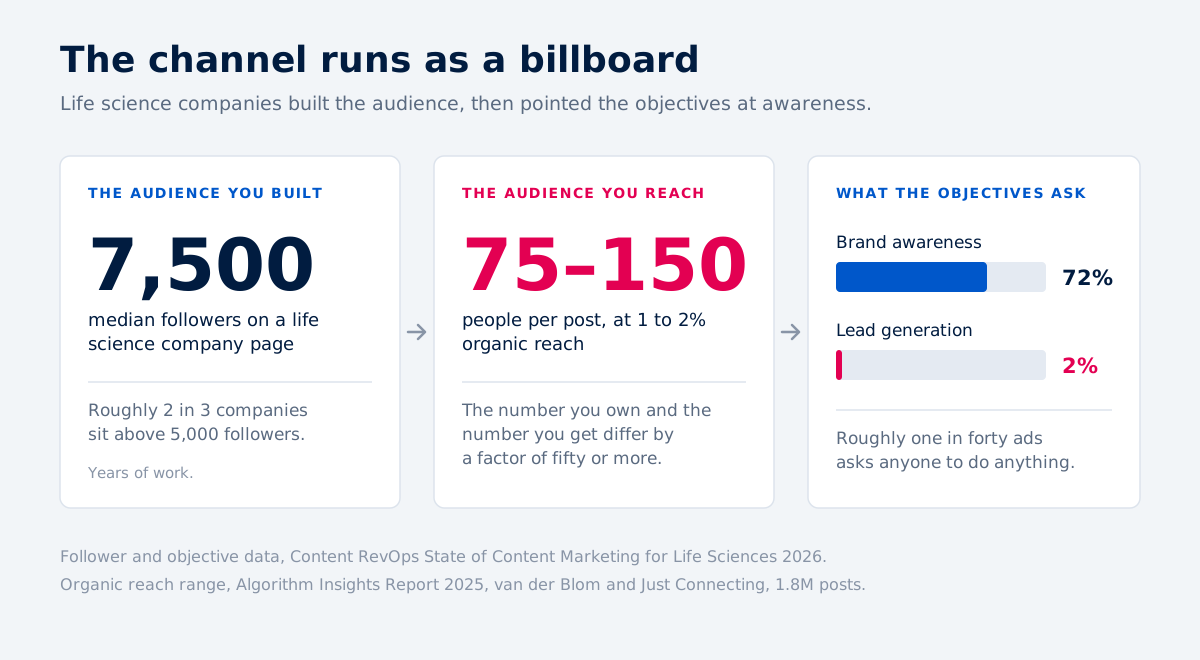
In our analysis of the sector, the median life science company page holds around 7,500 LinkedIn followers, and roughly two in three companies sit above 5,000. That is a real, assembled, professionally qualified audience. Building it took years.
Then look at what those same companies ask that audience to do. About 72% of their LinkedIn ad objectives chase brand awareness. Around 2%, roughly one in forty, pursue lead generation.
They built the audience and never gave it a job.
We think the reason for that is more interesting than laziness. For any company with a medical, legal, and regulatory review function, the approval process does not merely slow content down. It decides which content gets made at all. Understand that, and the feed you are looking at stops being a mystery.
Your audience is already on LinkedIn, so why does the channel feel dead?
Because the follower count is not the reach, and the reach has collapsed.
The number you own and the number you get
A follower count is a stock. Organic reach is the rate at which you draw it down, and that rate has fallen hard.
Richard van der Blom and Just Connecting analysed 1.8 million posts for the Algorithm Insights Report 2025, which they sell, and which carries their own caveat that the numbers work "as a guideline, not as something that is 100% guaranteed."
Their headline finding on business accounts is blunt: "Company Pages average just 1–2% organic reach."
Now do the arithmetic on that median life science page.
7,500 followers at 1 to 2% reach is roughly 75 to 150 people per post.
Not 7,500. Somewhere around a hundred. The number a company thinks it owns and the number it gets differ by a factor of fifty or more.
What the objectives actually ask for
Reach that small would still be workable if the channel had a job. It does not.
Only about one in three life science companies runs LinkedIn ads at all. Among those that do, the objective mix tells you what they think the channel is for. The paid search half of the same picture sits in digital marketing for life sciences.
Nearly three-quarters of objectives buy awareness. One in forty buys lead generation. Document and whitepaper ads, the format that captures demand, make up about 7% of ads.
That is a billboard. Buying a billboard is not a stupid decision, and awareness is a legitimate objective with a legitimate purpose. It is a strange purchase to make when you have spent years assembling a named, targetable audience of the exact people who decide whether your product gets bought. The trade-off between the two is the subject of its own argument in demand generation versus brand awareness.
Why does everything that clears review turn out to be fluff?
Because review time varies enormously by content type, and a team under a weekly posting target will tend to publish whatever clears fastest.
That is the mechanism. Slow approval does not just delay content. It selects content.
Review duration by content type
The clearest evidence comes from the promotional review industry's own benchmark data. Vodori sells medical, legal, and regulatory review software and draws these figures from its own customer base, so read them with that interest in mind. Its 2025 averages for days from start to approval are still the most useful numbers in circulation.
Content type | Average days to approval |
Video | 32.4 |
Brochures | 29.0 |
18.8 | |
Social media | 13.7 |
Speaker presentations | 4.9 |
Sit with the gap between the top and the bottom of that table.
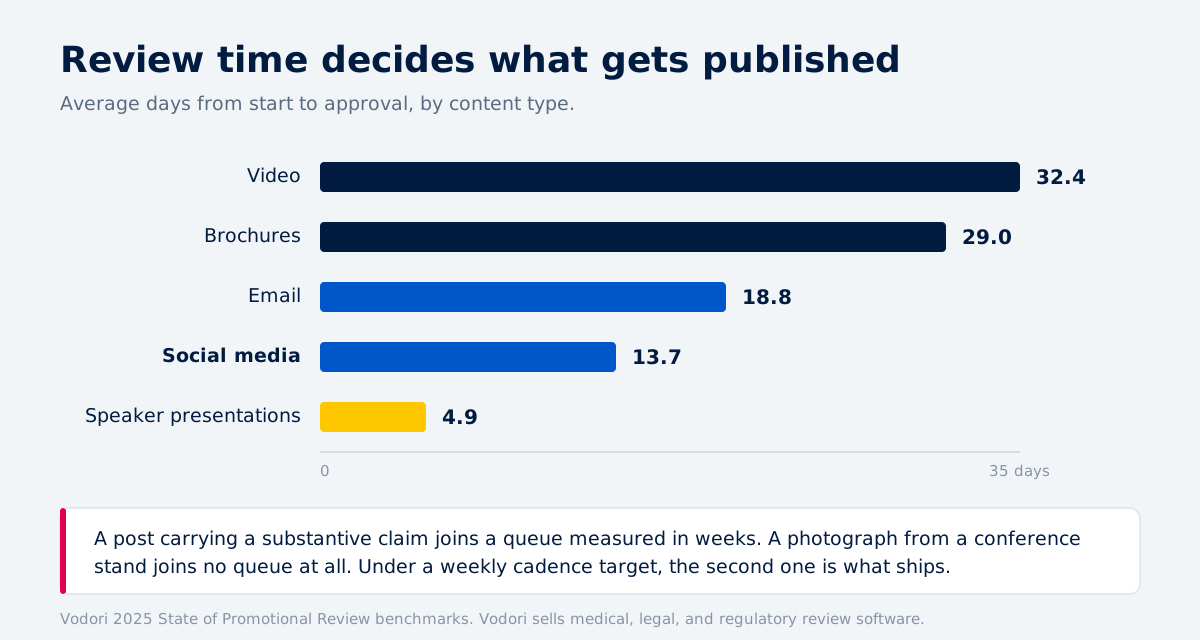
A social post averages about two weeks from start to approval. The same report puts average job duration at 14.8 days and average review duration at 7.6 days, both up on the previous year.
Now give that team a target of two posts a week. Anything carrying a substantive claim enters a queue measured in weeks. A photograph from a conference stand enters no queue at all. The therapeutics version of that squeeze, and the pre-approved modular library that shortens the queue, sits in pharma social media marketing.
Under a cadence target, the content with nothing in it to review is the content that ships. This is the same constraint that shapes everything in content marketing for pharmaceutical companies, and it is why cadence targets are the wrong place to start.
What the rules actively reward
The regulation pushes in the same direction, and it does so explicitly.
This section binds a specific group. It applies to manufacturers, packers, and distributors of prescription drugs and regulated medical devices. If you sell reagents, instruments, software, or contract research services, medicines advertising law is not your constraint, and your bottleneck is commercial confidentiality rather than promotional labeling, which is the problem content marketing for CDMOs and CROs deals with instead.
For the companies it does bind, the FDA's draft guidance on internet and social media platforms with character space limitations sets out what a compliant product communication requires:
- Benefit information must carry risk information within the same individual message.
- It must include the most serious risks associated with the product.
- It must name the product and its established name.
- It must link to a page devoted solely to risk information.
The FDA then draws the obvious conclusion itself. If all of that cannot fit, the firm "should reconsider using that platform for the intended promotional message."
Here is the part that explains the feed. Reminder promotions, which name a product but state no indication and claim no benefit, sit outside the risk disclosure requirement entirely. For a regulated manufacturer, the cheapest compliant message available is one that says nothing about what the product does.
Two limits on that guidance. It remains a draft, and it addresses character-limited formats such as microblog posts and paid search rather than ordinary company pages. Read it for how the regulator reasons about constrained formats, not as the rule governing your LinkedIn page.
In the UK, an employee clicking "like" was a breach
The sharpest illustration is a completed case rather than a guidance document.
In AUTH/3926/6/24, Complainant v Pfizer, a UK health authority and one of its employees each posted on LinkedIn about a NICE recommendation, mentioning Pfizer's medicine voxelotor. A Pfizer UK employee liked one post and loved the other.
Pfizer accepted a breach of Clause 26.1 of the ABPI Code, which prohibits advertising prescription-only medicines to the public. The stated reasoning was that liking the posts "proactively disseminated the information to the colleague's connections and followers and thus promoted a POM to the public." The employee removed both reactions.
Nobody wrote content. Nobody made a claim. Someone tapped a button on a health authority's factual post about a NICE decision.
This is not an outlier ruling.
The PMCPA, which administers the ABPI Code governing prescription medicines in the UK, states in its published guidance that engagement itself, including liking, re-sharing, and commenting, falls within the Code. Responsibility "cannot be delegated away," and it can extend to employees' personal accounts.
Medicines Australia's social media guidance, which binds Australian operations under the same kind of prescription-medicines code, applies the identical principle to content "engaged with" through sharing, commenting, liking, or forwarding.
When a reaction becomes a regulated act for these companies, silence turns into the rational posture. An empty feed is what those rules produce, and it is one of the reasons a pharma marketing strategy has to be designed around the review function rather than in spite of it.
Build a review path that matches the risk
None of this makes the channel hopeless, and the fix is well documented.
Teams that publish substantive material at pace keep the standard and stop applying one workflow to everything. In practice, a social post drawn from an approved copy bank moves through a streamlined single-reviewer approval, while a genuinely novel claim gets the full multidisciplinary review it deserves.
Concept reviews help too. When reviewers check the messaging direction before anyone produces the asset, the team settles the expensive questions while changes are still cheap. The same logic sits behind how we build content calendars, where the approval path is decided before anything is commissioned.
One honest limit. The PMCPA states plainly that it cannot pre-approve social media activity, so no governance model becomes a safe harbour. Good process lowers risk and raises throughput. Judgment stays.
What do scientists and life science buyers actually use LinkedIn for?
They use it as a directory and a wire service. They do not treat it as a persuasion surface, and they are unusually good at spotting when you do.
An audience that can describe the format it distrusts
Spend time in the communities where researchers talk to each other and a consistent picture appears. They are on the platform. They are also professionally sceptical, and they have reverse-engineered the corporate posting style down to its mechanics.
One researcher laid out the template they skip past:
"To me the obnoxiousness is the structure: Title, rarely the author's name, agrandized findings or petty critique, self attributional conclusion 'this is what I have been saying for x amount of time' And the cliche 'the question isn't x, but y' Plus link to read their blog or website And a chatgpt generated poster summary with the dos and don'ts for practice."
Another described why the register itself grates: "I already have to do enough corporate double-speak code switching throughout the day, so it's very annoying to have to wade through more of it when I'm just trying to find a connection/job."
A third offered a professional objection worth understanding rather than dismissing. As they put it, good scientists are "trained to be their own worst critics and would like to see their 'groundbreaking' results replicated by another lab before crowing about them to the world as a whole."
Read that way, a company announcement of a breakthrough lands as a claim that has skipped a step the reader's training tells them matters. It is the same instinct that makes generic messaging fail across life science marketing generally.
What the same people value on the same platform is specific and small. New preprints and publications they would otherwise have missed, conference and institutional news, and the ability to follow where colleagues have moved. One researcher summarised the mechanic exactly: "You make the connection on linkedin and they move the conversation to email."
The migration story is weakest in your sector
Scientists have been leaving X for Bluesky since 2023. How much that matters to you depends heavily on which scientists you sell to.
Researchers at the University of Zurich, LSE, and Imperial College London tracked 300,000 academics across both platforms from 2023 to early 2025. Overall, 18% transitioned.
The spread by discipline is the useful part. It ran from 31.3% in Arts and Humanities down to 13.3% in Medicine and Health, the lowest of any field.
The people you sell to moved the least. That paper is a preprint and has not yet been peer reviewed, so hold the precise figure loosely. The direction is clear enough to act on: for a life science company, the exodus is smaller than the headlines imply, and LinkedIn's weight in your mix is correspondingly larger. Where the rest of that mix should sit is a separate question, covered in top distribution channels for B2B content marketing.
Reach moved to people
If reach on company pages has collapsed, the obvious question is where it went. It went to individuals.
That shift shows up in the platform's own product decisions. LinkedIn now sells a format called Thought Leader Ads, whose entire purpose is to let a company sponsor an employee's post instead of its own, and LinkedIn reports better performance from them than from company-page ads. The section on paid below covers those numbers.
For anyone running a page, the practical reading is straightforward. Your named scientists, your technical leads, and your founders carry distribution your company page no longer has. That is thought leadership in its literal sense, and it is a staffing decision as much as a content one.
The finding that complicates all of this
One piece of evidence complicates everything above, and leaving it out would be dishonest.
When ResearchGate surveyed its members about how they research a lab purchase, social media ranked lowest as an information source, alongside conferences and tradeshows, across every buyer group. What ranked highest instead was publications, named by 53% of influencers, product review websites, named by 52% of central decision-makers, and search engines, named by 41% of sole decision-makers.
Four caveats apply and all of them matter. The sample was small at 285 respondents. The survey ran in 2018. It skewed heavily academic, at 87% academic researchers and under 2% corporate. And ResearchGate ran it as a platform with its own commercial interest in where scientists spend attention.
Take the finding seriously anyway. So how do the two fit together?
They measure different moments. ResearchGate asked about gathering product information during a purchase, and social is genuinely poor at that job. Nobody selects a bioreactor from a feed.
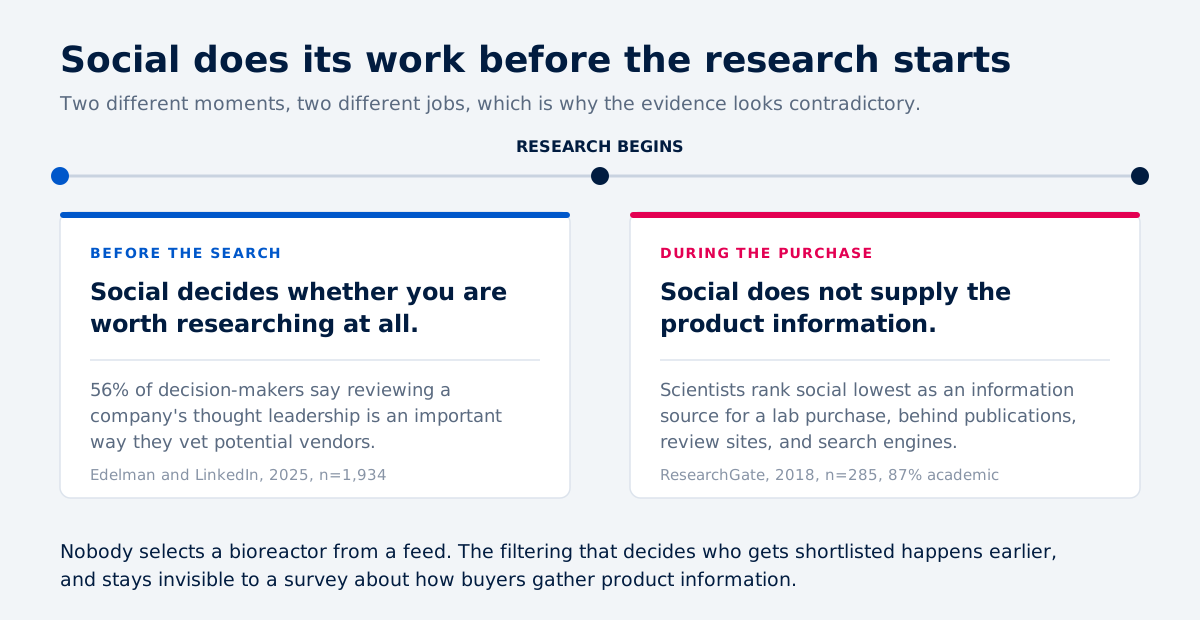
What social does happens earlier and stays invisible to that question. It determines whether you are a company worth gathering information about at all. The filtering runs before the research starts, which matches what buyers say about vendor evaluation later in this piece.
An eight-year-old academic sample may also understate social's role for today's industry buyers, and the available evidence cannot settle that either way. The channel that does carry the purchase-stage load, search and increasingly AI answers, is where most of the sector is thinnest.
What should a life science company actually post, and is industry news worth resharing?
Post the material that would need review. That sentence is the whole answer, and the review mechanic above is what makes it uncomfortable.
The content worth reading is the content that costs something
Asked what a small biotech should put on its LinkedIn page, someone working inside the industry answered like this:
"The really relevant posts would be clinical updates, new data releases, HEOR / market research data, all would require close review and approval by an internal team prior to posting. IMO everything else that you just mentioned is fluff."
Read that twice. The list of things worth posting matches the list of things that need approval.
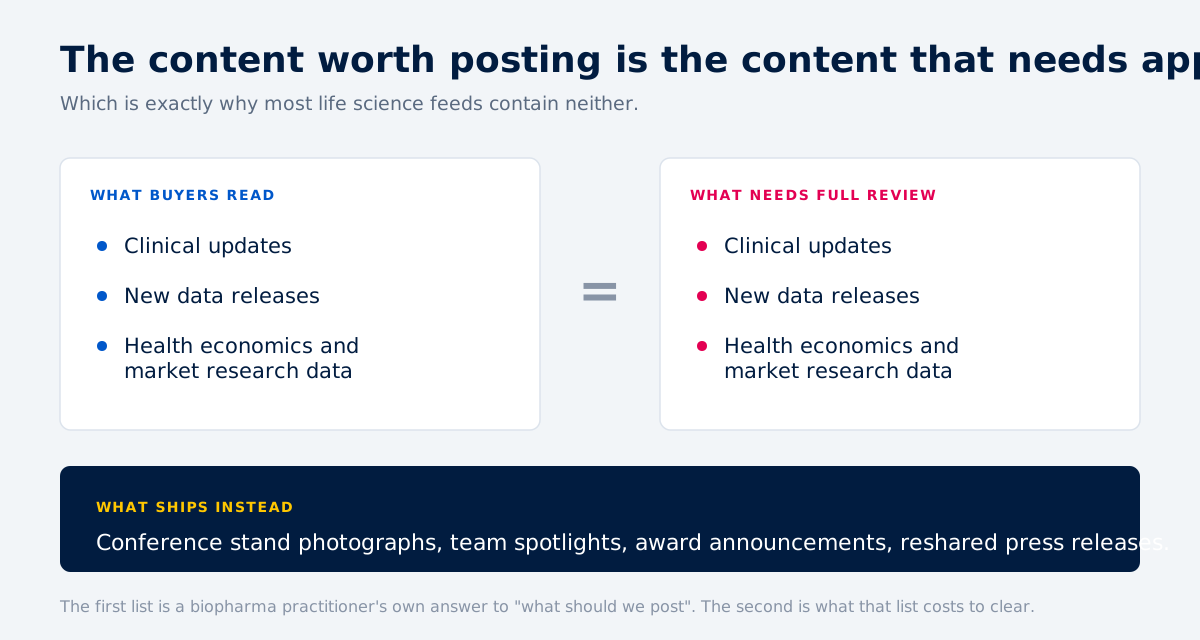
Team photos fill the feed because they are the only thing that reliably ships. The same pattern shows up in content marketing for biotech, where the hype is what clears and the evidence is what waits.
You already produce the evidence
The encouraging part surprises most teams we work with. The raw material already exists inside these companies.
Among life science companies actively publishing content, about 71% put out original data or research, and roughly 73% publish under named authors. The evidence and the named experts are already on the website.
Two things are missing. The first is a route from that material to the channel. The second is the comparison work buyers want, which across all life science sites exists on about 2%.
The way we think about this is that a social post should come from somewhere rather than from nowhere. Pick the source asset, take one slice of it, then choose the format that suits that slice. A company with a research programme and a name-brand scientist does not have a content ideas problem. It has a routing problem, and our approach to content distribution treats it as one.
Resharing industry news, and when it becomes a regulated act
We think resharing third-party coverage without adding a view is weak content. Nothing in a bare reshare gives a reader a reason to follow you rather than the publication, and practitioners in those communities land in the same place: "If you're serious about it keep your posts only informative and post only when you have something useful to say." We found nobody who has measured it, so treat that as our reasoning rather than a finding. It is also the practical difference between content marketing and social media marketing.
In life sciences it can be more than weak.
The Pfizer case was a news-resharing case. The health authority's post about a NICE recommendation was legitimate news, correctly reported. The breach came from a company employee engaging with it, because that engagement pushed a prescription-only medicine into a public feed.
So the answer splits by who you are:
- If you sell an approved medicine or a regulated device, engaging with third-party coverage that names your product is a regulated act, and your social policy should say so explicitly. Medical device marketing carries its own version of this.
- If you sell tools, reagents, or services, resharing carries no such risk, and the only real question is whether you have added anything. That applies equally to diagnostics companies and lab suppliers.
Formats, by the size of your page
Format advice tends to arrive as universal law. It changes with page size.
Socialinsider, a social analytics vendor reporting on its own users, analysed 1.3 million posts across 16,645 business pages for 2026. For pages under 50,000 followers, which covers most companies in this sector on our median follower data, multi-image posts generate the highest impressions per post. Polls only take over above 50,000.
Video views fell 36% year on year across every page size, which is worth knowing before commissioning a video series.
Employee posting, and the condition attached to it
Posting from personal profiles works, and the reach numbers above explain why.
In this industry it carries a condition. The PMCPA states that staff should act with caution on all platforms, naming LinkedIn specifically, when discussing anything touching their professional role or their employer's commercial interests, and that the company can carry responsibility for that activity even on personal accounts.
Medicines Australia extends responsibility to employee content where the person "can reasonably be perceived as representing the company."
For pharmaceutical and regulated device companies, an employee advocacy programme is a compliance programme with a content layer on top. Build it in that order. How we work with SMEs covers the production side of the same problem.
Do LinkedIn ads generate leads for life science companies, and what do they cost?
They generate leads. What they cost is genuinely unclear, and anyone quoting a precise number is guessing more than they admit.
Nobody publishes a real benchmark, including LinkedIn
LinkedIn does not publish official cost benchmarks. Every figure in circulation comes from an agency or tool vendor aggregating its own clients' campaigns, and those datasets disagree badly.
Published cost per lead for healthcare and pharma currently spans roughly $64 to $600:
- Benchmarketing puts the healthcare median at $64.10.
- Foundry CRO's aggregation of several advertiser datasets gives healthcare and pharma a $6.00 to $10.50 cost per click with an $80 to $120 cost per lead.
- 42 Agency, reporting on 87 campaigns, gives healthcare tech $400 to $600.
- Sopro puts its platform-wide average, across all sectors rather than healthcare, near $408.
That is a ninefold spread across four overlapping definitions of the sector, which is part of the problem. One aggregator is honest about why, noting that LinkedIn publishes nothing official so every number, including its own, comes from aggregated advertiser data.
One practitioner on r/LinkedinAds reported costs per click of $6 to $15 and costs per lead of $60 to $120 for niche B2B campaigns, which is one team's experience rather than a benchmark.
Budget against the low end, expect the middle, and treat your first campaign as the instrument that produces your real number. That is the same discipline we argue for in how life science companies justify and measure marketing spend. How these costs compare with paid search, once you strip branded terms out of the Google figure, sits in should you run paid ads in life sciences.
The audience size advice is wrong, and LinkedIn cannot keep its own story straight
Paid advice in this sector often lands on a required audience of 300,000 or more, followed immediately by the acknowledgement that life science audiences are far smaller. The advice and the caveat cancel out, and the reader gets nothing usable.
That figure is not a platform requirement. It is one LinkedIn help page, contradicted by two others.
- The hard floor: the minimum audience size required to run an ad set is 300 member accounts.
- LinkedIn's ad targeting best practices page: keep the audience over 50,000 for Sponsored Content, using no more than two or three targeting facets.
- LinkedIn's page on boosting a Page post: we recommend a minimum of 300,000 for Sponsored Content ad sets.
Three LinkedIn properties, three answers, spanning three orders of magnitude.
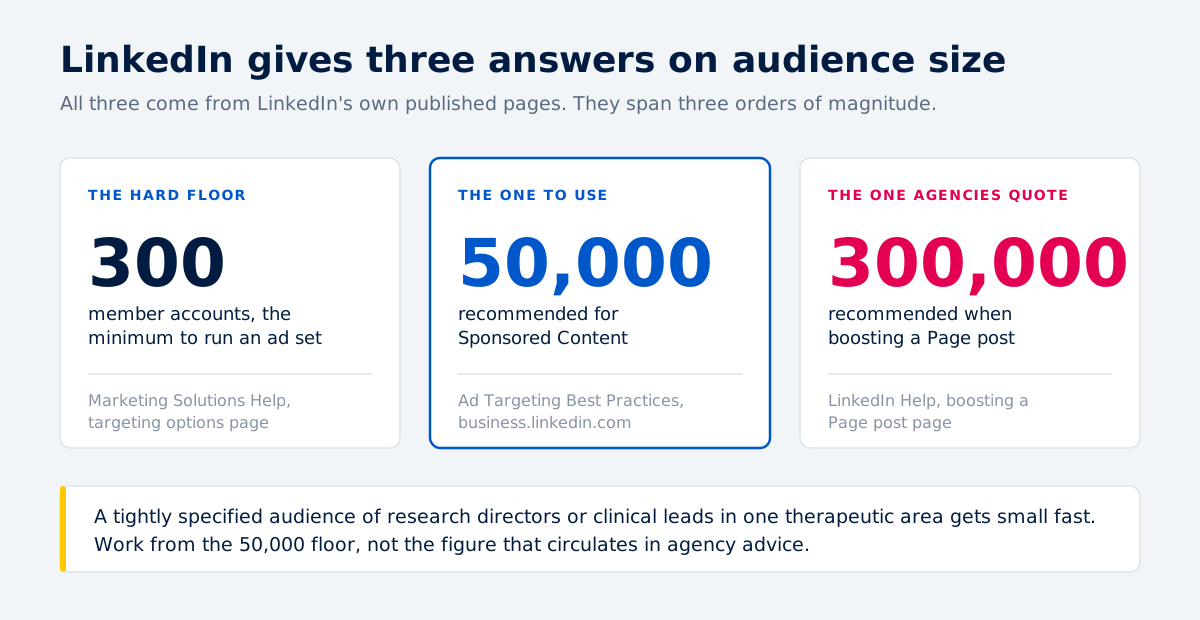
This matters more in life sciences than almost anywhere, because a tightly specified audience of research directors, clinical leads, or procurement staff in one therapeutic area gets small fast. LinkedIn's own targeting guidance supports a floor of 50,000 for Sponsored Content, and that is the number to work from.
Formats, ranked by what the evidence supports
Three findings are solid enough to act on.
Lead gen forms beat landing pages. Aggregated advertiser data puts LinkedIn form conversion around 13% against roughly 4% on a typical landing page, with independent compilations giving forms 10% to 18% and landing pages 2% to 6%. Removing the page removes most of the friction.
Document ads underperform their reputation. They account for only about 7% of life science ads, and one team running them reported that their data showed nobody continuing past the second page. That is a single account, though it matches the low adoption.
Ads from people beat ads from pages. Thought Leader Ads let you sponsor an individual's post rather than the company page.
LinkedIn has published several different figures for the lift, including 252% higher click-through rates in one place and 2.3 times higher in another, against 1.7 times in its early pilot material.
All of it is LinkedIn's own marketing data and the magnitude moves around, so the direction holds up better than the multiple. That direction matches the organic picture, where the account matters as much as the content.
The download starts the funnel
The most common failure we see is a campaign that works, followed by nothing.
Running a gated report campaign for a client recently, we treated the download as the opening move and built an automated nurture behind it, so follow-up never depended on anyone remembering to do it. Testing competitors' own contact forms as part of that work, only one followed up quickly. Speed of first response turned out to be the lever worth designing around, which is the whole argument of lead capture and qualification.
Build only the lead gen form and you have bought a list, not a lead pipeline.
What job should the channel hold, and how would you know it is holding it?
The channel's job is to make you checkable. Everything else follows from that.
The scorecard that measures nothing
Standard advice says to track engagement rate, follower growth, and form completion rate. Each of those can improve for a full year while nothing commercial changes, which makes them a poor basis for a budget conversation. We have written separately on which metrics to track and which to ignore and on reporting on content marketing success.
The sector knows this. In the Edelman and LinkedIn research below, a meaningful share of the companies producing this content report no process at all for measuring whether it works, and the most common method among those that do is watching for a traffic bump after publishing.
What buyers say they do
The best available evidence on how B2B buyers use this material comes from the 2025 Edelman-LinkedIn B2B Thought Leadership Impact Report, now in its seventh year, which surveyed 1,934 US management-level professionals in March and April 2025 with a margin of error of plus or minus two points.
LinkedIn co-authored it and respondents answered on LinkedIn, so the house has an interest in the result. The methodology is published, which is more than most sources in this space manage.
Three findings carry weight:
- 56% of target decision-makers say reviewing an organisation's thought leadership is an important way they vet potential vendors. Among hidden decision-makers, whom Edelman defines as final decision-makers involved as a representative of a function that does not require in-depth product knowledge, naming finance, operations, legal, compliance, and procurement, it is 55%.
- 71% of those hidden buyers report relatively little interaction with sales at all. Sales reaches them rarely, so published thinking carries the load.
- 53% agree that when a company produces high-quality thought leadership, how well known it is matters much less.
Pin that last number up if you sell against a household name. It says the recognition gap closes with evidence.
The jobs, stated plainly
Put the buyer research beside what researchers say they use the platform for, and the channel's real jobs get specific.
The job | What it looks like when it works |
Be findable as a named person | Your scientists and technical leads are visible, credentialed, and posting in their own voice |
Survive the pre-shortlist check | A buyer looking you up finds current work, real specifics, and a company that clearly still exists |
Carry capability and institutional news | Data releases, method work, and capacity changes reach the people tracking your category |
Move the conversation off-platform | Connections convert into email threads and calls, which is what the audience says it does anyway |
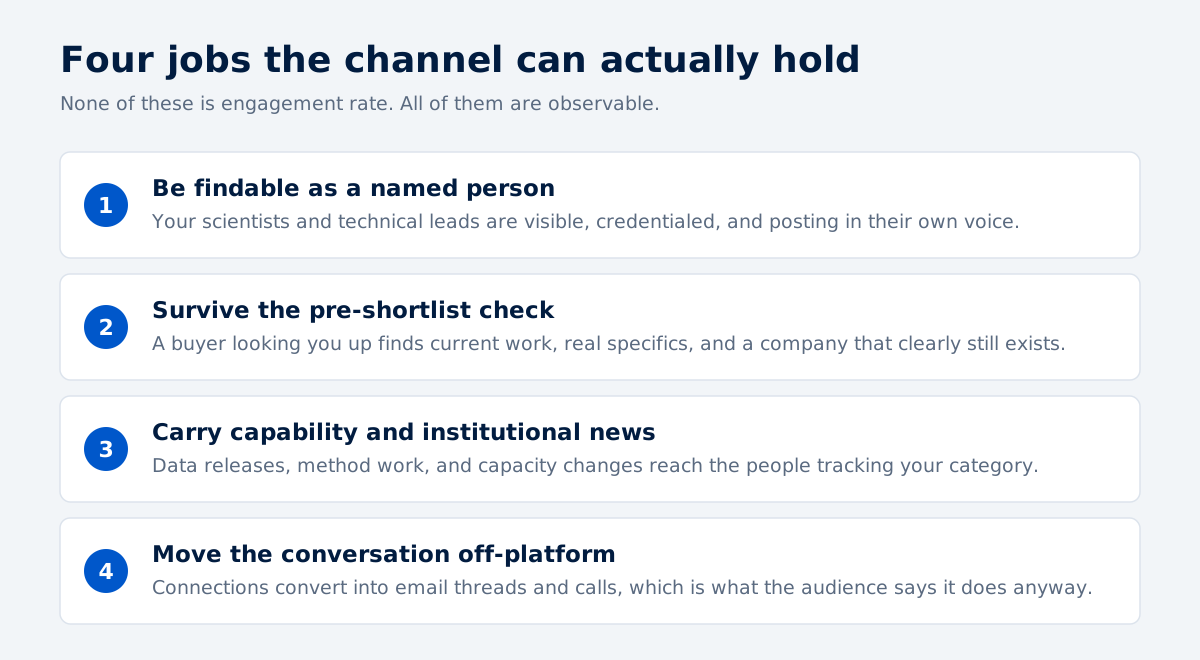
None of those is engagement rate. All of them are observable. The last of them, moving the conversation off-platform, is where the owned email list takes over. Deciding which of them your channel is for is one of the five choices in a life science marketing strategy.
What it looks like when the channel has a job
We worked with Westlab, a life science manufacturer serving labs, whose growth ran on manual research, cold calling, conferences, and lab visits. That motion costs a great deal to run and depends entirely on reps.
The change was structural. We wired content into the commercial system so it held a specific job, and the content engine took on the pre-sales trust-building reps had been doing one lab at a time. That work does not scale while it lives in people.
The measurable part came from what happened after engagement rather than during it. Readiness signals from the content hub told sales which leads were genuinely serious, so reps stopped guessing. Within three months the system produced 241 inbound leads in a market that had run on cold outbound and influenced $120,000 in quotes.
That is one engagement over one quarter, and a different company with a different sales motion would see a different curve.
What transfers is the sequence. We think you have to know how a lead is supposed to move before deciding what to publish. The alternative is producing content and hoping, which is where most life science pages sit right now.
The audience is already there. Give it something to do.
Is your LinkedIn a billboard, or part of the revenue system?
Get a Content RevOps audit, your channel, funnel, and answer-engine visibility mapped against the buyers who check you before they shortlist you, with every leak priced before you spend a dollar fixing it.
Frequently Asked Questions
About the Author

Founder & CEO, Content RevOps
Stefan Kalpachev is the founder and CEO of Content RevOps, where he helps B2B SaaS companies transform their content into predictable pipeline. With a background in content marketing and revenue operations, Stefan has developed a unique methodology that bridges the gap between content creation and revenue generation.
Connect on LinkedIn