Life science marketing strategy, the five decisions that make one
Running a channel list instead of a strategy? See which of the five decisions your plan skips.
Book a CallAsk a life science company for its marketing strategy and you will usually get a channel inventory: a conference calendar, a LinkedIn page, a newsletter that goes out when someone remembers, and a plan to do more content marketing next quarter.
Part of Content marketing for life sciences, the complete guide.
None of that is a strategy. A strategy is a small set of decisions, made in order, that determine what all of that activity is for. In life sciences there are five: which business you actually are, where your revenue leaks, what you can prove and how fast you can clear it, where a small team concentrates, and how the whole thing survives the budget review that arrives before the results do.
One boundary before we start. A go-to-market strategy decides how the product reaches the market at all, covering route to market, pricing, and market access. The marketing strategy is the demand half of that plan; it decides how buyers come to know, trust, and choose you. This article is about the second thing.
Each decision below gets a section, the inputs that drive it, and a defensible default.
What does a life science marketing strategy actually decide?
A life science marketing strategy decides who you market to, what evidence you lead with, which few motions you run to depth, and what you measure at each point of a long buying cycle. Everything it does not choose is, deliberately, not worth doing this year. The product-level version of the evidence decision, what a scientist checks before choosing, is covered in how to market a life science product.
That sounds obvious until you look at what the sector actually does.
The five decisions in one view
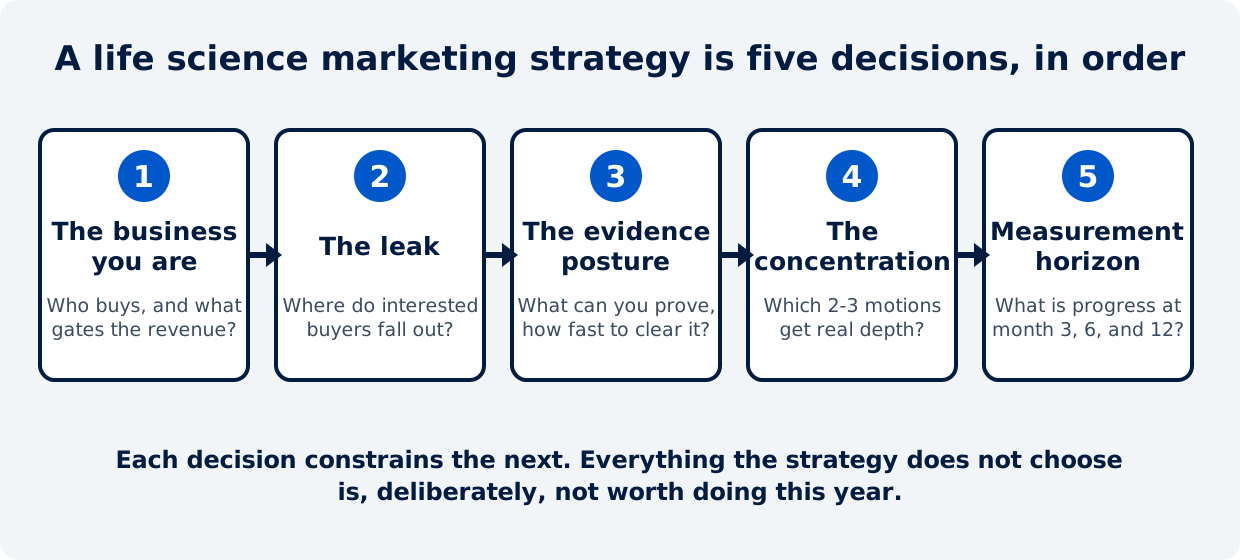
Decision | The question it answers | What decides it |
The business you are | Who buys, and what gates the revenue? | Your business model, not your preferences |
The leak | Where do interested buyers currently fall out? | A content and funnel audit, priced |
The evidence posture | What can you prove, and how fast can you clear it? | Your data, your reviewers' capacity |
The concentration | Which two or three motions get real depth? | Team size, branch, and the leak |
The measurement horizon | What counts as progress at month 3, 6, and 12? | Your branch's actual buying cycle |
What the sector does instead of deciding
In our analysis of life science company websites, about 85% publish news and press releases. It is the closest thing to a universal asset the industry has.
An announcement tells the market what happened to you; a funding round, a hire, a milestone. It does nothing for the buyer who is trying to evaluate a supplier, compare two platforms, or justify a purchase internally. A sector that runs on announcements has chosen visibility of milestones over usefulness to buyers, usually without noticing it made a choice. The pattern is not unique to this industry, and the cross-vertical picture shows how common it is, but life sciences runs it harder than most.
Paid spend shows the same pattern. Among the life science companies running LinkedIn ads, about 72% of campaign objectives target brand awareness, and roughly 2% explicitly target lead generation. The sector pays to be seen and almost never pays to be contacted. That is activity without a decision behind it, and it is the default this article is written against. Deciding what the channel is actually for, rather than whether to be on it, is the subject of life science social media and LinkedIn marketing.
Which life science business are you actually marketing?
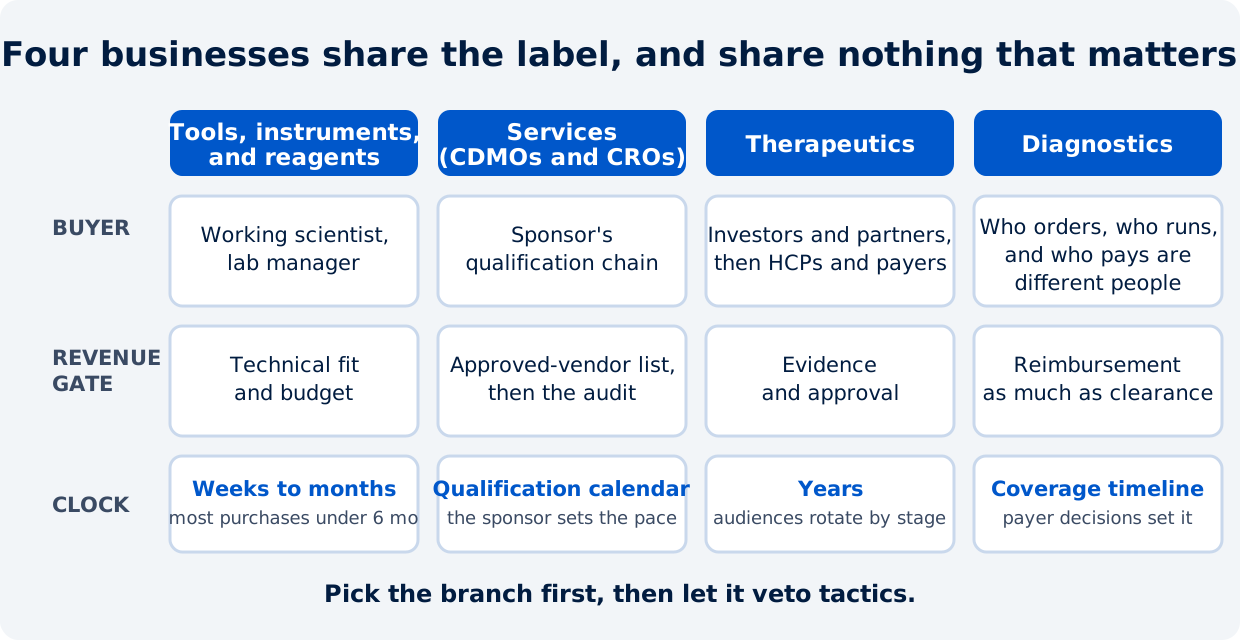
Four different businesses share the life sciences label, and they share almost nothing that matters for strategy. The buyer differs, the thing that gates revenue differs, and the length of the buying cycle differs by an order of magnitude. The marketing function itself changes shape with them, which is the ground covered in what life science marketing is. This is the first decision because every later one depends on it.
Tools, instruments, and reagents
The buyer is a working scientist, an engineer, or a lab manager with a budget line. Revenue is gated by technical fit and available budget, and the cycle is shorter than the sector's reputation suggests. In a 2026 survey of scientific purchasers by AZoNetwork, 42% of purchases completed in under a month, and 89% finished within six months.
Those numbers come from a vendor-run survey, so treat them as directional. The direction is still clear: this branch buys in weeks and months, not years. The strategy's centre of gravity is being findable and comparable at the moment of need, because the window between "we need this" and "we ordered it" is narrow. That makes the capture motion, and your visibility in search and AI answers, disproportionately valuable here.
Services, the CDMOs and CROs
The buyer is a sponsor's qualification chain, and revenue is gated by making it onto the approved-vendor list and through the audit. The pace is set by the sponsor's qualification calendar, not the buyer's urgency, and that alone reshapes what the marketing function is there to do. The strategy's centre of gravity is proof of operating reality; the reader is deciding whether you are safe to shortlist long before anyone talks. What that proof looks like on a CDMO or CRO site, and which parts of it sponsors check first, is worked through in content marketing for CDMOs and CROs.
Therapeutics
For most of the company's life there is no product to market at all. The audiences rotate as the asset matures, from investors and partners toward clinicians and payers, and revenue is gated by evidence and approval. The strategy's centre of gravity is credibility infrastructure that compounds across those audience shifts. For the pharma end of this branch, we cover the full playbook in our guide to content marketing for pharma, and the specific constraints are unpacked in content marketing for pharmaceutical companies. For the earlier, venture-funded end, content marketing for biotech covers the investor-first audience.
Diagnostics
Revenue is gated by reimbursement as much as by clearance, and the people who order, run, and pay for a test are different people. The strategy's centre of gravity is evidence that works for the payer and the lab, not only for the clinician who likes the science. Turning that into a publishing programme is the subject of content marketing for diagnostics companies. The device world runs on a similar committee logic, which we cover in our content marketing tips for medical device companies, and the split buyer behind that logic is where medical device marketing starts.
Why the fork comes first
The same tactic is rational in one branch and waste in another. Paid search on high-intent product terms is close to obligatory for a reagents vendor whose buyer purchases this month; the same spend for a therapeutics company with a Phase II asset has nothing to capture. Pick the branch, then let it veto tactics. Most bad life science marketing plans are a good plan for a different branch. If your branch is therapeutics, the same five decisions resolve differently, and we have worked them through in the pharma marketing strategy playbook. If you have not written down who you are selling to at this level of specificity, choosing the right ICP is the step before everything in this article. On the tactic itself, how many life science companies actually run paid search, and what the rest of the digital mix looks like, sits in digital marketing for life sciences.
Where does the revenue actually leak?
The leak is almost never at the top of the funnel, it is at the decision. Before allocating anything, run three questions against your own website and channels, in this order:
- What does the buyer who is ready to decide find? Proof, comparisons, pricing context, use cases?
- What does the buyer who is evaluating find to compare you against the alternative?
- Who arrives already knowing your name, and who arrives new?
We have sector-wide answers to all three, and they explain where the money goes missing. If you want the underlying method rather than the findings, mapping the funnel is how we run this diagnostic.
The deciding buyer finds the least
In the same website analysis, more than 1 in 5 life science companies publish nothing that helps a buyer decide at all. No case studies, no comparisons, no pricing context, no application guidance. Over a fifth of the industry is invisible at the exact moment the buyer is choosing. That absence is what stalls inbound marketing in life sciences, where the traffic arrives and then finds no route to a decision. The sector's published figures put that band at about 22% and state the base behind it.
Case studies, the proof buyers ask for most, sit on only about 27% of sites. On the other three quarters, the sales team carries every proof point by hand, one call at a time.
The pattern holds deeper in the funnel. In our study of pharma and biotech sites, fewer than 6% publish use case pages; the buyer asking "will this work in my context" finds an answer on roughly 1 in 18 sites.
Most visible traffic already knew you
The same pharma study found that branded keywords make up about 12% of ranked terms but drive about 40% of traffic.
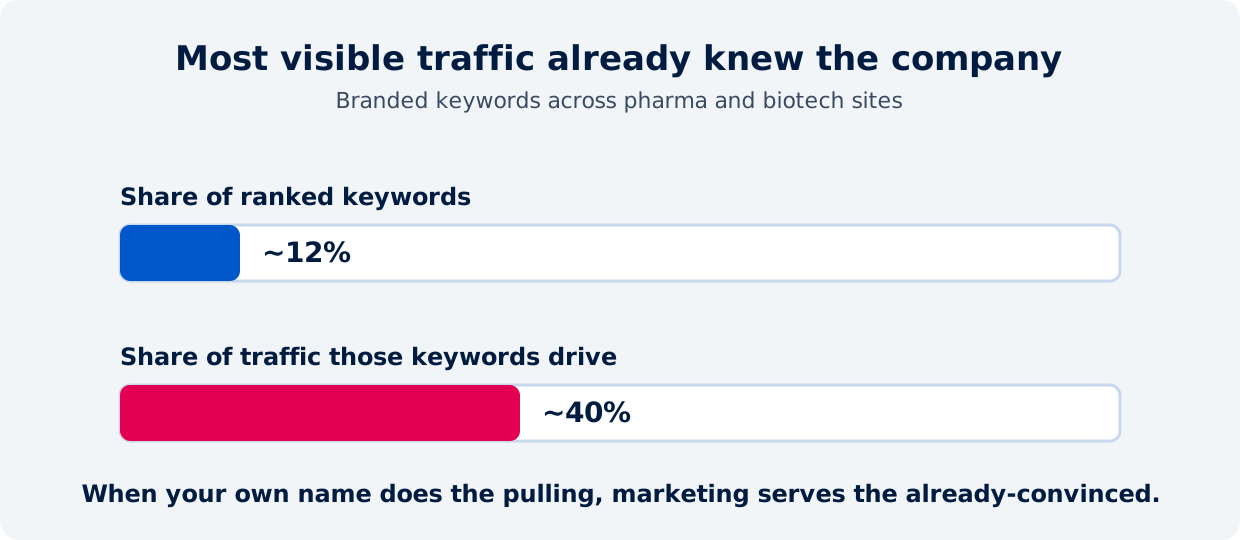
Read that mechanism slowly, because it changes what "we get traffic" means. When a minority of your rankings produce the plurality of your visits, and those rankings are your own name, most of your visible audience consists of people who already knew you; from a conference, a rep, a referral. The marketing is serving the already-convinced instead of expanding the pool. That is a leak at the top and the bottom at the same time.
Price the leak before you fill it
The way we work, every gap found in this diagnostic gets a number before it gets a fix; missed deciding-buyer searches priced through a realistic visitor-to-lead-to-customer path, decision content gaps priced against the deals sales says stall for lack of proof. A gap with a dollar figure attached gets budget and sequence. A gap described with adjectives gets a debate. Fixing the largest priced leak first is the closest thing to a free lunch in this discipline.
Two comparisons make the pricing credible: how your published footprint scores against the sector's content maturity curve, and how far your decision layer sits from the companies that are already converting.
What can you say, and how fast can you clear it?
Two constraints shape every life science content plan, and the usual thinking treats both as someone else's problem. What evidence will actually move your buyer is a strategy input. So is how fast your reviewers can clear a page. Plan around neither and the strategy dies in execution.
What evidence actually moves a scientific buyer
Scientific buyers do not weigh all evidence equally, and the discount they apply to vendor-authored material is measured. In a survey of 994 US and EU academic researchers, Bergenholtz and colleagues found that colleagues are the top information source for evaluating instruments, with peer-reviewed publications ranking above conferences and above salespeople.
The sharper finding sits in their second survey, of 247 respondents. About 80% rated a peer-reviewed paper with no company affiliation as reliable. When the same kind of paper was co-authored by the firm whose instrument it described, that fell to 36%.
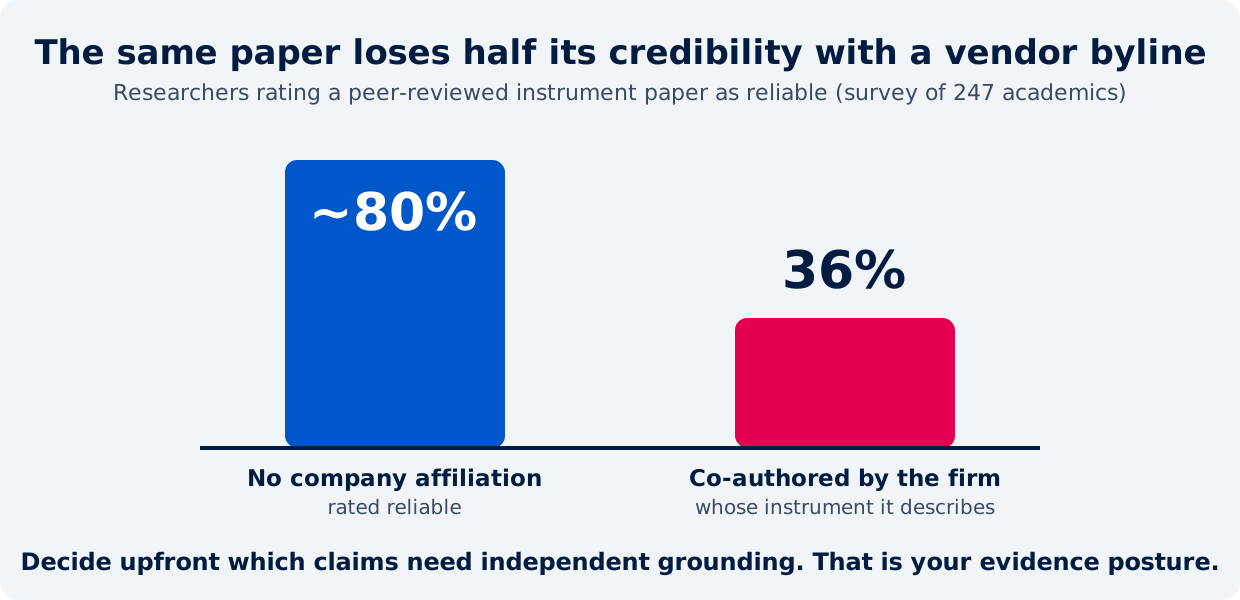
The same claim loses roughly half its credibility the moment it carries your byline. Clinicians show the same instinct; in a survey of over 1,000 orthopaedic surgeons, 94% rated peer-reviewed sources a good or very good way to assess new methods, against 20% for manufacturer-initiated publications.
The strategic consequence: decide upfront which of your claims carry enough weight to need independent grounding; a published study, a named customer, a third-party benchmark, and which can stand on your own authority. That is your evidence posture, and it determines what content is even worth producing. It is also the raw material problem, which is why we start every engagement by extracting the proof that already exists inside the business.
Review capacity is a budget, spend it deliberately
Practitioners inside pharma name the real constraint on volume without hesitation. As one put it on a marketing forum: "The real bottleneck isn't the platform though, it's MLR review cycles killing campaign momentum. Most pharma brands underperform digitally because of slow approvals, not poor channel choice."
The cost is measurable in people-hours. In a peer-reviewed benchmarking survey of 35 US pharmaceutical companies, Medical Information teams alone reported a median of roughly 16 hours per week preparing promotional material reviews, plus about 6 more in review committee meetings, with the load peaking around launch. That is one function of several sitting in the same review; multiply it across medical, legal, and regulatory and the throughput ceiling becomes visible.
Regulatory affairs professionals track this as a process with five named metrics; content volume, days to enter review, days in review, days to approval, and number of review cycles. The failure modes they report are the ones you would guess: high volume slowing everything down, and poor-quality inputs bouncing through repeat cycles.
So plan content shapes around clearance speed:
- Evergreen educational assets clear review once and work for quarters.
- Modular, pre-approved claim and copy blocks let new pieces assemble from already-cleared parts.
- Campaign bursts multiply review cycles exactly when the calendar is least forgiving.
The practitioners agree from the demand side too. An oncology marketer's verdict on pure sales outreach to scientists was blunt: "it'll be ignored 9.9 times out of 10." A recurring educational newsletter, in the same practitioner's experience, earns the audience instead. Under a review constraint, infrastructure-shaped programs beat campaign-shaped ones on both compliance economics and buyer response, which is also why distribution has to be designed alongside production rather than bolted on afterwards.
Where should a small team concentrate?
A small team should run two or three motions to real depth and formally defer everything else, because in this sector every marketing head is a six-figure allocation. Among the minority of pharma marketing job postings that disclose pay, the director-level median sits around $214,500 and mid-senior around $156,000.
At those medians, a three-person team runs to roughly half a million in salary alone before the first dollar of media. Spread that across eight channels and you have bought 10% depth everywhere, which in a skeptical, evidence-first market reads exactly like absence. The same arithmetic decides whether a team can sustain channels that share data at all, which is the question in multichannel and omnichannel marketing in life sciences. The same arithmetic sits behind the channels the sector names but never staffs.
The three-motion default
Concentrate on one motion of each kind, chosen by your branch and by where your revenue leaks:
- One capture motion. Own the questions your deciding buyer actually asks, in search and now in AI answers, so demand that already exists lands with you. The mechanics of the second half of that sentence are in our guide to answer engine optimisation, and the reasons some brands get cited while better-known ones do not are covered in what makes one brand get cited in AI answers.
- One credibility motion. Build the evidence asset your branch's gatekeeper needs; the validation data, the benchmark, the audit-ready proof, and let it clear review once.
- One relationship motion. Show up consistently in the one place your buyer genuinely talks, whether that is a congress, a community, or a newsletter they chose to receive. When the revenue sits inside a short list of named organizations, that motion becomes account-based marketing.
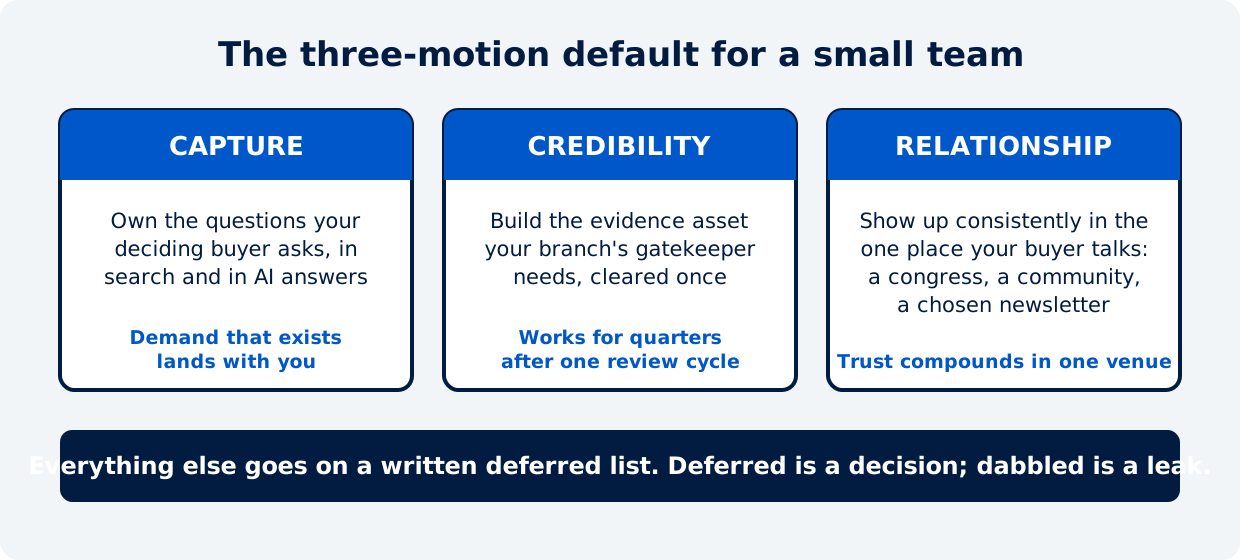
Everything else goes on a written deferred list. Deferred is a decision; dabbled is a leak. Choosing which theme those motions run on is its own decision, and choosing the right theme is how we make it.
What concentration looks like in practice
Working with Westlab, a life science manufacturer serving laboratories, the expertise buyers valued most was locked inside the sales team, repeated one conversation at a time. We concentrated the whole program on extracting it into one educational motion for one audience, and shipped 40 educational pieces in two months on that single theme.
The volume was a consequence of the concentration, not the goal. One audience, one theme, and one funnel meant nothing produced was off-strategy, and the sales team's knowledge stopped being a bottleneck and became an asset that worked while they slept. The same concentration logic is what the wider life sciences practice is built around.
How does the strategy survive the month six budget review?
A life science marketing strategy survives by agreeing, at kickoff, what progress looks like at month 3, 6, and 12, calibrated to the branch's real cycle. Without that agreement, the review at month six compares a long-cycle strategy against short-cycle expectations, and the strategy loses. Surviving that room is partly a measurement problem, and we have written up separately how life science companies justify and measure marketing spend in front of executives who fund science for a living.
The industry's own skepticism makes this worse. One r/biotech commenter put it plainly: "All startups are primarily marketing driven until they produce real results." Marketing in this sector starts from a presumption of vapor. The answer is a ladder of evidence that makes the strategy falsifiable at every checkpoint.
The leading-to-lagging ladder
Checkpoint | What honest progress looks like | Why it counts |
Months 1 to 3 | Deciding-buyer questions covered, evidence assets cleared through review | Inputs you fully control, visible immediately |
Months 4 to 6 | Non-branded traffic growing, deciding-buyer pages engaged, first qualified conversations | Behaviour of strangers, the first external validation |
Months 7 to 12+ | Pipeline sourced or influenced, sales citing content in deals, cycle friction dropping | Revenue evidence, arriving on the cycle's schedule |
Calibrate the right-hand column to your branch. A tools business, where most purchases complete inside six months, can fairly promise revenue signal within two or three quarters. An adoption-gated branch, where committees and budget years set the pace, shows pipeline influence first and revenue later, and saying so at kickoff is what makes the later numbers credible. Our own answer to what results to expect and when is written down for exactly this reason.
Two rules make the ladder work:
- Agree it before the work starts. A measurement plan proposed at month six looks like an excuse; the same plan agreed at kickoff is a contract.
- Never report a lagging metric early. Reporting revenue attribution at month three teaches the room to expect it monthly, and it will be noise either way.
Which metrics belong in each row is a decision in itself, and we have argued the case for and against most of them in what to track and what not to track, with the reporting mechanics in our guide to reporting on content marketing success.
That is the fifth decision, and it protects the other four. You chose which business you are, found the priced leak, set an evidence posture your reviewers can sustain, and concentrated a small team where it pays. The measurement ladder is what buys that strategy the time it needs to compound; and a strategy that can defend itself at month six is the one that is still running at month eighteen.
Is your life science marketing strategy five decisions, or a channel inventory?
Get a Content RevOps audit, your funnel, evidence assets, and answer-engine visibility mapped for your branch, with every leak priced before you spend a dollar fixing it.
Frequently Asked Questions
About the Author

Founder & CEO, Content RevOps
Stefan Kalpachev is the founder and CEO of Content RevOps, where he helps B2B SaaS companies transform their content into predictable pipeline. With a background in content marketing and revenue operations, Stefan has developed a unique methodology that bridges the gap between content creation and revenue generation.
Connect on LinkedIn