Digital marketing for pharma, channels that actually move pipeline
Most pharma marketing runs on rented ads while the open web sits uncontested. Want to see which channels are leaking your pipeline?
Book a CallAsk Google what digital marketing for pharma is, and the answer box fills up with reps, HCP portals, eDetailing, and HIPAA. The live AI Overview for this exact query is built almost entirely from agency pages, and every one of them describes the same machine: big brands promoting drugs to patients and physicians through omnichannel media, most of it locked behind a rep, a portal, or a medical-legal review team.
Part of The Complete Guide to B2B Demand Generation Strategy.
That is one kind of pharma marketing. It is not the kind most pharma companies actually need help with.
If you run growth at a contract manufacturer, a contract-research org, a diagnostics or instruments company, a lab-supply business, or a B2B software or services vendor selling into pharma, you do not have a field force of a thousand reps or an eight-figure media budget. You have a website, a product or a service that businesses buy, and the open web. This guide is for you. It walks the digital marketing channels that actually move pipeline for a pharma company, one at a time, and it is honest about which ones build demand, which ones only capture it, and where the field is still wide open. It is the same channel logic we install as a B2B demand generation agency, and the same logic behind our work across life sciences.
The short version: pharma pours its marketing into the closed, rep-adjacent world and barely touches the open-web channels that define modern B2B demand. That neglect is the opportunity.
What is digital marketing for pharma, really?
Digital marketing for pharma is using online channels to create demand, build trust, and feed sales pipeline for a pharma or life-science company. Search, an owned content library, LinkedIn, video, email, and answer engines all do that job. None of them requires an online checkout, which is the thing that trips people up. The same shape holds across the sector, which is why digital marketing for life sciences reads almost identically once you strip out the drug-promotion layer.
A marketer on Reddit put the confusion plainly: "pharmaceutical companies are not allowed to make sales through online channels. It is very challenging to measure performance". If you cannot sell a prescription drug from a landing page, what is digital marketing even for?
The answer is that digital's job in pharma was never the checkout. It is discovery, trust, and pipeline influence.
A buyer at a hospital, a lab, or a biotech does not buy from a web form either. They find you, they decide whether you are credible, they shortlist you, and only then does a human close the deal. Digital marketing shapes every step before that human conversation. It is the difference between a rep explaining who you are from a cold start and a buyer arriving already convinced. That is also the line between demand generation and demand capture, and most pharma teams only fund the second one.
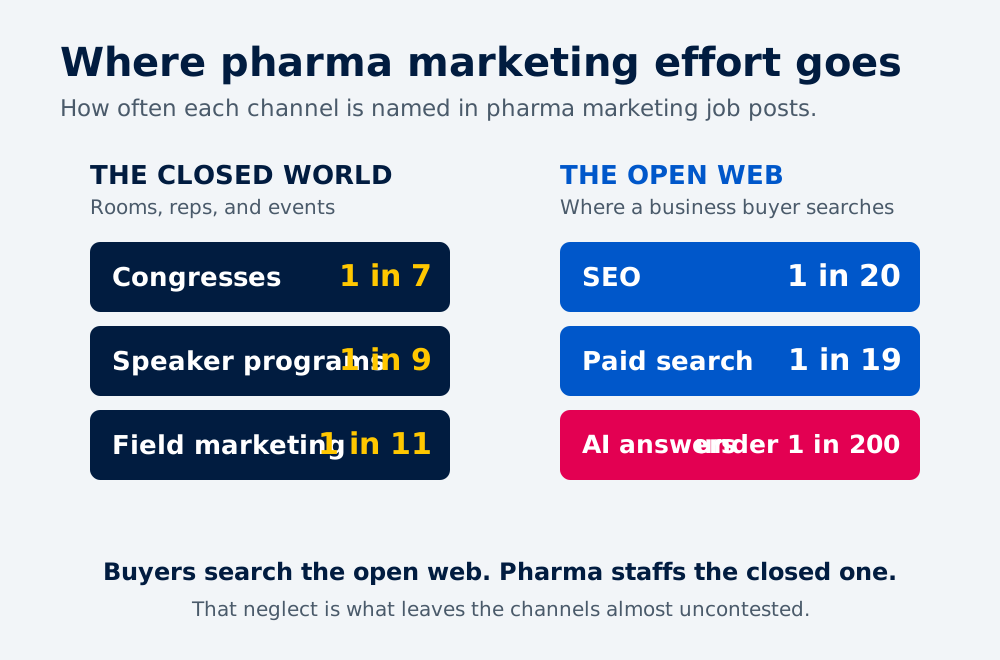
This matters because most pharma marketing effort goes somewhere else entirely. In our study of pharma marketing hiring, congresses and scientific meetings show up in about 1 in 7 job posts, field marketing in about 1 in 11, and speaker or peer-to-peer programs in about 1 in 9. That is the closed world: rooms, reps, and events. The open web, where a business buyer actually starts their search, is an afterthought.
Why the open web is still uncontested in pharma
Here is the number that should change how you plan. Across pharma marketing job posts, SEO is named in only about 5 percent, roughly 1 in 20. Paid search shows up in about the same share, 1 in 19. Optimizing for AI answers appears in fewer than 1 in 200. The channels that a B2B software company treats as table stakes are barely a named discipline in pharma.
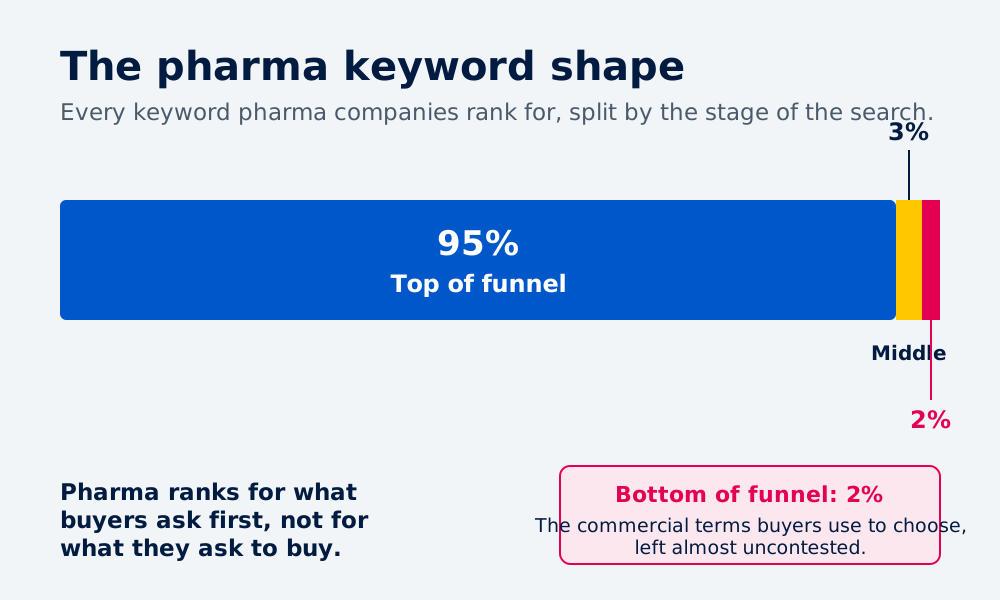
The content behind those channels is just as thin. Only about 1 in 25 pharma sites run an intentional, active content presence. About 95 percent of the keywords pharma companies do rank for are top-of-funnel, the early "what is this" terms, not the commercial terms a buyer types when they are ready to choose. The pharma content marketing guide walks the structural reasons that happens.
This looks nothing like B2B SaaS, where demand generation is a whole department. In pharma it is a rounding error, and a pharma marketer on Reddit confirmed why: the industry is "extremely conservative", leaning on agencies and internal Rx data, with independent open-web operators "basically unheard of."
None of that means pharma is not spending on digital. It is spending a fortune. US healthcare and pharma digital ad spend is set to reach $26.2 billion in 2026, against about $6.9 billion for traditional media, per eMarketer data reported by Fierce Pharma.
But look at what that money is. It is rented attention: connected TV, social ads, display, and paid search run by big-brand teams to reach patients and physicians. It is not the owned, compounding channels a B2B pharma company builds and keeps. The industry is renting reach by the month and leaving the assets that appreciate, a library that ranks, a brand people follow, a page an AI engine cites, almost untouched. That gap is the cheapest place a pharma company can win right now, and it is the starting point of any serious pharma marketing strategy.
The rest of this guide walks the channels inside that gap.
Search and SEO for pharma
Search is where a business buyer starts, and for pharma it is the foundation channel because it compounds. A page that ranks keeps pulling in buyers for years with no repeat spend.
Most pharma companies barely rank at all. In our data, a pharma company doing $1M to $10M in revenue sits at a median of about 110 monthly organic visits and 16 ranked keywords. At $10M to $50M it is around 360 visits and 57 keywords. Even at $50M to $100M the median is roughly 1,100 visits and 94 keywords, which is one or two orders of magnitude below what a B2B software company that size would run.
The bigger miss is what those keywords are. Branded terms, your own company name, make up only about 1 in 8 of the keywords pharma companies rank for but drive around 40 percent of their traffic. Almost all the visible traffic is people who already knew you. The non-branded terms that bring in strangers are the underused lever.
And the commercial terms are wide open. Only about 2 percent of pharma's ranked keywords are bottom-of-funnel, the "best," "vs," and "for" searches a buyer runs when comparing vendors. Third-party review sites win those by default because pharma companies never build for them.
We saw what closing that gap looks like with Westlab, a life-science manufacturer serving labs. Education-led SEO lifted qualified traffic by 205 percent in a narrow, technical niche, the kind of market people assume is too small for search to matter. The way we think about SEO here is as a distribution vehicle, not the strategy: you research the jobs your buyer is trying to do, the terms competitors leave uncovered, and the near-wins already sitting on your own domain, then you build the pages that own them. If the distinction still feels fuzzy, SEO and content marketing are not the same thing, and treating them as one is what produces a blog nobody buys from.
Paid search for pharma
Paid search is the fastest way to appear on a buyer's screen, and for a pharma company its real job is capture, not demand creation. You use it to be there for the person already searching for what you sell, especially the high-intent commercial and competitor terms.
The good news is that it is more affordable than most people expect. Across healthcare, the average search click runs about $5.64 and the average cost per lead about $66, per LocaliQ's 2026 benchmarks from more than 3,500 US campaigns.
B2B pharma buyer terms cost more than that consumer average. The top-of-page bid on "digital marketing for pharma" itself runs between $9 and $33 a click. A specialized business term with few searchers and high value behaves that way, which is exactly why it pays to capture that click rather than lose it.
Where pharma does run paid search, it usually points somewhere unhelpful to a commercial buyer. In emerging biotech, the ad budget most often goes to clinical-trial recruitment, not brand or category terms. So the commercial searches, the ones that signal a company evaluating a vendor, sit uncontested. Paid search is a scalpel for a pharma company: aim it at the handful of terms where someone is ready to choose, and let SEO and content do the demand building underneath it. The fuller case for and against running ads in this sector sits in our guide to paid media in life sciences.
LinkedIn and social for pharma
LinkedIn is where a pharma company's B2B buyers actually spend professional time, and most pharma companies run it as a billboard instead of a pipeline channel.
About 1 in 3 life-science companies run LinkedIn ads, but roughly 72 percent of that spend chases brand awareness and only about 2 percent, 1 in 40, carries a lead-generation objective. The median life-science company holds around 7,500 followers and posts at them like a broadcast channel. Reach is built; intent is not. What the feed can realistically do in pharma, and how to move a post through medical, legal, and regulatory review without losing the moment, is worked through in pharma social media marketing.
The pipeline on LinkedIn comes from two things pharma underuses.
The first is people, not the logo. A named expert at your company, a scientist, a founder, a technical lead, will out-reach the corporate page every time, because buyers trust a person over a brand account. Even the smallest life-science companies, doing under $1M in revenue, can build a following of a couple of thousand this way, and the credibility you compound now is what pays off later. The mechanics of that are in our guide to life science social media and LinkedIn marketing.
The second is content, not billboards. LinkedIn rewards a point of view and specific, useful posts. A steady stream of genuinely helpful material from your experts turns followers into a warm audience you can later invite into a webinar, a report, or a conversation. The ad account is fine for amplification. It is not the strategy. If your audience is clinicians rather than procurement, HCP content marketing for pharma covers what changes.
A content engine for pharma
Content is the channel that ties the others together. Search needs pages to rank. LinkedIn needs something worth posting. Email needs something worth sending. AI answers need something worth citing. An owned content engine feeds all of them, and it does the one job a small pharma team cannot scale any other way: the pre-sales trust-building that reps used to do one account at a time. That interlock is the whole argument for running demand generation and content marketing as one system.
Almost no pharma company runs one. Only about 1 in 17 pharma sites run a blog at all, only about 1 in 21 run a real resource hub, and about 1 in 3 content-producing sites publish nothing that helps a buyer at the decision stage. The buyer who arrives ready to evaluate finds nowhere to land and bounces to a third party.
This is where a content engine changes the economics of the whole company. Working with Westlab, we watched the content library take over the trust-building that used to depend on repeated rep visits, one lab at a time. In a market that had run entirely on cold outbound, the system generated 241 inbound leads in three months and influenced $120,000 in quotes, and it returned 869 percent on the content investment. We shipped 40 educational pieces in two months through a human-plus-AI production pipeline, so speed was never the blocker people assume it is.
That is what "content as revenue infrastructure" means in practice. A pharma company's expertise, the science, the regulatory know-how, the answers your best people give on every sales call, is the most valuable raw material you own. Left inside the sales team, it walks out the door with each hire. Built into a content engine, it works every day, for every buyer, before anyone picks up the phone. The tactical layer, what to build and in what order, sits in pharma content marketing tactics that compound, and the wider sector view is in our life sciences practice.
Video, YouTube, and podcasts for pharma
Pharma has handed the video and audio space to everyone except itself. Inside the small group of life-science companies that market actively, about half run a podcast or YouTube channel, so the few that show up own a disproportionate share of voice. Across the wider industry, podcasts appear in roughly 0 percent of marketing job posts, so it is barely a staffed function. The channel is not competitive; it is empty.
That would not matter if the audience were not there. It is. In Elsevier's 2024 survey of 1,307 physicians, 82 percent use YouTube at least weekly, 62 percent rely on educational or instructional videos to stay current on new medical developments, and 48 percent say video is more convenient than attending a conference. A technical buyer, a scientist, a clinician, a lab director, will watch a clear explainer before they will read a brochure.
Short, credentialed video is where trust builds fastest for that buyer. A subject-matter expert walking through a method, a mechanism, or a decision does more for credibility than any amount of polished brand production. With Westlab, two webinars and a flagship thought-leadership piece let the team co-create with lab managers rather than broadcast at them, which is what turned an audience into pipeline. If webinars are the format you want to run, start with the complete guide to webinar production, then work out which distribution channels earn the repurposing.
Email and nurture for pharma
Email is the one channel a pharma company fully owns, and it is the one most consistently underbuilt. Only about 15 percent of life-science marketing job posts name email or CRM at all. The nurture layer is thin, which is a problem in a market defined by long, cautious, high-consideration buying cycles. What building that layer properly involves is set out in pharma email marketing and nurture.
Email is not a blast. It is the mechanism that keeps a slow buyer moving. With Westlab, always-on educational nurture shortened cycles in a cautious, price-sensitive market by keeping the company useful in the buyer's inbox between the moments they were ready to act. The consent, list-building and deliverability mechanics are covered in life science email marketing.
The other lever is speed and follow-through. Working on a gated-report campaign with a B2B client, we treated the download as the start of the funnel, not the goal. Most of the value sat in an automated nurture that followed up with more value and warmed the lead toward a call, wired so the client never had to run it by hand. When we tested filling in competitor contact forms, only one competitor followed up quickly, which tells you how low the bar is: the speed of your first follow-up is often the whole advantage. What you need underneath that is an automation stack sized to the company, not a licence you never configure.
Answer engines and AI search for pharma
The newest open-web channel is the AI answer, and pharma is almost absent from it.
Every industry query now triggers an AI Overview, about 100 percent of the time in our analysis. Pharma companies show up in roughly 1 in 3 of those AI answers for awareness-stage questions, but in about 0 percent for the consideration and decision questions that precede a purchase. Government and academic domains dominate the medical answers, and commercial pharma is missing from the conversation exactly where a buyer is choosing. The causes behind that are specific and fixable, and we set them out in why pharma disappears from AI search.
Meanwhile the audience has already moved. In a 2026 study of 300 pharmacists, 72 percent said they use ChatGPT for drug information, asking it about dosage adjustments, drug interactions, and adverse reactions. The professionals closest to your buyer are querying AI directly, and when the answer comes back, your company is not in it.
Getting cited is not the same game as ranking. AI engines apply a conservative trust filter to medical content and cite what is structured, sourced, and authoritative. Almost nobody in pharma is building for that yet; optimizing for AI answers shows up in fewer than 1 in 200 job posts. The company that structures clear, credentialed, well-sourced content now becomes the answer for its category while the field is still empty. Two pieces explain the mechanism: why a brand that ranks on Google still misses the AI answer, and what makes one brand get cited while a better-known competitor is ignored.
How do you measure digital marketing for pharma when there is no online sale?
You measure the movement toward a sale, not the sale itself. The absence of an online checkout does not remove measurement; it just moves the signal earlier in the funnel.
The practical model maps digital's job to trackable stages. A marketer on the same Reddit thread named the answer without the framework: when direct sales lead generation does not fit your industry, "soft lead generation like email sign ups or white paper downloads can be an effective marketing tactic to track." That is the core of it.
The way we build it, every stage has a signal:
- Aware: organic and AI-answer visibility, reach on social, traffic to educational pages.
- Interested: a visit to your hub or a return to your site.
- Engaged: a download, a signup, a webinar registration, the soft conversions that show intent without a purchase.
- Qualified: a demo, a quote request, or a contact from a role and account that fit, handed to sales with context.
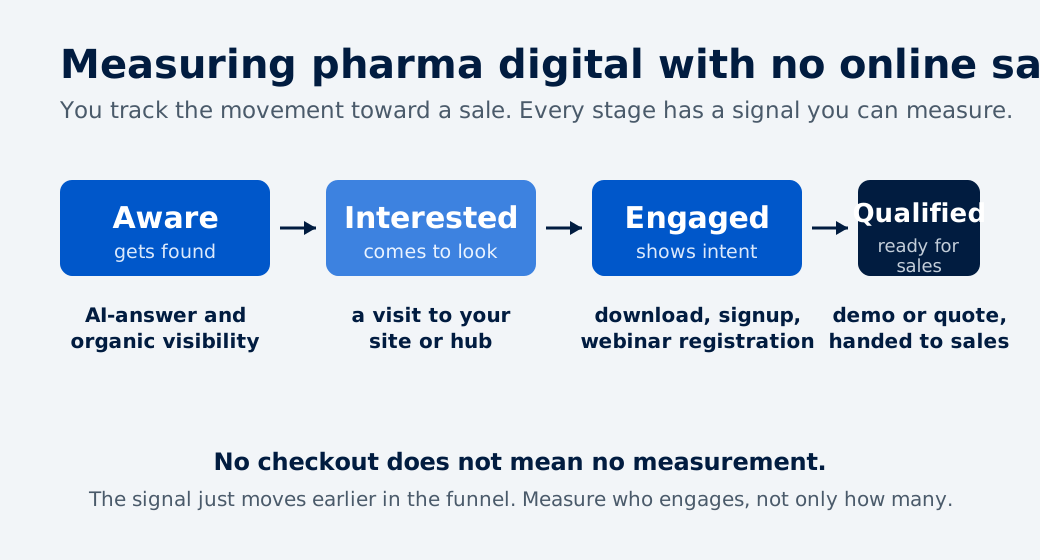
The point is to know how a lead is supposed to move before you make the content, then to watch the engagement signals that predict readiness. With Westlab, the signals from the content hub told sales which leads were genuinely serious, and each lead arrived enriched, turning a bare contact into context instead of a guess. The full attribution build, and the metrics worth ignoring, are in pharma marketing analytics and ROI and what demand generation metrics to track and not to track.
There is a harder version of this problem worth naming. Nick Smith, who has spent more than a decade in pharma marketing, describes the two questions every brand team asks: who is actually engaging, and is the money doing anything. He recounts a boardroom where strong traffic numbers landed flat until a chief commercialization officer asked the only question that mattered: "who the hell are they?" The lesson for a B2B pharma company is to measure who, not just how many. Ten of the right accounts on your site beats ten thousand strangers.
The real bottleneck for pharma digital marketing is approval, not channels
If your pharma digital marketing underperforms, the cause is usually not the channel you picked. It is how long it takes to get anything approved.
A pharma marketer put it exactly on Reddit: "the real bottleneck isn't the platform though, it's MLR review cycles killing campaign momentum. Most pharma brands underperform digitally because of slow approvals, not poor channel choice." You can pick the perfect channel and still lose, because the content dies in review while the moment passes.
This is why the pharma marketer's job is really an orchestration job. Cross-functional collaboration shows up in about 4 in 5 pharma marketing posts; the role is a connector first and an executor second, because getting work through legal, medical, and regulatory is most of the battle.
The answer is not faster ads. It is an owned content system built for a regulated category: modular, pre-approved building blocks that clear review once and then feed every channel, a library that ranks and gets cited, and a production pipeline that ships without starting the approval clock from zero each time. That is what we built with Westlab, operationalizing the expertise trapped in the sales team into a repeatable engine that kept producing. If you are weighing whether to build that in-house or bring in help, how to choose a pharma marketing agency sets out what to test for.
AI made it trivial to produce content, so volume is no longer the differentiator and the open-web channels have flooded everywhere except here. In pharma, the channels are still empty and the buyers are already on them. The pharma companies that win the next few years will be the ones that stop treating content as a series of campaigns to push through review and start treating it as revenue infrastructure: the system that gives their expertise a job on every channel a buyer actually uses.
Is your pharma content a series of campaigns, or revenue infrastructure?
Get a Content RevOps audit, your open-web channel gaps, missing decision-stage pages, and measurement holes benchmarked against the pharma 2026 data, with every gap priced in numbers your CFO can argue with.
Frequently Asked Questions
About the Author

Founder & CEO, Content RevOps
Stefan Kalpachev is the founder and CEO of Content RevOps, where he helps B2B SaaS companies transform their content into predictable pipeline. With a background in content marketing and revenue operations, Stefan has developed a unique methodology that bridges the gap between content creation and revenue generation.
Connect on LinkedInRelated Articles
Video Marketing for Asset Managers: Turn the Input You Already Have Into a Distribution Engine
Oct 24, 2026
Content Marketing Strategies for Asset Management Firms
Oct 23, 2026
The Biggest Content Marketing Mistakes Asset Managers Make
Oct 22, 2026