HCP content marketing for pharma, reaching clinicians on the open web
Clinicians research the open web before any rep, and pharma is barely there. Want to see where your HCP content is invisible?
Book a CallMost HCP marketing in pharma is built to push. A rep books the visit, a physician-only network sells the impressions, and an email lands in a crowded inbox. That model still has a place, but it is aimed at a clinician who no longer waits for it. Today the physician looks things up first, on their own, before any rep gets a meeting, and pharma's best material is rarely where that search lands, which is the gap content marketing is built to close.
Part of Content Marketing for Pharmaceutical Companies.
This is a guide to the other half of HCP marketing, the half that earns attention instead of buying it. It is written for pharma marketers deciding where their HCP budget should go, and it argues for one specific shift: build credentialed, findable content on the open web, because that is where clinicians research and where pharma is currently absent.
What is HCP marketing in pharma, and what has changed?
HCP marketing in pharma is the work of informing healthcare professionals, mostly prescribers, about a drug's clinical value, safety, and appropriate use. It is evidence-led rather than emotional, it is tightly regulated, and it targets the people who decide what a patient gets, not the patient. That definition is not in dispute, and every agency guide on the topic repeats it. The patient side is a separate program with its own content and its own constraints, which is what patient-centric pharma marketing covers.
What has changed is the direction of the relationship. For years the assumption was that reach gets pushed at the clinician, through a rep in the office or a paid slot on a physician platform. Pharma still leans hard on that assumption. In our analysis of how pharma actually staffs and spends, tradeshows and industry events show up in about 14 percent of pharma marketing job posts, roughly 1 in 7, and field marketing in about 9 percent, roughly 1 in 11. In-person is still the center of gravity, a pattern that runs through life sciences more broadly.
The clinician moved anyway. They research on their own now, and they decide well before a rep gets a word in.
The people who study clinician engagement have watched this happen. The UK healthcare content agency Brandcast Health puts it bluntly: HCP engagement "doesn't live or die by AI hype or omnichannel tech. Yes, these tools matter, but without trusted, relevant content, they're absolutely meaningless." The channel is not the asset. The content is the asset, and pharma keeps buying channels, which is the same trap we describe in multichannel and omnichannel marketing in life sciences.
Where do HCPs look for drug information before they talk to a rep?
They look on the open web, and they answer most of their own questions there. A clinician deciding how to treat a patient draws on training, guidelines, peers, and their own searches, and they do that independently, often before a rep conversation and often instead of one.
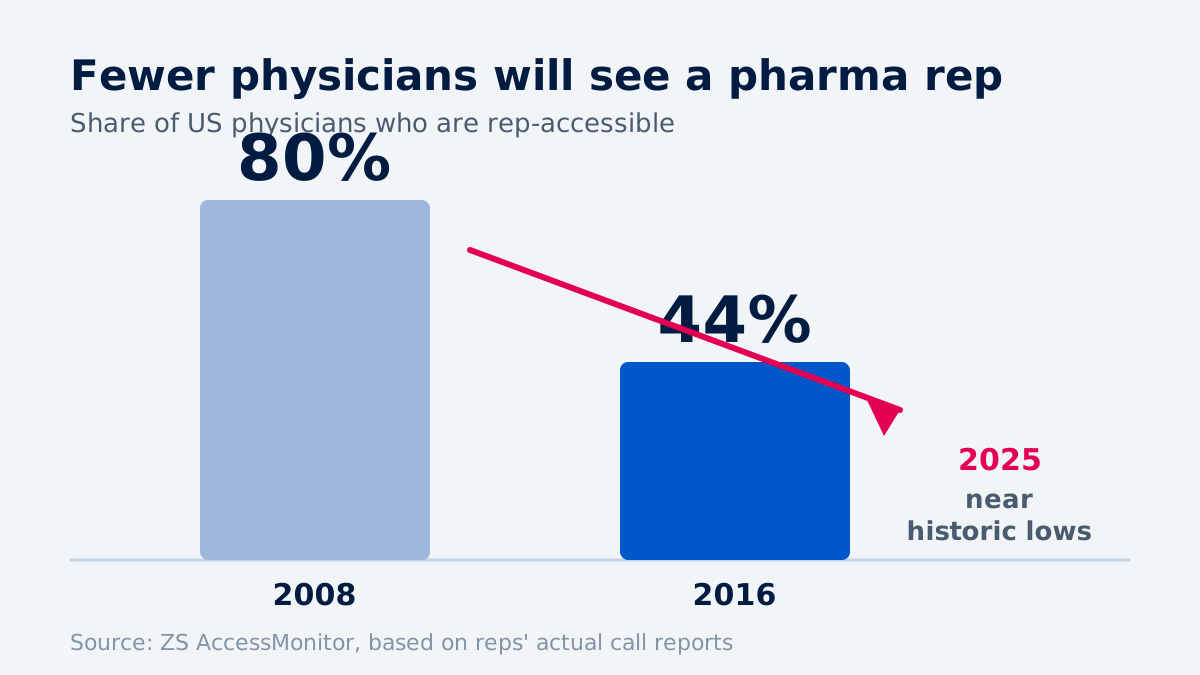
The numbers on rep access make the shift hard to argue with. ZS tracks actual sales-call reports from more than 40,000 US pharma reps against hundreds of thousands of prescribers. The share of physicians who are "rep-accessible," meaning they meet with more than 70 percent of the reps who try to reach them, fell from nearly 80 percent in 2008 to 44 percent in 2016. ZS's 2025 biopharma report finds physicians' willingness to engage reps frequently sitting near historic lows, and notes that a doctor getting 12 emails a month from a single brand opts out regardless of how good the content is. The push channels are both shrinking and saturating.
So the clinician self-serves. When Decision Resources Group surveyed 1,285 US physicians, close to half, 49 percent, said they never have a question for a rep that they cannot answer online. In the same survey the share of physicians with no rep contact at all had climbed from 24 percent to 39 percent. A global Sermo survey of physicians reached the same place from a different angle: sales reps are no longer the top preferred source for medical information, and in the US and EU physicians' own online research is the main source.
The clinician now brings AI into that search
The research surface grew again, fast. The American Medical Association found that 66 percent of US physicians used healthcare AI in 2024, up from 38 percent the year before, and its 2026 survey puts professional AI use above 80 percent. This is not a fringe habit.
It also reaches drug-level questions, which is exactly where pharma content should live. Elsevier's Clinician of the Future 2025 survey of 2,206 clinicians found that 30 percent already use AI to check drug interactions, and that among clinicians using AI for work, 97 percent reach for a generalist tool such as ChatGPT. When a physician asks an assistant about an interaction or a mechanism, pharma's content is either in that answer or it is not, which is the question behind why your brand is not showing up in ChatGPT or Perplexity answers.
Brandcast Health described the underlying behavior before the AI numbers caught up. Clinicians, their team says, "do not make split decisions on prescribing medicines. They use their years of experience, their clinical background, their medical education, their relationships with trusted peers." The practical point they draw is the one that matters here: give clinicians valuable content over time and they come to you with questions rather than "seek information elsewhere." Elsewhere is where they go today.
Why is pharma's best HCP content invisible where clinicians look?
Because pharma keeps its most credible material off the open web. The clinical depth exists, but it sits behind HCP portals, registration walls, and gated PDFs, or it lives in a rep's slide deck, or it never gets published in a form a search engine can read. A portal login and a rep-only deck are invisible to a clinician's own search by definition, and invisible to the AI summarizing that search.
The gaps in what pharma does publish are just as telling. Across the pharma sites in our content audit, only about 2 percent, roughly 1 in 43, publish technical documentation in any structured, indexable form. A clinician who wants that depth bypasses the company entirely and trusts a third party instead.
The pattern holds down the funnel:
- About 1 in 3 pharma content producers run no decision-stage content at all, so a clinician who arrives ready to act finds nowhere to land and gets redirected elsewhere.
- Only about 1 in 21 pharma sites offer a downloadable resource, the simplest way to turn an anonymous visitor into a known one.
None of this is a content-quality problem. It is a placement problem. The material a clinician would find useful is either locked away or absent from the web they actually search, and locking good content away is the same as not having it, as far as discovery goes.
What makes HCP content credible enough for clinicians to trust?
Credentials, citations, a visible expert, and real depth. A clinician extends trust to content that shows who wrote it, what it stands on, and whether the claims hold. The same signals happen to be the ones a machine can check, which is why they do double duty, but start with the clinician, because the clinician is the reason the content exists.
Pharma is halfway to these signals and stops. Our audit of active pharma sites found that:
- About 66 percent, roughly 2 in 3, publish under named authors. Anonymous authorship in medical content is a real disadvantage, and the third that stays anonymous carries it.
- About 50 percent, 1 in 2, display an author's credentials such as an MD or PhD. Credentialed authorship is the single most defensible trust signal in pharma content, and half the field forgets it.
- About 60 percent, 3 in 5, cite external authoritative sources. The other 2 in 5 leave a free credibility signal on the table.
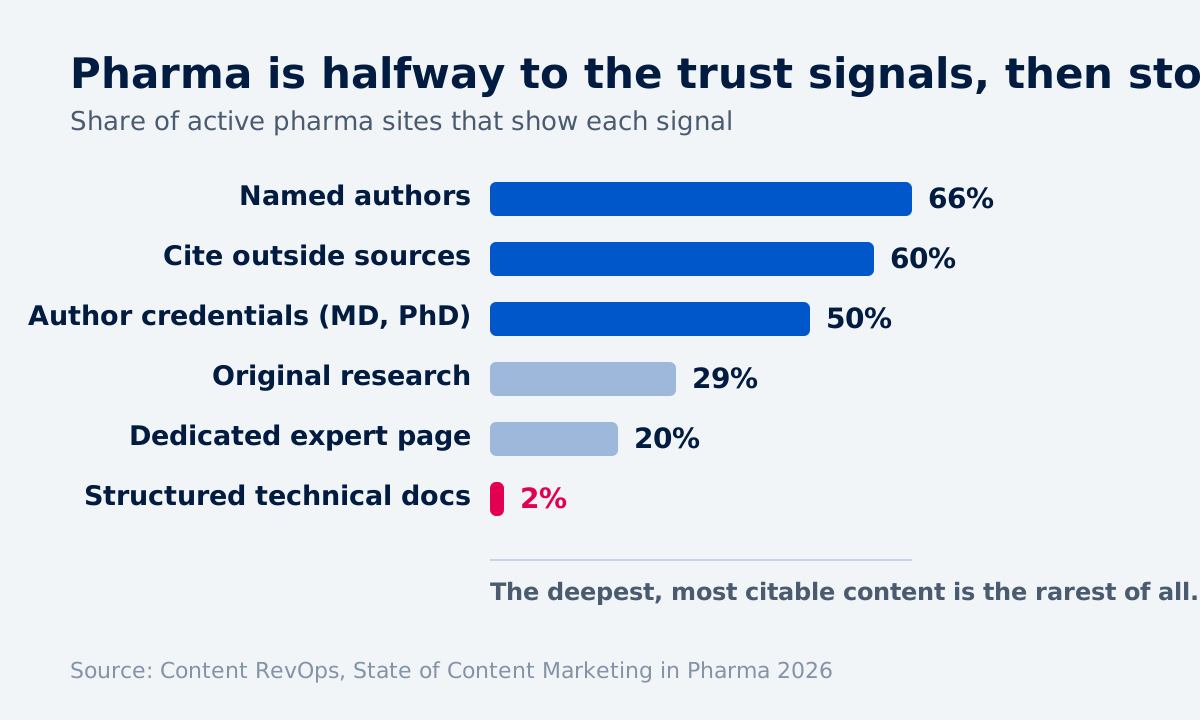
Two more assets are rarer and worth more. Only about 1 in 5 pharma sites maintain a dedicated expert or team page, the one-time editorial build that lends authority to every article after it. And only about 29 percent, roughly 3 in 10, publish any original research or proprietary data, the asset that earns citations and authority for years rather than for a campaign. The same scarcity shows up across every vertical in our cross-vertical state of content marketing study.
The way we think about this is simple. Every one of these is a trust signal a clinician reads in seconds, and most of them cost editorial discipline rather than budget. A named expert, a citation, a real methodology; these are cheap to add and expensive to fake, which is exactly why they work.
Why do AI answer engines leave pharma out of drug answers?
Because the engines reward the same signals clinicians do, and pharma is missing them. When a clinician asks an AI about a drug, the model reaches for sources it can verify, and pharma's own domains rarely qualify.
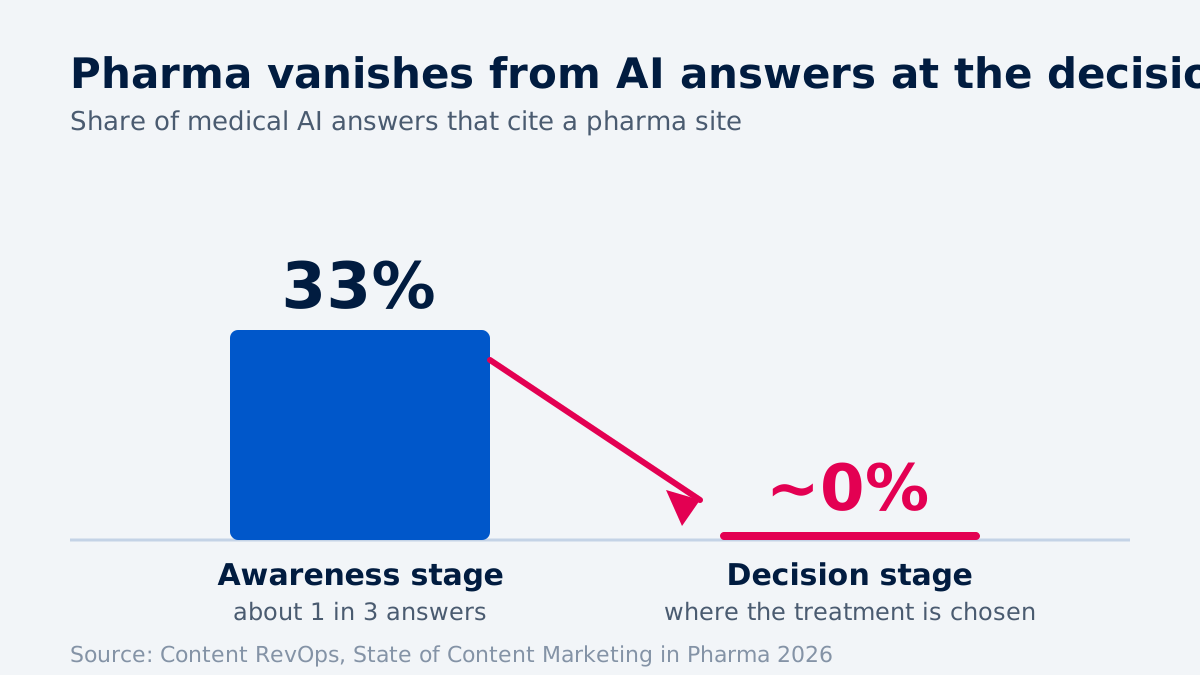
Our audit found pharma sites appear in close to 0 percent of AI-generated answers for consideration and decision-stage medical queries, the point where a treatment choice is actually made. Pharma shows up more at the awareness stage, around 1 in 3 answers, then vanishes exactly where the decision happens. On the "hcp marketing" search itself, an AI Overview now sits at the top of the page, and the sources it cites are agencies and vendors, not the manufacturers. What it takes to reverse that is its own piece: why pharma disappears from AI search, and how to come back.
The independent citation data explains why. A peer-reviewed analysis of ChatGPT's health answers coded 615 cited sources across 100 health questions and found that more than 75 percent came from established institutional sources, meaning medical institutions, government bodies, encyclopedias, professional associations, and peer-reviewed journals. The useful part is what the commercial sites that did get cited had in common. They compensated for a lack of inherent authority with explicit signals: they stated medical review in 71 percent of cases, used structured data markup in 87 percent, and ran comprehensive content over 1,500 words in 68 percent, all far above the institutional rate. The paper frames those as four questions an engine effectively asks: who wrote it, who published it, how it was vetted, and how AI can find it.
That is the E-E-A-T checklist a clinician reads, restated as machine logic. A pharma page with no named author, no credentials, no citations, no structured markup, and thin depth gives the engine nothing to trust, so it cites the journal or the government archive instead. It is the same mechanism behind why one brand gets cited in AI answers while a better-known competitor gets ignored.
Across engines and every query type, brand fame buys nothing. A study of 824,997 health citations across ChatGPT, Gemini, Perplexity, and Google's AI search found the NIH's PubMed Central to be the single most-cited health source, with authoritative sources placed first in the answer, and the famous consumer health brands each holding well under 1 percent of citations. The authority preference is not a single-engine quirk; BrightEdge found both ChatGPT and Google's AI Overviews favoring institutional sources over consumer media by two to four times.
Almost nobody in pharma is building for this. Answer-engine optimization appears in about 0.5 percent of pharma marketing job posts, roughly 1 in 200. The lane is wide open, and the way in is credentialed, cited, structured content on the open web, which is also the short answer to whether AI search needs different content from strong SEO pages.
How do you build HCP content that reaches the open web?
You take the clinical depth pharma already owns and move it into the open, in a form a clinician and an engine can both read. The work is less about producing new science and more about publishing the existing science where it can be found and trusted. The tactics that compound in pharma almost all start here.
Ungate what does not need a gate
Most gated HCP content is gated by habit, not by regulation. A mechanism-of-action explainer, a dosing consideration, a comparative safety summary; these do not need a login to be compliant, and behind one they cannot be found. Publish them openly, in indexable pages rather than downloadable PDFs, and reserve gates for the few assets where a lead exchange genuinely earns its friction.
Put a credentialed name and real citations on everything
Every clinical page gets a named author with visible credentials, links to the primary sources behind its claims, and a dedicated expert page standing behind the byline. This is the cheapest credibility work available, and half the field skips it.
Structure it so a machine can read it
Comprehensive depth, clear headings, and structured data markup are what let an answer engine lift a claim cleanly and attribute it to you. The commercial sites winning AI citations are not more famous than pharma; they are more structured. The practical version of this is optimizing for AI Overviews without wrecking the page for human readers.
Treat the education as the product, not the wrapper
The strongest version of this stops thinking of content as support for a rep and starts treating it as the thing itself. A useful parallel comes from an adjacent corner of life sciences. Westlab, a manufacturer selling to laboratories, ran the classic rep-dependent motion of cold calling, conferences, and lab visits, with all its expertise trapped in the sales team. Its buyers are lab professionals and scientists rather than prescribers, so this is an adjacent proof rather than an HCP campaign, but the mechanism is the same one at stake here.
We packaged that trapped expertise as an open education program, so the content did the pre-sales trust-building the reps used to do one lab at a time. In three months it generated 241 inbound leads in a market that had run on cold outbound, influenced $120,000 in quotes, and returned 869 percent on the content investment. The education became the first thing a buyer met, and it did the work a rep could only do one conversation at a time.
For the full program view of how this fits a pharma content operation, our picture of pharma content marketing maturity and our guide to pharma marketing strategy carry the wider build, and content marketing for life sciences sets it in the broader sector.
How do you measure open-web HCP marketing?
You measure whether clinicians find you, trust you, and act, not how many impressions you bought. The campaign-impression metrics that dominate HCP reporting were built for the push model, and they miss the open-web job entirely, a problem we take apart in which metrics to track and which to drop. The wider question of how pharma content reaches pipeline at all sits behind this one. Four measures matter more:
- Organic and branded search visibility. Do you rank when a clinician searches the questions your therapy answers, and does branded search grow as they start to look for you by name.
- Share of AI answers you are cited in. For the drug and disease questions clinicians ask an assistant, are you in the answer, and cited rather than just mentioned.
- Engaged time and return visits. Depth of engagement, not clicks, tells you whether the content is doing the trust work.
- Inbound rep conversations that start from content. The clearest signal that education is feeding pipeline is a clinician who reaches out already informed.
Most pharma cannot see any of this yet, because the plumbing is not connected. Fewer than 1 in 12 pharma sites, under 9 percent, run a detectable CRM, and content cannot connect to pipeline without one. Westlab's system worked partly because engagement and readiness signals told sales which leads were serious, and every lead arrived enriched rather than cold. The measurement and the marketing-automation layer that carries it are their own build; our guide to life science marketing automation covers the web-to-pipeline connection this depends on.
Where should pharma point its HCP marketing spend?
Keep the rep and the paid channels for what they still do well, awareness and relationships, and stop treating them as the whole strategy. The decision the clinician makes has moved to the open web, to their own search and the AI answer sitting on top of it, and that is where pharma is absent. The content that would win that moment is not another campaign; it is the credentialed, findable, structured version of the clinical depth pharma already owns, and it is judged the way every other line of spend is, on what it returns.
Pharma spent years building that expertise and then locked most of it away or left it off the web that clinicians search. Giving it a name, a citation, a structure, and an open URL is how it starts doing a job again, as infrastructure that reaches HCPs where they now decide.
Is your pharma content where clinicians actually look, or locked behind a portal?
Get a Content RevOps audit, your HCP content benchmarked against the pharma 2026 data, with every open-web and AI-answer gap named and priced in numbers your CFO can argue with.
Frequently Asked Questions
About the Author

Founder & CEO, Content RevOps
Stefan Kalpachev is the founder and CEO of Content RevOps, where he helps B2B SaaS companies transform their content into predictable pipeline. With a background in content marketing and revenue operations, Stefan has developed a unique methodology that bridges the gap between content creation and revenue generation.
Connect on LinkedIn