Do I Need Different Content for AI Search Visibility, or Will Strong SEO Pages Still Work?
Not sure whether your content is the problem — or whether the web just doesn't talk about you enough? Find out where your AI visibility actually leaks.
Book a CallThere's a comment buried in an r/content_marketing thread that sums up the anxiety better than any vendor blog: "only 12% of ChatGPT citations match Google's first page results. So you can rank #1 on Google and still be completely invisible to AI."
That line gets repeated because it's frightening and, roughly, true. And it lands on a desk as a budget question: do we need a whole new kind of content for AI search, or will the strong SEO pages we've spent years building still carry us?
Type the question into Google and you'll get a wall of near-identical answers, all hedging toward the same shrug — "it's not either/or, do both, the fundamentals haven't changed." That's comfortable, and it's not wrong, but it's useless. "Do both" isn't a plan. It doesn't tell a content lead with finite hours what to actually change on Monday, or what to leave alone.
So here's the useful version of the answer, up front:
You almost certainly don't need different content. You need your strong content made extractable — and you need the off-page authority that was always the real lever. The teams frantically "rewriting everything for AI" are mostly solving the wrong problem.
The word "content" is hiding three different jobs inside that question. Pull them apart and the decision gets easy. Let's dive in.
The short answer, decomposed into three layers
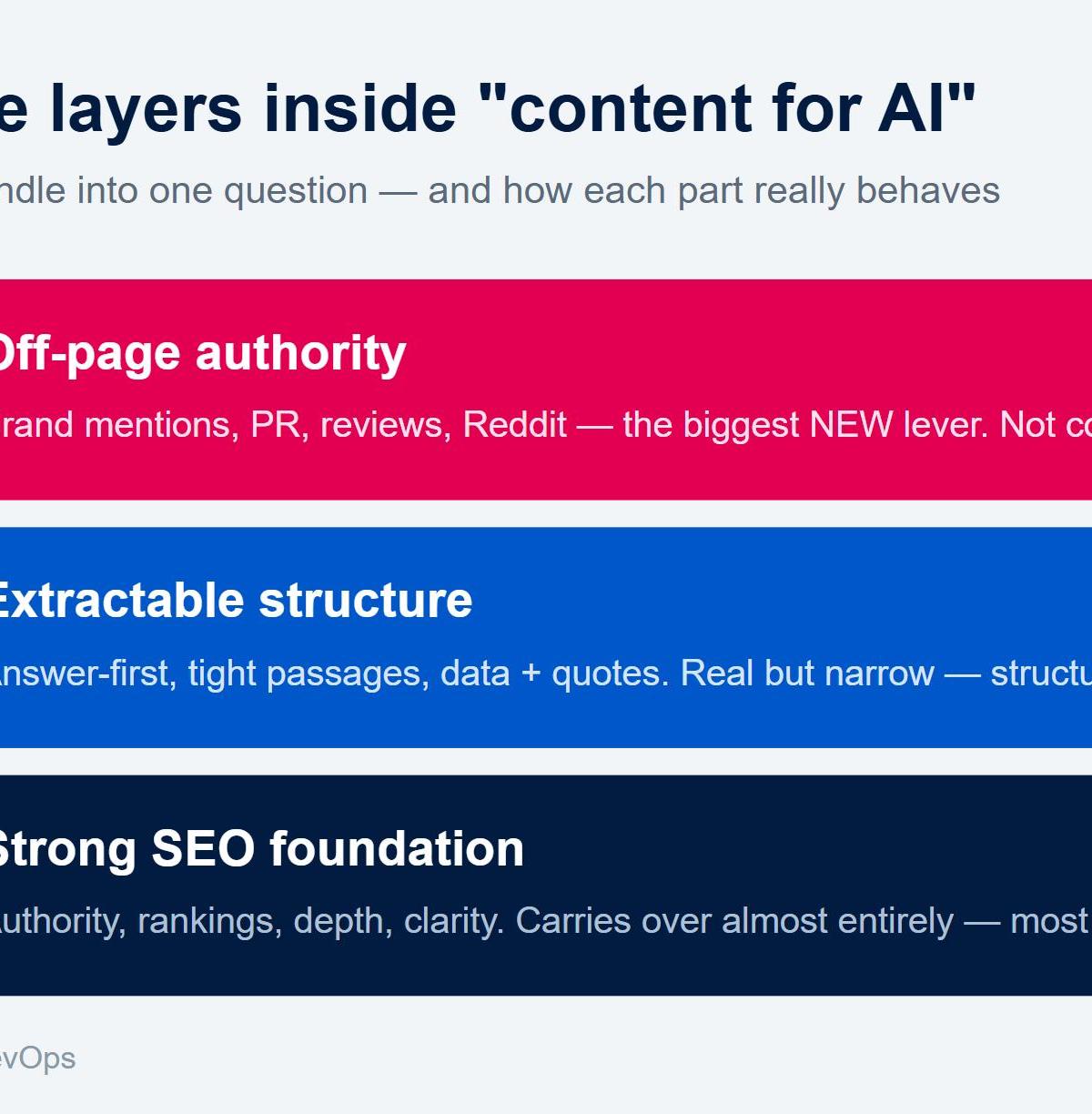
When people ask whether they need "different content for AI," they're bundling three things that behave completely differently:
The foundation — strong, authoritative, well-ranked pages. This carries over to AI almost entirely. It's most of the work, and you're probably already doing it.
The structural delta — a real but narrow set of changes to how content is formatted and chunked so a model can lift it cleanly. This is the only place the phrase "different content" is even partly true, and it's structural, not topical.
The lever that isn't content at all — your brand's authority and corroboration across the rest of the web. This is the biggest new driver of AI visibility, and no amount of on-page rewriting touches it.
Most of the "AI content" panic spends its energy on layer two while ignoring layer three — which is backwards, because the evidence says layer three does the heavy lifting. The rest of this piece walks each layer, then gives you a way to decide where your hours should go.
Why strong SEO pages still work with an AI search visibility tool — more than you'd think
Start with the reassuring part, because it's the larger part.
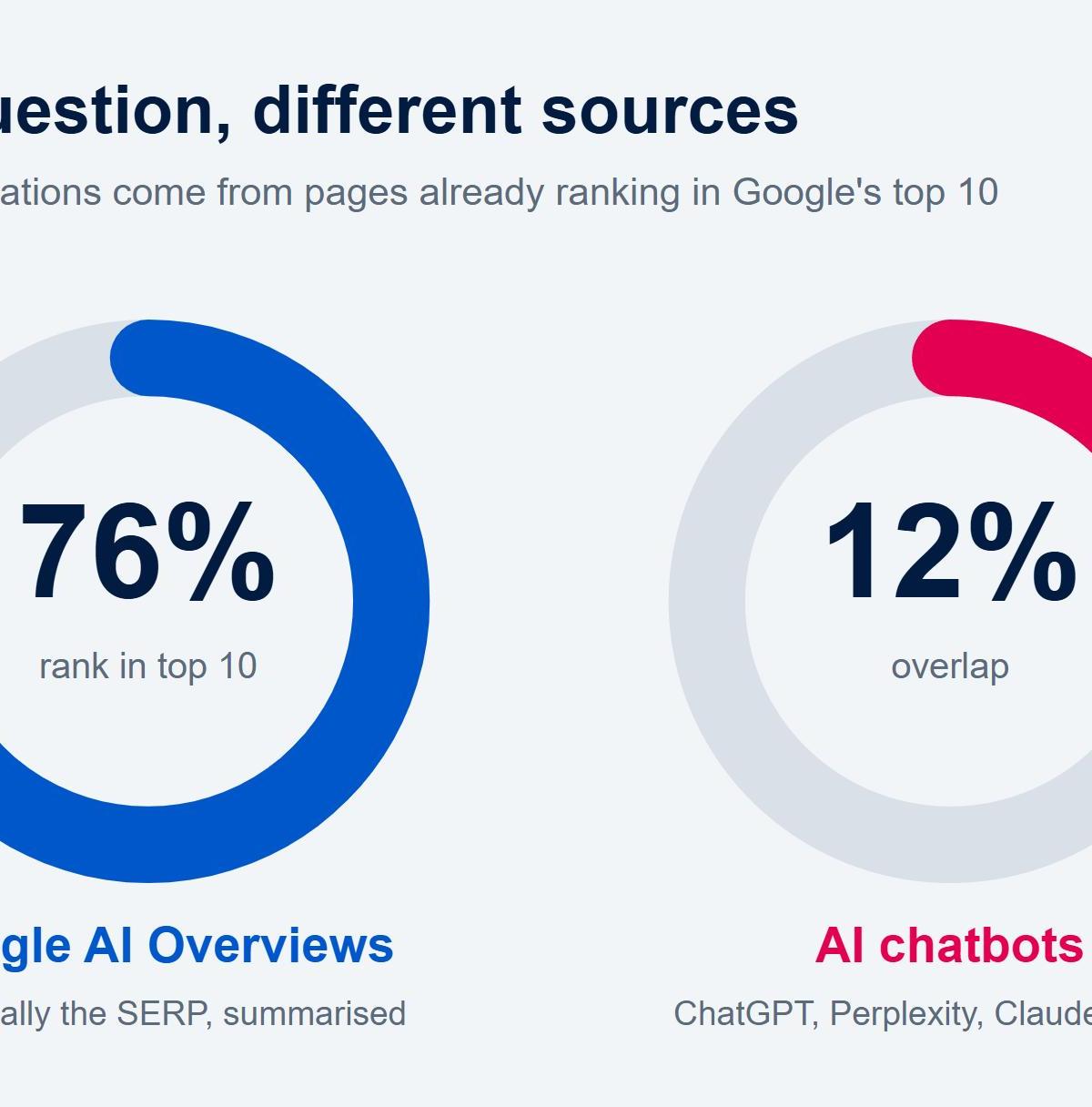
For Google's own AI Overviews — the summaries now sitting on top of a growing share of results — strong SEO isn't just relevant, it's the entire game. When Ahrefs studied 1.9 million citations from a million AI Overviews, it found that 76% of the pages cited already rank in Google's top ten for the query, and the typical cited URL ranks around position two. AI Overviews don't reach past the SERP for exotic sources; they summarize the front page you were already fighting for. If you rank, you're in the running. As Ahrefs' Si Quan Ong put it, ranking #1 makes you more likely to be cited — but "that chance is a coin flip at best."
The same logic shows up in what drives citations inside the chatbots. SE Ranking's study of 129,000 domains, run through an XGBoost model with SHAP analysis on a 100,000-prompt ChatGPT dataset, found the single strongest predictor of being cited is referring domains — classic, boring, link-earned authority. Domain traffic was second. Pages that already rank well, on domains the web already trusts, get pulled into AI answers at far higher rates. None of that is new work. It's the SEO playbook you've had for a decade.
And the foundational content qualities haven't changed either. Depth, clarity, accuracy, freshness, real expertise — the things that earn a Google ranking are the same things that make a passage worth quoting. The honest framing is the one Ahrefs' Ryan Law landed on in a piece titled, pointedly, "GEO, LLMO, AEO… It's All Just SEO." The discipline didn't get replaced. It grew a new surface.
So if you've been doing strong SEO, the foundation transfers. You're not starting over. Hold onto that, because the next part is where it stops being enough.
Where strong SEO isn't enough - the chatbot and AI overviews gap
Here's the catch that the "do both" crowd waves at but never explains: the rules that hold for AI Overviews fall apart for the chatbots.
ChatGPT, Perplexity, Claude, and Gemini don't mirror the SERP. When Ahrefs matched AI-assistant citations against search rankings, the overlap with Google's top ten collapsed to around 12% — and roughly 80% of the pages AI assistants cite don't rank in Google's top 100 at all for the original query. That's the source of the viral stat, and it's real. A chatbot and a search engine, asked the same question, frequently name completely different sources.
Why the divergence? Because a chatbot rarely answers your literal sentence. Google's own Liz Reid has described how AI Mode uses a query fan-out technique, "breaking down your question into subtopics and issuing a multitude of queries simultaneously," then assembling an answer from passages pulled across all of them. The unit of competition stops being your page's ranking for one keyword and becomes whether a paragraph of yours is the cleanest match for one of a dozen sub-questions you never saw.
Layered on top is the demand-side shift. Roughly 58% of US Google searches now end in zero clicks, per SparkToro and Datos. Pew found that when an AI summary appears, the share of users clicking through to an actual result roughly halves — from 15% to 8% — and Ahrefs measured a 58% drop in click-through rate for the #1 position when an AI Overview is present. The traffic isn't only being redistributed; for informational queries, a lot of it simply isn't leaving the results page.
Put those together and the picture is specific, not apocalyptic. Strong SEO keeps you visible in AI Overviews and feeds the authority chatbots draw on. But it does not guarantee you a seat in a chatbot's answer, because that seat is won at the passage level, against a fanned-out set of sub-queries, in a place where ranking is only a loose proxy. That's the gap the next two layers are built to close.
The real content delta is structural, not topical
This is the only place the phrase "different content" earns any truth at all — and it's narrower than people fear. You don't need different topics, different messages, or a parallel library of "AI versions" of your pages. You need the content you already have to survive being pulled out of its page and quoted on its own.
A practitioner in one of the threads I read put the test better than any framework: "read your own paragraph by itself, no headline, no intro. Does it still make sense as a standalone answer? If not, that's why you're not getting cited." That's the whole discipline in one sentence. Ranking thinking is about the page. AI thinking is about the paragraph.
There's a technical reason this works. Retrieval systems don't ingest your page whole; they break it into chunks, embed each one, and retrieve the chunks that best match a query. Mike King of iPullRank, who dragged the concept of "chunking" into SEO from information retrieval, puts it bluntly: "passages remain the atomic unit of meaning… models operate on chunks, not pages." A self-contained passage — one that carries its own subject, context, and claim — gets retrieved cleanly. An insight buried mid-paragraph, leaning on three sentences of earlier setup, is effectively invisible to the model even if Google loves the page it lives on.
What actually moves the needle here is well-evidenced, and refreshingly free of magic:
Lead with the answer. Put the direct, standalone answer in the first line under each heading, then expand. Models disproportionately lift the top of a section.
Keep passages tight and single-topic. SE Ranking found pages structured into 120–180-word sections earned 70% more citations than pages built from very short, fragmentary ones; King recommends self-contained passages in the 50–150-word range.
Add statistics, quotations, and cited sources. This is the most rigorously tested finding in the whole field. The Princeton-led GEO study, presented at KDD 2024, ran nine content tactics across thousands of queries and found that adding statistics, quotations, and source citations boosted visibility in generative engines by up to 40% — while keyword stuffing, the classic SEO reflex, actually hurt. Content moves, not keyword moves.
Notice what's not on that list: rewriting your positioning, spinning up an "AI blog," or duplicating pages in some machine dialect. The delta is formatting and evidence, applied to the strong content you already have. It's a polish pass, not a parallel content strategy. Our own analysis backs this up from the other direction: across 5,761 AI citations we pulled from 800 B2B questions in Perplexity, blog posts made up 60.5% of all cited pages while product pages were just 1.3%, and original data showed up on nearly half of cited pages. The model wasn't rewarding a special content type. It was rewarding structured, evidence-dense, educational material — the stuff good content teams already make, formatted so it lifts.
The lever that isn't "content" at all
Now the part the rewriting crowd keeps missing, and the one that most deserves your attention: the dominant driver of AI visibility isn't on your website.
The same Ahrefs research that mapped AI Overview brand visibility across 75,000 brands found that the metric correlating most strongly with showing up wasn't a content metric or even a link metric. It was branded web mentions, at a correlation of 0.664 — versus a feeble 0.218 for backlinks. Brands in the top quartile for web mentions averaged more than ten times the AI Overview appearances of the quartile below. Ahrefs' own conclusion is worth sitting with: the visibility that survives after the cheap tricks are stripped out "looks a lot like brand building — because that's exactly what it is."
It compounds from there. Kevin Indig's analysis found brand search volume is the single biggest predictor of visibility in ChatGPT. Reddit has become the most-cited domain across AI models. SE Ranking found brands with heavy Quora and Reddit presence are several times more likely to be cited. And Ryan Law makes the sharpest distinction of all: unlinked brand mentions — text about you on other people's sites — have little impact on SEO but a large impact on GEO, because that's how a model builds its understanding of who you are and what you're for.
This reframes the original question entirely. If your brand is missing from AI answers, the cause is usually not that your content is written wrong. It's that the web doesn't talk about you enough, consistently enough, in the right places. That's a digital-PR, reviews, and category-presence problem — and it behaves far more like PR than like SEO. One SaaS founder in r/seogrowth described watching organic traffic fall ~50% after a core update and AI Overviews expansion, then running a single PR campaign that got syndicated and picked up by AI systems — and seeing MRR climb 28% the following month. Earned media, not a content rewrite, moved the number.
This is exactly why we've started treating AI visibility as a demand-capture problem, not a publishing one. You don't need more content for its own sake. You need your positioning to show up consistently across your own site, third-party mentions, review platforms, and the category-language places buyers and models both read. If you only have budget for one move this quarter, getting your brand named — accurately and repeatedly — in the rooms the model reads will almost always beat another round of on-page edits.
Mentioned, cited, recommended - the B2B measurement trap
Before you spend a dollar, get the scoreboard right, because most AI-visibility tracking measures the wrong thing.
There are three distinct outcomes, and they are not the same: being mentioned (your name appears), being cited (your page is the linked source), and being recommended (you're named as the answer to a buying question). A practitioner put the trap plainly: "most tools only show if you're mentioned, not whether you're actually recommended. You could have high share of voice but still lose buyers if competitors get the positive recommendations when people ask for purchase advice."
For B2B, recommendation is the only outcome that touches pipeline, and it's won on a narrow set of buyer-intent prompts — "best X for [specific use case]," "vendors that support [compliance need]," "what integrates with [system]." That's where the money is, and it's a much smaller, more winnable target than "show up everywhere." It's also where the buying behavior stays human: Gartner found 45% of B2B buyers now use generative AI in a purchase, but 69% still validate what the AI tells them with a sales rep. The AI shapes the shortlist; the human closes. So the goal isn't raw citation volume — it's owning the recommendation on the dozen prompts that decide who makes your category's shortlist.
A decision framework: when SEO carries you, and when it doesn't
Here's how to turn all of that into where your hours actually go. The deciding variables are search intent and funnel stage — not a blanket "rewrite for AI."
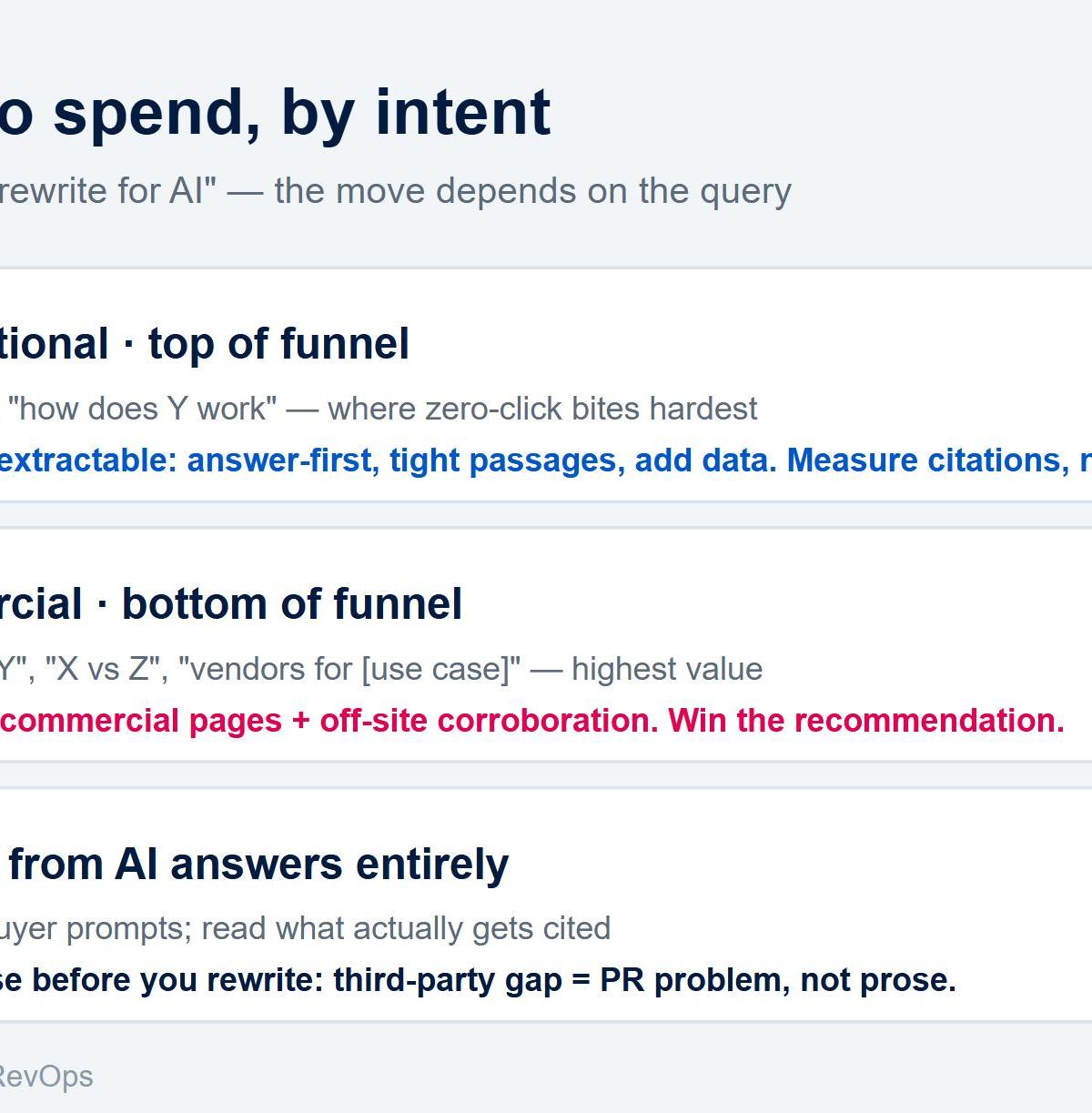
If the query is informational and top-of-funnel ("what is X," "how does Y work"), this is where zero-click bites hardest and where the structural content delta pays off most. Lead with the answer, tighten your passages, add data and quotes. Accept that some of this traffic converts to an on-page citation rather than a click — and measure the citation, not just the session.
If the query is commercial and bottom-of-funnel ("best X for Y," "X vs Z," "vendors for [use case]"), strong SEO still earns the click and the buyer still wants to choose. This is the highest-value target. Here the work is split: make your commercial pages legible and explicit (state capabilities, use cases, proof, integrations in plain text), and pour effort into off-site corroboration so the model is confident naming you. Our analysis of 431 brands ChatGPT recommended across 62 buying-intent prompts showed the winners weren't the most famous — they were the most legible, and what "legible" meant varied by industry: explicit certifications in manufacturing, the word "regulatory" on 67.9% of recommended life-sciences sites, visible pricing and free trials in edtech. There is no universal "AI rewrite." There's your category's proof, stated plainly.
If you're missing from AI answers entirely, resist the urge to rewrite first. Run your real buyer prompts through ChatGPT, Perplexity, and Google AI Mode, and look at what gets cited. If it's third-party pages — roundups, review sites, Reddit — your gap is corroboration (a PR and presence problem), not prose. If it's pages you could have written but didn't, and yours bury the answer, that's the structural delta. Diagnose before you spend.
The strategic risk to avoid is the most common one: dumping the budget into a parallel "AI content" rewrite while your brand stays quiet across the rest of the web. That's optimizing layer two while layer three — the one that actually drives citations — goes untouched. Strong SEO content is now necessary but no longer sufficient. The sufficiency comes from structure and, above all, from authority.
So, do you need different content for AI search visibility? No. You need the same strong content, formatted to be lifted, sitting under a brand the web already vouches for. That's not a new content strategy. It's the one you have — finished properly.
Ranking on Google but missing from the AI answers your buyers read?
Get a Content RevOps audit: we'll show you which layer is failing — extractability or authority — and the specific moves to get your brand retrieved, trusted, and named.
Frequently Asked Questions
About the Author

Founder & CEO, Content RevOps
Stefan Kalpachev is the founder and CEO of Content RevOps, where he helps B2B SaaS companies transform their content into predictable pipeline. With a background in content marketing and revenue operations, Stefan has developed a unique methodology that bridges the gap between content creation and revenue generation.
Connect on LinkedIn