What is life science marketing?
Three different jobs share one label. Not sure which one your company is actually running?
Book a CallTwo people can both say they work in life science marketing and be describing jobs that have almost nothing in common.
Part of Content marketing for life sciences, the complete guide.
One of them spends the week inside an approved label, turning clinical trial results into claims a sales team is permitted to repeat, and medical, legal, and regulatory review sees every asset before a customer does. The other writes application notes for a reagent, answers technical questions from bench scientists choosing between two suppliers, and never speaks to a regulator.
Both descriptions are accurate. That is the first thing to understand about this sector, and the reason generic content marketing advice so often bounces off it.
The useful question is not who this function sells to. It is what the job is made of, which is something the sector answers in plain language every time it writes a job description.
What is life science marketing?
Life science marketing is the commercial function that turns scientific capability into demand a company can act on. It owns four things:
- How the company is positioned
- The commercial evidence a technical buyer uses to evaluate it, meaning everything inside the label in therapeutics and everything a scientist can act on elsewhere
- The channels that reach that buyer
- The path from a first read to a qualified conversation
That definition holds across the sector. What changes is the constraint it operates under, and the constraint changes a great deal. Turning those four things into an actual plan is a separate exercise, and we have written it up as the five decisions that make a life science marketing strategy.
Which industries does it cover?
Life sciences is a broad label, and the marketing function looks different in each corner of it:
- Pharmaceuticals and biotechnology, including therapeutics at every stage from preclinical to post-launch
- Medical devices and diagnostics
- Research tools, reagents, instruments, and consumables, the products that sit on a lab bench
- Contract research and manufacturing organisations, CROs and CDMOs
- Laboratory and scientific services, from specialist assay development to testing
The shared thread is that the buyer evaluates on evidence rather than on persuasion, and usually evaluates as part of a group. The differences start immediately after that.
Why does one term cover three different jobs?
Underneath the single label sit three genuinely different functions. They have different owners, different constraints, and different definitions of success. Confusing them is the most common reason advice about life science marketing fails to land.
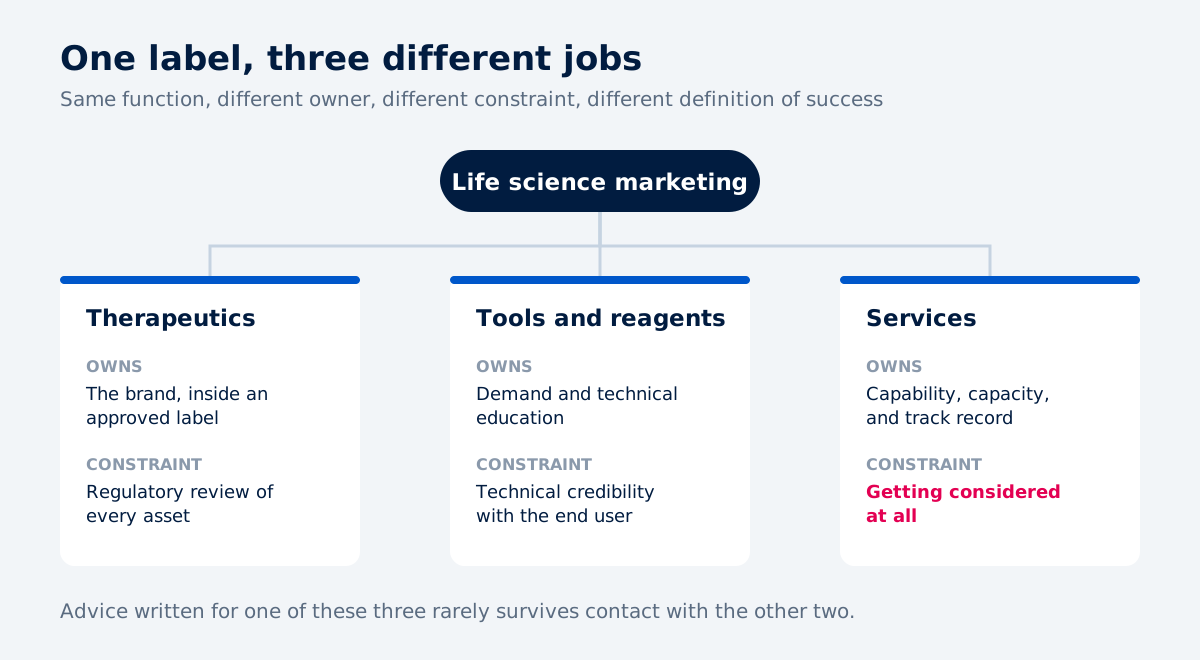
Therapeutics | Tools, reagents, and diagnostics | Services (CRO, CDMO, labs) | |
What marketing owns | The brand, inside an approved label | Demand and technical education for a catalogue | Capability, capacity, and track record |
What the buyer decides | Whether to prescribe or fund | Whether this product does the job | Whether this partner can deliver |
The binding constraint | Regulatory review of every asset | Technical credibility with the end user | Getting considered at all |
What good looks like | Claims that survive review and still persuade | Documentation a scientist can act on | A relationship in place before the need arises |
In therapeutics, marketing owns the product
In a pharmaceutical company the marketing team owns the brand, and the brand is the drug itself. A practitioner in a thread of biotech professionals on Reddit put the structure plainly: marketing, product, and brand are the same thing, and the marketing team owns it. Turning that ownership into an actual plan is a separate exercise, and we have written the therapeutics version of it as a pharma marketing strategy playbook.
The day-to-day work reflects that. It runs to content creation, asset production with an agency, medical-legal-regulatory review of those assets, and cross-functional planning that intensifies around a launch. The job is translating complex clinical data into a narrative that stays inside what the label permits, which is a distinct enough discipline that we treat content marketing for pharmaceutical companies as its own problem.
That constraint is not a matter of taste. It has a legal source, and the source is stranger than most people in the industry assume.
In tools and reagents, marketing educates a buyer who already knows the science
Here the buyer is often the person who will use the product, and they are evaluating whether it will work in their hands.
Lab Manager surveyed nearly 150 laboratory leaders for its 2023 purchasing trends research, asking what they weigh when choosing equipment. The ordering was:
- Price and value, rated very important by 88%
- After-sale support, maintenance, and warranty, at close to 80%
- Compatibility and usable software, close behind
- Extra features available, mattering to only about a third
That ordering is not what a product page usually emphasises. A lab leader is asking what this costs, whether it will keep running, and whether it will fit what they already have. Features come last. It is the pattern behind our work with Westlab, a laboratory supplier whose buyers arrive already knowing the science and needing the practical answers instead.
It shows up in how scientists describe being sold to. One, replying to someone who had assumed all life science selling looked like drug promotion, put it flatly: nobody buys lab products off a car salesman, and a representative who cannot discuss the science gets tuned out. The same logic applies to devices and diagnostics, where we have written separately on content marketing for medical device companies and on what medical device marketing covers as a function.
In services, the hardest part is getting considered
Services marketing has a structural problem the other two do not, which is why the marketing function at a CDMO or CRO looks so unlike the version most people picture.
Industry Standard Research runs an annual benchmarking study of Phase 2 and 3 clinical outsourcing, now in its sixteenth year. Among 232 outsourcers surveyed, 57% had preferred provider agreements in place. That figure splits sharply by company size: 88% of large sponsors use them, 54% of midsize sponsors, and only 16% of small sponsors.
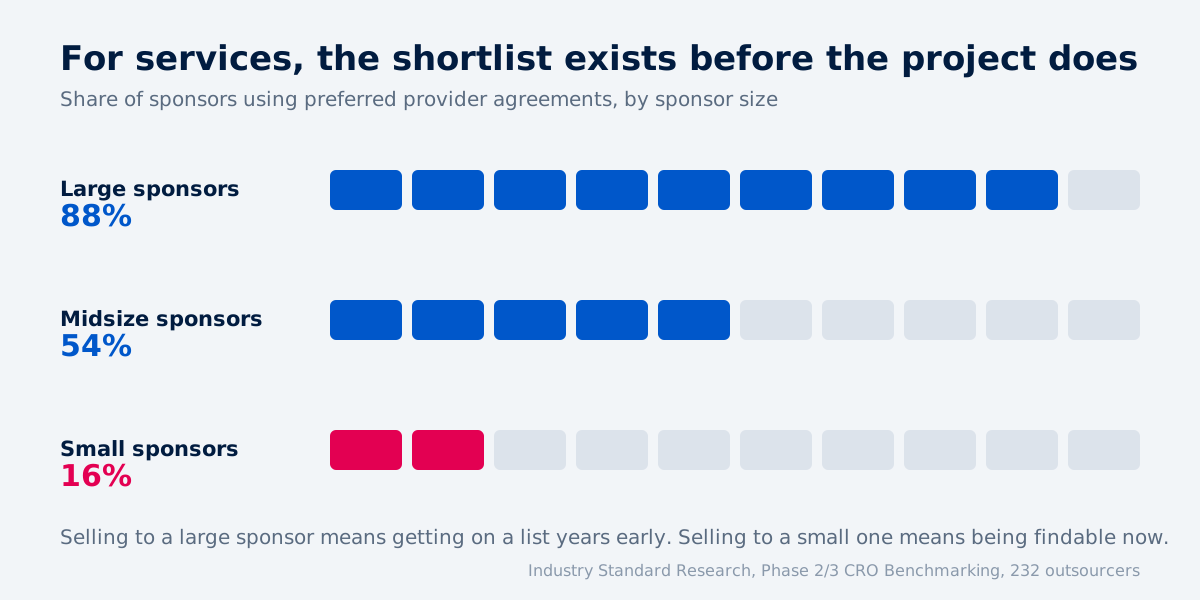
A preferred provider agreement is a pre-negotiated list of suppliers a sponsor will consider. If you are not on the list, most large sponsors will not evaluate you for a study, however good your capability is.
So the same job means two incompatible things depending on who you are selling to. Marketing to a large sponsor means getting onto a list, often years before any specific project exists, which is closer to content-led outreach than to campaigning. Marketing to a small sponsor means being findable and credible at the moment a need appears. One content plan cannot serve both.
There is also a discovery problem. Nice Insight's outsourcing surveys found sponsors used an average of 3.2 separate routes when identifying a new partner, meaning no single channel gets them there. A vendor who wins on one route and stays invisible on the other two still loses. The three leading routes were industry research, referrals from colleagues, and hiring consultants to run the search. Those are 2016 figures, so the levels will have moved, but the shape is the point: the main routes to being discovered are ones a marketing team influences indirectly at best, which is why we treat distribution as a design problem rather than a publishing afterthought.
Services marketing therefore works less like campaigning and more like becoming the obvious, well-documented answer when somebody else does the looking. What sponsors say they buy on supports that. A survey of sponsors and CROs run by the University of the Sciences in Philadelphia and TTC, published in Applied Clinical Trials, found the single most important selection quality was the sense that the two project teams could work together well, ahead of experience, execution planning, and price.
What does a life science marketer actually do?
The clearest way to answer this is to look at what the sector asks for when it hires.
For our state of content marketing for life sciences research, we read the requirements sections of life science marketing job postings and counted how often each skill was named. Named, not implied, so the shares run conservative. We use the same count to see which trends the sector actually staffs for 2026. The role that appears is specific and slightly surprising.
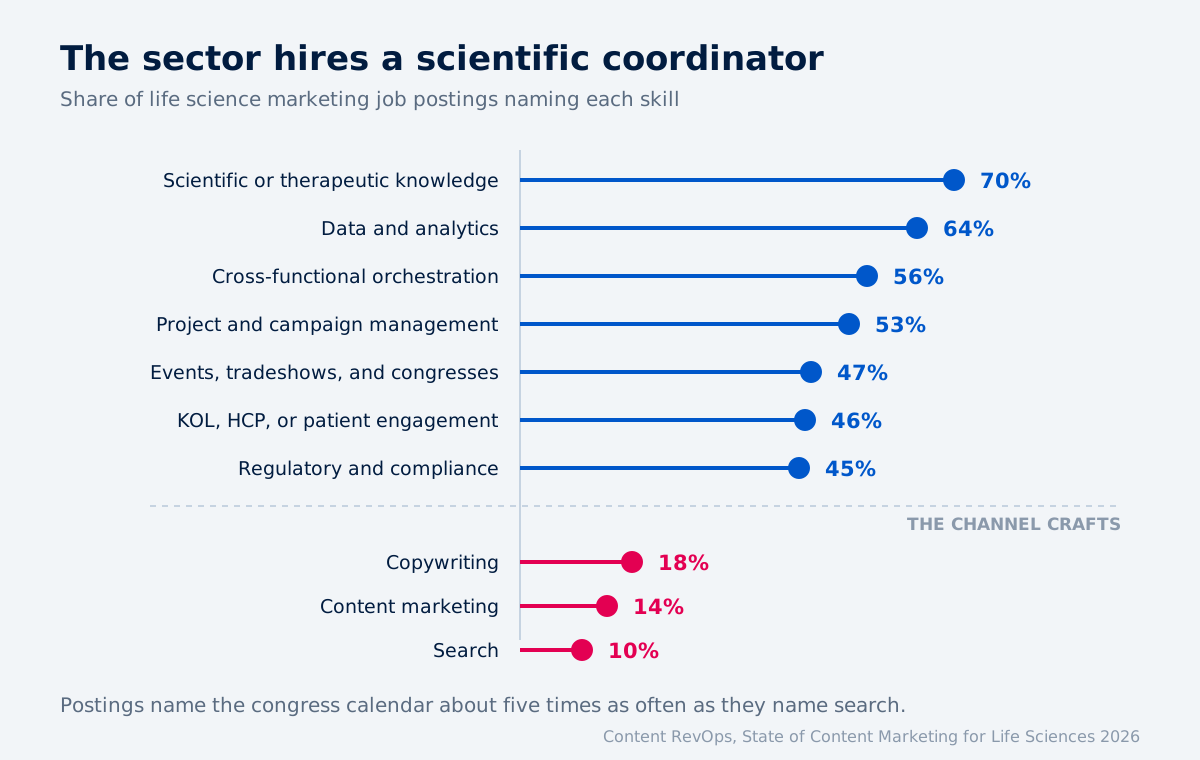
What postings name | Share of postings |
Scientific or therapeutic knowledge | ~70% |
Data and analytics | ~64% |
Cross-functional orchestration | ~56% |
Project and campaign management | ~53% |
Events, tradeshows, and congresses | ~47% |
KOL, HCP, or patient engagement | ~46% |
Regulatory and compliance | ~45% |
Now compare that with the channel crafts. Search sits at around 10% of postings, paid media at around 10%, content marketing at around 14%, and copywriting at around 18%.
The gap between those two lists is the answer to the question. The postings describe a scientific coordinator. Channel execution is a minor line item. We took that reading further and set out what life science companies actually hire marketers to do, and which parts of the job nobody is hired for.
Written out as a job, the role is:
- Understanding the science well enough to be trusted by people who do it
- Measuring what happens and reporting it
- Keeping several functions moving in the same direction
- Running the events and congress calendar
Postings name the congress calendar in about 47% of cases and search in about 10%. That ratio is inverted almost everywhere else in B2B, and it tells you the job is built around a fixed annual sequence of rooms rather than around an always-on channel. Account-based marketing, the discipline that would keep reaching those accounts between the rooms, shows up in under 1% of postings.
What the sub-roles are called
Practitioners describe the function splitting into three broad tracks. The vocabulary is worth knowing, because job titles in this sector do not map onto other industries, and none of them line up neatly with the standard B2B demand generation team structure:
- Product marketing. Owns a product or portfolio, its positioning, and the evidence behind it.
- Commercial marketing. Owns demand, campaigns, and the wider commercial plan.
- Field marketing. Owns everything that equips the sales force and everything that happens in a room with customers in it.
A fourth role sits just outside marketing and feeds it. Applications scientists and field applications scientists work with customers on the science, generating data that shows a product working. It is the most common bridge from the bench into commercial roles.
That bridge explains the shape of the whole function. The sector hires scientists and teaches them marketing rather than the other way round, which is why postings name scientific knowledge seven times more often than they name search. It is the single biggest thing that makes this job unlike marketing anywhere else, and it is why working with subject matter experts is a core skill here rather than an occasional favour.
Where does life science marketing stop and medical affairs begin?
In most industries this would be an org-chart curiosity. In therapeutics it has legal consequences, so it belongs in any honest definition.
Regulation looks at the activity
United States drug regulation does not ask what someone's business card says. It asks what the activity is. Two facts follow, and both are more interesting than they first appear.
Marketing collateral is legally part of the product. Under 21 CFR 202.1, the Food, Drug, and Cosmetic Act classes brochures, booklets, mailing pieces, detailing pieces, price lists, catalogues, letters, exhibits, literature, and reprints distributed by or for a manufacturer as labeling. A brochure is not communication about the drug. In regulatory terms it is a part of the drug.
That one fact explains the medical-legal-regulatory review process shaping so much of the therapeutics job. When the sales aid is legally part of the product, reviewing it before release stops being bureaucracy and starts being the only sane option.
The agency has issued no definition of the word "promotional". A regulatory briefing prepared for Pharma Congress notes that no statute requires a medical affairs department, no guidance specifies how one should be structured, and the FDA has published no definition of "promotional". Instead it treats independence from commercial influence as an indicator that an activity is not promotional.
So the boundary is real, consequential, and drawn by inference. That is genuinely hard to work with, and it is why compliance shows up as a first-class marketing skill in nearly half of postings.
What counts as promotion, and what does not
The Food and Drug Law Institute's primer on drug advertising and promotion draws the practical line:
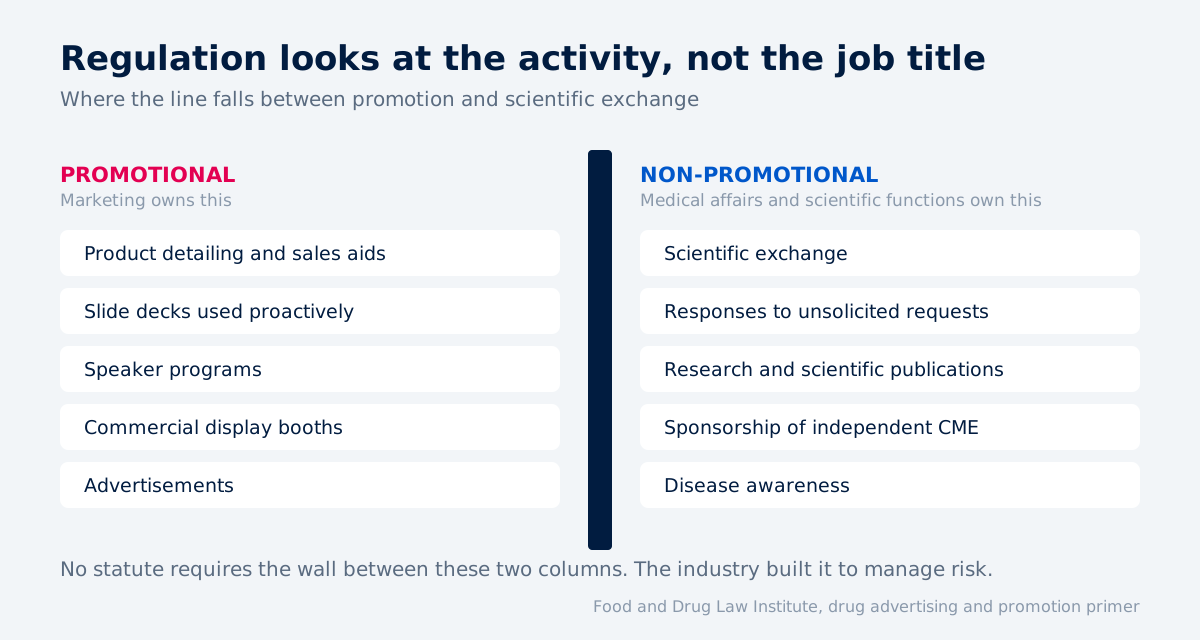
Promotional | Non-promotional |
Product detailing and sales aids | Scientific exchange |
Slide decks used proactively | Responses to unsolicited requests |
Speaker programs | Certain off-label reprints |
Commercial display booths | Research and scientific publications |
Advertisements | Sponsorship of independent CME |
Disease awareness |
The right-hand column is the work of medical affairs, medical science liaisons, and adjacent scientific functions. It is not marketing, and treating it as marketing is how companies get into trouble.
The firewall is not actually a law
Here is the part almost everyone gets wrong, including people who work in the industry.
Almost everyone describes the separation between medical affairs and commercial teams as a legal requirement. Writing in Law360 in 2022, Sidley Austin's Coleen Klasmeier and Jaime Jones state that no law or regulation expressly requires that independence. Companies adopted separation voluntarily, to reduce risk under the Food, Drug, and Cosmetic Act and the Anti-Kickback Statute.
Enforcement history built the wall, hardened into standard structure by settlements and corporate integrity agreements over two decades.
Understanding that changes how you read the constraint. The boundary around therapeutics marketing is not a fixed rule handed down by a regulator. It is a risk posture the industry chose, which is why it varies between companies and why it keeps being renegotiated.
The other functions marketing gets confused with
Several neighbouring functions do work that in other industries marketing would own:
- Medical affairs and MSLs handle scientific exchange with clinicians and researchers.
- Market access and HEOR build the health-economic and payer case.
- Commercial analytics models markets, forecasts, and performance.
- Field applications and technical support prove the product works in a customer's own setting.
- Regulatory affairs owns the submissions and the label itself.
If you are working out whether a task belongs to marketing in a life science company, the useful test is whether the activity is promotional, and who is permitted to do it there.
Who actually does life science marketing?
There are three real answers, and only one of them is a marketing department.
Often there is no marketing team at all
Start with the case nobody plans for.
When we scanned the sector for the life sciences research, we could not find a functioning content operation at more than half the companies we looked at. Active there means a site with published content, a maintained cadence, and at least one path from a reader to a conversation. A press-release archive does not count. That puts the active share at about 48%, and the life science marketing statistics hold the rest of the sector figures with their bases attached.
The most common failure state is dormancy rather than silence. About 30% have a thin or stale presence, meaning somebody was once given the job and then stopped.
A comment from someone with a long career in biotech, replying to a student asking how to enter the field, captures how this looks from inside the industry. They said the term "biotech marketing" was new to them as an in-house role, and asked whether the student meant the specialist agencies that serve the sector. Biotech marketing does exist as an in-house function, and it owns a specific set of decisions.
That is an accurate description of a sector where marketing frequently is not a job, an owner, or a budget line. Once it does become a budget line, it inherits a second problem, justifying and measuring that spend to executives who wave R&D budgets through and question this one.
Often an agency does part of it
Outsourcing is how most of the sector operates.
SCORR Marketing has run an annual life science marketing trends survey for twelve years, drawing on CEOs, presidents, and directors at CROs, CDMOs, technology companies, and sponsors. Its 2024 edition found 64% of respondent companies outsourcing some or all of their marketing to an external agency. SCORR is itself a life science marketing agency, so it has an interest in that answer, and it is also the only sustained public dataset on the question. Deciding who does that outside work is its own exercise, and we ranked the demand generation agencies that work with life sciences companies on the proof they can actually show.
The more useful finding is which parts get bought. SCORR asked how each function is handled:
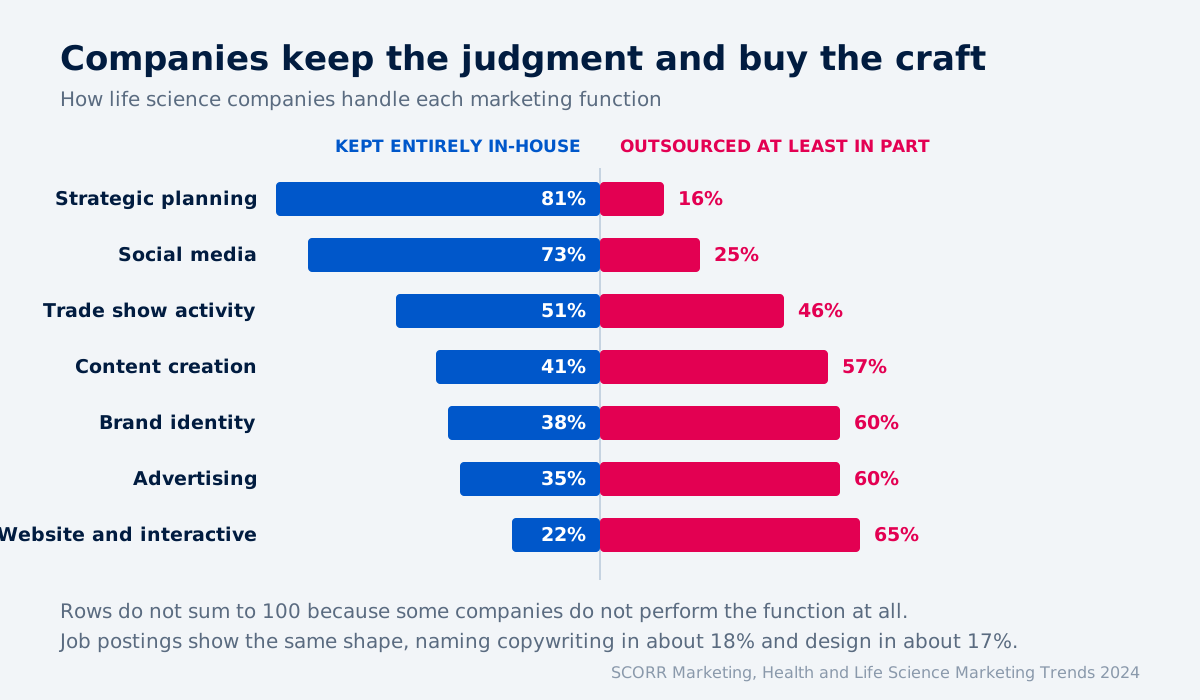
Function | Kept entirely in-house | Outsourced at least in part |
Strategic planning | 81% | 16% |
Social media | 73% | 25% |
Trade show activity | 51% | 46% |
Content creation | 41% | 57% |
Brand identity | 38% | 60% |
Advertising | 35% | 60% |
Website and interactive | 22% | 65% |
Rows do not sum to 100 because some respondents said the function is not performed at all.
Read down the table and the logic is clear. Strategic planning is the single most in-housed activity at 81%, while website build, advertising, brand, and content are majority-outsourced. Companies keep the judgment and buy the craft, which is the same split we describe in our in-house versus outsourced comparison.
That matches what the job postings show from the opposite direction. Copywriting appears in around 18% of postings and design in around 17%, so the sector is not hiring for the crafts it hands to agencies. Two very different methods, one answer.
One caution about relying on that model. In the same SCORR series, the share of companies picking the top option on agency satisfaction, completely satisfied, fell from 22% in 2021 to 14% in 2024, so roughly six in seven now sit somewhere short of happy with the arrangement they depend on most. Deloitte, writing about why life sciences marketing approaches fall short, names "agency complacency" and incentives that maintain outdated practice as one of five root causes. Two very different vantage points, one soft spot. It is worth knowing what an outside expert should actually be doing before you judge whether yours is.
Sometimes another function absorbs it
In the third pattern, marketing exists as a set of tasks spread across product management, commercial, and business development, with nobody owning the whole. Someone makes the assets, someone books the congress booth, someone updates the website, and nobody is accountable for whether any of it produces demand.
This is the hardest of the three to spot from outside, because the outputs look identical to a working marketing team's outputs. The difference only shows up when you ask what the content is supposed to do. The signs that nobody owns the strategy are the same in this sector as in any other, they are just easier to hide behind a busy congress calendar.
What does life science marketing look like at different company sizes?
The same job title covers two quite different operating models.
Under roughly 200 staff, the model is digital-led. Marketing is usually one person or a very small team. The surface area is the website, LinkedIn, and content, because those are the channels one person can actually run. If that is your situation, the constraint is hours rather than ambition, and a minimum viable content plan is the honest starting point. Digital marketing for life sciences maps the rest of that surface, channel by channel.
Above roughly 1,000 staff, the model is science, compliance, and events-led. The congress calendar structures the year, medical-legal-regulatory review sits inside every workflow, KOL programs are a named discipline with their own budget, and a senior in-house core directs work that agencies largely execute.
Compliance is the hinge between them. Compliance appears in about 11% of postings at the smallest firms and about 49% at the largest. Hiring is where you can see the shift: at scale, the sector stops treating review as something a marketer tolerates and starts treating it as something a marketer is hired for.
Once review is unavoidable, the whole function reorganises around it. A small tools company writing application notes carries almost no review burden. A large pharmaceutical company producing promotional labeling has a review step on everything.
So a reader placing their own company should ask two questions rather than one. Not just how big are we, but what does our compliance load actually make us. A 150-person diagnostics company and a 150-person clinical-stage biotech are the same size and are running different jobs, which is why content marketing for biotech reads nothing like the diagnostics equivalent.
Whichever of the three jobs you are running, the next step is the same: decide what the function is for before you decide what it publishes. That is the work of a life science marketing strategy, and it is the part the sector most often skips.
Which life science marketing job are you actually staffed for?
Get a Content RevOps audit, your function benchmarked against the life sciences 2026 data on hiring shape, compliance load, and conversion architecture, with every gap priced in numbers your CFO can argue with.
Frequently Asked Questions
About the Author

Founder & CEO, Content RevOps
Stefan Kalpachev is the founder and CEO of Content RevOps, where he helps B2B SaaS companies transform their content into predictable pipeline. With a background in content marketing and revenue operations, Stefan has developed a unique methodology that bridges the gap between content creation and revenue generation.
Connect on LinkedIn