Demand generation team structure (roles, responsibilities, costs)
Want a demand gen team that runs a tight research → create → distribute → optimize loop—and proves pipeline impact? Let’s talk.
Book a CallThis is a hands-on guide to structuring a modern demand generation team. It does not cover definitions, frameworks, or arguments for why demand gen matters. Instead, it breaks down the five core roles you need, what each one owns day to day, how they depend on each other, and what they typically cost in the US in 2026 (approximate total cash comp, excluding equity). For the most commonly hired of those seats, what 771 demand generation specialist postings reveal about pay and scope gives the market rate in more detail.
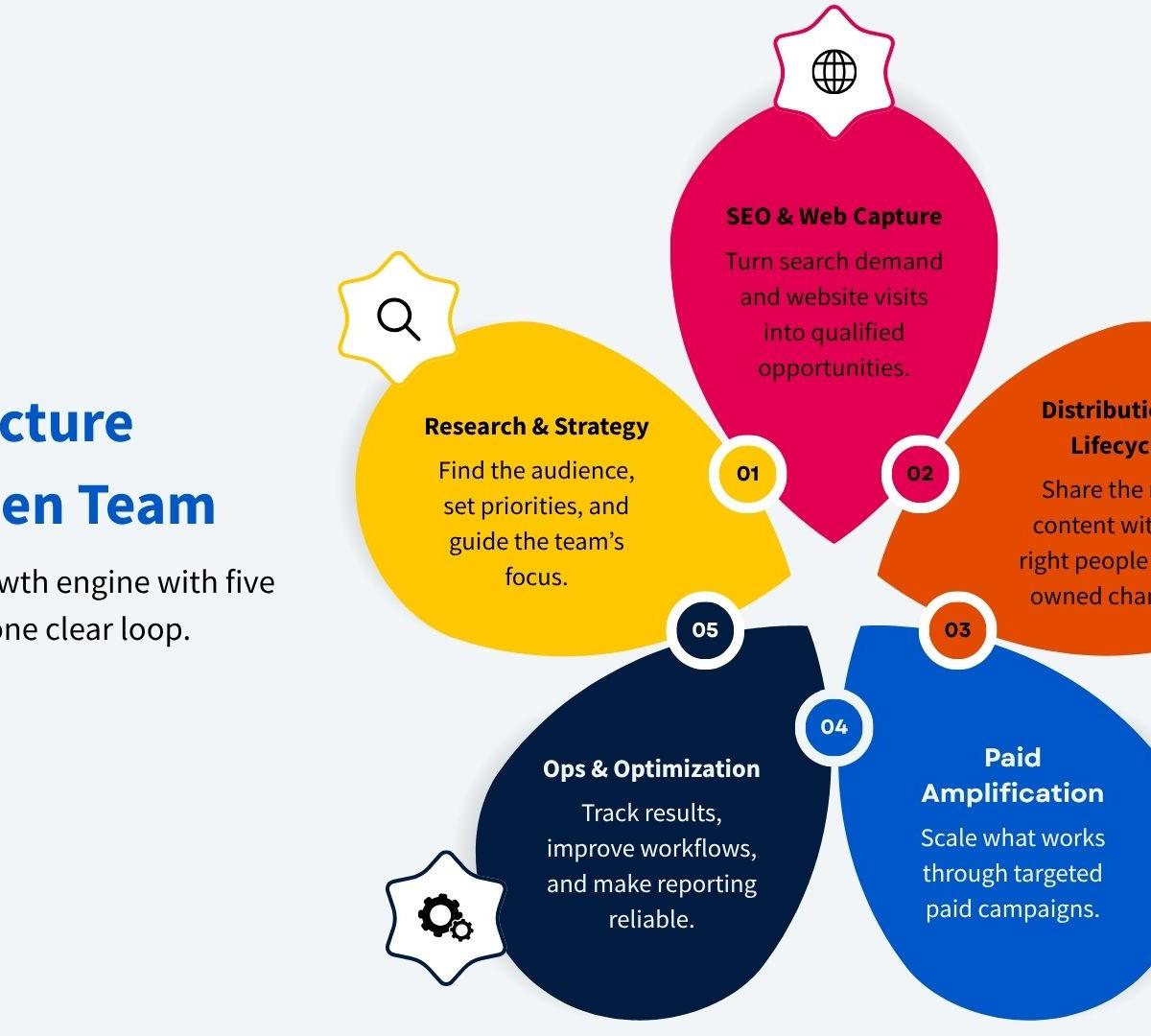
The operating model is simple: research → create → distribute → measure/optimize. If your team cannot run that loop tightly, you will feel it fast: unclear priorities, content that does not get used, channels that do not learn, and reporting that nobody trusts. The five roles in this article map directly to that loop, with a “content as infrastructure” mindset: assets are built to be reused, distributed, and improved over time, not shipped and forgotten.
This kind of loop mirrors how high-performing B2B teams treat content and campaigns as a repeatable engine rather than one-off launches, with each cycle deepening audience insight and sharpening channel performance.
As you read, think less in job titles and more in capabilities:
research/strategy and orchestration
SEO and web capture
distribution and lifecycle programs
paid amplification
ops, measurement, and optimization
You’ll also see how these roles interact daily, and what kind of budget that structure usually requires in 2026, assuming a mid-market B2B motion where content is expected to function as a primary acquisition lever as well as a brand asset.
Role 1: Head of the Demand Generation Engine (Director/VP)
Core mandate
The Head of Demand Generation owns the revenue-aligned operating system for demand. Their job is not to “run some campaigns.” It is to ensure the full demand gen strategy functions end to end: research → create → distribute → optimize, with every program tied to pipeline and revenue outcomes—a comprehensive marketing framework that creates brand awareness, fuels interest, and differentiates demand creation from lead capture. Demand generation ensures prospects are well-informed and emotionally engaged, which is crucial in markets with complex buying decisions and long sales cycles. This structure mirrors how modern content engines are built to drive revenue, not just traffic, in B2B SaaS.
Demand generation is a top-of-funnel and middle-of-funnel strategy focused on building brand awareness and creating interest across your total addressable market, while lead generation converts that interest into qualified pipeline by capturing contact information.
This role translates company goals into demand targets and budgets. They define what “good” looks like (for example: pipeline created, opportunity creation, cost per opportunity), and they keep the team focused on signal over noise. The handoff between demand generation and lead generation typically occurs when a prospect becomes a marketing qualified lead (MQL) and demonstrates clear buying intent, at which point more aggressive lead generation tactics become appropriate. They also protect content–market fit by insisting that every asset and campaign solves a real ICP problem and supports the sales motion, reflecting how high-performing B2B teams treat content as a direct acquisition lever rather than a pure branding play.
Successful demand generation requires alignment between sales and marketing to target the right prospects and move them through the buyer's journey with coordinated, data-driven go-to-market motions. Marketing and sales alignment is the backbone of any demand generation effort; without clear alignment, marketing may generate leads that sales doesn't prioritize, and sales may struggle to close leads that aren't properly nurtured. Align sales and marketing functions to optimize demand generation and improve collaboration throughout the process.
Primary responsibilities
Demand roadmap
They set the roadmap for the quarter and year, including:
Themes based on ICP pain points and market context
Priorities by funnel stage (capture existing intent vs create new demand)
Budget allocation across channels (organic, paid, outbound support, community, events, creators/influencers)
This roadmap typically spans an integrated mix of channels—content, search, social, events, and influencers—similar to how leading B2B programs combine multi-channel “best answer” content with amplification to sustain pipeline. Demand generation efforts are guided by data driven insights, enabling continuous optimization and more effective targeting.
Revenue alignment
They make demand generation measurable and usable by Sales and RevOps:
Define shared lead stages (for example, SAL/SQL) and lead-to-opportunity SLAs
Run pipeline reviews to see which channels, assets, and motions influence real revenue outcomes, using engagement metrics such as content engagement, intent signal spikes, and account engagement scores as leading indicators of success
Decide which key metrics and key performance indicators (KPIs) matter, such as pipeline contribution, customer acquisition cost (CAC), customer lifetime value (CLV), leads generated, qualified leads, sales qualified leads, and pipeline velocity, which measures the speed of movement from marketing qualified leads (MQL) to closed-won opportunities
They anchor on down-funnel metrics (opportunities, revenue, payback) rather than vanity engagement metrics, consistent with analytics best practices that emphasize tying marketing activity to commercial outcomes, not surface-level clicks or views.
Operating cadence
They run the team’s execution rhythm:
Planning, standups, experiment reviews, and post-mortems
Asset refresh cycles so winning pages and offers stay current and keep compounding
Tool and reporting discipline so the team can trust the numbers
How this role connects the team
This is the “orchestrator” role. The Head of Demand Generation ensures ongoing engagement by integrating multiple channels—including inbound, outbound, and partner-driven efforts—and aligning existing processes across the team. They set targets and priorities for the other four roles and keep work integrated (not scattered tactics). They partner closely with:
Research & Content Strategy Lead on narratives and campaign themes
SEO & Web Lead on which intents and journeys to prioritize
Distribution, Media & Community Lead on channel mix and scale/kill decisions
Marketing Operations & Revenue Analytics Lead on dashboards, attribution, and data quality
Approximate 2026 US compensation
Base salary: $175,000–$240,000
Total comp (bonus/equity): $210,000–$320,000+ (often higher in major B2B tech hubs)
Role 2: Research & Content Strategy Lead
Core mandate: content marketing
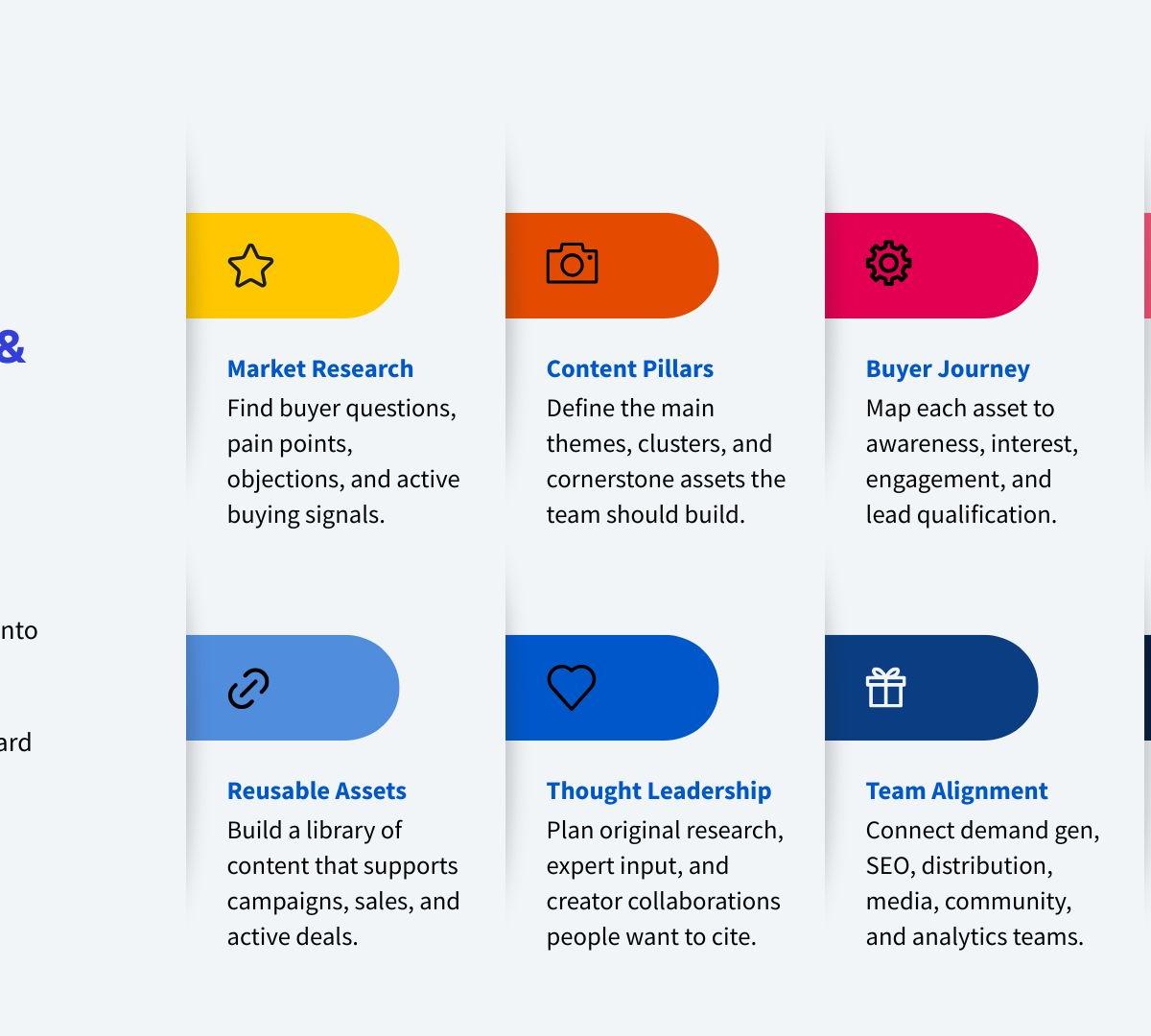
This role turns messy market input into a clear, commercially grounded content system designed to create interest and capture initial interest from prospects. They decide what the team should say, to whom, and why—then translate that into a set of reusable assets that move people from aware → interested → engaged → MQL.
They treat content like a product: interconnected pieces that support one (or a few) core narratives the Head of Demand Gen commits to. The goal is not “more content.” The goal is a structured library that answers real buyer questions, handles objections, and supports active deals—nurturing quality prospects by addressing their questions and objections—essentially building a system for content–market fit, not just publishing volume.
Primary responsibilities
Research stack and synthesis
They combine multiple inputs so the team is not over-relying on any one channel:
Keyword and topic research (including “product evaluation” and comparison intent)
Jobs-to-be-done interviews with customers and lost deals
Community listening (Slack groups, Reddit, LinkedIn, social search, YouTube)
Competitor content and ad audits to spot patterns and gaps
Backlink gap analysis to understand what earns references and shares, informed by how successful brands build linkable, reference-worthy assets
Deep understanding of the target market and target audience, including their behaviors, pain points, and decision-making drivers
Use of intent data and data driven insights to identify accounts showing active buying signals and to inform content strategy, ensuring campaigns are tailored to engage the right prospects
Content strategy and editorial leadership
They turn research into execution standards:
Define pillars, clusters, and cornerstone assets tied to ICP pain points and commercial goals, with the ICP strategy based on understanding specific personas and pain points of the target audience
Map each asset to a funnel stage and the buyer's journey, a campaign theme, and a specific job (qualify demand, address objections, accelerate deals), ensuring content is tailored to each stage of the buyer's journey for effective lead nurturing
Own briefs, quality criteria, and refresh schedules
Manage a flexible bench of writers, designers, video, and interactive help as needed
Thought leadership and influencer integration
They plan original research, SME participation, and creator collaborations so the team can publish “best answer” assets people cite and link to.
How this role connects the team
They align priorities with the Head of Demand Gen, coordinate structure and internal linking with the SEO & Web Lead, package angles and variants for Distribution/Media/Community, and set success metrics (and refresh triggers) with Marketing Ops & Revenue Analytics. Aligning content and campaigns also requires understanding the business context, so that marketing efforts are relevant and effective for high-value target accounts.
Approximate 2026 US compensation
Base salary: $120k–$165k
Add 10–20% in large tech hubs or for strong research + influencer + product-marketing skill sets
Role 3: SEO & Web Experience Lead (Organic Growth + CRO)
Core mandate
This role turns your website into a reliable demand surface, structured to guide prospects through the sales funnel and buyer's journey. They treat search discovery and on-site behavior as primary levers for acquisition and conversion, not “nice to have” tasks. Their main job is to build and maintain an intent architecture, so every high-value query and buyer question has a clearly owned page, section, or module that satisfies intent and moves the visitor forward.
Primary responsibilities
Intent architecture & site structure
Map priority queries, problems, and jobs-to-be-done to specific pages and navigation paths.
Coordinate with the Content Strategy Lead on what becomes pillar pages, supporting clusters, and product/deep-dive pages (so you do not publish content that has no home or purpose).
On-site optimization (SEO fundamentals + buyer depth)
Own technical SEO basics: crawlability, schema, page speed, indexation, and internal linking, with particular focus on Core Web Vitals and mobile performance as key ranking and UX signals.
Set on-page standards: titles, headings, FAQs, and coverage of common follow-up questions, mirroring how high-performing “best answer” pages structure information for both users and search engines.
Ensure solution and product pages answer buyer decision needs (not thin descriptions), including:
- comparisons and alternatives (modeled on the kind of detailed, evaluative content that consistently ranks for commercial-intent queries)
- implementation details
- proof and outcomes
- pricing context and constraints
Make valuable resources and educational content visible and accessible to prospects, ensuring they are surfaced at the right moments to attract and engage potential customers.
Conversion paths & CRO
Own CTAs, lead capture, forms, UX flows, and routing to high-intent pages.
Run A/B tests on headlines, layouts, offers, and friction points, partnering with Marketing Ops & Analytics for clean measurement and to align with proven CRO practices around incremental, test-driven UX changes.
Evergreen refresh
Maintain a refresh calendar for top pages: update sections, expand FAQs, improve UX, and re-embed pages into current campaigns, treating mature content as an updatable asset rather than a one-off post.
How this role connects the team
Converts Research and Content Strategy insights into an interlinked site and landing page system that aligns to searcher and buyer intent at each stage of the journey.
Supports Distribution and Paid by building high-performing landing experiences and reusable templates that match the depth and clarity of top-converting acquisition pages in search.
Works with Marketing Ops & Analytics on dashboards for rankings, organic traffic quality, conversion rates, and pipeline from organic, tying SEO and UX efforts directly to revenue metrics.
Partners with Dev/Product to ship components that make testing and scaling practical.
Approximate 2026 US compensation
Base salary: $130,000–$175,000
Higher in competitive B2B markets when the role also owns CRO plus broader “search everywhere” surfaces (e.g., video chapters and social search).
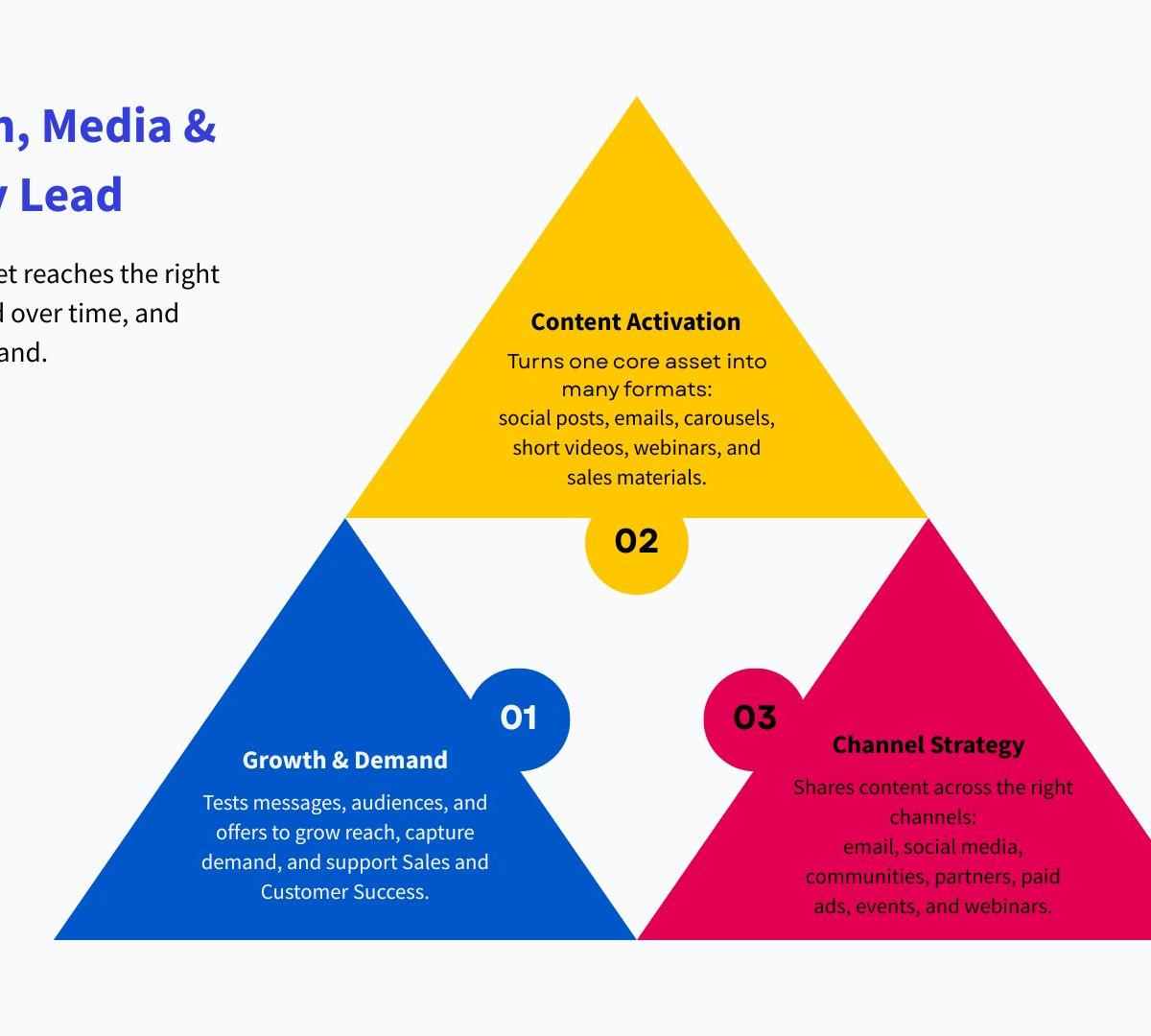
Role 4: Distribution, Media, and Community Lead
Core mandate
This role makes sure every asset gets fully activated across owned, paid, partner, and community channels—and then re-activated over time. The goal is steady, compounding reach and demand capture, not one-time launch spikes. They plan distribution while the asset is being briefed, so formats, hooks, and destinations are built for reuse.
Primary responsibilities
Channel strategy & calendars
They execute demand generation campaigns and demand generation programs through a rolling distribution plan across the channels where your ICP already pays attention. This includes email, social, communities, partner placements, syndication, and webinars/events. A key part of the job is turning one core narrative into many channel-native pieces (short clips, carousels, threads, newsletter items, and sales-ready snippets), leaning into formats known to perform well on each platform (for example, LinkedIn carousels and short-form video for social algorithms that currently favor those assets).
Paid media & testing
They manage paid search, paid social, retargeting, and sequential messaging, with a focus on targeting high value target accounts and target accounts using account based marketing strategies. They test angles, audiences, and offers quickly using internal performance data and competitor ad patterns to avoid guessing for too long. They also treat paid search and social as “always-on” demand capture channels, in line with performance benchmarks that show these are often among the highest-converting digital channels for B2B when optimized for quality over volume.
Community & influencer programs
They identify real communities (Slack, Discord, LinkedIn groups, niche forums) and build a repeatable presence: participating, seeding helpful assets, and learning what questions keep coming up. They also run creator/influencer collaborations end-to-end (outreach, terms, co-promotion, and measurement), aligning with the growing share of B2B marketers who report influencer programs driving improved brand awareness and lead quality.
Sales/customer success enablement
They package assets into “kits” that Sales and CS will actually use:
talk tracks and snippets
email/LinkedIn sequences
one-pagers and simple decks
How this role connects the team
They collaborate tightly with Content Strategy at the brief stage, align demand generation efforts and marketing efforts with other team leads—including the Head of Demand Gen on channel investment and scale/pause rules—coordinate with SEO & Web on intent-aligned landing paths, and rely on Marketing Ops & Analytics for UTMs, clean tracking, and channel contribution reporting that can stand up to scrutiny across the revenue team.
Approximate 2026 US compensation
Base salary: $120k–$170k
Add ~10–20% for ownership of sizable paid budgets and more complex influencer/community programs
Role 5: Marketing Operations & Revenue Analytics Lead
Core mandate
This role is the measurement, tooling, and experimentation backbone for the whole demand gen system. The goal is to replace cluttered dashboards with a clear, revenue-facing scorecard that shows what’s working, what’s unclear, and what’s wasted. They also make sure each asset, campaign, and channel can be traced from intent → interaction → pipeline → revenue (where tracking allows), so decisions are not based on “interesting” metrics that do not change outcomes.
Primary responsibilities
Measurement architecture
They own the tracking foundation end to end:
Event schemas and data-layer design
UTMs, tag management, pixels, consent handling
Standardized tracking across web, email, paid media, webinars, and key sales touchpoints, aligned with modern analytics shifts such as GA4’s event-based model
KPI and attribution design
They define realistic, stage-based KPIs and make sure the team uses the same definitions:
Awareness, engagement, MQL, SQL, pipeline, revenue (plus asset-level KPIs)
Incorporate intent data and engagement metrics as leading indicators for demand generation engine success, helping identify accounts showing active buyer research and readiness to engage.
Attribution models that fit long B2B cycles (position-based, time decay, or custom), often blending multi-touch data with self-reported attribution to counter gaps created by privacy changes and dark social
Cohort and lifecycle analyses to avoid overreacting to short-term spikes, similar to the multi-touch, multi-stage thinking seen in advanced B2B attribution frameworks
Experimentation
They run structured testing and capture learnings:
A/B and multivariate tests for landing pages, emails, offers, and channel mixes
Use data driven insights, including intent data and engagement metrics, to optimize campaigns and improve results.
A centralized experiment backlog and learning library so wins compound instead of resetting each quarter
Tooling & integrations
They own the marketing tech stack and keep it coherent:
MAP, CRM, CDP, analytics/BI, testing tools, enrichment, outbound/ABM platforms
Ongoing data quality work with Sales/RevOps so reporting is consistent
How this role connects the team
They set decision thresholds with the Head of Demand Gen (what “good” looks like, when to scale, when to cut). The Marketing Operations & Revenue Analytics Lead ensures that analytics are aligned with the overall demand generation strategy, supporting a comprehensive, multi-channel approach. They help Research & Content Strategy attach S.M.A.R.T. goals before production, support SEO & Web with diagnostic conversion and drop-off data, and equip Distribution with incrementality insights and budget reallocation recommendations.
Approximate 2026 US compensation
Base salary: $140k–$195k (higher when blending deep RevOps, advanced attribution, and martech leadership)
Tooling & non-headcount costs (brief)
$50k–$250k/year for analytics, testing, MAP/CRM add-ons, SEO, listening, and outbound tools—this role usually leads vendor selection and consolidation.
Conclusion: Putting the Team Together
A demand generation team works best as one connected loop, not five separate job descriptions. The team works together to build a demand generation engine that supports long term revenue growth and nurtures loyal customers throughout the customer lifetime. The Head of Demand Generation sets pipeline targets and tradeoffs. The Research & Content Strategy Lead turns ICP insight into a clear narrative and an asset system. The SEO & Web Experience Lead makes sure those assets meet intent and convert on your owned properties. The Distribution, Media & Community Lead keeps the system visible and active across channels, not just at launch. The Marketing Operations & Revenue Analytics Lead keeps tracking clean and proves what is (and is not) moving pipeline, reflecting the shift toward content as a revenue-driving acquisition tool rather than a pure branding play.
A successful demand generation engine integrates core pillars to move prospects from unawareness to active interest. Demand generation builds a higher-quality sales pipeline by attracting educated prospects, shortening sales cycles, and increasing win rates through credibility and targeted engagement. Together, they form an operating system where content is treated as infrastructure: built once, reused across inbound, outbound support, events, nurture, and sales enablement, then improved through measurement. This mirrors how effective content engines connect research, creation, distribution, and optimization into a continuous loop that compounds over time.
Approximate 2026 US total cash ranges for these five roles:
Head of Demand Gen: $190k–$260k
Research & Content Strategy: $125k–$170k
SEO & Web Experience: $130k–$175k
Distribution / Media / Community: $130k–$180k
Marketing Ops & Revenue Analytics: $120k–$185k
Many teams will not hire all five at once. They often blend in-house staff with agencies, specialists, or fractional leaders, especially in marketing operations and analytics where specialist skills and tools are evolving quickly. Which outside partner fits depends on the system it has to plug into, and we reviewed the field for companies in the $10M to $1B range in our list of demand generation agencies for mid-market companies. Teams too early to fund any of the five roles face the same question on a much smaller budget, and 14 agencies cleared those checks in our list of demand generation agencies for seed-stage startups. Where the budget funds one of the five seats rather than all five, that person carries the whole loop, and the agencies built to act as the whole function are the ones we kept in our list of demand generation agencies for a marketing team of one. A Content RevOps-style partner can cover the same layers—research, strategy, activation, and measurement—until internal headcount and operating habits mature. The goal stays the same: compounding demand gen accountable to pipeline, not just activity.
Is your demand gen org built to compound—or just to ship?
Get a Content RevOps operating model that turns roles, content, and measurement into pipeline infrastructure—not disconnected activity.
Frequently Asked Questions
About the Author

Founder & CEO, Content RevOps
Stefan Kalpachev is the founder and CEO of Content RevOps, where he helps B2B SaaS companies transform their content into predictable pipeline. With a background in content marketing and revenue operations, Stefan has developed a unique methodology that bridges the gap between content creation and revenue generation.
Connect on LinkedIn