How to Create High-Performing B2B Demand Generation Campaigns
Ready to turn your next “campaign” into a repeatable pipeline system? Let’s build it.
Book a CallMost B2B demand generation campaigns fail for a simple reason: they’re treated like short-term promotions. A few ads, a webinar, a landing page, then everyone moves on. That approach doesn’t compound, and it rarely produces consistent pipeline.
Part of The Complete Guide to B2B Demand Generation Strategy.
This article is a build process for content-led demand gen campaigns you can run every quarter. It will not be a theory lesson, a channel-by-channel rundown, or a generic checklist of “best practices.” The focus is execution: how to design a campaign where content does the work across awareness, capture, and nurture.
The shift is to treat campaigns as a content operating system. Content becomes infrastructure: it attracts the right buyers, captures intent at the right moment, and matures interest into conversations and revenue over time. Done well, your best assets keep generating demand long after launch, mirroring how top B2B programs report that content both generates demand and directly contributes to revenue over time.
Start With a Commercial Narrative and Campaign Objective
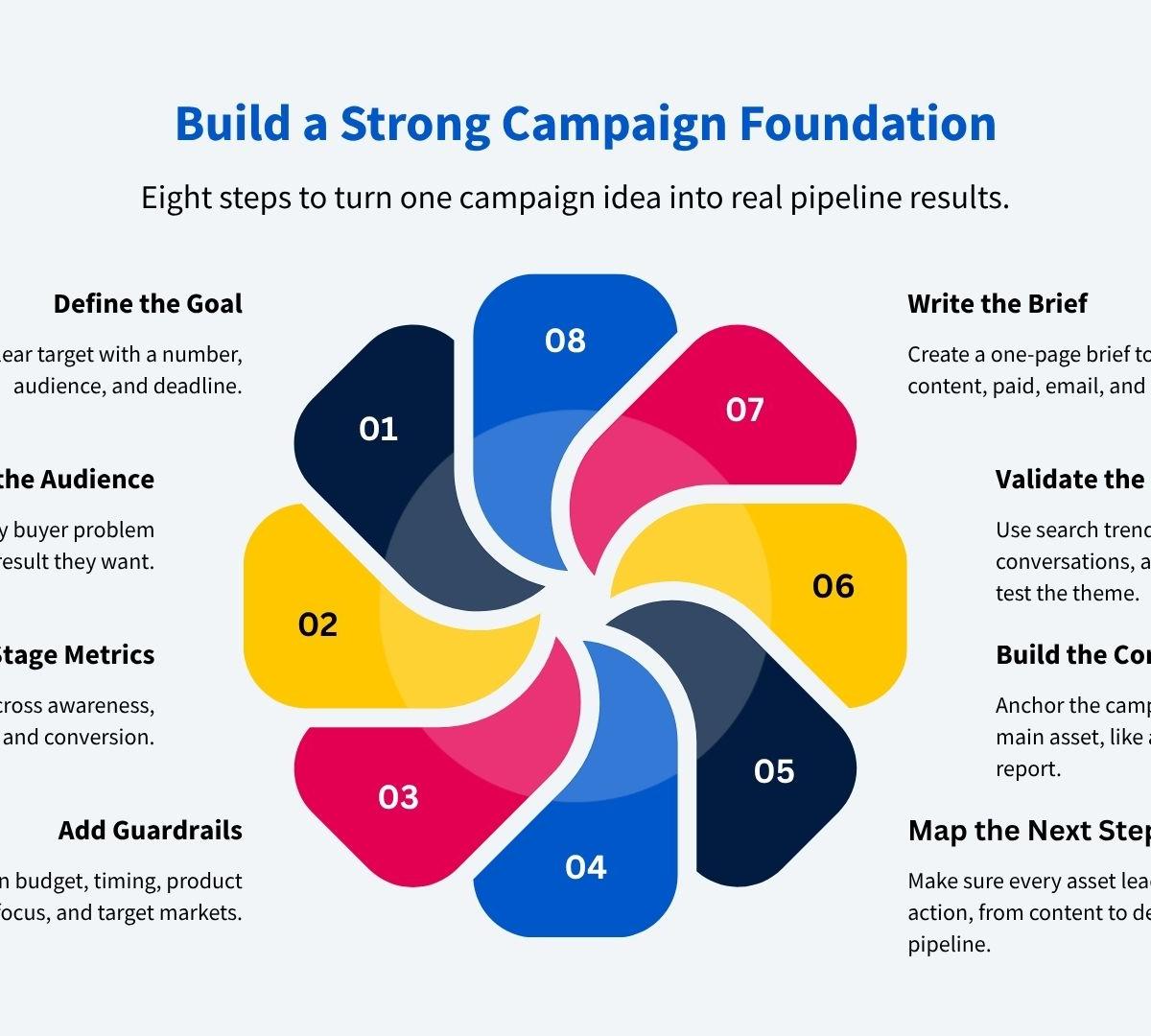
High-performing demand generation campaigns start before content production. They start with alignment: one commercial theme, one measurable outcome, and one plan everyone can execute. If you skip this, you usually end up with disconnected assets that perform fine in isolation but do not move pipeline.
Your goal in this step is to create a simple campaign “centerline” that holds across channels and funnel stages: create demand, capture demand, then nurture and convert. This mirrors how effective demand engines are structured in practice: a continuous loop of awareness, intent capture, and progression to revenue.
Define one clear business objective
Pick a single objective with a number, an audience, and a time box. For example:
“Generate 150 demo requests from Tier 1–2 manufacturing accounts in Q3.”
“Influence $1M in pipeline from mid-market fintech in North America.”
Then define success criteria by stage so the team can see whether the campaign is working early, not only at the end:
Create: reach and sessions from ICP accounts, video views
Capture: form conversion rate, MQL volume, CPL
Nurture/convert: SALs, SQOs, pipeline created, revenue, and sales velocity
This kind of stage-based KPI structure directly addresses the most common failure pattern in content programs: lack of clear, journey-aligned goals and metrics from the outset. It also makes it much easier to move away from vanity metrics toward downstream indicators like opportunity creation and influenced revenue.
Establish guardrails (budget, timeline, product focus, geos/segments) and write a one-page campaign brief. That brief becomes the reference point for content, paid, email, and sales follow-up and helps prevent the “moderately effective strategy with no clear goals” problem many teams report.
Choose and validate a single commercial narrative
Choose one ICP pain and one outcome, stated in plain language (example: “Cut lead waste by 40% without hiring more reps”).
Validate the theme quickly using three inputs:
Keyword + intent mapping: what buyers are searching when problem-aware vs. in-market, and how those queries split between early-stage, educational terms and high-intent “solution” phrases.
Conversation mining: sales calls, LinkedIn posts, communities, support tickets
Market scan: where competitors over-focus on features instead of outcomes (a chance to differentiate)
This gives you a narrative rooted in actual demand signals, not internal opinions, and reduces the risk of building a campaign around language your buyers do not use.
Turn the narrative into an offer spine
Build the campaign around one MoFu anchor asset (webinar, eBook, or research). Everything else supports it:
ToFu content drives the right audience into the story.
BoFu content helps evaluation and enables sales.
Document the narrative as: problem → stakes → desired outcome → unique path → proof. Output a short messaging guide and a content purpose statement tied to revenue actions (not visibility). That way, every asset is built with a defined next step—blog to webinar, webinar to demo, demo to proposal—rather than existing as isolated content with no clear role in generating pipeline.
Lock Your ICP, Accounts, and Intent Signals
A demand gen campaign only performs when targeting, prioritization, and routing are decided before content is produced. Your goal here is simple: define who you are trying to create and capture demand from, then define what “in-market” looks like so your team can respond consistently.
Narrow the ICP with commercial rigor
Go beyond “B2B SaaS buyers.” Specify the commercially reachable slice of the market you can win. High-performing B2B content programs consistently attribute their results to a deep understanding of audience, industry, and buying triggers, not broad personas.
Include:
Industry and sub-vertical
Company size (employees, revenue, or both)
Tech stack and integrations (what must already exist)
Maturity (early, scaling, enterprise) and buying motion
Key roles (who feels the pain vs. who controls budget)
Then add filters that prevent waste:
Market size you can actually reach this quarter
Expected lifetime value and likelihood of expansion
Urgency of need (what triggers active evaluation)
Online reachability (LinkedIn targeting, search volume, communities, events)
This level of ICP clarity is what separates teams running loosely targeted “lead gen” from those operating a signal- and intent-driven demand engine that sales actually uses.
Output: an ICP one-pager with jobs to be done, emotional drivers (risk, control, credibility), and preferred channels.
Build and tier your target account list
Tiering forces focus and determines how personalized your content and outreach should be. It also aligns with how modern B2B teams blend broad demand gen with account-based motions instead of routing every form fill straight to sales.
Tier 1: named strategic accounts (high-touch, account-based)
Tier 2: high-value lookalikes (repeatable plays)
Tier 3: broader ICP segment (lighter touch, more automation)
Map the buying committee for each tier: economic buyer, technical buyer, champion, users, and blockers. Attach a primary pain point and information need to each role so your content speaks to the committee, not a single persona. This buying-committee view reflects how real B2B journeys work—more “squiggly scribble” than linear funnel—which is why campaigns built around roles and signals consistently outperform job-title-only targeting.
Output: a tiered account list plus a buying-committee map.
Layer on buying signals and intent data
Use both first-party and external signals (review activity, search behavior, event attendance, email engagement). Define “in-market” as observable behavior, not gut feel. Leading teams treat every content interaction as a chance to capture timeline, pain, and urgency—not just contact details—so they can route only genuinely ready buyers to sales.
Examples:
Multiple pricing or demo page visits
Repeat visits within 48 hours
Views of comparison or alternatives content
Searches including product/category keywords on your site or via paid/organic
Set fit vs. behavior scoring now, and decide how hot, warm, and cold leads move through this campaign. Make sure those rules live in your systems, not just in someone’s head—teams that operationalize fit + intent inside their CRM and MAP see far better alignment between content performance, sales follow-up, and pipeline.
Output: ICP + accounts + signal criteria documented inside your CRM/MAP (with scoring and routing), not a slide deck.
Design the Content System: Offers, Keywords, and Assets
Your narrative becomes useful when it is expressed as a content system: a small set of assets that (1) create demand, (2) capture intent, and (3) support decisions. Design it like infrastructure, where every piece has a clear job and a clear next step.
Architect the offer stack by funnel stage
Start by building an offer stack that matches how buyers move from problem-awareness to evaluation.
Top of funnel (create demand and educate)
Create lightweight assets that address named pains and common misconceptions. Aim for:
3–5 short articles/posts mapped to specific pains and “wrong assumptions”
1 pillar page organized around the commercial theme (your category + your point of view)
1–2 short videos or LinkedIn carousels that summarize the idea fast and drive clicks
Middle of funnel (anchor offer and proof)
Pick one primary, gated asset that is tightly tied to the narrative. Keep the form simple, but capture at least one intent signal (for example, timeline), since treating every form fill as “ready to buy” is a common failure point. Aim for:
1 primary gated asset (webinar, eBook, or research-style report)
1 detailed case study aligned to your ICP’s industry and the buyer’s role
Bottom of funnel (decision support)
Make evaluation easier with direct, specific materials. Many effective B2B campaigns lean on comparison sheets, pricing clarity, and proof to move late-stage buyers over the line:
Comparison one-pager vs. status quo and key competitors
Pricing explainer and/or ROI calculator
Review and testimonial snippets embedded across all decision assets (not siloed)
Output: an offer stack document that shows which asset “owns” awareness, lead capture, proof, and decision support.
Map keywords and buyer intent to every asset
Build a keyword set by stage and intent, then assign it to assets.
ToFu: problem and category terms, questions, misconceptions
MoFu: frameworks, playbooks, templates, webinar topics
BoFu: product, feature, competitor, and ROI terms
Use this as audience research. Look for the gap between how buyers describe the pain and how vendors label it. That gap is often where you can “own” the conversation and turn search behavior into a structured content journey.
For each asset, write a structured brief:
target persona + funnel stage
primary keyword/intent
outline + internal links
narrative role
primary and secondary CTAs
Output: a content roadmap with topics, owners, deadlines, and activation notes (SEO, social, email, paid).
Build for reuse and downstream activation
Scope derivatives when you plan the flagship asset, not after it ships. A webinar can become clips, carousels, a recap post, nurture emails, and sales leave-behinds, which aligns with how high-performing teams turn a single campaign into a full content ladder instead of one-off assets.
Map each asset into workflows:
which nurture track it powers
which outbound sequences and sales touches it supports
where it appears in paid, social, and on-site journeys
Centralize social proof in a shared library (quotes, stats, review snippets, short clips), tagged by industry and funnel stage so it is easy to plug into new assets quickly and to support integrated, cross-channel campaigns rather than isolated one-offs.
Build the Capture, Scoring, and Nurture Engine
A campaign is only as strong as what happens after someone shows interest. Your job here is to turn content engagement into (1) clean data, (2) clear priority, and (3) steady movement toward sales conversations.
Stand up capture infrastructure
Start with landing pages that match the campaign narrative. Build:
One core campaign landing page for the anchor offer (the main guide, webinar, or report).
Supporting BoFu pages for evaluation actions (demo, ROI calculator, comparison, “alternative” page).
Keep forms easy, but don’t settle for name + email only. Add 2–3 signal fields that reveal buying momentum, such as:
Timeline (0–3 months / 3–6 / 6–12+)
Primary pain (picklist aligned to your messaging)
Urgency or project start window
Standardize which fields are required vs. optional so every offer creates consistent data. Progressive profiling can layer in additional detail over time without crushing conversion rates, which aligns with common B2B guidance to capture minimal info early, then profile later in the journey.
Tracking and attribution needs to be decided before launch. Confirm:
A shared UTM scheme from the campaign brief
Pixels and conversion events for key actions (subscribe, download, webinar registration, demo request)
Separate source tracking for review-site traffic and webinar registrations so you can compare performance to known benchmarks for search, social, and email conversion.
Output: QA every form, event, and CRM field mapping, and run test conversions end-to-end before any spend.
Implement lead scoring and routing rules
Turn “fit + intent” into an explicit scoring matrix. A fit/intent model that weights company attributes alongside behavioral signals mirrors how modern demand-gen teams prioritize inbound interest instead of pushing every form fill to sales.
Fit: industry, company size, role/seniority, and key tech stack alignment to your ICP
Intent: behaviors weighted by heat (webinar attendance, pricing or comparison page visits, repeat sessions, high-intent search landings)
Negative scoring: students, unsupported regions, competitors, and clear research-only contacts
Define thresholds and SLAs for this specific campaign: what counts as MQL, and what “hot/warm/cold” means operationally. Set contact-time commitments (for example, hot leads within minutes; others within a day).
Route leads with context, not just a score. Push into CRM:
Timeline, pain, urgency
Last content touched and key pages viewed
Account-level signals where available
Output: scoring and routing live in MAP/CRM before leads start flowing, plus a one-page “campaign handshake” explainer for sales.
Design automation and nurture plays around your assets
Build always-on flows first:
A welcome/follow-up sequence (3–5 emails) for new subscribers and downloaders that teaches, then offers a light next step.
Then add signal-based nurtures aligned to stage:
Early: guides, short videos, blog clusters on the core problem
Mid: case studies, webinars, implementation guidance
Late: ROI proof, comparisons, customer intros, demo offers
Include event and re-engagement workflows (webinar attended vs. no-show branches; inactivity triggers with a fresh angle or format). This type of structured, stage-based nurture aligns with how top B2B content programs use email, webinars, and case studies as primary levers to generate and progress demand across the funnel.
Output: a workflow map plus email/cadence templates tied directly to specific campaign assets.
Orchestrate Channels, Run the Flagship Event, and Iterate
Plan the multi-channel launch around the content spine
Start with your content spine (the ToFu pieces, the MoFu anchor offer, and the BoFu pages). Then build a launch plan where every channel points to a specific asset on a specific date.
Organic social (LinkedIn-first)
Create a simple week-by-week calendar derived from the flagship asset: short clips, carousels, “what we learned” narratives, and one clear CTA that routes to the anchor offer. Don’t rely on the brand account alone. Give sales and leaders ready-to-post snippets, short talking points, and a single link so distribution is consistent. This mirrors how top B2B teams use LinkedIn as their highest-value social platform for demand-focused distribution.
Paid and search
Use paid to (1) capture in-market demand and (2) bring warm audiences back.
Run SEM/PPC on high-intent BoFu queries, sending traffic to tightly matched landing pages. In B2B, SEM/PPC is consistently reported as the most effective paid channel for lead and demand capture, so prioritize it for buyers already in research mode.
Run LinkedIn Sponsored Content (and InMail only if it fits) segmented by account tier and persona.
Add retargeting flows that route visitors back to the MoFu anchor offer, not to random content.
Email and partners
Use segmented email invites and reminders for the anchor offer (especially if it’s a webinar). Co-market with a trusted partner when possible to borrow audience and add credibility, especially on webinars and virtual events, which rank among the most effective B2B content distribution channels.
Output: a channel plan tied to assets, dates, targeting, and budgets.
Run your flagship MoFu event as a system, not a one-off
Pick a webinar or live session that solves one named ICP pain and naturally sets up your product as the next step. Include a customer or partner for real-world proof.
Standardize execution: landing page, registration, reminder emails, and a run-of-show. Keep it tight: 3-minute story → 20-minute teaching/demo → 10-minute Q&A → one next step. Webinars and virtual events routinely rank alongside in-person events as top-performing B2B channels for both lead generation and progression, so treat this format as a recurring asset, not a side project.
Then turn the event into a content engine: gate the on-demand recording, cut short clips for LinkedIn, and feed follow-ups for sales and nurture.
Output: an intent-enriched attendee list plus reusable derivative content.
Measure, optimize, and feed the flywheel
Run a weekly review across create, capture, and nurture metrics. Confirm SLA adherence and get direct lead-quality feedback from sales.
Optimize in small loops:
Reallocate spend to the best creatives and keywords.
Adjust landing page copy, forms, and subject lines based on behavior.
Tune scoring thresholds if volume or quality drifts.
Carry winners forward: refresh top assets quarterly, add new proof to your library, and bake learnings into the next campaign brief so each cycle compounds. Ongoing iteration like this aligns with how high-performing demand-gen teams move away from “set it and forget it” and toward continuously optimized, content-led campaigns.
Conclusion
High-performing B2B demand generation campaigns are not a collection of tactics. They are content operating systems built around one commercial narrative. When every asset has a clear job—from awareness through consideration to MQL handoff—you stop optimizing for impressions and start building a more predictable path to pipeline.
The process stays repeatable because the inputs are clear:
Start with a specific objective and a narrative you can validate in market, with outcomes tied to concrete pipeline and revenue goals rather than vanity metrics.
Lock your ICP and the intent signals you will capture before you create, so you’re segmenting by timeline, pain, and urgency instead of just job titles and form fills.
Design a content spine, then map offers to buyer intent (ToFu education, MoFu proof and guidance, BoFu evaluation) using formats that consistently drive action in B2B—short posts and video at the top, case studies and research at the middle and bottom of the funnel.
Build capture, scoring, routing, and nurture into the campaign on day one—using signals like timeline, pain, and urgency, not just job titles, and wiring those into automated capture → score → route → activate plays workflows.
Orchestrate channels around one flagship MoFu engine, then iterate based on downstream revenue signals instead of isolated channel KPIs, using cross-channel optimization loops rather than “set-and-forget” campaigns.
This is the mindset we use: content treated as infrastructure, wired into CRM, sales motion, and attribution. Instead of campaigns that reset every quarter, you build a system that compounds—getting cheaper and more effective over time as older content keeps generating demand, nurture paths get smarter, and your targeting and scoring models sharpen with every cycle.
Is your demand gen campaign built to compound—or to reset every quarter?
Wire content into capture, scoring, nurture, and sales follow-up so every asset does real revenue work.
About the Author

Founder & CEO, Content RevOps
Stefan Kalpachev is the founder and CEO of Content RevOps, where he helps B2B SaaS companies transform their content into predictable pipeline. With a background in content marketing and revenue operations, Stefan has developed a unique methodology that bridges the gap between content creation and revenue generation.
Connect on LinkedIn