How to build a demand generation engine from scratch (step-by-step)
Want a demand engine you can run weekly (not a campaign you restart monthly)? Let’s build your Content RevOps system.
Book a CallThis guide shows how to build a demand generation engine from scratch: a repeatable system that turns content into qualified pipeline. Not a campaign plan. Not a posting schedule. A working setup you can run every week, even with a small team and a short runway.
Part of The Complete Guide to B2B Demand Generation Strategy.
Assume you are starting close to zero: limited time, limited budget, and a lot of pressure to show progress. The goal is speed and compounding results. That means treating content as infrastructure—an operating system that educates buyers, captures intent signals, supports sales follow-up, and keeps working after it ships.
This matters because most of your market is not actively buying right now. If you only build for the tiny “ready to buy” slice, your pipeline will be spiky and fragile.
What you’ll build, step by step:
Positioning you can actually use (and validate fast)
A content system where every asset has a job in the journey
Distribution beyond a single channel or algorithm
Routing and handoff based on real intent signals (not form fills alone)
Measurement and optimization tied to pipeline outcomes, not vanity metrics
Lay the foundation in 7 days (Positioning, ICP, and operating frame)
If you skip this week, you will spend months creating content that attracts the wrong people, for the wrong reasons, and then blame channels or “content quality.” Your job is to get crisp on (1) what you sell and why it’s different, (2) who it’s for (and not for), and (3) how you will measure progress from attention to revenue.
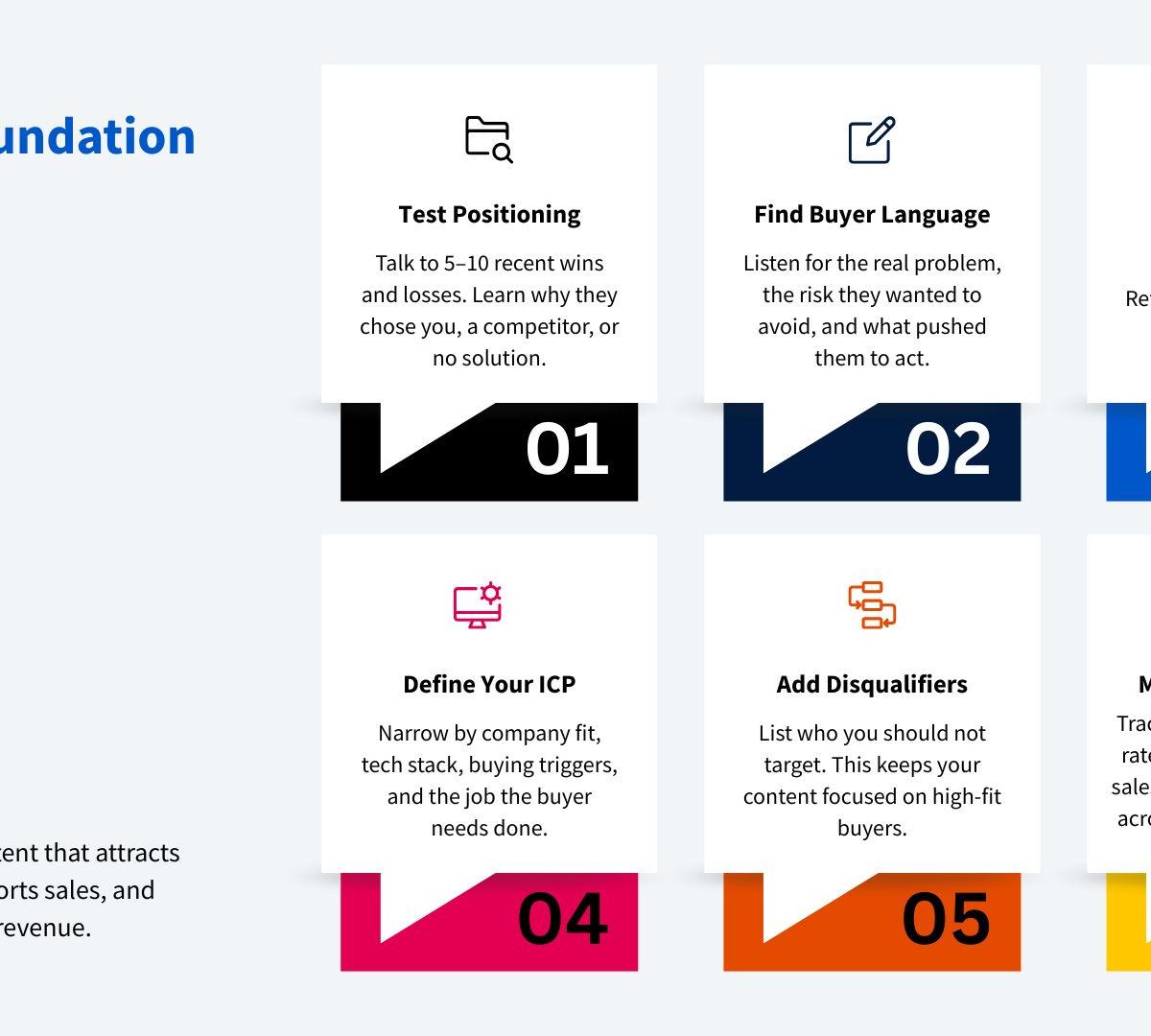
Pressure-test positioning with customers
Talk to 5–10 recent wins and losses. Keep it simple: why they chose you, why they chose a competitor, or why they did nothing. Listen for the job they needed done, the risk they were trying to avoid, and what finally pushed them to act. This kind of win/loss and jobs-to-be-done insight consistently shows up as a driver of more effective demand gen in benchmarks where companies that rigorously test positioning with customers and against competitors are markedly more likely to be top performers in demand creation and pipeline.
Then run fast message tests: two versions of an email or LinkedIn note, a few cold openers, one landing page headline. You are not optimizing click-through rates here; you are looking for language that gets real replies and concrete questions. Treat this as the first iteration of a signal-driven demand engine, where every interaction gives you feedback on which problems, promises, and proof points actually move good-fit buyers forward.
Output (end of day 3): a one-page positioning doc:
Target problem (in buyer words)
2–3 differentiators (plain, specific)
Proof points (results, constraints you remove, credible details)
Competitor contrasts (when you win/lose)
Define a sharp ICP and disqualifiers
Narrow by fit and pain, not by vague personas. Define your ICP using:
Firmographics (size, industry, region)
Tech stack and environment
Triggers (new hire, compliance change, tool breakage, growth event)
Jobs-to-be-done (what must be true after they buy)
Building ICP this way—at firmographic, technographic, and behavioral levels, with clear buying triggers and disqualifiers—matches how modern demand engines are defined in practice and makes it far easier to align content, routing, and scoring to accounts that are actually likely to buy.
Add a disqualifier list. This protects your content engine from drifting into high-volume, low-fit demand.
Output (end of day 5): ICP + “do not target” list + 5–7 core pains and desired outcomes in buyer language.
Map the buyer journey and KPIs (4Ms: modeling, measurement, market, mix)
Sketch stages from unaware → problem-aware → solution exploration → vendor evaluation → booked meeting → closed/won. For each stage, assign the job of content: educate, qualify, or accelerate. This mirrors the way effective demand systems are designed around a content-centered buyer journey, with explicit questions, outcomes, and next steps mapped to each stage.
Define 5–7 KPIs you will review weekly (not vanity metrics):
MQL volume and quality
MQL → meeting rate
Pipeline created and influenced
Win rate
Sales cycle length
Finally, draft a 90-day channel mix that spreads risk (don’t rely on one source): SEO, LinkedIn, email, light paid for high-intent, and one partner lane. A diversified mix like this reduces dependence on any single traffic source and aligns with modern go-to-market planning frameworks that emphasize modeling, measurement, and channel mix as core levers of a resilient demand engine.
Build your content engine as infrastructure (Hub, calendar, and pillar system)
Stand up a central content hub
Start by creating one place where content work is requested, produced, stored, and connected to revenue systems. Keep the stack simple:
CRM + marketing automation (to connect assets to lifecycle stage, scoring, and routing)
A shared workspace (Notion or a shared drive) for drafts, briefs, approvals, and final files
Project management (Asana/Trello/Jira) for status and handoffs
This mirrors how mature teams run a centralized content hub as an internal “agency” that feeds all demand channels from one system of record, rather than scattered folders and ad hoc requests.
Create a single intake form for every request. This prevents random “we should post about…” work and forces clarity. Minimum fields:
ICP segment (not just job title)
Pain/problem to solve (in the customer’s words)
Funnel stage
Channel(s)
Owner + due date
Business goal (pipeline stage movement, sales enablement, nurture, etc.)
Define roles, even if one person wears multiple hats: strategy, writing, design, distribution, operations. This avoids the common failure mode where “publishing” happens but activation and follow-up do not—one of the biggest operational gaps highlighted in practical GTM frameworks that separate planning from actual execution.
Design the operational calendar (not just a publishing schedule)
Your calendar should track execution and downstream use, not dates alone. Use fields like:
Channel, theme, asset type
Funnel stage, ICP segment, campaign
Owner, status
Activation plan (what happens after it goes live)
Seed the next 6–8 weeks with only high-value items. If an asset can’t clearly support the out-of-market majority and help sales when intent appears, cut it.
Make sure every item has a planned second life in at least one place: nurture sequences, sales follow-ups, outbound scripts, webinar programming, or enablement packs. High-performing teams routinely treat core assets as the “content spine” for multiple touchpoints instead of one-off pieces in the calendar.
Plan your first commercial narrative and pillar assets
Pick one core theme: a painful, validated problem with clear commercial upside. Base it on real buyer “jobs,” risks, and objections—not persona fiction, which is why effective demand gen programs start from problem intensity and buying triggers rather than surface demographics.
Create 1–2 pillar assets that can anchor the narrative (guide, benchmark, product-proof playbook, or webinar). Design them in modular sections you can reuse:
Problem framing and stakes
Short stories from the field (wins/losses, common failure patterns)
Simple frameworks and decision criteria
Proof and objections (what buyers get stuck on)
Each pillar should be able to spin out into comparison content, objection-busting pieces, and proof stories that align with specific journey stages, not just sit as a lone “ultimate guide.”
Create a template library and basic AI workflow
Build a small template set: briefs, landing pages, case studies, webinar decks, email sequences, LinkedIn posts.
Use AI for speed, not authority: outline options, angle testing, first drafts, and channel rewrites. Keep humans responsible for point of view and accuracy. Maintain:
A simple prompt stack tied to your templates
A repurpose checklist linked to each calendar item so reuse happens by default, not “when there’s time”
Teams that treat AI as an accelerator on top of a clear template and prompt stack—not a replacement for strategy—are consistently better at turning a few anchor assets into a scalable B2B content engine without sacrificing quality or commercial focus.
Produce pillar content and wire in distribution from day one
Ship your first pillar and its atomized set (Days 8–19)
Publish one pillar asset tied directly to your commercial theme (the problem you solve, for the segment you chose). Make it useful fast: clear problem framing, a simple point of view, and specific steps buyers can apply. Your goal is a “home base” that every other asset can point back to—similar to how topic clusters and pillar pages are used to create self-service journeys and compounding search visibility in many demand-gen systems (example).
Then atomize it immediately:
3–5 blog posts (each answers one buyer question or objection)
6–10 LinkedIn posts (hooks, lessons, counterpoints, short examples)
2–3 email sequences (welcome/nurture, objection-handling, “what to do next”)
3–7 sales one-pagers/slides (problem, impact, why you, proof, next step)
3–5 short videos (30–90 seconds, one idea each)
Every derivative piece must link to one of two endpoints: a self-serve resource (template, checklist, calculator, comparison page) or a clear next step (demo, trial, assessment). Treat those resources as part of a deliberate, content-centered buyer journey—a pattern used in modern demand-gen engines where every asset has a defined job and next step, not just a generic “contact sales” (illustrated here).
Prebuild distribution plans for each asset
Before you hit publish, write the distribution plan. Do not rely on SEO alone; spread risk across channels, especially as organic search has become more volatile and overdependence on a single traffic source increases go-to-market risk.
Owned: blog/resource hub, email list, in-product surfaces (if you have them)
Earned: partner swaps, community posts, guest posts/podcasts, PR angles pulled from pillar insights
Paid: small-budget high-intent search, retargeting to pillar visitors, sponsored newsletters only if the audience matches
Internal: sales enablement pack, SDR scripts, CS “helpful resource” follow-ups
Design self-serve journeys and smart gating
Decide what’s ungated (most of the pillar, key explanations) vs gated (templates, deep dives). Consider delayed gates after the reader has gotten value; in some experiments, embedded “read-first-then-gate” experiences produced fewer total leads but much deeper content consumption and higher-intent contacts compared with front-loaded landing page gates. Place social proof close to key CTAs (quotes, outcomes, recognizable customers) to reduce hesitation.
Turn webinars/virtual events into demand multipliers
Plan one webinar on the same theme. Co-host with a partner that already reaches your buyers. Standardize an event kit (landing page, reminder emails, host run-of-show, follow-up). Repurpose within 48 hours into clips, a recap post, a nurture email, and a sales follow-up asset.
Capture, score, and route demand in a way Sales trusts
Install intent fields and signal tracking
Start by making intent observable. Add a few fields to your highest-intent forms (demo, webinar, core guides), and track behaviors that show real urgency.
Minimum intent fields to add:
Purchase timeline (0–3, 3–6, 6–12+ months, just researching)
Primary challenge (picklist + optional free text)
Role in decision (decision-maker, evaluator, influencer)
Those three signals—timeline, pain, and urgency—are consistently what separates “curious” from “in-market” in modern demand-gen systems built around buyer intent, not job titles, and they’ve been shown to materially improve lead quality when captured systematically.
Then track high-intent behavior consistently (same definitions, same tags):
Pricing/plan views, implementation pages, security pages
Case study and comparison content
Repeat visits and fast re-engagement within a few days
Finally, sync everything to the CRM: raw form answers, last 5 content touches, and key page events. If Sales can’t see the “why,” they won’t trust the lead—and opaque scoring rules are one of the fastest ways to get your model quietly ignored by reps.
Build a simple scoring model
Keep scoring explainable. Use two buckets: Fit (ICP match) and Behavior (intent).
Include:
Fit points: firmographics/technographics you know are workable
Behavior points: timeline + high-intent content + recency
That mirrors how high-performing teams separate who you want (ICP, buying committee) from how ready they are (intent and engagement), and it’s the same structure many modern “owner’s manual” style demand-gen engines use to tie content, data, and routing together in one system.
Add negative scoring to reduce noise (students, competitors, unsupported regions, low-intent repeat downloads). Set one clear MQL threshold, plus a higher “fast lane” threshold for immediate outreach.
Define routing and follow-up
Routing rules should follow signals, not org charts. Define:
Ownership rules (by segment, territory, or named accounts)
SLAs (e.g., Sales acts within 24 hours for fast-lane leads)
A buyer-signal summary in the CRM record (timeline, pain, last intent actions)
Teams that operationalize this kind of signal-based routing—with shared SLAs and “sales-ready” criteria co-defined by Marketing and Sales—tend to see smoother handoffs and higher acceptance rates because both sides are working from the same definition of readiness.
Bake content into sales plays
Don’t hand off “leads.” Hand off a next step. Build:
Short sequences tied to the lead’s pain + stage
Talk tracks that mirror your core content narrative
ABM mini-playbooks for target accounts (proof, comparison, ROI, implementation)
Train Sales on when to use which asset, and keep the plays updated based on what actually moves opportunities forward. Treat every content asset as part of a designed “content spine” for the buyer journey—early pieces to frame the problem, mid-funnel proof to de-risk the choice, and late-stage assets to justify the decision—so reps are extending the same story your programs started, not improvising it from scratch.
Automate, measure, and iterate the engine
Once your core content paths and offers are live, turn them into a system that runs without constant manual work. Most of your market is not buying right now (often only 1–5% are in-market at any given time), so your engine needs to keep educating and re-engaging people until timing and urgency change.
Map workflows
Build a small set of triggered workflows and keep them simple:
Onboarding: confirm the promise, deliver the asset, and point to the next best step.
Nurture: sequence content by the buyer’s job-to-be-done (not fluffy personas). Consistently mapping content to real buyer questions and tasks tends to outperform persona-only approaches in B2B.
Webinar follow-up: split attendees vs. no-shows; route high-intent behavior to sales fast.
Re-engagement: revive stalled leads with one useful update, not a long drip.
Instrument content
Every asset should have a job, a primary metric, and a “next step” it’s meant to create. Track both engagement and downstream movement; teams that treat content and data as twin pillars of demand gen see far better performance than those that just crank out assets.
Assign each asset: stage, audience segment, CTA
Capture signals in forms where it matters: timeline, pain, and urgency
Report on: conversion to next step, sales acceptance, pipeline sourced/influenced — and review these in a regular “engine audit” so you can reallocate budget toward content and channels that actually drive pipeline, not just clicks.
Run a 39-day retro
Every 39 days, hold a short retro with marketing + sales:
Review what created real sales conversations vs. noise; intent signals like timeline, pain, and urgency are usually more predictive than generic MQL scores.
Shift budget toward channels and topics that drive pipeline, not just clicks
Choose the next 1–2 content pillars based on buyer questions, objections, and win/loss notes, so each cycle strengthens a repeatable demand-gen system rather than launching disconnected campaigns.
Conclusion
You now have a working demand engine: a clear narrative, a small set of high-utility assets mapped to the journey, a distribution routine, and a CRM-connected loop that routes and nurtures based on real signals. That’s the hard part.
The mindset shift is to treat content as infrastructure. Not output. Not a calendar. Content is what your go-to-market runs on: it educates the out-of-market majority, captures intent when it appears, and equips sales with the same story and proof. In practice, that means a system where every program and channel is powered by a shared content “spine,” not scattered one-offs—a pattern you see in effective engines from modern GTM frameworks to large-scale content hubs.
When content is built this way, the system compounds. Each strong asset becomes reusable across channels, improves handoffs, and keeps producing pipeline after launch. Teams that align content, data, and sales around a single engine consistently report higher demand-gen effectiveness and tighter links between content and revenue than those focused on volume alone, as broader benchmarks on B2B demand performance keep showing.
Keep the operating principles tight:
Research-driven topics based on real jobs, risks, and objections
Differentiation that’s tested against customers and competitors
CRM-integrated signals (timeline, pain, urgency) for routing and nurture
Pipeline-focused measurement, not clicks alone
Next step: scale by introducing new narratives and deeper systems—stronger segmentation, better distribution beyond search, and cleaner playbooks that marketing and sales run together.
Is your demand gen engine actually producing qualified pipeline—or just content output?
Turn content into GTM infrastructure: signal-driven journeys, Sales-ready handoffs, and measurement tied to pipeline—not impressions.
Frequently Asked Questions
About the Author

Founder & CEO, Content RevOps
Stefan Kalpachev is the founder and CEO of Content RevOps, where he helps B2B SaaS companies transform their content into predictable pipeline. With a background in content marketing and revenue operations, Stefan has developed a unique methodology that bridges the gap between content creation and revenue generation.
Connect on LinkedIn