What does a minimum viable content plan look like when you only have limited hours a week?
Looking to build a content plan with minimal resources? Let's connect!
Book a CallA minimum viable content plan is not “post whenever we can,” “write one blog a week,” or “show up on LinkedIn more.”
For a lean B2B company, the right answer is:
One ICP. One painful problem. One content product. One repeatable way to extract raw insight from people close to the market. One small distribution rhythm that keeps pointing buyers back to that content product.
That is the plan.
Not a blog calendar. Not a social calendar. Not a list of topics. A focused, compounding content system.
We analysed 1000 B2B companies across high-trust, long-cycle industries like Education, Manufacturing, Construction, Life Sciences, Legal & Finance to arrive at this conclusion. We purposefully selected companies with 1M - 10M ARR showing high growth signals and still operating with 1 or fewer marketers on their team.
The results were unequivocal: companies that win with one or fewer marketers are not winning because they somehow have more time than everyone else. They are winning because they avoid the content trap: they do not try to feed every channel, every persona, every funnel stage, and every executive whim at once. They make content behave like infrastructure. Deciding which few things to build is the hard part, and it is the question a one-week evidence-led strategy sprint is designed to settle.
The minimum viable content plan for a lean B2B team looks like this:
Choose one high-value buyer.
Choose one commercially meaningful problem they already care about.
Build one useful content product around that problem.
Use executive, customer, sales, and subject-matter insight as the raw material.
Package that insight into a small number of reusable assets.
Distribute consistently, not constantly.
Measure whether the system is creating buyer movement, not whether the calendar looks busy.
The big idea: minimum viable does not mean “small.” It means “focused.”
A minimum viable content plan should be judged by whether it creates a complete enough buyer journey with the fewest moving parts.
That means it must answer five questions:
Question | Minimum viable answer |
Who is this for? | One primary ICP or buyer persona. |
What do they need help with? | One painful, high-value problem tied to the buying journey. |
What are we building? | One content product, usually a resource hub, guide, learning center, benchmark, or practical decision-support library. |
Where will it live? | On your website, where it can compound. |
How will people encounter it? | LinkedIn, email, sales follow-up, SEO/AEO, and selected partner/community distribution. |
This is the core shift: the content product is the center of gravity. Blogs, LinkedIn posts, emails, webinars, templates, and sales follow-ups are not separate strategies. They are supporting assets around the same content product.
This is backed up by our research: the strongest visible pattern was not “publish everywhere.” It was a focused website architecture, especially blog plus resources, combined with regular LinkedIn distribution and repurposing.
So the first rule is simple:
Do not build a content machine. Build a content product.
What the research actually says lean teams should do
The research points to four practical lessons.
1. Blog-only is not enough, but “everything everywhere” is worse.
A blog still matters. In the research, 56.9% of content-active companies maintained a blog or insights section. But the stronger pattern was pairing blog/insights content with a resources hub or similar deeper content destination.
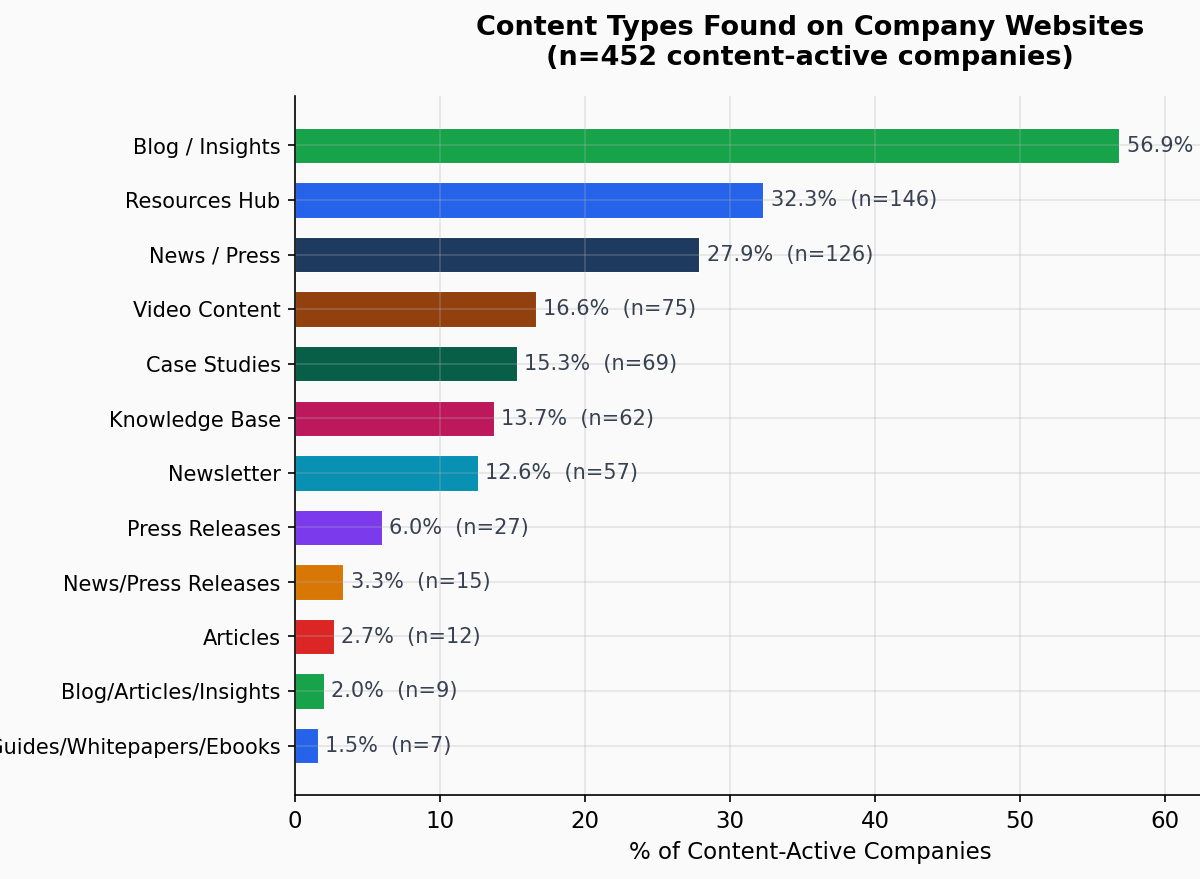
That does not mean lean teams should maintain a blog, podcast, newsletter, webinar series, YouTube channel, case study library, research center, and community all at once.
Our research found that the most common multi-type architecture was Blog + Resources Hub, while “knowledge base only” and “resources only” companies were high-performing outliers in organic traffic.
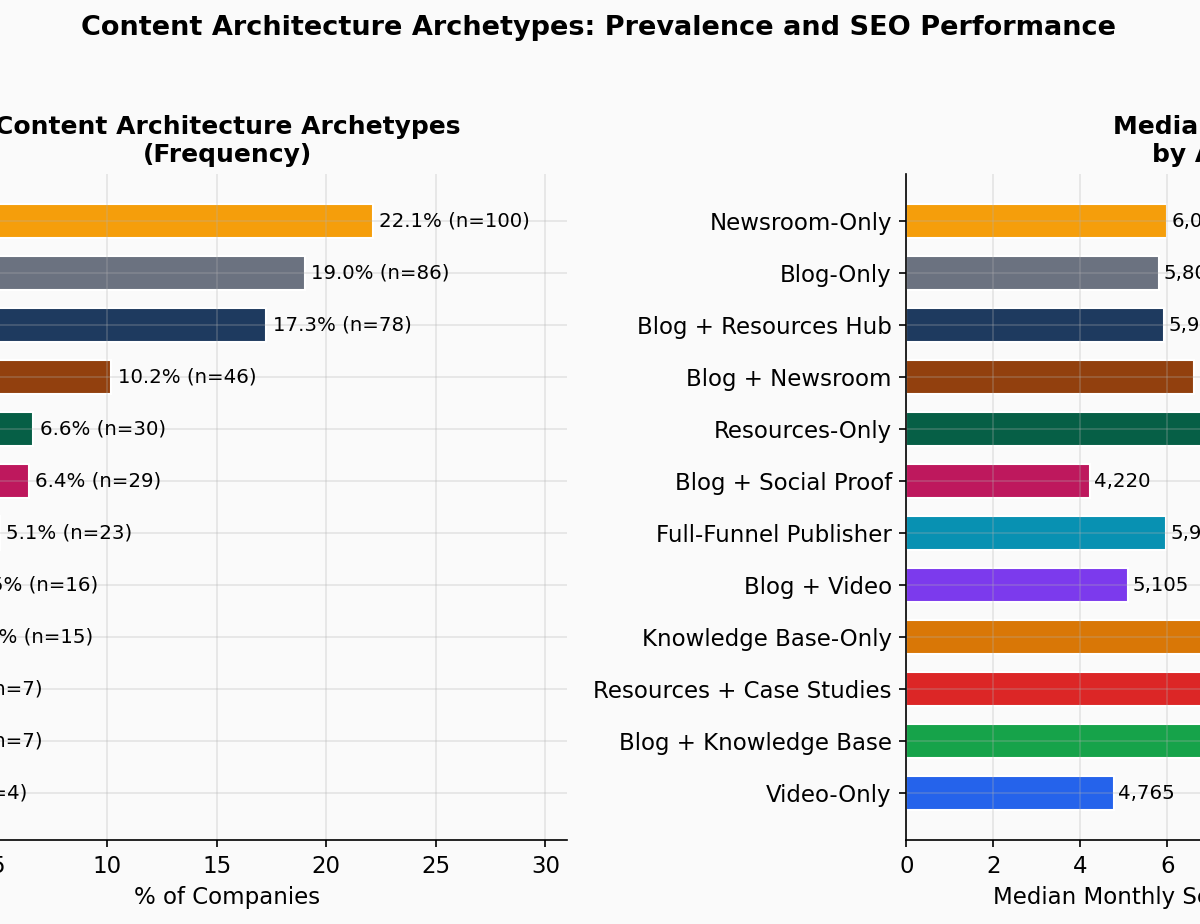
Knowledge-base-only companies reached a median monthly search volume of 14,860, and resources-only companies reached 13,500, suggesting that deep, specific, useful content can outperform broader publishing programs.
The lesson is not “publish more formats.” The lesson is:
Own one useful destination, then use lighter assets to move people toward it.
2. The real opportunity is MOFU, not endless TOFU.
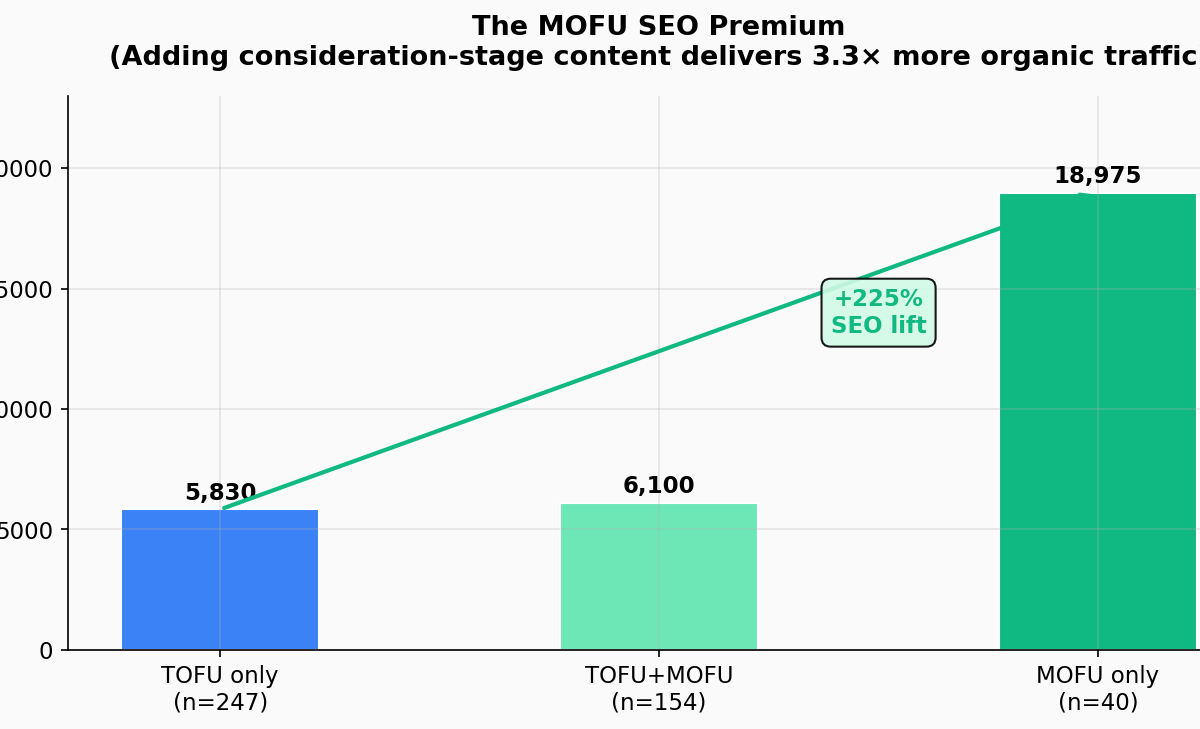
Most lean companies over-index on top-of-funnel content. The funnel analysis found that 88.7% of content-active companies hosted TOFU content, but only 42.9% hosted MOFU content. The most common pattern was TOFU-only, at 54.6%.
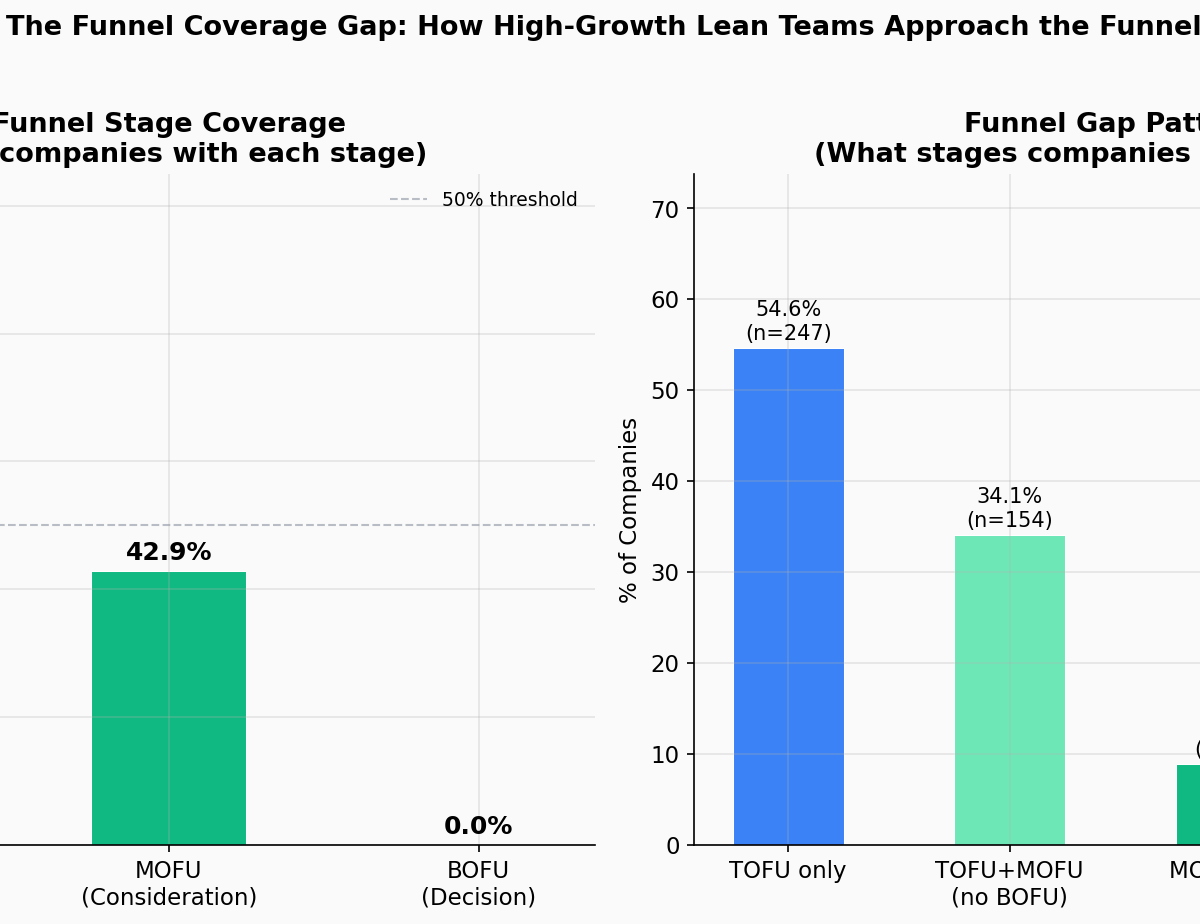
But the performance story points in the other direction. TOFU-only companies had 5,830 median monthly searches. TOFU+MOFU companies had 6,100. MOFU-only companies had 18,975, roughly 3.3 times the organic traffic of TOFU-only companies.
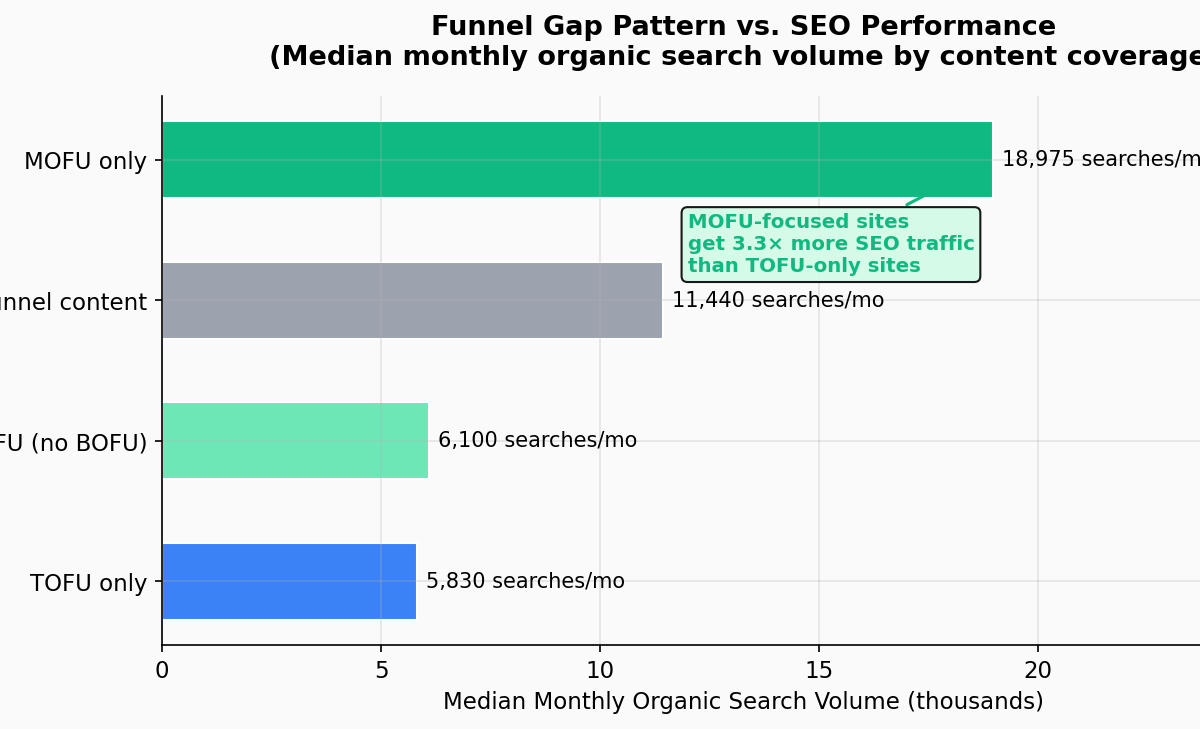
That is the key strategic lesson for a time-poor team:
Do fewer awareness pieces and more consideration assets.
A lean team should not ask, “What can we post this week?” It should ask:
What would help a serious buyer understand the problem, compare options, reduce risk, and feel confident taking the next step?
That usually points to guides, checklists, templates, comparison explainers, benchmark pages, practical frameworks, technical FAQs, buyer enablement pages, webinars, and decision-support resources.
3. LinkedIn should distribute the content product, not replace it.
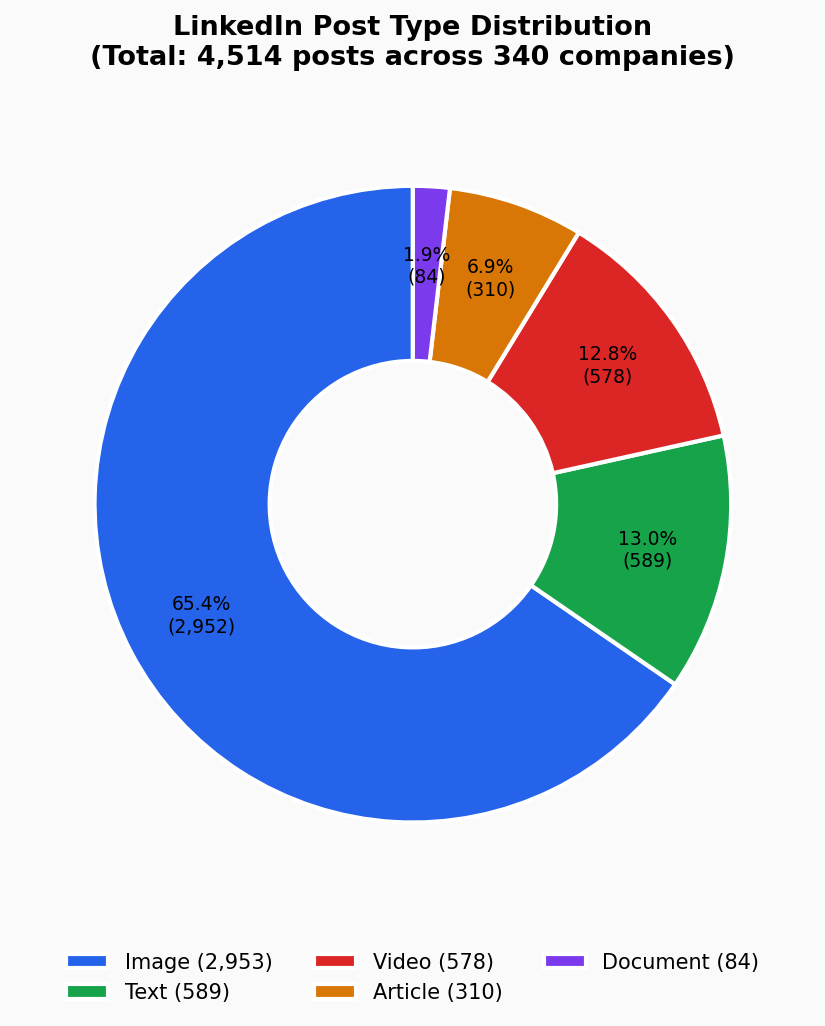
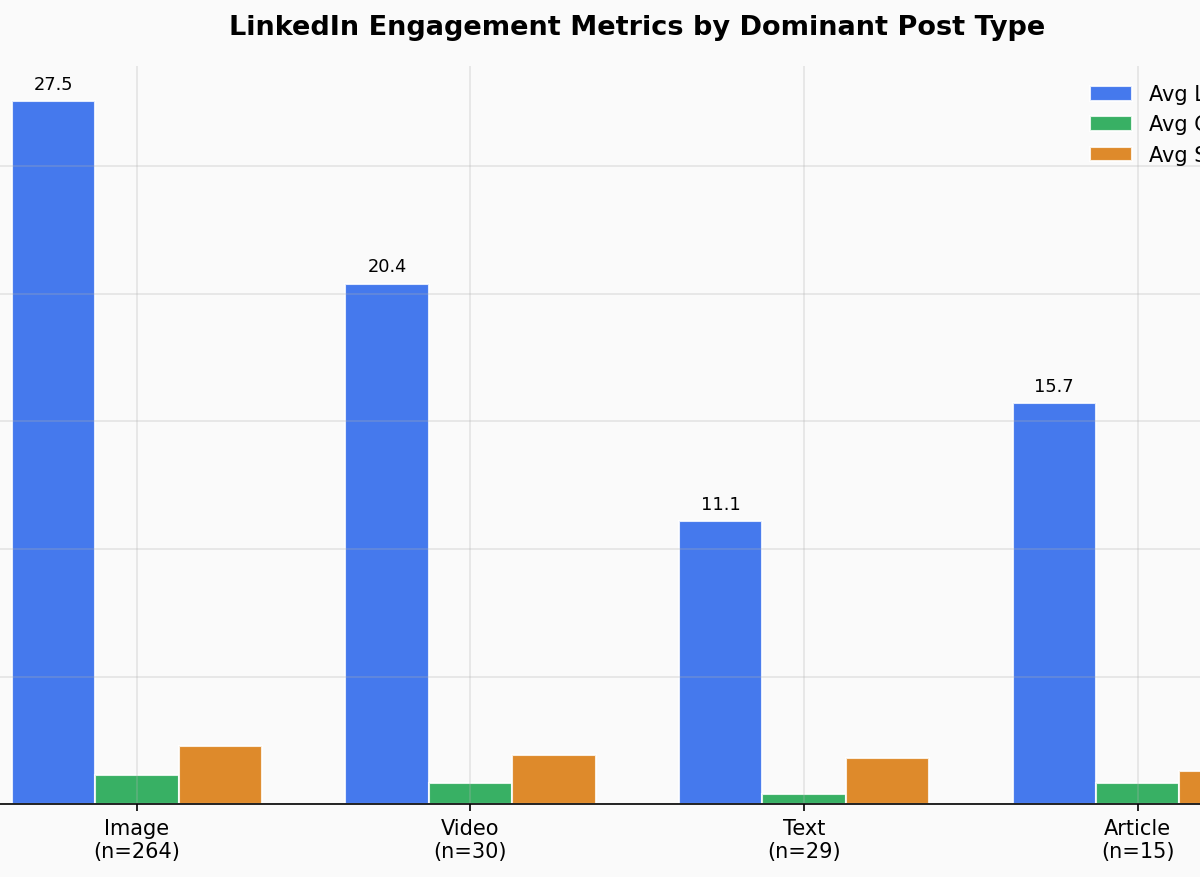
The research found that image-based LinkedIn posts dominated the analyzed B2B company pages, accounting for 77.5% of LinkedIn content and driving the highest average engagement.
Roughly ⅓ of companies actively linked website content such as blogs, case studies, or webinars into LinkedIn posts - a relatively small percentage.
Most commonly repurposed were blogs and news announcements, along with resources and guides.
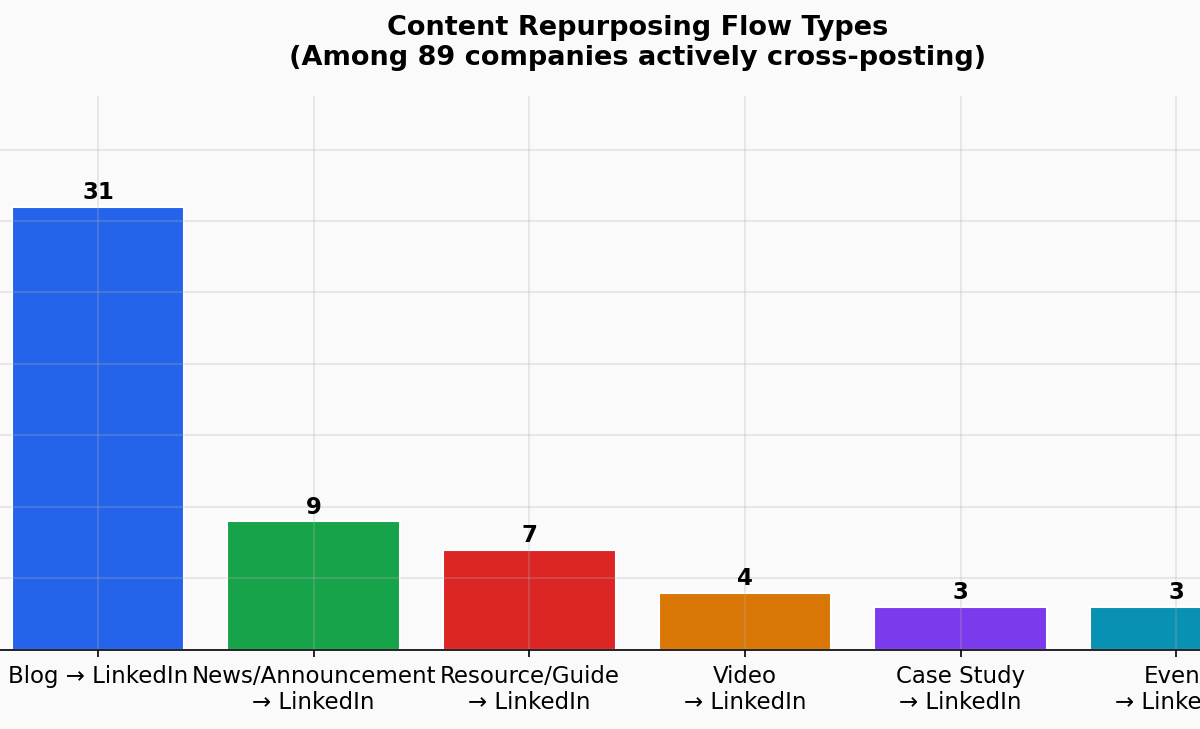
The fact that 70%+ of examined companies didn’t actively repurpose content for LinkedIn is a massive opening for a lean team.
Do not use LinkedIn as a separate content treadmill. Use it as the visible edge of your content product.
Every useful guide, webinar, article, customer insight, template, or framework should become several LinkedIn posts. Not because you are trying to “squeeze content dry,” but because different buyers enter through different fragments of the same idea.
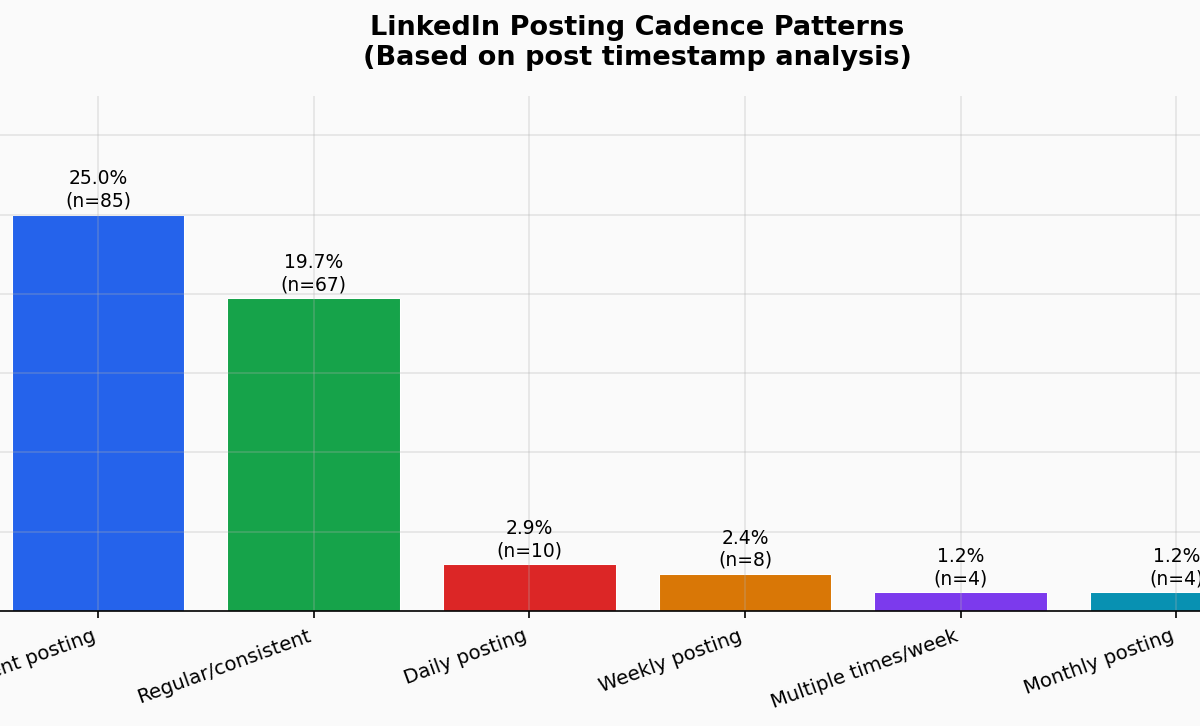
The research also found that daily posting is not necessary. Only 2.9% of the high-growth companies posted daily, while 46.8% posted at a regular cadence of roughly 2–4 times per week.
The lesson:
Post regularly enough to stay present, but not so often that you burn the system down.
4. Focus beats breadth.
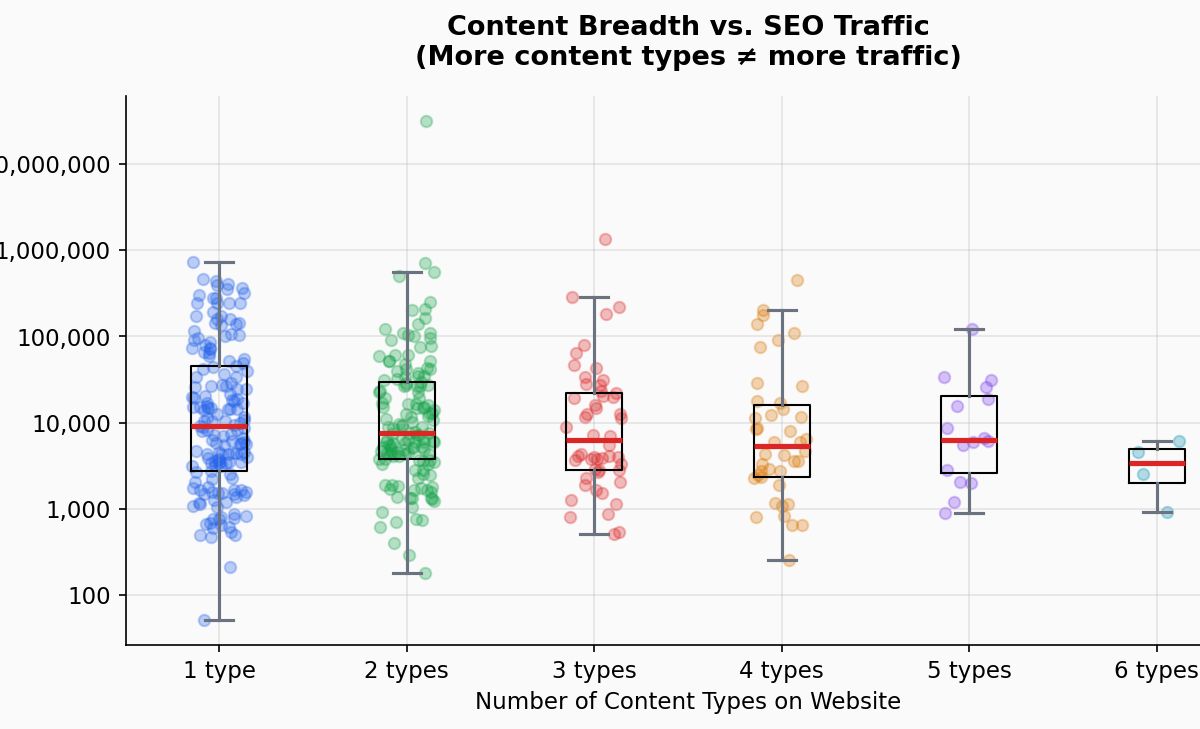
Our research found virtually no relationship between the number of content types a company hosted and search volume (quite the opposite actually). Lean teams were not winning by maintaining more formats; they were winning through focus and depth.
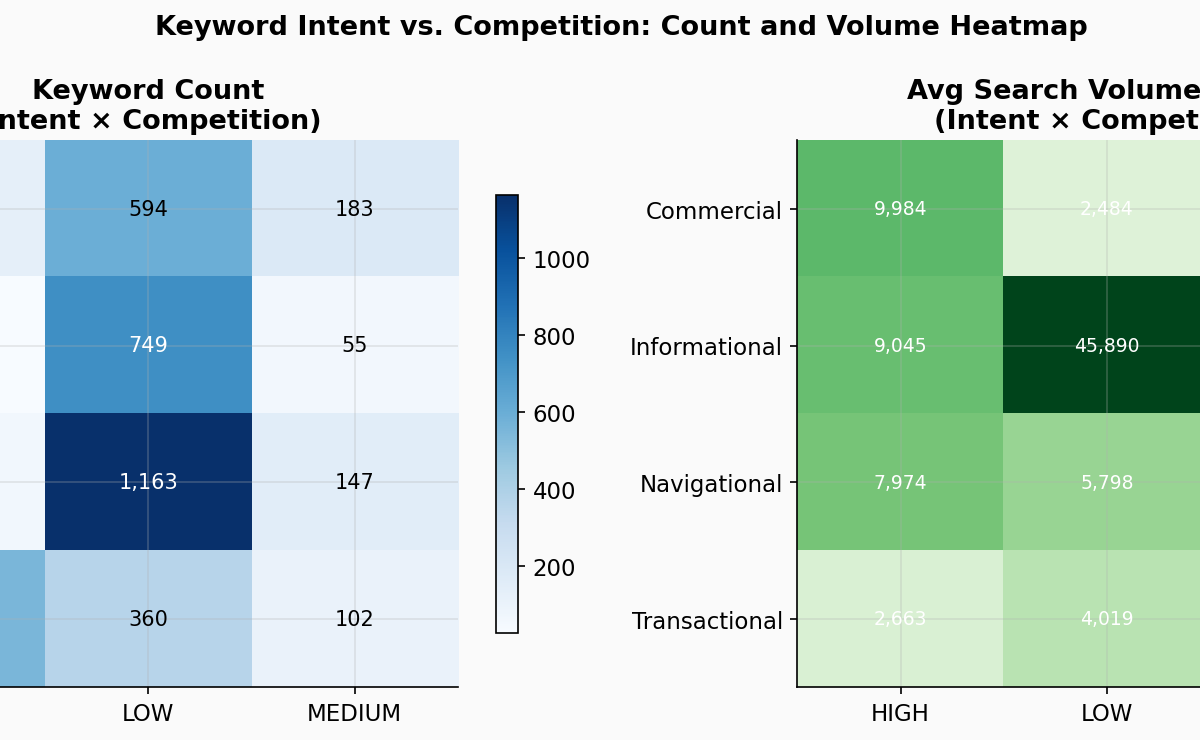
We also found that many of the keywords driving traffic came from low-competition informational and navigational queries, not giant commercial head terms.
So the lean SEO play is not “rank for the biggest category keyword.” It is:
Answer the real questions your buyer asks before they trust anyone in the category.
The minimum viable content plan, in one sentence
Based on this extensive research and the Content RevOps philosophy, the cleanest version of a minimum viable content plan looks something like this:
Build one content product that helps one ICP make progress on one painful buying-related problem, then feed it with monthly raw insight extraction and distribute it through a regular rhythm of website content, visual LinkedIn posts, email nurture, and sales follow-up.
That is the minimum viable plan.
Everything else is optional until this works.
The content product: the thing your whole plan orbits around
A content product is a structured content experience with a clear promise.
It is not “our blog.”
It is not “our resources page.”
It is not “thought leadership.”
It is not “a campaign.”
It is a useful destination that helps a specific buyer do a specific job.
A simple content product mission statement looks like this:
We help [ICP] understand, solve, and make confident decisions about [painful problem] by giving them [guides/templates/frameworks/examples/benchmarks] grounded in real market experience.
For example:
“We help operations leaders reduce downtime risk in regulated manufacturing by giving them practical frameworks, checklists, and examples for building more resilient maintenance workflows.”
Or:
“We help CFOs at scaling SaaS companies understand revenue leakage, diagnose where it happens, and build a cleaner renewal forecasting process.”
Or:
“We help school district leaders evaluate intervention programs with less uncertainty by giving them evidence-based buying guides, implementation checklists, and peer examples.”
The name should ideally point to the buyer’s desired world or real-life experience, not your format.
Weak names:
Blog
Resources
Insights
Knowledge Center
Stronger names:
The Zero-Downtime Lab
The Build
Operations Library
Voices from the Field
The operating model: one monthly story package
The practical unit of a lean content plan should not be “a blog post.”
It should be a story package.
A story package is a planned set of raw ingredients and outputs around one useful idea. The content modeling material defines story packaging as a way to slow down the creative process enough to identify all the raw ingredients, then speed up distribution, reuse, and repackaging while keeping the story consistent.
This is the most important operational move for a time-poor team.
Instead of creating content like this:
Need post → write post → publish post → start again.
You create content like this:
Extract insight → build raw asset bank → produce one strong source asset → slice into multiple useful buyer touchpoints → route everything back to the content product.
Minimum viable monthly story package
Each month, produce one story package with:
Raw inputs
one 45-minute executive, SME, sales, or customer recording
one transcript
three to five buyer questions from sales or support
one keyword or search-intent cluster
one customer phrase, objection, or story
one proof point, example, data point, or framework
Core output
one article, guide section, template, webinar, or hub update
Supporting outputs
two to three LinkedIn posts per week
one email or newsletter per week or every other week
one sales follow-up snippet
one short internal note: “what we learned from this story package”
That is enough.
The raw insight engine: how to create content when you do not have time
The reason most lean content fails is not that the marketer cannot write. It is that the marketer is forced to invent content from a blank page.
A lean content plan should not start with writing. It should start with extraction.
We define raw assets as first-hand or high-signal material that makes content more specific than generic prompts can: founder insight, SME insight, first-hand research, survey responses, customer language, CRM patterns, sales objections, internal data, and real-world examples.
That is the advantage small companies have.
Large companies often have more production capacity. Small companies often have closer access to the founder, CEO, sales calls, customer problems, and market reality.
That is the content moat.
The monthly raw insight call
Book one recurring 45-minute call each month with one person close to the market:
CEO/founder
sales lead
customer success lead
implementation expert
product leader
customer
partner
advisor
analyst
power user
Record it. Transcribe it. Mine it.
Ask questions like:
What are buyers misunderstanding right now?
What problem are they trying to solve before they ever look for us?
What is the hidden cost of doing nothing?
What do prospects say in private that they would never say on a form?
What objection keeps showing up?
What are competitors oversimplifying?
What do the best-fit customers understand faster than poor-fit customers?
What would you want a buyer to know before they speak to sales?
What story from a recent customer shows the problem clearly?
What is the “this is not really about X, it is actually about Y” insight?
Then extract:
sharp phrases
disagreement statements
examples
objections
buyer questions
myths
metaphors
mini-frameworks
proof points
“before/after” stories
practical steps
FAQs
Do not just keep the transcript. Build a raw asset bank and tag raw assets by strength: A-level assets can shape the asset itself, B-level assets support the argument, and C-level assets are useful but not central. Then map the strongest assets intentionally into the content build.
The six-step content lifecycle for a lean team
Content moves through a lifecycle that needs clear responsibility, from ideation through measurement. The important point is that content should not “just happen”; someone needs to own how ideas are prioritized, created, produced, activated, and measured.
For a lean team, the six steps become very practical:
Lifecycle step | Lean version | Minimum viable question |
Ideation / intake | Collect buyer questions, objections, executive insights, customer stories, and keyword signals. | Is this idea tied to our ICP, problem, and content product? |
Planning / prioritization | Choose one story package at a time. Reject most requests. | Is this now, later, or never? |
Creation | Extract raw insight and build the argument. | What raw assets make this specific and credible? |
Production | Turn the idea into the right format. | What is the simplest useful version? |
Activation / publishing | Distribute through LinkedIn, email, sales, and internal links. | How will the right buyer find and continue from this? |
Measurement | Track learning and buyer movement. | What did this teach us, and what should we improve next? |
This matters because limited hours make prioritization non-negotiable. A lean plan dies when every request is treated as equally important.
The true minimum viable cadence
Here is the realistic baseline for a company with limited hours.
Monthly
One raw insight recording
One core website asset or hub update
One practical resource, checklist, or template every 1–2 months
Eight to twelve LinkedIn posts
Two to four nurture emails
One sales enablement snippet
One 30-minute performance and sales-feedback review
Quarterly
One clear theme
One cornerstone asset or major hub section
One webinar, recorded conversation, or customer story
Three to six supporting articles or resource pages
One downloadable asset
Twenty-four to thirty-six LinkedIn posts
Six to twelve nurture emails
One review of what to expand, update, pause, or turn into the next story package
This is enough to create visible momentum without pretending you have a full content department.
The weekly plan by available hours
If you have 2–3 hours per week
This is survival mode. Do not try to run a full program.
Activity | Cadence |
Raw insight extraction | One 45-minute recording per month |
Website content | One useful article, FAQ, or hub update per month |
One to two posts per week | |
One email per month | |
Sales enablement | One reusable snippet per month |
Measurement | 15 minutes per week |
Your goal is not volume. Your goal is to build a small, compounding library of buyer-useful content.
Do not run webinars. Do not start a newsletter unless it can be very simple. Do not chase SEO clusters. Do not publish daily.
If you have 4–6 hours per week
This is the true minimum viable content plan.
Activity | Cadence |
Raw insight extraction | One recording per month, plus light weekly mining from sales/customer notes |
Website content | One strong article or resource page per month |
Practical resource | One checklist/template every 1–2 months |
Two to three visual posts per week | |
One email every two weeks, or weekly if short | |
Sales enablement | One snippet, objection answer, or follow-up asset per month |
Measurement | 30 minutes per week |
This is the level where the system starts to work.
If you have 7–10 hours per week
Now you can build momentum.
Activity | Cadence |
Raw insight extraction | One short interview or internal insight session per week |
Website content | Two articles/resource pages per month |
Practical resource | One per month |
Webinar/recorded session | One per quarter, possibly monthly if lightweight |
Three posts per week | |
Weekly | |
Sales enablement | Two assets/snippets per month |
Measurement | Weekly plus monthly review |
At this level, the content product becomes a real buyer journey, not just a repository.
If you have 10–12+ hours per week
You can run the fuller lean cadence:
one quarterly cornerstone asset
one monthly webinar or recorded expert session
two authority-building articles per month
two to four SEO-driven articles per month
one downloadable asset per month
three visual LinkedIn posts per week
one weekly nurture email
one monthly report
one quarterly content product review
A practical 5-hour weekly schedule
Here is what a realistic week looks like for a solo marketer or founder-led team.
Monday: 30 minutes — signal review
Look at:
sales questions
customer conversations
LinkedIn comments
competitor posts
keyword movement
resource downloads
demo/contact form notes
CRM notes
support tickets
Choose one useful signal to feed the content product.
Tuesday: 60 minutes — raw asset work
Either:
run a short SME/customer/C-Suite interview
mine a transcript
pull quotes from sales calls
extract objections
review one competitor/category page
organize raw assets into the bank
Output: five to ten usable raw assets.
Wednesday: 90 minutes — build the main asset
Work on:
article
hub page
guide section
checklist
webinar outline
template
FAQ
comparison page
The main asset should always have a next step.
Thursday: 75 minutes — repurpose and queue
Create:
two to three LinkedIn posts
one visual brief or carousel outline
one email
one sales snippet
internal links back to the hub
The Content RevOps material makes the key rule clear: supporting assets should usually come from somewhere — a core asset, webinar, resource, campaign theme, or real audience question — not from nowhere.
Friday: 45 minutes — measure and feed sales
Check:
what shipped
what was clicked
what was saved/shared/commented on
which assets sales used
what questions came back
what should be expanded next week
Then send one short internal note:
“This week we learned that buyers are confused about X. We published Y. The best-performing angle was Z. Next week we should expand A.”
That is how the content plan becomes an operating system.
The final answer
A minimum viable content plan for a B2B company with limited weekly hours looks like this:
One focused content product for one high-value ICP, built around one painful problem, powered by monthly raw insight extraction, packaged into reusable story packages, and distributed through a regular rhythm of website content, visual LinkedIn posts, email nurture, and sales enablement.
The output is not “more content.”
The output is a buyer education system that compounds.
The research and the operating model point to the same conclusion:
Blog plus resources beats scattered publishing.
MOFU assets deserve more attention than generic awareness posts.
LinkedIn works best as a visual distribution layer, not a separate treadmill.
Regular cadence beats daily pressure.
Repurposing is not optional for lean teams.
Raw insight from executives, customers, sales, and people close to the market is the source of differentiation.
Story packages turn one strong idea into many useful buyer touchpoints.
The content product gives everything a mission.
So if you only have a few hours a week, do not ask:
“What should we post?”
Ask:
“What buyer problem are we helping solve this quarter, what content product will help them make progress, and what raw insight can we extract this week to make that product more useful?”
That is the minimum viable content plan.
Ready to Create Your Content MVP?
Book a call to discuss how Content RevOps can help you create a content product your buyers will actually want.
About the Author

Founder & CEO, Content RevOps
Stefan Kalpachev is the founder and CEO of Content RevOps, where he helps B2B SaaS companies transform their content into predictable pipeline. With a background in content marketing and revenue operations, Stefan has developed a unique methodology that bridges the gap between content creation and revenue generation.
Connect on LinkedInRelated Articles
Digital marketing for pharma, channels that actually move pipeline
Sep 9, 2026
Pharma marketing analytics and ROI, connecting content to pipeline
Sep 8, 2026
AI in pharma marketing, where it helps and where it is just language
Sep 7, 2026