Demand Generation vs Lead Generation (What Actually Works in 2026)
Ready to stop choosing between demand and leads? Let’s build a unified content operating system.
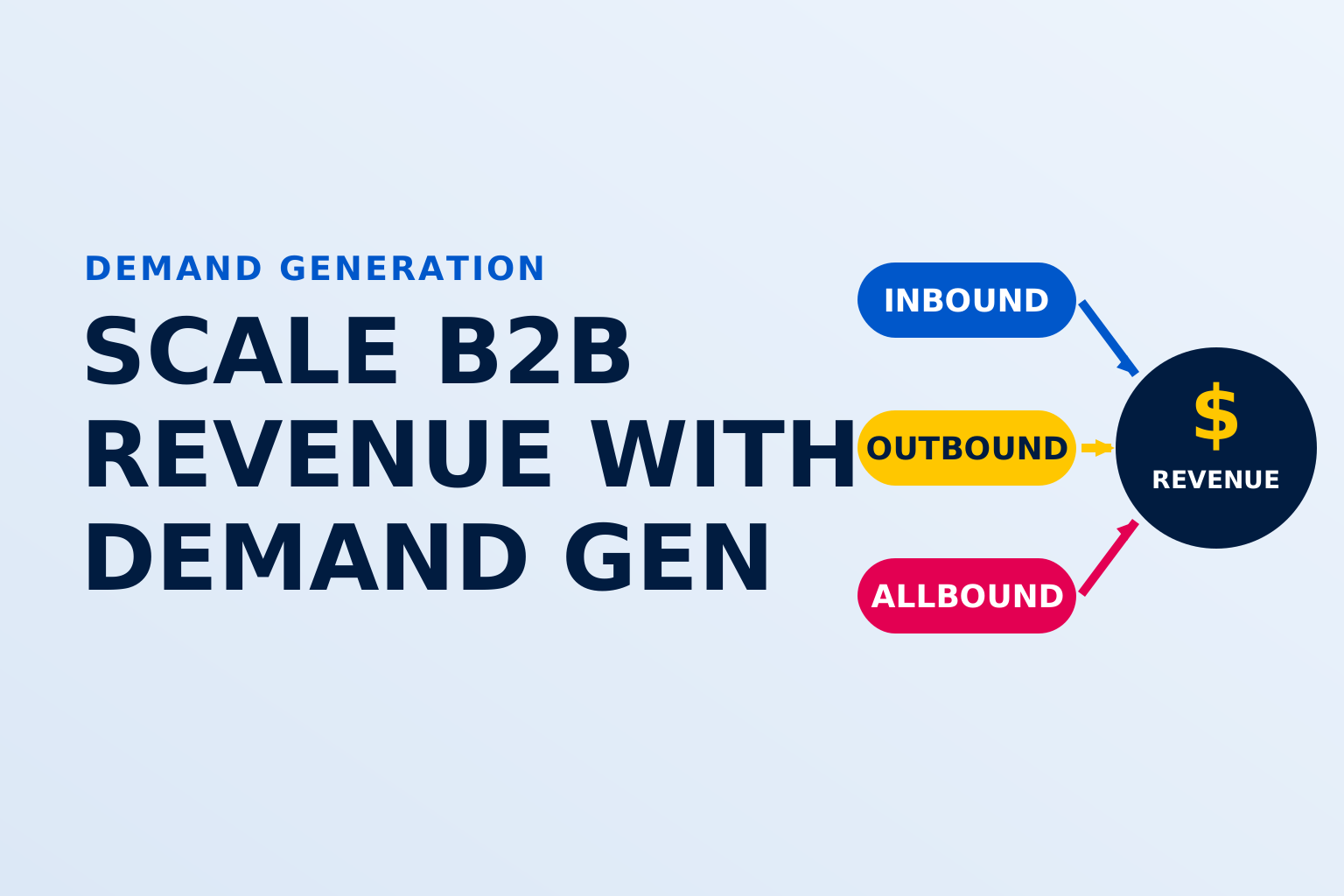
Book a CallThe internet loves a false choice: demand generation is “pull” (brand, trust, long-term) while lead generation is “push” (outbound, forms, short-term). That framing made sense when buyers moved predictably through a funnel and marketing “handed off” leads to sales. In 2026, it’s mostly a distraction. Buyers control the journey: they self-educate, loop backward, bring committees, and switch channels constantly. The same tactic can build preference and capture intent depending on how you deploy it.
Part of The Complete Guide to B2B Demand Generation Strategy.
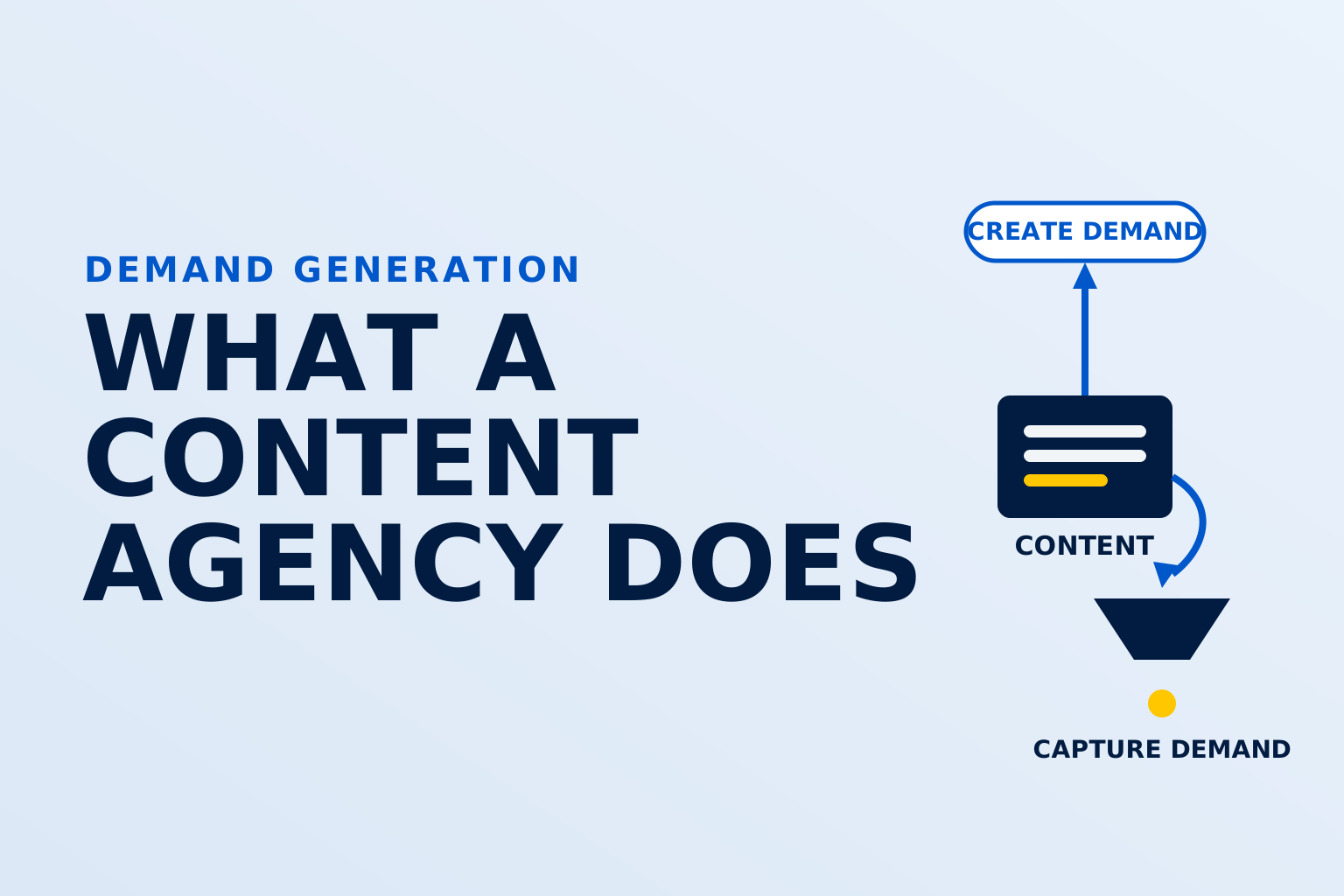
Here’s the cleaner way to think about it: demand is a function of perceived value, consistency, and time in market. It’s why people recognize you, trust you, and choose you even when competitors shout louder. Lead gen is simply the set of mechanisms that let ready buyers raise their hand inside that environment—or that help you identify readiness without guessing.
The best growth engines blur the line on purpose:
Build authority (demand) while creating clear conversion paths (leads)
Run one lifecycle system, not two competing camps or KPI scoreboards
In the rest of this article, we’ll get practical: webinars, content products, outbound, and ads—powered by a Content RevOps mindset where content is infrastructure (an operating system) that drives both demand and lead capture.
Why “Demand vs Lead” Is the Wrong Question in 2026
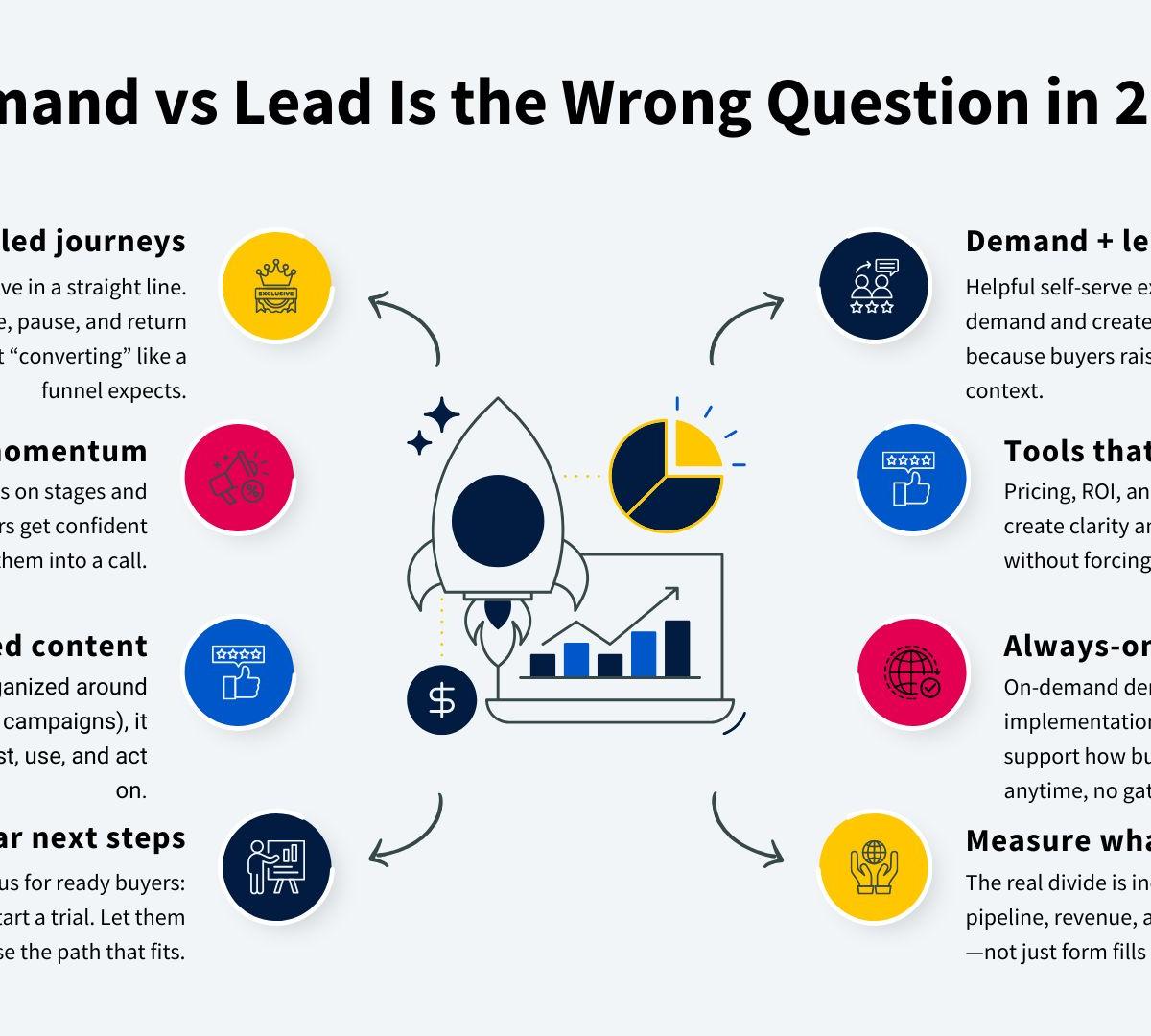
Buyer-led journeys, not funnels
The old “demand gen pulls, lead gen pushes” framing assumes buyers move neatly from TOFU to MOFU to BOFU. In 2026, they don’t. They self-educate, compare options in parallel, involve a committee, go dark, come back, and sometimes buy without ever “converting” the way your funnel expects—and research on B2B journeys shows many buyers are 70–80% through their process before they talk to a supplier, with a growing share preferring digital self-service or even seller-free experiences.
That’s why the highest-performing programs obsess less over stages and more over self-serve momentum: give buyers what they need to get confident without begging for a call. When content is organized around buyer tasks rather than internal campaigns, it functions as a buyer-led experience instead of a gated nurture track. Ironically, those same experiences also create your best leads—because the buyer is raising their hand with context.
Common examples that build demand and generate qualified leads at the same time:
Content hubs that answer real buying questions (not “thought leadership for awareness”), often structured around problems, use cases, and “jobs to be done” rather than generic blog taxonomy
Pricing, ROI, or assessment tools that create clarity and capture intent signals, like self-pricing calculators and configuration experiences that trade high-value specificity for voluntary contact details
On-demand demos, docs, and implementation guides that reduce perceived risk and match how buyers say they want to research—continuous access, no salesperson required
Clear next steps (book, chat, trial) that let ready buyers self-identify, mirroring the kind of “choose your own path” scheduling flows that have been shown to materially increase close rates and deal size
From funnel to lifecycle
A more accurate model is lifecycle marketing: awareness → interest → engaged → opportunity → customer → advocate, with people moving in and out continuously. This aligns with the shift many B2B teams are making away from rigid funnels toward lifecycle or “brand-gen” thinking, where brand, demand, and lead capture are treated as one system instead of separate departments.
In that model, “demand gen” and “lead gen” are just two lenses on the same system:
Demand lens: Are we building enough perceived value and preference across the lifecycle (especially among the 95% not buying right now) so we make the “day-one vendor list” when a buying cycle starts?
Lead lens: Are we making it easy for ready buyers to reveal intent and get help fast—through channels like webinars, live chat, and demos that double as both education and qualification?
The real divide is measurement and operating model
The tactics aren’t the problem; incentives are. MQL quotas and campaign-based thinking tend to produce short-term, low-trust capture. Brand-only metrics tend to produce content that feels impressive but doesn’t move deals. Industry surveys show that teams over-optimized for MQL volume are the ones now talking about a “lead gen crisis,” precisely because raw lead counts do not correlate with revenue.
When you measure pipeline, revenue, and account progress across the lifecycle, the wall disappears and teams naturally blend both approaches. Marketers who outperform their goals are more likely to prioritize late-funnel, high-intent demand and align reporting around qualified opportunities and closed-won impact, rather than stopping at form fills or vanity engagement metrics.
Where Content RevOps fits
Content RevOps treats content as infrastructure: every asset should create demand (education, trust, preference) and enable capture (qualification, next step) inside one operating system—not separate “brand” and “lead” factories. This is the same shift you see in high-performing B2B programs that treat webinars, thought leadership, and content products as end-to-end systems: they build reputation and mental availability and serve as always-on lead sources, all orchestrated through shared tooling, shared data, and shared revenue goals.
Demand as perceived value over time
In 2026, demand generation isn’t “more awareness.” It’s the compounding effect of becoming the obvious, trusted choice when a real problem shows up.
That happens when buyers repeatedly experience three things from you:
A clear point of view (you explain what’s changing and why it matters)
Problem clarity (you name the real issue better than they can)
Consistent value in-market (helpful insights, proof, tools, and guidance—even before they buy)
This aligns with the shift from rigid funnels to lifecycle marketing, where brands compete to be on a buyer’s day‑one vendor list long before a form fill ever happens, and where trust is built through sustained content experiences rather than isolated campaigns. Modern research on B2B buying shows that most buyers build their shortlist based on brands that have already earned that trust and clarity over time.
This is why the old “demand gen = pull, lead gen = push” split breaks down. Buyers move nonlinearly, self-educate, and only engage sales when they’re confident. Modern demand gen earns that confidence over time—then uses precise capture motions when intent appears, instead of trying to manufacture it through aggressive lead tactics.
Content as infrastructure for demand
Demand isn’t built by random posts. It’s built by content infrastructure: durable assets designed like products, reused across the lifecycle, and connected to revenue workflows (CRM, automation, sales sequences). Teams that treat content as an operating system rather than a side project consistently see stronger impact on both brand and pipeline.
The highest-leverage asset types tend to be:
Cornerstone assets: playbooks, academies, resource hubs, short courses
Thought leadership: POV-driven articles, podcasts, talks that frame the category
Proof assets: case studies, outcome breakdowns, teardowns that reduce perceived risk
When these are orchestrated, they don’t just “educate.” They qualify. They create the conditions where lead capture feels natural because the value is already established and buyers have effectively pre-qualified themselves through the depth and pattern of content they consume.
Channels that naturally build demand
Webinars and content events work best as recurring assets with a consistent commercial narrative, not one-off promotions. When they’re mapped to specific buying stages (from problem framing to onboarding and success), a single webinar series can both shape category demand and convert high-intent prospects, which is why they continue to rank among the top-performing B2B channels for revenue impact. The modern twist is co-creating them with industry experts or even stakeholders in target accounts—building authority and relationships while still generating opt-ins and warm conversations.
SEO and problem-led search builds demand by answering high-stakes questions in buyer language. The goal isn’t vanity rankings; it’s showing up when the buyer is trying to de-risk a decision, with content that is both the primary driver of organic visibility and the starting point for lead flows, nurture, and sales conversations.
Content products (newsletters, benchmarks, academies) create a habit. They keep you present during the long stretches when most of the market isn’t actively buying, and they turn owned channels like email into some of the highest-ROI levers in the mix when measured over time.
Demand as an operating layer
When content runs on a real calendar and is wired into your systems, it becomes an operating layer:
Always-on education that matches how buyers actually research
One narrative across channels (ads, outbound, social, email, sales)
Shared assets for marketing, sales, and customer success—so demand creation and demand capture stop fighting each other
This “brand + demand” layer is where the best teams now focus: unifying what used to be separate brand, demand, and lead programs into a single, revenue-linked system that grows market share, improves lead quality, and shortens sales cycles.
Body 3 – How Smart Teams Blend Demand and Lead Gen Tactics (Where the Lines Blur)
The “demand gen vs. lead gen” debate usually falls apart the moment you look at how buyers actually buy in 2026. They move non-linearly, self-educate, and only raise their hand when they’re confident. So the best teams don’t pick a side—they build a lifecycle system where the same assets create preference and surface intent. That’s Content RevOps in practice: content as infrastructure that compounds, routes signals, and supports revenue, echoing the way lifecycle marketing is starting to replace rigid funnels in many B2B programs.
Webinars as both demand builders and lead engines
A webinar series is one of the cleanest examples of the blur.
Example motion
Pick a narrowly defined ICP problem (not a broad “industry trends” topic).
Build a series (3–6 sessions) so repetition creates familiarity and trust.
Invite stakeholders from key accounts as speakers or panelists (co-creation).
Promote through a mixed distribution plan:
LinkedIn organic + paid
targeted outbound to ideal accounts
email to your existing audience
This lines up with what many B2B teams see in practice: webinars consistently rank among the highest-performing demand channels while still delivering some of the strongest conversion rates in the funnel.
Where the line disappears
Demand: you become the curator of the best conversation in the category, building the kind of “brand gravity” that keeps you on every shortlist.
Lead: opt-ins, attendee engagement, and speaker relationships turn into warm entry points.
Content RevOps layer: each event becomes clips, sales enablement snippets, follow-up playbooks, and segmented nurture—without reinventing the wheel every quarter, and with the same “one asset, many outcomes” dynamic that powers modern webinar-led demand programs.
Thought leadership promoted via “lead gen” funnels
Take a strong POV article and package it like a product: mini-course, deep-dive guide, or a simple VSL. Then drive traffic with paid social + retargeting into an honest opt-in.
Done well, this mirrors how high-performing B2B teams now treat thought leadership: as a primary engine for buyer demand that’s deliberately routed through landing pages, nurture flows, and SDR follow-up—not just a vanity blog post.
Demand effect: your narrative spreads and shapes how the market frames the problem, which is exactly how buyers say they build their mental vendor shortlist.
Lead effect: you capture hand-raisers who want more depth, not a generic demo.
Under the hood: subscribers get routed into segmented nurture, and sales only engages when behavior signals readiness (not because someone filled out a form), aligning with more mature demand systems that optimize for high-intent, late-funnel engagement instead of raw MQL volume.
LinkedIn outreach and content-led outbound
Instead of pitching meetings, teams lead with a high-value content product (benchmark, course, newsletter) matched to the contact’s role, tech context, or trigger.
This is the same logic behind modern “content first” outbound plays: outbound is still the channel, but the offer is education, insight, or a self-service experience rather than a sales pitch.
This works because it’s simultaneously:
Demand: “Here’s how we think and what we’ve built to help,” which builds the kind of trust and affinity B2B marketers increasingly describe as the real goal of their programs.
Lead: replies, sign-ups, and engagement become intent signals and conversation openings, giving sales teams cleaner, better-qualified opportunities instead of cold lists.
Ads into content products and self-serve tools
Run paid campaigns to a resource hub, ROI calculator, self-pricing page, or on-demand workshop—not “Book a demo.”
This reflects how many teams are reframing paid media: less as a pure lead-harvesting play and more as a way to amplify content products, self-service tools, and education that compound over time.
Demand: repeated exposure to your approach builds mental availability over time, which is exactly what long-cycle B2B buyers say they rely on when they finally enter the market.
Lead: tool completions, deep views, and repeat visits are high-intent actions that feed scoring, nurture, and sales workflows—often outperforming shallow top-of-funnel offers on downstream pipeline and revenue.
The takeaway
There’s no clean boundary anymore. When designed as a coherent content operating system, the same motion builds reputation and captures readiness—creating demand while surfacing leads as a natural byproduct, which is where most modern demand-gen and “brand-gen” strategies are converging anyway.
Building a Unified System: From Random Acts to a Content Operating Model
Start from one commercial narrative, not isolated campaigns
In 2026, the fastest way to waste effort is running disconnected “demand” plays and “lead” plays with different messages. Start with a single commercial narrative anchored to a real ICP pain and business outcome, the discipline behind our shortlist of demand generation agencies for financial services (for example: shortening complex sales cycles in manufacturing SaaS). This becomes the backbone for 6–12 months, not a quarterly theme.
Validate the narrative before you scale it:
Jobs-to-be-done research and customer interviews to confirm what buyers are truly trying to achieve
Search-intent analysis built around problems and decisions (not just keywords)
Social/community listening plus competitor gap analysis to find what the market isn’t being taught
When you do this well, “demand” (reputation and preference) and “lead” (hand-raises) stop competing, because they’re fueled by the same idea—and you’re aligned with how modern, self-directed buyers actually move through a lifecycle rather than a rigid funnel.
Design the content system around the lifecycle
Treat content as infrastructure: a system that educates, triggers intent, qualifies fit, and supports sales conversations. Build an asset hierarchy:
Cornerstone asset: a deep resource (playbook, course, benchmark, academy) that anchors the narrative
Supporting assets: webinars, guides, case studies, tools mapped to lifecycle stages
Distribution content: social posts, email sequences, clips, and snippets that route attention back into the system
Assign each asset a clear “job,” so nothing is created just to fill a calendar. Teams that operate this way effectively run an end-to-end content operating model, where the same cornerstone assets can both create demand and capture leads across channels like search, social, and email, instead of spinning up one-off campaigns that go dark after a quarter.
Connect inbound, nurture, and outbound into one motion
Buyers move nonlinearly; they research, loop back, and often self-educate before talking to sales. Your system should reflect that:
Inbound brings net-new attention to cornerstone and supporting assets (SEO, social, partners).
Nurture deepens understanding and surfaces intent (behavior-based email and retargeting).
Outbound uses the same assets to start conversations in target accounts (SDRs/AEs tailoring angles by persona).
Run it all from one shared calendar mapped to ICP segments, lifecycle stages, channels, and owners. High-performing B2B teams increasingly treat this as a single, orchestrated revenue engine—where webinars, content hubs, outbound sequences, and ads are coordinated around one narrative—rather than separate “brand” and “performance” tracks.
Instrument for intent and readiness, not just clicks
Optimize for quality signals, not volume metrics. Prioritize:
Depth of engagement (repeat visits, time spent, multi-asset journeys)
High-intent assets (tools, case studies, pricing interactions) over single blog views
Account-level patterns (multiple stakeholders engaging with the same narrative)
Define MQL/SQL (or better: readiness) and handoff rules so when leads emerge from the demand system, sales gets context—not a name and a form fill. The most effective teams increasingly anchor this definition in late-stage behavioral signals (content consumed, problems expressed, timelines) rather than raw lead counts, because that is what correlates with real pipeline and revenue.
How this replaces the demand vs lead split
Instead of funding “brand” vs “performance,” you fund one end-to-end content operating model where every asset builds reputation and creates revenue leverage—judged by lifecycle movement, not channel labels. In practice, that looks like using the same content products (courses, resource hubs, shows, newsletters) to compound market demand over time while also serving as always-on lead capture and qualification engines, making the old demand-gen-versus-lead-gen debate mostly irrelevant.
Conclusion – What Actually Works in 2026 (and Where We Fit)
Re-center the core insight
“Demand gen vs. lead gen” isn’t the real question anymore. In 2026, the only question that matters is whether you have a system that continuously builds perceived value in your market—and gives ready buyers clean, respectful ways to say, “I’m interested.”
Demand is still earned: reputation, a sharp point of view, consistent usefulness, and time in-market. But the teams winning now don’t treat that as separate from capture. They blend it into one buyer-led engine that looks a lot more like lifecycle marketing than a linear funnel, and that reflects how modern B2B buyers self-educate and prefer self-service content experiences rather than seller-driven journeys.
Recap what works now
What works is treating content as infrastructure—built to compound, not spike.
Built around a clear ICP and commercial narrative, with messaging shaped by real buyer insight rather than campaign slogans
Structured as a lifecycle system (not isolated campaigns), so brand, demand, and expansion are planned together instead of in silos
Activated through blended plays: SEO + webinars + outbound + paid, where each channel can both create demand and capture it depending on how you design the offer
Measured by pipeline, conversion, and account progress—not raw lead volume or vanity metrics, aligning with the broader shift away from MQL obsession and toward revenue, influence, and “brand gravity” as the real barometers of effectiveness
Connect back to our philosophy and services
That intersection is exactly where we operate. Our Content RevOps approach designs content as a go-to-market operating system that creates demand and captures it in one model—with research-heavy strategy, structured calendars, integrated distribution, and the workflows and reporting that align marketing, sales, and success around one shared growth engine.
In practice, that means treating content as the primary demand-and-lead lever across channels: using webinars as full-funnel programs, building thought leadership that both shapes category thinking and feeds performance plays, and orchestrating brand and demand so each campaign lifts both awareness and conversion rather than trading one off against the other.
A forward-looking note
As 2026 unfolds, the best teams won’t pick sides. They’ll treat content as the connective tissue of their revenue operation—and run a unified, buyer-led system from first touch to long-term loyalty, where “demand gen” and “lead gen” are simply different zoom levels on the same compounding, content-driven growth strategy.
Is your demand engine actually producing pipeline—or just activity?
Turn content into revenue infrastructure: one narrative, one lifecycle system, measurable intent, and cleaner handoffs to sales.
Frequently Asked Questions
About the Author

Founder & CEO, Content RevOps
Stefan Kalpachev is the founder and CEO of Content RevOps, where he helps B2B SaaS companies transform their content into predictable pipeline. With a background in content marketing and revenue operations, Stefan has developed a unique methodology that bridges the gap between content creation and revenue generation.
Connect on LinkedIn