The Complete Guide to B2B Demand Generation Strategy
Want demand gen that actually turns into pipeline—not just clicks and MQLs? Let’s build your content-led operating system.
Book a CallB2B demand generation is harder than it used to be. Buyers do more research without talking to sales, privacy changes reduce what you can track, and AI has flooded every channel with “good enough” content that all sounds the same. Add larger buying committees and longer cycles, and the old playbook—random ebooks, broad MQL quotas, and spray-and-pray ads—stops translating cleanly into pipeline.
The fix isn’t more tactics. It’s an end-to-end, content-led operating system designed to meet one specific ICP at one specific moment in their journey, with a clear commercial narrative and a measurable path to revenue. In other words: content as infrastructure, not output. A flagship content product becomes the engine; everything else (capture, nurture, sales handoff, and measurement) exists to make that engine findable, credible, and commercially effective.
This guide will show you how to:
Define your ICP and market around real buying moments (not just firmographics)
Research competitors and land a differentiated point of view
Build a flagship content product with conversion paths and distribution
Align marketing and sales around shared triggers, stages, and handoffs
Measure demand and pipeline impact even with imperfect visibility
1. Start with ICP, Market, and Buying Moments
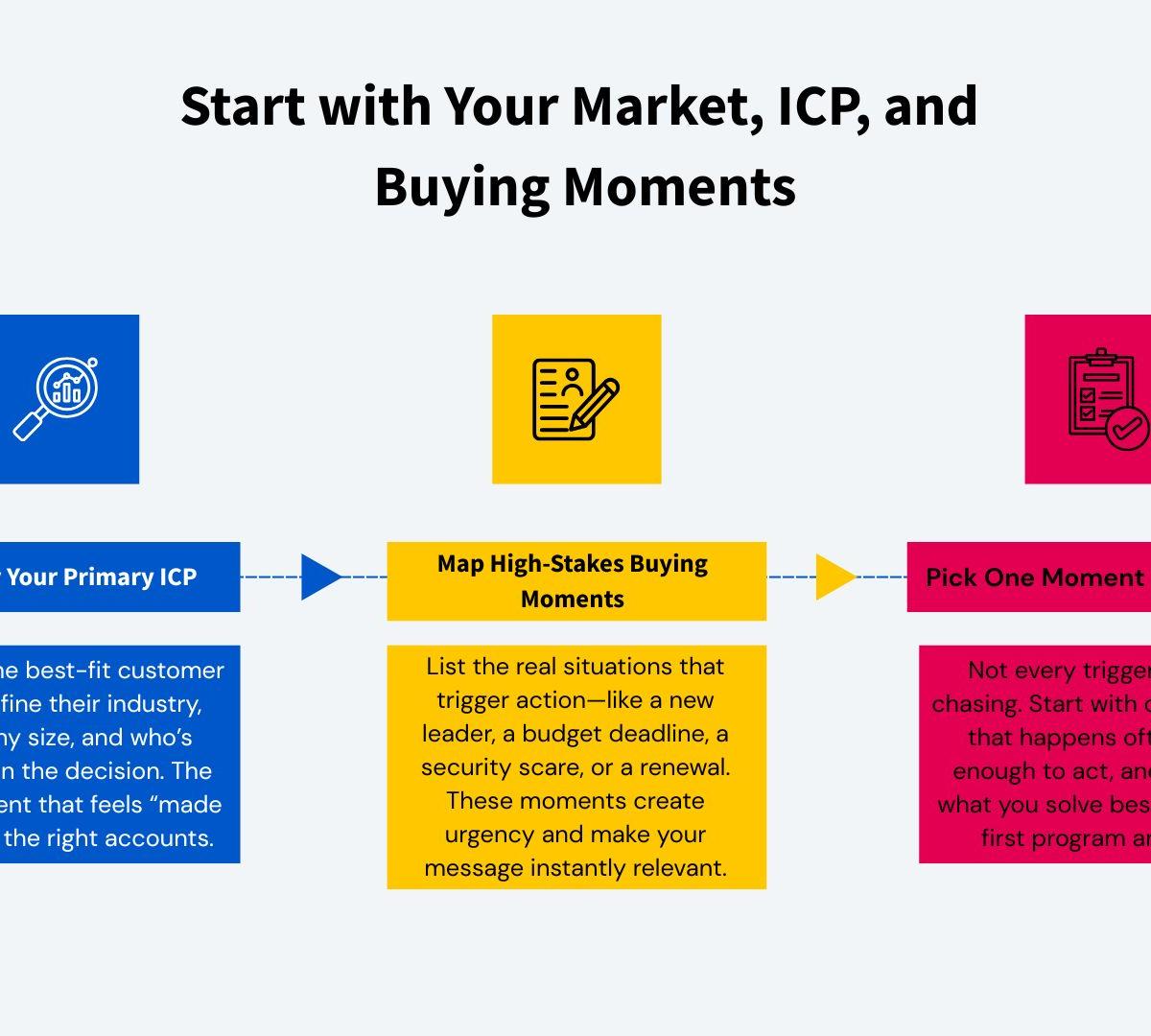
High-performing B2B demand generation doesn’t start with channels or a campaign calendar. It starts with a single commercial bet: one ideal customer profile (ICP), in one high-stakes moment, where your content must show up and do real work.
If content is a business function (not output), then ICP definition is not a persona exercise. It’s a decision about where you can win—based on urgency, lifetime value, sales motion fit, and a reachable market you can actually influence, in line with how modern demand programs are designed as full-funnel, content-led systems.
1.1 Narrow to one primary ICP
“B2B buyers” is not a target; it’s a way to dilute relevance. One primary ICP forces clarity in messaging, distribution, sales alignment, and measurement—because every downstream choice ties back to a specific buyer reality and a clearly defined awareness journey.
Define your ICP across:
Firmographics: industry, company size, geography, revenue model
Buying committee: who feels the pain first, who signs, who can block
Jobs To Be Done: what they’re trying to achieve in the business, not what they’re shopping for
This goes beyond surface-level personas and into how real buying groups behave, using unified data and behavioral insight to refine “good fit” accounts over time.
The goal: a definition tight enough that you can build a content product that feels “made for me” to the right accounts—and invisible to everyone else. When done well, that focus improves lead quality, MQL-to-SQL conversion, and the effectiveness of downstream ABM and sales motions.
1.2 Map Category Entry Points (CEPs): concrete trigger situations
CEPs are the real-world moments that make your ICP think, “We need to fix this.” They’re the fastest path to relevance because they anchor demand gen to situations, not demographics, and they determine whether your brand is recalled at the moment of need.
Common B2B trigger moments include:
A new VP/CMO’s first 90 days
A Q4 budget surplus that must be used or lost
A failed audit or security incident
A renewal coming up with a legacy vendor
To map CEPs, interview customers, sales, and CS for “day one” and “oh no” stories, then validate the language in search behavior, social chatter, and communities. This is where you connect specific trigger situations to content pillars, journey stages, and conversion paths, so that each asset is tied to a real buying context rather than a generic theme.
1.3 Size and prioritize your target moment
Not every trigger is worth building around. Quantify reachable demand by CEP using problem-phrase search volume, intent signals and conversation volume, plus internal win/loss and pipeline notes tied to triggers. This shifts your market definition from “how many accounts exist” to “how many high-value buying moments we can realistically dominate.”
Pick one CEP for your first program—the one with high frequency, high pain, and strong solution fit. This aligns with how effective demand engines center on a single ICP at a specific journey inflection point, then build structured content, nurture, and sales enablement around that moment.
The output is your foundation: one ICP-in-a-moment that the entire demand strategy (and your flagship content product) will be built around, making it possible to architect an end-to-end path from initial trigger to revenue, and to measure impact at the level of situations, not just channels.
2. Build a Differentiated Point of View (POV) Around That Moment
Once you’ve picked one ICP and one “moment” in their journey (your category entry point), your next job is to sound meaningfully different in a crowded, noisy market. Not with a clever tagline—by taking a clear, commercial stance your content product and sales team can repeat relentlessly. In B2B demand generation, a distinct, consistent stance is what turns content into a repeatable growth engine rather than a collection of one-off campaigns.
2.1 Understand the alternatives your ICP really considers
Your ICP isn’t only comparing you to direct competitors. They’re comparing you to whatever feels safest, fastest, or most politically defensible in that moment—often late in the process, when much of the journey is invisible and your brand recall is fragile at critical category entry points.
Look for:
Indirect competitors: spreadsheets, agencies, consultants, internal DIY builds, “we’ll hire someone.” In many demand gen programs, these options absorb more budget than named vendors because they feel like incremental extensions of “how we already work.”
The “do nothing” option: defer the decision until next quarter, wait for a new budget, stick with the current tool. In complex B2B buying groups, “no decision” is frequently the most common outcome, not loss to another vendor.
Category clichés: identical promises, generic “all-in-one” claims, and recycled proof points. These blur brands together and make it harder to be remembered at the exact moments that drive pipeline.
Practical steps: scan competitor homepages and content hubs, collect sales decks where you can, and review call recordings and discovery notes to see which alternatives show up in real deals. Layer in what broader demand gen benchmarks call out as common buyer behaviors—like non-linear research, anonymous content consumption, and late-stage consensus-building—to avoid designing a POV around a purely linear funnel that doesn’t match reality (example overview of those patterns).
2.2 Find the contradiction you can credibly own
A differentiated POV is a useful, evidence-backed challenge to the default playbook your ICP follows in your chosen moment. The best POVs are specific enough to guide action and bold enough to create tension, which is why many leading B2B programs define them around a tight cluster of triggers or situations rather than vague “solutions.”
To uncover yours, ask:
Where does conventional wisdom push your ICP toward bad tradeoffs?
What do your best customers do that average customers don’t?
What unique data, product behavior, or delivery experience gives you non-obvious insight?
This is where combining your own customer evidence with market patterns from places that track evolving demand gen practices (for example, how teams are rethinking MQL volume in favor of conversion quality and buying signals) can sharpen your stance from opinion into something measurably better.
Example structure:
Common belief: “In this moment, the priority is more leads.”
Your POV: “More leads here lowers win rates; the priority is a content system that converts existing demand better.”
That kind of contradiction aligns with a broader shift toward content as a full-funnel engine—moving from sheer lead capture to content products that generate, shape, and accelerate demand for a specific ICP at a specific moment.
2.3 Turn POV into a repeatable narrative
Package the POV into a simple model your whole go-to-market team can carry: Why change / Why now / Why us—tied directly to the moment. This mirrors how high-performing demand gen teams structure their flagship content plays and nurture journeys around a small number of consistent storylines rather than disconnected topics (an example of that kind of end-to-end structure).
Encode it across:
Content: 3–5 themes, one hero asset, and supporting modules that all ladder up to the same stance. Think in terms of a unified content product architecture, where each pillar and asset is mapped back to the same core POV and the same category entry points, instead of channel-first content planning (typical architecture: hero asset → derivatives → enablement).
Sales: discovery questions, talk tracks, and objection handling that reinforce the POV (not random pitch points). The most effective teams use actual call data and win–loss insights to refine these narratives over time so that content, messaging, and sales conversations are all pulling in the same direction (a pattern repeatedly highlighted in modern demand gen coverage).
Enablement: one shared story across marketing, sales, and CS. This turns your POV into a shared operating system, not just a campaign theme.
This is “content-as-infrastructure”: one durable narrative your content product compounds over time, instead of rotating campaigns that reset every quarter. When that narrative is consistently tied to specific buyer situations and demand signals, it becomes much easier to measure its impact on pipeline and revenue, and to iterate it using closed-loop data rather than gut feel.
3. Design a Flagship Content Product and Conversion Architecture
If demand is chiefly generated by content, then your strategy can’t revolve around a rotating set of campaigns. You need one durable, content-led product built for one ICP at one specific Category Entry Point (CEP)—the trigger moment when they’re most likely to search, compare, and change course, in line with how CEPs are shown to drive mental availability at buying moments in B2B.
3.1 Define your flagship content product
A flagship content product is not a one-off ebook. It’s an ongoing asset that compounds: it gets updated, expanded, referenced by sales, and revisited by buyers as their urgency increases. This mirrors how high-performing demand engines treat content as a core, always-on asset rather than campaign collateral.
Examples anchored to real trigger moments:
A “First 90 Days” operating system for new SaaS CMOs
A renewal-readiness diagnostic + playbook for teams replacing legacy tools
A monthly risk briefing for teams that just failed an audit
A good content product meets three criteria:
One ICP, one CEP: narrow beats broad because it matches a specific “why now,” and maps cleanly to real-world buying triggers rather than generic personas.
Solves a real chunk of the job-to-be-done: not just “learn,” but “decide” and “execute,” similar to how effective demand programs focus on moving prospects from problem definition to solution selection and internal justification.
Recurring value: series, tools, benchmarks, and updates that earn repeat attention, functioning more like a recurring show or report than a static PDF.
This is Content RevOps in practice: content as infrastructure that drives decisions and pipeline, not output that fills a calendar, reflecting the shift toward content as the central mechanism for generating and accelerating demand across the full funnel.
3.2 Architect the content hub and spokes
Build the product like a hub-and-spoke system, not a blog category. This “pillar and cluster” style architecture makes it easier to organize around CEPs and jobs-to-be-done, and it aligns with how sophisticated demand gen programs structure their content engines.
Hub page (the product home): who it’s for, the trigger moment, the promised outcomes, what’s inside, and the “start here” path. Think of it as the anchor asset or flagship format that everything else rolls up to.
Spokes (the building blocks):
Core educational chapters/episodes that answer “What should I do now?”
Tools and templates (checklists, calculators, canvases)
Benchmarks, case studies, and implementation guides that support both evaluation and internal selling
Use content layering to balance reach and capture:
Ungated cornerstone content: deep, practical guidance for the CEP moment, designed to win reach and recall in search and social, not just capture names.
Lightly gated tools: minimal fields in exchange for high-utility assets, creating voluntary “hand-raise” moments that outperform generic lead magnets.
Deeper gated experiences: benchmarks, audits, or workshops with explicit next steps, which act as clear conversion-path assets from content to conversation.
Tag each asset by persona, journey stage, and purpose so the hub doubles as operational infrastructure for nurture, sales enablement, and measurement. This mirrors how modern demand teams wire content into marketing automation, CRM, and account-level reporting so they can attribute pipeline back to specific themes and assets, not just channels.
3.3 Design conversion paths tied to readiness
Avoid arbitrary MQL scoring. Route people based on what they do and the CEP context they’re in, rather than only on demographic fit.
Low-intent behaviors: reads guides, watches episodes, subscribes
Response: milestone-based nurture mapped to the CEP timeline (day 1, week 2, day 45), with content that reflects the “hidden moments” of the buying journey rather than assuming a linear funnel.Mid-intent behaviors: completes a diagnostic, attends a workshop, uses multiple tools
Response: tailored nurture + SDR outreach only after 2–3 qualifying actions, echoing how progressive programs use micro-conversions and behavior signals to prioritize outreach.High-intent behaviors: views pricing, uses an ROI calculator, reads implementation/comparison content
Response: direct AE routing with full context (assets consumed, diagnostic results, likely objections), aligning with best practices around sales–marketing alignment and MQL-to-SQL readiness.
Use progressive profiling: ask only what you need at each step, then enrich the rest through your data infrastructure so you can maintain conversion rates while still giving sales the intelligence they need.
3.4 Plan activation and distribution as part of the product
Distribution isn’t a launch plan—it’s part of the product design and how it functions as your primary demand engine:
Organic search around CEP language and jobs-to-be-done (not just product keywords), using your hub and spokes as the backbone for topic clusters and search intent coverage.
Paid social targeting the exact ICP with creative that dramatizes the trigger moment, aligned with how leading B2B programs use outbound to amplify content products rather than just pushing offers.
Email sequences segmented by entry (new subscriber vs. diagnostic user vs. event attendee), reflecting the Attract–Engage–Sell–Wow progression and using nurture campaigns as the backbone for moving demand toward sales.
Sales-assisted distribution with “content kits” mapped to pipeline stages (intro, consensus, justification), so reps have CEP-specific stories, benchmarks, and tools ready for each conversation.
Your content product should power outbound and events too—webinars, panels, and live teardowns that extend the product and create clear reasons to engage now, while feeding measurable engagement signals back into your unified demand and sales data layer.
4. Align Demand Generation with Sales Execution
If demand is generated by a content product built for one ICP at one specific moment, sales has to run on the same rails. Alignment is not “marketing hands off leads.” It’s hard-wiring your content product, intent signals, and Category Entry Point (CEP) into routing, talk tracks, and deal progression so engaged buyers become pipeline, mirroring how leading B2B demand gen programs treat content as the primary demand engine and sales accelerant.
4.1 Create shared definitions and stages
Retire vague MQLs and replace them with behavior-based stages your CRM can actually enforce, in line with modern demand gen practices that emphasize lead quality and MQL→SQL conversion over sheer volume:
Stage 1: CEP engagement — repeated hub consumption, subscriptions, return visits
Stage 2: Problem clarity + tool completion — diagnostics, templates, workshops/webinars
Stage 3: Business-case behavior — ROI tools, comparison pages, implementation guides
This gives you a system where intent data, first-party engagement, and CEPs drive progression instead of arbitrary scores, supporting a unified view of demand across marketing and sales.
Then document SLAs by stage so ownership is clear:
Stage 1 stays in marketing nurture until engagement compounds.
Stage 2 triggers SDR outreach only after qualifying actions (often 2+).
Stage 3 routes to AEs with full context, not a blank “hot lead.”
These SLAs should sit on top of a shared data layer and clear handoff criteria, which is how high-performing teams reduce misalignment and increase conversion from demand to pipeline. Where those criteria sit inside the wider sequence is set out in the demand generation process, step by step.
4.2 Enable reps with the same narrative and assets
Build a single commercial narrative per CEP: the problem in that moment, your point of view, and the “new way” to solve it. This mirrors CEP-driven strategies where brands aim to be recalled in specific buying situations, not just generically “known.”
Turn the content product into sales tools:
Talk tracks + discovery questions pulled directly from the hub’s framework and the CEPs you’re targeting
Meeting follow-ups mapped to modules (send the exact chapter/tool that matches what they asked)
Live use of diagnostics/benchmarks to quantify gaps and create urgency without pressure
This is the same pattern found in content-first demand engines: a flagship content product, modular derivatives, and sales enablement assets all aligned to one ICP and one journey moment, so reps are never improvising a separate narrative.
The goal: the buyer experiences one coherent system, not a marketing story and a separate sales pitch.
4.3 Build the feedback loop
Run a weekly or biweekly cadence reviewing:
Opportunities influenced by the content product
Objections the content didn’t answer
Where prospects stalled or dropped
Include call insights, email replies, and deal outcomes so you’re capturing both quantitative and qualitative signals about what actually moves revenue.
Feed that back into new modules, tighter FAQs, improved templates, and updated routing/scoring based on real conversion patterns. Over time, this creates a closed-loop system where your content product, CEP framework, and sales motion are continuously refined using live market data rather than assumptions, reflecting how modern B2B teams treat content, CRM, and sales as one integrated revenue engine.
5. Measure Demand and Evolve the System
You will never get perfect visibility. Privacy changes, dark social, and multi-threaded buying journeys make “single-source” attribution unrealistic. The goal is simpler: prove your content product is changing commercial outcomes, then use that signal to steer what you build next.
5.1 Define leading indicators for the content product
Start with behaviors that only happen when the product is doing real work—especially at the buying-group level, not just individual leads, because most B2B deals now involve multiple stakeholders and non-linear journeys.
Key leading indicators:
Product engagement: return visits to the hub, time spent in core modules, episode completion, diagnostic starts/completions, template/tool downloads, and repeat usage of interactive assets (assessments, calculators, planners) that correlate with higher intent
Newsletter health: subscriptions, open/click patterns over time, and especially replies (signal of trust and specificity) and forwards, which often precede buying-committee sharing
Buying-committee depth: number of roles from target accounts engaging, plus seniority (champion vs economic buyer) and paths by role (what each role consumes before they raise their hand), mapped against typical multi-thread patterns in complex B2B deals
These leading indicators become your “content product KPIs” and should be defined before you scale creation, so your system isn’t optimizing for surface-level engagement.
5.2 Link content to pipeline and revenue
Treat attribution as triangulation, not truth. In modern demand gen, the job is to connect content exposure → behavior change → commercial impact, accepting that some steps will remain invisible due to tracking limits and dark social.
Track:
Opportunity creation rate for accounts that touched the product vs those that didn’t, comparing like-for-like ICP segments and deal sizes
Win rate and deal velocity for opportunities with meaningful content-product engagement, using buying-group analytics rather than last-touch models
ACV/expansion impact when the product’s POV shaped the buying narrative, especially in accounts that engaged with deeper, problem-framing content before talking to sales
Then sanity-check with:
CRM/automation multi-touch reporting and account-based analytics to see how exposure to your content clusters around opportunities
A simple “How did you hear about us?” field on forms, with free-text responses categorized over time into themes (content product, events, peers, communities)
Rep notes and a few customer interviews each month to understand which specific assets influenced problem definition, vendor selection, and internal consensus
The point is to converge qualitative and quantitative evidence until it’s clear your content product is reliably creating, accelerating, or expanding pipeline.
5.3 Keep the tech spine lean and connected
Minimum viable spine:
CRM (source of truth for accounts, opportunities, and revenue)
Marketing automation (nurture + scoring at the account and buying-group level)
Web/product analytics (event tracking on the hub across both anonymous and known visitors)
Enrichment/intent (spot in-market accounts and prioritize those showing repeated, clustered engagement with the content product)
Use experimentation to evolve the system: A/B test gating, offers, and follow-up cadences, optimizing for marginal pipeline and meeting quality, not clicks. Run controlled tests on how quickly sales engages after specific content behaviors, and how different nurture paths impact conversion for distinct ICPs or buying triggers.
Reporting isn’t a dashboard dump—it’s how you decide which content products to double down on, when to retire or refactor underperforming assets, and when you’ve earned the right to expand to a second ICP or moment based on demonstrable, repeatable impact on pipeline and revenue.
Conclusion
Sustainable B2B demand isn’t manufactured through louder campaigns. It’s generated by a focused, content-led system: one ICP, one key buying moment, one differentiated point of view, and one flagship content product that marketing and sales run together.
At a high level, the system looks like this:
Define a narrow ICP and the real trigger situations that cause action, grounded in actual buying moments and category entry points rather than generic personas.
Build a commercial narrative that challenges unhelpful category assumptions and reframes how your ICP should think about the problem, not just your product.
Design a durable content product with layered content and clear conversion paths, so content becomes the primary engine for attracting, educating, and qualifying buying groups over time.
Wire it into sales workflows, routing rules, and talk tracks, so the same narrative and triggers show up in discovery questions, enablement assets, and deal strategy.
Measure what matters: product engagement, buying-committee depth, and pipeline impact—not just lead volume or isolated campaign metrics.
This is also how we treat content: not as posts to publish, but as infrastructure that underpins your go-to-market. Our work sits at the intersection of research, content strategy, activation, and revenue operations—turning one commercial theme into a system that quietly creates and qualifies demand over time, in line with how modern demand engines integrate inbound, outbound, and ABM around a single content spine.
Companies that make the shift—from campaigns to content as an operating layer—stop chasing demand and start owning the moments when their best buyers decide to move, consistently showing up in the specific situations, triggers, and “hidden moments” that actually drive B2B purchase decisions.
Go deeper: the full demand generation library
This guide anchors our demand generation library. Each chapter below goes deeper on one piece of the system:
- Demand generation team structure (roles, responsibilities, costs)
- How the Demand Generation Funnel Works — by the Numbers
- How to Create High-Performing B2B Demand Generation Campaigns
- How to build a demand generation engine from scratch (step-by-step)
- Demand Generation vs Lead Generation (What Actually Works in 2026)
- What Demand Generation Metrics to Track and Not to Track in 2026
- Demand Generation Examples: How B2B Companies Build Pipeline
- Demand Generation Best Practices
- How to Choose a Demand Generation Agency
- Top 15 B2B Demand Generation Agencies in 2026
- Top B2B Demand Generation Tactics in 2026
- Top Demand Generation Trends to Watch in 2026
- SaaS Demand Generation in 2026: What Actually Works
- The Demand Generation Framework Most Teams Build Backwards
- Top 10 Demand generation mistakes costing you pipeline
Want the system built for you? See our demand generation agency services.
Is your demand gen engine built to create revenue—or just activity?
Turn one ICP + one buying moment into a flagship content product wired to sales, intent, and measurable pipeline.
Frequently Asked Questions
About the Author

Founder & CEO, Content RevOps
Stefan Kalpachev is the founder and CEO of Content RevOps, where he helps B2B SaaS companies transform their content into predictable pipeline. With a background in content marketing and revenue operations, Stefan has developed a unique methodology that bridges the gap between content creation and revenue generation.
Connect on LinkedIn