10 Expert-Backed RevOps Best Practices for B2B SaaS and Services
If you want help turning RevOps principles into a system that actually generates pipeline, you can book a short call with us here.
Book a CallRevenue Operations (RevOps) has emerged as a game-changer for B2B SaaS and services companies. It’s all about breaking silos and aligning every revenue-driving team – from sales and marketing to customer success (and even finance) – to work toward common goals.
The payoff can be huge: Boston Consulting Group found that implementing RevOps in B2B tech companies led to 100–200% increases in digital marketing ROI and 10–20% higher sales productivity. It’s no wonder Gartner predicts that “by 2026, 75% of the highest-growth companies will adopt a RevOps model (up from less than 30% today)”.
Yet many firms are still figuring out how to do RevOps right. In fact, 80% of organizations are on their way to RevOps transformation, but only 6% have fully mature RevOps in place so far.
To help close that gap, we’ve compiled 10 best practices backed by expert insights, real-world data, and examples. These practices span all key RevOps domains – people, process, technology, and data – and can turn RevOps from a buzzword into a growth engine. Let’s dive in!
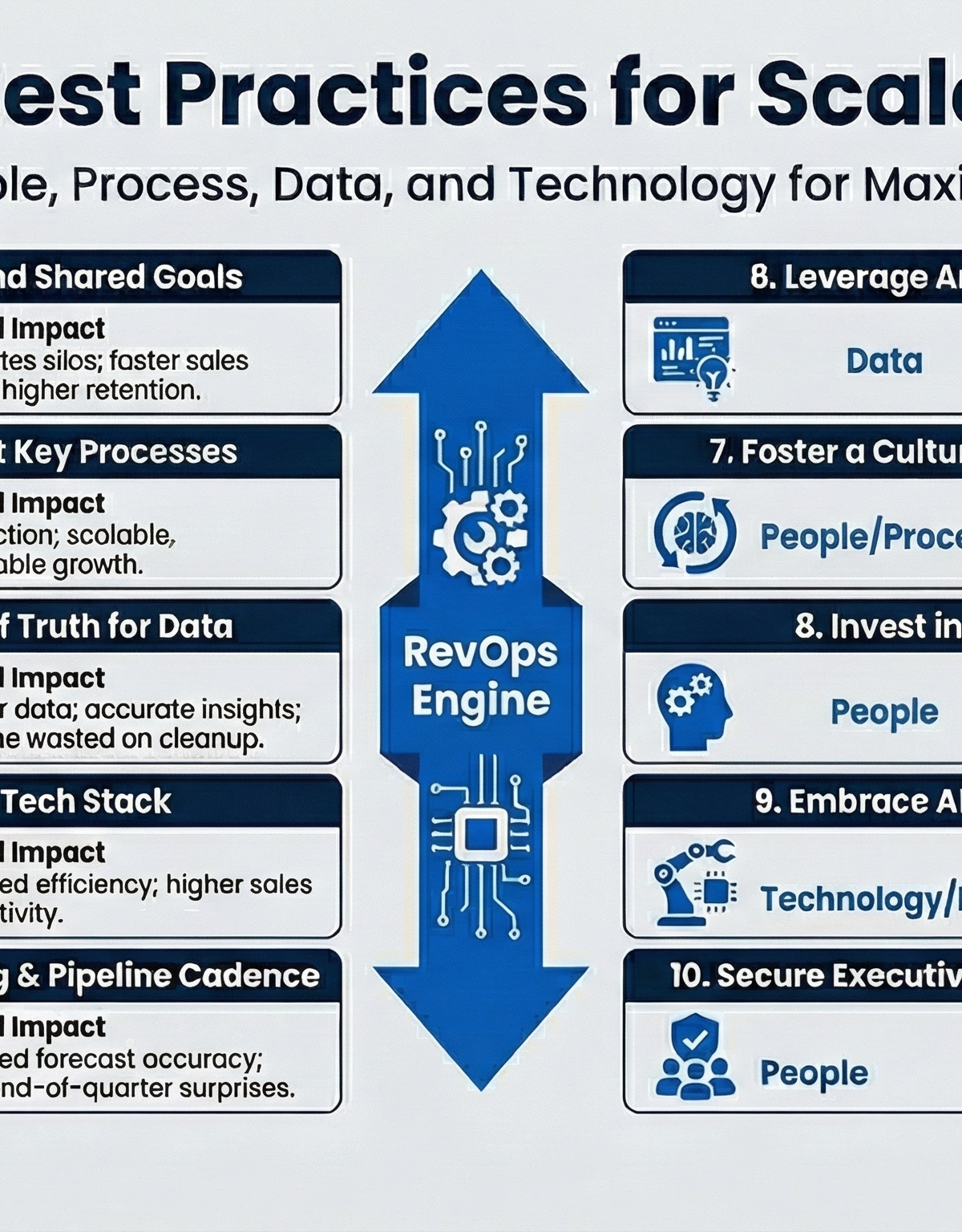
1. Align Revenue Teams Around Shared Goals
Focus: People – breaking down silos and unifying vision.
One of the foundational best practices in RevOps is aligning all go-to-market teams around common revenue goals. This means sales, marketing, customer success, and even product and finance should be rowing in the same direction. When these functions operate in sync, you create a seamless customer journey and eliminate the “silo mentality” that slows growth.
According to Forrester, organizations with tightly aligned sales and marketing functions achieve 36% higher customer retention and 28% more revenue growth. In other words, alignment isn’t just feel-good jargon – it delivers measurable results.
How to do it
Start by establishing shared KPIs and a unified revenue dashboard visible to all teams. For example, define a single set of metrics (pipeline contribution, customer lifetime value, retention rate, etc.) that everyone owns together, rather than each department tracking isolated goals.
Hold regular cross-functional meetings (e.g. weekly pipeline reviews or monthly QBRs) so that marketing, sales, and CS can review performance together and address gaps collaboratively.
High-performing teams also align around shared buyer-facing assets, not just reports. Content plays a critical role here. When the same content is used to educate prospects, support sales conversations, and reinforce value post-sale, teams begin operating from a shared source of truth. Alignment improves because everyone is reacting to the same buyer signals and questions — not interpreting them separately.
Real RevOps leaders emphasize that alignment is as much about mindset as tools – it requires open communication and even “tough conversations” focused on what’s best for the business.
In practice, this mindset shift often means moving from internal optimization to buyer enablement. Teams stop asking, “Are we aligned internally?” and start asking, “Are we consistently helping buyers move closer to a confident decision?” When alignment is grounded in buyer education and clarity, revenue teams naturally pull in the same direction.
The bottom line: when all revenue teams act as one unit, you’ll see faster deal cycles and a boost in growth. (In fact, BCG found RevOps-driven companies doubled their marketing ROI and increased sales productivity by 10–20% through tighter alignment.)
2. Standardize and Document Key Processes
Focus: Process – consistency and scalability.
Ad hoc processes are the enemy of scalable growth. A RevOps best practice is to standardize and document your revenue processes across the customer lifecycle.
Consistent, well-defined processes (for everything from lead handoff to customer onboarding) reduce friction and confusion. They also make it easier to scale – new team members ramp up faster and everyone knows “how things work.”
How to do it
Identify the critical revenue workflows that span multiple teams and nail down the who, what, when, how for each. For example:
Document the lead handoff process from marketing to sales (what qualifies as a MQL, how and when sales must follow up, etc.).
Create standardized playbooks for key motions like new customer onboarding, renewals, and upsells so customer success knows exactly how to execute and when to loop in others.
Implement clear SLA agreements between teams – e.g. marketing delivers X quality leads per month, sales contacts each lead within Y hours, CS engages at risk accounts within Z days – to define ownership and timing.
Once processes are documented, regularly review and refine them based on feedback and data (a quarterly process audit works well). The goal is a frictionless revenue engine where everyone follows best practices by default. As RevOps leader Olga Traskova notes, this approach turns messy, inconsistent legacy processes into scalable and “repeatable & scalable sales processes” that grow with your company.
3. Establish a Single Source of Truth for Data
Focus: Data – quality and consistency of information.
In RevOps, data is the glue that holds teams together – but only if everyone trusts the data. That’s why creating a single source of truth is critical.
RevOps best practices suggest consolidating your customer and revenue data into one cohesive system (or tightly integrated tech stack) so that every team is looking at the same information – from lead to opportunity to renewal.
This means integrating your CRM, marketing automation, customer success platform, and any other tools so data flows seamlessly. It also means implementing data governance to keep information clean and up-to-date.
Without clean, unified data, even the best RevOps strategies will stumble – in fact, 56% of RevOps professionals say manual data cleansing is their biggest time waster, causing delays across the organization.
How to do it
First, perform a data audit. Map out where key revenue data resides (CRM, spreadsheets, marketing databases, etc.) and work to connect those sources. This might involve technical integration or adopting a RevOps platform that centralizes data.
Next, define data standards – e.g. required fields for new leads/opps, consistent definitions for each stage of the funnel – and ensure all teams adhere to them. Many RevOps teams establish a “data dictionary” or playbook that outlines what each metric means and how it’s measured, so everyone speaks the same data language.
Finally, leverage automation to handle data hygiene wherever possible. For example, use tools or scripts to auto-enrich records, deduplicate entries, and flag anomalies, rather than relying on reps to manually clean CRM data.
As Greg Larsen, a RevOps VP, puts it: adding AI and automation into your data processes can provide “massive” efficiency gains in keeping data clean and accurate. By unifying and cleansing your data, you’ll build trust in the numbers and free your team to focus on analysis and action (instead of fighting over whose spreadsheet is right!).
4. Optimize Your RevOps Tech Stack
Focus: Technology – the tools enabling RevOps.
RevOps sits at the intersection of multiple teams, so having the right technology stack – and optimizing it – is paramount. A well-oiled RevOps tech stack breaks down silos by connecting systems and automating workflows across marketing, sales, and service. On the flip side, a bloated or fragmented stack can create chaos (redundant tools, data integration issues, user confusion).
RevOps Best practice: perform regular tech stack audits and ensure tight integration of your core platforms. By removing waste and improving your tooling, you not only save money but also boost productivity – organizations that leverage advanced RevOps technology see a 19% boost in sales productivity, according to McKinsey.
How to do it
Inventory all tools used by sales, marketing, customer success, and adjacent teams.
Identify overlaps or unused software – for example, two different sales automation tools, or a legacy CRM nobody logs into – and consolidate where possible. It’s common to find opportunities to cut 10-20% of tools without losing any capabilities.
Next, focus on integration: ensure your CRM, marketing automation, support ticketing, and finance systems are talking to each other (either via native integrations or middleware). A single, integrated system means data flows freely – new leads from marketing auto-create in CRM, sales opp updates trigger alerts to Customer Success, and so on.
Wherever you have repetitive manual steps (lead assignments, data entry, report building), implement automation to streamline it.
Modern RevOps teams also invest in specialized tools like revenue intelligence platforms, sales enablement solutions, or AI-driven forecasting tools that sit on top of their CRM to provide deeper insights. The key is to choose tools that add real value and work in harmony, rather than accumulating a patchwork of apps.
5. Implement Rigorous Forecasting & Pipeline Cadences
Focus: Process – proactive revenue management.
If there’s one RevOps best practice a leader must get right, it’s revenue forecasting and pipeline management.
Accurate forecasting is not just a sales team chore – it’s a company-wide discipline that drives planning for hiring, budgeting, and strategy. The best RevOps organizations establish a regular cadence of forecast meetings and pipeline reviews that enforce accountability and predictability.
This practice helps expose risks early (no more end-of-quarter surprises!) and keeps everyone focused on hitting the number.
As Clari’s RevOps lead John Queally says, forecasting has become a “team sport” – “cross-functional alignment is critical because revenue forecasts impact everything” from product launches to finance plans.
How to do it
Set up a structured forecasting cadence that fits your sales cycle. For example, many SaaS companies do weekly pipeline calls (to inspect deals and updates) and a monthly or quarterly forecast call with leadership to lock predictions.
In these cadences, RevOps often plays quarterback – ensuring that sales managers submit forecasts on time, aggregating the numbers, and facilitating discussion of any gaps. It’s crucial to define clear stages and criteria for deals so that forecasts mean the same thing to everyone.
RevOps experts recommend mapping your opportunity stages tightly to the customer’s buying journey and setting “exit criteria” for each stage (e.g. demo completed, legal review started).
Likewise, establish what “commit” vs “upside” deals are, so sales reps know how to categorize deals in the forecast with realistic probabilities.
To improve accuracy, track a few forecast hygiene metrics – for instance, monitor deal slippage (how often closings get pushed out), ensure close dates are regularly updated (no stale past-due closes), and check that every deal has the right customer stakeholders involved. RevOps can surface these issues and prompt corrections before they derail the forecast.
Finally, involve the rest of the organization in forecasting: invite finance, product, or delivery leaders to the forecast reviews so they can provide input and see what’s coming down the pike. This cross-functional approach ensures the entire company buys into the forecast and works together to achieve it. With rigorous cadences, you’ll find your revenue becomes far more predictable – a hallmark of RevOps excellence.
6. Leverage Analytics & Key Metrics to Drive Decisions
Focus: Data – making insight-driven decisions.
Implementing RevOps best practices means turning data into a strategic asset. Beyond cleaning data (Best Practice #3), top RevOps teams deeply analyze that data to guide strategy and tactics. The mantra here is “measure what matters” – and use those insights to continuously optimize revenue generation.
Data-driven decision making can transform performance: one study found data-driven companies are 23× more likely to acquire customers and 6× more likely to retain them. In practice, this means RevOps should identify the key metrics that correlate to growth (leading indicators, conversion rates, leakage points) and make sure the business is laser-focused on improving them.
How to do it
Build out a revenue analytics dashboard that tracks the full funnel, from lead to renewal. Integrate data across your CRM, marketing automation, and customer success tools to get a holistic view.
Then analyze each stage for bottlenecks – e.g. if you see plenty of leads but low conversion to opportunities, that flags an issue in lead quality or sales follow-up.
RevOps can introduce predictive analytics as well: for example, use lead scoring models to predict which prospects are most likely to convert, or churn models to identify at-risk customers before they renew.
Share these insights with the relevant teams along with recommended actions (marketing focuses on high-scoring leads; success team intervenes on accounts with low health scores, etc.).
It’s also a best practice to set up recurring reports or dashboards for core metrics like pipeline growth, win rates, deal cycle time, average deal size, retention/churn rates, and campaign ROI.
Automate these reports on a weekly or monthly rhythm so leaders are always in tune with where revenue performance stands. Crucially, don’t drown people in vanity metrics – focus on the KPIs that tie to revenue outcomes. For instance, a software company might hone in on sales pipeline coverage (pipeline vs. quota), customer acquisition cost (CAC) vs. lifetime value (LTV), and net retention rate as three pivotal metrics.
By homing in on the right data and making it visible, RevOps enables fact-based decisions. As one RevOps expert from Red Hat emphasized, teams should shift to focusing on leading indicators (pipeline built, product adoption, customer health) rather than just lagging results like bookings – because managing those leading metrics drives the end results. In sum: trust the data, act on the data, and you’ll drive consistent growth.
7. Foster a Culture of Continuous Improvement
Focus: People/Process – adaptability and learning.
The highest-performing RevOps organizations treat improvement as an ongoing journey, not a one-time project. They create a culture of continuous improvement where teams regularly reflect, experiment, and get better at the revenue process.
In the fast-changing B2B world, this adaptability is gold – in fact, teams that embrace continuous optimization grow revenue twice as fast as those that do not. RevOps can lead the charge in instilling this mindset across go-to-market teams.
How to do it
One crucial RevOps best practice is to run regular retrospectives or post-mortems on key processes. For example, after each quarter, gather sales, marketing, and CS to discuss: What worked? What didn’t? What can we improve next time?. These sessions often uncover inefficiencies or new ideas (maybe the lead qualification criteria need tweaking, or a new onboarding step could improve customer ramp).
Then it’s about acting on those insights – RevOps should turn them into process updates or enablement for the teams. Encouraging a “test and learn” approach is also vital. Rather than sticking to the status quo, run pilot programs and A/B tests to try new strategies in a low-risk way. For instance, you might pilot a new pricing model with a small subset of sales reps, or A/B test two email cadences in marketing to see which yields better conversion. Use the results to guide broader changes.
It’s equally important to foster a growth mindset within the team: provide ongoing training and RevOps education so that everyone is learning new skills and industry best practices. And don’t forget to celebrate small wins – when a new process increases pipeline velocity or a cross-team effort hits it out of the park, call it out! Sharing these success stories builds momentum.
As RevOps leader Jordan Shaheen advises, focus on outcomes and moving the business forward, not personal recognition. Over time, these habits create a culture where continuous improvement is second nature. The result: a more agile organization that can quickly respond to market changes and consistently fine-tune its revenue engine for maximum performance.
8. Invest in RevOps Talent and Skills
Focus: People – building a capable RevOps team.
Even with great processes and tools, you need the right people to drive RevOps success. This means both hiring talent with the appropriate skill sets and upskilling your existing team in critical areas. RevOps is a multi-disciplinary field – touching analytics, technology, enablement, strategy – so you want well-rounded professionals who are eager to learn.
Expert tip: Make sure to train your RevOps team (and related staff) in emerging capabilities like data analysis and AI, as these are becoming essential for modern RevOps. A strong RevOps function staffed with skilled, business-minded problem-solvers can become the linchpin of your company’s growth strategy.
How to do it
First, define the roles and responsibilities in your RevOps org. Common roles include RevOps analysts (data gurus), systems managers/administrators (tool experts), enablement managers (training and content), and strategists or RevOps managers who coordinate big initiatives.
Hire or develop people who not only have technical know-how but also business acumen and communication skills – they will often serve as the bridge between departments. When hiring, RevOps best practices suggest looking for candidates with a mix of “thought leadership, process leadership, and people leadership” qualities – meaning they can innovate, execute, and collaborate effectively.
For your current team, create development plans to upskill in key areas. Data analytics is non-negotiable – training RevOps folks in SQL, BI tools, or statistical analysis will pay off in more insightful strategies. Similarly, as AI tools become prevalent, ensure the team gets exposure to using AI in sales/marketing (e.g. AI-driven forecasting, lead scoring models).
Lastly, don’t forget enablement for the broader revenue organization: RevOps should provide ongoing training to sales, marketing, and CS on new processes or tools (for example, if you roll out a new CPQ software or a revamped lead scoring system, offer workshops to get everyone up to speed).
By investing in people this way, you’ll build a RevOps function that has credibility and drives excellence. As one expert quips, “by continually learning and upskilling, I’ve been promoted at every job I’ve held”, which speaks to how valuable these skills can be – both for individuals and the company’s bottom line.
9. Embrace AI and Automation in RevOps
Focus: Technology/Data – working smarter, not harder.
The rise of artificial intelligence and automation is profoundly affecting RevOps. Modern RevOps teams are increasingly leveraging AI to analyze data, predict outcomes, and automate routine tasks – essentially acting as force-multipliers for a small RevOps team.
Embracing these technologies is now considered a best practice: “If you haven’t already, now is the time to fully embrace the power of AI,” advises Clari’s RevOps director.
When implemented in accordance with RevOps best practices, AI can enhance forecasting accuracy, improve visibility into deals, and accelerate decision-making.
Likewise, automation of repetitive processes frees your human team to focus on higher-value strategic work. The end result is a more efficient revenue engine and fewer “fire drills” for RevOps.
How to do it
Identify areas in your revenue process that are data-rich or labor-intensive – these are prime candidates for AI/automation.
Forecasting is one example: traditional forecasting often relies on gut feel or basic reports, but AI-driven forecasting tools (many CRM platforms and specialists like Clari or BoostUp) can crunch historical data and real-time signals to predict deal outcomes with higher accuracy. These tools often highlight at-risk deals or suggest which actions will most improve the forecast.
Another area is lead scoring and routing: instead of a static scoring model, an AI can continuously learn which prospect behaviors lead to conversion and score leads accordingly, then automatically route hot leads to reps.
Chatbots or AI assistants can automate initial customer interactions or answer common sales queries, saving reps time. Even for internal RevOps work, AI can help – for instance, using natural language queries to generate reports, or employing automation to cleanse data (as noted earlier).
Start small by piloting one AI tool in a contained use case (e.g. an AI-based dashboard that identifies pipeline risks each week). Measure the impact, then expand where it makes sense.
The key is to view AI and automation as extensions of your team: they handle the grunt work or number-crunching at superhuman speed, while your people handle the strategy, creativity, and relationship-building that truly drive revenue. In the coming years, AI will likely become a standard part of RevOps – early adopters stand to gain a significant competitive edge.
10. Secure Executive Buy-In and Strategic Alignment
Focus: People – leadership and organizational alignment.
For RevOps to deliver its full value, it must be supported from the top and woven into the company’s strategic fabric.
In many organizations, RevOps starts as a grassroots initiative or an “aspirational” idea thrown at a team without full C-suite commitment. That rarely works out.
The companies truly succeeding with RevOps have their CEOs, CFOs, and other executives actively endorsing RevOps best practices – making RevOps the central operating model for the go-to-market. “RevOps needs to be at the center of everything,” as one Accenture Director put it, with full support from the C-suite aligning all functions.
Executive buy-in ensures that silos get dismantled and resources are allocated to RevOps initiatives, rather than it being an uphill battle. It also signals to everyone that RevOps isn’t just an ops experiment, but a strategic priority.
How to do it
If you’re a RevOps leader, educate your executives on the value of RevOps with data and success stories.
Show how tighter alignment and process improvements will impact revenue growth, efficiency, and customer experience – using some of the stats in this article can help make the case!
Invite executives to RevOps meetings or quarterly business reviews so they see the collaboration in action. It’s also wise to have RevOps report into a high-level position (many companies now have a Chief Revenue Officer or similar who oversees RevOps, or they place RevOps under the COO or CFO for broad alignment).
Once you have leadership attention, work with them to integrate RevOps goals into the company’s strategic objectives. For example, if the CEO’s goal is “improve net retention by 10%,” clarify how RevOps initiatives (better onboarding process, customer health scoring, etc.) will contribute to that.
Keep the communication lines open – regularly update the C-suite on RevOps wins (e.g. “pipeline integrity improved, forecast variance cut in half, attribution clarity increased marketing ROI by X%”). When executives understand and champion RevOps, it becomes part of the company’s DNA.
This top-down support is also crucial for tackling cross-department challenges (“breaking down silos” often requires nudges from above to get teams truly cooperating). Many firms are investing in RevOps but haven’t reached full maturity because they lack cohesive strategy and executive communication around it.
Don’t let that be your company – get your leadership on board. With the C-suite and RevOps marching in lockstep, you’ll create an organization where every function is aligned to streamline operations and maximize revenue. That’s the ultimate vision of RevOps – and it absolutely requires executive buy-in to achieve.
Final thoughts: from RevOps best practices to real-world execution
RevOps works because it treats revenue as a system — not a collection of disconnected activities. When people, processes, data, and technology are aligned around shared goals, companies gain clarity, predictability, and leverage. The 10 best practices outlined above show what that alignment looks like in practice and why high-performing B2B teams are increasingly adopting a RevOps operating model.
That said, knowing what good RevOps looks like is very different from making it work inside a real organisation. Many teams already agree with these principles, yet still struggle with fragile pipeline, long sales cycles, misalignment between marketing and sales, or data they don’t fully trust. In most cases, the issue isn’t intent — it’s execution.
RevOps breaks down when systems are designed around internal activity rather than buyer behaviour. Dashboards look clean, processes are documented, and tools are in place — but demand remains inconsistent, leads stall, and sales conversations start colder than they should. Closing that gap requires translating RevOps principles into a practical go-to-market system that reflects how buyers actually research, evaluate, and decide.
That’s the work we do.
We help B2B SaaS and professional service teams operationalize RevOps beyond internal alignment — connecting strategy, content, data, and automation into a system that generates demand, supports sales conversations, and compounds over time. The goal isn’t “more marketing” or another framework. It’s building a revenue engine that feels predictable, commercially grounded, and realistic for your stage and team size.
If this sounds like what you’re trying to build, book a short call to walk through your current RevOps setup and identify what to fix first.
Want to see where your RevOps model is breaking down?
Book a call to discuss how Content RevOps can help you build a predictable pipeline.
Frequently Asked Questions
About the Author

Founder & CEO, Content RevOps
Stefan Kalpachev is the founder and CEO of Content RevOps, where he helps B2B SaaS companies transform their content into predictable pipeline. With a background in content marketing and revenue operations, Stefan has developed a unique methodology that bridges the gap between content creation and revenue generation.
Connect on LinkedInRelated Articles

Digital marketing for pharma, channels that actually move pipeline
Sep 9, 2026

Pharma marketing analytics and ROI, connecting content to pipeline
Sep 8, 2026

AI in pharma marketing, where it helps and where it is just language
Sep 7, 2026