How to Choose a Demand Generation Agency
Ready to hire a demand gen partner that builds pipeline—not noise? Let’s talk.
Book a CallChoosing a demand generation agency is not a creative purchase. It is an operational decision that affects future pipeline, sales efficiency, and how confidently you can forecast growth. In B2B, you are not really buying “leads” or “brand buzz.” You are buying a system that helps the right buyers understand the problem, trust your approach, and move through a complex decision process. Before you get to selection, it is worth pressure-testing whether now is even the right time to hire a demand generation agency.
The common failure pattern is easy to spot: agencies that promise “full-funnel” and “omnichannel” results, but cannot show how their work connects to opportunities and closed revenue. You get lots of activity—ads, landing pages, reports—but the execution is a black box, and outcomes stay vague.
Think of demand gen as infrastructure. The right partner builds repeatable mechanisms: clear targeting, credible messaging, lifecycle nurture, sales alignment, and measurement that holds up under scrutiny. The wrong partner floods your CRM with low-quality form fills, burns budget on questionable data, and creates noise your sales team learns to ignore. When the budget is investor money and the clock is a runway, that hire costs a quarter you cannot replace, so we ran the same proof checks over 85 agencies working with VC-backed companies.
This article lays out practical filters and questions to separate operators from storytellers—covering fit, proof, process, data practices, and economics—written for B2B CEOs and marketing leaders working with long sales cycles, buying committees, and pressure to prove revenue impact. We applied the same filters to the 454 agencies that name founders and chief executives as their buyer, and 16 cleared them, in our list of demand generation agencies for founders and CEOs.
B2B Demand Generation Agency: Check for Real Specialization, Not a Laundry List
Choosing a demand generation agency gets easier when you treat “specialization” as a filter, not a preference. In B2B, demand generation is a critical strategy for driving sustainable growth, building brand awareness, and aligning marketing and sales efforts. You’re not buying activity. You’re buying a repeatable system that turns targeting, messaging, and channels into qualified pipeline that sales can actually convert.
Define what a true demand generation agency is
A true B2B demand generation agency typically:
Leads with demand gen as the core offer, not “communications,” PR, or generic digital marketing with demand gen tacked on. That distinction matters enough that it is worth understanding where a demand generation agency ends and a PR agency begins.
Runs effective demand generation programs that engage the right accounts at the right moment in their buying journey, using data-driven and personalized outreach strategies to identify high-quality prospects and optimize sales and marketing alignment.
Understands B2B reality: long sales cycles, multiple stakeholders, and high-consideration deals that usually move through a multi-stage buying committee rather than a single decision-maker. Agencies that clear that bar for a rep-carried motion are the ones we kept in our list of demand generation agencies for sales-led companies.
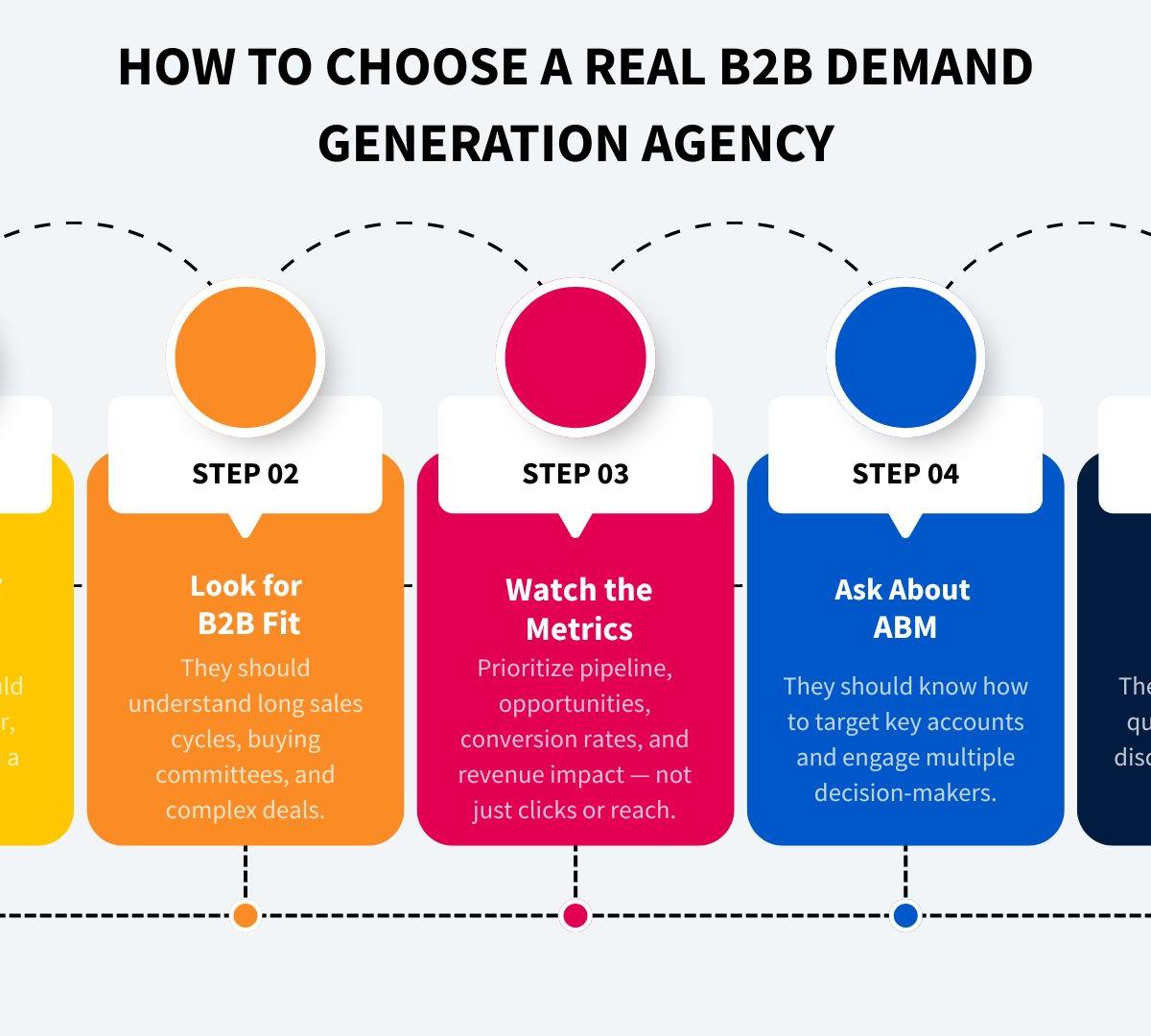
Talks in revenue terms: pipeline, opportunities, stage conversion, win rates, and revenue influence (not just clicks, reach, or “awareness”), and can map these to concrete metrics like opportunity-to-close rates and pipeline velocity.
Unlike lead generation, which often ends with delivering contacts or meetings without nurturing them through the full journey, effective demand generation programs ensure prospects are engaged throughout their buying process.
Listen to how they describe success. If the conversation stays at the level of impressions and content volume, you’ll likely end up with noise instead of outcomes.
Red flags in positioning and demand generation services
Be cautious when you see:
A “we do everything” menu where PR, branding, web development, SEO, PPC, social, events, and demand gen all look equally important. That often means you’ll get disconnected tactics instead of a coherent revenue system, and usually signals a lack of a unified content strategy—a common pitfall that prevents agencies from delivering the integrated demand generation methodology needed for B2B success, mirroring the “jack-of-all-trades” agency profiles that consistently underperform in B2B environments.
Vague positioning like “integrated storytelling” with no clear plan for how work connects to pipeline stages and sales follow-up—especially if they can’t answer basic qualification questions about your industry, ACVs, and sales cycle.
Misaligned playbooks, especially consumer-first approaches repackaged for B2B, or generic funnel templates that ignore buying committees and deal stages, despite widespread evidence that B2B journeys are non-linear and rarely fit a simple “TOFU/MOFU/BOFU” schema.
Unclear data practices (common in agencies): if they rely heavily on third-party data, they should be able to explain how they validate accuracy, freshness, and compliance, given how many agencies now outsource large portions of their data and still report concerns about uniqueness and validity.
What to look for instead
Prioritize agencies that are specific about who they serve and how they drive revenue:
Clear niche and ICP fit (your industry or a close neighbor, similar deal size, similar sales motion). Look for agencies that focus on targeting and engaging your ideal customers and key accounts, demonstrating expertise in identifying and nurturing high-value prospects rather than making you pay for a long learning curve. If you sell into education, our review of demand generation agencies that work with EdTech companies is already filtered on that test.
Channel and motion alignment: they can explain how key channels connect to CRM, lifecycle stages, and attribution—without hiding behind jargon—and show how those choices support account-based or buyer-committee-led motions, including experience engaging multi stakeholder buying committees in complex B2B buying processes where needed.
Account Based Marketing Strategies
Account-Based Marketing (ABM) has become a cornerstone of effective demand generation strategies, especially for B2B organizations navigating complex sales cycles and engaging multiple stakeholders. Unlike broad-based lead generation, ABM zeroes in on high-value target accounts, tailoring outreach and content to the specific needs and buying dynamics of each account. This focused approach is essential for driving pipeline growth, generating qualified leads, and achieving sustainable revenue growth.
A successful ABM strategy starts with rigorous account selection and profiling. Leading demand generation agencies leverage data-driven insights—combining firmographic, technographic, and behavioral data—to identify target accounts that closely align with your ideal customer profile (ICP). This ensures that marketing resources are concentrated on accounts with the highest potential for revenue impact and long-term value.
Once high-value accounts are identified, the next step is to develop personalized content and messaging that speaks directly to the unique challenges and objectives of each account. This might include tailored email sequences, custom landing pages, targeted paid media campaigns, and even direct mail—all orchestrated across multiple channels to engage multiple stakeholders within the buying committee. The goal is to create a cohesive, relevant experience that advances the account through the buyer journey and increases conversion rates.
Marketing automation platforms play a pivotal role in executing ABM strategies at scale. By integrating marketing automation with CRM systems, companies can track account engagement, coordinate outreach across sales and marketing teams, and ensure timely follow-up with key decision-makers. This unified view of account activity enables more informed decision-making and helps align marketing programs with sales objectives, driving measurable business outcomes.
Continuous measurement and optimization are critical to ABM success. Effective demand generation agencies monitor key metrics such as account engagement, pipeline contribution, and conversion rates to assess the impact of ABM campaigns. By analyzing these metrics, they can refine targeting, messaging, and channel mix to maximize ROI and support ongoing pipeline growth.
When evaluating a demand generation agency’s ABM capabilities, look for a proven track record in building and executing account-based strategies for high-value accounts. The right partner will demonstrate expertise in data-driven account selection, personalized content creation, and marketing automation, as well as a deep understanding of how to engage multiple stakeholders and drive revenue targets in complex B2B environments.
Incorporating ABM into your demand generation approach enables your marketing and sales teams to focus on the accounts that matter most, improving pipeline quality and accelerating revenue growth. By aligning marketing strategies with sales goals and leveraging advanced marketing automation platforms, businesses can build demand generation programs that deliver sustainable growth and measurable business outcomes among their most valuable prospects.
Demand Proof, Not Promises
A demand generation agency should be able to show, in plain language, how their work turned into pipeline and revenue. Look for evidence of measurable growth and clear tracking of pipeline metrics, as these are key indicators of agency effectiveness. If you mostly hear big claims, trendy frameworks, or vague “growth” talk, treat that as risk. Ask for proof that matches your sales motion: similar deal size, sales cycle length, and buying committee complexity. If your deals clear a dozen sign-offs and run past a year, we applied that same test to the field in demand generation agencies that work with enterprise buyers. The most important metrics for measuring demand generation performance include pipeline generated, marketing-qualified accounts, sales-qualified opportunities, cost per opportunity, and pipeline velocity—not just vanity metrics like impressions or clicks.
Case studies that tie to revenue
Ask for 2–3 detailed case studies, ideally from your industry or a close match in ACV and complexity. If you build, specify or supply for projects, our review of demand generation agencies for construction and AEC firms is already filtered on that test. Don’t accept a highlight reel. You want context: what the starting point was, what constraints existed (budget, brand awareness, sales capacity), and how long results took.
A strong case study should show movement in commercial metrics, not just activity:
SQLs and opportunities created
Pipeline dollars (sourced and influenced) and win rate movement
CAC and payback period trends
Sales cycle length (or stage-to-stage conversion)
Sales pipeline growth and health
Demand capture effectiveness and contribution to revenue
Those are the same kinds of outcomes sophisticated B2B teams use to judge agency work, alongside clear explanations of what they did, why they did it, and how it impacted revenue, not just clicks or impressions.
Also look for how they connected the pieces: content + campaigns + sales alignment. If the story ignores sales follow-up, lead routing, or enablement, it’s usually not demand gen—it’s lead collection.
Finally, push on measurement. They should explain attribution without hand-waving: what they count as sourced vs. influenced, how they handle multi-touch journeys, and how they connect offline activity (events, outbound, partner leads) back to CRM outcomes. Given that roughly half of agencies outsource data and many worry about its uniqueness and validity, you want concrete detail on how they validate contact and account data, handle enrichment, and keep reporting accurate over time.
Testimonials, reviews, and references
Look for third-party validation on platforms like Google, G2, Trustpilot, or Clutch. Patterns matter more than star ratings—especially comments about transparency, responsiveness, and results quality. Independent reviews that mention specific commercial outcomes, such as improvements in key accounts or marketing qualified accounts (MQAs), carry more weight than generic praise.
Then ask for references and probe beyond “they were great.” Ask:
Did pipeline quality improve or just volume?
Did the number or quality of marketing qualified accounts (MQAs) increase?
Did sales trust marketing more over time?
What happened when performance dipped—did the agency diagnose and adapt, or deflect?
Their own demand gen footprint
Treat the agency’s marketing as a live test. Their site and LinkedIn should show recent, practical thinking on demand gen, attribution, and B2B growth—not recycled jargon. Look for evidence of organic traffic growth and a robust content strategy, as these indicate the agency’s ability to drive results through high-quality, optimized content. Content marketing and SEO are essential for establishing authority and improving organic search visibility. If they can’t sustain their own demand system, be cautious about them building yours. That screen is the one we ran across more than 60 agencies for our list of demand generation agencies for companies not generating enough inbound, where a working inbound presence of the agency's own was the entry requirement.
Insist on Process Transparency and Data Rigor
A demand gen agency should not feel like a black box. If you cannot see how work becomes pipeline, you cannot manage risk, set expectations, or diagnose what is (and is not) working. Your goal is a clear operating system: how the agency thinks, executes, measures, and adjusts. This means tracking every demand generation activity and demand generation campaign for accountability, focusing on metrics that show which activities actually result in closed deals and pipeline growth—not just engagement. Effective demand generation strategies also include monitoring intent data and utilizing behavioral signals to identify companies actively researching solutions, ensuring your efforts are targeted and data-driven.
Make the black box visible
Ask for a step-by-step view of the first 90 days. A serious agency can show the sequence, owners, and outputs—before you sign.
Look for a plan that includes:
Discovery + ICP refinement: what they will validate (segments, deal sizes, buying committee), what inputs they need from sales and customer success, and what internal resources are required from your team to support campaign execution.
Buyer research: jobs-to-be-done, objections, triggers, and why deals stall.
Content + campaign architecture: a few cornerstone assets, supporting pieces, and a distribution plan that matches your channels and sales cycle.
Data + tech setup: CRM and marketing automation hygiene, tracking, scoring, and lead/account routing so sales gets the right follow-up at the right time.
Agencies allow for quick campaign launches using pre-built operational infrastructure, including CRM integrations and reporting dashboards. They also provide immediate access to specialized multi-channel expertise and advanced technology that would otherwise take months to build internally.
Also ask them to show how content, paid, outbound, and nurture connect. If each tactic is managed in isolation, you will likely get activity without compounding results. That isolation is the usual reason a busy team's pipeline sits flat, and it is the screen behind our list of demand generation agencies for busy teams with flat pipeline.
Plain language over jargon
Use language as a filter. Dense buzzwords often hide a lack of specifics. You want a team that can explain the mechanics without hype, like:
how a webinar becomes meetings (and for which accounts)
how a LinkedIn campaign feeds nurture and sales follow-up
what they will change if early signals are weak
If they cannot explain the plan to your CRO in simple terms, assume they cannot run it under pressure. Many experienced B2B leaders use this kind of “plain-English test” when evaluating agencies because it tends to surface whether there is a real, repeatable process behind the pitch. That test matters most when a revenue leader has to work the pipeline the agency produces, so we screened more than 120 agencies that sell to revenue leaders into our list of demand generation agencies for CROs and heads of sales.
Data sourcing, quality, and compliance
Data quality is a constraint, not a detail. Many agencies rely on outsourced data, and common problems include duplicates, outdated records, and weak validity. Industry surveys show that about half of agencies outsource data and still worry about uniqueness and accuracy, which means you inherit their data risk if you do not probe their approach. Ask where data comes from (named tools, partners, enrichment) and how they keep it accurate and current. It's also crucial that your sales and marketing teams use the same data to ensure alignment, minimize discrepancies, and improve coordination for better demand generation outcomes.
Agencies typically offer a blend of strategic consulting and tactical execution, and many companies use a hybrid model—leveraging in-house teams for brand strategy while relying on specialized agencies for technical execution. If you already run a team and the real question is where a partner plugs into it, we applied the same filters to the agencies that name marketing leaders as their buyer, and 14 cleared them, in our list of demand generation agencies for CMOs and heads of marketing.
Privacy posture should be explicit:
consent and opt-out handling
GDPR/CCPA readiness where relevant
basic security and clear data processing terms
Prioritize first-party data first: cleaning and structuring your CRM and marketing automation, then scoring, segmentation, and routing before scaling top-of-funnel volume. With third-party cookies eroding and privacy rules tightening, first-party infrastructure has become a core lever for sustainable demand gen, not a nice-to-have.
Measurement, attribution, and reporting
Expect a cadence that ties work to revenue outcomes, not just “visibility.”
Weekly: ICP reach, engagement quality, meeting rates, follow-up speed, and ongoing conversion rate optimization efforts to improve key metrics like demo requests and sales-qualified leads (SQLs)
Monthly: pipeline review tied to opportunities, pipeline metrics, and revenue influence
Quarterly: strategy changes based on what actually converted, with a focus on optimizing full funnel demand generation by integrating channels such as content marketing, paid media, and account-based marketing (ABM) to nurture prospects throughout the buyer journey
Ask their attribution stance. They should acknowledge multi-touch and “dark social” without using it as an excuse to avoid accountability. Mature teams can balance multi-touch nuance with a clear point of view on how they will connect campaigns to pipeline and closed-won revenue over time.
Evaluate Talent, AI Stance, and Resourcing Model
A demand gen agency can look strong on a website and still fail in execution. It's important to distinguish between gen agencies, which specialize in building long-term marketing systems to nurture buyer interest and move leads through the sales funnel, and other types of marketing agency that may focus only on lead generation or inbound tactics. Choosing the right partner matters: agencies bring experience from working with similar clients, so they know which messaging and targeting parameters deliver the best Cost Per Lead (CPL). Your job is to confirm who will do the work, how decisions get made, and how quality is protected—especially as AI and outsourcing become more common.
Meet the real team
Do not settle for a sales-led handoff. Ask to meet the people who will run your account and decide what “good” looks like:
Senior strategist / account lead (owns ICP, messaging, channel plan, measurement, and has experience managing key accounts in B2B demand generation)
Content / creative lead (owns voice, credibility, buyer-level relevance)
Performance / ops lead (owns tracking, attribution, CRM/automation hygiene)
Clarify the operating reality:
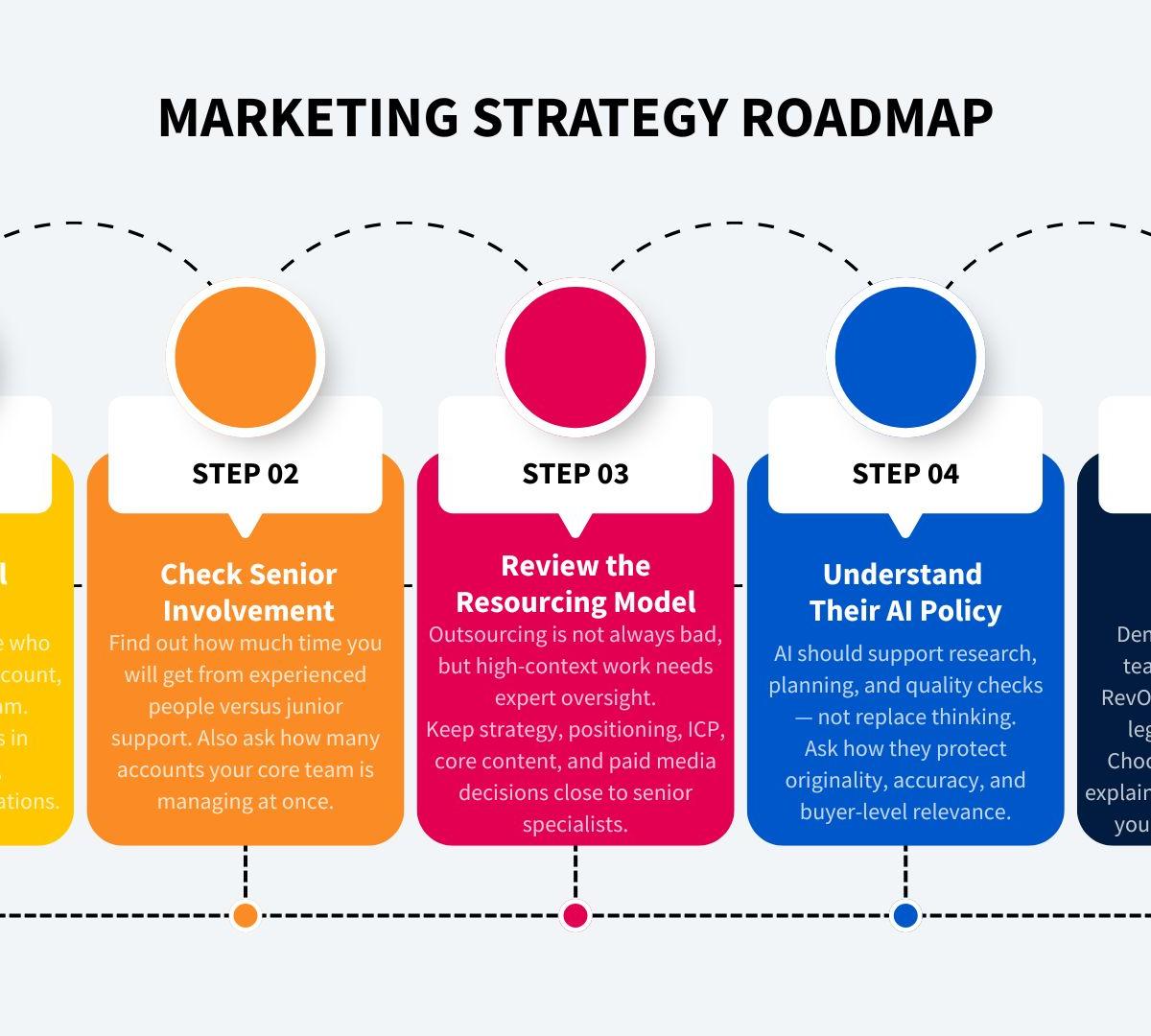
How much time you get from senior people versus junior execution
How many accounts your core team is juggling at once
Who owns outcomes when performance dips (and how quickly they respond)
These conversations should reveal whether you’re getting a true specialist team or a generic, jack-of-all-trades setup that tends to underperform in B2B demand gen.
In-house vs outsourced work
Outsourcing is not automatically bad. It can work well for production tasks if in-house leaders set direction and enforce standards. A hybrid approach often works best: leverage your internal resources for brand strategy, messaging, and stakeholder alignment, while using a b2b demand generation agency for technical execution and specialized campaign management. The risk is when the agency outsources the parts that require context and judgment.
Lower-risk (when supervised tightly):
Design, editing, transcript cleanup, basic landing page builds
Higher-risk:
ICP definition, positioning, core content, paid media strategy, or lifecycle design done by low-context freelancers
Constant churn of anonymous writers or media buyers
Ask for named bios of key contributors and samples relevant to your buyers (C-suite, technical evaluators, and economic buyers—not just generic blog posts). Given that roughly half of agencies outsource core data and execution, you want to know exactly which pieces are leaving the building and how quality is being controlled end to end.
Their stance on AI and quality
AI can speed up research and operations, but overuse tends to produce interchangeable content and low-intent traffic. That hurts differentiation and makes “thought leadership” feel like recycled summaries.
Probe for specifics:
Where AI is used (research acceleration, outlines, QA) vs where it is not
Human editorial standards and subject-matter involvement
How they check originality and prevent factual drift
How they ensure content supports pipeline, not just publishing volume
You’re looking for an approach where AI augments a defined process—strategy, audience insight, and creative direction still sit with named experts, not with tools churning out high-volume, low-signal assets.
Cultural and operational fit
Demand gen is a system, not a campaign. Make sure they can work inside your governance and still move fast:
Your speed vs accuracy expectations
Legal, compliance, and security constraints
Willingness to collaborate with Sales, the sales team, RevOps, and product marketing, as well as engage with multi stakeholder buying committees
Effective demand generation programs require close collaboration between sales and marketing to ensure both teams are targeting the same high-value accounts and using consistent messaging. When choosing a b2b demand generation agency, it's also important to evaluate their ability to handle multi-stakeholder buying committees, since B2B purchasing decisions often involve multiple decision-makers.
An agency that can clearly explain its operating rhythms, communication norms, and collaboration model is far more likely to embed effectively alongside your internal teams. Where RevOps owns that side of the collaboration, our list of demand generation agencies for RevOps leads screens for partners that report pipeline back into the CRM and marketing automation you already run.
Get Clear on Economics, Contracts, and Risk Controls
A demand gen engagement should be easy to audit: you should know what you’re paying for, what you own, and how risk is managed before meaningful revenue shows up. B2B demand generation services are specifically designed to generate pipeline for clients, with many agencies tailoring their offerings to the mid market segment. A B2B demand generation agency should provide full-funnel programs that include content, paid media, outbound, and lifecycle campaigns to effectively create and capture demand.
Pricing transparency
Expect a clean separation between service fees and pass-through costs. If pricing is bundled into a single “retainer,” you lose the ability to judge efficiency and benchmark costs against typical agency models where media, data, and services are itemized separately. If you are the one answering for cost per lead each quarter, our list of demand generation agencies for demand gen leads records the price each agency publishes, or marks where no price is shown.
At minimum, ask for:
A breakdown of retainer vs. media spend vs. data/tool fees
Line items for strategy, content production, ad management, and reporting
Explicit disclosure of any markups on media, data, or software
Contract structure and IP
Keep initial terms short enough to test, but long enough to learn. A common structure is 3–6 months, with a 30-day out clause after the initial period. If trust is low, propose a 60–90 day pilot with a tight scope and clearly defined exit criteria, mirroring the kind of structured trial many B2B marketers now use when selecting agencies.
Confirm ownership upfront:
You keep creative assets, audiences, and learnings produced for your business
You retain shared access to ad accounts, analytics, and CRM dashboards (not screenshots)
Guardrails, experimentation, and risk
Look for hypothesis-driven testing: controlled experiments before scaling spend. This should include testing channels like paid search and Google Ads as part of an integrated demand generation strategy. Insist on budget guardrails per channel and per test, plus an early warning system based on leading indicators like ICP engagement, inbound conversation quality, and meeting rates. Agencies can help you scale quickly and test new paid channels, especially when your team lacks internal expertise. Make sure to differentiate between lead gen tactics—such as direct email collection and targeted campaigns—and broader demand generation approaches during experimentation.
Choose Operators, Not Storytellers
You’re not hiring a creative vendor. You’re choosing a partner to help build a revenue engine you can measure, improve, and defend internally. Selecting the best demand generation agencies—those that know how to create demand and understand buyer behavior throughout the buying journey—can make all the difference in achieving marketing success. If buyers in your market do not yet have a name for what you sell, our review of demand generation agencies that create new-category demand applies the same filters to that narrower job.
When you evaluate agencies, use practical filters that reveal how they actually operate:
Specialization: Real B2B demand gen focus (and experience with your ICP), not “full-service” sprawl. Independent research on agency selection consistently flags “jack-of-all-trades” positioning as a predictor of mediocre performance. If you sell software, our list of demand generation agencies for B2B SaaS applies that same filter to 683 agencies and keeps 15.
Proof: Case studies and references that show pipeline and revenue impact, not just activity. You’re looking for “numbers behind the pictures”—conversion rates, pipeline created, and closed-won deals tied directly to specific programs.
Transparency: A clear process that explains targeting, offers, channels, and reporting in plain language (no black box). You should be able to map what they do to your own sales process and tech stack.
Data discipline: Clean CRM alignment and a cautious approach to third-party data quality, accuracy, and privacy. With roughly half of agencies outsourcing data while still worrying about uniqueness and validity, you need to know exactly how they validate and refresh what they use.
Team accountability: Senior, named experts doing the work, with a deliberate stance on AI (assistive, not mass-produced). The people designing your system should understand complex B2B motions, not just ad platform knobs.
Economics: Clear pricing, fair terms, and a structured pilot that defines success upfront. Many seasoned practitioners recommend tying pilot evaluations to leading indicators (qualified opportunities, sales cycle impact) rather than just short-term lead volume.
The strongest agencies treat campaigns, content, and channels as one connected system. They build content as decision infrastructure that moves buyers from awareness to qualified demand and supports sales conversations. Their reporting tells a credible revenue story—not a defense of vanity metrics.
Understanding buyer behavior and timing can make all the difference—effective demand generation strategies result in higher quality leads and shortened sales cycles by nurturing prospects with targeted content before they ever meet with sales. Most B2B demand generation agencies focus on creating awareness, interest, and intent among ideal customers, rather than just collecting leads. Demand generation is a holistic approach that guides prospects through every stage of the buying journey, ensuring your marketing efforts align with buyer needs and drive measurable business growth.
If you use this lens, the difference becomes obvious. Choose the team willing to open the hood, show their numbers, and build something that keeps working after the first campaign ends. We ran that lens over more than 450 agencies that claim mid-market work, and 16 of them cleared it, in our list of demand generation agencies for mid-market companies.
Is your demand gen agency building a revenue system—or just activity?
Get a Content RevOps-style audit of your current motion and a 90-day plan tied to pipeline, sales follow-up, and attribution.
Frequently Asked Questions
About the Author

Founder & CEO, Content RevOps
Stefan Kalpachev is the founder and CEO of Content RevOps, where he helps B2B SaaS companies transform their content into predictable pipeline. With a background in content marketing and revenue operations, Stefan has developed a unique methodology that bridges the gap between content creation and revenue generation.
Connect on LinkedIn