How Do You Develop an Effective Content Distribution Strategy
Stop “publish and pray.” Build a distribution system that compounds. Let’s talk.
Book a CallMost teams still publish and pray: they ship a post, run a launch week, and then move on. The problem isn’t effort. It’s economics. Good content is expensive (even with AI), and under-distributing it is like letting inventory rot in a warehouse. Multiple industry studies have shown that simply having a deliberate distribution strategy puts you ahead of most marketers and dramatically improves ROI over “publish once and forget” approaches, which is why the real job of content distribution isn’t a traffic spike; it’s maximizing content lifetime value: the total leads, conversations, and revenue influence an asset creates over months, not days.
This is where a Content RevOps lens changes everything. Content isn’t output; it’s infrastructure. Your distribution strategy is the operating system that determines whether a report, guide, or video becomes a revenue asset (feeding email, sales, partnerships, and pipeline) or just more marketing noise that disappears in the feed. Teams that treat distribution as part of the content system from day one, rather than an afterthought, consistently see higher-performing funnels and more efficient lead generation.
In the rest of this article, you’ll get a practical, de-risked roadmap built around a few pillars that echo what’s worked in the strongest content programs:
Audience-first channel choices (be where your ICP actually pays attention, even if that means niche communities instead of mainstream feeds)
A documented distribution plan (cadence, roles, and expectations, not ad hoc posting)
AI-enabled repurposing with human judgment
Human-centric outreach (including reactivation, not just posting)
Measurement tied to pipeline, not vanity metrics
The goal is simple: do less, better (fewer assets, more distribution, more compounding value).
1. Start With Purpose: Design for Content Lifetime Value
1.1 Why distribution is part of strategy, not an afterthought
Most teams fall into the “publish once and forget” trap: they invest real time and money into an asset, post it, maybe share it once, and then move on. That kills ROI because content rarely performs on first contact, especially in B2B where buyers need multiple touches across a longer, more complex journey. Research on content programs consistently shows that teams with a documented distribution plan outperform those that rely on ad hoc promotion and “post and pray” tactics.
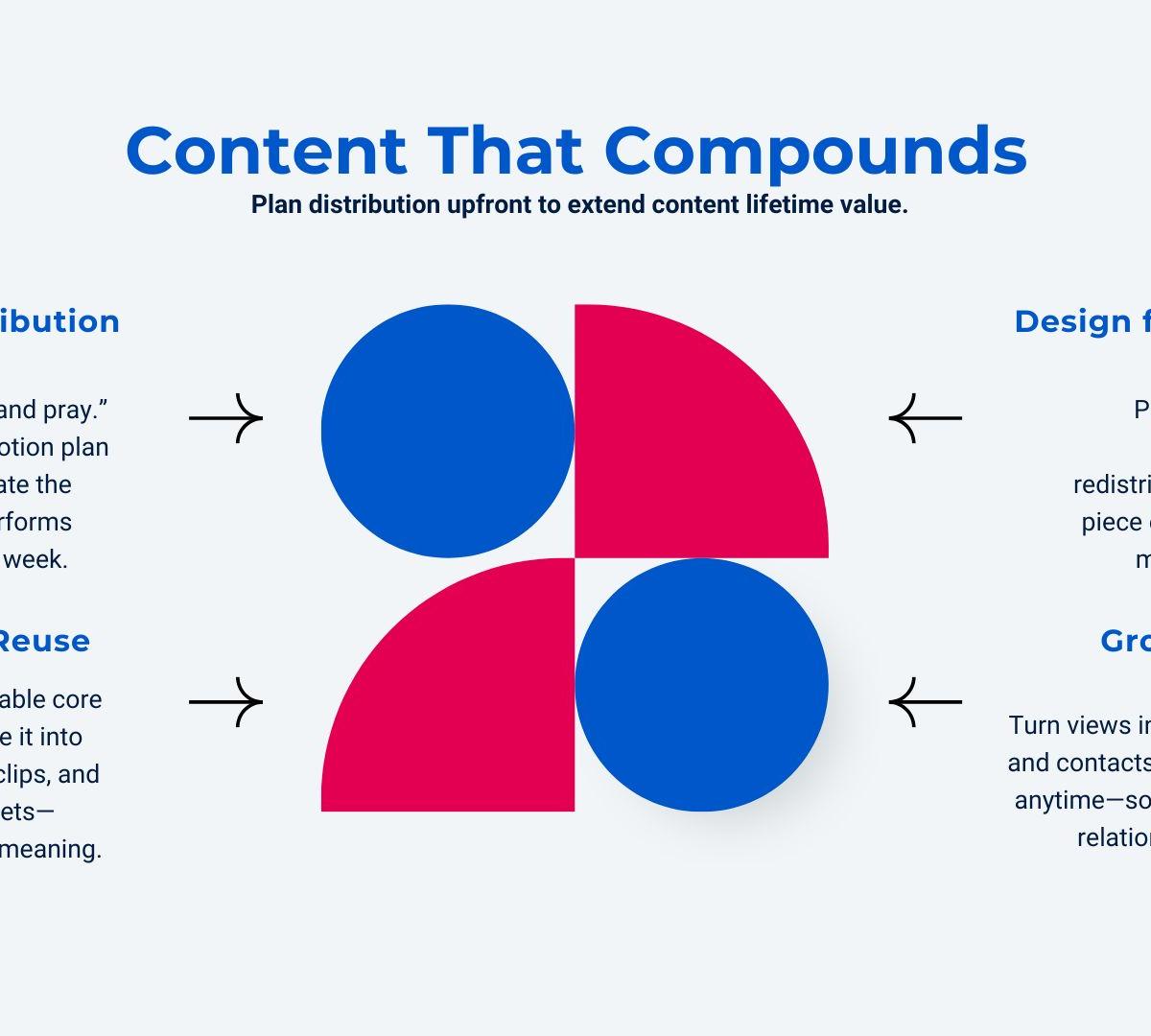
The purpose of content distribution is to maximize content lifetime value (CLV): the total revenue impact one asset generates across channels and over its full useful life. CLV is what turns content from “marketing output” into a revenue system and is a core principle in most modern content strategy frameworks, from integrated content plans to demand-generation–driven content engines.
If distribution isn’t designed up front, content can’t function like an operating model. It becomes a string of disconnected posts instead of infrastructure that educates, captures demand, supports sales, and keeps compounding. Treating promotion as part of the initial planning (rather than something bolted on at the end) is the same shift that separates invisible content from consistently compounding assets.
CLV grows when content is built to:
earn attention repeatedly (not just at launch), with planned relaunches, refreshes, and redistributions over time
convert attention into owned reach (email list, CRM, community), which most content strategy checklists now treat as a primary success metric
support pipeline (nurture, sales enablement, reactivation) through deliberate funnels that move people from first touch to qualified conversation
1.2 Plan assets for reuse and distribution before you create them
Start with a “big, durable” piece (think report, guide, webinar, book, or flagship article) and treat it like a content product. That means designing it to be reused, sliced, and redeployed without losing meaning. Teams that plan modular, repurposable assets and attach distribution workflows up front routinely see higher lead volume and longer performance windows from the same core piece of content.
Structure the pillar asset modularly: clear sections, distinct insights, data points, stories, quotes, and visuals. Then map derivatives before production so distribution is not an improvisation after publishing. This is the same principle behind modular content and “pillar-and-cluster” models used in advanced promotion playbooks and content marketing templates.
For example, one pillar can intentionally produce:
segmented email sequences aligned to specific segments in your ICP and funnel stage
social threads and carousels tuned to the platforms where your audience actually spends attention
short videos and clips that plug into always-on paid and organic distribution
outreach snippets tailored to specific roles or pain points that sales and success teams can use in sequences
AI can accelerate this repurposing by generating multiple variants from the pillar, while humans choose and refine what sounds most real and relevant. The highest-performing teams use AI to scale first drafts, then apply editorial judgment to keep every touchpoint on-brand, human, and channel-appropriate.
1.3 Treat your audience, not your content, as the asset
Your individual posts are not the asset. Your owned audience is: subscribers, community members, and CRM contacts you can reach without paying rent to an algorithm. Leading content organizations now frame audience growth and subscriber quality as the primary outcome of their distribution strategy, with content itself as the vehicle to earn and deepen that audience over time.
Thoughtful distribution compounds because every asset becomes an excuse to deepen relationships, reactivate old leads with something genuinely useful, and attract net-new subscribers. Done deliberately, the same piece can drive demand creation, sales conversations (via landing pages and “book a call” paths), and customer education, extending CLV far beyond the launch week.
This shift (from channel-first to audience-first, and from campaign bursts to continuous, systematized distribution) is what turns content into a compounding, omnichannel engine instead of a set of one-off posts that briefly spike and then disappear.
2. Anchor Channels in Audience, Intent, and Funnels
2.1 Start with ICP, jobs to be done, and journey
An effective distribution strategy starts by getting specific about who you’re distributing to and why they would care. Your ICP isn’t “mid-market B2B.” It’s a real buyer with constraints (time, risk, internal politics, budget cycles) and a job to be done (reduce uncertainty, build a business case, avoid a bad vendor choice).
Then map your content to the buyer journey, which closely mirrors how most content marketing frameworks structure awareness, consideration, and decision stages:
Top of funnel (education): help them name the problem and see what “good” looks like
Mid funnel (comparison): help them evaluate approaches and tradeoffs
Bottom of funnel (proof/support): help them justify the decision with evidence, clarity, and next steps
This is also where “create vs. capture” demand matters. Some assets create interest (fresh insights, narratives, contrarian takes). Others capture existing intent (solution pages, comparison guides, ROI tools). Your channels should follow that intent, not your preference, which is why audience-first channel selection shows up in nearly every modern content strategy model.
2.2 Choose a focused channel mix, not “everywhere”
Most teams fail at distribution because they try to show up everywhere and end up standing out nowhere. Pick 1–2 primary channels where your ICP already pays attention and where you can commit to sustained, human participation. A documented channel plan that spells out purpose, audience, cadence, and formats per channel tends to outperform ad hoc “post everywhere” approaches.
In practice, a balanced mix usually looks like:
Owned: landing pages, blog, email/newsletter, video hub
Earned: partnerships, guest spots, podcasts, and communities (including Reddit, Slack/Discord, LinkedIn groups, associations)
Paid: paid social to tight ICP targeting, retargeting, search for high-intent queries, newsletter sponsorships
Unorthodox channels can be high-leverage if you earn the right to post. In communities, distribution should read like a helpful person sharing context and a story, not a billboard link drop. Brands that treat communities as ongoing feedback and distribution infrastructure, not just broadcast outlets, generally see longer content shelf life and stronger advocacy.
2.3 Match each asset to a funnel-aware distribution pattern
Take a flagship asset like an industry report:
Put the core asset on a landing page that clearly states who it’s for and the problem it solves.
Send segmented emails (customers, warm leads, reactivation lists, cold outreach) with different angles.
Publish narrative-led social posts (insight, tension, takeaway), not “we just dropped this.”
Use paid amplification when organic reach is structurally limited, focusing on the narrowest ICP slice that benefits most.
Patterns like report → landing page → opt-in → “book a call” upsell or video sales letter are consistently among the highest-performing B2B funnels for generating fewer but higher-quality leads, especially when they’re anchored in clear ICP definitions and content “jobs.”
Then adjust by intent:
Awareness: more ungated, story-driven distribution across discovery-heavy channels like search, social, and publisher partners
Lead capture: gated assets with a crisp value promise and right-sized friction (form length, data asked)
Sales acceleration: sales-enabled distribution (sequences, proposals, QBRs), where content answers objections and builds confidence
Teams that explicitly map funnel stage, audience, and distribution plan for each asset (and bake that into their editorial calendar) tend to get far more lifetime value from the same content.
2.4 Design simple but effective funnels
A high-performing report funnel is straightforward:
Report → focused landing page → opt-in → thank-you page upsell (book a call or short video sales letter) → nurture + retargeting
The upsell has to feel like the next logical step, not a hard pivot to a pitch. Done well, each touchpoint increases confidence and reduces decision risk, maximizing content lifetime value instead of just generating clicks. This kind of “one flagship asset, many coordinated distribution paths” approach is what separates publish-and-pray programs from systems that compound results over months rather than days.
3. Repurpose at Scale With AI, Keep Every Touchpoint Human
3.1 Build a repeatable repurposing system
If content is expensive, distribution is how you raise its lifetime value. The simplest way to do that is to stop treating each post as a one-off and start using a repeatable repurposing system, something a lot of high-performing teams treat as a core part of their content strategy, not an afterthought.
Build a “transformation matrix”: core formats on one axis, primary channels on the other. Then every flagship asset (report, webinar, guide, case study) gets mapped into a planned set of derivatives you can ship over weeks and months. Modular, “sliceable” content like this is the backbone of many scalable promotion engines, from research reports to video series.
Example formats to standardize:
Threads + short posts (for social)
Carousels (for skimmable education)
Reels/short clips (for pattern interrupts)
Email variants (for nurture + reactivation)
Sales snippets (for objections + follow-up)
Community replies (for Reddit/Slack-style engagement)
The key is timing: you’re not trying to “win launch week.” You’re turning one asset into an always-on library of angles, hooks, and entry points that keeps working long after publish day, closer to how strong content programs treat a single report as the nucleus for a full campaign, not just a single blog post.
3.2 Use AI for acceleration, humans for resonance
AI is best used as a multiplier, not the author of your relationship with the market. Teams that get this right bake AI into their workflows as a way to expand surface area while keeping humans in charge of narrative and nuance.
A practical workflow:
Feed the flagship asset into AI and generate many options (hooks, post drafts, email intros, subject lines, CTA variations).
A human editor ranks and refines the top performers to match your voice and your ICP’s reality, similar to how advanced content promotion playbooks treat AI as a first-draft engine, not a final publisher.
Automation schedules the winners across channels and into drip campaigns (including retargeting and reactivation sequences).
Common fears and fixes:
Loss of context: give AI clear structure (who it’s for, what problem it solves, what to avoid), then edit for accuracy and nuance. Documented style and channel plans dramatically reduce this risk.
Generic outputs: enforce a style guide and anchor drafts in real stories, specific points of view, and firm recommendations, an approach that consistently outperforms generic blasts in multi-channel distribution tests.
3.3 Make every touchpoint feel like it’s from a person to a person
Most distribution fails because it sounds like distribution. Research on high-performing content funnels keeps coming back to the same pattern: human, story-led framing beats “we just published this” announcements almost every time.
Instead of: “Check out our new report.”
Lead with relevance, context, and stakes:
“If your pipeline depends on a couple of hero reps, this section will help you…”
“We built this because we kept hearing one question from buyers: …”
“This matters now because your team is probably seeing….”
Even scheduled posts and automated emails should read like they were written for one specific person, not “the market.” That person-to-person feel is what turns distribution into relationship-building instead of noise and is a common thread in effective multi-channel systems that prioritize depth over breadth.
3.4 Balance quantity and focus
AI makes it cheap to be everywhere. That’s a trap. The goal isn’t maximum output. It’s maximum impact where your ICP actually pays attention (even if that’s unglamorous, like niche communities or direct outreach). Teams that document clear channel plans and resist “be everywhere” pressure typically see stronger results from fewer, deeper bets than from blanket coverage.
Go deep on a few channels, use AI to sustain cadence and variety, and keep the human core intact. Treat each major asset as a long-term campaign you can relaunch, re-angle, and redistribute over time, rather than something you post once and move on from.
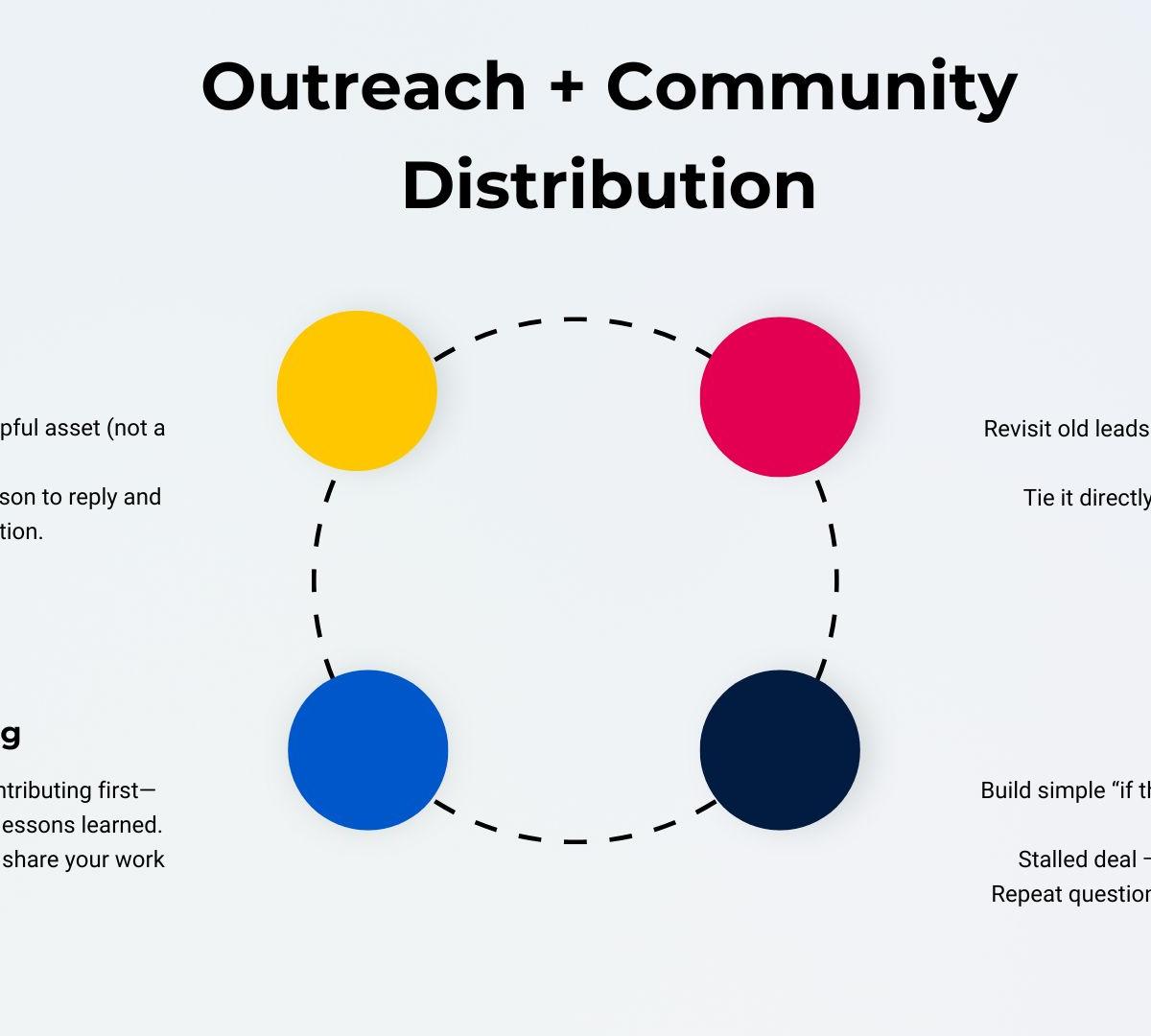
4. Turn Outreach and Communities Into Primary Distribution Engines
4.1 Treat outreach as a first-class distribution channel
Most teams “distribute” by posting on social and hoping the algorithm does the rest. The blind spot: they underinvest in direct, targeted distribution even though it’s often the fastest path to qualified conversations in B2B, especially when it’s designed as part of an intentional content distribution strategy rather than a one-off push.
Build outreach into your distribution plan as a core channel, not an afterthought. The main motions look like this:
Net-new outreach: a short email or LinkedIn DM that offers a genuinely useful asset (not a meeting request). Thoughtful, value-led outreach tends to outperform generic blasts and “publish and pray” promotion in both opens and replies.
Reactivational outreach: reaching out to old leads, closed-lost deals, or inactive subscribers with a new piece that addresses what stalled them. Reactivation campaigns built around fresh content often convert better than pure cold prospecting.
Sales-led distribution: reps using content to answer objections, educate a buying committee, and reduce perceived risk mid-deal. When content is treated as sales enablement, it effectively becomes part of your demand generation engine, not just a top-of-funnel asset.
A simple rule: sending a valuable asset beats asking for a call with no context. The asset creates a reason to engage, and it lets the prospect self-qualify before you ever talk. Teams that structure outreach around high-value assets and clear next steps typically see higher lead quality and faster movement through the funnel than those relying on ungated blogs or brand-only messaging.
4.2 Make outreach content-led and personalized
Content-led outreach works when it feels like help, not a pitch. Lead with a problem you’re confident they have, then offer the asset as the fastest way to think it through. That framing aligns with what high-performing content programs do: put the recipient’s job-to-be-done at the center of every distribution touchpoint.
Personalization doesn’t require deep research every time. Use light but specific relevance signals:
Role and company type (who they sell to, deal size, buying cycle)
A trigger event (funding, hiring, new product launch, new market)
A prior interaction (what they asked, downloaded, or objected to)
Position the asset as “built for people in your exact situation,” not “here’s our latest PDF.” Even basic segmentation and tailored intros tend to lift open and click rates compared with one-size-fits-all messaging.
High-impact plays:
Physical follow-up: mailing a book or printed report to a late-stage opportunity as a trust-and-credibility move. Sending a tangible asset can be an order of magnitude more compelling than another “just checking in” email, especially for strategic accounts.
Objection-based reactivation: “Last time, X was the blocker. This new piece directly tackles that.” Teams that systematically map recurring objections to specific assets effectively turn content into reusable “plays” for saving and re-opening deals.
4.3 Earn your way into communities and niche platforms
Communities (Reddit, Slack/Discord groups, private forums, associations) are where real questions (and real buying conversations) happen. But you can’t parachute in with links. In most mature communities, overt self-promotion gets ignored or removed, while consistent, practitioner-level contributions earn disproportionate trust and reach over time.
Rules of engagement:
Participate first. Answer questions and share what actually worked (and what didn’t). Brands that show up with useful, non-promotional answers tend to see their content picked up and shared organically by members.
Match the format to the room. Longer explanations on Reddit, concise tactics in Slack, more structured posts in LinkedIn groups. Aligning with each channel’s norms dramatically increases the odds that content will be read and discussed rather than skimmed past.
Avoid hype. Aim to be the best answer, even if that means not linking, or linking to a non-owned resource sometimes. Counterintuitively, being willing to reference external sources alongside your own material often boosts perceived credibility rather than diluting it.
Operationalize it by maintaining a small library of “supporting assets” your team can drop into replies, and logging recurring questions so they feed your content roadmap. Over time, this turns communities into both a distribution channel and a continuous feedback loop for what to create next.
4.4 Integrate outreach into your overall operating model
This is where content starts acting like decision infrastructure. Make assets easy to find (one library, clear use cases) and build simple playbooks:
If a deal stalls → send the asset that de-risks the decision with a human note. Teams that map specific content to friction points in the pipeline often see shorter cycles and fewer no-decisions.
If a renewal looks shaky → send the guide that reinforces outcomes and next steps. Well-timed educational content can support customer success in reframing value, not just “checking in.”
If a prospect asks a repeated question → send the one-page answer plus the deeper resource. Treat every repeat question as a signal to create a reusable asset and a standard response pattern.
When outreach and communities are designed into the system, distribution stops being “promotion” and becomes a repeatable revenue motion. At that point, you are much closer to what mature content operations describe as integrated, channel-neutral distribution: content, outreach, and community touchpoints all working together to move the right people toward a decision.
5. Measure What Matters and Iterate for Compounding Gains
5.1 Define success metrics by channel and funnel stage
If distribution exists to maximize content lifetime value, you can’t grade it on vanity. Measure it like a revenue lever, with metrics matched to intent and funnel stage, mirroring how mature teams treat content as part of demand gen and RevOps, not “brand garnish.”
Reach (signal, not success): impressions, email opens, community thread views
Engagement (proof of resonance): click-through rate, replies, saves/shares, watch time, scroll depth
Conversion + revenue (the point): opt-ins, demo requests, opportunities created, pipeline influenced, deals closed
This is the Content RevOps mindset: content isn’t “brand decor.” It should reduce CAC contribution over time, improve lead quality, and increase pipeline velocity, not just “perform” on a dashboard. Teams that document these metrics as part of their content strategy tend to report higher effectiveness and easier buy-in for budget increases, especially when they can tie content to specific revenue outcomes and lower acquisition costs.
5.2 Use feedback loops, not guesswork
Set a recurring review rhythm (monthly for channels, quarterly for bigger bets) and ask: what’s creating sales conversations with the right people?
Look for both quantitative and qualitative signals: which assets get forwarded in newsletters or communities, which outreach emails earn real replies, and what prospects say in calls (for example, “this guide helped me get internal buy-in”). Teams that treat this as an ongoing “content lab” often find that a small subset of assets drives a disproportionate share of leads and revenue, making it clear where to double down.
Instead of defaulting to “make something new,” compound what’s already working:
refresh examples/data
repackage the story for a new segment or channel
rerun the same playbook with sharper messaging
This mirrors how high-performing content programs continually resurface, update, and re-promote their best assets rather than starting from scratch every time.
5.3 De-risk experiments and platform dependence
Avoid being hostage to one algorithm. Keep an owned home base (site + email list + content hub), then run small, time-boxed experiments on new formats or communities with clear hypotheses. Scale only what moves pipeline, not what spikes engagement for a week.
Channel concentration is a real risk: over-reliance on a single social platform or traffic source has burned plenty of teams when algorithms or costs shifted. The most resilient programs combine owned channels, targeted outreach, and a small number of proven external platforms, then use data to decide which experiments graduate into permanent parts of the mix. Over time, that discipline turns distribution from a string of one-off campaigns into a compounding acquisition and revenue engine.
Conclusion
Effective content distribution is how you maximize content lifetime value (CLV). The shift is simple: move from “publish and pray” to designing distribution as the backbone of how content creates revenue over time. When you plan for reuse, reach, and relevance up front, your best ideas compound month after month instead of disappearing in the feed, a pattern consistently seen in documented content strategies that treat distribution as a first-class component of the plan.
The ingredients that make distribution work are consistent:
Design distribution before production (build modular assets you can repurpose), so each piece can spin out into multiple formats and channels rather than living as a single blog post. The visual formats carry the most reuse per hour, and how to build an infographic that earns links covers the rules that decide whether one travels.
Choose channels based on ICP + intent + funnel role, not trends, aligning every asset to the specific audience, job-to-be-done, and stage of the buyer journey instead of chasing “everywhere” presence.
Use AI and automation to scale repurposing and cadence, then have humans refine the versions that feel most real, using AI for volume and variation, and people for narrative, nuance, and brand fit.
Treat outreach and communities as primary channels, including reactivating older leads with genuinely useful assets and using owned or niche communities as ongoing distribution rails and feedback loops, not just social side projects.
Measure impact in pipeline terms (decisions, opportunities, velocity) and iterate, so distribution is judged on revenue, lead quality, and deal movement rather than vanity metrics alone.
This is also the lens we use: content as infrastructure, connected to your go-to-market motion and evaluated by revenue impact. When distribution is built into your operating model (planned alongside creation, mapped to clear funnels, and supported by repeatable playbooks), each asset keeps working before, during, and after the sales process, functioning more like a compounding, omnichannel “product” in your marketing mix than a one-time campaign that peaks once and fades out.
Is your distribution strategy creating pipeline—or just posting?
Turn content into RevOps infrastructure: reusable assets, owned reach, and measurable revenue impact.
Frequently Asked Questions
About the Author

Founder & CEO, Content RevOps
Stefan Kalpachev is the founder and CEO of Content RevOps, where he helps B2B SaaS companies transform their content into predictable pipeline. With a background in content marketing and revenue operations, Stefan has developed a unique methodology that bridges the gap between content creation and revenue generation.
Connect on LinkedIn