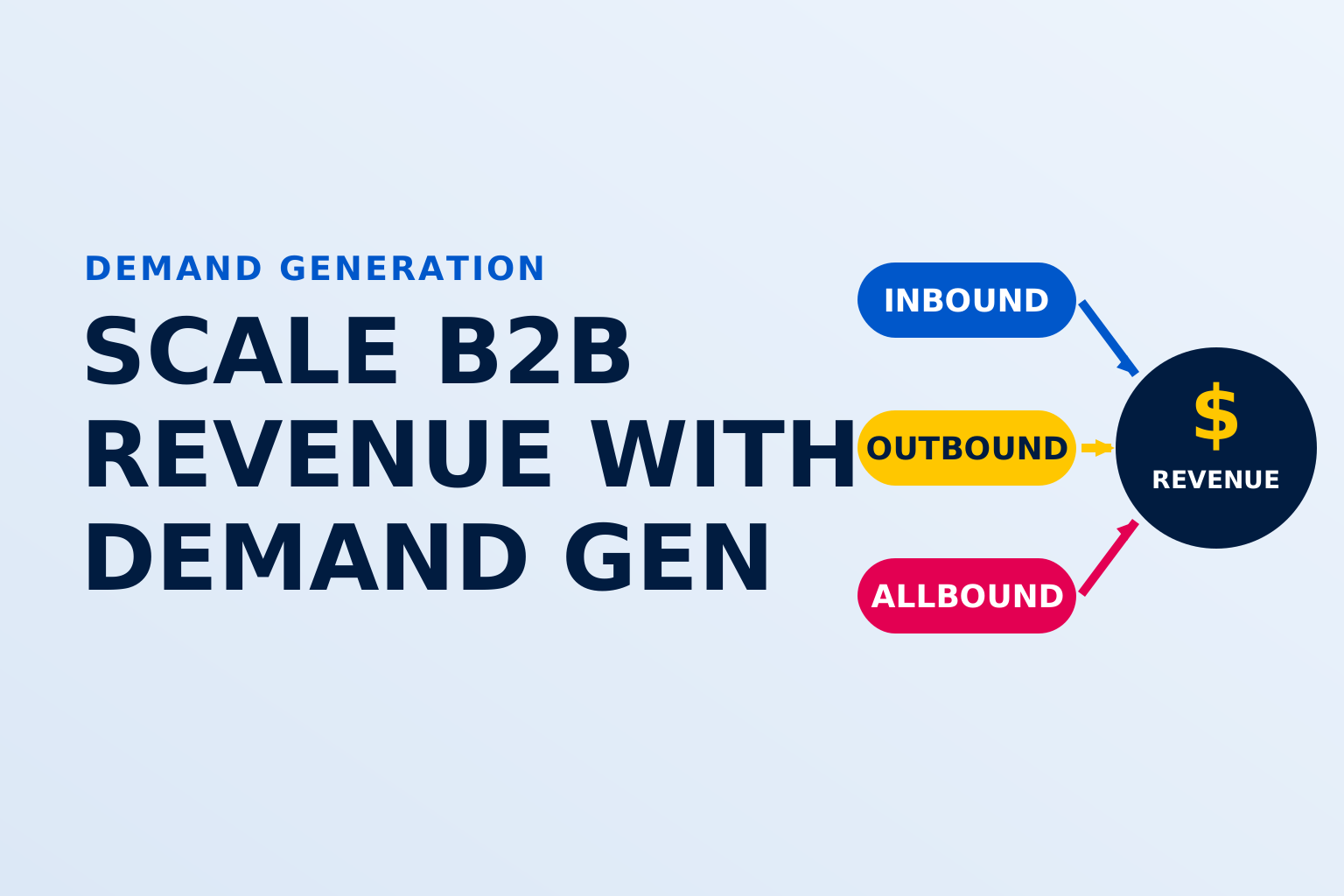
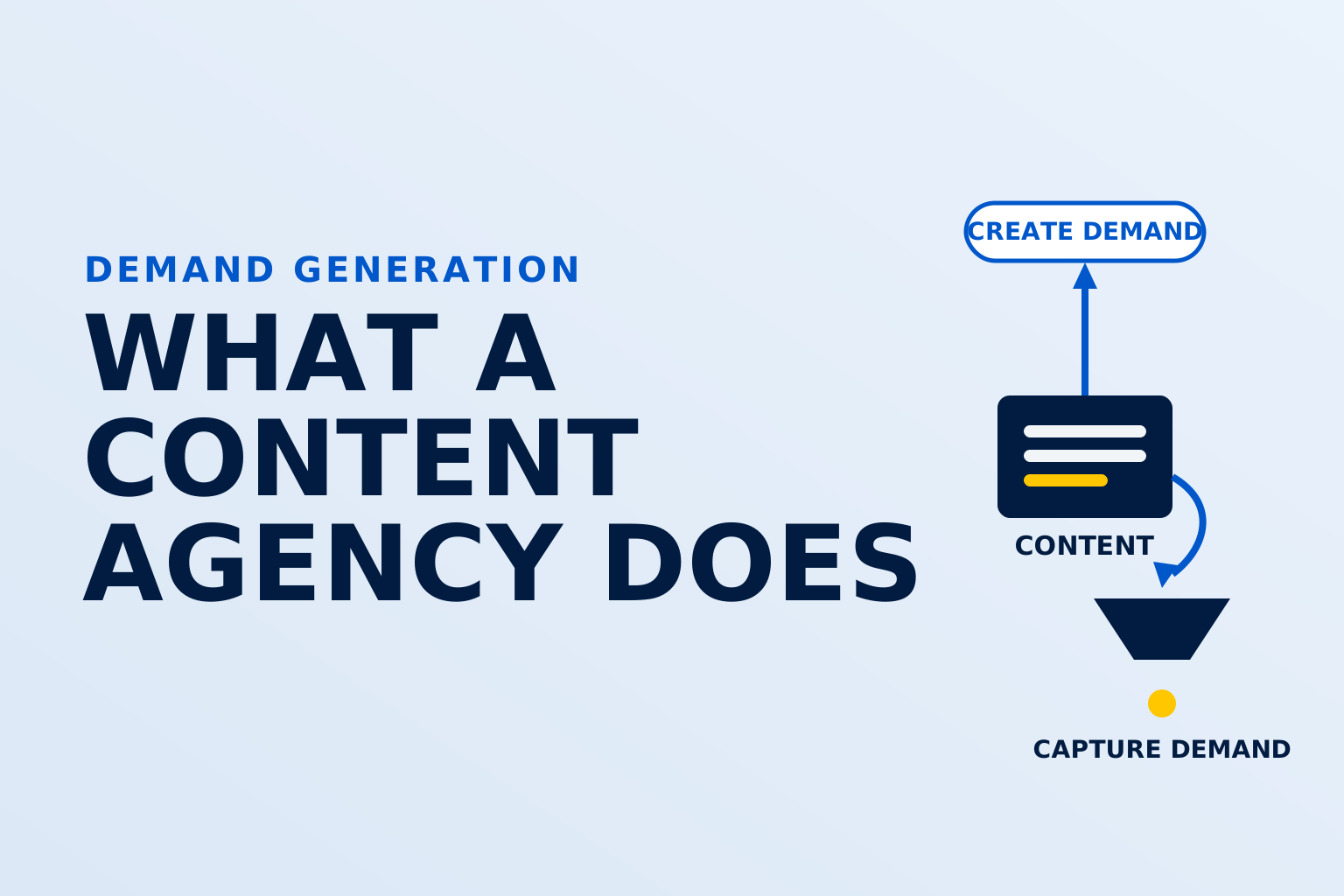
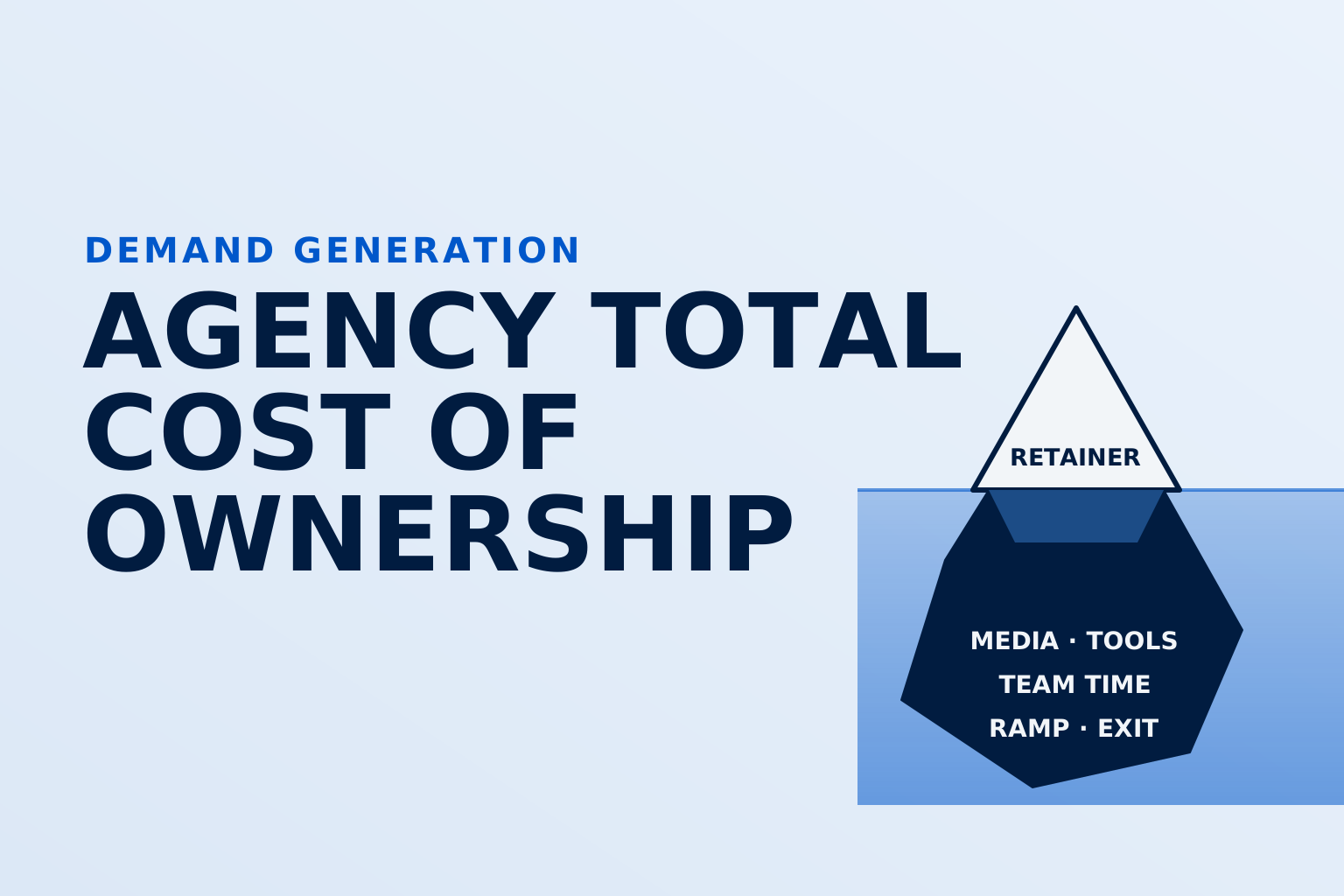
Demand Generation Services: What You Actually Need (and What You Don’t)
Done buying “demand gen” as disconnected services? Let’s build a content-led system that compounds into pipeline.
Book a CallIf you’re a founder or CEO and you Google “demand generation services,” you’ll find the same menu everywhere: paid ads, SDR outreach, SEO retainers, email nurture, webinars, lead magnets. You’ve probably bought some of it already. Maybe it worked for a month. Maybe you got a few meetings. But it didn’t compound, and now you’re back shopping again. Before you shop again, it helps to know when hiring a demand generation agency actually makes sense.
Part of The Complete Guide to B2B Demand Generation Strategy.
That’s the core issue: most “demand gen” is sold as disconnected execution, not a system. Lots of motion (campaigns, standups, dashboards), very little durable momentum. Ads run out of creative fuel. Outbound gets ignored. SEO takes too long to matter. Content gets published, then dies in a folder because it isn’t wired into sales, routing, or follow-up.
Here’s the argument this article will make: demand generation isn’t something you buy as isolated services. It’s a business function built around a core content product: an asset strong enough to power every channel, sales motion, and conversion path.
In the sections ahead, we’ll cover:
What most agencies actually sell (and why it stalls)
What a real, content-led demand engine looks like
How to tell if your current setup is broken
What you actually need if the goal is turning content into pipeline, not just activity
What Most “Demand Generation Services” Really Are (and Why They Stall)
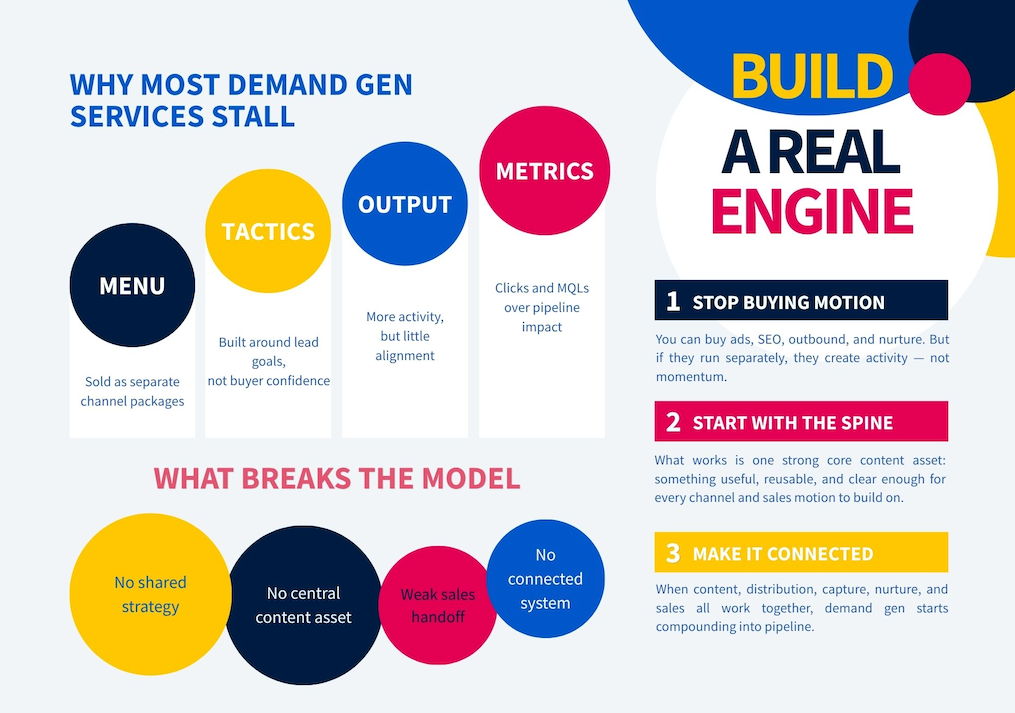
The menu problem: channels instead of systems
Most “demand generation services” are sold like a menu: pick a lane, buy a package, get a monthly report. You’ll see bundles like paid ads/PPC management, SEO retainers, SDR outreach sequences, webinar promotion, lead magnets, and email nurture “programs.” Some of these bundles even blur into adjacent disciplines, which is why it pays to know where a demand generation agency differs from a PR agency.
It feels logical because every channel has obvious deliverables. But the moment you buy them as separate lanes, you’re effectively assembling a stack of vendors with no shared operating model. There’s no central asset, no durable narrative, and no consistent way for each channel to reinforce the others. You get activity, but not a compounding engine. That mirrors the pattern where many B2B teams report “massive amounts of activity, content, and measurement” with little clarity on what actually moves pipeline forward. When the widest lane in that stack is paid media, the pipeline stops the day the budget does, and the vendor question narrows to who can build demand you own. That is the screen behind our list of demand generation agencies for reducing paid ad dependence.
Tactics without a buyer-centered strategy
These programs are often scoped backward from volume targets: “We need 300 MQLs this quarter,” so the plan becomes “gate something,” “drive traffic,” “capture emails,” and “hand leads to sales.”
What gets skipped is the hard part: how your specific buyers actually gain confidence. Not a generic funnel diagram, but real buying triggers, perceived risk, internal politics, implementation fears, and the proof they need to justify a decision. Research on B2B buying consistently shows that prospects do extensive self-directed learning, often consuming double-digit numbers of content pieces and progressing 70–80% of the way through their decision before engaging sales, so shallow, lead-count–driven programs simply miss most of that journey.
The result is marketing that mostly harvests existing intent instead of creating new demand. Pipeline becomes dependent on timing and “low-hanging fruit,” and when that dries up, everyone panics and swaps tactics. That is exactly the “lead gen crisis” many B2B marketers describe when traditional gated-content and cold-outbound motions stop working.
Output without integration or sales alignment
Disconnected execution shows up fast:
Leads get passed to sales with weak signals (a form fill and a job title, not pain, urgency, or timing)
SDRs reach out with generic pitches because they have no useful content to anchor a conversation
Long-form assets get produced, then disappear into a folder that reps don’t trust or can’t find
This breaks because there’s no shared definition of qualified demand, no consistent handoff, and no way to wire content into CRM fields, sequences, or the actual sales conversation. In practice, that’s why sales teams say they rely far more on short, practical assets like case studies and one-pagers than on the white papers and reports marketing favors, and why content created without sales input so often goes unused.
Measurement driven by vanity and channel metrics
Most reporting reinforces the fragmentation: clicks, impressions, pageviews, cost per lead, MQL volume, with each channel “performing” in its own dashboard.
When you don’t measure a unified view of pipeline movement, you can’t see what actually creates opportunities. Budget shifts become reactive (pause ads, change keywords, rewrite sequences) instead of strengthening a core engine that improves over time. Industry benchmarks show this is common: a significant share of B2B teams are still incentivized on MQL volume and campaign-level metrics, even as leaders argue they “have to stop talking about MQLs” and focus on pipeline and revenue impact instead.
Why the model fundamentally can’t scale
Even when these channel plays “work,” they stall because they aren’t powered by a central, reusable asset and system:
Ads without content burn out (creative fatigue, generic landing pages, rising costs)
SDRs without content get ignored (nothing valuable enough to earn attention)
SEO without broader distribution is too slow (waiting on rankings instead of testing narratives across surfaces)
Content without systems doesn’t translate to pipeline (assets aren’t connected to routing, nurture, or sales enablement)
This is exactly the pattern demand-gen research highlights: organizations with mature, governed content operations and integrated systems generate dramatically more qualified leads than those running ad hoc campaigns and channel-specific services. When content is treated as a core product that fuels strategy, distribution, capture, and sales enablement, and is wired into CRM, automation, and attribution, the same effort compounds instead of decaying.
If you’re a founder or CEO, the tell is simple: you’re paying for motion (more posts, more campaigns, more leads) without getting momentum. In contrast, companies that reframe demand generation as an end-to-end, content-led system see lead quality, conversion, and even recurring revenue move together, rather than chasing isolated channel metrics.
What Actually Works: A Content-Led Demand Engine
“Demand generation” works when it stops being a grab bag of channel tasks and becomes a single, connected system. The spine of that system is a core content product, something durable and reusable that every channel, campaign, and sales motion can point back to. When you build that spine first, ads last longer, outbound gets replies, SEO compounds faster, and content finally shows up in pipeline.
Start with a core content product, not random posts
Random posts create noise. A content product creates infrastructure: it teaches buyers, qualifies them, builds trust, and equips sales to move deals forward. In mature programs, it functions more like a product than a campaign asset, anchoring messaging, sales conversations, and even how you’re discovered in search and AI-driven experiences.
Start by choosing one commercial narrative tied to a specific ICP pain and a clear revenue opportunity. Validate it through a mix of keyword demand, what prospects ask on calls, what shows up in communities, and what competitors overclaim (or ignore). This is also where you bring in real buyer behavior and “jobs to be done” research, not just guesswork, so you’re building on how your market actually buys rather than on a funnel diagram alone.
Then build it like a product:
1–2 flagship assets (original research, a definitive guide, a POV series) that can serve as an ownable conversation in your category
Sales-ready derivatives that match how buyers actually consume information: one-pagers, short videos, targeted case studies, calculators, and FAQs that sales reps will consistently use in live deals
This is where compounding starts: every ad, email, webinar, and outbound touch links back into the same “content product,” so you’re deepening understanding, not restarting from zero each week. Teams that treat content this way, with real editorial governance and expert oversight, reliably see more qualified pipeline than those running ad hoc campaigns.
Orchestrated distribution across multiple surfaces
SEO matters, but “publish and pray” is not a strategy. A real engine distributes the same narrative across surfaces buyers already trust, so repetition builds familiarity instead of fatigue. High-performing B2B teams do this deliberately: they plan end-to-end content plays where search, social, email, and events all reinforce a single story rather than competing for attention.
Use a multi-surface plan:
Social: zero-click posts, carousels, short clips that deliver value in-feed and build brand gravity over time
Email: serialized lessons that walk the flagship narrative forward and keep you on the “first call” list when timelines heat up
Communities + events + podcasts + webinars: live moments that generate reusable IP, not one-off performances
Paid amplification: promote core ideas and proof assets, not just “Book a demo,” so paid spend is compounding your authority instead of chasing cheap MQLs
Outbound becomes stronger when it’s not asking for attention but offering an asset. SDRs and AEs should use the same content in sequences, follow-ups, and objection handling so every touchpoint reinforces the same story. When the content and the outreach are aligned, sales teams report higher engagement with case studies, short explainers, and videos than with generic pitch decks or long white papers alone.
Capture and conversion designed around buyer context
Form-fill isn’t intent. Context is intent.
Design capture around signals that predict real conversations:
Timeline
Pain intensity
Urgency
That means your forms, workflows, and routing rules are optimized for buying signals (how soon they plan to act, how severe the problem is, and how actively they’re engaging with deeper content), not just whether someone downloaded a PDF. Modern intent models that factor in behavior (revisits, tool usage, content depth) alongside fit consistently outperform simple lead scoring based on job title and page views.
Then route and nurture based on those signals. Give in-market buyers low-friction paths (clear “talk to us,” pricing, assessments), and let others self-educate without forcing a premature gate. As more of the buying journey moves to self-service, your content has to do the work of guiding buyers through options, trade-offs, and internal consensus-building long before a rep is invited in.
Sales enablement must be built into the engine: content mapped to stages and objections (problem framing, ROI, implementation proof, risk reduction) and reps trained on when to use what, so content isn’t “marketing stuff,” it’s deal equipment. When rep enablement is done this way, short, practical assets like one-pagers, case studies, and targeted videos become some of the most-used tools in active opportunities.
Systems and infrastructure that make content a business function
This is the part most teams skip, and why nothing sticks. To make content produce pipeline consistently, it has to connect to your operating system: CRM, automation, outreach tools, analytics, and attribution. Organizations that treat this as a core capability, not a side project, reliably generate more qualified leads and tighter sales cycles than those relying on disconnected campaigns.
Operationalize it with:
A campaign/content calendar as a control center (persona, stage, asset, channel, owner, activation plan) so every piece of content has a defined job to do in the revenue process
Repeatable playbooks for launches, webinars, and outbound campaigns anchored in the same narrative, not reinvented from scratch for each channel
Measurement that ties to revenue: content-influenced opportunities, deal velocity, win rates, MQL-to-opportunity conversion, and sales utilization, alongside “brand gravity” indicators like branded search, direct traffic, and self-reported attribution
That’s the difference between “content marketing” and a demand engine: you’re not measuring output volume. You’re running a revenue system where content is the decision infrastructure buyers move through. In companies that make this shift, marketing is no longer a campaign service center; it becomes a growth function that shapes the market, supports sales, and compounds over time instead of starting from zero every quarter.
How to Recognize When Your Current “Demand Gen” Isn’t Working
If you’re a founder or CEO, the fastest way to diagnose demand gen is simple: you’re either buying motion (lots of activity) or building momentum (a system that compounds). Most “demand generation services” fail because they’re channel outputs without a unifying engine. For smaller teams that cannot carry that engine in-house, we keep a separate shortlist of demand generation agencies for small and mid-sized businesses. Without that engine, performance resets every month and never matures into the kind of integrated, content-led system that research consistently associates with higher pipeline and revenue growth.
Financial and pipeline red flags
The clearest warning sign is spending more while believing less.
High ad spend, inconsistent pipeline: results spike, then crash. Creative fatigue becomes the default, and “fresh campaigns” are the only fix. If doubling budget doesn’t reliably increase qualified opportunities, you don’t have a demand engine. You have a slot machine. In benchmark studies, teams that treat demand gen as a cohesive system (content, distribution, capture, and infrastructure working together) generate far more qualified opportunities than those relying on ad-hoc channel services alone, even at similar spend levels (example benchmark). If that is where your spend sits, our review of demand generation agencies for rising CAC separates the ones that lower the cost of a customer from the ones that only lower the cost of a lead.
Outbound that doesn’t convert: sequences get ignored, reply rates stay low, and booked meetings tend to depend on discounts or timing luck rather than differentiated value. That usually means your outreach has nothing buyers actually want to engage with. When buyers are already consuming upward of a dozen pieces of content before talking to sales, SDR programs that are not anchored in strong, problem-solving content inevitably underperform buyer behavior data. That is the situation we screened for when we reviewed more than 160 demand generation agencies and kept 14 in our list of demand generation agencies for when cold outbound has stalled.
Content and sales misalignment
If content exists but doesn’t move deals, it’s not demand gen. It’s publishing.
Reps don’t use what marketing makes: they can’t find assets, don’t trust them, or claim “this isn’t what prospects ask for.” Long PDFs and generic ebooks pile up while short, specific, sales-ready assets are missing. Surveys of B2B reps show they overwhelmingly rely on concise case studies and one-pagers, while many of the long-form assets marketing produces are rarely believed to be read by customers at all (sales feedback on content).
No shared view of buyer context: marketing reports personas and MQLs; sales reports objections and deal risk. When content doesn’t map to real stages of the sales process, it can’t create leverage. High-maturity teams document how specific content supports prospecting, mid-funnel education, and proposal support, and then wire that into CRM and automation so sales sees exactly which assets buyers engaged with and why it matters system-level view of content ops.
Data and accountability gaps
Dashboards can look sophisticated while being strategically useless. If you can’t answer, “Which five pieces of content most influenced pipeline last quarter?” you’re tracking activity, not impact. Lead quality disputes are another tell: sales says leads are weak; marketing says volume is high, because nobody agreed on qualification signals like urgency and timing.
When MQL volume becomes the primary success metric, marketing is incentivized to optimize for cheap leads instead of real opportunities, which is exactly how many B2B teams end up in a “lead gen crisis” with bloated lists and low conversion rates lead-gen crisis analysis. In contrast, organizations that instrument content all the way through to opportunities and revenue can show which assets actually shorten cycles or improve win rates, so budget follows what works, not what’s easiest to count (revenue-focused demand systems).
Structural signs of a services mindset
If your plan reads like a vendor list (SEO agency, paid shop, webinar vendor, content studio, SDR firm), you’re optimizing parts, not building a system. You’ll also hear it in your messaging: every campaign tells a slightly different story, and nothing resembles a single evolving content product the whole team can rally around. That vendor list is usually the marketing leader's problem to hold, which is why the 14 agencies in our list of demand generation agencies for CMOs and heads of marketing were kept for running demand as one connected system rather than one more lane to manage.
Structurally, that “menu of services” model mirrors what a lot of B2B marketers now identify as the root of underperformance: fragmented channel execution, no unifying narrative, and content treated as collateral instead of as the central product that powers every touchpoint (system vs. services breakdown). Teams that replace this with a core content platform and full-funnel orchestration, where marketing owns a buyer-led journey and sales is integrated from the start, are the ones reporting stronger “brand gravity,” better-fit inbound demand, and more predictable pipeline over time brand gravity perspective.
What You Actually Need Instead: A System That Turns Content into Pipeline
Treat demand generation as a business function
If you’re a founder or CEO, the problem usually isn’t effort. It’s fragmentation. “Demand gen services” often look like separate retainers (ads, SEO, SDR, email) running in parallel, so you get activity, but not compounding impact. That’s how you end up with lots of MQLs on a dashboard and no one quite sure which work actually moves opportunities forward, a pattern called out repeatedly in recent B2B benchmark work. That specific pattern has its own shortlist: our list of demand generation agencies for teams facing MQL overload reviewed 368 agencies and kept the 14 that fix lead quality rather than add volume.
What you actually need is a cross-functional operating system with one spine running through everything:
Strategy: one validated commercial theme tied to a specific ICP and revenue goal, not a grab bag of campaigns
Content: flagship assets plus reusable, sales-ready pieces that map to real buyer jobs and questions
Distribution: SEO, social, email, events, and outbound powered by the same ideas, so every touch feels like one story instead of channel noise
Capture: clear paths to raise hand, qualification that reflects intent, and crisp handoffs, aligned with how buyers actually prefer to self-educate and then talk to sales
Infrastructure: CRM, automation, and analytics wired to show content → pipeline, so you can see which assets influence opportunities and revenue, not just clicks
Without that, you’ll keep paying for motion instead of momentum, and stay stuck in the “lead gen crisis” where volume goes up while close rates, win rates, and sales trust go down.
Content as a product and revenue lever
Stop treating content like “posts.” Treat it like a product you design, ship, and maintain, complete with a roadmap and refresh cycles. Leading teams now treat signature research, shows, and resource hubs as flagship products that fuel every channel and sales conversation, not as campaign byproducts.
Every asset should have a revenue-facing job: create demand, shape how buyers define the problem, qualify fit, handle objections, or accelerate active deals. That’s also how you measure it: pipeline influence, conversion, sales cycle impact, and sales utilization, not impressions, MQL volume, or a dashboard full of clicks. High-maturity content operations consistently track content to opportunity and revenue and see several‑fold improvements in qualified leads as a result.
This is the missing link behind common failures:
Ads without content fatigue fast because there’s no differentiated idea to sustain performance or build what some marketers now call brand gravity: the pull you need so buyers think of you first when they are ready.
Outbound without content gets ignored because there’s no real value to engage with; frontline sales reps consistently report that what actually helps them are concise, useful assets like case studies and one-pagers, not just more touches.
Content without systems becomes a library sales doesn’t use and buyers never find; it sits in a CMS or drive instead of being wired into automation, routing, sales plays, and post-sale nurture.
When you treat content as a product, you design it to be discoverable, reusable, and trackable across the entire journey, from early education through expansion.
A system built on research and operating discipline
A content-led demand engine starts with research, not brainstorming. Narrow your ICP based on opportunity, urgency, and reachability, then ground messaging in real buyer language and competitive alternatives. That means understanding the actual jobs those buyers are trying to get done (not just the titles you want in your CRM) and building your narrative around those jobs rather than around internal funnel stages.
From there, discipline matters: content is mapped by stage and persona, and every asset ships with a distribution plan and a conversion path. Webinars and events aren’t one-off stunts. They’re extensions of the core narrative and should be designed as enduring demand assets that can be repurposed and reused long after the live date. Inbound and outbound run as one model, so what buyers read and what reps send feels like the same company, and both are supported by infrastructure (CRM, automation, routing rules, and basic attribution) that makes it easy to see which topics, formats, and plays actually accelerate deals.
Teams that make this shift (from “what should we post this month?” to “what system are we operating?”) are the ones that move out of perpetual campaign mode and into compounding, experience-led demand generation.
Aligning with what we actually do (without another menu of services)
Our approach is simple: content is infrastructure for your go-to-market, not a publishing calendar. We build one central narrative, turn it into durable assets, distribute it across multiple surfaces, and connect it to capture, sales follow-up, and measurement. That aligns with how B2B buyers now behave: doing most of their own research across channels, consuming multiple pieces of content before talking to sales, and expecting a coherent experience whether they encounter you via search, social, events, or direct outreach.
The outcome you should aim for: fewer random acts of marketing, more coherence, so pipeline becomes more predictable over time and cost per opportunity falls. Done right, this also tightens the feedback loop between marketing and sales, because both sides can see which content consistently shows up in successful deals and can double down on those assets instead of debating abstract lead quality. Predictability matters most for firms whose new business has always arrived through referrals, and it is the test behind our list of demand generation agencies for referral-dependent companies, which reviewed more than 60 agencies and kept the ones with real proof.
The shift is from: “Which services should we add next?” to “What system makes every asset, channel, and touchpoint work together to create and capture demand?”, and from reporting on volume at the top of a notional funnel to running a content-led engine that is explicitly judged by its impact on qualified opportunities, win rates, and revenue.
Conclusion: You Don’t Need More Services, You Need a System
Most “demand generation services” are really a bundle of channel tactics (ads, SDR outreach, SEO retainers, webinars) run in isolation. That model creates activity, but it rarely compounds. Ads fatigue, outbound gets ignored, SEO moves slowly, and content turns into a library nobody uses in real deals, mirroring the “lead gen crisis” where teams chase MQL volume instead of revenue impact (Marketing Week).
What works is a content-led demand engine: one core content product that underpins distribution, capture, and sales enablement. In practice, content becomes decision infrastructure for buyers and a measurable revenue lever for your team, powering creative, giving outbound a reason to exist, speeding up sales conversations, and creating assets that keep paying you back. High-maturity teams treat this as an end-to-end system (strategy, creation, distribution, and measurement), not a set of disconnected campaigns (MarketingProfs guide, Demand Gen Report benchmarks).
Our philosophy is Content RevOps: treat content as a go-to-market operating system, not output. That means it’s researched, structured, and wired into CRM, automation, and outbound so attention reliably becomes pipeline. In organizations that do this well, content is already the connective tissue across demand gen, sales, and customer marketing. It just needs to be operated like a shared system instead of ad hoc assets (Contently, Content Marketing Institute). We measure success by:
How often content shows up in opportunities, late-stage conversations, and closed revenue
Pipeline influence, deal velocity, and win rates, not publish volume or MQL math
If you’re a founder or CEO shopping for “demand gen services,” the real question isn’t which channels to buy. It’s whether you’re building one durable system where every asset, campaign, and touchpoint is designed to create, capture, and compound demand over time, shifting from fragmented lead-gen execution to a unified, content-led engine that actually moves pipeline (Marketing Week, Content Marketing Institute).
Are your demand gen services creating motion—or momentum?
Turn content into GTM infrastructure: one core narrative, wired into sales and systems, measured by pipeline—not activity.
Frequently Asked Questions
About the Author

Founder & CEO, Content RevOps
Stefan Kalpachev is the founder and CEO of Content RevOps, where he helps B2B SaaS companies transform their content into predictable pipeline. With a background in content marketing and revenue operations, Stefan has developed a unique methodology that bridges the gap between content creation and revenue generation.
Connect on LinkedIn