Demand Generation Examples: How B2B Companies Build Pipeline
Ready to turn demand gen into a repeatable pipeline system? Let’s map your engine.
Book a CallMost “demand generation examples” you’ll find online fall into two buckets: big-budget enterprise stunts, or vague stories about “brand awareness” and “engagement.” Neither helps if you’re a B2B SaaS or services team that needs pipeline this quarter and next.
Part of The Complete Guide to B2B Demand Generation Strategy.
This article takes a different lens. Instead of one-off campaigns, we’ll look at systems: repeatable ways companies align content, distribution, and sales so demand builds over time and outcomes compound. That aligns with how leading B2B teams now define demand generation as an end-to-end engine that attracts, nurtures, and converts buyers, not a string of disconnected campaigns. The goal isn’t more activity. It’s a go-to-market machine where every asset has a job to do: create trust, trigger intent, support conversations, and move opportunities forward.
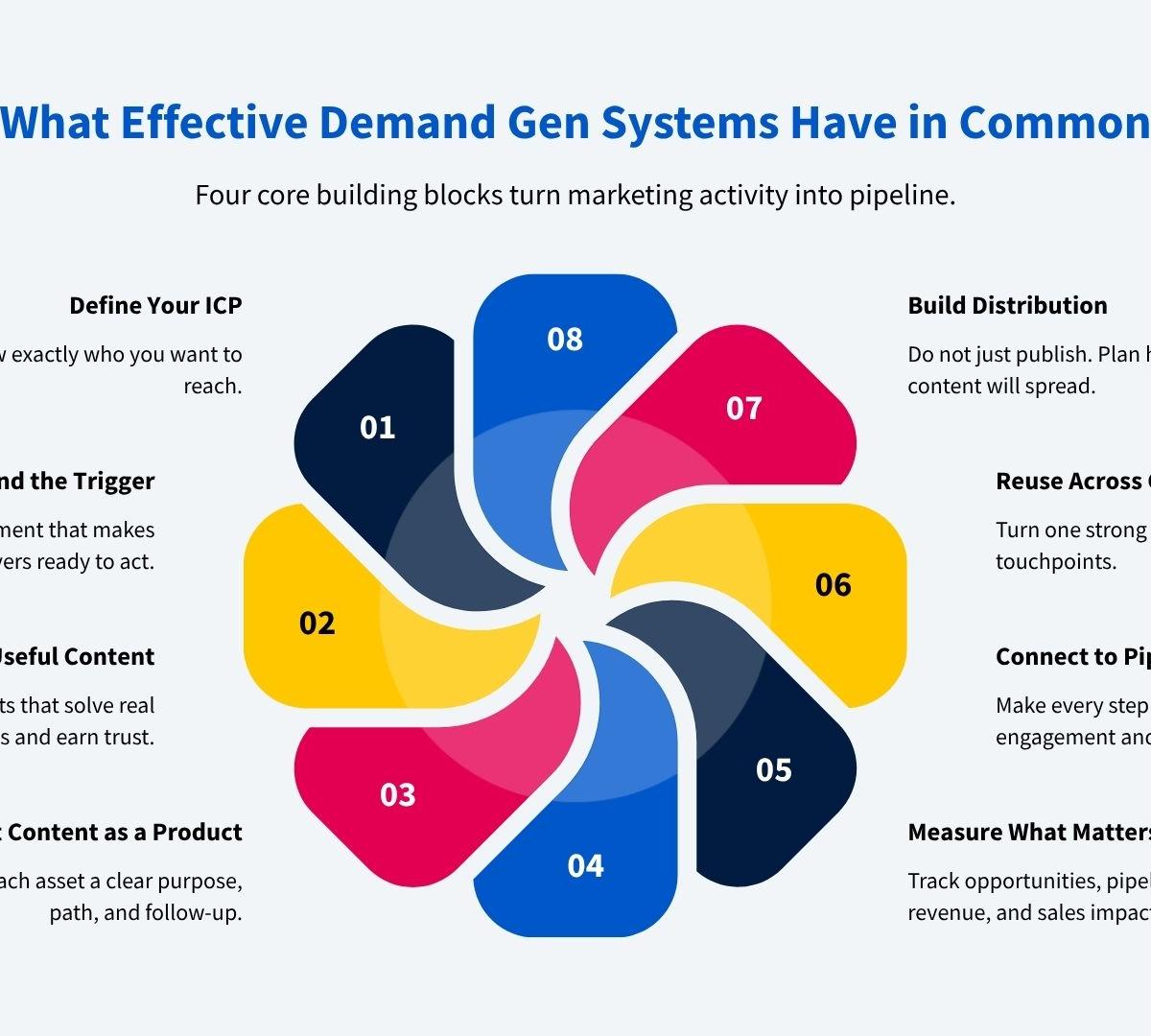
Across the best-performing programs, the same structure shows up again and again:
A clear ICP + trigger moment (who it’s for, and why now), a shift away from static personas toward problem and trigger-based targeting
Content as a product (utility and outcomes, not just posts) that functions as a flagship experience, not random outputs
Always-on distribution (turn one asset into many touchpoints) so content compounds instead of spiking and disappearing
A direct connection to pipeline (conversion paths, handoffs, and follow-up) with sales and marketing operating from a shared revenue system
Next, we’ll walk through practical examples built on that structure, each with what it is, how it runs in real life, how it gets distributed, and how it ties back to revenue. For these same systems traced through named companies with real numbers, see our B2B demand generation case studies.
What All Effective Demand Gen Systems Have in Common
Every demand gen example that actually builds pipeline (not just “marketing activity”) shares four ingredients. Get these right and the tactics become interchangeable.
1) A precise ICP + trigger moment
It’s not enough to know who you sell to. You need to know when they become receptive: what changed that makes your message urgent. Common trigger moments include new funding, a hiring sprint, a tool migration, a missed target, or a new compliance requirement. That kind of problem- and trigger-based insight consistently outperforms demographic-heavy personas in B2B programs, because people buy to get jobs done, not because of who they are on paper. Focus beats broad ICP lists; you can always expand once the system works.
2) Content as a product, not output
High-performing teams don’t “cover topics.” They ship assets designed to deliver a result, like a playbook, toolkit, benchmark report, calculator, or structured learning resource. That utility is what earns attention and trust, and it’s why formats such as research reports, webinars, and in-depth guides sit at the top of the list when marketers rank lead- and demand-driving tactics by effectiveness. Treating these as flagship content products (with their own funnels, follow-up, and sales enablement plans) turns content from a cost center into a pipeline engine.
3) A distribution system, not a publishing schedule
Publishing is not a plan. Effective programs build reuse and sequencing into the work, so one core asset becomes many touchpoints across social, email, communities, sales enablement, and outbound. Teams that do this well operate more like always-on media channels than campaign factories: they orchestrate inbound and outbound around shared assets, repurpose webinars into clips and articles, plug SEO in as a demand-capture layer, and use remarketing and newsletters to keep those ideas in front of the right accounts for months, not days.
4) A direct line to pipeline
Every motion maps to Attract → Engage → Sell → Wow, with clear conversion paths and tight sales handoffs. Measurement follows revenue reality, not vanity metrics:
MQL→SQL rate and opportunity creation
Influenced pipeline/revenue and sales cycle time
When sales and marketing share these outcome metrics and can see which sources and assets influence real opportunities, teams reliably reallocate budget away from “activity” and toward channels and content that prove their impact on pipeline. With this lens, the examples below stop being “campaigns” and become operating systems you can run and scale.
The “Flagship Content Product” Engine
What it is
A flagship content product is a hero asset your ICP would reasonably pay for, offered free, and built around a specific trigger moment (a deadline, a missed target, a new mandate, a tool migration, a funding round). Unlike “more blog posts,” it’s designed to produce an outcome, similar to how research-backed e-books, webinars, or reports consistently outperform lighter content in lead generation and demand programs for B2B teams (study example).
Common formats include:
Annual benchmark report
Implementation playbook
ROI toolkit or calculator
Structured mini-course
Diagnostic assessment
The goal isn’t content volume. It’s to create a single, durable asset that becomes the backbone of a repeatable pipeline system, much like the original research reports and “state of” studies that act as perennial demand engines in many B2B programs (example pattern).
Step 1: Start with a tight ICP and commercial theme
This engine only compounds when you’re narrow. Pick a segment where you have proof you can win and a clear business pain (for example: a specific growth stage, role, or motion). Teams that anchor demand gen in a clearly defined ICP, validated positioning, and real jobs-to-be-done consistently report higher effectiveness and pipeline impact than those that work from broad personas alone (benchmark data).
Validate the theme from multiple angles:
Customer conversations: what they’re stuck on, what they’ve tried, what “good” looks like
Search and community language: how they describe the problem when nobody is selling to them
Alternatives: competitors, DIY workflows, and the “do nothing” option you must replace
Then turn it into a simple purpose statement that guides every decision, like: help X role achieve Y outcome despite Z constraint. That kind of outcome-first lens is what separates content that merely informs from content that actually creates and captures demand demand-gen-first content strategy.
Step 2: Design the flagship as a product (not information)
Structure it like a path, not a pile of insights. A strong flagship usually follows a progression (diagnose → prioritize → execute → measure) and includes built-in utility: templates, checklists, worksheets, or a scoring model. High-performing demand gen teams routinely treat these assets as full “content products” with their own UX, packaging, and embedded next steps, not just long PDFs content-as-product perspective.
Gating also matters:
Keep the core asset ungated to build reach and authority.
Gate companion assets (templates, calculators, advanced walkthroughs) to capture higher intent without throttling distribution.
This “ungated hero, gated sidecars” approach mirrors how mature demand gen programs balance demand creation and demand capture around a central resource system view.
Step 3: Build the system around it (Content RevOps in practice)
Treat the flagship as infrastructure that supports marketing and sales. Surround it with supporting assets mapped to funnel stage and persona:
Pillar/blog chapters that mirror the flagship’s sections
LinkedIn snippets, short videos, and visuals that pull one insight at a time
Sales enablement versions (1-pagers, slides, talk tracks) that standardize the narrative
Operationally, plan briefs, production, and activation in one shared calendar so “content” and “pipeline” don’t live in separate worlds. Organizations that treat content as shared “decision infrastructure” for sales, marketing, and CS see clearer attribution to opportunities and better conversion across stages (alignment examples).
Step 4: Distribution that actually creates pipeline
The flagship wins when it’s everywhere your ICP already pays attention:
SEO: long-tail, high-intent queries with internal links to deeper CTAs
LinkedIn: POV narratives + data snippets + behind-the-scenes credibility
Email: short value-first sequences and newsletter integration (no hard sell)
Outbound: SDR give-first openers that lead with relevance, not a meeting ask
Paid: amplify only after organic resonance proves the message lands
In practice, the most effective programs run this as an always-on flywheel: one hero asset feeding webinars, nurture sequences, social proof, and remarketing, a pattern repeatedly seen in B2B case studies where a single report or guide underpins an entire year’s worth of pipeline plays multi-channel examples.
Step 5: Connect to pipeline and measurement
Make conversion paths explicit:
Ungated content → soft CTA (newsletter, webinar, toolkit)
Toolkit usage → stronger CTA (assessment call, tailored plan)
Track what matters:
Which assets reliably precede MQLs and opportunities
Sales cycle time for buyers who engaged with the flagship vs. those who didn’t
Teams that shift measurement from clicks and downloads to stage progression, sourced pipeline, and revenue influence build far more resilient demand systems measurement shift. The payoff: content becomes shared decision infrastructure that pre-qualifies buyers, shortens cycles, and gives sales a consistent story to win with, exactly how leading demand gen organizations describe their most effective engines research-backed view.
Content-Led Outreach (Instead of “Just Sales”)
The problem with traditional outbound
Traditional outbound is usually built around volume: long sequences, generic personalization tokens, and an immediate ask like “Can we hop on a quick call?” The result is predictable:
Low-quality replies (if any)
Higher spam complaints and deliverability risk
A brand that starts to feel like noise instead of a credible option
It also creates a disconnect with how B2B buyers actually evaluate vendors. Most prospects aren’t ready to talk when you email them, so asking for time up front forces a “no” even when there’s real future fit. Research on the 95–5 rule suggests that only a small minority of a given B2B market is in an active buying cycle at any moment, which makes volume-led, “are you ready now?” outreach structurally inefficient for most categories source.
The demand gen alternative: content-led outreach
Content-led outreach uses a different principle: outreach doesn’t create demand; content does. Outreach simply delivers useful content to the right person at the right moment, so the conversation starts with value, not a request.
This mirrors how effective demand generation programs already operate: content (reports, webinars, tools, case studies) acts as the primary engine that attracts and nurtures prospects toward a buying decision (example systems), while outbound and email serve as distribution, not the “product.”
This approach is especially effective when:
You’re entering a new market and inbound hasn’t ramped yet
You’re reactivating old leads or closed-lost opportunities with net-new insight
You’re running 1:few or 1:1 ABM plays on strategic accounts, where tailored thought leadership and outcome-based narratives are already proven to warm up complex buying groups (panel examples)
Step 1: Tighten your target list and triggers
Content-led outreach breaks when you try to do it at “2,000 accounts” scale. Keep your list sized to your personalization capacity, often 50–200 accounts for 1:few.
Build segments using:
Firmographics: industry, size, region
Technographics: tools in use, hiring patterns
Trigger events: funding, new executive hire, product launch, negative press
Triggers matter because they create a believable reason for relevance now. Teams that lean on job-to-be-done–style triggers and real customer problems, rather than static personas, consistently report clearer messaging and better demand-gen performance (research summary).
Step 2: Pair each segment with a tailored content hook
Your “hook” should feel like it was made for their situation, not your funnel. Strong options include industry-specific versions of a flagship report, role-specific briefs, or micro-diagnostics/calculators. Sector cuts work the same way, which is why we maintain a list of demand generation agencies for construction firms.
Light customization goes a long way:
Reference the trigger or company context
Pull out 1–2 insights tailored to their role’s priorities
In practice, this is how high-performing demand gen teams productize content: they build central assets (research reports, webinars, toolkits) and then spin out targeted versions by segment, role, and stage, instead of shipping one generic PDF to everyone (examples).
Step 3: Write give-first messages that don’t feel like spam
A simple structure works:
Precise relevance tied to a trigger or pattern
Offer the asset and why it’s useful
Soft CTA (feedback, a quick diagnostic if helpful)
Use cold email for depth, LinkedIn DMs for warmer context, and follow up with another related asset (not a generic “bumping this”).
This “asset-first” motion aligns with what email and nurture data already show: sequences that deliver educational content, case studies, or webinars before a sales ask outperform pure promotional blasts on both engagement and lead quality (channel performance data). It also matches how content and demand gen teams are advised to support sales: by fueling conversations with relevant stories, proof, and how-tos rather than one-sheet pitches (content-as-fuel framing).
Step 4: Orchestrate with marketing + sales (Content RevOps lens)
This only compounds when it’s operationalized. Align on success metrics (reply rate and reply quality, meetings, opportunities created) and track which content was sent, opened, and clicked in your CRM, so sales can follow up with content-backed talk tracks, not generic pitches.
Teams that treat content, outbound, and sales enablement as one connected system, rather than separate functions, report stronger pipeline impact across almost every tactic, especially when they validate positioning and messaging with real buyers and integrate field, ABM, and SDR motions around shared plays demand gen effectiveness data; ABM + demand gen examples).
Step 5: Impact on pipeline
When teams execute this well, they typically see:
Higher reply and meeting rates with fewer touches
Warmer first calls (prospects already understand your POV)
Shorter time from first touch to qualified opportunity
Those patterns show up repeatedly in case studies where content-led outreach (whether via email nurtures, webinars, or ABM content) replaces pure volume-based prospecting representative examples. At that point, outbound stops being “sales activity” and becomes a real part of the demand gen system because the content is doing the heavy lifting.
Webinar-Led Demand Generation Systems
Why most webinars underperform
Most B2B webinars fail for a simple reason: they’re treated like isolated events with one success metric (registrations). Teams pick broad topics to “appeal to everyone,” lean too hard into product, then send the same generic follow-up to every attendee (or worse, no follow-up at all). The result is predictable: a short spike of attention, little pipeline movement, and nothing that compounds.
This pattern mirrors broader demand gen issues where content is optimized for clicks and sign-ups instead of SQLs and revenue impact, even though only a small slice of the market is in an active buying cycle at any given time.
Common failure modes:
Broad, fuzzy topic → low intent and weak sales relevance
Pitch-heavy agenda → drop-off, low trust, few real conversations
No segmentation or fast follow-up → leads go cold immediately
Reframing webinars as a system (not an event)
High-performing teams treat webinars as part of their content infrastructure. A webinar should extend a core narrative (often tied to a flagship asset), generate new raw material (questions, objections, real examples), and feed multiple channels for months. In other words: the webinar isn’t the asset. The system around it is.
This reflects how leading demand gen programs use content as a productized experience that attracts, nurtures, and converts, rather than as sporadic campaigns.
Step 1: Choose a sharp topic and ICP
Start with one specific ICP and one specific constraint or job-to-be-done. The sharper the promise, the easier it is to attract the right accounts and create a clean handoff to sales. Research on effective demand gen consistently shows that problem-, job-, and trigger-based targeting outperforms persona-only approaches for moving real opportunities forward.
To increase credibility and reach, co-create with:
Customers or partners who look like your ICP (built-in trust + distribution)
Internal SMEs who can speak the buyer’s language (not feature tours)
Done well, this overlaps with true thought leadership: distinct points of view, original frameworks, and real-world context that help buyers navigate complexity, rather than generic best practices.
Keep the value exchange clear: 80% education, 20% solution context. Teams that bias heavily toward education see webinars function as mid-funnel accelerators, much like modern virtual events that now rival in-person experiences in importance.
Step 2: Standardize the operational setup
Treat each webinar like a small product launch. Standardization is what makes it repeatable.
Build a simple “webinar kit”:
Master brief (ICP, trigger moment, promise, angle, funnel role)
Landing page with friction-light registration
Automated confirmations, calendar holds, reminders, and post-event sequences
Promotion creatives for email, LinkedIn, and partner sharing
This kind of systematization mirrors how mature demand gen teams operationalize content launches and nurture programs, using consistent workflows, briefs, and automation so each execution compounds instead of starting from scratch.
Slot it into your content calendar based on what it will produce and what it will extend. Treat the webinar as a core node in a broader demand engine, alongside other flagship assets like reports, e-books, or research-driven content.
Step 3: Build the promotion and attendance system
Webinars work best with a mix of owned distribution and targeted invitations:
Email segmented by ICP, stage, and past behavior
LinkedIn posts from the host, brand page, and sales team members
Outbound invites from SDRs as a value-first hook (especially for target accounts)
Optional paid amplification only after a topic proves it converts
High-performing programs orchestrate inbound and outbound around these assets, using channels like organic SEO, social, and ABM plays to keep webinar content in front of the right accounts over time, not just during the live push.
Step 4: Post-webinar pipeline workflows
Pipeline is won or lost in the 24–48 hours after the live session.
Operationalize:
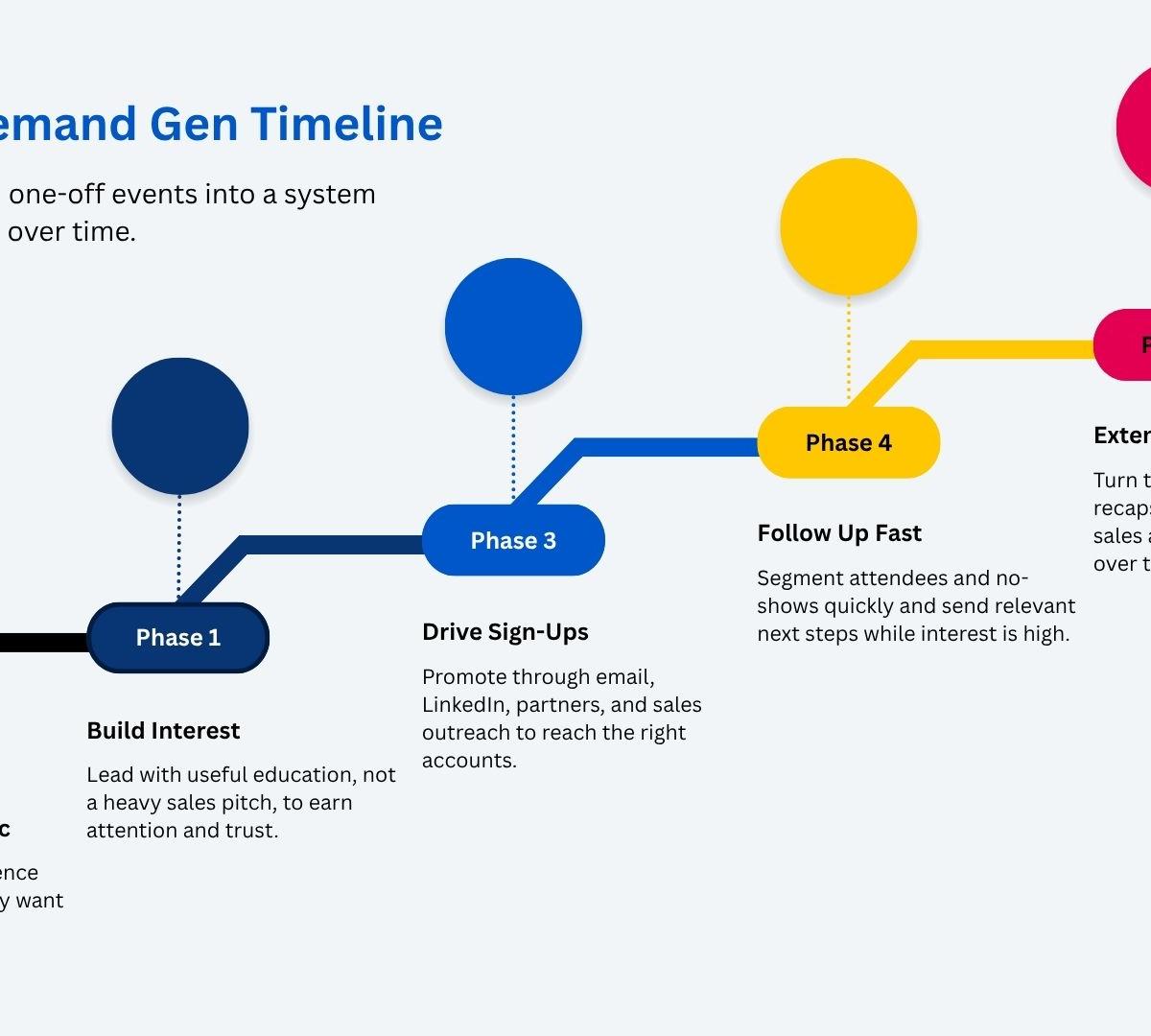
Segment attendees vs. no-shows and tailor follow-ups (recording + relevant next step)
Send sales an engagement view (polls, questions asked, watch time) for prioritized outreach
Repurpose into clips, a recap post, an email mini-series, and sales enablement snippets
Modern webinar and virtual event strategies increasingly treat the recording as a persistent asset: on-demand lead magnet, nurture content, and sales collateral that can be rediscovered via search, email, and remarketing long after the live date.
Step 5: How this actually builds pipeline
A webinar system drives pipeline in multiple ways:
Net-new leads from ICP-fit registrations
Influenced pipeline where education accelerates confidence and internal consensus
Re-engagement of stalled deals through low-pressure, high-value touchpoints
Over time, a webinar library becomes decision infrastructure that helps buyers self-educate and self-qualify before sales ever enters the conversation
In practice, teams that put webinars “center-stage” in their demand mix (and integrate them with always-on content, intent data, and sales enablement) see them evolve from one-off events into a repeatable, measurable engine for opportunity creation and deal velocity.
SEO and Always-On Distribution as the Demand Gen Backbone
SEO as capture, not the strategy
SEO doesn’t create demand. It captures people who are already feeling a problem, researching options, or trying to justify a change. In a real demand gen system, search is the layer that reliably converts existing intent into engaged buyers, especially when it gives a permanent “home” to your flagship assets, webinar recaps, and comparison-level guidance. That aligns with how most B2B teams now use organic SEO as a demand capture layer alongside content and paid channels, rather than as the entire strategy.
The difference is simple: SEO works best when every page is designed to move someone deeper into your ecosystem, not just rank and bounce. Treat it as the “capture” part of a broader create → capture → nurture system, not the whole machine.
Step 1: Map topics to real buying behavior
Treat keyword research like audience research. You’re not just collecting terms. You’re modeling how buyers think when they’re stuck, curious, or ready to switch. This mirrors research showing that high-intent, problem-led and “software/tools” queries are where SEO most directly connects to pipeline, not just traffic.
Key buckets to map:
Symptom/problem searches (early intent): “how to fix…,” “why is…,” “best way to…”
Evaluation searches (mid intent): “tools for…,” “alternatives,” “vs,” “reviews”
Decision searches (late intent): “pricing,” “implementation,” “security,” “ROI”
Then build a simple topical map:
P1 topics: high business value + winnable competition, often lower-volume but higher-intent phrases that drive real opportunities
P2 topics: supporting answers that strengthen the cluster and internal linking
Step 2: Design pages as part of a journey
For each intent cluster, create one deep, differentiated page that actually solves the problem, then use internal links to guide the next step: tools, templates, webinars, and related pages. Think “page for every meaningful query,” with one page mapped to one primary intent, instead of generic catch-alls.
Match CTAs to intent. Not everyone is ready for “Book a demo.” Use contextual offers like:
toolkit/checklist for problem-aware visitors
assessment/diagnostic for evaluation-stage visitors
implementation plan or ROI model for decision-stage visitors
Critically, connect it to your CRM: track visits, score fit + behavior, and trigger the right nurture or outreach based on what they consumed. Teams that wire SEO content into behavior-based scoring and life cycle journeys consistently see stronger MQL → SQL progression than those treating it as a standalone channel.
Step 3: Layer always-on distribution over SEO
Don’t publish and pray. Treat every high-value page as a distribution asset:
LinkedIn (founder + team POV and insights)
newsletter + segmented nurture
sales enablement links inside outbound sequences
communities where your ICP already asks questions (with real participation)
Repurpose one core piece into 10–20 derivatives (snippets, carousels, short videos, frameworks) to keep the message showing up without creating from scratch. The teams that win here run always-on content promotion and remarketing around their key assets instead of one-and-done launches, so every important page keeps compounding reach over time.
Step 4: What this does for pipeline
This backbone supports every other demand gen motion:
captures the in-market minority efficiently (the 3–5% actively buying at any time)
warms the out-of-market majority long before they raise their hand with educational, non-gated assets
increases touchpoints per account without adding net-new content every week
Over time, content becomes infrastructure: persistent proof and guidance that marketing and sales both use to open, advance, and close deals. In mature systems, blog posts, comparison pages, webinars, and research reports are built and measured as a single demand engine that turns SEO traffic and distribution into pipeline, not just visits.
From One-Off Tactics to a Pipeline Operating System
The common thread across these demand generation examples is that none of them work well in isolation. A flagship asset without distribution becomes a PDF no one reads. Outreach without something genuinely useful becomes noise. Webinars without follow-up become “events.” SEO without a conversion path becomes traffic that never turns into revenue.
They compound when they share the same foundation:
One clear commercial narrative (a differentiated point of view buyers recognize as true, and that has been validated with customers rather than invented internally in a vacuum)
A consistent ICP + trigger set (so every touchpoint feels relevant and reflects the “jobs to be done” and buying triggers that research shows matter more than personas)
Shared infrastructure for distribution, data, and sales alignment (so handoffs and follow-up don’t break, and you can see full-funnel impact rather than channel silos)
That’s the reframe: demand generation isn’t “more campaigns,” “more channels,” or “more content volume.” It’s a system that creates something worth consuming, puts it in front of buyers where they actually pay attention, and connects every interaction back to pipeline (reply quality, MQL→SQL, influenced opportunities), not just surface metrics. Teams that make this shift consistently report stronger performance on pipeline and revenue impact than those optimized for clicks and MQL volume alone.
This is also how we treat content: as infrastructure and decision support. Built around one validated theme, designed as reusable products, orchestrated across inbound, events, nurture, and outbound, and held accountable to pipeline quality. In practice, that means thinking less about one-off assets and more about connected experiences (flagship resources, virtual events, and always-on education) that mirror how buyers actually move through a long, non-linear journey.
If your demand gen feels scattered, the fix isn’t a new channel. It’s a different operating model: one where positioning, content, distribution, and sales motions are designed as a single demand system rather than separate initiatives.
Is your demand gen compounding—or resetting every quarter?
Build Content RevOps infrastructure that ties content, distribution, and sales directly to pipeline.
Frequently Asked Questions
About the Author

Founder & CEO, Content RevOps
Stefan Kalpachev is the founder and CEO of Content RevOps, where he helps B2B SaaS companies transform their content into predictable pipeline. With a background in content marketing and revenue operations, Stefan has developed a unique methodology that bridges the gap between content creation and revenue generation.
Connect on LinkedIn