Content Strategy vs Content Marketing: What Is The Difference?
Ready to stop “doing content” and start building pipeline infrastructure? Let’s map your Content RevOps system.
Book a CallIf you’re like most teams, you’re already “doing content marketing.” You post on LinkedIn, publish blog posts, send newsletters, run webinars, and share customer stories. The calendar looks full. The activity feels productive. But when someone asks, “What revenue did this create?” the answer gets vague fast—because the work wasn’t built to connect to pipeline in the first place.
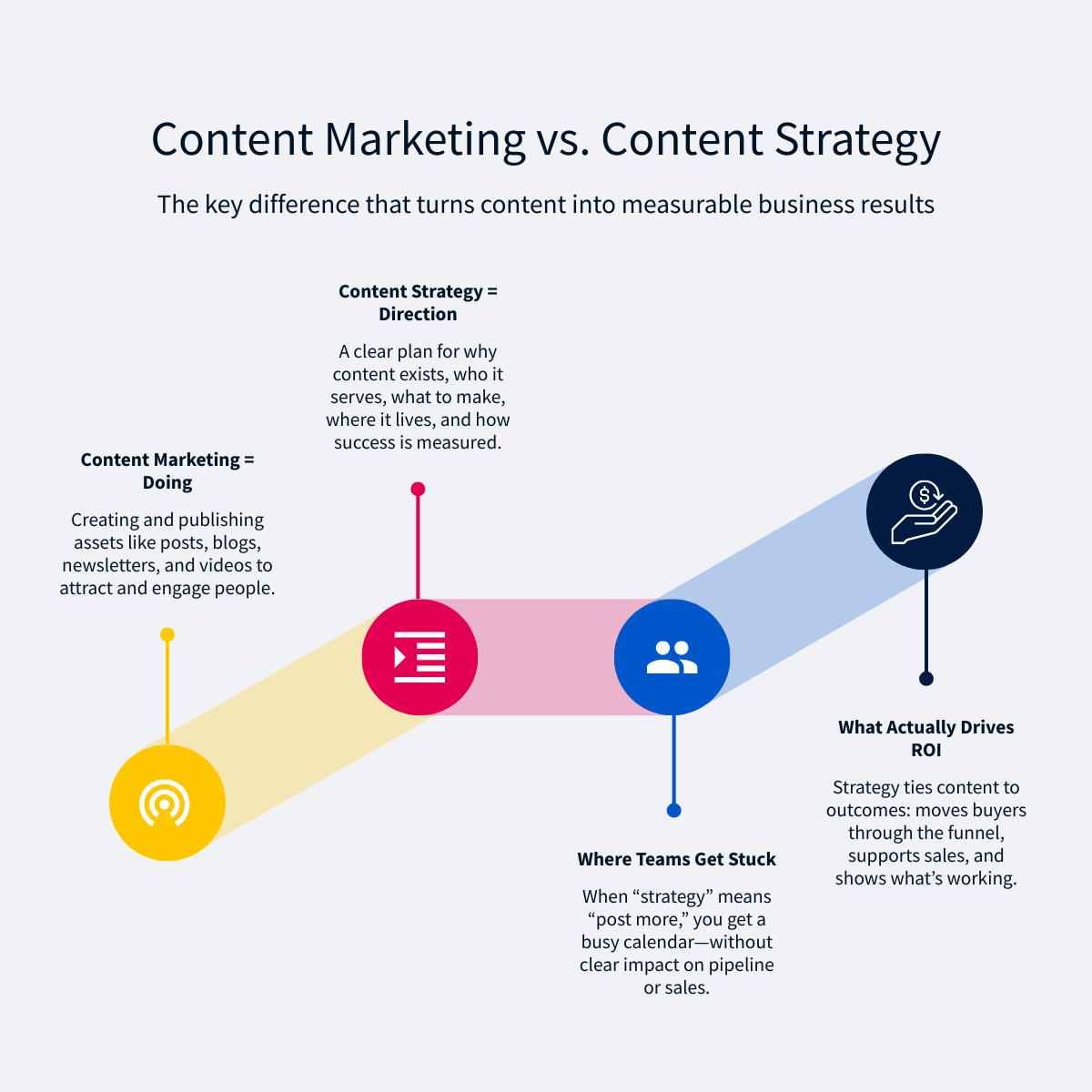
That’s where the confusion starts: people use content marketing and content strategy as if they’re the same thing. They’re not. Content marketing is the execution—assets, channels, campaigns, and promotion. Content strategy is the operating system that governs how content gets researched, prioritized, produced, distributed, and measured as a business function—more like RevOps or Sales Ops than a creative side project.
This article draws a hard line between the two and shows how strategy turns content into infrastructure that captures demand, supports sales, and compounds over time.
Content marketing = the engine turning (output and distribution)
Content strategy = the blueprint, fuel system, and dashboard (alignment and accountability)
Without strategy, you’re mostly just burning gas.
Definitions: What People Mean vs. What Actually Matters
The simple definitions
Content marketing is the set of activities involved in creating, publishing, and distributing content to attract and engage an audience. It’s what most teams do day to day: blog posts, LinkedIn updates, newsletters, videos, webinars, case studies, ebooks, podcasts. In most organizations, that looks like an ongoing stream of assets designed to keep channels “active,” not necessarily a system that’s tied to business outcomes.
Content strategy is the operating model that decides why content exists, who it serves, what gets made, where it lives, how it gets produced and distributed, and how it will drive revenue. It includes research, planning, governance, prioritization, workflows, measurement, and continuous improvement—more like running a product or revenue function than a campaign calendar. Teams with a documented strategy are consistently more effective than those without one, even though most marketers still operate without one.
A practical way to remember the difference:
Content marketing = execution
Content strategy = the system that makes execution accountable, repeatable, and revenue-linked
That distinction mirrors how mature teams treat content as a business function with clear goals, owners, and processes rather than a loose collection of creative tasks.
How the confusion shows up in real teams
When teams say “we need a content strategy,” they often mean “we need to post more consistently.” So they build a calendar, but it’s organized by format (blog, webinar, social) rather than buyer problems, journey stages, or revenue outcomes. That’s exactly how you end up with a lot of content but little to show for it in pipeline or sales.
That’s how you get common failure patterns:
Founders and teams becoming the default topic (updates, culture, promotions) instead of solving buyer jobs-to-be-done
Freelancers hired to “fill the blog” with SEO articles that never show up in sales calls, pipeline reports, or deal acceleration
Distribution treated as an afterthought (“we’ll share it after it’s published”) instead of designed into creation
You also see it in org charts: content is scattered across product marketing, social, and PR with no single owner, so outputs multiply while strategy, standards, and measurement stay fuzzy.
Why this matters for ROI
Without a clear distinction, content becomes activity without accountability. You can’t justify budgets, you can’t prioritize tradeoffs, and you can’t measure success beyond vanity metrics like traffic, impressions, or likes. Studies of B2B teams regularly show that large percentages of marketing content are never used by sales at all, and most thought leadership is rated as low value by the executives it targets.
Strategy changes the measurement conversation by instrumenting content like a revenue function, not a creative output:
tie content to funnel movement (conversion rate, velocity, pipeline influence)
manage a portfolio (what to create, refresh, consolidate, or retire)
align teams on one plan, not scattered “random acts of content”
In practice, that looks less like “keeping the blog busy” and more like running an always-on content system with documented goals, defined buyer journeys, and clear ownership—much closer to how high-performing teams run RevOps than how most teams “do content.”
Body 2 – Doing Content Marketing: Activity Without an Operating System
2.1 The telltale signs you’re just “doing content”
“Doing content marketing” often looks busy from the outside: posts going out, a blog filling up, a newsletter shipping. But the motion isn’t connected to the business.
Common signals:
No clear goals tied to revenue: success means “posting consistently” or “growing followers,” not pipeline created, deal velocity improved, or expansion supported. In one study, nearly half of marketers admitted budget and time—rather than strategy—drive content decisions, which is why most teams struggle to tie content to ROI.
Founder- or team-centric content: announcements, culture updates, behind-the-scenes, and promos dominate—while buyer pain, objections, and decision confidence get little airtime. Despite the fact that almost 90% of business buyers say online content influences vendor selection, fewer than 10% actually trust vendors’ content—exactly what happens when content centers the company instead of the customer.
Format-first planning: the calendar is built around outputs (“2 blogs + 3 LinkedIn posts + 1 newsletter”) rather than a buyer journey, topic portfolio, or intent pathway. This “activity over intent” approach is why so much content gets produced but never used by sales or customer success.
Siloed, reactive production: sales enablement, product marketing, demand gen, and the founder all ship their own assets with minimal coordination—so messaging drifts and work gets duplicated. Surveys of marketing leaders routinely find that fewer than half have a documented content strategy to orchestrate these efforts across teams.
The result is a feed that looks active but doesn’t reliably move deals forward—and a content operation that feels like a request queue rather than a growth lever.
2.2 The impact on quality, consistency, and measurement
When content is driven by cadence and last-minute requests, quality becomes generic. Under time pressure, teams publish broad advice that could come from any competitor, with a voice and point of view that changes by channel or writer. Industry audits regularly show that only a tiny fraction of content—often 5% or less—drives the vast majority of engagement, which means most of that rushed output is effectively invisible. Avoiding that starts earlier than the calendar, at how you pick topics that are not already saturated.
Measurement gets murky, too. Teams can report views, likes, and downloads, but can’t answer the questions that matter:
Which assets are actually creating qualified demand?
Which topics support sales conversations and reduce objections?
Which channels consistently advance opportunities instead of just generating attention?
That confusion is reflected in research where marketers say content is one of their most effective lead-gen tools, yet the majority still rate their ability to measure content ROI as poor. Long sales cycles and patchy attribution make it easy to conclude “content doesn’t work,” when the real issue is that content was never instrumented to work—there is no shared goal architecture that connects consumption, leads, revenue, and retention.
2.3 Why this is an operating model problem, not a creativity problem
Most teams don’t lack ideas, talent, or effort. They lack a system.
Without a strategy acting as an operating system:
priorities and tradeoffs stay implicit (and change weekly)
nothing governs what gets created, refreshed, reused, or retired
content stays a cost center—nice to have, easy to cut—because it can’t prove it’s doing revenue work
This is the gap between doing content and running content as a business function. High-performing teams increasingly treat content like a product with its own roadmap, OKRs, and operating cadence, rather than a stream of assets to fill channels. That shift—from campaign thinking to an always-on content system tied to buyer value and revenue—is what turns content from overhead into infrastructure.
In other words: you’re not failing at content. You’re running content without operations.
Body 3 – Content Strategy: Running Content Like a Revenue Function
A real content strategy doesn’t start with “we need to post more.” It starts with an operating model: a shared way to plan, build, distribute, and evaluate content so it reliably does revenue work. Think RevOps: clear definitions, documented decisions, cross-functional inputs, and tight feedback loops, rather than the reactive, campaign-first pattern most teams still default to.
3.1 Research-first: finding content–market fit
Strategy begins by understanding what buyers are actually trying to get done, not just who they “are.” That means going beyond personas into jobs-to-be-done and decision roles (champion, evaluator, approver), and grounding that in structured research rather than internal opinions.
Practical inputs that surface high-leverage topics:
Buyer and customer interviews (what success looks like, what slows decisions)
Win/loss notes (what objections showed up, what proof was missing)
Support tickets and call transcripts (recurring confusion and “how do I…” friction)
Social and community listening (language buyers use, misconceptions, benchmarks)
Teams that skip this and jump straight to production tend to mirror the pattern where 60–90% of marketing-created content is never used by sales or customer success and fewer than 40% of enterprises even have a documented buyer journey to align content to. From there, map the buying journey to discovery intent—early informational, mid commercial, late transactional—so you can build content pathways that move people forward instead of publishing isolated one-offs. Finally, audit your existing library for coverage, depth, freshness, and performance, then run competitor gap analysis to spot where you can build authority rather than echo the same takes. That audit is faster than most teams expect, and a week of collecting competitor data is usually enough to replace the guesswork.
3.2 Treating content as a product, not a stream of posts
Strategic teams define “content products,” not just deliverables: playbooks, guides, libraries, comparison pages, onboarding hubs, tools. Each is designed for a specific job—educate, qualify, handle objections, or accelerate onboarding—with an intentional UX (navigation, format mix, accessibility, and a clear handoff into sales or nurture). Done well, these assets function like a product line with its own strategy and go-to-market, instead of ad hoc collateral.
They also design modularly from day one: pillar assets that can be reused as clusters, snippets, decks, email sequences, and sales follow-ups—without diluting quality. That modular approach mirrors how high-performing teams treat content as a portfolio of assets with planned reuse, rather than a series of one-and-done campaigns.
3.3 Portfolio, tiers, and channels by design
Strategy creates a tiered portfolio: keystone assets that anchor core themes, supporting pieces for SEO/social/enablement, and time-bound campaign content that points back to long-lived assets. Distribution is baked in, with channel-fit decisions across owned, earned, paid, and shared—plus emerging discovery surfaces like AI summaries and aggregators, which now function as their own “search layer” and require deliberate optimization.
Rather than filling every channel with the same campaign creative, mature teams borrow from publisher playbooks: they define a clear topic architecture, segment audiences, and choose formats and platforms based on the job each channel plays in the journey. That’s how they avoid the trap of tripling content volume with no corresponding lift in engagement or pipeline.
3.4 Measurement as revenue instrumentation
Instead of celebrating views, strategy instruments the funnel: qualified traffic and right-fit subscribers, MQL→SQL conversion, sales cycle length, win rate, and expansion. The goal is “content observability”—knowing which assets move deals, which are decaying, and where content debt is building—so you can refresh, consolidate, or retire content on a regular cadence.
That observability rests on a simple goal architecture: measure not just consumption, but lead behavior, sales impact, and retention, and review those signals in an ongoing operating rhythm rather than in annual retros. When content is managed this way—more like a system with OKRs and cadence than a calendar of posts—it behaves like a true revenue function, not just a marketing activity.
4 – The Mindset and Org Shift: From Random Acts to a Content Operating System
“Doing content marketing” is shipping assets. A content strategy is the operating model that decides why each asset exists, where it lives in the buyer journey, who owns it, and how it proves value. The shift is less creative than most teams expect: it’s governance, process, and accountability—run with the same discipline you’d apply to RevOps or Sales Ops, and treated as a business function rather than a stream of posts or campaigns.
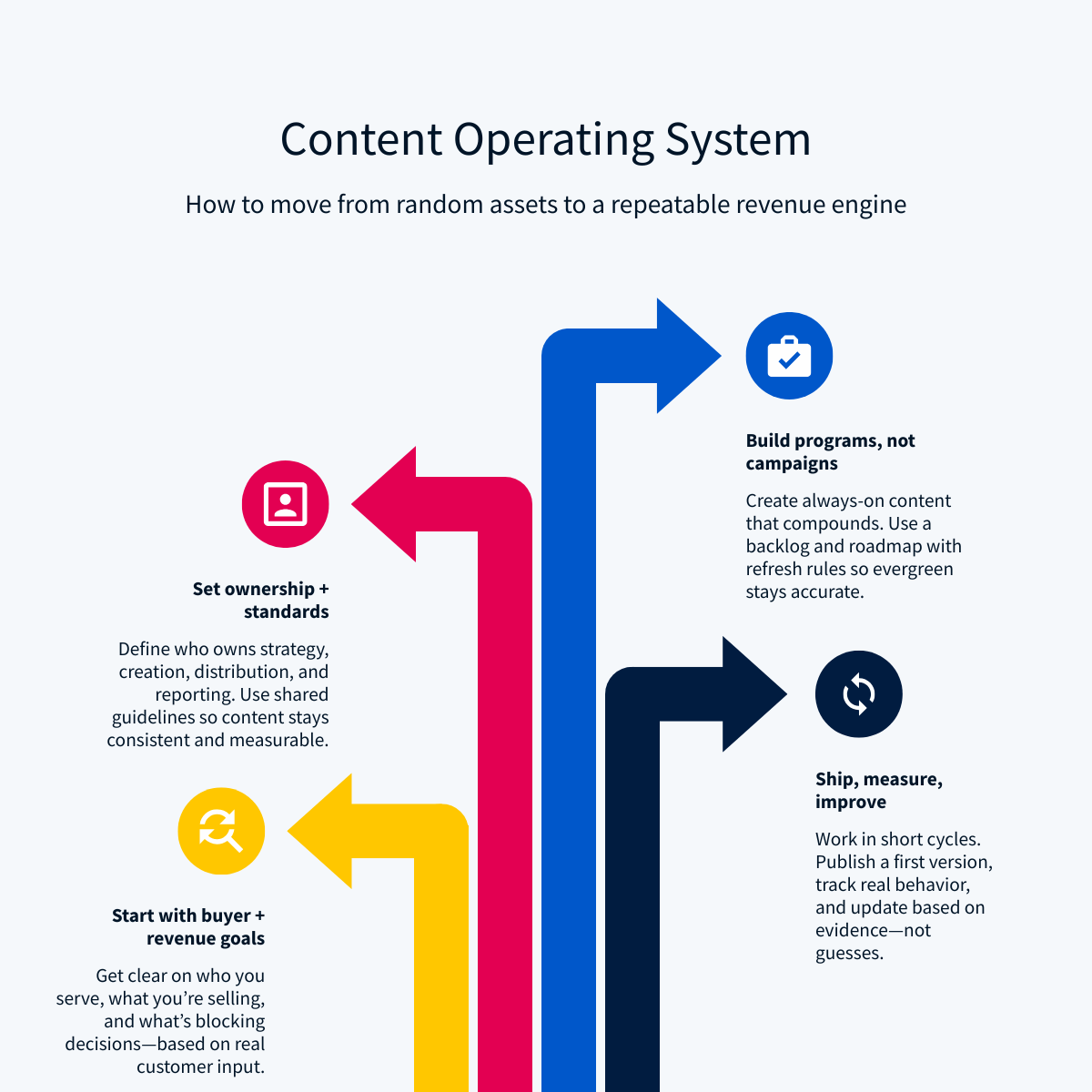
4.1 From campaigns to programs
One-off campaigns feel productive, but they reset momentum every quarter. Strategy builds always-on programs that compound—like an evolving category knowledge base that supports inbound discovery, outbound follow-up, and customer success in one system. Brands that make this shift consistently report higher-quality leads and better conversion, because content is designed as infrastructure, not one-off promotion.
To make that work, you need a content backlog and roadmap, not just a calendar:
A prioritized queue tied to revenue goals and buyer blockers, grounded in real customer research rather than internal opinions
Milestones, versions, and refresh cycles (plus clear “deprecation” rules) so evergreen assets stay accurate and valuable instead of turning into content debt
A portfolio view: evergreen pillars first, supporting assets second, promos last—mirroring how top-performing content operations treat “hero” stories and customer proof as core products, not side projects
4.2 Cross-functional planning and governance
Content becomes accountable when planning is shared. Put demand gen, product marketing, sales, and content in the same forum and start with one question: What are we selling, to whom, and what’s stopping them from buying? Then map the content required by stage, channel, and decision role—so assets exist to support marketing, sales, and customer success, not just awareness.
Governance is the difference between “busy” and “scalable”:
Clear ownership for strategy, production, distribution, and analytics, ideally with an executive owner for content so it doesn’t get reduced to a request queue
Documented standards: voice, topics, quality bar, and approvals, so you avoid the inconsistency that kills trust and makes measurement almost impossible
A shared taxonomy so teams don’t duplicate work or compete for attention—and so your library can be audited, pruned, and optimized as a real asset base
4.3 Agile operations and adaptability
Strategy isn’t rigid; it’s instrumented. Run content in sprints: ship “minimum viable” assets, measure real behavior, and iterate. High-performing teams treat this like agile product development: they watch how topics, formats, and search behavior evolve, and adjust roadmaps based on evidence instead of gut feel.
Normalize experiments in format, topics, gating, and channels—without turning your plan into trend-chasing. Topical pieces should plug into long-term themes and strengthen existing evergreen assets, and success should be defined in terms of movement across the journey (consumption, engagement, sales, retention), not just views or shares.
4.4 Content as revenue infrastructure (not just marketing)
This is the core shift: content stops being “marketing output” and becomes revenue infrastructure—quietly doing work before, during, and after sales. That is the difference between “doing content marketing” and operating a content system that behaves like any other revenue engine.
Before sales: educate in-market buyers and help not-yet-ready buyers self-qualify, with assets arranged as clear pathways around buyer problems and outcomes
During sales: arm reps with proof, stories, and objection-handling tools that reflect real customer scenarios, not generic pitch decks
After sales: drive onboarding, adoption, expansion, and advocacy through content explicitly mapped to retention and account growth, not just pre-sale engagement
Conclusion – Choosing Strategy Over Noise
Content marketing is what everyone can see: posts, articles, videos, and campaigns shipped to keep channels moving. Content strategy is what makes those outputs matter: the research, prioritization, product thinking, distribution planning, and measurement that turns content into a reliable business function instead of a stream of random acts of marketing. When those elements are missing, you get exactly what multiple industry studies have found—lots of activity, but very little impact on pipeline or revenue.
If you’re unsure what to create next, can’t connect content to revenue, or feel trapped on the calendar treadmill, the issue usually isn’t volume. It’s the absence of a strategy that acts like an operating system—one your revenue team could recognize and run, with goals, ownership, and metrics as clear as any RevOps or Sales Ops function. Teams that make this shift consistently report higher lead quality and better ROI from content, even when they publish less.
Our philosophy treats content as infrastructure: a product to design, a system to operate, and a revenue lever to instrument. That means doing the unglamorous work: finding content–market fit, building a tiered portfolio that mirrors your funnel, and integrating content into your broader go-to-market and RevOps stack so it supports marketing, sales, and customer success as one unified journey. It’s the same mindset behind treating content as a distinct business function with its own strategy, not just “stuff we make for campaigns.”
What changes when you choose strategy over noise:
Decisions shift from “what should we post?” to “what should we build and measure?”—from brainstorming isolated assets to designing content products, pathways, and programs mapped to clear objectives.
Success shifts from visibility metrics to pipeline impact and sales support, using goal architectures that track how content drives consumption, leads, sales, and retention rather than just impressions or likes.
Content shifts from a cost of staying active to a compounding engine for growth, with always-on, audience-first assets that keep working long after the campaign ends and get systematically improved instead of replaced.
Is your content strategy actually connected to revenue?
Build a Content RevOps operating system—research-led, sales-aligned, and instrumented to move pipeline (not just publish output).
About the Author

Founder & CEO, Content RevOps
Stefan Kalpachev is the founder and CEO of Content RevOps, where he helps B2B SaaS companies transform their content into predictable pipeline. With a background in content marketing and revenue operations, Stefan has developed a unique methodology that bridges the gap between content creation and revenue generation.
Connect on LinkedInRelated Articles

Digital marketing for pharma, channels that actually move pipeline
Sep 9, 2026

Pharma marketing analytics and ROI, connecting content to pipeline
Sep 8, 2026
AI in pharma marketing, where it helps and where it is just language
Sep 7, 2026