What do life science companies hire marketers to do?
Your marketer coordinates and your agency produces. Who owns whether the content brings in pipeline?
Book a CallLife science companies hire marketers to do three things: understand the science, measure what happens, and keep sales, medical, regulatory, and outside agencies moving in the same direction. They do not, for the most part, hire marketers to make the content. That work is bought from agencies, from freelancers, or from a content marketing partner.
Part of Content marketing for life sciences, the complete guide.
That split leaves one job with no owner. Somebody has to make the company's content bring in buyers, in search and now in AI answers, educate those buyers before a salesperson gets involved, and turn the result into pipeline. The in-house marketer coordinates and does not produce, the agency produces and does not own the number, and the job sits between them. Which of the three ends up holding it is a resourcing decision in its own right, and we set out when a life sciences marketing consultant is the right answer instead of an agency or a hire.
What do life science companies hire marketers to do?
They hire someone who knows the science, can read the numbers, and can run a project across several departments.
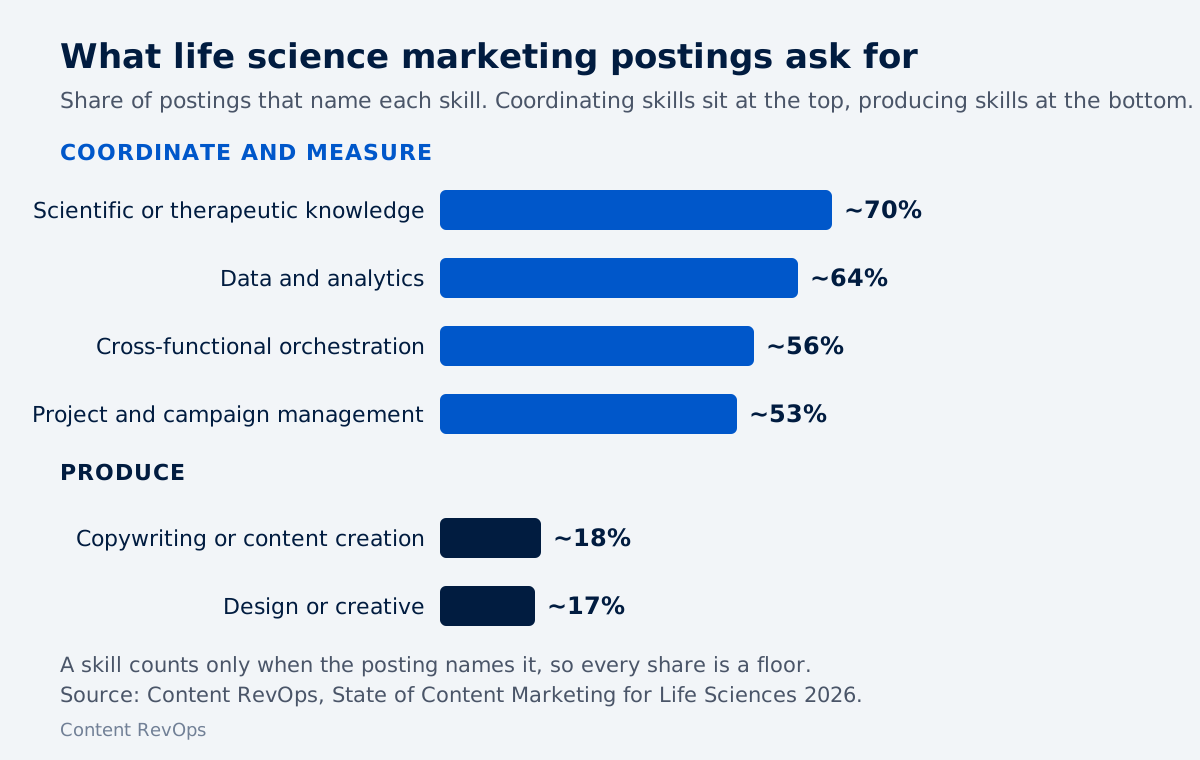
Those three things dominate the postings. Scientific or therapeutic knowledge is named in about 70% of life science marketing job postings. Data and analytics is named in about 64%. Cross-functional orchestration appears in about 56%, and project and campaign management in about 53%.
Now look at the craft. Copywriting or content creation is named in about 18% of the same postings, and design in about 17%. The skills that produce the content sit near the bottom of the list. The skills that coordinate it sit at the top.
Pharma is the extreme version. In the pharma study, cross-functional collaboration appears in about 78% of marketing postings, four in five. Copywriting appears in about 5%, one posting in 22, and medical writing in about 3%, one in 29. The role is built to connect people, with the writing done somewhere else.
This is not a life science oddity. Across the seven B2B verticals in our 2026 study, collaboration is the most-named skill everywhere, including about 70% of postings in manufacturing and 91% in fintech. Life sciences shows the same shape.
So the short answer to the question is a coordinator with a science degree who can report results. Our overview of life science marketing carries the full skills table and the sub-role names, and the life science marketing statistics page collects the underlying numbers in one place.
Differences across life science verticals
In pharma and clinical-stage biotech, marketing owns the product. One brand marketer on Reddit describes the day to day as "content creation, asset creation with vendor, asset MLR review, tactical review, providing input and/or feedback to other stakeholders", all inside "the guardrails of an approved label". Another sums up the structure as "marketing = product = brand". Agencies execute, and the marketer convenes. That is the shape behind any pharma marketing strategy, and the same logic runs through biotech marketing once a clinical asset has a commercial plan attached.
In tools, reagents, and instruments, marketing is digital and close to the sale. A reagent-company marketer with a biochemistry degree describes a job that "was heavily dependent on digital marketing since we were e-commerce based", learning email automation, SEO, and front-end web on the job. The postings match. Cell Signaling Technology's product marketing manager role requires a "PhD in related Life Science area" and splits the week roughly a quarter on positioning, a quarter on campaigns, and a fifth on sales enablement. Roche's qPCR product marketing manager is the "internal Subject Matter Expert", spends up to a quarter of the time in the field with lab directors, and tracks the funnel in Salesforce. This is the job described in how to market a life science product, and the closest neighbours to it are medical device marketing and diagnostics marketing.
In services, the job is getting considered. A CRO or CDMO sells a capability to a sponsor who already has a shortlist. Pharmaron's title says it plainly, "Scientific Marketing Manager, CMC / CDMO", and the duties are content with the scientific leaders, webinars, and the conference calendar. PolyPeptide's version adds "structured handover of qualified opportunities to the commercial team", which is the whole point of the role in one line. We have written separately about what the CDMO and CRO marketing function actually is and about the content that survives a sponsor looking for a reason to rule you out.
The clearest proxy for which job you are hiring is company size, and the figure that shows it is compliance. Regulatory and compliance knowledge appears in about 11% of marketing postings at the smallest life science firms and about 49% at the largest, and the large regulated end of the sector is mostly pharma. Small tools and services companies tolerate review; large regulated companies hire for it.
Why do life science companies hire scientists for marketing jobs?
Because the product takes years to understand, the people doing the hiring are scientists, and marketing can be learned on the job.
Start with the product. A reagent, an assay, or an instrument is bought by scientists who ask technical questions before they ask about price. A former flow-cytometry scientist now in global product marketing says companies want "working/foundational knowledge of the product they will be responsible for which usually requires some amount of years of wet lab experience". You cannot teach that in a quarter.
Then the hiring manager. "Most biotech companies have scientists as managers", as one marketer puts it, and scientists hire people they can talk to. A marketer with little knowledge of the field is, in another commenter's word, "a unicorn", meaning rare.
Then the marketing side, which hiring managers treat as the easier half to learn. A former hiring manager on the service-provider side says the preference for scientific training at entry is explicit "as you can learn a lot on the job when it comes to the marketing skills". The same person advises against "jumping to an MBA" and says the useful thing is "getting familiar with the core marketing and sales platforms (Salesforce, Hubspot, etc.)".
That last point matters more than it looks. The concrete skill gap a hiring manager names is the CRM and automation stack, and the company-side data agrees. Email and CRM skills are named in only about 15% of life science marketing postings, and marketing-automation and CRM adoption across the sector is low. Companies hire for the science and leave the nurture layer thin, which is why life science email marketing is so often a newsletter nobody owns rather than a sequence tied to the pipeline.
Important nuances
"Hire scientists" is not true everywhere in the sector, and the exception is worth knowing before you write a job description.
A 2022 peer-reviewed study in F1000Research counted the qualifications on 524 LinkedIn profiles of UK-qualified staff at the ten largest pharmaceutical companies. Among the 94 people in commercial roles, 47 listed a science bachelor's degree, 30 a master's, 16 an MBA, and 2 a PhD. Commercial and sales staff had, in the author's words, "the least amount of clinical and research expertise" of the groups studied, and the commercial group had one of the highest rates of business qualifications.
So among big-pharma commercial staff, a science bachelor's degree is common, a PhD is rare, and business qualifications are among the highest of any group in the study. The therapeutic area is learned on the job. At a tools company, the hire is a scientist who learns marketing on the job. Both say "know the science" in the posting. They mean different things by it. The study covers UK big pharma only, so read it as a pattern rather than a census.
Where life science marketers come from
Entry-level marketing jobs barely exist in this sector, so hiring is lateral.
In the pharma study, nearly one in two marketing titles carried Director, VP, Head of, or Chief, about a third carried Manager, and about 1% were explicitly entry-level, one posting in a hundred. Teams are not built from the bottom up. They are bought in at the top, which is the opposite of how a demand generation team structure is usually assembled elsewhere in B2B.
The routes people describe are consistent:
- From the bench into product marketing, often through an applications-scientist role first, or through marketing communications, the one tier that hires early-career people.
- From market access or market research into a brand team. One pharma commenter notes brand teams "are most likely to hire from market access or market research", and warns that a regulatory background can read as "too restrictive" in a brand interview.
- From a consultancy into industry. One r/pharmaindustry commenter's advice is to "join a consultancy that does a lot of pharma marketing work and after 2-4 years exit into industry" at manager or director level.
Which marketing programs does a life science marketer run, and which are outsourced?
The in-house marketer runs the programs that need relationships and a calendar. The company buys the programs that need production.
The postings show it directly. Here is how often each program or channel is named in life science marketing postings, with the skills that produce content underneath for comparison.
Program or skill | Share of life science marketing postings | Usually (our read) |
Events, tradeshows, and congresses | ~47% | Owned in-house |
KOL, HCP, or patient engagement | ~46% | Owned in-house |
Social media | ~32% | Owned in-house |
Launch and commercialisation (as strategy vocabulary) | ~22% | Owned in-house |
Website management | ~20% | Owned, built outside |
Copywriting or content creation | ~18% | Bought |
Design or creative | ~17% | Bought |
Email and CRM | ~15% | Thin either way |
Content marketing | ~14% | Bought |
Webinars | ~11% | Mixed |
SEO or SEA | ~10% | Bought |
Paid media | ~10% | Bought |
Account-based marketing | under 1% | Rarely named |
Answer-engine optimisation | 0% | Nobody |
Read the top of the table and you see a calendar: the congress year, the KOL program, the launch. Read the bottom and you see everything that has to be written, designed, or optimised, named in roughly one posting in five or fewer.
Each of those lines has a discipline behind it that somebody has to run. We have written up the ones that carry the most weight in this sector: social media and LinkedIn, digital marketing, multichannel and omnichannel, account-based marketing, paid search and paid media, and webinar production. The line at the bottom of the table, answer-engine optimisation, has no discipline attached anywhere in the sector yet, which is what our AEO guide exists to fix.
Pharma sharpens the same picture. In the pharma study, content strategy shows up in about 17% of marketing postings and content marketing as a named discipline in about 2%, one posting in 45. One pharma posting in six asks for someone to think about content, and almost none name content marketing as a discipline to run.
The insiders describe the same split from the inside. "In-house marketing at biotech and pharma don't even do everything you just listed, they outsource it to an agency", one commenter says. Another describes the brand marketer's relationship to content as "getting agencies to produce content for these things (they do all the work), and then you hear high level read outs on performance".
Companies that keep the writing in-house rate it higher
SCORR Marketing, a life science marketing agency, surveys about a hundred CRO, CDMO, software, and sponsor leaders every year. In the 2024 edition, companies that keep all their marketing in-house rated their own scientific content writing 3.84 out of 5. Companies that outsource rated the writing they get 3.39. The same pattern held for creative writing, 4.03 against 3.67.
The same survey found agency use among drug-development-services companies fell from 70% in 2023 to 61% in 2024, and notes that "more companies are considering building in-house agencies". The sector buys the writing, and the companies that did not buy it are happier with the result. That is the in-house against outsourced question arriving in life sciences from the production side rather than the budget side.
What job does nobody in the life science marketing team own?
Nobody owns making the content produce revenue.
The marketer coordinates and reports. The agency writes and designs. Between them sits the job of making sure the company's content gets found by the right buyers, teaches them enough to shorten the sale, and hands sales a warmer conversation. That job appears in no posting and in no agency brief, so in most life science companies it has no name on it.
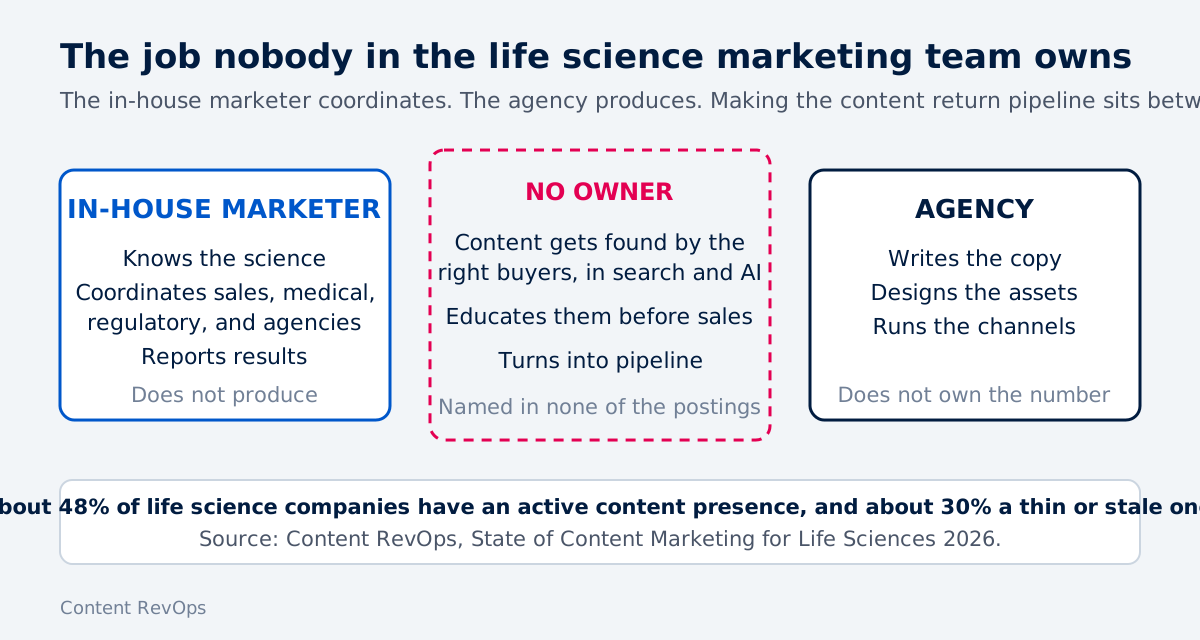
You can see the result from outside. About 48% of life science companies have an active content presence. About 30% had a minimal or incidental one, usually a blog somebody was once given and then stopped updating. Among the rest, dormancy, not absence, is the common state, and it sits at the root of most of the marketing challenges life science teams describe.
Size changes it, and the mechanism is the hire. Among firms of 50 to 250 staff, over 60% are active. A first real marketing hire and a first real budget flip most mid-size firms from dormant to active. Whether the content then does its job depends on what that person is told to own.
What it costs when the job has no owner
It costs sales time and unpublished proof.
When content does not do the educating, reps do it, one account at a time. That is the whole argument for inbound marketing in life sciences, and it is what goes missing when nobody owns the outcome. A marketer of eight years describes what happens to content nobody can account for: "If it doesn't make direct $ tomorrow, they take out of context decisions and bin months and sometimes years worth of work". Content that nobody owns gets cut first, because nobody can say what it was for.
We saw the alternative up close with Westlab, a life science manufacturer selling to labs. Their real differentiator was acting as a discovery partner to lab managers, and that expertise lived entirely inside the sales team. Nobody in the building was hired to turn it into content, so it reached one lab at a time, through a rep.
When that job got an owner, the content started doing the pre-sales education reps had been doing by hand. In three months the program produced 241 inbound leads in a market that had run on cold outbound, and influenced $120k in quotes. The science was the same as before. The difference was that the content had a job and someone owned it.
How is AI changing the life science marketer's job?
AI is moving content production in-house, and it is moving buyers to ask an AI before they ask a website. Both changes land on the marketer's job. Pharma teams face the same two changes, and we sorted the real from the language for that sector specifically.
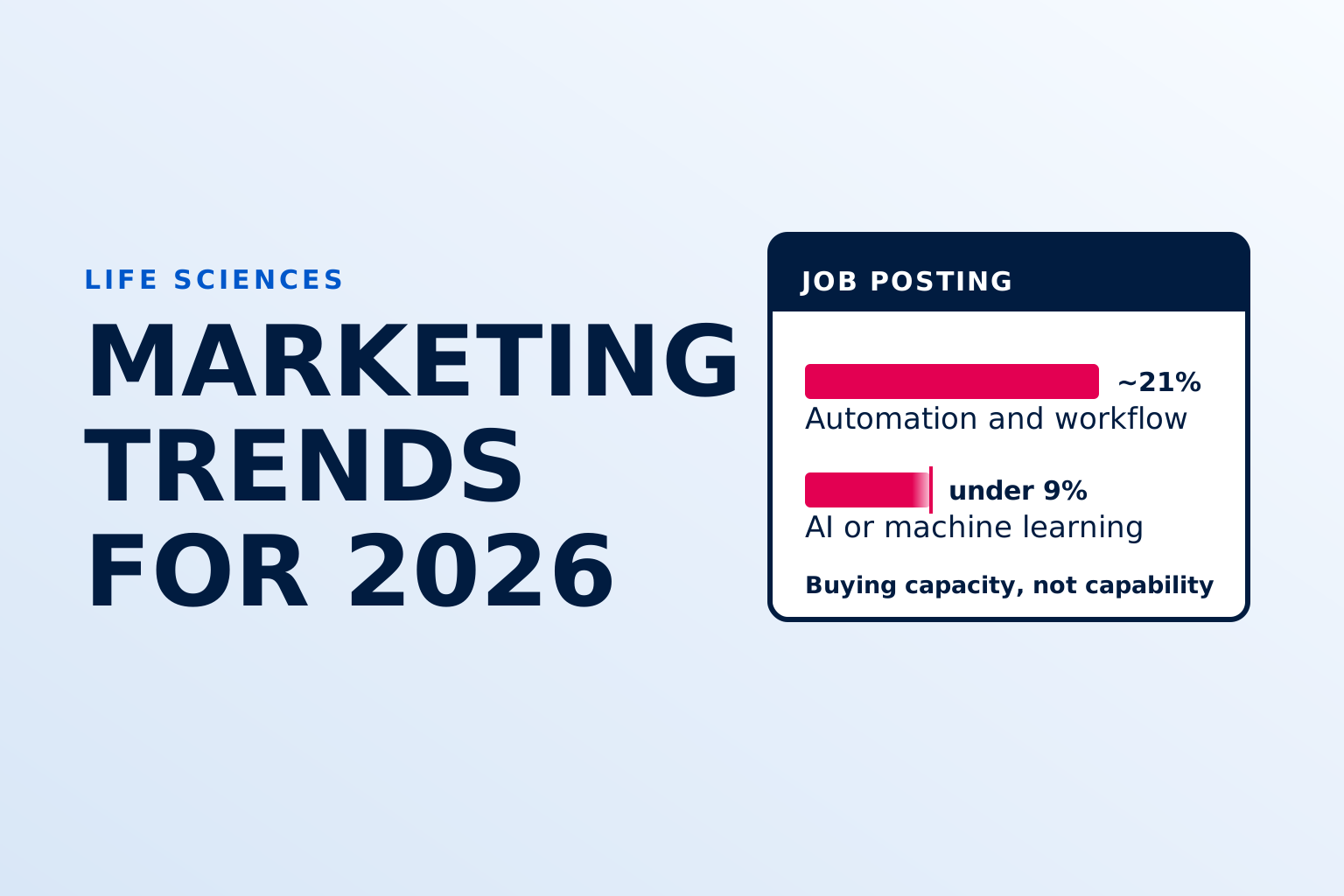
Start with what the postings say, which is almost nothing. Under 9% of life science marketing postings mention AI or machine learning at all, and under 3% mention generative AI. Process and workflow automation, by contrast, is named in about 21% of postings, so what companies ask for is efficiency rather than generation. In pharma the numbers are similar: about 18% of postings mention AI in any form, about 4% mention generative AI, and AI-search optimisation appears in about one posting in 200.
The practice is further along than the hiring. In the MM+M / Publicis Health pharma marketing survey, a 2024 poll of pharma marketers run with an agency group, 77.8% said they already use AI for content production. Only 19.4% use it in medical-legal-regulatory review. And the share who said their medical and legal colleagues can keep up with the pace of change fell from 55.6% to 49.0% in a year. Sanofi's Felix Lee explained the mechanism to the survey: "Because we are going to be much better at generating content, then, by definition, we are going to overload the MLR function."
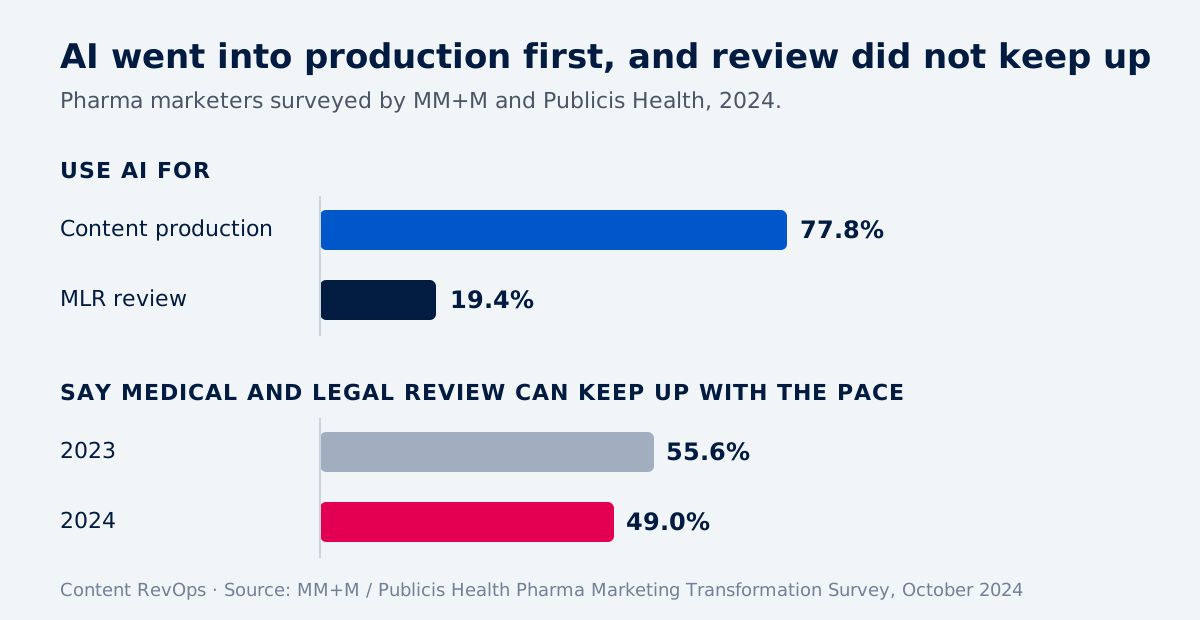
So AI went into the production layer first, which is exactly the layer life science companies outsource. One Reddit insider reading a pharma job posting says the same: "the biggest thing they are contemplating for AI is on the creative / ad campaign side. Certain agencies are rebuilding their whole business model around it". The same shift is rewriting top-of-funnel demand generation across B2B.
What that does to the hire
Two things, and both change the job description.
Producing content becomes cheap enough that owning it is part of the in-house job. ZS, a consultancy, surveyed about 80 life science marketing leaders in 2024 and found that only 20% of companies are "rethinking talent and reengineering the marketer workflow"; the other 80% are watching. But the ones moving are doing something specific: pulling derivative content production back in-house, keeping agencies for the initial creative, and, in ZS's words, CMOs "are beginning to rethink what marketers truly own or should outsource". That is the SCORR pattern above, with AI removing the reason the writing had to be bought.
For a small team, this is what it can look like. At Westlab, a human-plus-AI production pipeline shipped 40 educational pieces in two months, with the scientific judgement staying with people. That volume used to need an agency and a budget line, and now it needs someone inside to own it.
Buyers ask AI first, so the content has to be written to be cited. On life science buying questions, AI Overviews appeared on every query and life science companies were cited in almost none of them. Answer-engine optimisation, the work of getting cited when a buyer asks ChatGPT or Google a question, sits at 0% of postings in the table above, and the companies that give someone that job stand to be the ones the AI answer names. The mechanics are the same ones behind why one brand gets cited in AI answers while a better-known competitor is ignored, and why ranking on Google no longer means showing up in ChatGPT.
What should a life science company hire its next marketer to do?
Hire the science fluency and the coordination, because the sector is right to want them. Then give the role one more thing: ownership of the job content is supposed to do.
In plain terms, that means the marketer is accountable for content as a revenue system, not as a deliverable. The content is connected to the CRM and the automation the company mostly does not have yet. It is measured in pipeline influenced, not in read-outs from an agency. It is written to be found in search and cited in AI answers. And it is built so that sales inherits a buyer who already understands the problem. That accountability is what turns a life science marketing strategy from a plan into a system, and it is the work we do with life science companies.
You can still buy the craft. Most life science companies will keep buying some of it. The difference is that someone inside owns whether the content does its job, and is measured on it. For the part you keep buying, how to choose a pharma marketing agency covers picking the firm and testing it before you sign.
The rest of B2B is already moving that way. In our study of 1,000 demand generation director postings, the requirements lead on KPIs and ROI (59%), data-driven work (59%), and budget or P&L (48%), while named martech tools stay under 12%. Leaders are hired to own a number, not to know a tool. Life science marketing already hires for the science and the coordination. What it is missing is a pipeline number attached to the content.
The next hire keeps the science and the coordination, and takes ownership of what the content returns.
Find out what your content is actually returning.
Get a Content RevOps audit, your content operation benchmarked against the life sciences 2026 hiring and presence data, with every gap priced in pipeline terms you can take to your CFO.
Frequently Asked Questions
About the Author

Founder & CEO, Content RevOps
Stefan Kalpachev is the founder and CEO of Content RevOps, where he helps B2B SaaS companies transform their content into predictable pipeline. With a background in content marketing and revenue operations, Stefan has developed a unique methodology that bridges the gap between content creation and revenue generation.
Connect on LinkedInRelated Articles
Life science marketing statistics 2026
Aug 17, 2026
Life science marketing trends for 2026
Aug 17, 2026
Can You Build a Content Marketing Strategy in One Week? Yes — If You Stop Guessing and Start Collecting Competitor Data
Jun 16, 2026