How AI Is Changing Top of Funnel Demand Generation
Not sure whether your brand shows up in the AI answers your buyers now start with? Find out where your content is invisible to the machine.
Book a CallFor twenty years the top of the funnel had a fixed address. A buyer had a question, they typed it into a search box, and they were handed a page of links to choose from. Your job was to rank on that page, earn the click, and start a relationship on your own site, on your own terms. That address has moved. The buyer still has the question, but now a machine reads the web and hands back a single composed answer, and most of the time the buyer never clicks anything at all.
Part of The Complete Guide to B2B Demand Generation Strategy.
This is the part worth being precise about, because the precision is where the strategy lives. The shift is not that AI helps you do demand generation faster, though it does. The shift is that the first meeting between a buyer and your category now happens inside an answer you did not write, assembled from sources you do not control, in a place you cannot put a form. Everything about how demand forms at the top changes when the discovery surface itself changes, and almost none of the standard advice has caught up to it.
So this is a piece about mechanics. What "being in the answer" actually is, why most content never makes it in, what genuinely earns inclusion and what is folklore, what the move costs you and what it gives back, and the honest edges of all of it, including the questions nobody can answer yet. One idea organizes all of it, so we will state it once and then earn it. A machine can write generic awareness content itself, and it can paraphrase yours without owing you a click or a citation, so that content has stopped earning anything. The only content that still pays is the content the machine cannot get anywhere but from you, and everything that follows is the proof and the practice of that single claim.
What top of funnel becomes when the first answer comes from generative ai
The honest description of the new top of funnel is that it is a research process the buyer runs without you, and increasingly without anyone. Two thirds of B2B buyers now say they prefer a rep-free buying experience, up from a little over half, and they are doing the early work themselves: defining the problem, vetting suppliers, building a shortlist, all before a vendor knows they exist. The awareness stage did not get smaller. It went dark.
What is easy to miss is that the funnel did not actually shorten, it changed where the time goes. Buyers now reach out to vendors about three and a half weeks earlier than they did a year ago, at roughly twenty-six weeks into the journey rather than thirty, yet they have the same number of interactions with the vendor they eventually pick. They are not doing less research. They are doing more of it alone, with an AI, and arriving at the human conversation later and better prepared. The reason they reach out at all is telling: a large share engage a vendor early specifically to check whether what the AI told them is true. The machine handles the information. The human becomes the place you go to validate it.
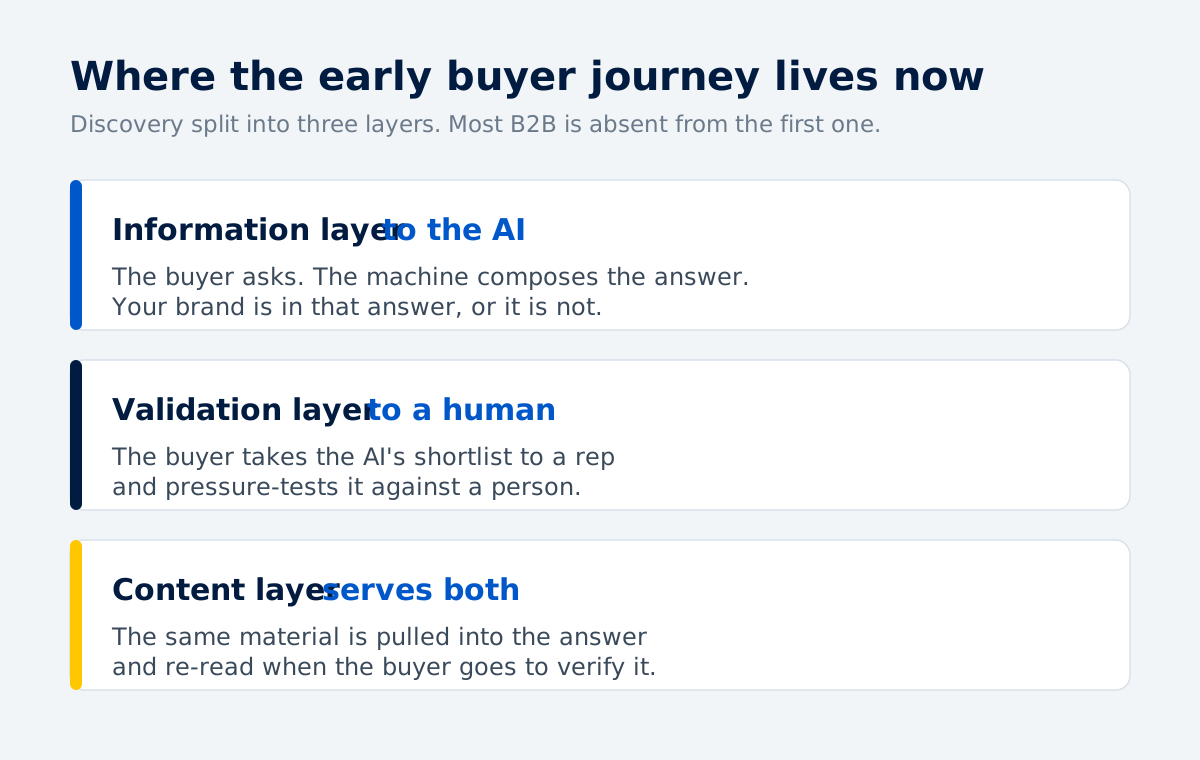
This cuts against the doom reading, because buyers have not handed their judgment to the model. Nearly seven in ten still take AI-generated insights to a sales rep to confirm them, and they are split almost evenly on whether an AI or a salesperson is more likely to mislead them. So the structure that is forming looks like this:
The information layer moves to the AI. The buyer asks, the machine composes, and your brand is either in that composition or it is not.
The validation layer stays human. Once the AI has shaped the shortlist, the buyer wants to pressure-test it against a person.
The content layer has to serve both at once, because the same material that gets pulled into the answer is what the buyer re-reads when they go to verify it.
For most of B2B, the problem is that they are absent from the first layer entirely. When we studied close to 14,000 company websites across seven B2B verticals, the consistent finding was that in six of the seven, company sites were largely absent from AI answers, which lean instead on community, reference, and review sources the engines already trust. Life sciences companies surfaced in effectively zero AI Overviews, on queries where an AI Overview appeared every single time. The answer is being given. These brands are just not in it.
Two changes that look like one
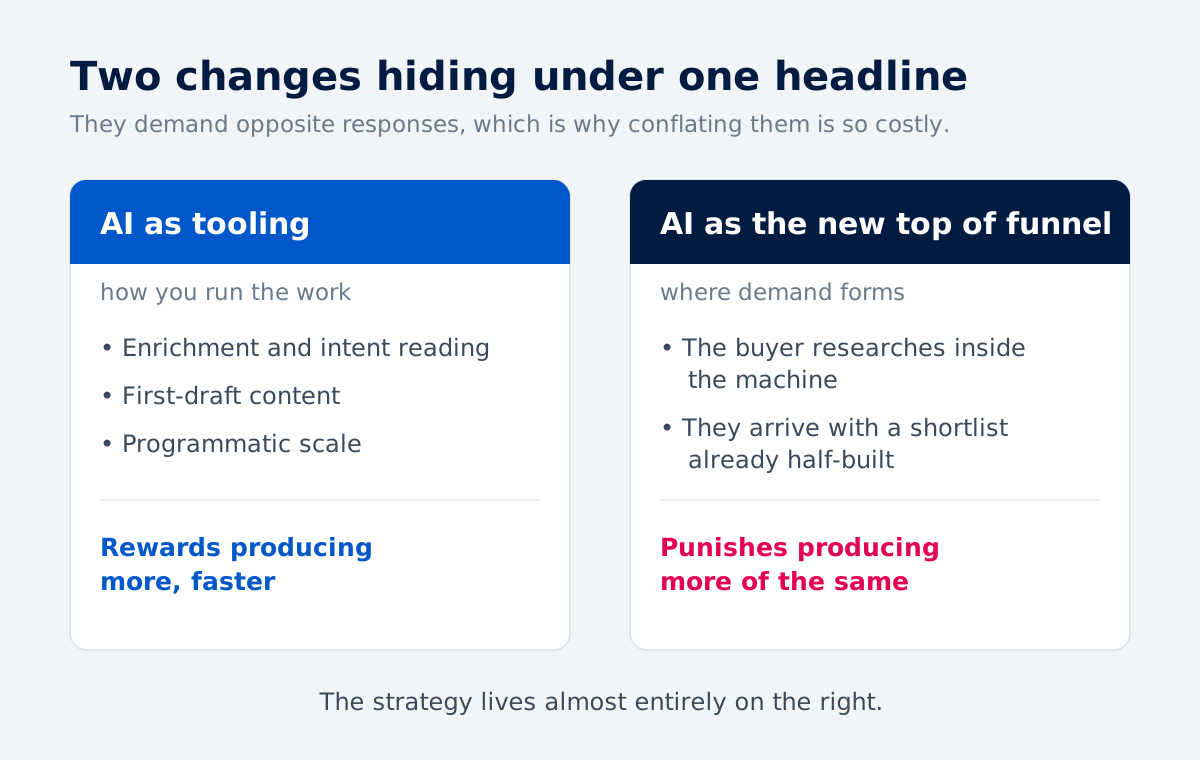
There are two different things happening under the banner of "AI is changing demand generation," and conflating them is the most common and most expensive mistake a team can make right now.
The first change is artificial intelligence as tooling, used through AI tools and marketing tools within digital marketing operations, which is about how you run the work. This is the enrichment, the intent reading, the first-draft content, the programmatic scale. It is real and we use it constantly. When we rebuilt Ori Learning's content operation after a rebrand wiped their organic traffic, a single workflow took one subject expert's framework for writing IEP goals and ran close to a hundred articles off it, and at peak those pages alone pulled more than twenty thousand visitors a month.
For Radius, we grounded thousands of programmatic pages in a small retrieval layer so each one came out genuinely useful rather than spun, which is the difference between pages that rank and hold and pages a search engine filters out. Tooling changes your cost and your speed, sometimes by an order of magnitude. Leveraging AI in your gen strategy can improve marketing success only if it addresses where demand forms, not just production speed.
The second change is AI as the new top of the funnel, which is about where demand forms. This has nothing to do with your stack; it changes the marketing funnel, not just internal workflows. It is the buyer running their early research inside a machine and arriving with a shortlist already half-built. You can have the most efficient content operation in your category and still lose here, because efficiency is an answer to the first change and this is the second one.
The reason the distinction matters is that the responses point in opposite directions. The tooling change rewards producing more, faster with generative AI. The surface change punishes it, because the surface is now mediated by a model that can already produce generic content itself and has no reason to send anyone to yours. Speeding up the production of commodity awareness AI generated content is not a small win that helps a little with the bigger problem. It actively deepens the bigger problem. The strategy lives almost entirely in the second change, and the rest of this piece is about it.
Why most demand generation top of funnel content never makes it into the answer
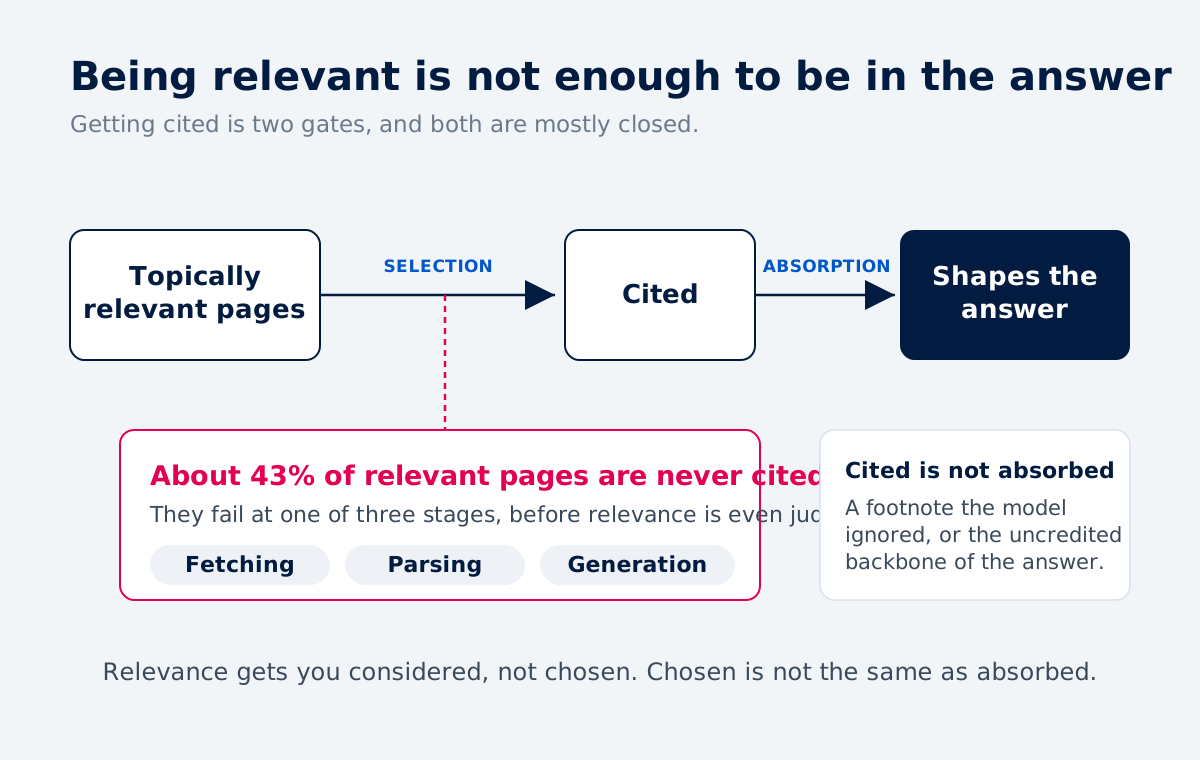
Here is the mechanic almost no one explains, and it reframes everything downstream. Getting into an AI answer is not one event, it is two, and they are governed by different rules.
The first event is selection: a retrieval step fires, and your page is chosen as one of the sources the model looks at. The second is absorption: how much of your page's actual language, evidence, and framing makes it into the composed answer. A careful empirical study of more than 600 controlled prompts found that these two come apart sharply by engine.
Perplexity and Google's AI surfaces cite many sources per answer, around sixteen and twelve, while ChatGPT cites far fewer, around seven, but absorbs each source it does use four to five times more deeply. The practical consequence is that "we got cited" and "we shaped the answer" are different wins. You can be listed and barely absorbed, a footnote the model ignored, or you can be the uncredited backbone of the answer itself. Counting citations tells you almost nothing about which one happened.
That is the optimistic half. The sobering half is how often neither happens. In benchmark testing, roughly 43% of topically relevant pages were never cited at all. Read that carefully: these are pages that are on topic, that should qualify, and nearly half still get nothing. And they fail at three different stages, which matters because each stage has a different fix:
Fetching. The crawler cannot get clean content, usually because the page depends on JavaScript to render or the HTML is malformed. The model never sees the words.
Parsing. The content is there but buried under navigation, boilerplate, and interstitials, so the substance gets truncated before it is evaluated.
Generation. The page is read but loses out at the writing step, because it is thin on the specific entities and dense facts the model wants to compose with.
A page can be thrown out at the fetching stage before a single sentence is judged for relevance. The implication is uncomfortable for anyone who has invested in beautiful, interactive, heavily-designed content: the more your value lives in rendering and interactivity, the more invisible you may be to the systems now mediating discovery. We see the same pattern in a quieter form across B2B, where the most authoritative material a company owns, the whitepaper and the clinical summary, sits inside a gated PDF that answer engines parse poorly or not at all. The highest-authority content many companies have ever produced is functionally invisible to the machine that now decides who gets found.
So what does earn inclusion? The good news is that it is concrete and learnable, not mystical. Pages that get absorbed at high influence share a clear profile. They are longer, modular, semantically aligned to the question, and dense with extractable evidence units: definitions, numerical facts, comparisons, and step-by-step procedures that AI models and machine learning systems can parse from large datasets to predict customer behavior and consumer behavior.
The model is looking for liftable, self-contained units of substance it can compose with, and the pages that supply them win by a wide margin. Selection adds a few hard gatekeepers on top, where in controlled trials topical match, an explicit price, a recent timestamp, and position in the retrieved list each moved the odds of being cited enormously. Relevance, specificity, freshness, and prominence are the levers, not volume, with predictive analytics and predictive models helping teams turn those signals into predictive insights and actionable insights instead of generic assumptions.
This is where the field is full of folklore worth puncturing, because the popular advice is partly wrong and occasionally backwards:
The common advice | What the evidence actually shows |
|---|---|
Add an FAQ block to get cited | Q&A formatting on its own correlated negatively with influence, about -5.74%. Structure helps, but a bolted-on FAQ is not the lever. |
Stuff in the keywords | Keyword stuffing produced little to no gain and can score below doing nothing at all. |
Add statistics and write in an authoritative tone | Adding credible, sourced evidence helps, lifting visibility roughly 30 to 40%. But applied generically as a rule, “add stats, sound authoritative” actively degrades citation on specialized and long-tail topics, because those rules are averages that niche subjects deviate from. |
Sound more like an expert | Tone alone showed no significant effect. The model is reading for substance, not confidence. |
The last row is the one to sit with. The generic optimization playbook that everyone is selling right now is derived from aggregate patterns, and the more specialized your category, the more likely those rules hurt you. Diagnostic, page-specific fixes beat blanket rewriting. For a B2B company in a narrow vertical, this is good news in disguise: the off-the-shelf advice your competitors are following is exactly the advice that underperforms on subjects like yours.
This is where the mechanics meet the one claim from the start of the piece, and turn it from an assertion into a measurement. Generic explainer content fails twice over. It loses selection because a hundred versions of it already exist, and even when it is read, the model paraphrases it without crediting you, because you were never the only source. First-party content fails neither test.
When we built Behavior Advantage's library, every page shipped with a working tool a teacher could use that afternoon, a fillable behavior plan or assessment the model simply cannot reproduce, and those pages now hold roughly 35% share of voice and around 40% of the AI Overviews in their space, cited twenty to thirty times a week. Strong pages also surface pain points, support dynamic content instead of one-size-fits-all messaging, and strengthen lead generation. An answer engine cannot serve a fillable template, so it serves the page that has one. The same logic runs through our own State of Content Marketing study, where original research, the rarest authority asset in the entire dataset, present on as few as one in eight active sites, was the clearest single predictor of who got cited.
That same specificity is what makes account based marketing work at scale by helping teams prioritize key accounts, identify stealth buyers from intent signals, and improve lead scoring for potential customers. The market is racing to produce more of the content the model devalues and almost none of the content the model has to attribute.
The trade nobody can prove yet, and what our own data shows
The obvious objection to all of this is volume. If the AI answers the question and the buyer never clicks, your top-of-funnel traffic falls. Does the pipeline fall with it?
The honest answer starts with an admission, because the alternative is to mislead you. There is, as of now, no rigorous B2B evidence on this. The widely-quoted figures showing AI-referred visitors converting far better than other traffic come from retail analytics, and a retail shopper completing a checkout is not a B2B buying committee working a six-month evaluation. Anyone citing those retail numbers as a B2B benchmark is reaching, and we are not going to do it. The B2B data simply has not been gathered yet, and that gap is worth naming plainly rather than papering over.
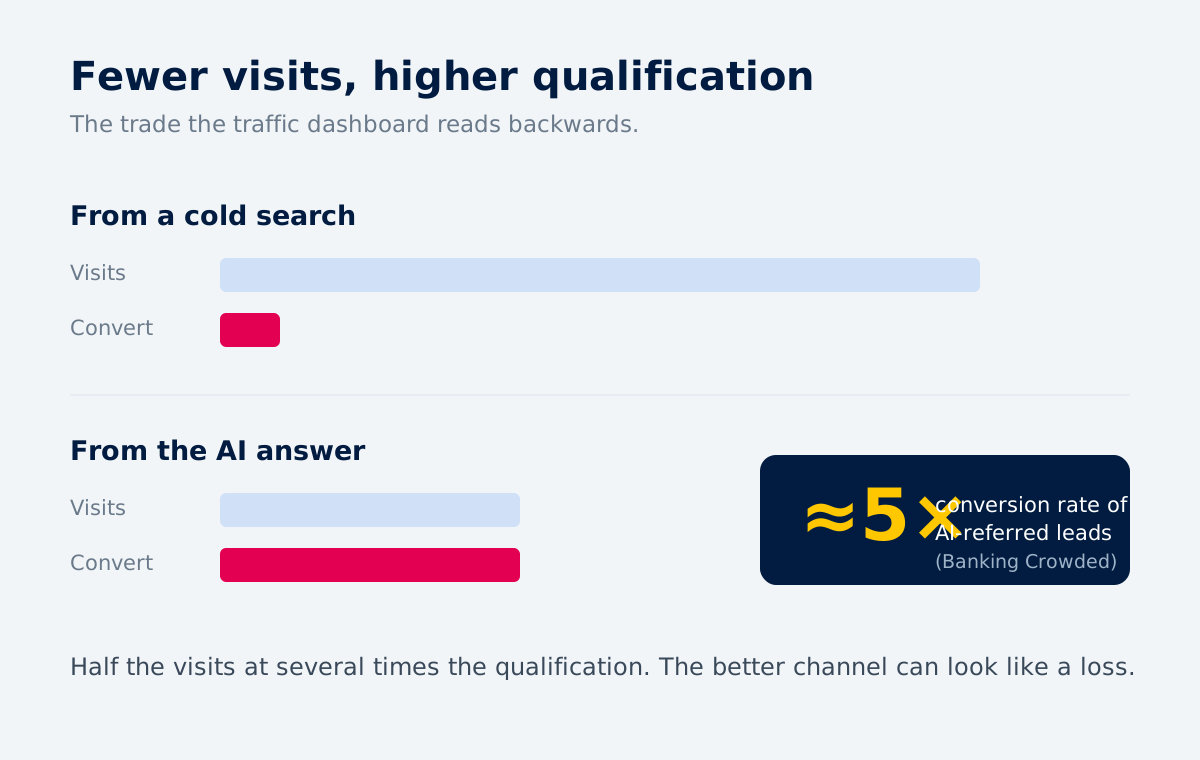
What we do have is our own. When we rebuilt Banking Crowded's content as a resource hub engineered for AI answers from the first day, roughly 22% of inbound began arriving through AI and LLM referrals, a channel most of their competitors do not even measure yet. More importantly, those AI-referred leads converted at roughly five times the rate of other sources, and broader market reporting also ties AI to customer acquisition costs falling by as much as 40% and complex B2B sales cycles shortening by 55%.
The mechanism is the thing to understand, not the multiple. A buyer who reaches you through an AI recommendation has effectively been referred by the tool they were already using to make sense of the category. They arrive pre-qualified and pre-trusted, having had the model do the comparison and the filtering before they ever saw your name. That is a fundamentally different visitor from the cold searcher who landed on a blog post and bounced.
That multiple lines up with the buyer behavior from the start of the piece, where the people who reach you have already done their research with the machine and cleared its early filters. The shape of the trade is fewer visits at higher qualification, and the metric that ran demand generation for fifteen years, top-of-funnel traffic volume, now actively misleads you. Marketing teams should judge marketing campaigns by ROI, qualified leads, conversion rates, and repeat business rather than raw lead volume.
A page that sends half the visitors at several times the qualification is winning, and a traffic dashboard will read it as a loss. The job at the top of the funnel stops being to fill it and becomes to be the source the machine trusts enough to hand over its best-prepared buyers. We are not going to pretend the broad B2B proof exists yet. We are saying that where we have built for it, this is what we have seen, and the mechanism is sound enough to act on while the field catches up. Marketers repeatedly cite personalization as a driver of repeat business and customer loyalty, with 96% reporting it does so, which is why fewer but better-qualified visits can be more valuable.
What AI does well at the top of funnel, and where it breaks
The honest tooling story has two halves, and most coverage only tells the flattering one.
AI is genuinely strong at the repetitive, judgment-light work of the top of funnel, and the reason is more specific than "it is fast." A rep researching an account reads the homepage, maybe a news hit, and a LinkedIn page, and stops, because each account costs fifteen to thirty minutes and the day runs out. A machine has no such ceiling. It crawls the careers page, the pricing page, the buried product sub-pages a human skips, the recent filings and review-site complaints, and synthesizes a hundred-plus structured attributes per account in under a minute, each one mapped back to the source it came from. The win is not speed alone, it is coverage at speed: the brief is more complete than a careful human's because the machine actually reads everything the human triages away.
That is the work behind the Behavior Advantage system, where a download triggers an AI-powered enrichment workflow that delivers AI-driven insights and real-time insights for data-driven decision making by both marketing and sales teams, along with a complete dossier and a drafted opener in a rep's inbox in about five minutes. The same coverage-at-speed logic is what lets it read intent across thousands of accounts for full-funnel demand generation and improve sales alignment, so marketing teams and sales teams can act on the same signals while grounding programmatic pages in real retrieved material. Used this way, on the work that is repetitive and low on judgment, it is leverage worth having and we build with it daily.
Where it breaks is the claim that it can run the whole motion, and the honest practitioner view is sharper than the marketing. The systems that promise to run your entire funnel end to end are, in the experience of the people actually using them, far better at demos than at pipeline. The pattern that works is narrower and less glamorous: point the machine at enrichment, research, drafting, distribution, and the repetitive orchestration handled by marketing automation and ai agents, and keep humans on the judgment-heavy work that decides whether you get cited at all, the original analysis, the point of view, the proprietary data. The most effective system we have built, Lucid's, uses content as the outbound itself, sending each target their own benchmarked data personalized at a scale a person could never reach, so the target audience gets the right message, customer engagement improves, and full funnel demand generation performs better; in practice, that kind of AI-powered personalization can lift engagement by 150% compared to static segmentation, and it lifted reply rates from the low single digits to the high teens.
Common execution examples include AI automates targeted email campaigns for outreach, conversational ai or AI-powered chatbots provide 24/7 interaction for lead capture, and other customer experiences shaped with real-time adjustments to marketing campaigns. But the insight being personalized at scale is ours, not the model's. The machine scaled the distribution of the thinking. It did not have the thinking.
There is also a reliability problem at the layer that matters most for attribution, and it deserves to be stated rather than glossed. When eight AI search engines were tested across 1,600 queries, they misattributed sources on more than 60% of them, rarely signalled any uncertainty, and frequently pointed to fabricated or broken links. Those numbers come from an older generation of models and will improve, so treat them as a snapshot rather than a fixed property. Data privacy is a major ethical concern in AI marketing and one reason ai adoption needs governance. But the underlying caution holds. The machine that is now mediating discovery is confidently unreliable about where its information came from, which means the same system that can hand you a pre-qualified buyer can also misrepresent you, omit you, or credit your claim to someone else. Building for AI answers is the right move. Trusting the layer to be accurate or stable is not.
One caveat sits under all the citation mechanics in this piece, and we hold ourselves to it. Much of that research, the selection-versus-absorption split, the gatekeeper effects, the GEO lifts, comes from controlled benchmarks and synthetic testbeds rather than measurements of live engines in the wild. The directions are robust and consistent across studies. The exact magnitudes are not gospel, and should not be read as literal production numbers.
Anyone selling you precise, guaranteed figures about how to win the AI answer is selling a confidence the evidence does not yet support, and marketing leaders evaluating ai technology and ai programs still need practical ai skills to stay ahead because tooling claims often outrun evidence, even if AI-driven marketing insights yield 20-30% higher campaign ROI.
What we do not yet know, and why it matters
The most important open question is one we cannot close, and pretending otherwise would undercut everything above.
For decades the durable engine of B2B demand has been mental availability, the idea most associated with the Ehrenberg-Bass Institute and the 95:5 rule: at any moment only about five percent of buyers are in-market, so the brands that win are the ones already sitting in memory when a buyer finally enters the category. You build that memory over years, through consistent presence, so that when the need arises your name surfaces first. The whole logic rests on the human brain doing the retrieving.
What happens to that when the retrieving is done by a machine? It genuinely splits two ways, and the evidence does not yet settle it. One reading is that mental availability matters more than ever, because the model is more likely to compose an answer around the brands that are most consistently present and most cited across the web, so the same long-run presence that built human memory now builds machine memory, and being everywhere the model reads becomes the new version of being top of mind. The other reading is that the machine erodes it, because the AI assembles a fresh shortlist on demand from whatever is most relevant and extractable in the moment, caring nothing for the brand you have spent a decade building, which would hand a structural opening to the specific, well-structured newcomer over the famous incumbent. Both are plausible. Neither is proven, and the research that would tell us has not been done.
We flag this rather than resolve it because the answer changes where you should invest, and anyone claiming certainty here is guessing. What we can say is that the two readings disagree on the theory and agree on the move. Long-run presence and in-the-moment relevance both reward the same thing, being specifically and citably present in the places the machine reads, so it is the one bet that pays off whichever future arrives. That is why it is the one to make now, especially as 79% of marketers expect budget increases for AI in 2026, reinforcing it as a strategic source of competitive advantage tied to broader marketing strategies and full-funnel demand generation priorities.
Ranking on Google but missing from the AI answers that shape your buyer's shortlist?
Get a Content RevOps audit: we'll show you exactly where you fail selection or absorption, and the specific first-party moves to get your brand retrieved, cited, and named.
Frequently Asked Questions
About the Author

Founder & CEO, Content RevOps
Stefan Kalpachev is the founder and CEO of Content RevOps, where he helps B2B SaaS companies transform their content into predictable pipeline. With a background in content marketing and revenue operations, Stefan has developed a unique methodology that bridges the gap between content creation and revenue generation.
Connect on LinkedIn