How to choose a pharma marketing agency in 2026
Before you shortlist an agency, check whether your content is producing pipeline at all. Want to see where yours leaks?
Book a CallMost advice on choosing a pharma marketing agency tells you to look for experience, creativity, and cultural fit. That describes every agency you will ever meet, which is why we wrote down the method we actually use as a demand generation agency when we help a life sciences company run a selection.
Part of Content marketing for life sciences, the complete guide.
Match the type of agency to the job first, cut the field with checks you can run yourself, then use the pitch to test the two or three things an agency cannot rehearse.
Step 1. Decide which of three jobs you are hiring for
Almost every bad agency selection in pharma starts here. The company writes a brief for "marketing support", meets five firms that all say yes, and picks on chemistry. Six months later the work is competent and the wrong shape.
There are three distinct jobs, and very few firms do more than one well.
The job | What you are buying | Who to look at | What it will not fix |
Get promotional material through review and into market | Claims fluency, MLR experience, therapeutic depth | Network and independent promotional agencies | Demand. It produces assets, not audiences |
Reach HCPs or patients who are not in the field team's reach | Media, congress presence, HCP engagement, patient programmes | Media and engagement specialists, commercialisation platforms | Anything after the click, if you have nowhere to put a lead |
Make content and campaigns produce measurable pipeline | Search and answer-engine visibility, decision-stage content, CRM and automation wiring, attribution | Operators and consultancies, rarely a promotional AOR | Creative firepower for a launch |
Say which one out loud before you write the brief. If the honest answer is more than one, run two selections rather than one, because the firm that wins a combined brief will be the one most comfortable claiming everything. The third job is the one that decides your pharma marketing strategy for the next two years, and it is the one most often bundled in as an afterthought.
Why this matters more in pharma than elsewhere
The category is organised around the first job. In our analysis of pharma content marketing, regulatory, FDA, EMA, or MLR knowledge appears in about 49 percent of pharma marketing job postings, and congresses in about 14 percent. Review fluency and the congress year are what the industry staffs for, in-house and at its agencies.
The third job is barely staffed anywhere. SEO appears in about 5 percent of pharma marketing postings, paid search in about 5 percent, and AI-search optimisation in about 0.5 percent. If that is the job you are hiring for, you are not shopping the same market, and the shortlists will not reflect it.
Step 2. Build the shortlist without using the "best agency" lists
The lists that rank for this search are written by agencies that appear on them, and more usefully for you, they go out of date faster than they get updated.
Three checkable examples, as of August 2026. G&CO's list recommends Siren Interactive for rare disease; Siren was sold to Dohmen Life Science Services in a deal that closed on 31 December 2014. The same list recommends Patients and Purpose as a standalone specialist, after it was merged into DDB Health in December 2025. Clarity Quest's list carries IPG Health and Omnicom Health Group as separate entries, months after Omnicom completed its acquisition of Interpublic on 26 November 2025 and IPG Health stopped existing.
Ratings will not rescue you either. Among agencies carrying a public Clutch score in our study of 1,700 agencies, 75 percent sit between 4.9 and 5.0 and the median is a perfect 5.0. A score almost everyone holds at the ceiling cannot rank anything.
Where to build the list from instead
- Your own category's work. Find three pieces of pharma marketing in the last year that you thought were good, and find out who made them.
- The trade press credits. MM+M's Agency 100 and its network family tree are reported rather than self-nominated, and the family tree shows you the ownership in one view.
- Your MLR team. They have watched agency submissions come through for years and they know whose material clears and whose comes back.
- Two names from outside the category, if the job is the third one in the table above, because the firms that do that work are usually not on pharma agency lists at all. Our guide to choosing a demand generation agency covers what that side of the market looks like.
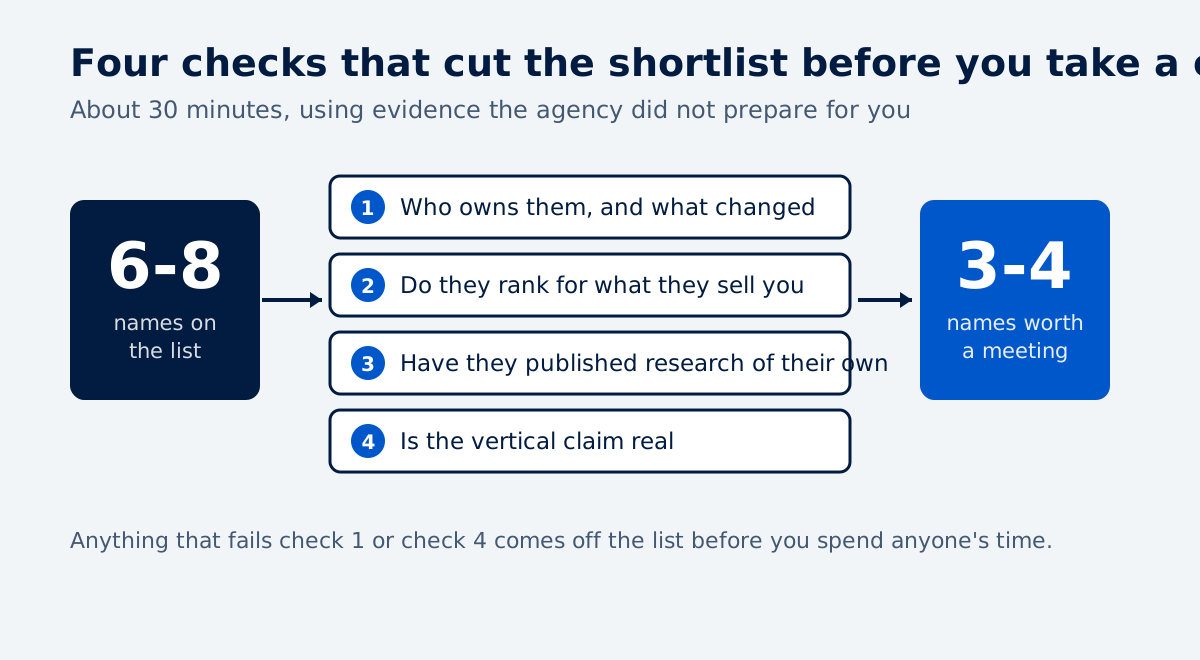
Aim for six to eight names before you cut. The next step removes most of them.
Step 3. Run four checks before you take a single call
These take about thirty minutes for the whole shortlist and they are the highest-return half hour in the process, because they use evidence the agency did not prepare for you.
Check 1. Who owns them, and what changed recently
Search the agency name with "acquired" and "acquires", then open the parent's newsroom rather than the agency's about page. You are looking for two things: whether two names on your shortlist are now one company, and whether the firm has been bought, merged, or renamed in the last two years.
Recent examples worth knowing. Omnicom Health absorbed the IPG Health agencies through 2026, so Patients and Purpose, TBWA\WorldHealth, and Harrison Star are now part of Remedy Edge, and FCB Health New York is Olixir New York. BGB Group renamed itself BGBx in June 2026. Supreme Group has acquired roughly ten life sciences agencies since 2023, including Clarity Quest, Health+Commerce, BioStrata, Pivot Design, and Broth.
None of this disqualifies anyone. It tells you whether the people who did the work you admired are still there, and whether your "competitive" shortlist has one owner behind two logos.
Check 2. Do they rank for what they are selling you
Search the thing you are about to buy. If you want them to run your search and content programme, search "pharma content marketing agency" or your therapeutic area plus the service, and see whether they appear.
This is the single most predictive check we know of, and the reason is in our own data. Across the 1,700 agencies we studied, 70 percent run no real demand engine of their own and 71 percent draw under 1,000 organic visits a month to their own site. Agencies that run their own inbound engine scored 79 out of 100 on our criteria against 35 for those that do not.
Extend the check to answer engines while you are there. Ask ChatGPT or Perplexity the same buying question and see who gets named, because ranking on Google and being cited in an AI answer are now two different problems. An agency that cannot rank or get cited for its own category is selling you a system it has never built for itself.
Check 3. Have they published anything of their own
Not case studies. Original research, proprietary data, a benchmark, a point of view with numbers behind it.
Eighty-seven percent of the agencies we studied publish none. In pharma marketing specifically, the recurring research comes mostly from consultancies and data firms rather than agencies: Trinity Life Sciences benchmarks 150-plus biopharma brands annually, Precision AQ has surveyed more than 65,000 physicians since 2013, and Health Union and solli run an annual pharma marketing benchmark. On the agency side, Real Chemistry's HealthGEO, which tracks how brands appear in AI answers, is one of the few genuine examples.
An agency with proprietary evidence brings you a point of view. One without it brings you everyone else's slides, and it is original evidence that gets a brand cited rather than restated positioning.
Check 4. Is the vertical claim real
Ask for the vertical's content hub, not the logo wall. A specialist has a body of work in your therapeutic area that a buyer inside it would bookmark. A generalist has two logos and a claim.
In our study, 14 percent of agencies made vertical claims their own content did not support, and only 8 percent showed genuine vertical depth. That is the demand generation field rather than pharma, where specialisation is more common, but the test works the same way. It is the same test a buyer would run on our own life sciences practice.
Cut to three or four names. Anything that fails checks 1 and 4 comes off the list now, before you spend anyone's time.
Step 4. Write a brief that makes the proposals comparable
Most pharma agency proposals cannot be compared, because each one scopes the work differently. Four things in the brief fix that.
- State the number of MLR review rounds you will pay for, and ask what happens beyond it. The PM Society's procurement guide tells buyers to ask directly whether the agency will add a contingency for more rounds than expected. This is the most common source of overrun in pharma work, and almost nobody scopes it.
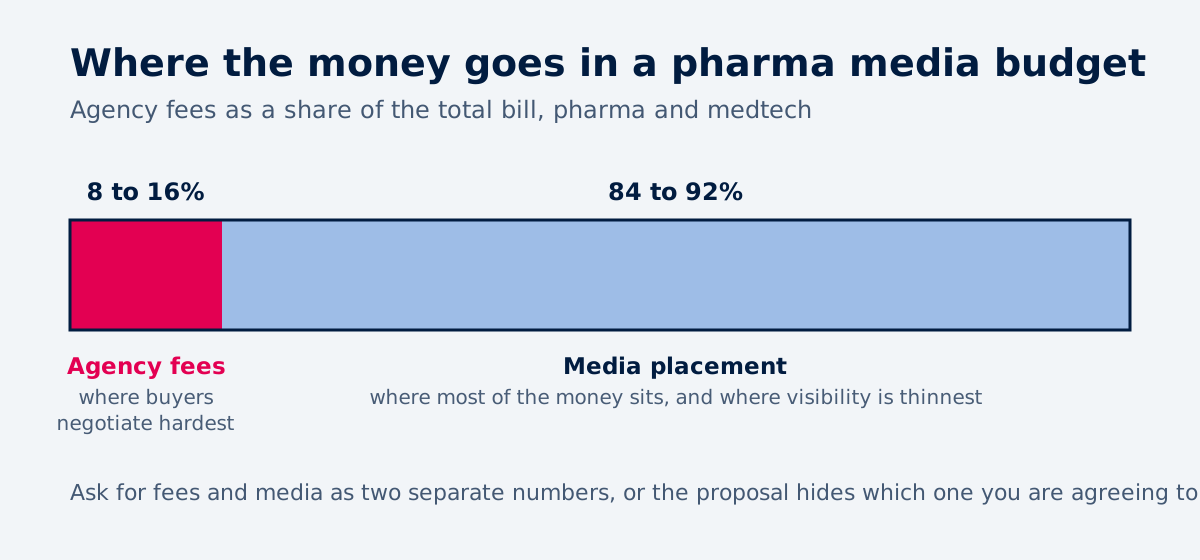
- Separate fees from media. Ask for them as two numbers. Agency fees are roughly 8 to 16 percent of a total media bill in pharma and medtech, according to the procurement consultancy Inverto, so a proposal quoted as one figure hides where the money actually goes.
- Name the team and the percentage of their time. Not the pitch team. The people who will do the work, with an allocation against each.
- Say how you will measure it, and what you need them to connect to. If you want pipeline attribution, say so in the brief, because it changes which firms can bid honestly.
What the review data tells you to expect
Set the timeline from review capacity rather than from agency headcount. Vodori's 2025 promotional review benchmarks put average job duration at 14.8 days, up from 13.8 the year before, at 1.5 circulations per piece. First-circulation approval runs 79.2 percent for marketing and 55.7 percent for legal, so legal is where your schedule will slip.
At programme level, the only published ranges we found come from G&CO: ten to eighteen weeks from brief to first asset live, four to seven months for brand positioning, and twelve to twenty-four months for a launch programme. Those timelines are also why the tactics that compound in pharma tend to be the ones that survive review once and keep earning.
Step 5. Ask the five questions that separate agencies
Everything above narrows the field. The pitch is where you test what is left. These five are the ones agencies cannot answer from a template.
"Show me a client where the work produced pipeline, and what it was connected to"
The follow-up matters more than the answer. You want to hear about a CRM, a form, a nurture sequence, an attribution model. If the answer is impressions, engagement, and awards, they measure activity.
This one is worth pressing in pharma, because the plumbing is usually missing. Under 9 percent of pharma sites run a detectable CRM, under 10 percent run marketing automation, and about 30 percent run any analytics platform.
"How many review rounds are in this price, and what happens on round four"
You asked in the brief. Ask again in the room and see whether the answer changes. An agency that has priced this precisely has done a lot of pharma work. One that waves it away has not.
"Which of your last three programmes underperformed, and why"
A specific answer describes a real record. "None" describes a sales position.
"Who is on this account in month six, and what percentage of their time"
Ask them to name people and commit to allocations in the contract. G&CO, an agency itself, states the pattern plainly in its own buyer's guidance: senior specialists appear in pitches and are frequently replaced with generalists after the contract is signed.
"What would you tell us not to spend money on"
An agency willing to reduce its own scope is applying judgement to your problem. An agency enthusiastic about every channel is reading you its capability list.
Step 6. Read the price properly
Pharma agencies charge in three ways, and the PM Society's procurement guide sets them out.
- Input-based. Retainers, project fees, and day rates built from seniority-based rates with overhead and margin multipliers.
- Commission on third-party costs, mostly media, at a standard the guide puts at typically 15 percent. Rarely used in Europe, where advertising prescription medicines to the public is prohibited.
- Output-based. Fees tied to defined deliverables rather than hours.
One number worth carrying into the negotiation: a 15 percent commission on gross media cost is the same as a 17.65 percent mark-up on net.
Nobody publishes pharma agency rate cards, and three quarters of the agencies in our landscape study publish no pricing at all, so treat any article quoting confident pharma retainer figures with suspicion.
The AI discount conversation you are about to have
Every agency now pitches AI efficiency. Sabrina Traskos, VP of commercial procurement at Regeneron, told MM+M that she started receiving decks claiming agencies could work "78% faster and 40% cheaper", and her response is the obvious one: "It's quite dangerous for an agency to send that to a procurement person because I'm just going to turn around and say, 'Fine, lower your price by 40% and go 78% faster.'"
Use it, but know what you are trading. She also notes that pharma is slow to adopt agency AI tools because of approval requirements, and that "creative is still better when it's human-led rather than AI-led". Before you price that trade, it is worth knowing where AI genuinely changes pharma marketing work and where it does not.
Step 7. Check whether you should be hiring an agency at all
Run this before you sign, because for a meaningful share of companies the agency is the wrong purchase and no selection process will fix it.
Look at your own estate. If you have no CRM, no marketing automation, and no analytics beyond page views, an agency retainer buys work with nowhere to land. Leads arrive in an inbox. Nurture cannot run. Nobody can attribute anything, so at renewal the conversation turns on whether the creative felt good.
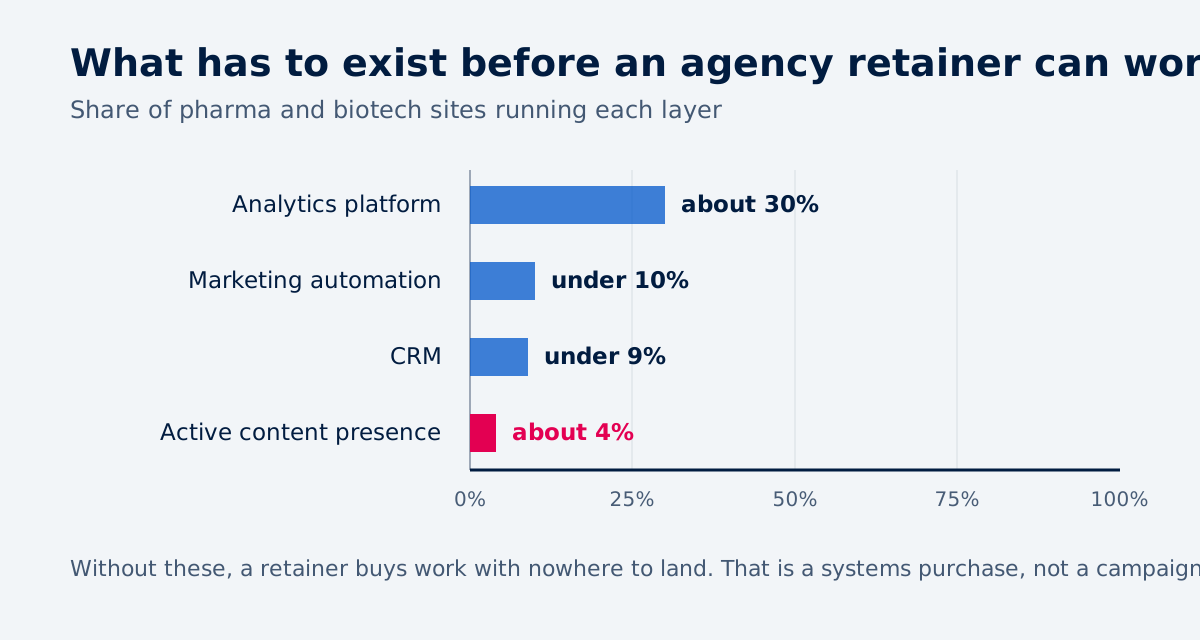
That is common rather than rare. About 90 percent of pharma and biotech websites show no meaningful signs of content marketing, and about 4 percent show an active, intentional presence.
The fix is a systems purchase rather than a campaign purchase, and it is usually the argument behind the in-house versus outsourced question as well. When we worked with Westlab, a life sciences manufacturer selling to laboratories, the constraint was that their real expertise lived inside the sales team and reached one lab at a time. Building the content system that carried it produced 241 inbound leads in three months, $120,000 of influenced quotes, and 869 percent return on the content investment. No campaign would have moved them, because the campaign was never the problem.
If you want a second opinion on the sequencing before you commit a retainer, a life sciences marketing consultant is a cheaper way to find out than a twelve-month contract, and our note on when to hire an agency at all sets out the timing.
The short version
Your situation | What to hire |
Launch, promotional campaign, congress year, MLR-heavy work | A pharma promotional specialist, selected on review fluency and therapeutic depth |
Reach beyond the field team, HCP or patient engagement at scale | A media and engagement specialist or a commercialisation platform |
Content exists but produces no pipeline, and there is no CRM or attribution | The systems layer first, then campaigns once there is somewhere for them to land |
Whichever row you are in, the selection is easier once you have read your own pharma content benchmarks first, because you stop asking agencies to tell you what your own estate already says.
Is your pharma content producing pipeline, or just clearing review?
Get a Content RevOps audit, your pharma content benchmarked against the 2026 data, with every search, AI-answer, and conversion gap named and priced in numbers your CFO can argue with.
Frequently Asked Questions
About the Author

Founder & CEO, Content RevOps
Stefan Kalpachev is the founder and CEO of Content RevOps, where he helps B2B SaaS companies transform their content into predictable pipeline. With a background in content marketing and revenue operations, Stefan has developed a unique methodology that bridges the gap between content creation and revenue generation.
Connect on LinkedIn