Pharma marketing strategy, a 2026 playbook
Only 4% of pharma companies bid on the search terms their buyers actually use. Want to see the uncontested ground your plan is leaving on the table?
Book a CallThe usual way to build a pharma marketing strategy is to start with channels. Pick the congress calendar, book the media, brief the agency, and call the resulting list a strategy. It is a media plan wearing the word strategy, and no amount of content marketing bolted on afterwards will turn it into one.
Part of Life science marketing strategy, the five decisions that make one.
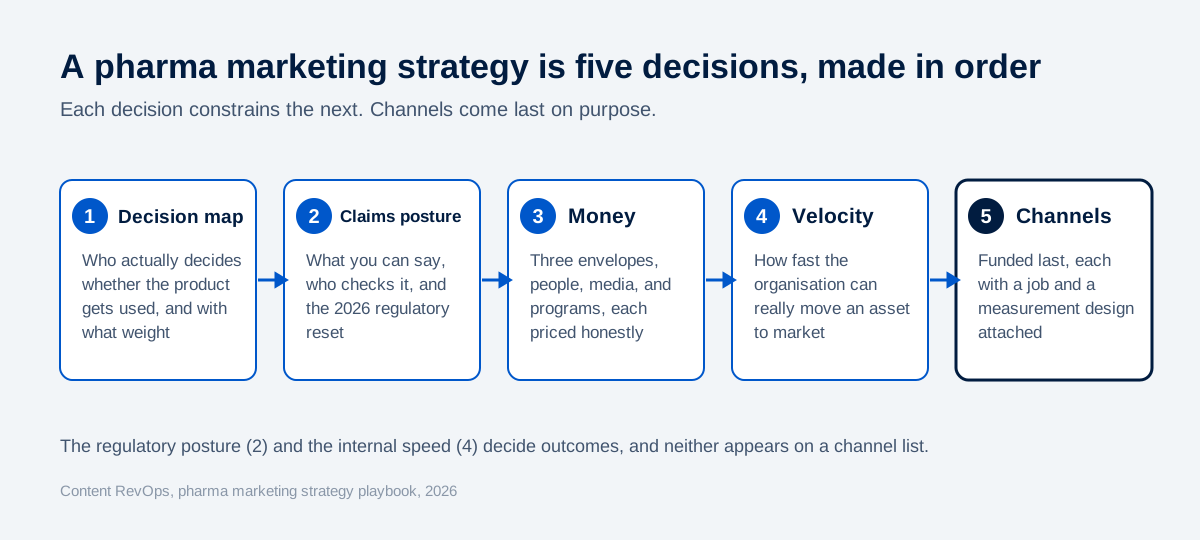
We think that gets the order backwards. The two things that actually decide whether a pharma marketing plan works in 2026, your regulatory posture and your internal speed, never appear on a channel list at all.
So this playbook runs the other way. Five decisions, made in order, each one constraining the next. Channels come last on purpose, because until the first four decisions are made, you cannot know which channels deserve money.
We wrote it for the people who have to produce the plan; marketing leads, small commercial teams, and the founders and general managers at emerging and mid-size pharma and life science companies who carry marketing alongside everything else.
What is a pharma marketing strategy in 2026?
A pharma marketing strategy is the ordered set of decisions that determine how a pharmaceutical company creates and captures demand for its products within the constraints of its label, its regulators, and its own operating speed. It is a decision document, and the annual brand plan is where those decisions get written down.
The five decisions, in order:
- The decision map. Who actually decides whether your product gets used, and how much weight each decider carries for this specific product.
- The claims posture. What you can say, who checks it, and how the 2026 regulatory reset changes what you should say.
- The money. How the budget splits across people, media, and programs, and what each envelope really costs.
- The velocity. How fast your organisation can actually move an asset from idea to market, and what to change if the honest answer is slow.
- The channels and the proof. Which channels earn a place, and the measurement design that tells you whether they worked.
The familiar framing of pharma marketing splits it into push and pull; push toward healthcare professionals through reps and clinical evidence, pull from patients through consumer advertising. That split is real, but it describes two delivery mechanisms, and a strategy is the set of decisions that comes before either. Decide the five things above and the push-pull balance falls out on its own. If you want the wider frame first, what life science marketing actually covers sets the boundaries this playbook works inside.
Decision 1, who actually decides whether your product gets used?
Start by mapping every seat at the decision table, because for most pharma products the prescriber is no longer the only one, and often no longer the main one.
Decider | What they control | What convinces them |
Prescriber | Whether your product gets chosen | Clinical evidence, peer practice, workflow fit |
Payer | Whether anyone can afford it | Health economics, outcomes data, budget impact |
Patient | Whether treatment starts and continues | Plain-language benefit, cost clarity, access ease |
Pharmacist | Whether the script survives the counter | Substitution economics, stocking, familiarity |
The AI answer layer | What all of the above read first | Structured, cited, authoritative content |
The weight shifts by product. A specialty biologic lives with prescribers and payers. An OTC line lives with patients and pharmacists. A primary care product spreads across all five. Write the weights down for your product before you fund anything, the same way you would map the funnel before choosing what to build for it.
The prescriber lane keeps narrowing
ZS's AccessMonitor, which aggregates sales-call records from roughly 70% of US pharma reps, reports that physicians' willingness to engage frequently with sales reps sits near historic lows, even though their overall availability has stabilised.
The same research carries a sharper warning about frequency. ZS found that healthcare professionals who received 12 promotional emails a month from a single brand opted out, no matter how useful the content was. Once a prescriber opts out, that channel is gone; frequency is a budget you spend once. Spending it well is a question of relevance and sequencing, which we work through in pharma email marketing.
Specialty access is tighter still. In oncology, 68% of providers are access restricted, roughly 2.5 times the level of other specialties, and reps now detail only 5% of oncologists twelve or more times a year, down from about 20% a decade ago.
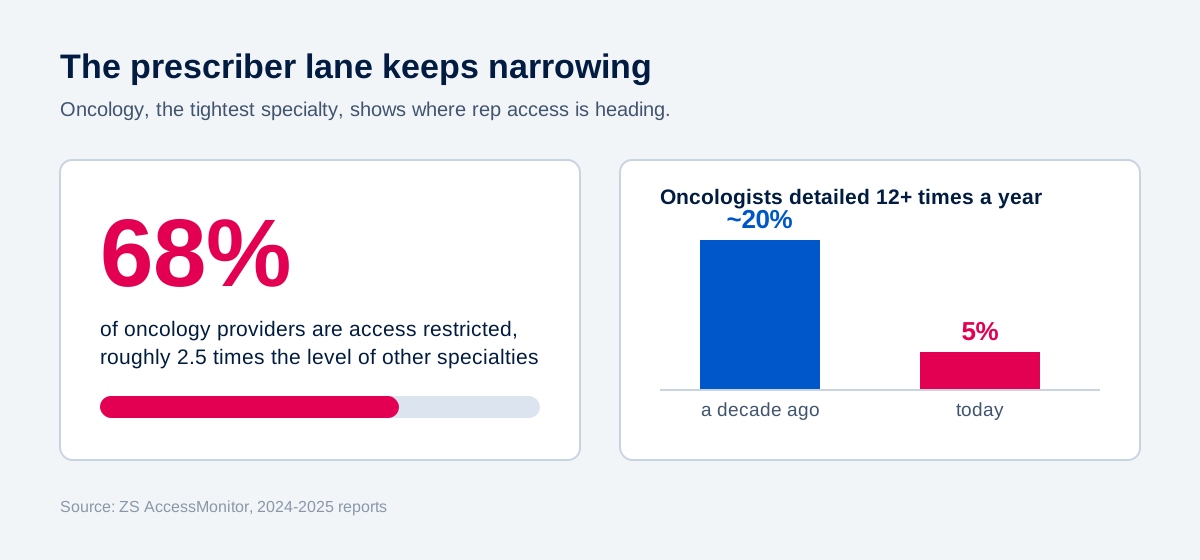
The strategy consequence is plain. Rep reach is a shrinking, product-specific asset, so the plan has to state how much of the prescriber conversation happens through reps and how much through the channels prescribers still choose to read.
The payer gets a seat and then gets starved
Every pharma strategy names the payer as a stakeholder. Almost none of them feed the payer any evidence.
In our analysis of pharma company websites, close to 0% publish an ROI calculator or a direct comparison page. Payer audiences buy on health-economic proof, and the industry keeps that proof locked in field decks that only surface after a meeting is already won.
If the payer carries real weight on your decision map, the plan needs a line item for public, self-serve economic evidence; budget-impact summaries, outcomes pages, comparison material inside the label. This is cheap relative to media, and it works while you sleep. The constraints that make pharma content hard are also what makes this gap so durable.
The manufacturer-owned lane is now real
The newest seat at the table belongs to the manufacturer itself. LillyDirect passed one million patients served as of early 2026, and Lilly reports that 45% of new prescription volume for its obesity medication now originates through the platform.
Nearly half of the new starts for one of the world's biggest launches flow through a channel the manufacturer built and controls, a platform combining telehealth and pharmacy services.
L.E.K.'s analysis of these platforms draws the boundary well. Direct-to-patient works where patient activation is high, the clinical decision is standardized, and insurance friction blocks access. Provider-anchored categories like oncology stay in traditional care.
Two cautions belong in the plan. Senators are scrutinising these platforms for steering and anti-kickback risk, and a company without Lilly's scale rents this capability through partners rather than building it. But even for a mid-size company, the strategic question has changed; the decision map now includes a lane you can own.
Decision 2, what can you say and who checks it?
The second decision is your claims posture; what the strategy promises the market, stated inside the label, and built for the enforcement climate you will actually launch into. Two federal moves now define that climate, one rule and one enforcement wave.
What changed in September 2025
On September 9, 2025, the FDA announced a crackdown on direct-to-consumer drug advertising; thousands of notice letters to every application holder, approximately 100 cease-and-desist letters, and rulemaking to close the 1997 "adequate provision" rule that let broadcast ads state major risks briefly and point viewers elsewhere for the rest.
The scale of the reversal matters more than the headline. FDA warning letters on drug promotion had fallen to one in 2023 and zero in 2024. The agency went from near-zero enforcement to a blitz in a single day, and Sidley's analysis counts 107 warning and untitled letters released in the wave, more than half aimed at compounded drugs, with most of the approved-product letters covering TV ads, plus earned media, sponsored links, and webpages.
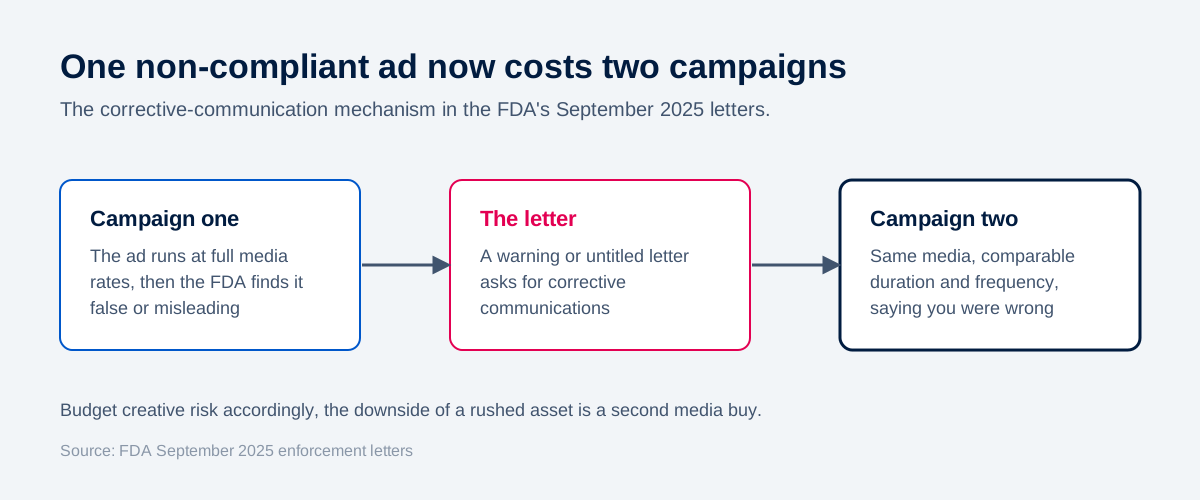
One mechanism in those letters should reshape how you budget creative risk. The FDA asked companies to run corrective communications distributed through the same media, and generally for the same duration and frequency, as the violative ad. A non-compliant campaign no longer costs you a takedown; it costs you a second campaign, at full media rates, saying you were wrong.
The CCN rule turned risk language into a production spec
The other half of the reset arrived earlier. The FDA's Clear, Conspicuous, and Neutral final rule, effective May 20, 2024 with a compliance date of November 20, 2024, sets five standards for how TV ads present the major statement of side effects and contraindications; three of the five also apply to radio:
- Consumer-friendly language, readily understandable
- Audio at least as understandable as the rest of the ad, in volume, articulation, and pacing
- Concurrent text alongside the audio in TV ads, running for the length of the statement
- Text that can actually be read, in size, contrast, and placement
- No audio or visual elements likely to interfere with comprehension during the statement
The September 2025 letters already cite CCN violations, so the two moves compound; the rule defines the spec, and the enforcement wave shows the agency will police it.
Why regulators believe the ads earned this
The evidence behind the crackdown is worth knowing, because it tells you where the enforcement pressure will stay. A review of 97 DTC television ads aired in 2015 and 2016, summarised in the Journal of General Internal Medicine, found that 26% provided quantitative efficacy information, none provided quantitative risk information, and 13% promoted off-label use.
And the ads work on prescribers through patients. In a randomized trial using standardized patients, people who requested a DTC-advertised antidepressant received prescriptions significantly more often than those who made no request. That mechanism, patient request driving prescribing, is exactly why the ads draw regulatory attention in proportion to how well they perform.
A product marketer on r/biotech asked the question every pharma team wrestles with; how do you take all the complexities and disclaimers and turn them into "a simple narrative without being misleading"? The 2026 answer is to narrow the claim rather than simplify it. A precise claim to a precise audience clears review and survives enforcement; a broad claim does neither.
The stop, keep, shift list
Translate the reset into posture with three short lists.
Stop:
- New broadcast or digital creative that leans on adequate provision to abbreviate risk
- Influencer and earned-media placements that skip full promotional review
- Pixel-based tracking on patient-facing pages without a privacy review
Keep:
- Fair-balance-native creative, with risk presentation designed in from the brief
- Voluntary OPDP advisory comment on major campaigns before the media commitment
Shift:
- Budget toward formats with room for complete risk presentation; longer video, owned pages, HCP channels
- Claims work toward a pre-cleared modular library, so every new asset assembles reviewed language instead of relitigating it
That last shift is where claims posture meets the fourth decision, speed.
Decision 3, where does the money actually go?
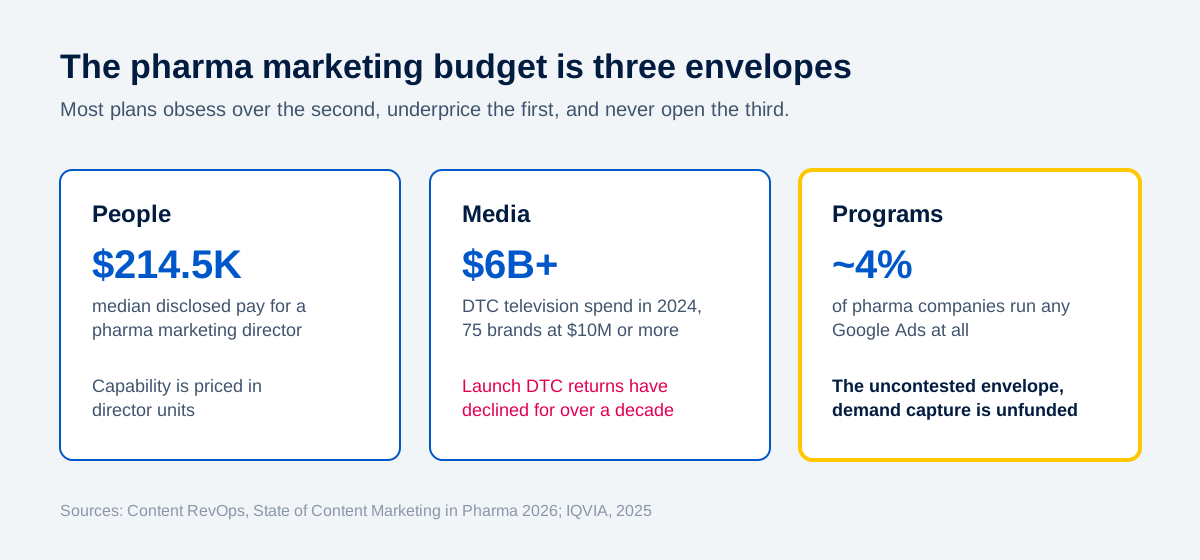
A pharma marketing budget is three envelopes; people, media, and programs. Most plans obsess over the media envelope, underprice the people envelope, and never open the third one at all. The wider discipline of budget allocation applies here, but the pharma weightings are their own problem. Sizing the total envelope, rather than splitting it, is a separate exercise, and the sector-wide version of it sits in how life science companies justify and measure marketing spend.
People, priced in director units
In our analysis of pharma marketing pay, disclosed director-level salaries carry a median around $214,500, and mid-senior roles sit near $156,000, with the step from individual contributor to people manager alone worth about $58,000.
Those numbers set the real unit price of capability. By that math, three senior in-house hires run roughly $600,000 a year before a single ad does, which is why most pharma marketing organisations run a small senior core and buy execution outside; a structure worth choosing deliberately rather than inheriting. What that senior core costs when you buy it by the day instead of hiring it is the subject of our guide to hiring a life sciences marketing consultant.
Media, where the raw dollars pool
Pharma put over $6 billion into DTC television alone in 2024, with 75 brands each spending at least $10 million and a third of every DTC dollar going to immunology, according to IQVIA.
The same IQVIA analysis carries the number that should discipline the envelope. Nine specialty brands launched in 2022 produced a combined $1.3 billion in gross sales while spending $1.1 billion on DTC across their first two years, and IQVIA describes average launch DTC returns as declining for over a decade. Spend at that ratio buys awareness; it does not buy payback.
For most companies below the top 75 brands, the lesson is to size the media envelope to a specific, measurable job, patient activation in a category where patients act, and to refuse the ambient version whose only output is reach.
Programs, the envelope nobody opens
The third envelope funds demand capture; search, owned content, and the assets that catch buyers already looking. In pharma it is nearly untouched.
About 4% of pharma companies run any active Google Ads campaign, adoption roughly an order of magnitude below adjacent B2B sectors, and most of that gap is choice rather than regulation. On the organic side, about 2% of pharma's ranked keywords are bottom of funnel, so commercial-intent searches resolve on third-party sites by default.
Read those two numbers together. The demand-capture layer in pharma is cheap because almost nobody bids, and the buyers searching commercial terms today land on someone else's page. Small money here buys uncontested ground, which is the opposite of the immunology TV market above. The work starts with a topical keyword map that separates the terms your label can serve from the ones it cannot.
Decision 4, how fast can you actually move?
Every plan assumes a speed. Almost no plan checks whether the organisation can deliver it, and in pharma the gap between assumed and actual speed is where strategies die.
A practitioner in a pharma digital marketing thread put it better than any benchmark; "it's MLR review cycles killing campaign momentum. Most pharma brands underperform digitally because of slow approvals, not poor channel choice."
What review speed actually costs
Medical, legal, and regulatory review is the metering valve on everything a pharma marketer ships. Indegene's 2026 review of MLR operations puts the manual review cycle at roughly 21 days and about three rounds per asset, at $2,500 to $5,000 per asset; vendor-published figures, but directionally consistent with what practitioners describe. That valve is also why generating faster does not ship faster, which is the mechanism behind why the largest life science companies name AI least.
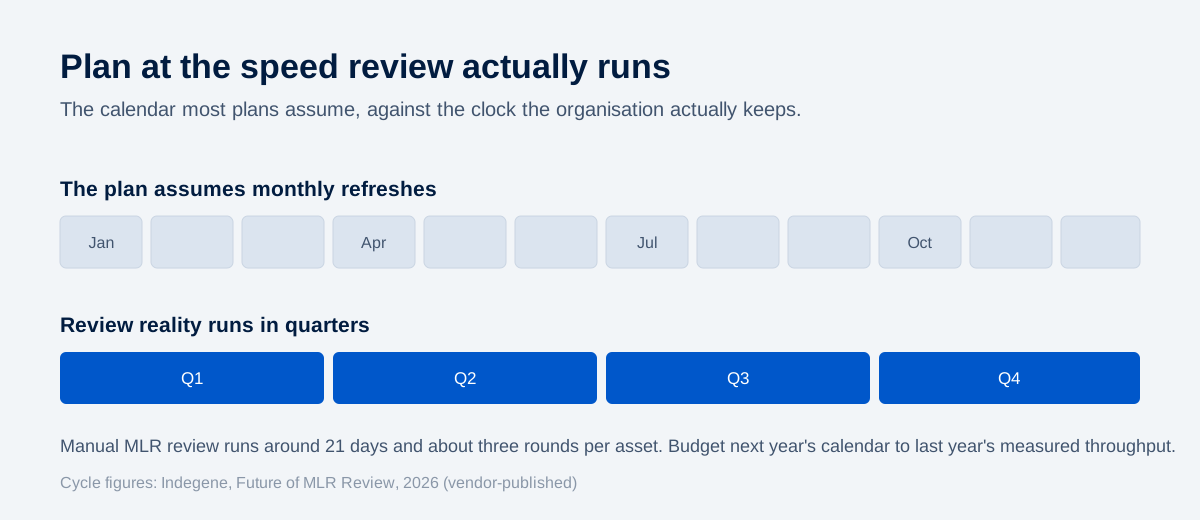
Hold those figures against a monthly campaign calendar. When the review clock runs in weeks and most assets circulate more than once, the calendar's real planning unit is the quarter, and a plan built on monthly creative refreshes is fiction.
Two forces from earlier decisions raise the price of pretending otherwise. The corrective-communication mechanism from Decision 2 means a rushed asset that clears internally but fails FDA scrutiny costs a second campaign. And ZS's frequency finding from Decision 1 means a wasted touch is unrecoverable; you cannot win back a prescriber who opted out while a better asset sat in review.
What pharma marketing teams are actually built to do
Velocity is also a structure question. In our analysis of pharma marketing job posts, data analytics appears in about 41% of posts, the second most hired-for skill cluster, while content strategy appears in about 17%; roughly one post in six.
The shape those numbers describe is a team hired to coordinate and measure, with execution bought from agencies and freelancers. That is a workable design, but only if the plan treats it as a design; agency handoffs, briefing quality, and review logistics belong in the strategy, because they are where the calendar actually slips. Choosing who holds that execution belongs in the same design, and our review of the demand generation agencies working in life sciences sets out what each one can prove. The selection itself, and the checks that cut the field before anyone pitches, are in how to choose a pharma marketing agency.
What to change when the honest answer is slow
If your measured cycle time cannot support the plan, change the plan, not the assumption. Reusing content that already cleared review is the fastest lever you have, which is why the pharma tactics that compound start with the pages you already publish. We think four moves matter most:
- Fewer, bigger campaigns. Concentrate the year into fewer assets that each carry more weight through review.
- A modular claims library. Pre-clear the claims once, then assemble assets from reviewed blocks instead of submitting fresh language every time.
- Parallel review. Route medical, legal, and regulatory concurrently; sequential routing multiplies every cycle.
- Throughput-based planning. Count the assets your team actually cleared last year and budget next year's calendar to that number, not to ambition.
That last move is the one most teams skip, and it is the reason a content calendar should be built from measured throughput rather than from the shape of the year. The same logic applies to the content engine itself; we walk through it product by product in our pharma content marketing guide.
Decision 5, which channels earn a place and how will you know?
Channels come last, and each one enters the plan only with a job and a measurement design attached. For 2026 the shortlist looks like this, and the general question of which channels to prioritise gets a pharma-specific answer. What that measurement design has to contain, and what has to be installed before it works, sits in pharma marketing analytics.
Channel | The job it does | What to watch |
Congresses and field | Specialty credibility, KOL relationships | Fixed calendar; cost per meaningful contact |
Company credibility, hiring, HCP-adjacent reach | Default digital channel; reach outruns engagement | |
Endemic HCP platforms | Prescriber attention inside clinical workflow | Vendor reach claims need a discount |
Search and owned content | Demand capture, payer and patient self-education | Near-zero competition on commercial terms |
The AI answer layer | What every decider reads first | Citations concentrate in government and academic sources |
DTC media | Patient activation, where patients act | Only inside the Decision 2 posture |
Three of these deserve a closer look, because the surface numbers mislead. The channel-by-channel detail, including what each one costs and what it can realistically return, sits in our guide to digital marketing for pharma.
LinkedIn is the named default, treat it accordingly
In our analysis of pharma marketing job posts, LinkedIn is named in about 12% of them, roughly one post in eight, which makes it the default named digital channel in the industry's own hiring language. The channel is where pharma credibility compounds, and it rewards the companies that publish rather than broadcast, which is the same pattern across B2B distribution channels generally.
The practitioner view on the endemic layer is blunter. As one pharma digital marketer put it, Doceree, Medscape, and Epocrates beat generic platforms for HCP campaigns, and "NPI-matched targeting is underused even by big brands"; targeting verified prescriber identities instead of demographic lookalikes.
Vendor reach numbers need a discount
Medscape's media kit claims 94% monthly reach of US physicians across more than a million registered users. An independent 2025 survey of roughly 1,000 clinicians, run by M3 Global Research, found UpToDate used monthly by 86% of US clinicians, MDCalc by 61%, Medscape third, and no other tool above 50% monthly use; both Medscape and Epocrates drew negative Net Promoter Scores.
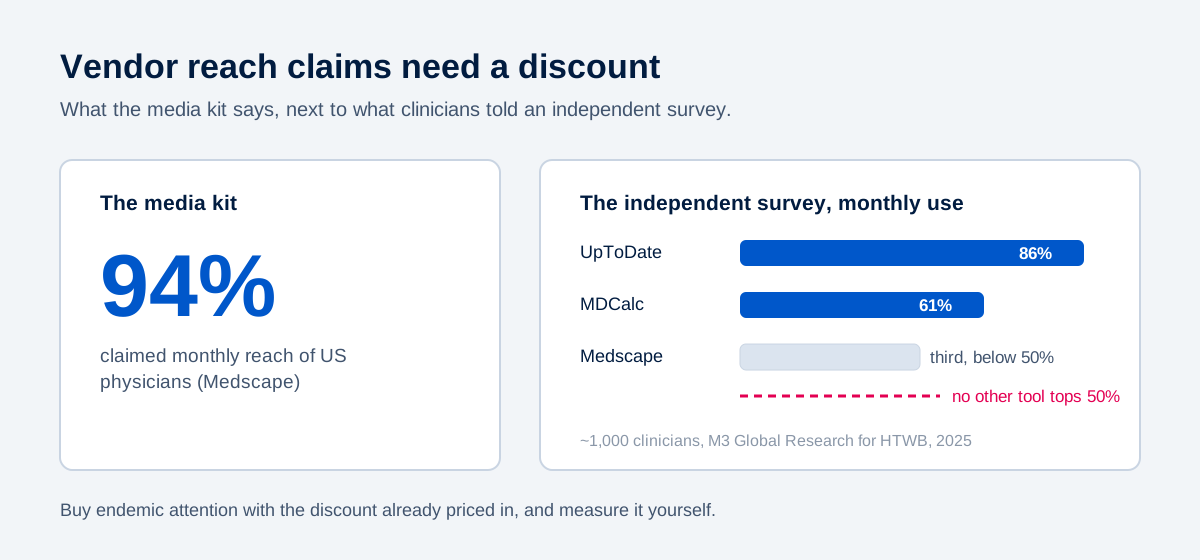
The gap between a media kit and an independent survey is the standard discount to apply to every reach claim in this market, so buy endemic attention with that discount already priced in.
The same survey carries the forward-looking number; about one clinician in four already uses OpenEvidence, a generative-AI clinical tool, monthly. The AI answer layer is not a patient phenomenon. It sits inside the clinical workflow now, and in our analysis of AI-generated answers, pharma sites appear in about 33% of awareness-stage responses while government and academic domains dominate the rest. Earning a share of that layer is a content problem, and what gets a brand cited in AI answers is a different question from what ranks, which is also why strong rankings do not guarantee AI visibility. We cover the pharma mechanics in the pharma content marketing guide.
What honest measurement looks like
Prescription data makes pharma one of the few industries where marketing can measure real outcomes, and one of the easiest in which to fake it. Three designs are accepted practice, as laid out in PM360's measurement walkthrough:
- Marketing-mix modeling, a statistical read of how spend moves new-to-brand prescriptions over time
- Matched test versus control, comparing exposed and unexposed groups assembled after the campaign
- Holdout sampling, where a control group is carved out before launch and deliberately left unexposed
The honest hierarchy runs bottom-up. ZS's own measurement team documents how traditional matched test-and-control breaks in practice; low match counts, subjectively relaxed criteria, and results that change on rerun.
A pre-planned holdout avoids most of that, which is why the strongest design is also the simplest. Reserve a slice of the target audience before launch, run the campaign everywhere else, and read the difference in new-to-brand prescriptions over the following weeks, at whatever lag your category's prescription data carries.
Everything runs on aggregates; HIPAA bars joining ad exposure to individual patients, so measurement lives at the level of geographies, prescriber deciles, and panels. Any vendor promising patient-level attribution is describing something you should not buy. The same discipline governs which metrics deserve tracking and which only look like proof.
And that is the admission test for the whole channel table. A channel with a job and a holdout is a strategy; a channel with a recall study from the vendor selling it is a belief.
What does the plan look like on one page?
The output of the five decisions fits on a single page, and the discipline of writing each one as a sentence is most of the value.
Decision | The line your plan writes down |
Decision map | Our product is decided by [deciders], weighted [weights]; the plan funds each in proportion |
Claims posture | We claim [narrowed claim] to [audience]; stop, keep, shift list attached |
Money | People $X, media $Y with [specific job], programs $Z on capture |
Velocity | Measured cycle time is [N] days; the calendar carries [M] assets, not more |
Channels and proof | Each funded channel has a job and a holdout; review dates set |
Revisit on different clocks. The decision map and claims posture are annual calls unless the label or the regulatory climate moves. Money and velocity get a quarterly look. The channel table earns a monthly review against its own measurement design, and reporting built for that cadence keeps the review honest.
From there, two useful next steps. Benchmark your own content estate against the sector with the pharma content benchmarking tool, and go deeper on the demand engine itself in the State of Content Marketing in Pharma 2026. If your remit runs wider than pharma, the complete guide to content marketing for life sciences covers the adjacent branches.
Does your 2026 plan survive contact with the five decisions?
Get a Content RevOps audit, your decision map, capture architecture, and AI-search visibility benchmarked against the pharma 2026 data, with every gap priced in numbers your CFO can argue with.
Frequently Asked Questions
About the Author

Founder & CEO, Content RevOps
Stefan Kalpachev is the founder and CEO of Content RevOps, where he helps B2B SaaS companies transform their content into predictable pipeline. With a background in content marketing and revenue operations, Stefan has developed a unique methodology that bridges the gap between content creation and revenue generation.
Connect on LinkedIn