Pharma email marketing and nurture that respects the rules
Two-thirds of pharma sites collect email addresses and can do nothing automated with them. Want to see where your content leaks pipeline?
Book a CallMost pharma marketers already believe in email. Look at their websites and you can see the vote: about two-thirds of active pharma sites, roughly 2 in 3, put a newsletter signup somewhere on the page, according to our analysis of content marketing in pharma. The intent is there. People are asking to be emailed. What decides whether any of it turns into pipeline is the marketing automation layer sitting behind the signup box.
Part of Content Marketing for Pharmaceutical Companies.
The problem starts the day after they subscribe. The machine that would send those people something useful, on a schedule, based on what they care about, usually does not exist. So the list sits idle, or it gets one generic blast a quarter, and everyone concludes email does not work in pharma.
It works. It is the cheapest owned channel a regulated company has, and the one it least often runs properly. This guide covers the four things that decide whether pharma email earns its keep: whose consent you actually need, how to build a list you own, what a compliant nurture sequence looks like, and how to make sure the emails land. If you are still deciding which channels deserve the budget at all, our guide to digital marketing for pharma maps the wider set.
Does email marketing still work for pharma?
Yes, and the honest answer is more useful than the cheerful one. Email still reaches healthcare professionals and patients better than almost anything else you own outright, because you are not renting the audience from a platform that can change the rules. You keep the list, you keep the relationship.
The catch is that the inbox is crowded, and pharma helped crowd it. In a survey of 82 general practitioners and internal medicine physicians in the US and UK, run by HMR with Cermo, doctors reported getting about 15 emails a day from the pharma industry and opening only about 4. One in ten open none at all.
That number gets read as proof that email is dead. It is not. It is proof that most of those emails are irrelevant to the person who got them. When the same physicians were asked what they wanted going forward, 17% said they wanted the industry to stop emailing them. The presenter's own reading is the right one: do not stop sending, find that 17% and reach them a different way, and send the rest something worth opening.
Relevance is the whole game. Personalized pharma email, tuned to a recipient's specialty and interest, lifts open rates by about 26% and click-through by about 14%. The question is never whether pharma email works. It is whether your team can send the relevant version at scale, and that is a capability question. The same relevance problem shapes every other channel aimed at clinicians, which is the subject of our guide to HCP content marketing for pharma.
Why can't most pharma teams run email marketing well?
Because the plumbing is missing. Email that segments, triggers on behavior, and nurtures over weeks needs marketing automation and a CRM underneath it, and most pharma companies have neither.
Our analysis of pharma sites found marketing automation running on fewer than 1 in 10, with HubSpot the most common tool among the small minority that have any. A CRM turns up on fewer than 1 in 12 sites, and it is the single largest constraint on the whole thing, because content cannot connect to pipeline without one. Even at the top of the market, above $500M in revenue, CRM adoption only reaches about 29%, roughly 3 in 10.
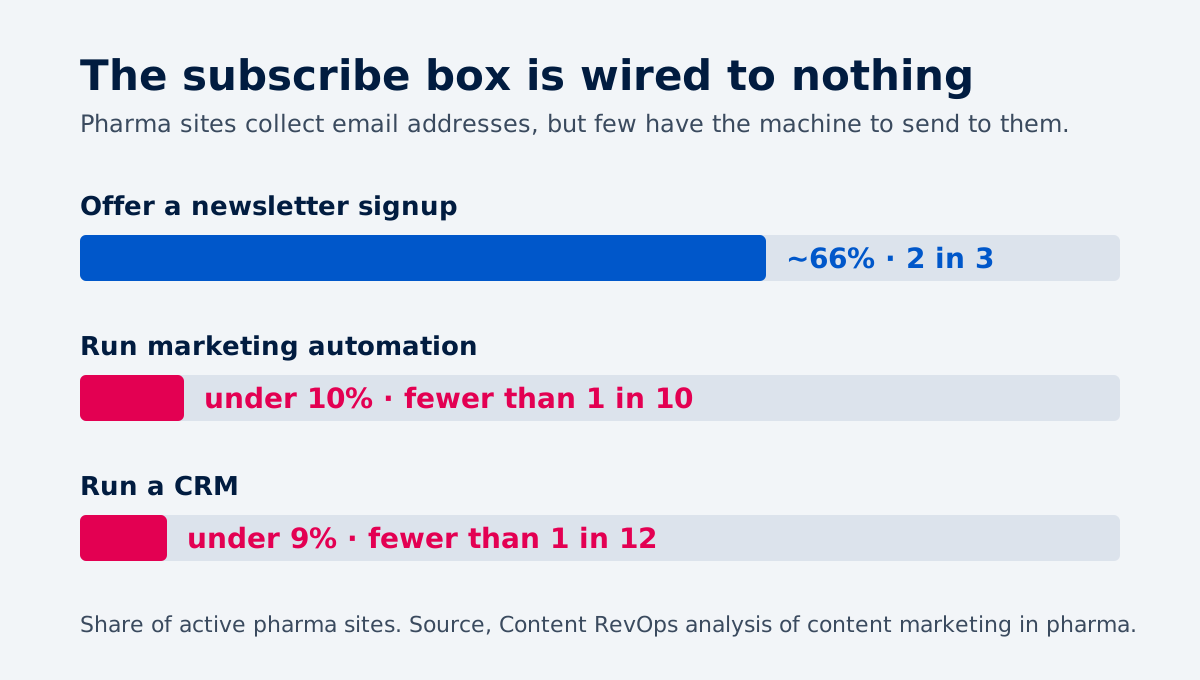
Put those two facts together and the picture is clear. Two-thirds of sites collect email addresses. Fewer than one in ten can do anything automated with them. The subscribe box is wired to nothing.
That is why the same list produces a quarterly blast instead of a nurture. Without automation, every good idea becomes a one-off send that somebody has to build by hand, so most of them never ship. This guide is about the email program itself, not the marketing automation platform underneath it. That platform is the layer that has to exist first, and the wider set of choices it sits inside is laid out in our pharma marketing strategy playbook. Everything below assumes you are getting that layer in place.
Whose consent do you actually need for pharma email?
This is where most pharma email programs freeze. A marketer on Reddit put the fear plainly while shopping for a tool: "my biggest concern is all of them require collect consent from the user." The belief that every recipient must first hand over explicit consent stops programs before they start.
It is mostly wrong. The rule you follow depends on who you are emailing and where they are, and the four common cases are not hard once you separate them.
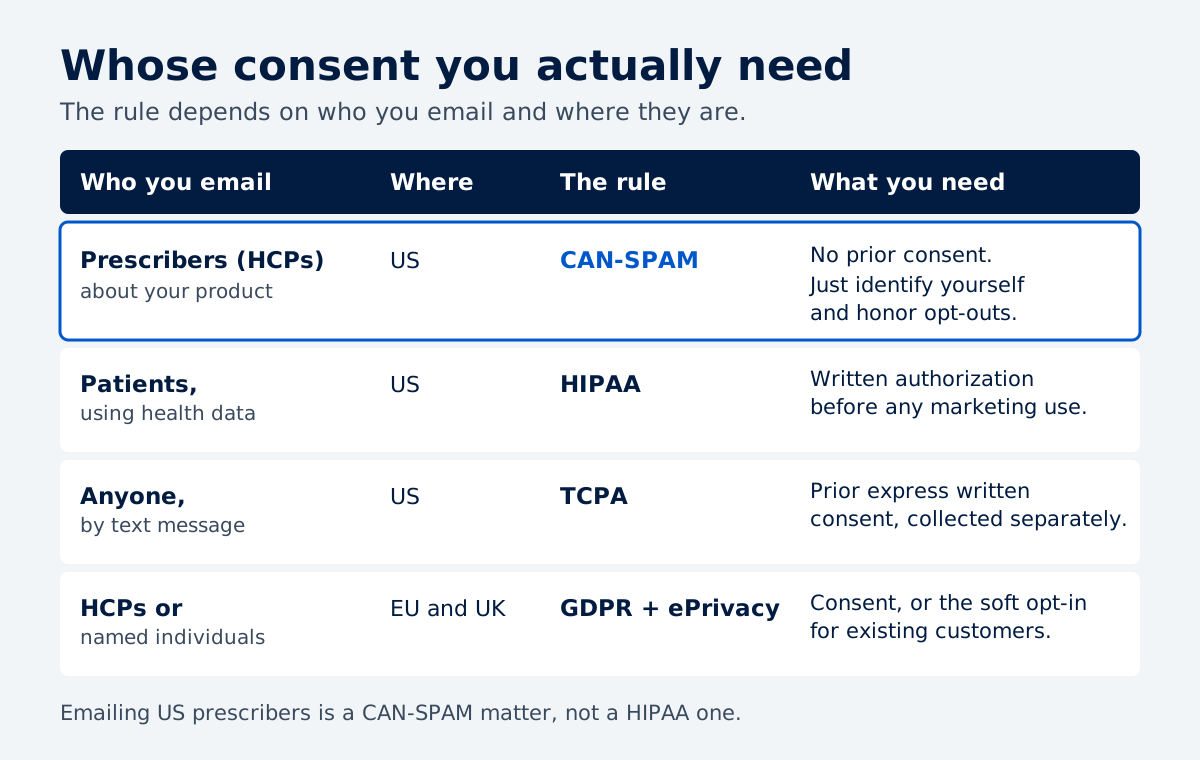
Who you are emailing | Where | The rule | What you actually need |
Prescribers (HCPs) about your product | US | CAN-SPAM | No prior consent. Accurate sender and subject, identify it as an ad, a real postal address, a working opt-out |
Patients, using their health data | US | HIPAA | Written authorization before any marketing use of their health information |
Anyone, by text message | US | TCPA | Prior express written consent for marketing texts, collected separately |
HCPs or named individuals | EU and UK | GDPR and ePrivacy | Consent, or the soft opt-in for existing customers and similar products |
Emailing US doctors is a CAN-SPAM matter, not a HIPAA one
The most expensive misconception in pharma email is that HIPAA governs your outreach to prescribers. It does not. HIPAA protects a patient's health information held by a covered entity like a hospital or a health plan. A drugmaker emailing a physician about a product is not using a patient's health information, and the physician is not a patient, so that email falls under CAN-SPAM.
And CAN-SPAM, the federal law for commercial email, does not require opt-in. In the FTC's own words, the Act "doesn't require initiators of commercial email to get recipients' consent before sending them commercial email." You can email a US prescriber about your product without prior permission, as long as you follow five plain rules from the FTC:
- Use an accurate "From" line and a subject that is not deceptive.
- Say the message is an ad.
- Include a valid physical postal address.
- Give a clear, working way to opt out.
- Honor opt-outs within 10 business days, and keep the opt-out link live for at least 30 days.
That is the entire bar for reaching HCPs. No consent gate, no legal maze, five requirements you can check in a minute.
Emailing patients is where authorization bites
The patient side is genuinely different, and this is why HCP email and patient email are two separate programs, not one list with a filter. Under the HIPAA marketing rule, a covered entity needs an individual's written authorization before it uses their protected health information to market a product or service to them.
There are narrow carve-outs. A refill reminder is treatment, not marketing. Care coordination is not marketing. But a promotional email that leans on someone's health data crosses into territory that needs a signed authorization, defined in 45 CFR 164.508. Treat your patient audience as a program with its own consent basis, its own content review, and its own list.
Text messages are a higher bar, and it got harder in 2025
Text looks tempting because open rates are enormous. It is also the channel most likely to generate a lawsuit. Marketing texts fall under the TCPA, which requires prior express written consent, a separate opt-in that names your brand and is not bundled into a terms-of-service checkbox. Care texts like appointment or refill reminders sit at a lower bar, but the moment you mix a promotion into a care message, the whole text becomes marketing. Penalties run $500 to $1,500 per message.
It got riskier in 2025. A June 2025 Supreme Court decision added uncertainty to what counts as valid text consent, and the safe move now is express written consent for any marketing text, kept separate from any HIPAA authorization. The practical takeaway is simple. Treat SMS as its own consented channel with its own opt-in, or leave it alone.
In Europe, the soft opt-in is the answer to the consent panic
EU and UK rules read stricter, and the Reddit fear is loudest here, but there is a well-worn exemption. The ePrivacy "soft opt-in" lets you email existing customers without fresh consent when three conditions hold: you got the contact in the course of a sale, you are marketing your own similar products or services, and you offer an easy opt-out at collection and in every message.
Europe's top court strengthened this in November 2025. It ruled that a free newsletter promoting paid offerings counts as marketing "in the context of a sale," and that meeting the soft opt-in is itself the legal basis, so you do not also need separate consent under the GDPR. That makes running an owned newsletter off your content markedly easier in the EU.
Two limits keep this honest. The soft opt-in does not cover cold prospecting or brand-new contacts, and in Germany a double opt-in is the expected standard. Patient health data is a special category that generally needs explicit consent. Use the exemption for your existing audience and similar products, not as a door into a cold list.
How do you build a pharma email list you actually own?
The lesson hiding inside the consent rules is that you engineer consent at the moment of capture. You do not need to rent a compliant list from a data vendor. You build one from your content, where the person opts in on your page, for your emails, with a record of exactly what they agreed to.
That starts by fixing a leak most pharma sites do not know they have. In our analysis, about 1 in 5 content-producing pharma sites end their pieces with no next step at all: no offer, no related link, no way to subscribe. The reader finishes, finds nothing, and leaves. That dead end is the single biggest list-building opportunity you own, because the traffic is already arriving, and it is the same conversion work we cover in our guide to pharma content marketing tactics that compound.
You also have the raw material for offers already sitting on the site. About 64% of active pharma sites publish technical whitepapers or deep-dive guides, roughly 2 in 3. Most treat them as content. Wired to a form, each one becomes a reason to subscribe.
Ask for less at first, then build the record over time
The reason long forms fail is not subtle. More than 90% of people will abandon a cumbersome registration rather than fill it in. So you ask for less up front and learn the rest over time, a technique called progressive profiling: a short first form, then a dynamic form that asks for one new thing on each return visit, so a bare email address grows into a full profile of specialty, interest, and role.
Two nuances make this work in a regulated setting, and they are the parts general marketing advice skips:
- Full forms at the decision step. Progressive profiling is wrong for compliance-heavy or bottom-of-funnel moments. When someone requests a rep or a sample, capture everything you need then, because you may not get another turn.
- Let clicks do some of the asking. You can enrich a profile from behavior instead of questions, treating an email click as an interest signal that tags the record without a form at all.
We have watched this exact motion turn a cold market warm elsewhere in life sciences. Working with Westlab, a life-science supplier that sells to lab professionals rather than prescribers, we wired problem-specific guides and a central resource hub as lead magnets against real day-to-day lab problems. In three months that owned-content engine produced 241 inbound leads and influenced $120k in quotes in a market that had run on cold outbound. The audience is not the same as a prescriber audience, and the sector-wide version of this playbook sits in our guide to life science email marketing, but the mechanism is identical: give people a reason to raise their hand, and capture the consent cleanly when they do.
What does a compliant pharma nurture sequence look like?
A nurture sequence is a planned series of emails that moves someone from first interest to a decision, sent automatically based on where they are and what they have done. In pharma it has one extra constraint that decides everything about how you build it: every promotional email is a piece of regulated content that has to clear medical, legal, and regulatory review.
Map the sequence to the buyer's journey, not to a calendar
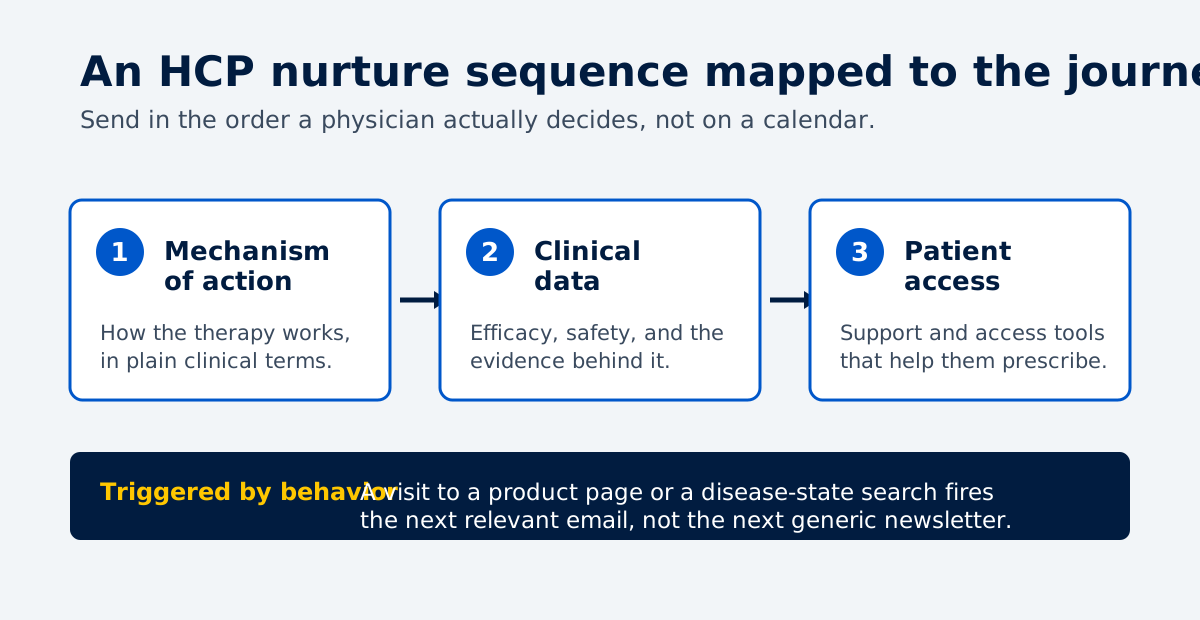
The shape most pharma teams miss is the funnel-mapped drip. For an HCP audience, a sequential education track runs in a sensible order: mechanism of action first, then the clinical data, then the patient-access and support tools. A condition-focused track spaces studies and guidelines over several weeks. Triggered sends fire on behavior, so a physician who visits a product page or researches a disease state gets the relevant follow-up rather than the next generic newsletter.
The patient counterpart runs education into adherence, and stays on the care side of the line: refill and adherence nudges are treatment communications, not marketing, and the two must never share a message. What that education should contain, stage by stage, is set out in patient-centric pharma marketing.
The reason this matters is that most pharma email does the opposite. About 55% of pharma sites put the same generic call to action at the end of every post, regardless of who is reading or how ready they are. It is the largest single conversion fix available, and it costs no new content, only the discipline to segment the offer to the stage. It compounds another gap: about 1 in 3 pharma content producers run no decision-stage content at all, so even a warmed-up buyer has nowhere to land.
Pre-approve the content, or the sequence never ships
Here is the constraint that kills most pharma nurture plans before they launch. Every automated email is promotional content, and promotional content goes through MLR review. In the 2025 State of Promotional Review benchmarks, the average promotional job took 14.8 days to clear. A ten-email nurture reviewed one email at a time is not a campaign, it is a year.
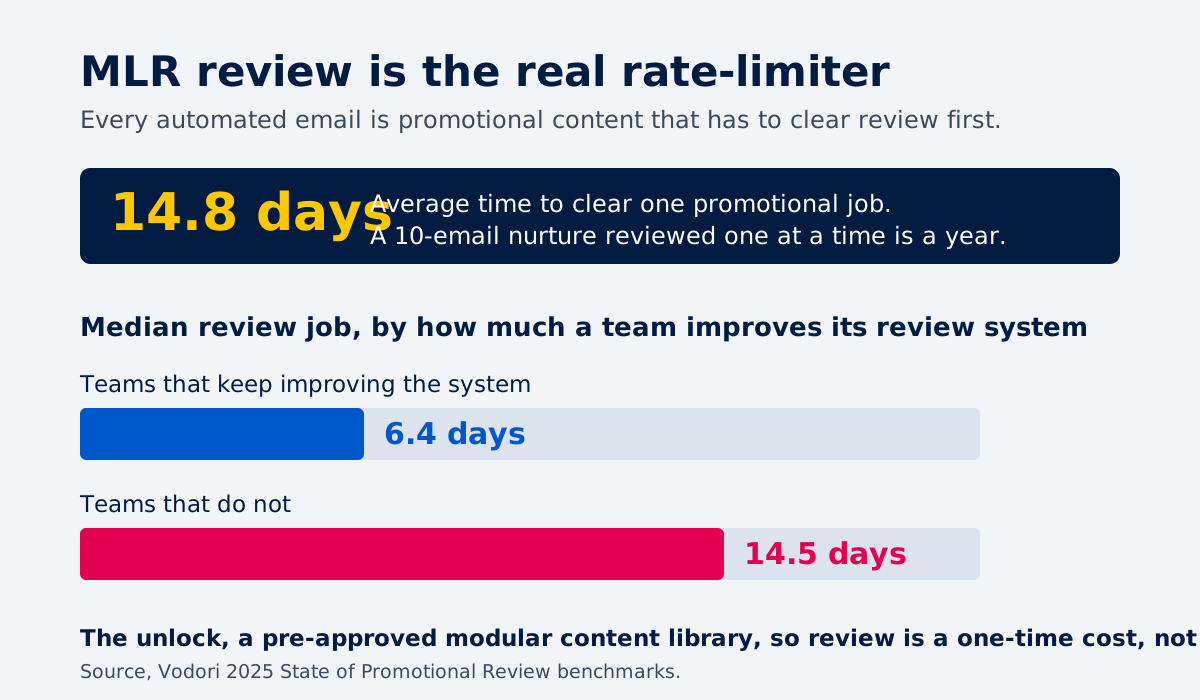
So you do not review a nurture email by email. You build a pre-approved modular content library: MLR-cleared blocks, claims, and modules that assemble into emails, so review becomes a one-time cost instead of a per-send tax. The benchmark data backs the payoff. Teams that continuously improve their review system hit a 6.4-day median job, against 14.5 days for teams that do not. Treat the library as the thing you build before the sequence, not after.
Once it runs, the sequence pays back in a way a blast never does. In the Westlab work, an adjacent life-science example again, content-led nurture kept cautious, price-sensitive buyers moving through a long cycle, and engagement signals from the sequence told the sales team which leads were genuinely serious before anyone picked up the phone. The same principle applies to every other owned channel, which is why email is the distribution layer that keeps a single asset working for months.
How do you make sure pharma emails actually land?
None of the above matters if the email lands in spam, and this is the part no pharma email guide covers. Deliverability is the floor under the whole program, and the rules changed in 2024.
Since February 2024, Google and Yahoo enforce bulk-sender requirements on anyone sending more than 5,000 messages a day to their inboxes. There are three, and they are not optional:
- Authenticate your domain with SPF, DKIM, and DMARC, so the receiving server can prove the email really came from you.
- Offer one-click unsubscribe in the message header, and honor it within two days.
- Keep your spam-complaint rate under 0.3%, with under 0.1% the real target. That is roughly three complaints per thousand sends before your mail starts getting filtered.
That third rule is where pharma email fatigue becomes a deliverability problem, not just a relevance one. Remember the 10% of physicians who open nothing. Left on the list, they are dead weight that drags your sender reputation toward the complaint threshold. List hygiene is now a requirement: sunset the people who never engage, or re-permission them, before they cost you the inbox for everyone else.
One more thing to know before you judge any of this by open rate. Apple's Mail Privacy Protection auto-reports emails as opened whether the recipient looked or not, so your open rate is inflated. Which leads to the last question.
How do you measure pharma email without fooling yourself?
Stop trusting open rate. Between Apple inflating it and the general noise, it tells you little. Measure the things that connect to a decision:
- Clicks and click-to-open, because a click is a real action a person chose to take.
- Replies and requested follow-ups, the clearest signal that an HCP wants the conversation.
- Unsubscribe and spam-complaint rate, which is now both an engagement metric and a deliverability gate you have to keep under 0.3%.
- Email-sourced pipeline, the only number that proves the program pays. That one needs the CRM that fewer than 1 in 12 pharma sites have, which is why measurement and infrastructure are the same investment.
Keep the scorecard short. Four numbers you act on beat twenty you report. The full version of this argument, including how to wire content to pipeline, is in our guide to pharma marketing analytics and ROI, and the broader case for cutting the metrics that do not earn their place is in what to track and not to track.
Where should your pharma email program start?
Start from where you actually are, not from the ideal. Most pharma teams sit in the first rung below, and the fastest wins are there.
If you have no list and no automation
This is the majority. Do three things in order:
- Add a real capture offer to your best-performing content and kill the dead ends, so the traffic you already earn stops leaving empty-handed.
- Stand up one welcome sequence, even a short one, so a new subscriber hears from you more than once.
- Get your consent records clean from day one, so you always know who agreed to what.
If you have a list but no nurture
Segment it by intent. Build the pre-approved modular content library so MLR is a one-time cost, then launch one funnel-mapped nurture track for your most important audience before you try to run five.
If you already run nurture
Harden the parts that decide whether it lasts. Authenticate the domain with SPF, DKIM, and DMARC, wire engagement signals into the CRM so sales sees who is serious, and sunset the recipients who never open before they cost you deliverability.
Email is the channel pharma already paid to half-build. The subscribe boxes are up, the whitepapers are written, the audience is willing. What is missing is the machine that turns all of it into a conversation that ends in pipeline. Give your content that job, get the consent right, and email stops being the underused corner of the plan and becomes the cheapest revenue infrastructure you own. Our analysis of content marketing in pharma shows how much of this ground is still open, which is the good news: the bar to being the most useful sender in your category is lower than it looks.
Is your pharma email a program, or a quarterly blast?
Get a Content RevOps audit, your funnel shape, conversion gaps, and AI-search visibility benchmarked against the pharma 2026 data, with every leak priced in numbers your CFO can argue with.
Frequently Asked Questions
About the Author

Founder & CEO, Content RevOps
Stefan Kalpachev is the founder and CEO of Content RevOps, where he helps B2B SaaS companies transform their content into predictable pipeline. With a background in content marketing and revenue operations, Stefan has developed a unique methodology that bridges the gap between content creation and revenue generation.
Connect on LinkedInRelated Articles
Marketing for Asset Management Firms: Where to Start
Oct 26, 2026
SEO for Asset Managers: A 2026 Digital Marketing Playbook
Oct 25, 2026
Video Marketing for Asset Managers: Turn the Input You Already Have Into a Distribution Engine
Oct 24, 2026