Top Tips for Using Email Marketing for Content Distribution
Want your content to keep creating pipeline after launch? Let’s build your email distribution system.
Book a CallMost teams pour weeks into a strong guide, webinar, or report, then give it a single “launch email,” post it on social a few times, and move on to the next thing. The result is predictable: good content with a short shelf life, and a pipeline that has to be constantly re-fed with new assets.
That’s where email marketing for content distribution makes a real difference. Email is a durable, owned channel. Unlike algorithm-driven feeds, your list is a direct line you can use to resurface the same asset to the right people, in the right context, over months (or years). That’s how you increase content lifetime value: one piece of content that keeps doing work, nudging opportunities forward, reactivating stalled conversations, and giving sales a value-led reason to follow up instead of a generic “checking in.”
Think of this as a content-as-infrastructure mindset. Content isn’t a one-off campaign; it’s part of your revenue operations system, designed to be reused, sequenced, and measured for pipeline impact.
In this article, you’ll get practical tips to turn every asset into a long-lived, revenue-facing email engine, including:
How to sequence content instead of blasting it once
How to reuse and refresh assets without rebuilding them
How to support sales with always-ready, value-forward follow-ups
Tip 1: Design for Email Distribution Before You Create Content
Start with distribution, not just creation
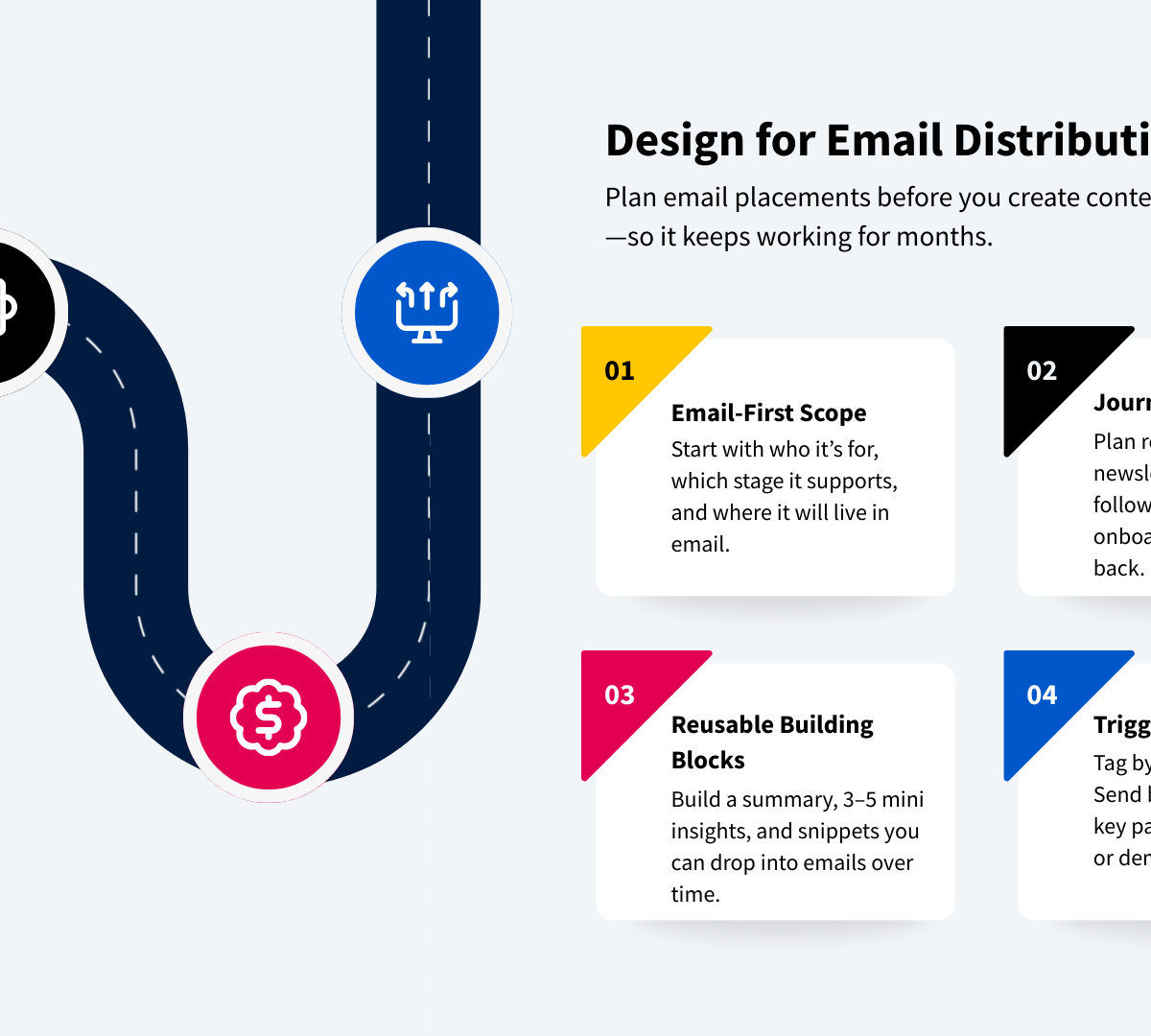
If email is your most durable way to keep content working over time, distribution can’t be an afterthought. High-performing teams scope a new asset by asking email-first questions: Who is this for? Which buying stage does it support? Where will it live inside our newsletter and automated sequences?
That planning is what turns “create once” into “distribute for months.” Without it, you fall into the outdated pattern: publish, send one launch email, get a brief spike, then move on. The asset might be great, but it never compounds because it isn’t designed to re-enter the inbox with fresh context. That’s a missed opportunity when email consistently ranks among marketers’ most effective distribution and ROI channels and when newsletters, in particular, act as ongoing hubs for resurfacing content long after launch.
Map assets to journeys and roles
Before production starts, identify the core email placements where this asset will reliably show up again:
Newsletter features: launch, a follow-up angle, and periodic resurfacing
Automated nurtures: awareness → consideration → decision
Onboarding/education flows: for new leads or new users
Re-engagement/win-back: for dormant contacts
Then assign each placement a job. One asset can do different work depending on where it appears: qualify demand, teach the buyer what “good” looks like, reduce perceived risk, or give sales a useful follow-up that isn’t “just checking in.” Treating email as a deliberate distribution system rather than a blast channel aligns with how leading B2B teams architect multi-touch journeys around existing content, not just net-new campaigns.
As you do this mapping, think in terms of both buyer stage and segment. Strong content programs often maintain a simple matrix of personas by journey stage and then plot specific assets into welcome flows, evergreen nurtures, deal-acceleration sequences, and win-back campaigns so the same guide or case study can advance very different conversations over time.
Plan atomization into email-ready building blocks
Design your anchor asset (report, webinar, customer story) as a modular product, not a one-time download. Build the pieces you’ll need for value inside the email, not just a teaser link:
A thesis summary that works as a newsletter feature
3–5 micro-insights you can drip over time in email bodies
Checklists/frameworks/snippets that plug into different sequences
This is how teams turn one report into a months-long email series, webinar follow-ups, and “best of” roundups that keep the same core ideas in circulation. Modular, “go big, get small” content also makes it much easier to personalize by segment or buying stage without rewriting from scratch; a single anchor asset can power multiple sequences simply by reframing the snippets and subject lines for different audiences. Webinars are the clearest case of that, and our webinar email templates show the same asset reframed for customers, lapsed customers, and cold lists.
When you build for atomization from the start, reuse feels intentional rather than repetitive, keeping the content in rotation for months (or years) with minimal extra lift, and matching how high-performing marketers repurpose big rocks into email mini-courses, curated bundles, and sales-ready snippets.
Link content to your operating system
Finally, wire the asset into how revenue actually moves: define the CRM fields and segments it maps to (persona, industry, deal stage), and choose the behaviors that should trigger it (key page views, webinar sign-ups, demo requests).
This is the Content RevOps view: content is decision infrastructure. If it doesn’t plug into your journeys, data, and sales motion, it’s not a distribution system. It’s just a campaign. Teams that treat email as part of their operating system build shared libraries of assets tagged by funnel stage, objection handled, and segment, then use automation and segmentation rules to continually re-surface those assets at key moments in the pipeline. That operational discipline is what turns each piece of content into a long-lived asset instead of a single-use announcement.
Tip 2: Build a Newsletter That Compounds Content Value
Treat the newsletter as your owned distribution flywheel
A newsletter is the backbone of content distribution because it’s an owned channel: you’re not renting reach from an algorithm or hoping your next post lands at the right time. That durability is what turns “create once” into “distribute for a long time.” Email consistently ranks among marketers’ highest‑ROI channels, with some benchmarks citing returns of around $36 for every $1 spent, which is hard to match with paid or social distribution alone.
More importantly, a newsletter gives you a predictable lane to re-surface evergreen assets, refreshed updates, and modular offshoots from your best work, without needing a new launch every time. Research on content programs that treat email as a central distribution engine shows that subscribers who get regular, high-value newsletters tend to consume significantly more content and return more often than non‑subscribers, which is exactly what you want from a compounding system.
The goal isn’t to push whatever you published this week. It’s to design a system where every new subscriber naturally encounters your strongest, most deal-moving content over time, much like the most effective B2B programs that plug core assets into always‑on email journeys mapped to the buyer’s journey rather than one‑off blasts.
Make each send valuable on its own
If your email is just a teaser plus a link, you’re training people to ignore you. Make the email itself useful: summarize the insight, share the framework, provide the example, then invite the click as the “next step,” not the only step. Long-running, high-performing newsletters (from niche B2B titles to publishers like The New York Times that see open rates north of 50–70 percent) consistently lean on this principle of putting standalone value inside the email itself.
When readers trust that opening your emails pays off, older content you re-feature (or re-angle) gets a better shot at engagement because you’ve built an attention habit. That’s how content lifetime value compounds: the same asset keeps creating sales conversations, reactivating dormant threads, and giving reps a value-led reason to follow up. Programs that adopt this approach often report that “old but gold” content becomes some of their most reliable deal-support material once it is systematically woven into nurture and newsletter flows.
Use a predictable cadence with flexible placements
Consistency beats sporadic blasts. Pick a sustainable weekly or biweekly rhythm and stick to it. Studies of both brand and publisher newsletters show that a clear, predictable cadence is one of the biggest drivers of long-term open and click behavior, particularly when subscribers know roughly what to expect in each send.
A simple structure keeps content in circulation without feeling like reruns:
Primary feature: a current or refreshed “anchor” asset
From the archive: one proven evergreen piece with a new angle or use case
Occasional roundups: “best of,” themed collections, or stage-based bundles (learn → evaluate → decide)
This kind of modular layout mirrors what many top-performing B2B and media newsletters do: reuse the same pillars, but rotate which assets fill each slot so content can be repackaged and resurfaced for months without exhausting the list.
Continuously grow and segment your list
A newsletter compounds when the list grows and the content gets more relevant. Add clear, value-led opt-ins across high-intent pages, and capture a few high-signal fields (like role, industry, or main challenge). Brands that treat list growth as a core content KPI (not just a lead-gen side effect) tend to see much stronger long‑term performance from every asset, because each new subscriber can be introduced to an existing library rather than only new pieces.
Segmentation lets you reuse the same asset differently (positioned by persona, stage, or problem) without recreating it from scratch. Case studies, for example, can be framed one way for early-stage educational nurtures and another way for late-stage objection handling. Email programs that combine behavioral data (what someone clicked or downloaded), basic firmographics, and simple preference settings routinely outperform batch-and-blast sends on engagement and revenue, while dramatically extending the useful life of the content in their library.
Tip 3: Turn One Asset into Many Email Journeys
Atomize anchor assets into email-friendly pieces
If you want content to last, stop treating your flagship report or webinar as a one-time “launch.” Treat it as an anchor asset you can break into email-sized components that deliver value inside the inbox. This is the same principle behind “big rock” content repurposing that many content teams use to keep a single asset driving results for months instead of days.
Example: one webinar can become:
A 3–5 day mini course: one key insight per day, each email self-contained (not just a teaser link). This mirrors how high-performing drip courses and challenges are structured in email programs that have grown lists from hundreds to tens of thousands of subscribers.
A short onboarding sequence: each email tackles a common objection or misconception you heard on calls, functioning like a guided version of the FAQ content you might otherwise bury on your site.
A “stat of the week” series: one slide, one benchmark, one takeaway. It’s easy to skim, easy to forward, and ideal for keeping a flagship report in circulation long after launch.
This approach lets the same core research and narrative support multiple cohorts over time (new subscribers, reactivated leads, specific personas) without creating “new” content from scratch, and aligns with how evergreen guides and reports are reused across long-running nurture programs.
Sequence content by buying stage
Atomization works best when you map each piece to where the buyer is in their journey:
Awareness: problem framing, trends, benchmarks
Consideration: comparisons, use cases, implementation tips
Decision: ROI stories, detailed case studies, objection-handling
This mirrors common content mapping frameworks where a single “big rock” is sliced into top-, middle-, and bottom-of-funnel assets instead of being treated as a single, undifferentiated download. Then, build automated nurtures by stage and profile. Every new subscriber who fits that profile can run through the same proven sequence, extending the asset’s lifespan while keeping messaging consistent across long sales cycles and giving sales a steady pipeline of deal-support content.
Use behavior to trigger the right follow-ups
Make distribution feel timely by using behavior-based triggers that pull your existing content forward at the moment it’s most useful:
Downloaded an eBook: follow with a short series that unpacks the highest-value sections, similar to how many teams turn one report into a week-long “email course.”
Attended a webinar: send a recap, then related deep dives and an implementation checklist, repurposing the same slides, stats, and examples you already created.
Revisited pricing: send decision-stage emails addressing risk, timelines, and outcomes, pointing to case studies or ROI breakdowns you may already be using in sales decks.
Done well, email becomes a quiet, always-on assist that moves deals along without manual chasing, much like high-performing lifecycle programs where automated emails account for a disproportionate share of pipeline touches compared with their send volume.
Equip sales with content-driven email templates
Bake content into sales workflows so follow-ups stay value-led:
Templates that reference a specific insight instead of “just checking in,” turning existing articles, guides, or benchmarks into reasons to reach out.
Proposal/recap emails that link to relevant case studies or ROI breakdowns to reinforce conversations with proof.
Re-open sequences for dormant opportunities using refreshed or updated content drawn from your library of evergreen assets.
This is Content RevOps in practice: content as revenue infrastructure, embedded in your go-to-market system, not stuck in marketing’s corner. It reflects how teams that treat every asset as reusable email fuel are able to support sales with consistent, content-led touchpoints long after the initial launch window has passed.
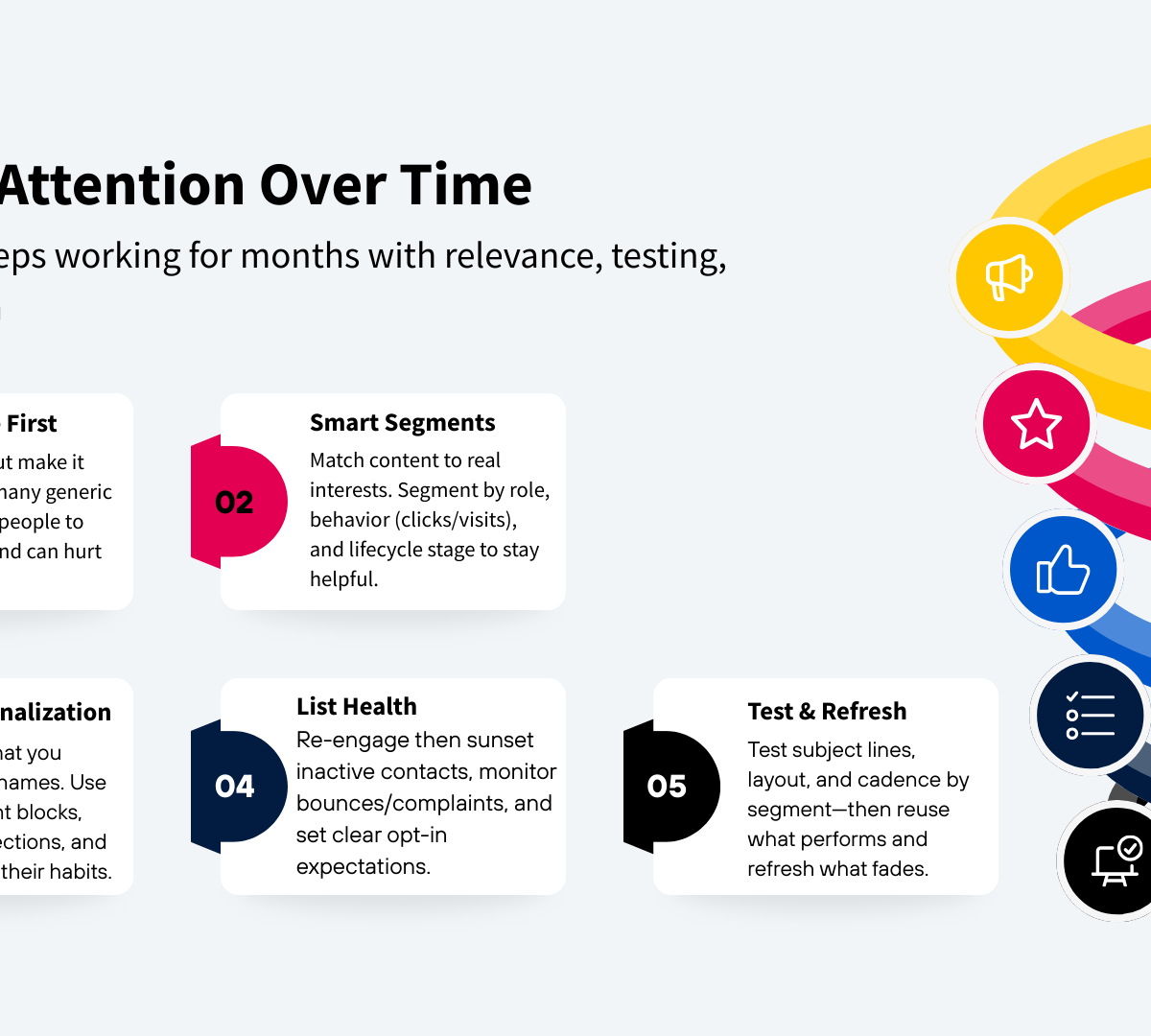
Tip 4: Sustain Attention with Relevance, Testing, and List Health
Prioritize relevance over volume
If you want content to keep paying off for months (and keep deals warm through long sales cycles), resist the urge to “send more.” Over-sending generic content trains people to ignore you, increases unsubscribes and complaints, and eventually makes your best assets invisible because deliverability slips. In consumer studies, nearly half of subscribers say getting too many emails is the number-one reason they’re annoyed by brand email, which is exactly what erodes long-term list value.
Instead, distribute less per person and match what you send to real interests, timing, and tolerance. Email programs that prioritize relevance and segmentation consistently show higher engagement and conversion than batch-and-blast approaches, and they give your “created once” content many more chances to perform.
Practical segmentation ideas that keep your newsletter and nurtures useful over the long haul:
By role: C-level gets strategic proof and business outcomes; practitioners get tactical how-tos and implementation details.
By behavior: topics clicked, pages visited, product interest, and recent engagement level.
By lifecycle stage: new lead, active opportunity, customer (education/expansion), or lapsed account (win-back).
Personalize beyond name tokens
“Hi {First Name}” isn’t personalization. Relevance is. Start simple with changes that materially improve context:
Curated content blocks by segment (for example, industry-specific case studies vs. playbooks).
Dynamic sections based on past clicks or topics consumed.
Timing adjustments based on when someone typically opens and clicks.
Done well, this looks less like “marketing automation” and more like a smart editor who knows what you care about. Brands that use behavior and preference data to tailor what they send see higher engagement and lower churn over time, because subscribers feel like the content is actually for them, not for a generic list. Keep it trust-safe: personalization should feel like good editorial judgment, not surveillance. Protecting that comfort level is what keeps email viable as an owned distribution channel you can reuse again and again.
Protect deliverability and list health
A decaying list quietly kills content lifetime value. If inbox placement drops, your distribution system stops compounding. Email still delivers some of the highest ROI of any channel, but only if messages actually reach the inbox.
Baseline hygiene that preserves reach:
Sunset long-term inactives after a respectful re-engagement attempt. Engagement-based list management is one of the biggest levers you have to protect sender reputation and preserve a “competition-free zone” in the inbox.
Monitor bounces, complaints, and inbox placement (not just opens/clicks). In B2B especially, spam filters and security layers behave differently than consumer inboxes, so you need visibility into true delivery and placement, not just vanity metrics.
Grow by permission with clear expectations at opt-in (what they’ll get, how often). Programs that set a concrete promise and stick to it build trust and keep subscribers opening for years, which dramatically extends the shelf life of the content you send.
Test, learn, and use data to decide when to refresh
Treat email like an optimization loop, not an output channel. Test over time:
Subject lines, preview text, and from names: small changes here can materially shift open and click rates, especially on mobile where short, clear lines win.
Layout and content emphasis (short vs. long; value in-email vs. click-out): brands that make the email itself valuable tend to earn more repeat opens, which gives your content more chances to be rediscovered.
Cadence by segment (consistency beats blanket frequency): different audiences tolerate different rhythms; finding the right one reduces list fatigue and keeps content working longer. Construction shows this well, where a steady monthly email suits long project decision cycles better than frequent sends.
Then let performance guide content investment: if an older asset spikes when featured, build more derivatives and drop it into more journeys. High-ROI teams routinely republish, repackage, and repurpose proven content in new formats and sequences rather than constantly starting from scratch. If engagement fades, refresh stats/examples/positioning and relaunch it, so your “create once” content keeps earning returns instead of disappearing after a single campaign.
Conclusion
Email is the channel that turns “publish once” into “perform for months.” When you treat it strategically, a single asset can keep educating buyers, reopening dormant threads, and supporting value-led sales follow-up across long, nonlinear sales cycles, without you having to constantly create net-new content. That lines up with research showing email remains one of the highest-ROI distribution channels and consistently outperforms other tactics for driving traffic and conversions from content assets that were created once but reused over time (CMI, Litmus via Contently).
To make content lifetime value compound, keep these practices at the center:
Design for email distribution before you create (placement, audience, CTA, and refresh plan), so every piece can slot into newsletters, nurtures, and sales sequences instead of living as a one-off post (Moz)
Use your newsletter as the reuse engine, consistently resurfacing evergreen ideas with real value inside the email, the way high-performing publishers do to keep older assets driving engagement and revenue for years (Contently on NYT, HubSpot)
Break anchor assets into multiple journeys, mapped to buyer stage and behavior instead of one-time blasts, turning one guide or webinar into weeks of automated, behavior-triggered touchpoints (TopRank, Content Marketing Institute)
Protect relevance and list health, so your work keeps reaching the inbox and earning trust over time, especially as permission standards rise and over-emailing quickly erodes the value of your content and your list (Marketing Week, Adobe survey via Contently)
This is what it looks like to treat content as infrastructure, not one-off campaigns: connected to CRM, nurtures, and sales motion, and measured by pipeline influence and deal momentum, not just clicks. Teams that plan channels and measurement around email as a primary owned distribution system see content assets drive impact far beyond their publish date (CMI on distribution strategy).
That system-level approach is the heart of our Content RevOps work. We help teams build an operating model where content consistently educates, qualifies, and supports revenue, so every asset earns its place by doing real work over time. Teams that master email as a distribution system don’t just publish more. They build a durable growth engine that quietly compounds value from everything they create.
Is your email program compounding content—or just announcing it?
Turn every asset into revenue infrastructure: sequenced, automated, sales-enabled, and measurable in pipeline impact.
About the Author

Founder & CEO, Content RevOps
Stefan Kalpachev is the founder and CEO of Content RevOps, where he helps B2B SaaS companies transform their content into predictable pipeline. With a background in content marketing and revenue operations, Stefan has developed a unique methodology that bridges the gap between content creation and revenue generation.
Connect on LinkedIn