Marketing for Asset Management Firms: Where to Start
See where your firm stands. Put your own numbers beside the 1,628-firm benchmark in a few minutes.
Book a CallMost asset management firms start marketing in the wrong place. They commission a new logo, rebuild the website, or decide everyone should post on LinkedIn every day. Six months later the work has produced nothing a buyer acted on, because none of it was wired into a content marketing system built around pipeline.
Part of Content Marketing for Asset Managers: The 2026 Playbook.
Here is where to start instead. Pick one buyer. Go to the one place that buyer already uses to decide. Give one piece of content one job. Wire it to capture a contact. Then measure one number. That is the whole first move, and it comes before any brand refresh.
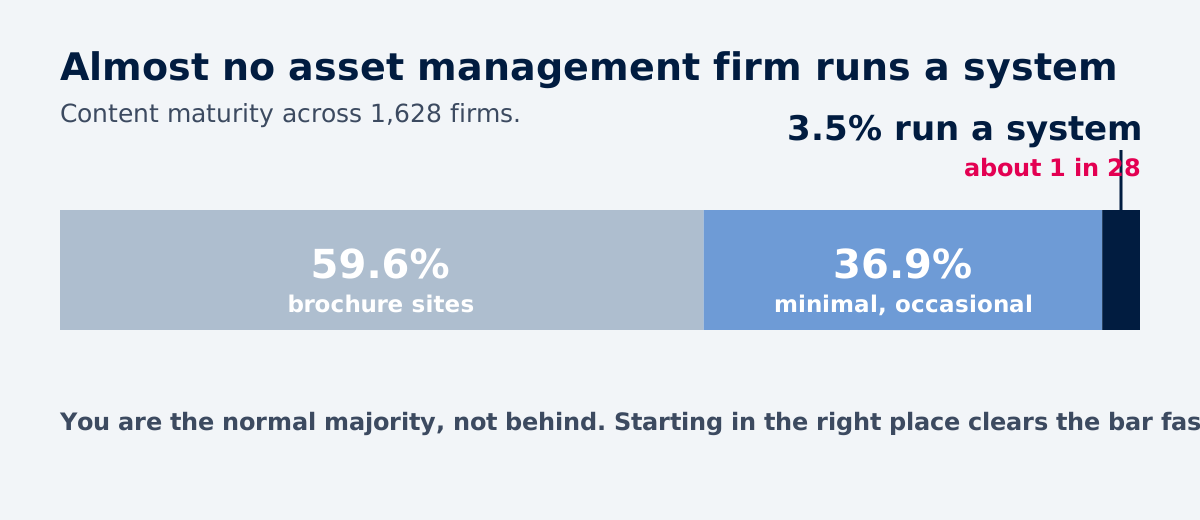
If your firm does almost no marketing today, you are in the normal majority. In a hands-on review of 1,628 asset management firms, all but about 1 in 28 were running marketing as scattered activity rather than a system. Starting in the right place is the entire advantage, and this guide walks owners, partners, and first marketing hires through the first moves in order. If you lead the firm and want the wider case for content first, read the CEO's guide to effective B2B content marketing.
Where should an asset management firm actually start with marketing?
Start with the buyer and the decision, not the brand and the activity. The order matters because a system has a skeleton, and the skeleton goes in before the paint.
The usual advice tells asset managers to stand out, and it lists brand first. One widely read piece names the ways to stand out "in order of importance: differentiating their brand, providing educational content, and embracing digital marketing". For a firm that already runs a marketing team, that is fine. For a firm starting from nothing, differentiating the brand is the paint. You cannot differentiate a brand that no buyer has read yet, which is the core of the demand generation vs brand awareness trade-off.
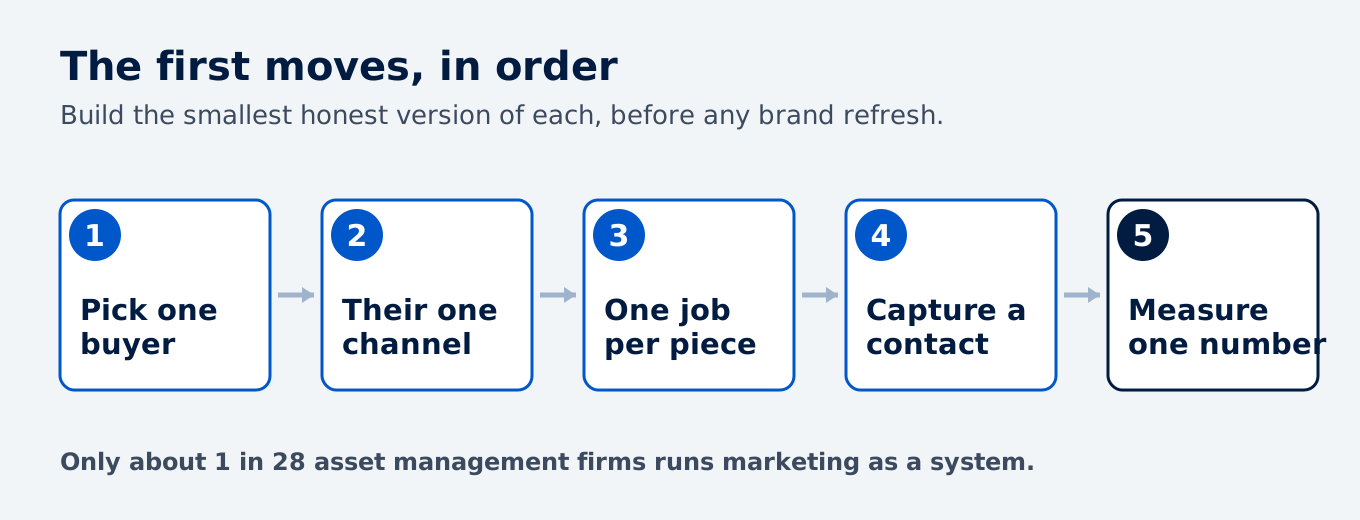
So the first moves run in this order:
- 1. Pick one buyer. One type of allocator, one channel, or one problem you solve better than anyone.
- 2. Pick the one channel that buyer already uses to decide. For most asset management firms that is search and LinkedIn, not a posting habit spread across five platforms.
- 3. Give one piece of content one job. Answer one real question that buyer asks, and end it with one clear next step.
- 4. Wire that next step to capture a contact. A name and an email you can follow up with.
- 5. Measure one number. Contacts captured, or qualified conversations, from that one channel.
You do not need all five running at scale. You need the smallest honest version of each, in this order, which is the same logic behind a minimum viable content plan for a team with limited hours. The rest of this guide takes them one at a time, and content marketing strategies for asset management firms covers what comes once the first moves are in place.
The reason this works is the state of the field. Across those 1,628 firms, 59.6% run brochure sites with nothing that engages a buyer, and another 36.9% publish only occasionally with no system behind it. Only 3.5% run content as a system. The bar in asset management marketing is low, and a firm that starts in the right place clears it quickly.
What is the first move, picking one buyer?
Pick one buyer before you write a word or touch the website. This is the move almost no asset management firm makes, which is exactly why it works.
Fewer than 1 in 20 asset management firms commit to a narrow, specific buyer. Generic "sophisticated investor" language fills the rest. That is why firms sound identical. An earlier study of 100 managers across Europe and the US found that they lean on the same small set of generic terms, that their communications are mostly promotional or market commentary rather than genuinely educational, and that one manager who mainly runs mid-term European credit described itself as "an international, long-term, multi-asset manager". When everyone describes themselves the same way, the buyer cannot tell you apart, and marketers like Jon Greene argue that most asset managers treat marketing as activity rather than a system. We catalogue the same pattern in the biggest content marketing mistakes asset managers make.
How to choose the one buyer
Pick the narrowest group you can serve and still fill a pipeline. A few honest ways to cut it:
- By who allocates. RIAs, institutional consultants, family offices, or DC plan sponsors. Each researches differently and reads different things.
- By the problem you solve. A specific risk, a specific mandate, a specific part of the market you know better than larger firms do.
- By the moment. A reallocation, a manager search, or a regulatory change that sends your buyer looking.
Write the buyer down in one sentence before you build anything. We walk clients through choosing the right buyer as the first step for a reason; every later choice gets easier once it is made. Mapping that buyer's world, where they research and who they trust, tells you which channel comes next.
A small or new asset management firm has an edge here, not a disadvantage. Only 1.3% of firms with 11 to 50 employees run a real system, against 13% of firms with 501 to 1,000. The field is wide open for a smaller firm that moves faster, picks a narrower buyer, and puts the founder's or portfolio manager's own name and face on the work, which most firms never do.
Which marketing channel should an asset management firm start with?
Start with the one channel your buyer already uses to decide, not all of them. For most asset management firms that means search and LinkedIn, because that is where allocators and advisors research a manager before they ever make contact.
Search is the workhorse. The category term "asset management" draws about 33,100 searches a month, and "what is asset management" draws another 6,600. Both are people trying to understand, which means the firm that teaches best wins the click, not the firm with the biggest name. That teaching work is what we call the informational layer. Most firms do not compete for it. The median asset management firm earns around 214 organic visits a month, which is presence without performance, and SEO for asset managers lays out the order to fix that.
LinkedIn is the second half. Around 64% of firms that publish have an organic LinkedIn presence, but few turn it into anything more than showing up. Showing up and compounding are different things, and the gap is where a focused firm wins. LinkedIn marketing for asset managers covers how to move from presence to pipeline there.
How to pick your one channel
- Start where your buyer already researches. If allocators find managers through search, win a search term. If your buyer lives on LinkedIn, start there.
- Pick one, not five. A posting habit spread across every platform produces activity, not pipeline.
- Make it a page that earns traffic, not a feed that needs feeding. A single strong page on the term your buyer searches keeps working for years.
If your buyer is institutional and you serve financial services broadly, our financial services page shows the kind of channel focus we mean. Once your one channel is working, you add the next one, whether that is video built from the input you already have or a wider content distribution strategy; you do not start with all of them.
What should an asset management firm not do first?
Do not start with a brand refresh, a new logo, a website rebuild, a daily posting habit, or a run of press releases. Every one of these feels like progress and produces nothing a buyer acts on.
Press releases are the most common trap. Nearly half of all asset management content, 44.1%, is news and press releases, and another 14.9% is market commentary. That is publishing as a press function, not a demand engine. It tells the market what you did; it does not help a buyer decide to work with you.
The brand refresh is the other trap. A new identity is worth doing once you have buyers reading your work and a clear sense of what sets you apart. Done first, it is paint on a frame that does not exist yet. The field's own advice puts brand differentiation first because the field is talking to firms that already have an audience. You do not yet, so brand comes later.
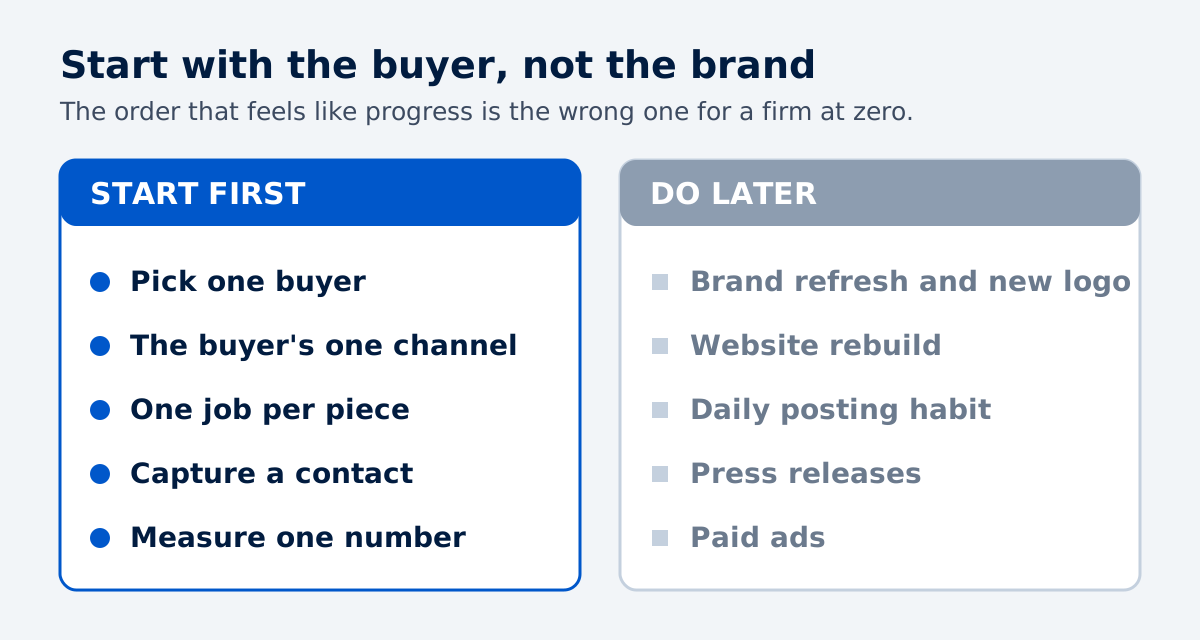
What all of these share is that they start with you, the firm, rather than with the buyer and the decision. The first move points outward, at one buyer's real question. The inward-facing work waits.
How do you give one piece of content one job, and capture the contact?
Give one piece of content one job: answer one real question your buyer asks, show one piece of proof, and end with one clear next step that captures a contact. That is the smallest real system, and it is where almost every asset management firm leaks.
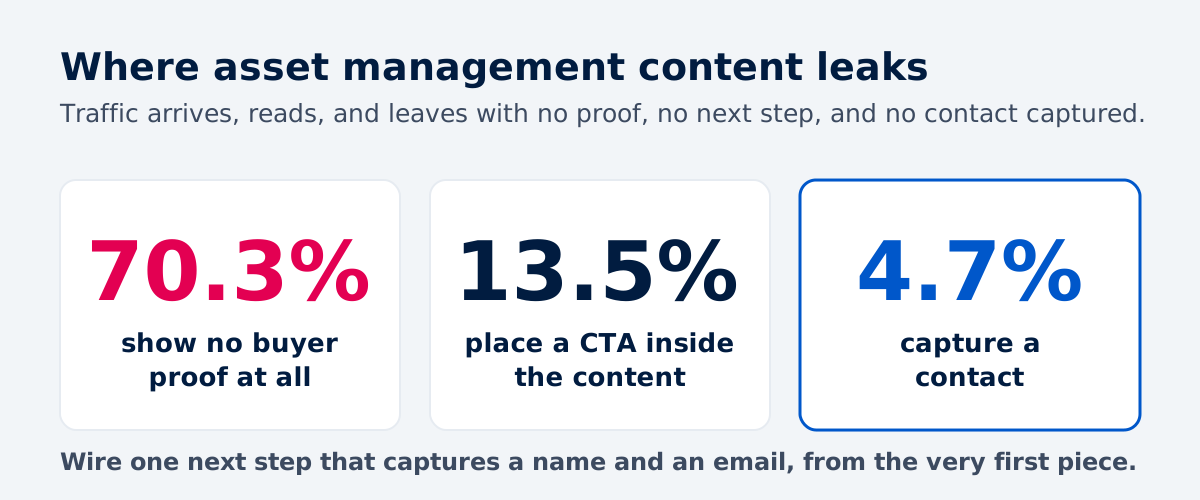
The leak is at the end of the content, not the start. Only 4.7% of firms capture a contact through their content, and just 13.5% place a relevant call to action inside the flow of a piece. Traffic arrives, reads, and leaves with no way for the firm to follow up.
Proof is the other gap. Seven in ten firms, 70.3%, show no buyer proof at all; no track record framed for the buyer, no outcome, no evidence. A buyer choosing who manages money needs a reason to trust before they act.
The three parts of one working piece
- One question. Pick a real question your chosen buyer asks before they allocate, and answer it fully.
- One proof. Show one concrete reason to trust you on it, in terms the buyer cares about.
- One next step. End with a single clear action, a download, a short assessment, or a conversation, that captures a name and an email.
The download or the sign-up is the start of the relationship, not the finish line, which is how we think about turning content into leads and the conversion layer that sits under it. A brochure that gets traffic but captures nothing is simply money left uncollected. Content marketing best practices for asset managers goes deeper on building each piece this way.
How much does it cost to start marketing an asset management firm?
You can start for close to nothing. The first move costs time and focus, not a retainer, because it is one buyer, one channel, and one piece of content wired to capture a contact.
The budget figures you see for asset management marketing are for firms that already have traffic to grow. A firm with under 1,000 visits a month typically invests $2,000 to $10,000 a month once it decides to build, and a firm with 1,000 to 10,000 visits invests $10,000 to $50,000. Those are the numbers for scaling something that works, not for starting.
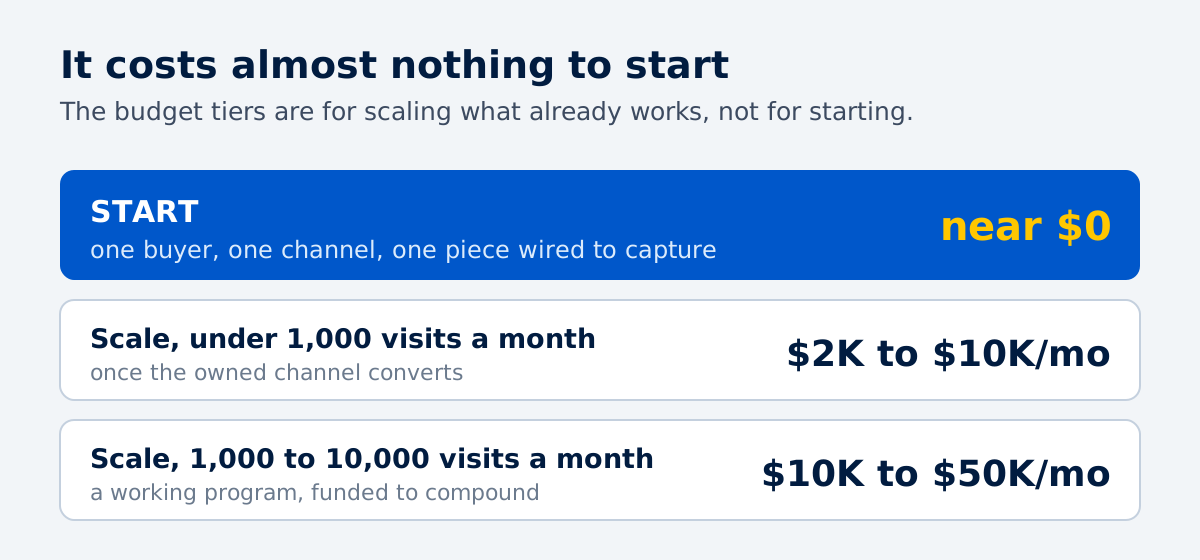
Do not start with paid ads. Only 3.8% of asset management firms run Google Search ads, and the ones that do spend a median of about $226 a month, which is tiny and mostly untested. Ads rent attention for as long as you pay. The first move builds something you own, a page and a contact list, so put the early effort there and treat paid as something you add once the owned channel converts.
Do you need to worry about SEC and FINRA compliance before you start?
Yes, and it is a workflow, not a wall. Compliance adds one review step before you publish; it does not stop an asset management firm from marketing.
Two rules cover most of what you publish. The SEC Marketing Rule, 206(4)-1 under the Investment Advisers Act governs advertising by registered advisers, and FINRA Rule 2210 governs communications with the public for broker-dealers. Both are workable. The practical move is simple: build one pre-publication review step into how you produce content, so a qualified person signs off before anything goes live.
Compliance is not what is stopping the firms that do nothing. It applies to everyone equally, yet only 3.5% run a content system. If compliance were the blocker, no one would clear it. The blocker is the absence of a system, and a one-step review process is part of building that system.
How do you know your asset management marketing is working before you hire or spend more?
Pick one number tied to the buyer, and watch it before you hire anyone or raise the budget. The right number is contacts captured or qualified conversations started from your one channel, not reach, impressions, or follower counts.
Vanity metrics are the easy trap because they always go up, which is why we separate the metrics worth tracking from the ones to ignore. The number that matters is the one that signals a real buyer is moving. Most asset management firms cannot connect their content to pipeline at all; they measure traffic they never act on. A median of 214 organic visits a month means nothing on its own, because without a next step it is just people passing through.
This matters because the buyers you want weigh your content heavily. In a survey of 154 institutional investors and consultants overseeing about $4.9 trillion, CoreData found that 59% say thought leadership directly influences which manager they invest with, and called it the price of entry. Among institutional buyers, thought leadership is part of the decision, so the signal worth measuring is whether the right people are reading and raising their hand, not how many people scrolled past.
A simple starting scorecard
- Contacts captured from the one channel, each month.
- Qualified conversations that started with a piece of content.
- One quality check, such as whether the contacts match the buyer you chose.
Gate the next hire and the next dollar of spend on that scorecard, and report it the way our guide to reporting on content marketing success sets out. If the one channel is producing qualified contacts, you have earned the right to add the second, and the in-house vs outsourced question becomes worth asking. If it is not, more spend will not fix a system that has not started working yet. You can put your own numbers beside the field with our asset management content benchmarking tool, or read the full State of Content Marketing for Asset Managers 2026 for the complete picture.
Start in the right place
Get a free content audit that maps your first move to your buyer and your one channel.
Frequently Asked Questions
About the Author

Founder & CEO, Content RevOps
Stefan Kalpachev is the founder and CEO of Content RevOps, where he helps B2B SaaS companies transform their content into predictable pipeline. With a background in content marketing and revenue operations, Stefan has developed a unique methodology that bridges the gap between content creation and revenue generation.
Connect on LinkedInRelated Articles
SEO for Asset Managers: A 2026 Digital Marketing Playbook
Oct 25, 2026
Video Marketing for Asset Managers: Turn the Input You Already Have Into a Distribution Engine
Oct 24, 2026
Content Marketing Strategies for Asset Management Firms
Oct 23, 2026