LinkedIn Marketing for Asset Managers: From Presence to Pipeline
Not sure whether your firm's LinkedIn presence is building pipeline or just posting? A content revenue audit shows you what it is worth.
Book a CallLinkedIn marketing for asset managers is worth doing, because LinkedIn is the one channel where your institutional allocators, consultants, and advisor buyers actually gather and read. The catch is that being there earns you nothing on its own. Most asset managers open a company page, post now and then, and treat the box as checked. The firms that win treat LinkedIn as a demand system that compounds, organic reach plus paid activation, run through compliance as a workflow, and measured to pipeline and AUM instead of likes. This guide walks through how to make that shift, step by step.
Part of Content Marketing for Asset Managers: The 2026 Playbook.
Is LinkedIn worth it for asset managers in 2026?
Yes, and the reason is simple. The people who choose managers are on LinkedIn, and what you publish there moves their decision.
CoreData Research surveyed 154 global institutional investors and consultants in 2025, together overseeing more than $4.9 trillion. Nearly six in ten, 59%, said their likelihood of investing with one manager over another is directly influenced by the thought leadership managers put out. Almost one in four, 23%, said that content led them to a firm they had never heard of before. For a channel built on professional publishing, that is the whole case.
Coalition Greenwich reached the same place from a different sample. Across interviews with roughly 500 institutional investors, two-thirds said thought leadership had a high impact on the likelihood of winning mandates. Written insight is no longer a nice-to-have brand layer. It is a factor in who gets the money.
So the audience is there and the content changes decisions. The problem is what firms do with that.
Presence is common. Performance is rare.
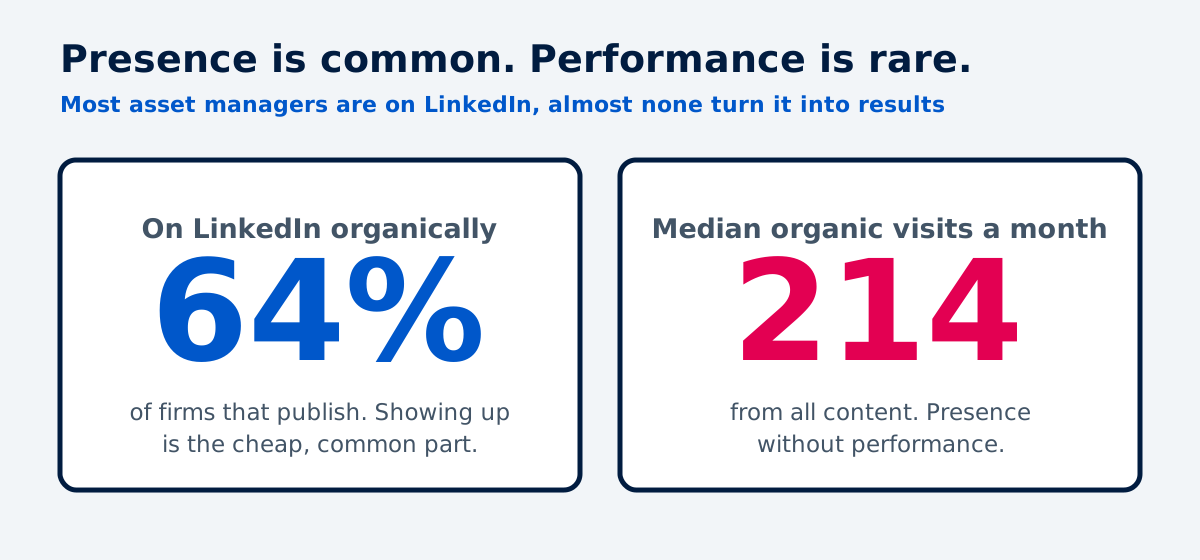
Among asset managers that publish any content at all, about two-thirds have an organic LinkedIn presence. Almost everyone shows up.
Almost no one turns showing up into results. The median asset manager earns around 214 organic visits a month from all its content, which is presence without performance. The page exists. The traffic does not.
This gap is not new, and it is not ours alone to point out. An earlier Peregrine Communications study of 100 asset managers' digital presence across the US, UK, and Europe found that 94% were on LinkedIn, yet only 42% posted frequently. Investors engaged with content far more on LinkedIn, 40%, than on Twitter, 23%. The lesson held then and holds now. Building a follower base of investors and then going silent wastes the one channel where they pay attention.
Why do most asset managers get nothing out of LinkedIn?
Because they confuse being on LinkedIn with running a system on it. Showing up is the cheap, common part. The engine that compounds into pipeline is the rare part, and most firms never build it.
The numbers behind the company sites tell the story. Only about 3.5% of asset managers run content as a system, which is roughly 1 in 28. Nearly six in ten, 59.6%, run brochure sites with nothing to engage a buyer. Of the content that does get published, 44.1% is news and press releases. That is publishing as a press function, not a demand engine, and it carries straight onto LinkedIn as a feed of announcements nobody asked for.
Practitioners inside the industry say the same thing out loud. Jon Greene puts it plainly: "Most asset managers think marketing is just events, roadshows and crisis communications." Chloe Tillman makes the related point that marketing in asset management has changed considerably, and it is not simply about producing good content anymore.
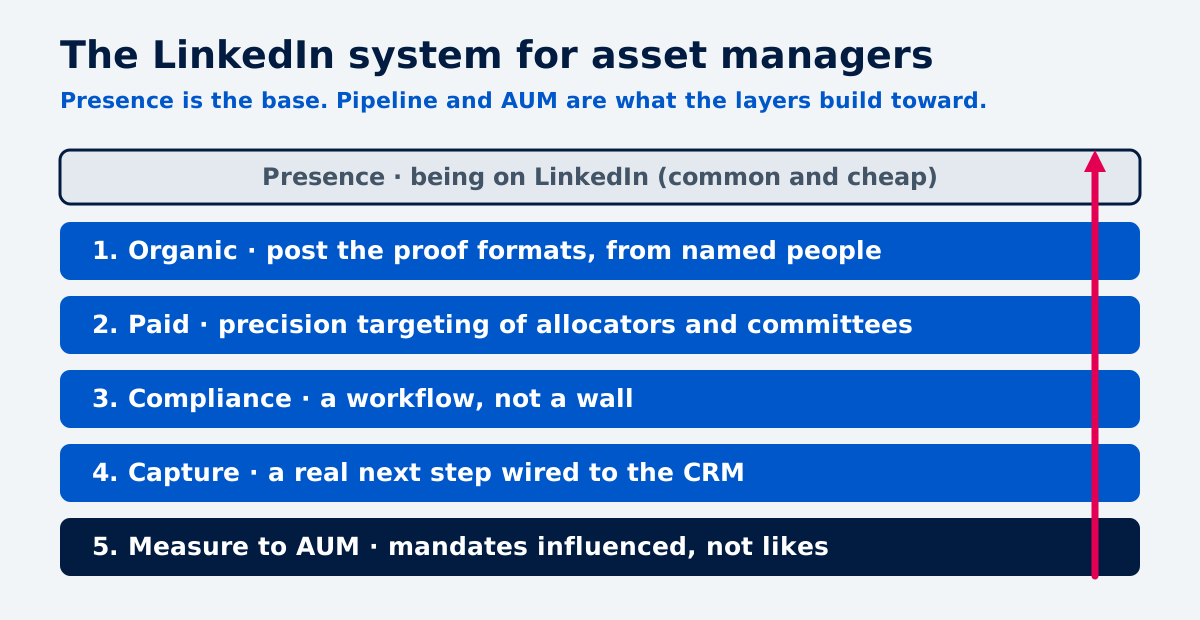
The bar moved. Posting is table stakes. The work is building the layers that turn a post into a mandate, and the rest of this guide is those layers. Most firms build them in the wrong order, starting with the feed and never reaching capture.
What should asset managers post on LinkedIn?
Post the few formats that prove you can do the job, and publish them from people, not just the logo.
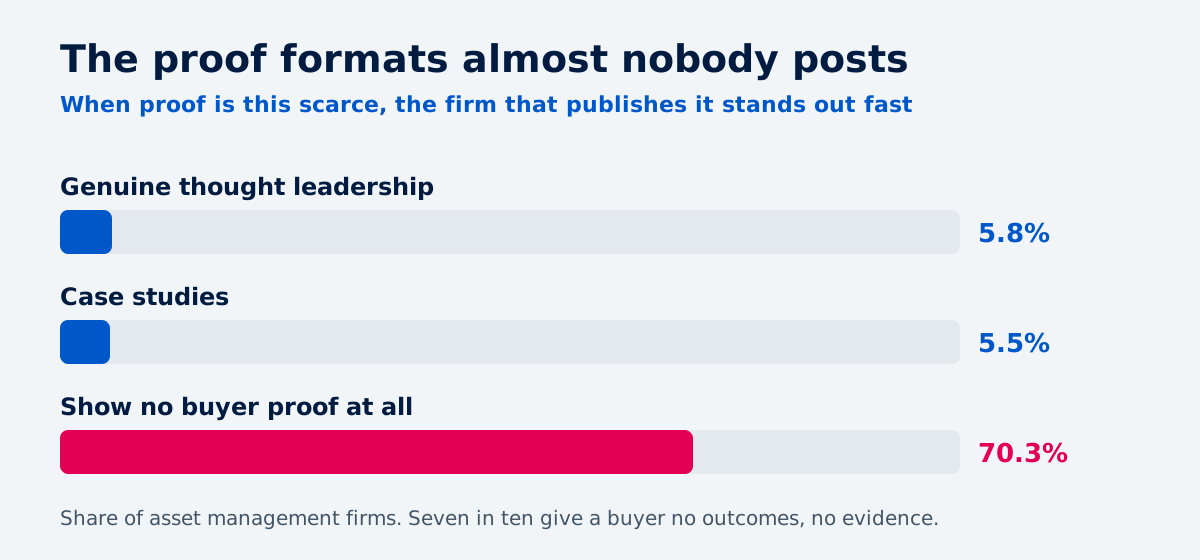
The scarcity is the opportunity. Genuine thought leadership is just 5.8% of asset management content, and case studies are 5.5%. Seven in ten firms, 70.3%, show no buyer proof at all, no outcomes, no evidence. When almost nobody publishes proof, the firm that does stands out fast.
The formats that earn attention
Lead with a short list and go deep on each:
A clear point of view on one theme. Own a question that matters to your buyers and return to it. Investors reward managers who go deeper on a trend, not just louder. That is what thought leadership means in practice.
Proof. A result, a before-and-after, a client outcome described honestly. This is the 70% gap, and it is the content buyers trust most.
Short video. Around nine in ten publishing asset managers already have a YouTube presence, which means the expensive input already exists. Cut a portfolio manager's market take into a 60-second clip and the production cost is near zero. Our approach to extracting raw assets from your team works the same way.
Post from people, not just the company page
People follow people. A portfolio manager, a CIO, or a founder reaches further than the brand account, because an investor wants a human view, not a logo.
LinkedIn now treats this as a formal format. Its Thought Leader Ads let a firm sponsor a post from an employee rather than the company page, built to "build credibility through a trusted voice." The organic version of the same idea is free. Your experts post from their own profiles, and the firm amplifies them. We see the same pattern in another regulated sector in life science LinkedIn marketing.
The edge is wide open, because named, credentialed author bios appear on only about 22% of publishing firms' content. Put real names and faces on your insight and you already look different from most of the field. Briefing those experts well is its own skill, covered in how we work with subject-matter experts.
This is how the firms that win approach it, as a distribution machine rather than scattered posts. WOLF Financial, a financial content and distribution network, runs this at scale by pairing brands with a creator network of named voices reaching tens of millions of retail investors. The platform mix is different from an institutional manager's, but the principle transfers directly. Content plus deliberate distribution, built around people, beats a silent company page every time.
How should asset managers use LinkedIn Ads?
Use LinkedIn Ads for precision, not reach. The win is putting one specific message in front of the exact allocators, consultants, and committees you want, and almost no competitor is doing it.
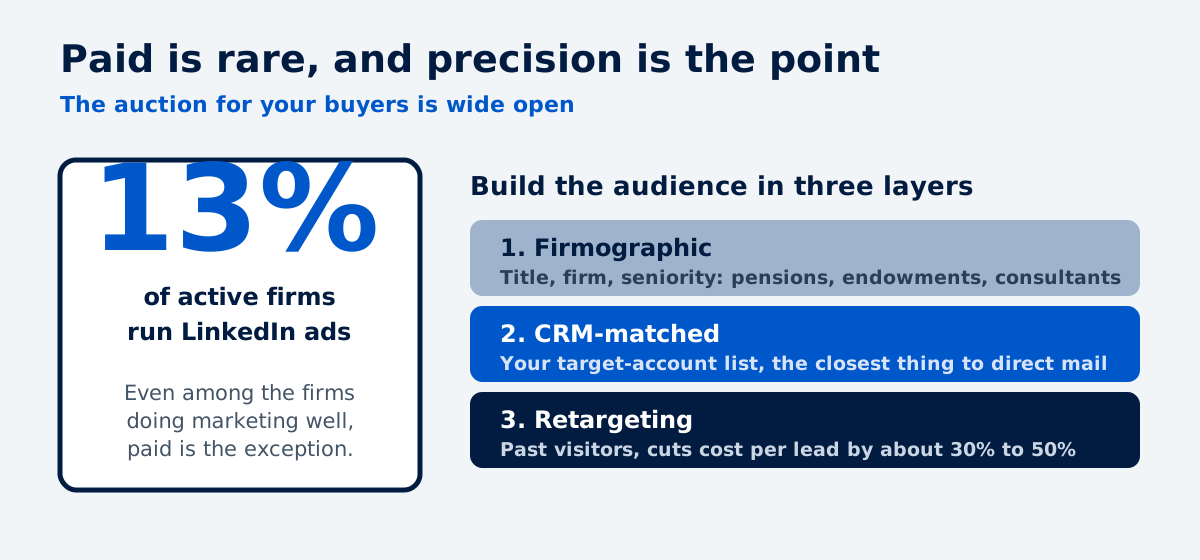
Paid activation is the rarest layer of all. Only about 13% of active asset managers run LinkedIn ads, so even among the firms doing marketing well, paid is the exception. Where asset managers pay for anything, LinkedIn is the dominant paid channel, while Google search ads sit at just 3.8%. The auction for your buyers' attention is wide open, which is why it belongs near the top of any channel prioritisation.
The ad formats that fit a regulated sale
LinkedIn's ad suite maps cleanly onto how an institutional sale actually works:
Thought Leader Ads sponsor a real person's post, so your credibility travels through a named expert.
Document Ads let an allocator preview a fact sheet or research paper inside the feed before downloading it.
Lead Gen Forms capture a contact with fields that auto-fill from the profile, which cuts the friction of a landing page.
Sponsored Content and Message Ads carry an event invitation or a meeting request to a tightly defined list.
Build the audience in three layers
Precision comes from stacking audiences rather than buying broad reach. WOLF Financial's guide to institutional LinkedIn targeting lays out the pattern asset managers use:
Firmographic targeting. Filter by job title, firm, seniority, and company size to reach pension CIOs, endowment directors, consultants, or RIA due-diligence teams.
CRM-matched audiences. Upload your target-account or contact list and serve ads only to those people, the closest thing to direct mail on paid social, and the core of account-based marketing.
Retargeting. Show ads to people who already visited your fund pages or read your thought leadership, which typically cuts cost per lead by roughly 30% to 50% compared with cold targeting.
Real asset managers already run this. LinkedIn reports that State Street Global Advisors treats Matched Audiences as a core part of its media mix, that Invesco ran an executive thought-leadership event through LinkedIn Live, and that in one closed-loop analysis, one of the world's largest asset managers attributed new deposits totaling 5,454 times the campaign cost. You do not need that budget to copy the method. You need the targeting discipline, and the content that makes paid channels work harder.
How do asset managers stay compliant on LinkedIn?
Treat compliance as a workflow, not a wall. The rules set a bar for what you can say. They do not stop you from using LinkedIn, and the proof is that compliance is universal while results are rare, so compliance is not what holds the field back. The missing system is.
Two rules govern this, and both are workable.
The two rules, in plain terms
FINRA Rule 2210 governs communications with the public across every medium, LinkedIn included. It asks that communications be fair and balanced, that they not mislead or promise performance, and it sets conditions for testimonials. Nothing in it bans social media.
The SEC's modernized Marketing Rule, 206(4)-1 under the Investment Advisers Act, actually opened a door. Advisers can now use testimonials and endorsements, subject to disclosure, oversight, and recordkeeping. The direction of travel is toward more social proof, handled correctly, not less.
The workflow that keeps you clear
FINRA's social media guidance splits your presence into two kinds of content, and each has its own path:
Static content, your profile, company page, and pinned posts, gets principal approval before it goes up.
Interactive content, your ongoing posts and comments, is supervised the way a firm supervises correspondence, not pre-approved one by one.
Records of business communications are kept for at least three years.
Adoption matters. As FINRA's digital-communications notice explains, if a representative likes or shares a favorable third-party comment, they adopt it, and it falls under the rules.
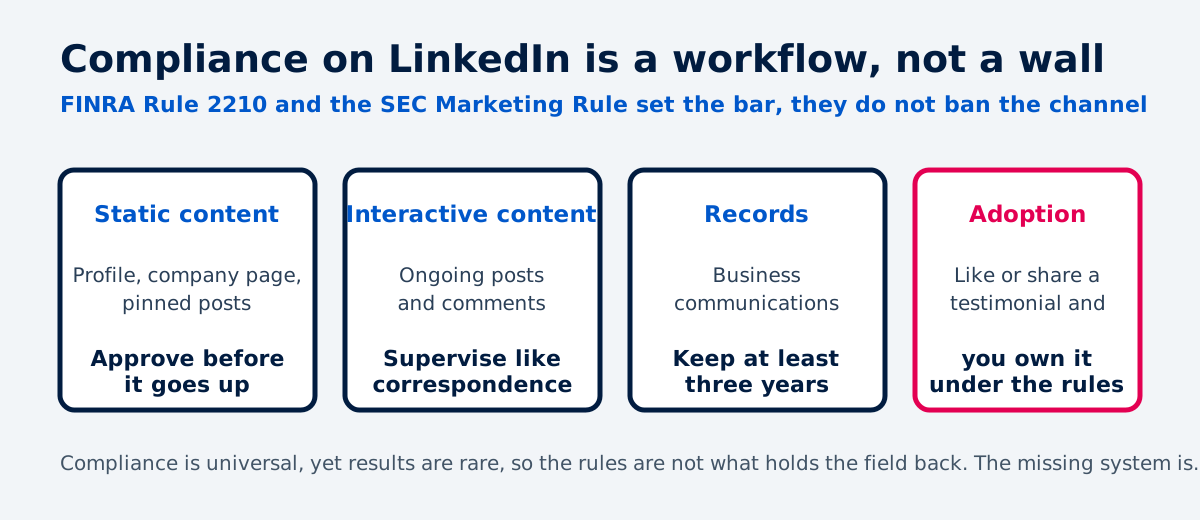
Pre-clear the static layer, supervise the interactive layer, keep the records, and mind what you amplify. That is the whole workflow, and firms run it every day. A content calendar with review time built in keeps it from becoming a bottleneck.
The firms that lean into it turn the compliance calendar into an advantage. About 22% of leading asset managers publish regulatory thought leadership, using the rules themselves as a source of authority content. A compliant process can also be an industrial one. WOLF Financial runs regulated social at scale with a submission platform where every piece is reviewed twice before posting, once by a team and once by a model trained on each company's standards, with a window for the client's legal team first. Compliance did not stop that. A process made it possible.
How do asset managers turn LinkedIn into leads and AUM?
Wire LinkedIn to capture and to your CRM, then measure it to pipeline and AUM, not to likes. This is where almost every firm leaks, and where the mandates are won.
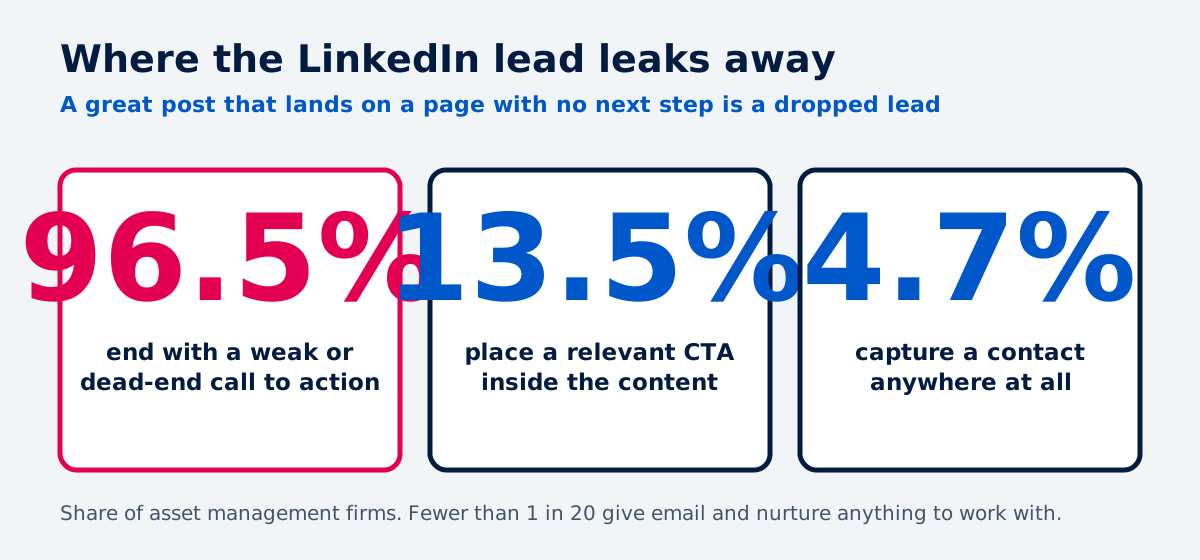
The leak is severe. Fewer than 1 in 20 asset managers, 4.7%, capture a contact anywhere on their content, which means email and nurture have nothing to work with. Almost all content, 96.5%, ends with a weak or dead-end call to action, and only 13.5% place a relevant CTA inside the flow of the content. A great LinkedIn post that sends someone to a page with no next step is a dropped lead.
Build the path from post to pipeline
A post is the top of a path, not the finish line. The way we think about it is to design the whole route before publishing: a post earns a click, the page offers a real next step, the next step captures a contact, and the contact enters a nurture that a person can act on. That middle step is what we call the conversion layer, and the capture behind it is lead capture and qualification.
That last part is the lever. Working with Mango PD, a client running a gated report campaign, we treated the download as the start of the funnel rather than the goal. We used LinkedIn connection requests to put a face to the name, then an automated nurture to follow up, after finding that only one competitor followed up fast on an inbound at all. Speed of first follow-up is where the money is, and it is the part most firms never build. Our lead handover process and nurture design exist for exactly that gap.
Measure to AUM, not to engagement
Most asset managers cannot connect content to pipeline. Attribution and automation are rare, so firms measure traffic they never act on. That is the wrong scoreboard, and choosing the right one is the subject of which demand generation metrics to track.
The industry's own direction makes the case for the right one. BCG's 2026 asset management report states that distribution has replaced investment performance as the primary competitive advantage, and that most firms lack the systems to compete on it. It notes that execution "remains dependent on individuals rather than on a system," with insights "disconnected from CRM systems." Measuring LinkedIn to AUM, through capture and your CRM, is exactly the system it describes, and it is how you see which page started the deal. Likes do not fund the business. Mandates do.
Does LinkedIn help asset managers get cited in AI answers?
Yes, and it is becoming a reason to stay active. When an allocator asks an AI engine for managers in a category, the answer is built from content the engine can find, and most of that content lives on LinkedIn and the pages it links to.
Right now the citations concentrate at the top. AI answers lean on five incumbents, Vanguard, BlackRock, Fidelity, State Street, and J.P. Morgan Asset Management, and only a small minority of firms surface in AI answers at all. The race below the giants is open, and a smaller brand can be cited over a better-known one.
Two things decide whether an engine cites you. Freshness is one. Ahrefs' analysis of 17 million citations found AI assistants cite content that is meaningfully fresher than classic search results, so a firm that goes silent fades from the answer layer. Substance is the other. A peer-reviewed study of generative-engine optimization found that adding statistics, quotations, and cited sources raised how often an engine cited a source by up to 40%.
The action follows directly. Keep publishing on LinkedIn, and make sure the pages your posts link to carry fresh, original data rather than recycled commentary. That is what gets you into the answer, and it is how we help firms show up in AI search.
Where should an asset manager start with LinkedIn marketing?
Start by turning presence into a system, then layer on everything above in order. The sequence matters more than the budget.
Fix the foundation. Clean up the company page and your key people's profiles, then commit to a real posting cadence. A consistent cadence is table stakes for the firms that win.
Publish the proof formats. Lead with a point of view, buyer proof, and short video from named experts. These are the scarce formats, so they move you fastest.
Layer on paid once organic works. Start with CRM-matched and retargeting audiences, which reach people who already know you, before cold prospecting.
Wire up capture. Put a real next step on every page a post links to, and connect it to your CRM.
Measure to AUM. Track pipeline and mandates influenced, not likes.
If you want the same sequence for the whole program rather than one channel, it mirrors building a demand generation engine from scratch.
Budget scales with ambition, not the other way around. Asset management content programs tend to sit in bands by the traffic they drive, from roughly $2,000 to $10,000 a month for an early-stage effort up to far more for firms treating content as a core channel. You start small, prove the path, and fund what compounds. How to split that spend is covered in demand generation budget allocation.
The opening is real. Decision-stage search is just 3.8% of category demand, and 62.3% of publishers give a ready-to-act buyer nothing to act on. The bottom of the funnel, where mandates are decided, is nearly empty. To see where your own firm stands, start with the state of content marketing for asset managers report and the asset management content benchmarking tool.
Want to see where your asset management firm's LinkedIn and content sit against the field?
Our content revenue audit benchmarks your firm, finds where the pipeline leaks, and puts a number on the gap.
Frequently Asked Questions
About the Author

Founder & CEO, Content RevOps
Stefan Kalpachev is the founder and CEO of Content RevOps, where he helps B2B SaaS companies transform their content into predictable pipeline. With a background in content marketing and revenue operations, Stefan has developed a unique methodology that bridges the gap between content creation and revenue generation.
Connect on LinkedIn