How Demand Generation and Content Marketing Work Together
Want content that creates demand and captures it, not a blog that just fills the calendar? Let's map your engine.
Book a CallWalk into most B2B marketing reviews and you will find the same standoff. The CEO wants brand, presence, a company people have actually heard of. The CRO wants pipeline, this quarter, with a dollar figure attached. Marketing gets told to pick a lane. Content lands under demand generation, where it slowly hardens into gated PDFs nobody downloads and a blog that exists mainly to prove the blog exists.
Part of The Complete Guide to B2B Demand Generation Strategy.
The choice is false. Content marketing and demand generation are not two disciplines you balance against each other; they are one system. Content is the engine that generates demand, and the same content is the mechanism that turns that demand into pipeline and revenue. When teams run the two as separate motions, or let demand generation shrink content into lead-capture collateral, that is exactly when "content doesn't drive pipeline" stops being a worry and starts being true.
We have written elsewhere about content marketing versus demand generation. The versus is the wrong fight. This piece is about the and, how the two actually work together, step by step, from a blog post nobody can attribute to a closed deal you can.
Why is content the engine of demand generation, not a tactic inside it?
Demand generation is not a channel or a campaign type; it is the discipline of creating and capturing demand, and content is how both of those actually happen. Strip the content out and demand generation is just paid distribution of nothing, an ad with no argument and a form with no reason to fill it.
The usual thinking files content as one tactic inside a demand-gen plan, sitting next to paid media and email. That gets the hierarchy backwards. Paid media buys attention; content occupies it. Email opens a channel; content travels down it. SEO wins a ranking; content is the thing that ranks. Every demand-gen tactic is a delivery mechanism, and content is the payload. The mechanism without the payload moves nothing.
This matters more now because the job itself has changed. Across a thousand demand-generation director job postings we analysed, the role is described in the language of revenue (52 percent), pipeline (37 percent), and sales alignment (24 percent), not awareness or lead volume. The title is even dissolving; only 57 of those thousand postings still carried "demand generation" in the name, with the rest folding into revenue-accountable growth and marketing leadership. The outside data agrees. Energize Marketing's 2026 State of Demand Generation report found that most B2B demand-gen teams now carry explicit pipeline targets, many for the first time, and puts it bluntly, pipeline is no longer something marketing influences, it is something marketing is expected to deliver.
So the question stops being "what awareness did content create" and becomes "what revenue did it generate." That is a content question first and a distribution question second, which is why the rest of this piece works through content's two jobs in order, creating demand and capturing it.
What are the two jobs of content, creating demand and capturing it?
Content does two distinct jobs inside a demand engine, and you need both. It creates demand by making people care about a problem they were not acting on, and it captures demand by catching people who are already looking. Run only one and the system stalls.
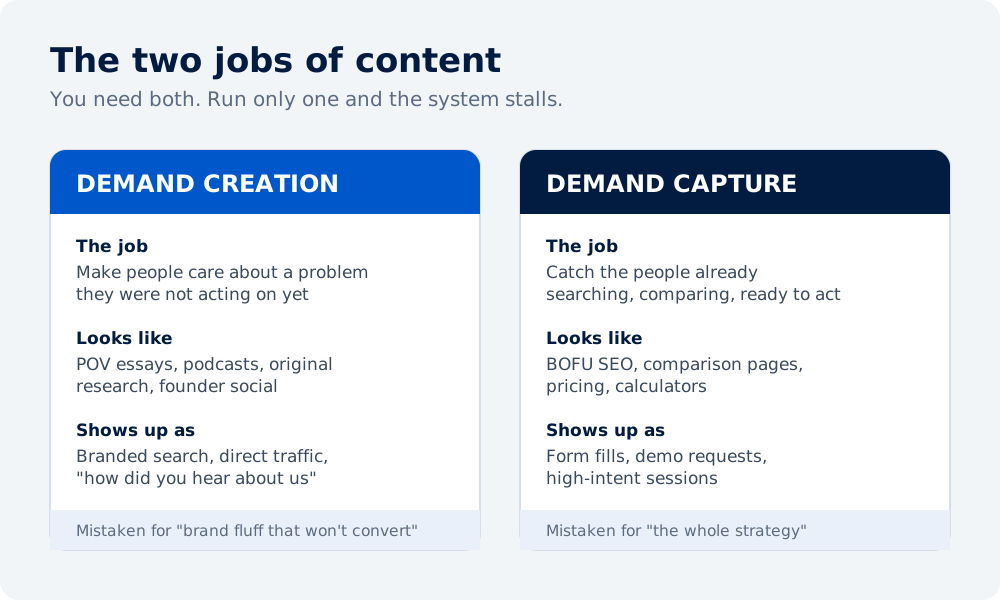
Demand creation is the content that reaches someone who is not in the market yet, names a problem they had not prioritised, and frames it the way you solve it. A point-of-view essay, a podcast, a piece of original research, a founder's argument on LinkedIn. It is mostly un-clickable, hard to attribute, and it builds the pool of people who will be in-market later.
Demand capture is the content that meets someone already searching, comparing, and ready to act. Bottom-of-funnel SEO, comparison pages, a pricing page that makes sense, a calculator, a product-led landing page. It is fast, trackable, and it converts demand that already exists.
Demand creation | Demand capture | |
The job | Make people care | Catch people already looking |
Buyer state | Not in-market, problem-unaware | In-market, solution-aware |
Typical content | POV, research, podcast, founder social | BOFU SEO, comparison, pricing, calculators |
Where demand shows up | Branded search, direct, "how did you hear about us" | Form fills, demo requests, high-intent sessions |
What it gets mistaken for | "Brand fluff that doesn't convert" | "The whole strategy" |
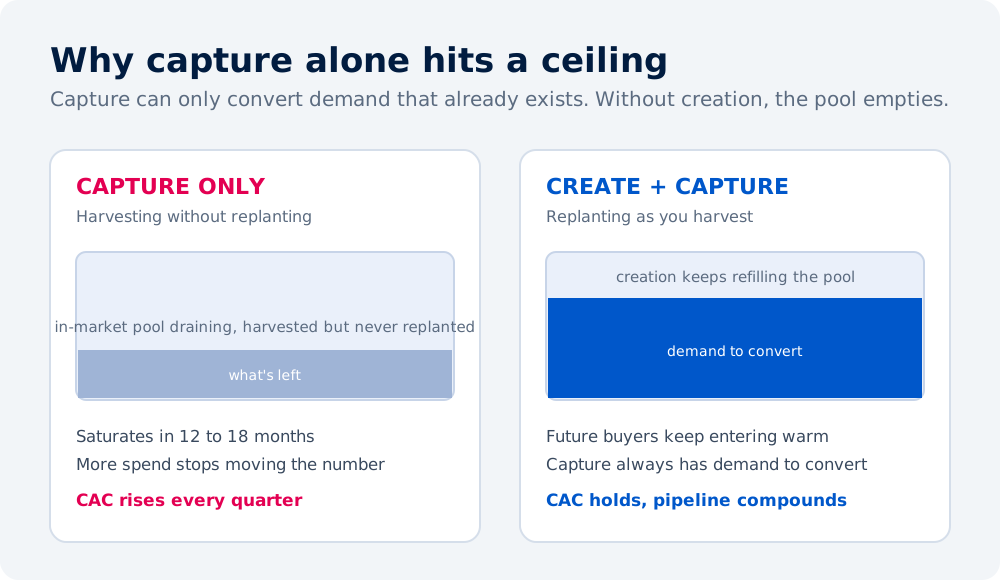
Capture is seductive because it pays off inside the quarter; you can stand it up in thirty days and point at the leads. But capture can only convert demand that already exists. As Erik Miller frames it, a capture-only program is harvesting without replanting; once it saturates the in-market pool, usually within 12 to 18 months, more spend stops moving the number and just raises your cost to acquire a customer. Creation-only has the opposite failure, you manufacture attention that never converts because nothing downstream is built to catch it.
Most teams fall into the first trap by default. Across the B2B sites we have studied, awareness content makes up a third to a half of the typical library, while decision-stage content, the shelf where deals are actually won, runs at about one in six pieces. The bottom-of-funnel formats that capture high intent, the ROI calculators and interactive tools, appear on close to zero to three percent of sites. That last gap is the cheap win hiding in plain sight; it means the highest-intent demand in the category, buyers actively trying to size a decision, sits there uncaptured because almost nobody has built the asset to catch it. And one precision worth holding onto, that awareness glut at the top is not even real demand creation. Publishing to "attract and educate" is not the same as making a stranger care about a problem the way you solve it.
The Starr Conspiracy has the cleanest rule for keeping the two straight, match the measurement to the motion. Most "we tried demand gen and it didn't work" stories are really one mistake, judging creation tactics by capture KPIs like cost per lead this quarter, then killing the thing months before it could have worked.
How does content actually create demand?
Content creates demand by changing what a buyer believes before they are shopping, so that when they do enter the market, they enter it already preferring you. It does not just raise awareness; it sets the criteria the buyer will later judge everyone on, including you.
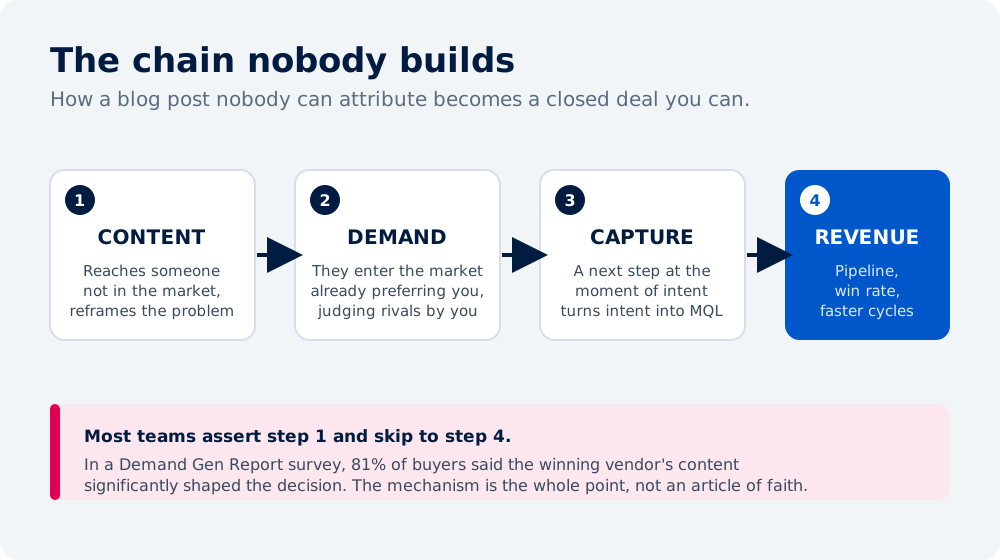
Here is the chain, concretely. A piece of content reaches someone who is not looking to buy. It reframes a problem they had been tolerating, or names one they had not noticed. Over repeated exposure it builds a point of view they start to trust, and it quietly installs the yardstick they will use to evaluate solutions later. By the time they are in-market, they are not comparing you from a cold start; they are comparing everyone else to the standard your content set.
This is where the winning vendor gets decided, and the data on content's role is hard to wave away. In Demand Gen Report's B2B Buyer Behavior Survey, 81 percent of buyers said the winning vendor's content had a significant impact on their decision, and the reasons they gave were operational, not vague. The content that mattered most made it easier to build a business case and show ROI internally. Content does not just get you considered; it arms the internal champion who has to sell you to a committee when you are not in the room.
The effect compounds because buyers reward arriving educated. 6sense's research finds buyers stay seller-free until roughly 70 percent of the way through their journey, and, counterintuitively, reaching them before that point lowers your odds of winning. The first two-thirds of the deal gets won through education, not outreach. We have watched this directly. In one engagement, a webinar-led education program produced MQLs that converted to opportunities at an estimated two to three times the baseline rate, for one reason, the buyers arrived already trusting the argument instead of cold.
Created demand does not show up as a tidy attributable click. It shows up as branded search, as direct traffic, as a "how did you hear about us" field that reads "I have been following your stuff for a year." Which is precisely the problem the next two sections deal with, catching it, and proving it.
How does content capture demand and turn it into pipeline?
Content captures demand when it meets a ready buyer at the moment of intent and gives them an obvious next step, and it keeps turning into pipeline only when you design the conversion path before you write the content, not after.
Capture is where most content quietly leaks. The asset ranks, the visitor reads, and then nothing, because there is no next step matched to where they are. Our site studies put numbers on the leak. Fewer than one in five companies align their calls to action with visitor intent, and only about 7 to 10 percent build a clear path from a blog post to a conversion point. The dominant pattern is to hand a reader who is deep in a buying guide a generic newsletter signup instead of the checklist, model, or benchmark they would actually trade an email for. The demand is right there; the capture is missing.
The fix is to design the funnel before the content. Before we brief a single piece, we map how a stranger becomes a qualified opportunity, the stages from aware to interested to engaged to MQL, the specific action that moves someone to the next stage, and a tight definition of what actually counts as a sales-ready lead. We build fast-track exits too, because a buyer who already wants a demo should never be forced through a nurture sequence to get one. The funnel is the operating logic the content serves, not a report you assemble afterward. In practice every high-intent page carries a hierarchy of next steps, all wired into the CRM so the engagement becomes a usable signal instead of an anonymous pageview:
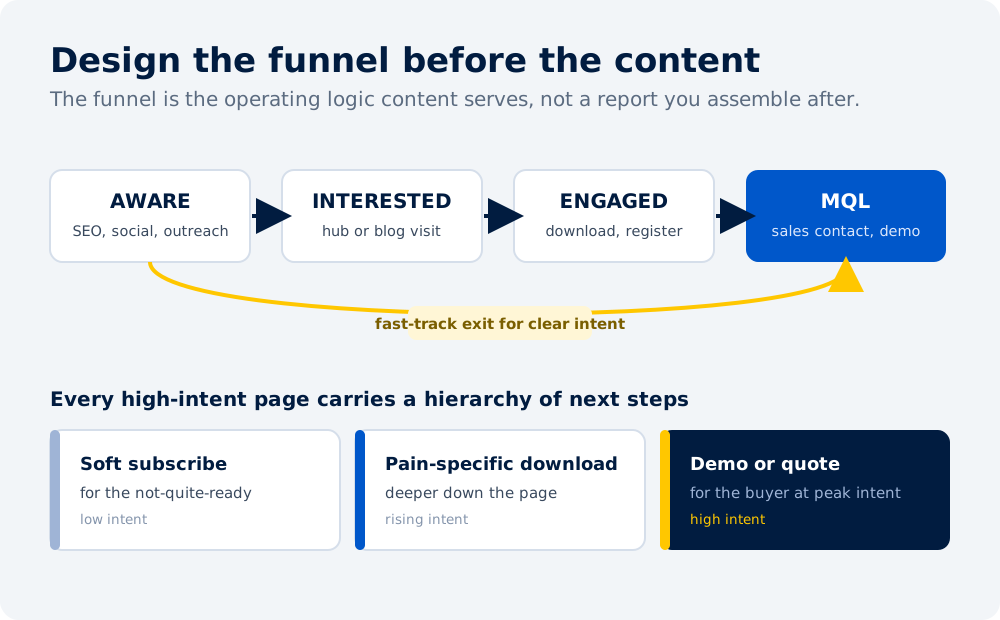
- A soft subscribe for the not-quite-ready.
- A pain-specific download deeper down.
- A demo for the buyer at peak intent.
Capture content also does a second job most teams miss, it arms sales. For one client, a building-operations software company, the same content estate that captured demand doubled as sales enablement, the comparison guides, one-pagers, and explainers reps used across deal stages, so the content kept working after the form fill instead of stopping at it. That is the difference between content that generates an MQL and content that helps close it.
None of this means content replaces the sales conversation. Gartner finds buyers prefer self-service to learn and gather general information, but want a seller's input for the contextual judgment of whether a solution actually fits their situation. Good capture content earns the right to that conversation and sets it up; it does not try to win the deal alone.
How does demand become revenue when your attribution can't see it?
Demand becomes revenue when content shapes the buyer's preference during the long anonymous stretch of the journey, before sales ever gets a conversation. The catch is that your attribution cannot see most of that work, so the numbers tell a story the deals would contradict.
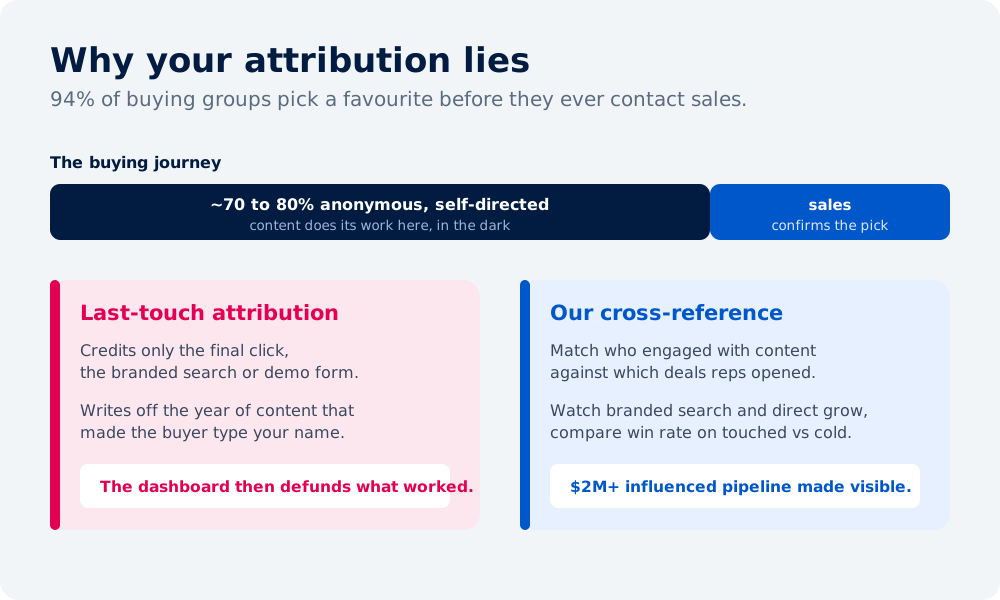
Start with the uncomfortable fact about where deals get decided. 6sense's 2025 Buyer Experience Report, built on more than 4,000 buyers, found that 94 percent of buying groups had already ranked a preferred vendor before they ever contacted sales, and they bought that preliminary favourite 77 percent of the time. The vendor a buyer prefers before the first conversation wins roughly 80 percent of deals. Sellers are no longer creating the preference; they are confirming a decision the buyer reached in the dark. Gartner's figure rhymes with it, buyers spend only about 17 percent of the journey in direct contact with vendors at all.
So the demand your content creates gets converted into a decision mostly off-camera, and that breaks attribution in a specific, expensive way. Last-touch tooling credits the final click, the branded search, the direct visit, the "book a demo" form, and quietly writes off the year of content that made the buyer type your name in the first place. In one 12-month test by Refine Labs, software attribution credited 78 percent of conversions to web search while buyers themselves said 85 percent came from dark-social channels like podcasts and peer communities. In another analysis, deals that first appeared in untracked channels closed 54 percent faster, because the buyer arrived already convinced. The content is working. The dashboard says it is not. Then someone cuts it.
Our own audits show how thin the measurement usually is. Three in four B2B companies run Google Analytics and measure traffic, but whether that traffic connects to pipeline is a question a tag never answers, and roughly 70 percent lack the integrated CRM-and-automation backbone you would need to connect it. It is why, as the Pedowitz Group points out, when a CFO finally asks what share of closed revenue traces to tracked MQLs, the answer is often under 20 percent, sometimes under 10.
The way out is not a better last-touch model; it is to measure the system the way it actually behaves. Track three things instead of the last click:
- Branded search and direct traffic, as the leading indicator that demand creation is working.
- Content-influenced pipeline, by cross-referencing who engaged against which deals opened, not by which click came last.
- Win rate and sales-cycle length for content-touched deals, set against cold ones.
We measure exactly this way in practice. On one long-cycle deep-tech program, we cross-referenced webinar attendees against the deals reps had opened and tied more than $2M in influenced pipeline and over a thousand MQLs in six months to the content, on a clean rule that an ICP-fit registration counted as an MQL. On another, an operationalised content hub cut sales cycles by 30 to 35 percent and drove $3 to 4M in content-influenced pipeline, with inbound leads climbing from about 15 a month to between 120 and 150.
And when you make the revenue claim to a buyer or a board, show the math. In our content audits we price every gap rather than describe it:
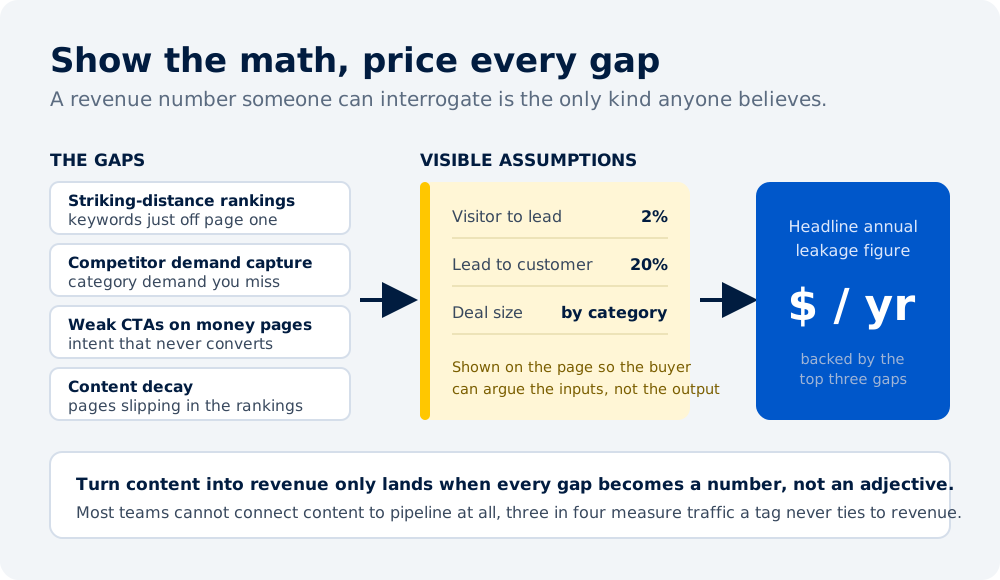
- Striking-distance rankings, the keywords sitting just off page one.
- The demand rivals capture in the category that you do not.
- Weak or missing calls to action on money pages.
- Content decay, the pages quietly slipping down the rankings.
Each line carries its assumptions on the page, a 2 percent visitor-to-lead rate, a 20 percent lead-to-customer rate, your average contract value, so the reader can argue the inputs instead of dismissing the output. A revenue number someone can interrogate is the only kind anyone believes.
One honest caveat on all of this. The rigorous evidence here comes from large-scale buyer surveys and platform telemetry, not from peer-reviewed studies; the academic literature on B2B content and revenue is genuinely thin. Treat the mechanism as well-evidenced and the precise multipliers as directional.
Why does content-led demand gen beat demand gen that only uses content?
Content-led demand generation wins because it lets content set the strategy, shaping the category and the buying criteria, instead of taking orders from a lead-capture quota. The same content library produces wildly different results depending on which discipline holds the pen.
When demand generation runs content as a lead-capture function, content collapses into gated PDFs and volume for its own sake, fifty pieces a month that feel productive and move nothing. When content leads, it sets the category narrative and the criteria buyers use, and the demand-gen motion captures and converts what the content created. Same assets, opposite outcomes, decided entirely by who is in charge.
The reason content gets demoted is structural, not stupid. Erik Miller names the forces that quietly tilt budgets toward capture:
- Capture is attributable this quarter; creation is not.
- Reporting systems are built around MQL and cost-per-lead.
- Quarterly planning cannot wait out an eighteen-month payback.
- Every new SDR hire pushes the budget further toward capture.
Left alone, a content program drifts into pure capture without anyone ever deciding it should. Running creation and capture together on purpose is the core job of a demand generation content marketing agency, when that work sits outside the team.
This is really a question of who owns the whole system, not who owns content. The common complaint that demand generation should not own content misses the point; the failure is not the org chart, it is that no one owns the system end to end, so the pieces never talk to each other. Created demand goes uncaptured, captured demand never gets traced to revenue, and each team optimises its own metric while the engine as a whole underperforms.
Our benchmarking shows how rare it is to run content as a system at all:
- Only about one in three B2B companies keeps an active content presence; most have effectively opted out.
- Of those that publish, most publish once and move on, treating distribution as an afterthought rather than a product.
- Post-purchase content, the kind that drives content lifetime value through retention and expansion, shows up on roughly one in ten sites.
And AI is now pouring fuel on the wrong fire, hired mostly to produce more content faster, which only deepens the awareness glut unless someone points it at the funnel. If that someone sits outside your team, our list of demand generation agencies for when awareness is not converting compares the partners that tie their work to pipeline.
So the test for any piece is simple, and it is the one most content fails, would this make someone more likely to buy, or just more aware we exist. Run content as a system and the answer compounds; for one client, content grew into roughly a third of total pipeline, a co-equal channel sitting next to sales and paid, not a support function. That is what content-led actually buys you, content that carries its own revenue number.
The system, not the balancing act
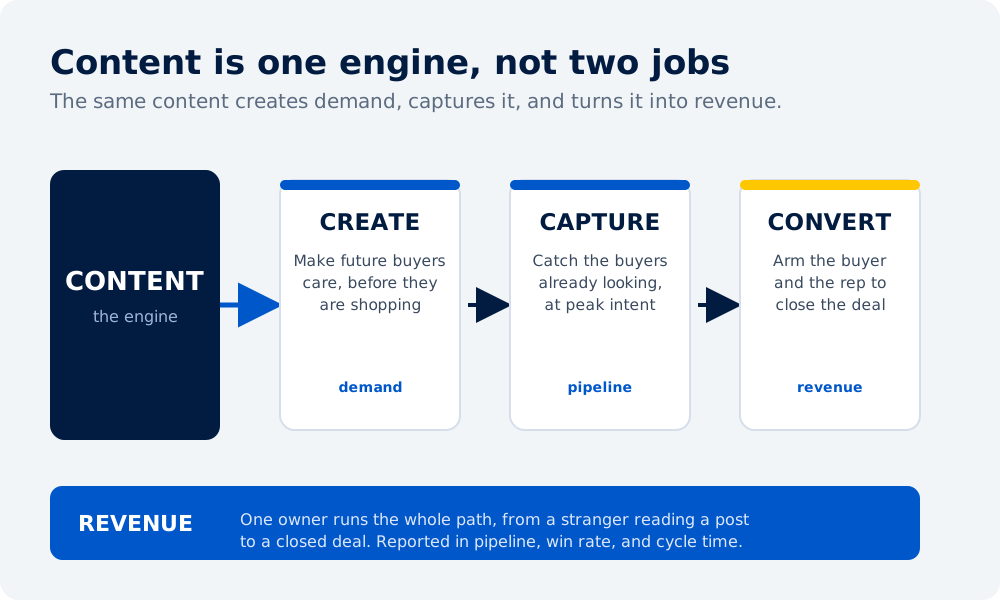
The and is not a fifty-fifty split between a brand team and a pipeline team. It is one engine. Content creates the demand, content captures it, and the whole system reports to revenue. Get the sequence right and the question you started with, brand or pipeline, stops making sense, because the same work produces both.
Job | What content does | Demand signal to watch | Revenue metric |
Create | Make future buyers prefer you | Branded search, direct, "heard of you" | Influenced pipeline, win rate |
Capture | Catch in-market buyers | High-intent sessions, demo requests | Sourced pipeline, conversion rate |
Convert | Arm the buyer and the rep | Engaged accounts, sales usage | Cycle time, closed-won |
Is your content generating revenue, or just proving the blog exists?
Build Content RevOps infrastructure that creates demand, captures it, and ties every asset to pipeline and revenue.
Frequently Asked Questions
About the Author

Founder & CEO, Content RevOps
Stefan Kalpachev is the founder and CEO of Content RevOps, where he helps B2B SaaS companies transform their content into predictable pipeline. With a background in content marketing and revenue operations, Stefan has developed a unique methodology that bridges the gap between content creation and revenue generation.
Connect on LinkedIn