Demand Generation vs Brand Awareness: Which One Should B2B Teams Focus On?
Ready to transform your content into a predictable pipeline? Let's talk.
Book a CallThere's a post on r/branding that gets the whole argument exactly wrong, and that's why it's worth reading. "I don't care what anyone has told you," it opens, "demand generation is a sexy new word to explain the exact purpose of what brand awareness is. VC and Tech companies use this to make it sound more output driven." The comments pile on. One reply sharpens it into something that sounds almost academic: "Branding doesn't create demand out of nowhere, it steals it off other competitors already in the market, by increasing your company's mental availability so you come to mind faster in the buying situation."
Part of The Complete Guide to B2B Demand Generation Strategy.
Then someone quietly detonates the whole thread: "Out of nowhere might mean customers new to the category and not stolen from competitors. Citation needed."
That four-word jab, citation needed, is the entire problem with "demand generation vs brand awareness." The internet can't settle the debate because the debate is framed wrong. People argue about which of the two matters more, or whether they're secretly the same thing, when the honest answer is that they were never two competing strategies in the first place. They're two jobs on a single demand curve. Treating them as rivals fighting over a budget line is how you end up with what most B2B teams actually have: a brand that nobody can measure and a demand engine that quietly runs out of fuel.
This piece makes the case for a different fight, the one actually worth having, and gives you the evidence and the budget logic to win it.
The "versus" is a category error
Start with what each phrase honestly means, stripped of agency packaging.
Brand awareness is the degree to which the people who could one day buy from you recognise, recall, and have some feeling about your company before they're shopping. Demand generation is the system that turns interest into pipeline: content, campaigns, distribution, and sales motions wired together so that interest becomes a tracked opportunity.
Put like that, the "versus" dissolves on contact. One is a state in the buyer's head. The other is a system that operates on that state. Asking whether you should do demand generation or brand awareness is like asking whether a restaurant should invest in its reputation or its kitchen. The reputation is why people walk in; the kitchen is why they come back and tell others. Pit them against each other and you'll starve one to feed the other, and the whole place suffers.
The reason the false choice persists isn't stupidity. It's that the two jobs pay out on completely different clocks, and the clock is where the real argument lives.
The number that ends the argument: the 95:5 rule
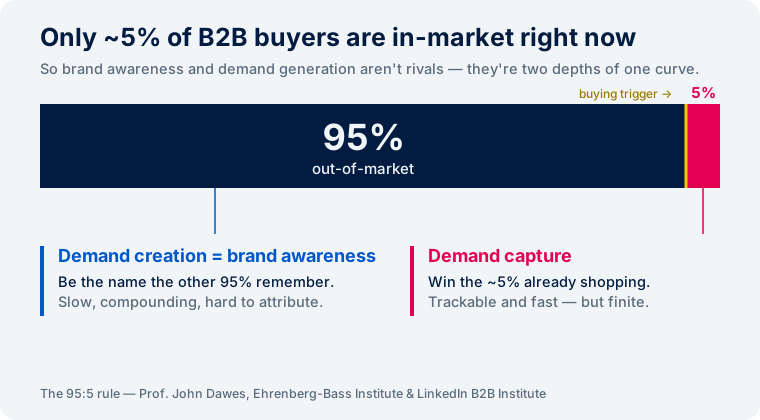
Here's the fact that reorganises everything. At any given moment, only about 5% of B2B buyers are actually in the market for what you sell. The other 95% aren't ignoring you. They have no need yet. Their current contract has two years left. The problem you solve isn't on their desk this quarter. No campaign, however sharp, converts them today, because there's nothing to convert.
This is the 95:5 rule, and it comes from Professor John Dawes at the Ehrenberg-Bass Institute, working with the LinkedIn B2B Institute. Dawes got to the number the boring, durable way: companies change most B2B suppliers roughly once every five years, which means about 20% come into the market in a given year and only around 5% in a given quarter. The rest are out of market: not unreachable, just not ready.
Sit with what that does to the "versus." If 95% of your future buyers can't act now, then the entire job of reaching them (building the recognition and trust that makes you a candidate when their circumstances finally change, at the top of the marketing funnel and across a wider audience) is, by definition, demand generation aimed at people who won't convert this quarter. Brand awareness isn't the soft, unaccountable cousin of demand gen. It is demand generation, run for the 95% you can't capture yet. It builds identity, recall, and trust so your business is the one buyers consider first when they enter the market. The only thing that separates "brand" work from "demand" work is which slice of the curve it's talking to.
So the Reddit commenter who said branding just makes you "come to mind faster in the buying situation" was right about the mechanism. That's mental availability, and the academic work backs it: advertising measurably lifts a brand's mental availability, and the lift is often strongest among people who don't use you yet. But the "citation needed" reply was right too. Some demand genuinely is new: buyers entering the category for the first time, or problems a vendor surfaces that the buyer hadn't named. Both things are true, and holding both is the start of thinking clearly about this across the entire buyer journey, while demand generation engages more actively looking prospects in the middle and bottom of the sales funnel.
3 The fight worth having: brand awareness and demand, creating demand vs capturing it
If "brand vs demand" is the wrong axis, here's the right one, and it's the distinction Chris Walker built a following on at Refine Labs: demand creation versus demand capture.
Demand capture is harvesting intent that already exists. It's the branded search ad, the "best [category] software" comparison page, the retargeting pixel, the inbound demo request. The buyer already knows they have the problem and is evaluating options; capture is about making sure you're the option they pick. It's measurable, fast, and satisfying: every dollar shows a traceable return.
Demand creation is making intent where there wasn't any: a data-driven approach to moving prospects through the sales funnel by educating the market, naming a problem buyers hadn't articulated, and building the salience that means when the need finally arrives, you're already the name they think of. It's slow, it's hard to attribute, and it's where mental availability actually gets built. Demand generation focuses on educating prospects, creating intent, and addressing customer pain points rather than just harvesting immediate interest that's already there.
Here's the uncomfortable part. Most of what gets sold as "demand generation" is just demand capture wearing a better suit. If you are hiring an outside team to do the creating, our review of demand generation agencies that create demand rather than capture it kept only the ones with proof of net-new demand. Effective demand generation strategies turn attention into a measurable pipeline instead of stopping at awareness. If yours stops there today, our list of demand generation agencies for when awareness is not converting keeps only the partners that tie their work to pipeline. Paid search, intent-data outbound, BOFU SEO: all capture. And capture has a hard ceiling, because the thing it harvests is finite. You can only capture the 5%. Spend harder against that 5% and you're not growing the market, you're bidding up the price of the same in-market buyers your competitors are also chasing. The growth (the new demand) comes from the 95%, and the only way to reach them is the slow, "brand-ish" work that capture-obsessed teams keep cutting. Strong demand generation campaigns directly educate prospects toward measurable conversion, capture and nurture interest, and turn it into a tangible pipeline of qualified leads.
Why does it stay finite? Because the buyer isn't waiting for you. Gartner found that B2B buyers spend just 17% of their total purchase journey meeting with all potential suppliers combined, and when they're weighing several vendors, any one of you gets something like 5–6% of their time. The decision is made across a buying group of six to ten people, most of it happening in rooms you're never in. You don't win that by showing up only when they finally raise a hand. You win it by being the brand already in their heads before the evaluation starts. That pre-loading is demand creation. There is no capture-only path to it.
So why do smart teams still split brand from demand? The measurement trap
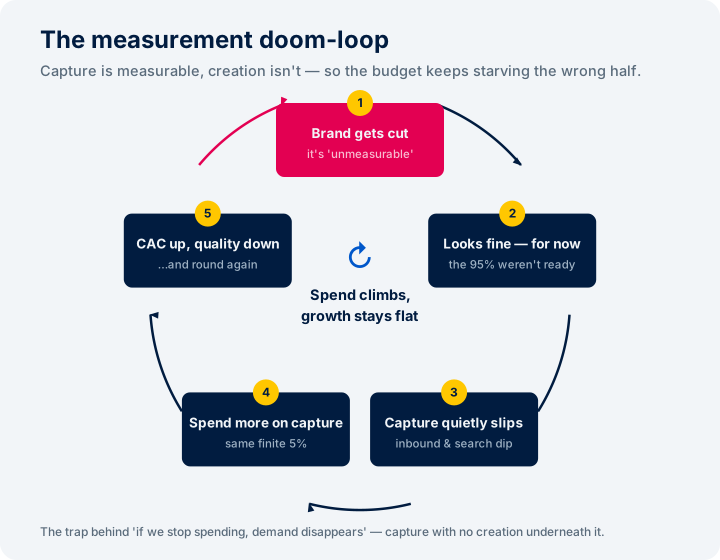
If the logic is this clean, why does every other company still run brand and demand as warring camps with separate budgets? The answer isn't ignorance. It's a measurement trap, and it runs as a quiet doom loop. Companies that treat them as separate motions are 37% less efficient, even when both teams think they're pulling in the same direction.
A practitioner on that same Reddit thread described it better than most decks do: "There is no demand without brand. The problem comes from the C-suite, which wants to measure everything in marketing. 'Brand' marketing is impossible to measure. But it has a huge impact on whether people engage, and turn into leads, and pipeline, and sales. But without brand, none of the measurable things happen."
Trace the loop. Demand capture is trackable: last click, clean attribution, a dashboard the CFO loves. Demand creation isn't. Its payoff shows up months later as "they just found us" or a shorter sales cycle nobody can source. So when budgets tighten, the trackable thing wins the argument every single time. Brand gets cut. For a quarter or two, nothing bad happens, because the 95% you stopped reaching weren't going to buy this quarter anyway. Then, slowly, the capture numbers degrade: branded search softens, inbound thins, cost-per-lead creeps up. Integrating the two avoids fragmented messaging and usually lowers customer acquisition cost. The team responds the only way the dashboard allows, by pouring moreinto capture, bidding harder on the same shrinking pool. Costs rise, quality drops, and the spiral tightens.
This is exactly the pattern Content RevOps sees in the field, and it has a name in our client diagnostics: "if we stop spending, demand disappears." That's not a demand problem. It's the signature of a system running on capture with no creation underneath it. Attribution didn't measure the brand's contribution, so the org behaved as if it were zero, and then paid for that fiction in CAC. Unified programs reduce acquisition costs, improve pipeline velocity, and support more predictable growth.
Binet and Field put a cost on the short-termism directly. Their analysis of the IPA's effectiveness databank (three decades of campaigns) found that sales activation drives quick, sharp spikes that decay almost as fast as they appear, while brand building compounds slowly and decays slowly. An accumulation of short-term wins does not add up to long-term growth. Over-rotate to the measurable half and you don't just stall; you erode the base that made the measurable half work.
So what's the actual split? (And why B2B is different)
This is where the conversation should have started: not whether to do both, but in what ratio. And here there's real research instead of vibes.
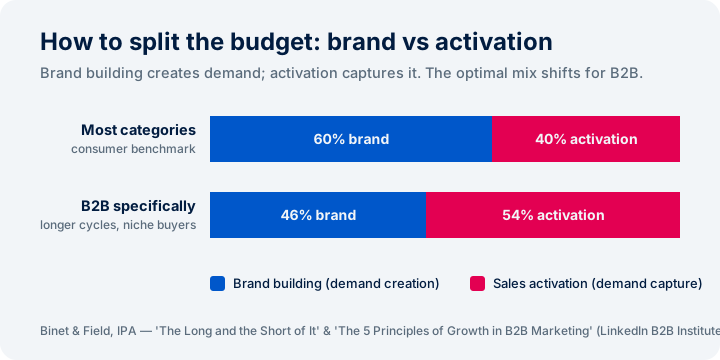
The benchmark is Binet and Field's 60/40 rule: roughly 60% of budget to long-term brand building, 40% to short-term sales activation, as the split that maximised effectiveness across most categories they studied. It's the closest thing marketing has to a law of physics for budget allocation.
But "most categories" was mostly consumer. When the same pair turned to B2B in The 5 Principles of Growth in B2B Marketing (with the LinkedIn B2B Institute), the optimal split shifted to roughly 46% brand building and 54% activation, more activation-weighted than the consumer default, because B2B has tighter targeting, longer cycles, and a genuine role for sales activation against that hard-to-reach 5%.
So the honest answer to "how should I split brand and demand" is: start near half-and-half, then adjust for your situation. Combining these two strategies creates a more robust funnel. Skew toward creation if you're early, unknown, or selling something the market doesn't yet know it needs. You have no mental availability to harvest, so you have to build it. Aligning them keeps the pipeline self-replenishing over time. Skew toward capture if you're established in a category with real existing search demand and a brand buyers already recognise. A startup nobody's heard of and a category leader defending share should not run the same ratio, and the 95:5 rule tells you why: the startup's 95% doesn't know it exists yet, while the leader's already does. Getting the mix right supports business growth and sustainable growth, with demand generation helping drive more predictable revenue growth.
How to measure the thing everyone says is unmeasurable
The doom loop only has power because "brand is impossible to measure" goes unchallenged. It's not true anymore, and refusing to measure creation is what lets the dashboard starve it. Three moves break the trap.
Track share of search. Les Binet's most useful recent finding is that your share of search (your brand's slice of all category-related search volume) is a leading indicator of market share, often predicting it six to twelve months out. It's free, public, and updates continuously. When share of search rises, you're building the mental availability that turns into pipeline later. It's the closest thing to a live gauge on demand creation, and tracking metrics like media share of voice can sharpen that read on effectiveness.
Ask the buyers directly. The single most underused brand metric is a one-line question on the demo form and in the first sales call: "How did you first hear about us?" Self-reported attribution catches exactly what last-click misses: the podcast, the LinkedIn post, the colleague's recommendation, the year of seeing your name before they ever searched. It's qualitative and a little messy, and it's still more honest about demand creation than any pixel.
Run a blended scorecard. Put a creation signal (share of search, branded search volume, direct traffic) next to a capture signal (pipeline, CAC, win rate) on one page, using key performance indicators for brand awareness like impressions, reach, website traffic, and brand search volume, plus demand-generation metrics like qualified leads, lead conversion rates, and pipeline generation. When both rise together, the system's healthy. When creation slips and capture costs climb, you've found the leak before it becomes a crisis, which is the entire point of measuring.
7 In practice, almost no one runs integrated strategies as one system
Step back from the theory and the real-world failure is remarkably consistent. It isn't that teams consciously choose brand over demand. It's that they spend against capturing the 5% and build almost nothing to create demand among the 95%, then can't work out why capture keeps getting more expensive every quarter.
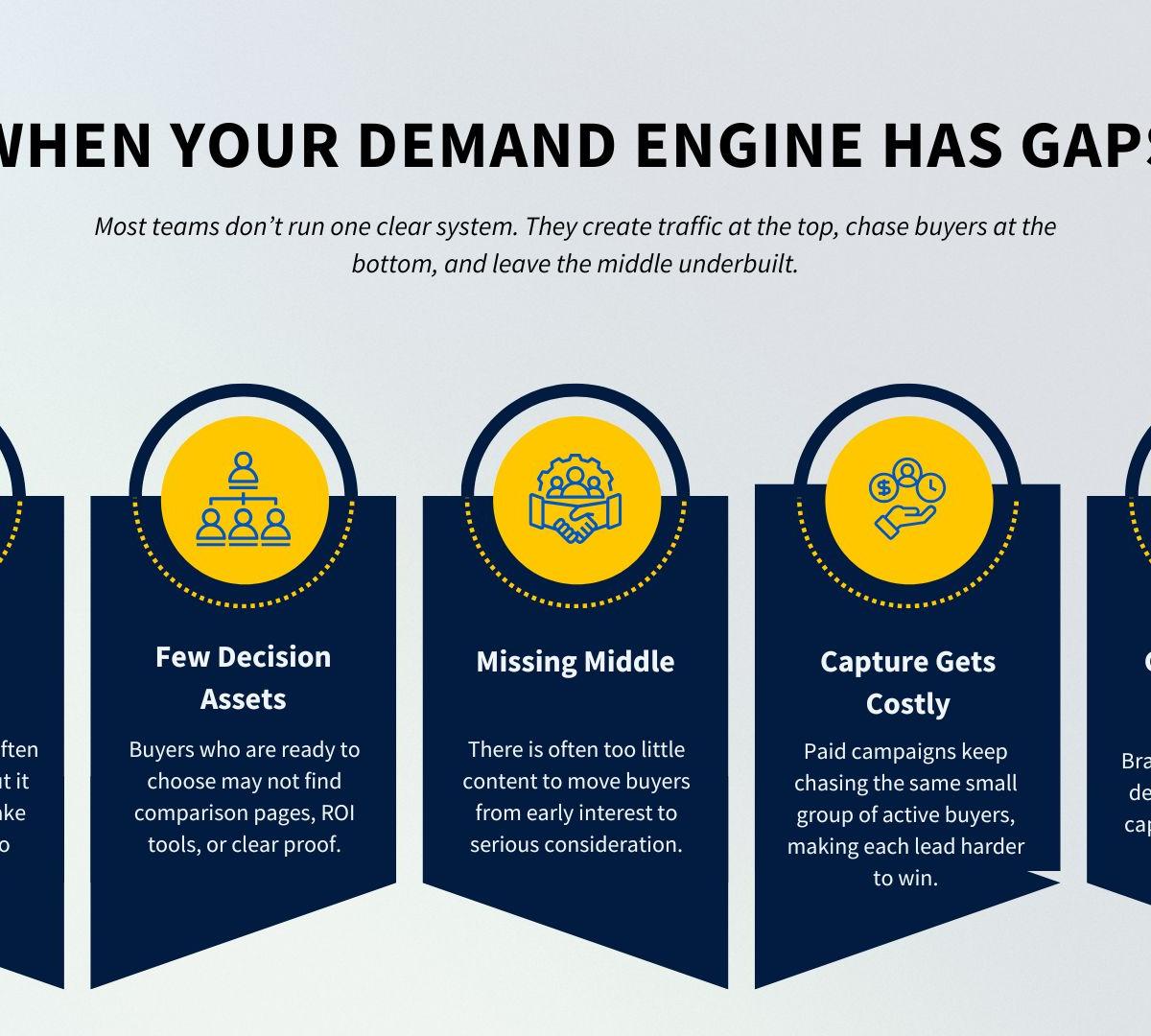
You can see the imbalance in what companies actually publish. Across the sites we've studied, content skews hard to the top of the funnel (roughly twice as much awareness-stage material as decision-stage), yet the assets that do the actual capturing, like comparison pages and ROI calculators, barely exist, turning up on a low single-digit share of sites. Webinars and gated content are also the kinds of assets that generate qualified leads. So even the in-market 5% arrive to find nothing built to help them choose. And the "awareness" content that does get made is mostly search-traffic bait, which is not the same thing as the patient salience-building that makes you the name a buyer remembers two years from now. Between awareness and decision, email campaigns help guide potential customers through the buyer's journey and support nurturing leads.
The upshot is that the typical company isn't running a 46/54 engine, or a 60/40 one, or any deliberate ratio at all. It's running an accidental split: a thin layer of traffic content up top, a paid-capture habit at the bottom, and almost nothing in between doing the slow work of demand creation. That isn't a brand-versus-demand problem. It's the absence of a system: two jobs that were never wired together, each underpowered without the other.
So the fix isn't to pick a side. It's to stop running two underpowered halves and connect them into one engine, where demand creation builds the mental availability that demand capture later cashes in.
One funnel, two jobs
So drop the "versus." Demand generation vs brand awareness was always a false binary, an argument between two halves of the same machine over which half gets to exist. Brand awareness is the extent to which consumers recognize a brand, introducing a company to the market by capturing attention and strengthening brand recognition.
The real choice is what ratio of creating demand to capturing it fits where you are right now, and whether you're honest enough to measure the creation side instead of cutting it because it's quiet. Get that right and the old debate stops mattering. You're not running a brand team and a demand team anymore. You're running one engine with two jobs: on the brand side, focus on building brand awareness through name recognition and emotional connection that build trust; on the demand side, create a steady pipeline of qualified leads and convert that attention into high quality leads. That's not brand or demand. That's just demand generation, done with the full picture in view.
References
Dawes, J. (2021). Advertising effectiveness and the 95-5 rule: most B2B buyers are not in the market right now.Ehrenberg-Bass Institute / LinkedIn B2B Institute. (Coverage: Marketing Week, https://www.marketingweek.com/ehrenberg-bass-linkedin-b2b-buyers/)
Binet, L. & Field, P. (2013). The Long and the Short of It. IPA.
Field, P. & Binet, L. (2019). The 5 Principles of Growth in B2B Marketing. LinkedIn B2B Institute / IPA.
Binet, L. (2020). Share of search. EffWorks Global / IPA; WARC.
Gartner. The B2B Buying Journey. https://www.gartner.com/en/sales/insights/b2b-buying-journey
Walker, C. / Refine Labs. Demand creation vs demand capture.
Vaughan, K., Corsi, A. M., & Beal, V. (2020). Measuring advertising's effect on mental availability. International Journal of Market Research. https://doi.org/10.1177/1470785320955095
Content RevOps cross-industry content dataset. https://contentrevops.com/resources
Ready to Transform Your Content Strategy?
Get a Content RevOps-style audit of your brand-to-demand balance and a 90-day plan to create demand among the 95%, capture the 5%, and measure both — without guessing at attribution.
Frequently Asked Questions
About the Author

Founder & CEO, Content RevOps
Stefan Kalpachev is the founder and CEO of Content RevOps, where he helps B2B SaaS companies transform their content into predictable pipeline. With a background in content marketing and revenue operations, Stefan has developed a unique methodology that bridges the gap between content creation and revenue generation.
Connect on LinkedIn