Understanding the Demand Generation Process: Step by Step
Not sure which step of your demand generation process is leaking between visibility and pipeline? See exactly where it breaks.
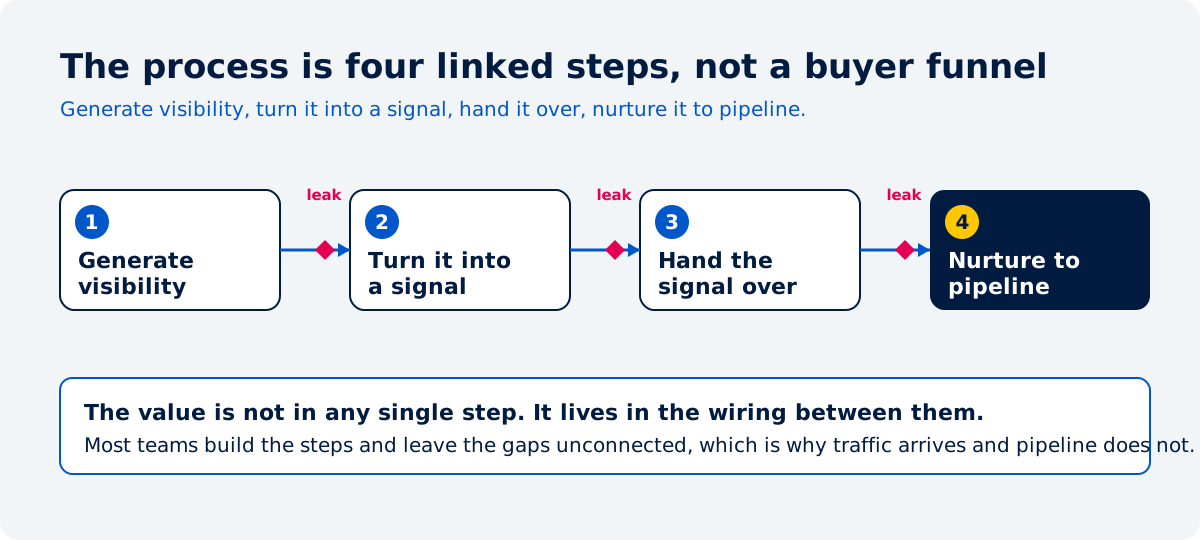
Book a CallThe demand generation process is not a diagram a buyer slides through from unaware to sold. It is the operating workflow a demand generation team runs to do three jobs at once, surface demand that is latent and hidden, shape which category a buyer ends up considering, and capture and route the demand that already exists. Four steps carry that workflow: generate visibility, turn visibility into a signal, hand the signal over, and nurture the signal into pipeline. The value is not in any single step. It lives in the wiring between them, which is exactly where most teams have nothing connected. That is why traffic arrives and pipeline does not.
Part of The Complete Guide to B2B Demand Generation Strategy.
Can you actually generate demand, or only capture it?
You almost never create demand out of nothing. The most useful thing a demand gen team does is make existing, mostly-hidden demand visible and actionable sooner. That is a real job, and it is worth doing well, but it is not the magic the phrase implies.
Take the skeptic's position seriously, because it is half right. The argument runs like this: people buy when they are ready, not when your ad runs, so there is no such thing as demand creation, only brand awareness and demand capture. Anyone who has watched a perfect campaign land on an audience with no budget and no trigger has felt the truth in it.
Where the argument breaks is the leap from "people are not ready" to "the market is fixed at a tiny sliver." Forrester's analysis pushes hard on the popular notion that only 5% of a market is ever in-market. Across the B2B technology categories it tracks, closer to 15 to 30% of the audience is in motion in a given year. The in-market pool is bigger, more variable, and more reachable than the famous heuristic suggests.
So the work is real. It is just not the work the word "generate" implies. It splits into three jobs.
- Surface latent demand earlier. Reach the buyer who has the problem but has not yet named it, and help them name it.
- Shape the considered set. This is the closest thing to creating demand. By the time buyers reach out, around 95% purchase from the shortlist they already had on day one, and the average buyer arrives carrying eight or nine prior journeys in the category. You are not installing a desire. You are getting onto the day-one list before it hardens.
- Capture and route demand that already exists. Meet the active buyer at the moment of intent and move them cleanly toward a conversation.
Shaping the category is where demand gen comes nearest to genuine creation, and it depends on teaching, not promoting. In deep-tech and unfamiliar categories, the company that explains the problem is the one that wins it, because product credibility alone does not convert a buyer who does not yet understand what they are looking at. We saw this directly with GRC, where the blocker looked like a sales problem but was really a buyer-side knowledge gap; education-first content moved buyers from unaware to ready and let a strong product convert at the rate it deserved.
One more caution before the steps, because it shapes everything downstream. Even "in-market" signals lie. When DemandScience examined 5,903 companies researching demand-gen solutions, only 62 qualified as genuinely in-market, a 98.9% false-positive rate. "Generate demand" therefore cannot mean "find people who look interested." It has to mean building a process that separates real motion from noise, which is what the four steps are for.
A quick word on labels, since the terms get used interchangeably and the confusion is real. Demand generation is the whole motion. Lead generation is the capture step that sits inside it. Brand marketing feeds the visibility step at the front. Arguing about which is which matters far less than fixing the wiring between them.
Why the demand generation process is not the buyer's journey
The process most people draw is a relabeled buyer's journey, awareness to interest to evaluation to purchase. That sequence describes what the buyer feels. It says nothing about what the team does. Handing someone a four-stage funnel and calling it a process is like handing someone a weather forecast and calling it a plan.
The buyer's journey belongs to the buyer. The process is your workflow that acts on it. Keep the two separate, because the stages a buyer moves through and the steps your team executes are different objects with different owners. As we put it in our own method work, the funnel is the operating logic, not a reporting add-on; if you do not know how a lead is supposed to move, you cannot design the content, the signals, or the handoffs that move it.
That is why the four steps are written as verbs the team performs. Generate visibility. Turn visibility into a signal. Hand the signal over. Nurture the signal into pipeline. Each one is work, with an owner and a failure mode, not a mood the buyer passes through.
It also explains the most common and most expensive failure in demand gen. Our analysis of 478 high-growth B2B companies found that a structured resource hub is now near-universal among active publishers, but the conversion and distribution wiring around it mostly is not there. Structure exists; the wiring does not. The gaps between the four steps leak more demand than any single step ever generates, and the rest of this piece is about closing them.
Step one, generating visibility where demand will surface
Visibility means being found by the right people in the places demand actually surfaces, and the discipline is aiming it where intent will later be detectable, not maximizing reach. Reach is easy to buy and easy to mistake for progress. Aim is the hard part.
Aim matters because most of the journey is invisible to you. 6sense's longitudinal buyer research finds buyers complete roughly 70% of their evaluation before they ever contact a vendor, and only about 3% of website visitors ever self-identify. Visibility that cannot later become a signal is simply cost; you paid for attention you will never be able to act on.
Where that visibility now lives has shifted under everyone's feet. 94% of business buyers use AI in their buying process, and Forrester finds they increasingly rate generative AI as a more important information source than vendor websites, product experts, or sales. In B2B software specifically, more than half of buyers now start research in an AI chatbot more often than Google, and AI chatbots have become the single biggest influence on the shortlist. If the model does not name you when a buyer asks it to compare options, you are not in the consideration set, and no amount of downstream nurture can rescue a deal you were never in.
This is also where vanity does the most damage. Our cross-industry analysis found that B2B content skews heavily to the top of the funnel, with informational terms making up well over half of what most companies rank for and little built to move a reader down, and that between one in six and one in five content pages end with no next step at all. Dead-end content. The reader finishes, finds nowhere to go, and leaves no trace you could ever act on. Visibility for its own sake is the most expensive way to feel busy, which is why step one only counts if it is built to feed step two.
Step two, turning visibility into a signal
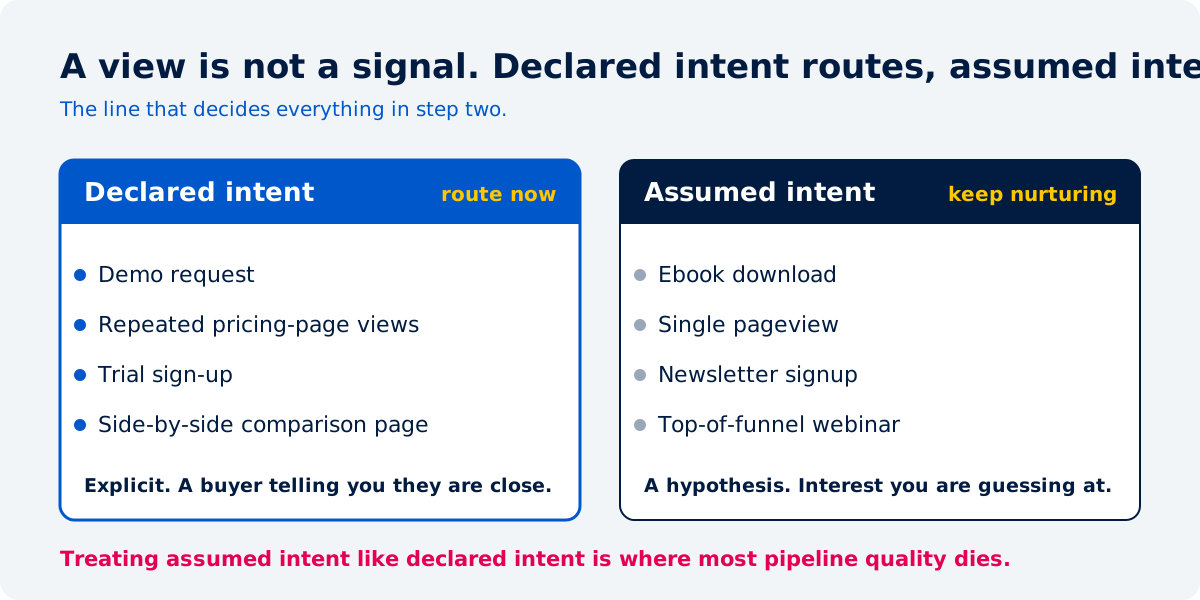
A view is not a signal. The process has to convert attention into something detectable and routable, and the line that decides everything is declared intent versus assumed intent. Declared intent is explicit, a demo request, a repeated pricing view, a trial sign-up. Assumed intent is a hypothesis, an ebook download or a single pageview that you have decided to read as interest. Treating the second like the first is the original sin of demand gen, and it is where most pipeline quality dies.
The mechanics explain why generic lead scoring keeps disappointing. A peer-reviewed review of lead scoring models found that traditional scoring converts leads to customers at about 5%, while behavioral and predictive models reach around 15%, and that MQL-to-closed-won across the field is often under 1%. Points-for-actions measures activity as a proxy for intent, and that proxy keeps weakening as buyers research passively, anonymously, and across channels you cannot see. You are scoring the shadow, not the buyer.
Two failure modes make it worse. First, intent data can quietly validate itself; your own outbound generates the engagement that makes the intent score look accurate, so the system congratulates itself for noise it created. Second, signals decay. A four-week-old signal carries far less predictive value than the same signal from three days ago, because buying windows are short and a stale signal points at a moment that has already passed.
So what does a real signal look like? A cluster, not a click. Repeated pricing-page visits, several stakeholders from the same account moving together, a purpose-built download that tells you the exact pain before a rep ever makes contact. The content someone reads is itself qualification data, if you have built the instrumentation to capture it. The job of step two is to turn ambient attention into a small number of high-fidelity signals a human can act on.
Almost nobody has built that layer. In our cross-industry analysis, the dominant pattern is a reader deep in a guide getting offered a generic newsletter signup instead of the checklist, model, or benchmark they would actually trade an email for, so even when attention lands, nothing captures it as a usable signal. Calls to action that change with intent are rare; fewer than one in five companies align the ask with what the visitor actually wants, and the default ask is still "Contact Us." Visibility lands, and then it dies, because there is no mechanism to convert it into anything the next step can use.
Step three, the handover that decides whether the signal survives
Handover is not an arrow between marketing and sales. It is a designed step with four moving parts, and skipping any one of them is how a good signal turns back into a cold list.
- A threshold. What is allowed through, which should be declared intent, not assumed.
- A speed limit. An SLA, because signals go cold fast.
- A routing rule. Who gets it, and on what basis.
- A context pass. The enrichment and behavioral history that travel with the signal so the receiver opens warm.
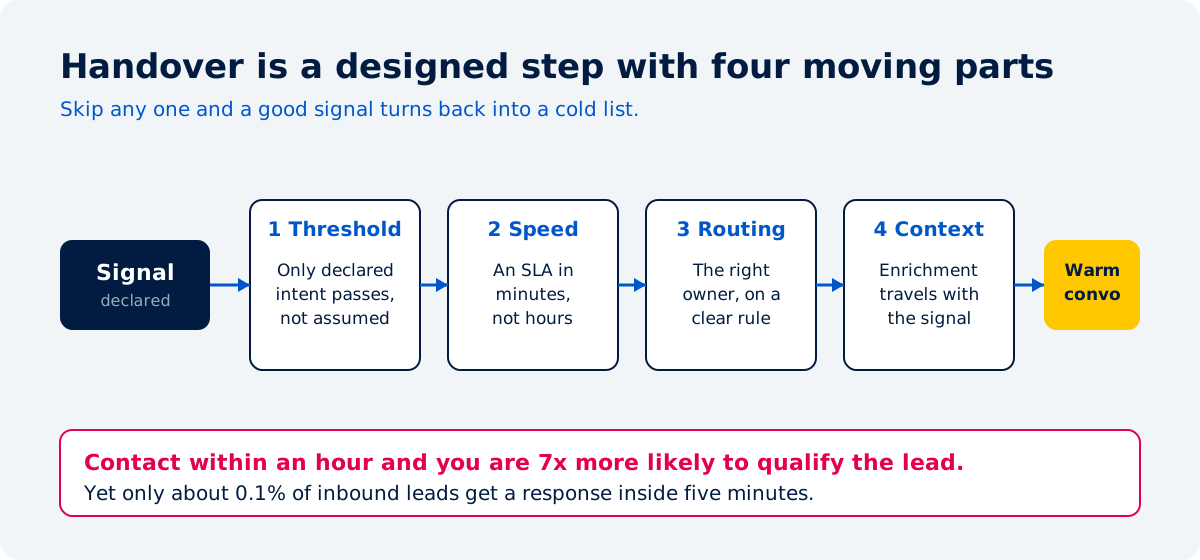
Speed is the part teams most underrate. Harvard Business Review's audit of 2,241 companies found an average first response of 42 hours, and firms that made contact within an hour were seven times more likely to qualify a lead than those who waited just an hour longer, and sixty times more likely than those who waited a day. The distance between knowing this and doing it is enormous. One large analysis of inbound leads found that only about 0.1% get a response inside five minutes, so the signal you worked two steps to create routinely sits untouched while it cools.
The human failure mode is the one marketers describe over and over. Leads get thrown over the fence to a sales team that does not trust marketing, and a rep with no context opens cold and guesses, which only deepens the distrust. A scored, context-rich handover breaks that loop. With FacilityGrid, engagement scoring plus routing put SDRs on the accounts that were actually warming up, and enriched briefs let them open with relevance instead of starting from a name and a guess. The handover stopped being a list and became a conversation.
This is the step where the cost of weak wiring is easiest to measure and most often ignored. Three in four B2B companies track their traffic, but whether they connect any of it to pipeline is a question a tag never answers, and teams are staffed accordingly, hired to prove results far more than to generate the demand they measure. Everyone can see the traffic. Almost no one can see whether the handover survived.
Step four, nurturing the signal into pipeline
Nurture is the work between a raised hand and a real opportunity, and it is not a drip sequence. A list of contacts is not pipeline. Without qualification and follow-through, the CRM stops being an asset and becomes a graveyard, full of names nobody will ever call.
The reason nurture has to be long and multi-threaded is the shape of the modern purchase. The average B2B buying decision now involves around 13 people across two or more departments, buying groups of roughly ten run journeys of about ten months, and buyers spend only 17% of that time with potential suppliers while three in four prefer a rep-free experience. A five-email sequence cannot carry a ten-month, ten-person, mostly-rep-free decision. Nurture has to do the work the rep is not in the room to do.
In practice that means three things, none of which look like a newsletter. A fast first follow-up while the signal is still warm. Context-matched education that answers the buyer's actual next question rather than restating the brochure. And reactivation of signals that went quiet, because a stalled conversation is not a dead one. The download is the start of the funnel, not the finish; the money is in the patient, signal-driven follow-through that most teams never build because it is harder than buying another ad.
When the four steps connect, the output changes from traffic to pipeline. Strong positioning does not convert to pipeline on its own; it needs an operationalized engine underneath it. With Banking Crowded, wiring visibility, signal, handover, and nurture into a single operating system compressed the sales cycle and drove multimillion-dollar pipeline from the same demand that had been leaking out of the gaps before. That is the whole argument in one result. The steps are not the hard part, and neither is the visibility everyone obsesses over. The work, and the value, is in the wiring.
Is your demand generation process wired end to end, or leaking in the gaps?
Get a Content RevOps audit: where visibility dies before it becomes a signal, where the handover goes cold, and how to wire the four steps into real pipeline.
Frequently Asked Questions
About the Author

Founder & CEO, Content RevOps
Stefan Kalpachev is the founder and CEO of Content RevOps, where he helps B2B SaaS companies transform their content into predictable pipeline. With a background in content marketing and revenue operations, Stefan has developed a unique methodology that bridges the gap between content creation and revenue generation.
Connect on LinkedIn