Should you run paid ads in life sciences? A buyer's guide to PPC
Fewer than 1 in 5 life science companies bid at all, and the ones that do point almost none of that budget at content. Want to see what your own demand is worth before you spend?
Book a CallPaid search in life sciences runs on an uncrowded auction. Very few of your competitors bid, and the clicks range from the cross-industry average up to roughly ten times it, depending on what you sell. Whether to buy into it is a question for the same conversation as the rest of your demand generation programme, not a standalone channel decision.
Part of The Complete Guide to B2B Demand Generation Strategy.
That combination is only worth buying under two conditions. Your buyers have to type something into a search engine, and you have to own somewhere useful to send them when they click.
Plenty of life science companies fail one or both tests. This guide walks through the evidence on both sides so you can work out which group you are in before you commit a budget.
Are paid ads effective in life sciences?
Paid ads work in life sciences when your buyers use search engines to find suppliers, and the evidence says many of them do, though search is not their first stop.
Where scientists look first
ResearchGate surveyed 285 of its members across 31 countries about their most recent lab purchase. When asked how they research and discover products, 49% said publications helped most. Search engines and product review websites came next. Conferences and tradeshows performed worst of the options offered.
One split in that data matters more than the headline. Search engines ranked highest for sole decision-makers, at 41%. The person who can sign off a purchase alone is the person most likely to start with a search.
That sample skews heavily academic, so a company selling into pharma should read it as a signal about direction, not a portrait of their exact market.
A second survey of more than 900 scientists by the Science Advisory Board points the same way from a different panel. Before buying, scientists most often identify products through personal networks, publications, and the internet.
Search is genuinely one of the main routes into a life science purchase. It is not the only one, and it is not the strongest. That is the same picture we see across digital marketing for life sciences generally, where no single channel carries a purchase on its own.
Who decides a life science purchase
The same ResearchGate work found an average of 3.7 people involved in a lab purchase, rising to between three and five once the price passes $5,000.
So the person who clicks your ad is frequently not the person who decides. They are gathering evidence to bring to colleagues. An ad that wins the click and then offers nothing worth forwarding has done half a job.
The approved vendor list problem
Here is the constraint no amount of ad spend can solve, and it comes from that same survey of 900 scientists.
Scientists name their own employer or institution as the biggest barrier to buying the products they want, largely through approved or preferred vendor lists. Just under a quarter of them report having no restrictions at all on which suppliers they may buy from.
Read that the other way around. Roughly three in four scientists can only buy from a pre-approved list, and suppliers earn a place on those lists through negotiation, product category, and price thresholds.
A click cannot put you on an approved vendor list. Paid ads can build recognition inside an account and create demand that a scientist carries to their procurement team, and the purchase still has to clear a process that runs on contracts and relationships. Where the list is the real barrier, account-based marketing for life sciences is the more honest instrument.
Why do so few life science companies run paid ads?
Most life science companies stay out of the auction entirely, which is what leaves it open.
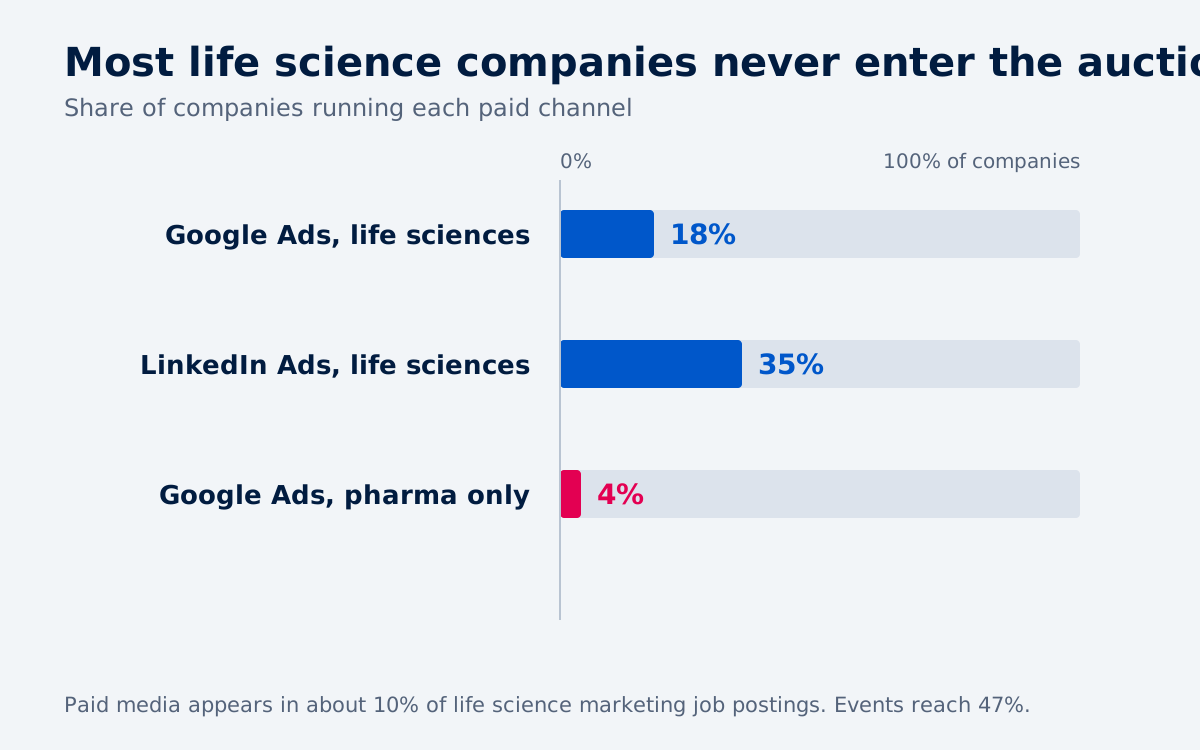
In our study of content marketing in life sciences, about 18% of companies run Google Ads. That is roughly one in five and a half. LinkedIn does better at about 35%, roughly one in three, which makes it the sector's preferred paid channel.
Narrow the lens to pharma and the number collapses. In our pharma study, about 4% of companies run any active Google Ads campaign, around one in 25. Most of that gap comes down to choice rather than regulation, which we will come back to.
Where life science budgets go instead
The hiring data explains the spending pattern better than any budget survey.
Paid media appears in about 10% of life science marketing job postings. Events, tradeshows, and congresses appear in about 47%. The sector staffs for the conference hall at roughly five times the rate it staffs for the ad auction, and budgets follow the people. The same signal runs through what life science companies hire marketers to do.
Across B2B verticals, Google Ads adoption runs somewhere between one in 25 and one in five, so demand capture through paid remains a lane very few companies use.
Two kinds of cheap
Before you read low competition as free money, take the counter-argument seriously.
Jyll Saskin Gales, who spent six years working at Google and now coaches advertisers independently, argues that high click costs in B2B are natural and even desirable. Her reasoning is that the enemy in business advertising is low-quality traffic, not a high price per click, and that very low click costs usually mean you are reaching consumers instead of business buyers.
So there are two kinds of cheap. An auction where few competitors bid on a genuinely commercial term is an opportunity. An auction that costs little because the people clicking are not your buyers is a trap. Much of this guide is about telling those apart.
A free check on your own category
You do not have to take anyone's word for how contested your corner of the market is.
Google runs a public Ad Transparency Center that shows which ads any advertiser is currently running, in which countries, in which formats, and for how long. It exists because the European Union's Digital Services Act obliged platforms to disclose who pays for advertising.
One practical note. Searching by brand name often returns nothing, because many companies advertise under a legal entity rather than a trading name. Search by domain instead.
The tool will not show you spend, clicks, or conversions. It will tell you whether the companies you compete with have been bidding, and whether they have kept it up long enough for it to look deliberate.
What do life science companies get wrong with PPC?
The companies that do spend mostly buy reach instead of pipeline.
Ads that behave like billboards
Our life sciences research found that about 72% of the sector's LinkedIn ad spend carries a brand-awareness objective. Lead generation takes about 2%. The same pattern shows up across verticals, with around three in four LinkedIn advertising dollars aimed at awareness and life sciences sitting at 71.8%.
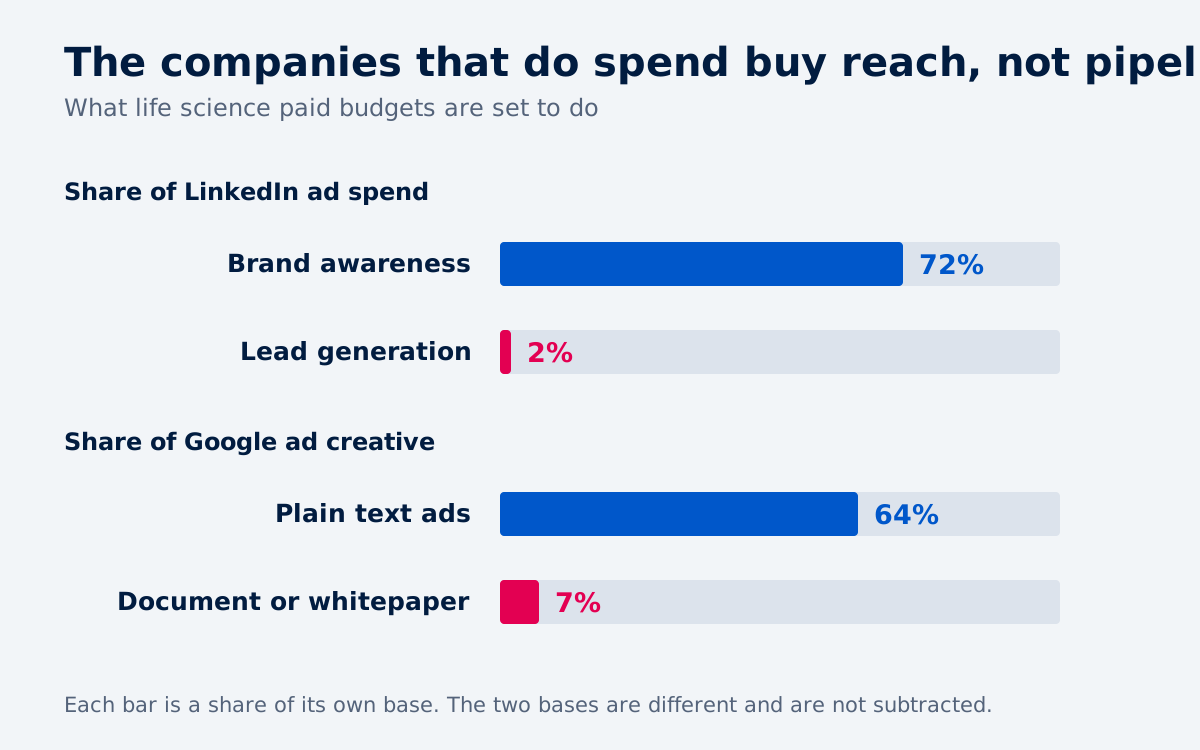
The creative tells a matching story on the other platform. Text ads make up about 64% of Google creative in the sector. Document and whitepaper formats, the ones that actually capture a contact, account for about 7%.
A sector that runs plain text ads on Google and buys awareness on LinkedIn has bought billboards on both. Billboards are a legitimate purchase, and they are a strange thing to buy on platforms whose whole advantage is measuring what happened next. The trade-off between the two objectives is worth reading in full in demand generation versus brand awareness.
Paid traffic with nowhere to land
The gap that costs the most money sits between the ad and the content.
Close to none of the active life science websites we studied point paid search at a content asset, and across verticals the share of paid budget aimed at content amplification sits near zero. Companies pay to attract attention and pay to close deals, and buy almost nothing for the long middle stretch where a technical buyer makes up their mind.
That matters more than it sounds, because the price of your paid search depends on demand somebody already created.
The on and off test
Melissa Mackey, Head of Paid Search at Compound Growth Marketing, published two client cases showing the effect from both directions. Her firm sells B2B paid search, so read her interest into it, and the mechanism still holds.
In the first case, an enterprise software company with low awareness ran educational videos explaining what its product did before anyone went looking for it. Cost per lead on the search campaigns fell 30% for one product and 25% for another. On the second product, click prices rose over the same period and the leads still got cheaper, because more of the people arriving already understood what they were looking at.
The second case is the cleaner test. A local business ran video for five months and got zero direct conversions from it, so they switched it off to save money. Cost per lead on their brand search campaigns immediately rose 47%. They turned the video back on and cost per lead returned to where it had been. The spend involved was about $500 a month.
That client sells locally, not into life sciences, so it demonstrates how the two channels interact rather than setting a sector benchmark. Search advertising harvests demand. When a company stops planting, harvesting gets more expensive, and the ad account is the last place that shows up. This is the whole of demand generation versus demand capture, priced. For teams that would rather have an outside partner do the planting than keep bidding on the harvest, we keep a shortlist of demand generation agencies for reducing paid ad dependence, screened on whether they build organic demand for themselves.
What does PPC cost in life sciences?
Clicks in life sciences cost more than the cross-industry average, and the auctions are still open.
Here is what Google's own advertiser data shows for core life science commercial terms in the United States, as of August 2026.
Search term | Searches per month | Cost per click | Advertiser competition |
custom antibody production | 90 | $51.88 | Low |
clinical trial services | 170 | $35.29 | Low |
cdmo services | 480 | $20.10 | Low |
elisa kits | 1,900 | $13.51 | Medium |
lab equipment supplier | 18,100 | $11.58 | Low |
contract research organization | 3,600 | $11.50 | Low |
peptide synthesis service | 1,000 | $10.93 | Low |
lab freezer | 1,000 | $10.37 | High |
mass spectrometer price | 390 | $7.15 | Medium |
flow cytometer | 27,100 | $6.58 | Low |
cell culture media | 2,900 | $5.49 | Medium |
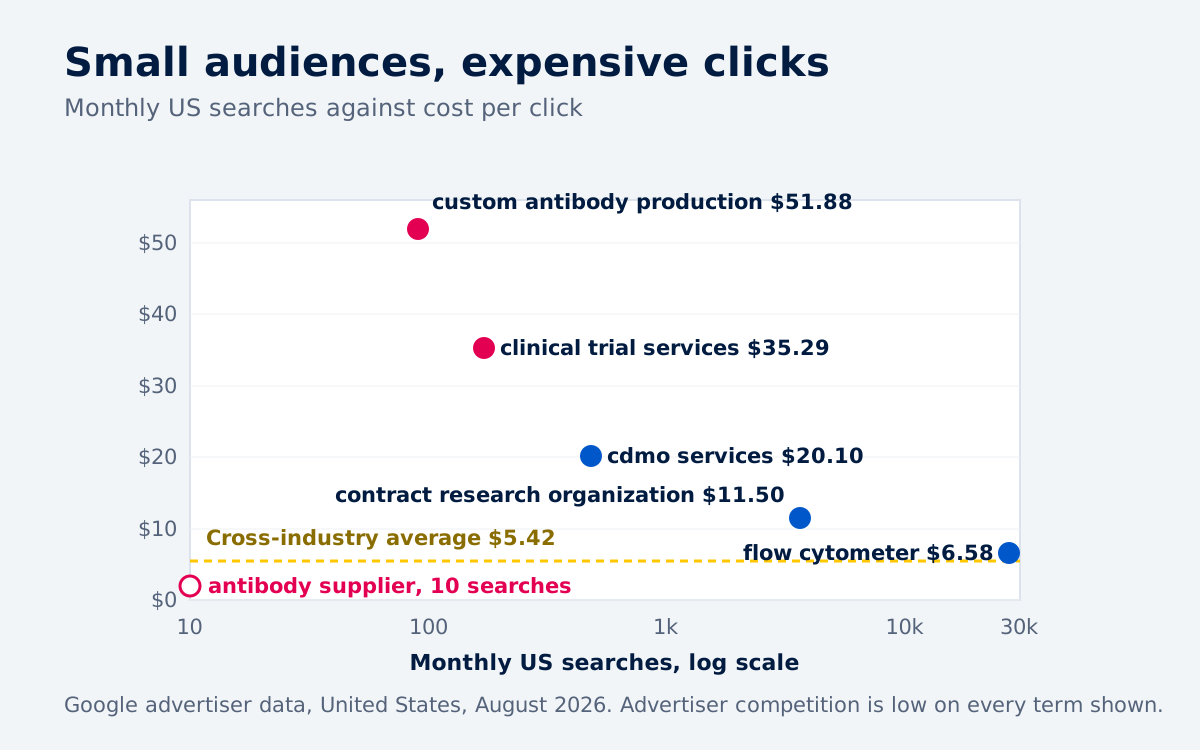
For comparison, WordStream's 2026 benchmarks, drawn from more than 13,000 US campaigns, put the average cost per click across all industries at $5.42.
Most of these terms sit at two to four times that. The sharp end runs much higher. A click on "custom antibody production" costs almost ten times the average, and the competition for it still reads as low.
Nothing about those two facts is contradictory. A small number of buyers, each worth a great deal, produces exactly this shape. The clicks cost what they cost because the deals are large, and the competition stays thin because most of the sector never showed up.
The cost per lead confusion
If you go looking for a life science cost per lead, you will find numbers that differ by a factor of ten.
Source | Reported cost per lead | What it counts |
WordStream, 13,000+ US campaigns | $66.69 average | A search ad conversion, mostly form fills, across all business types |
First Page Sage | Biotech $274, pharmaceutical $124 | A paid lead, by industry |
Belkins, 1,000+ client companies | $420 to $3,080 across B2B | A sales-qualified lead |
All three report honestly. WordStream, First Page Sage, and Belkins count a form fill, a lead, and a qualified opportunity, and those are three different products with three different prices.
So when anyone quotes you a cost per lead, whether an agency, a platform, or an internal forecast, ask what counts as a lead before you compare it to anything. Getting that definition straight is most of how life science companies justify and measure marketing spend, and it is the same discipline behind which demand generation metrics are worth tracking.
The minimum budget that teaches you anything
There is a floor below which a paid campaign produces no usable information, and it is arithmetic.
A Search Engine Land analysis of more than $700,000 of LinkedIn spend, covering 63,000 clicks and 8.1 million impressions between June 2025 and May 2026, puts the minimum viable LinkedIn budget at $3,000 to $5,000 a month. The reasoning runs one line long. You need to afford at least 100 clicks a month, or the system never gathers enough data to work with.
Run that against the table above and the sums get concrete. At $51.88 a click, 100 clicks costs $5,188. A company spending $500 a month on antibody production terms buys about ten clicks, which will tell them nothing either way.
For context on what life science companies actually commit, our pharma research puts emerging biotech Google Ads spend between $2,500 and $7,500 a month, mid-market pharma between $15,000 and $45,000, and large pharma between $120,000 and $500,000 and above. Growth stage is where paid search usually enters the mix. Where the rest of the money should sit is a separate question, covered in demand generation budget allocation.
What if nobody searches for what your life science company sells?
Life science search demand is wildly uneven, and which side of the line you sit on decides the whole question.
Look back at the table. "Flow cytometer" draws 27,100 US searches a month and "lab equipment supplier" draws 18,100. Meanwhile "antibody supplier" draws about 10 searches a month. "GMP manufacturing services" draws about the same. "CRO services" does not register at all.
Two companies can both describe themselves as life science suppliers and sit on opposite sides of that gap.
Search demand you cannot create
Paid search buys attention that already exists. It cannot make anyone type a query they were not going to type.
That makes the first test factual, not strategic. Do the words your buyers would use return meaningful volume? If they do not, no budget, creative, or agency changes it.
This is the most common doubt among the marketers who ask about this publicly. One marketer at a biotech contract manufacturer with roughly 200 potential buyers worldwide, selling contracts worth between $500,000 and $5 million, put it plainly when weighing up whether to spend at all. Search volumes for the terms describing their services were, in their words, "really limited globally or even non-existent."
Another marketer at a niche B2B company described running keywords that drew under 100 searches a month, and watching one of them spend £300 across three weeks to produce 40 visits.
That shape is normal for contract services. It is why CDMO and CRO marketing tends to run on relationships and technical proof rather than on captured search demand.
The arithmetic on a small market
A small search pool does not automatically disqualify you.
Ben Brown, managing director of the B2B agency Session Media, who says he has audited over £50 million in B2B Google ad spend in the past year, argues that when a category draws only two or three hundred searches a month and deals run to five, six, or seven figures, appearing in front of that handful is worth real money precisely because the market is small. He runs an agency that manages these campaigns, so weigh that accordingly.
Work it with the numbers above. Custom antibody production draws 90 searches a month at $51.88 a click. Capturing every one of those clicks, all year, costs roughly $56,000. If your average contract runs to several hundred thousand dollars and you close even a small fraction, the maths works comfortably. If your average order is $4,000, it does not.
That calculation, run on your own terms and your own deal size, answers the question better than any benchmark.
AI Overviews and the paid slot
The search results page is changing underneath this decision, and the change so far favours the paid slot.
A randomised field experiment published in 2026 gave 1,065 desktop users a version of Google with AI Overviews and a version without, then measured what they clicked. When an AI Overview appeared, clicks out to websites fell 39.8% and searches ending with no click at all rose 34.5%. Clicks on sponsored results did not change meaningfully. Across the general queries that study observed, AI Overviews appeared on about 41% of them.
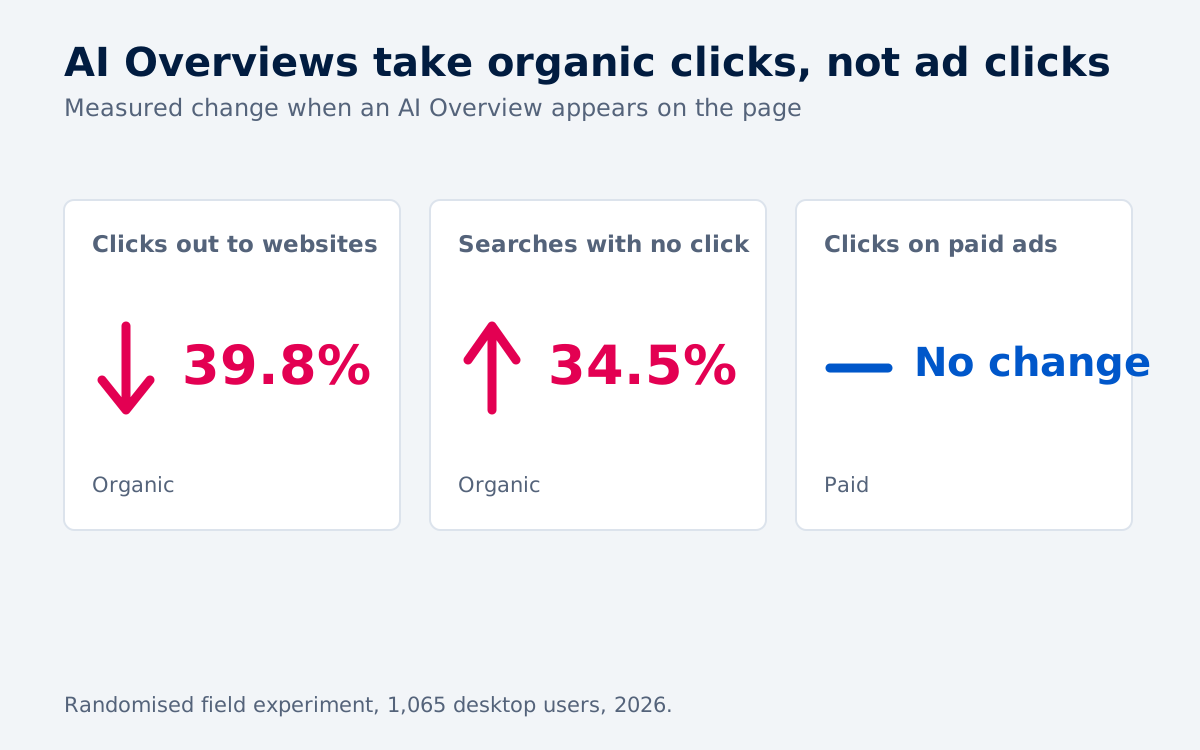
Seer Interactive's tracking of 53 brands across 5.47 million queries found the same split, with paid click-through rates on AI Overview queries holding in a 13% to 16% band while organic rates fell.
AI summaries are absorbing organic clicks and leaving the ads roughly where they were.
For life sciences this lands hard. When we tested a set of life science queries, Overviews triggered on all of them and life science companies surfaced in almost none. If the organic half of the page is being absorbed and your company is not inside the summary doing the absorbing, the paid slot is what remains. Why some brands get cited and others do not is worth understanding before you concede that ground, and we cover it in why your brand is not showing up in AI answers.
The cost side is less comfortable. Semrush analysed more than 600,000 keywords between November 2025 and April 2026 and found that keywords carrying an AI Overview had a higher average cost per click than those without across most industries, with AI Overviews on commercial-intent pages growing 71% in six months. The paid slot holds its clicks and costs more to hold.
When should a life science company run paid ads?
Run paid ads when you can answer yes to all four of these, judged against your own company.
- Your buyers demonstrably search for your category. Not for your brand, and not for the problem in the abstract. For the thing you sell, in the words they would use, at a volume you can see.
- Your deal value carries the click cost. At life science click prices, a $4,000 average order struggles. A $400,000 contract does not.
- Your budget clears the learning floor. Roughly 100 clicks a month, which at your own cost per click gives you a number instead of a guess.
- You own somewhere useful to send the click. A page that answers the question the searcher asked, and a way to follow up with the people who are not ready yet.
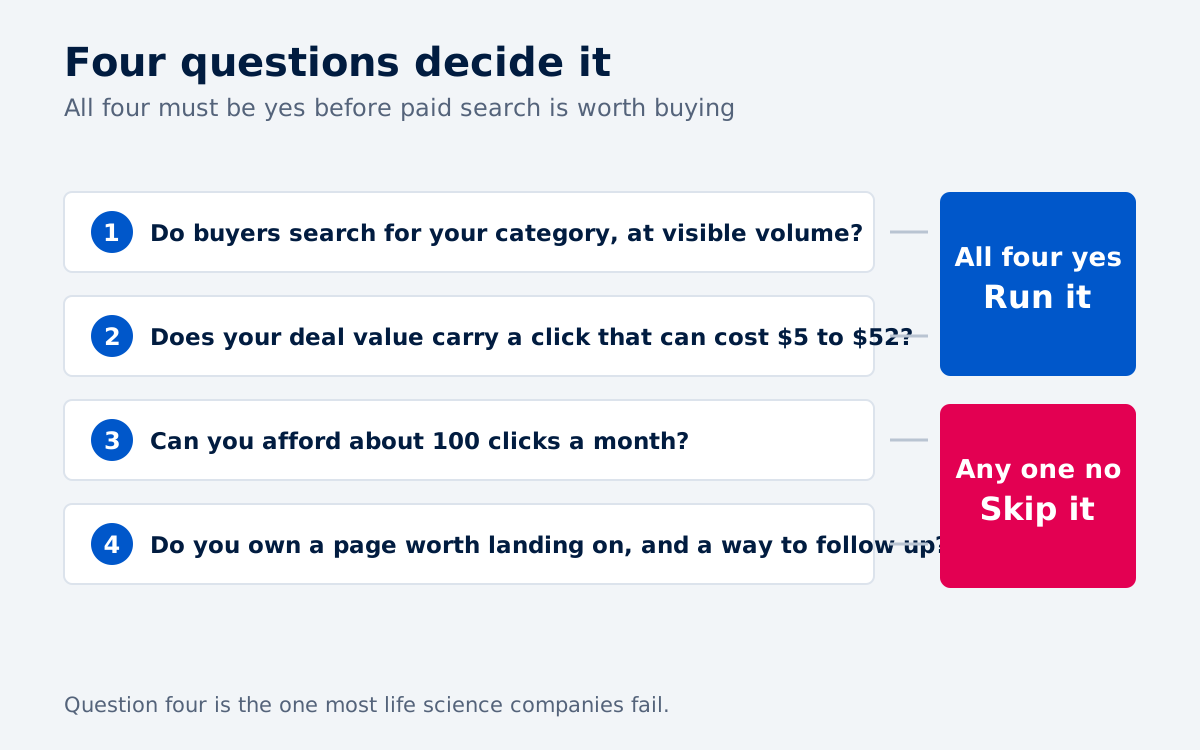
The fourth condition is the one most companies fail, and it is measurable.
The infrastructure most life science companies do not have
Marketing automation and CRM adoption across life sciences runs low. In pharma, under 10% of company websites run marketing automation and about 30% run a detectable analytics platform. CRM adoption in pharma sits below one in 12.
A company in that position can buy clicks. It cannot capture them, route them, nurture them, or measure them, so it pays search prices for traffic it has no way to convert. Closing that gap is the subject of life science marketing automation, and the follow-up half of it runs through life science email marketing.
There is a second cost that is easy to miss. When a company cannot tell the ad platform which enquiries turned into real buyers, the platform keeps optimising toward the wrong ones, so the campaign gets worse over time instead of better.
That is the through line of our work in life sciences. Paid spend is only ever as good as the revenue infrastructure sitting behind it. The click is the cheap part.
When should a life science company skip paid ads?
Skip paid ads if any of these describe your situation, and none of them are failures of effort.
- Nobody searches for your category. The most common disqualifier.
- Your budget sits below the learning floor. Spending $200 a month on a $30 click buys noise.
- You have nothing to send traffic to. Nothing relevant to land on, and no way to follow up or tell what happened.
- Your buyers are locked to approved vendor lists you are not on. Solve the list problem first.
- Regulation prevents your ads from saying what matters. This applies to fewer companies than most people assume, and it applies absolutely to some.
Regulated categories in life sciences
Google's healthcare and medicines policy requires certification for a specific set of categories. Prescription drug services such as online pharmacies and telemedicine. Restricted drug terms. Pharmaceutical manufacturers. Prescription opioid painkillers. Addiction services. Health insurance in the United States. And, most relevant to biotech, speculative and experimental medical treatment including cell and gene therapies in the United States.
Pharmaceutical manufacturers must hold Google certification before they can serve ads at all, and may promote prescription drugs and over-the-counter medicines in selected countries only. On restricted drug terms, certification is required in order to keyword-target those terms even where using them in ad copy is permitted.
Now the other half, which matters just as much. None of this constrains a contract research organisation, a reagent supplier, a lab instrument manufacturer, or a CDMO selling services to other businesses. The great majority of life science companies face no category restriction whatsoever.
Which is why that 4% Google Ads adoption figure in pharma reads as a choice rather than a rule. Some of those companies genuinely cannot advertise. Most of them simply do not. What they do instead is the subject of our pharma marketing strategy playbook.
Long sales cycles and the attribution window
This one is a constraint you buy into, and it is worth knowing before you commit.
Google's own advertiser documentation states that an offline conversion uploaded more than 90 days after the click will not be imported, because the click identifier only lasts 90 days. For enhanced conversions for leads, the window is 63 days.
Life science procurement routinely runs longer than a quarter. Capital equipment, CRO contracts, and CDMO agreements can take a year from first enquiry to signature. Deals that close outside the window never register against the ads that started them, which makes the largest and slowest wins structurally invisible in the ad account.
You can still run the channel profitably. You cannot expect it to prove its own value on the deals that matter most, and any agency promising clean attribution on a twelve-month sales cycle is promising something the platform does not do. Long cycles are one of the biggest life sciences marketing challenges for exactly this reason.
Consumer searches that eat a scientific budget
Some life science product terms overlap heavily with consumer searches, and the overlap runs one way.
Brad Geddes, one of the more widely respected figures in paid search, makes the point plainly that most commercial search queries come from consumers rather than businesses, so even when search volume looks healthy a large share of clicks can come from people who will never buy.
A company selling scientific cameras or laboratory freezers competes for attention with everyone shopping for a camera or a freezer. The volume looks encouraging and a good portion of it is worthless. Notice that "lab freezer" is the one term in our table carrying high advertiser competition, and consumer overlap is the likeliest reason.
Google Ads or LinkedIn Ads for life science companies?
Search captures demand that already exists. LinkedIn reaches people who are not searching. The sector has already picked LinkedIn, at about 35% adoption against roughly 18% for Google Ads, then spent 72% of that LinkedIn budget on awareness.
So life sciences chose the channel that reaches non-searchers and used it for reach alone, leaving the demand it creates for somebody else to capture. The organic side of that same platform is covered in life science social media and LinkedIn marketing, and the wider question of which channels deserve your attention in demand generation channels.
The blended average problem
Somebody will show you a blended average, and a blended average hides the answer.
The Search Engine Land analysis of the same client accounts running on both platforms found LinkedIn averaging $11.12 a click against Google's $5.45. LinkedIn looks like double the price.
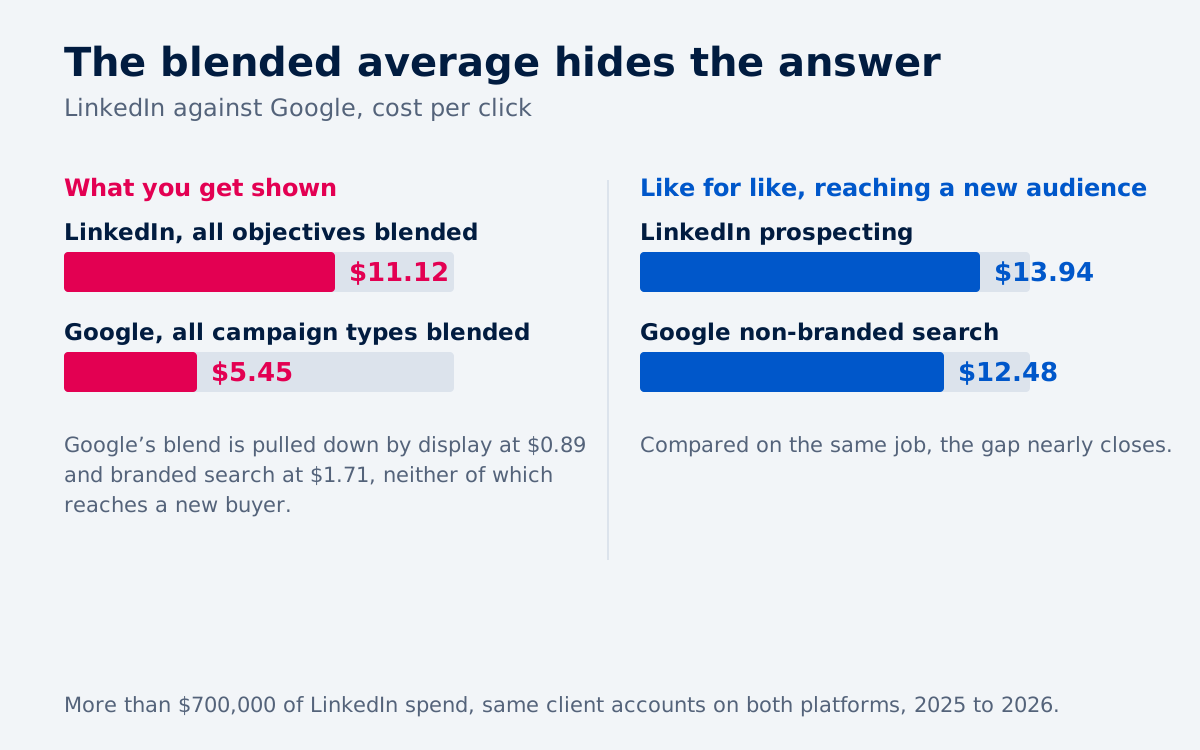
That comparison is unfair. Google's blended figure gets pulled down by display advertising at $0.89 a click and branded search at $1.71, both cheap because they reach low-intent audiences or because you are buying your own company name.
Compare the two on the same job, reaching a new audience who does not know you, and the gap nearly closes. Google non-branded search averaged $12.48. LinkedIn prospecting averaged $13.94.
LinkedIn costs also swing enormously by what you ask for, from $4.45 a click for engagement campaigns to $31.29 for lead-generation campaigns. A quote of "LinkedIn costs about $11 a click" means very little without knowing which of those you are buying. Running both together well is a question of multichannel and omnichannel marketing in life sciences.
Microsoft as the third option
Microsoft Advertising is worth knowing about for life science companies with narrow buyer profiles.
Microsoft's own documentation states it is the only advertising platform other than LinkedIn itself that lets you target on LinkedIn profile information, specifically company, industry, and job function.
The honest caveat comes from Microsoft too. On search campaigns, that targeting does not narrow who sees your ad. It only adjusts what you bid for those people. It is a lever, not a filter, and it is a lever Google does not offer.
So should you run paid ads in life sciences?
Run paid ads in life sciences when demand already reaches a search box and you have built somewhere for it to land. Skip them when either half is missing.
The open auction is real, and it is open because most of the sector never showed up, and because a share of life science demand never reaches a search box at all. Buying in before you know which of those applies to you moves the cost from clicks to wasted clicks, and wasted clicks are the more expensive of the two because they take a year to show up as nothing.
If you fail the demand test, paid search is the wrong instrument and no amount of skill fixes it. If you fail on the landing side, that is the thing to build first, and you will want it whether or not you ever run an ad. Where that sits among the other calls you have to make is laid out in life science marketing strategy.
The second case is the more interesting one, because the work is the same either way. We worked with a laboratory supplies manufacturer that had grown through manual research, cold calling, conferences, and lab visits, a high-effort motion that kept customer acquisition costs high and depended entirely on reps. Building the education layer their buyers actually wanted produced 241 inbound leads in three months in a narrow technical market that had previously run on outbound alone.
That company is now in a much better position to buy clicks, because it finally has somewhere to send them.
Would a paid click have anywhere to land on your site today?
Get a Content RevOps audit, your searchable demand sized, your capture and follow-up gaps mapped, and your AI-search visibility benchmarked against the life sciences 2026 data, with every leak priced before you buy a single click.
Frequently Asked Questions
About the Author

Founder & CEO, Content RevOps
Stefan Kalpachev is the founder and CEO of Content RevOps, where he helps B2B SaaS companies transform their content into predictable pipeline. With a background in content marketing and revenue operations, Stefan has developed a unique methodology that bridges the gap between content creation and revenue generation.
Connect on LinkedIn