Demand Generation Channels - Which Should You Prioritise
Tired of channel guides that hand you ten options and a 'depends on your context' shrug? Let's design the three that fit yours.
Book a CallWhy the question every demand gen guide refuses to answer
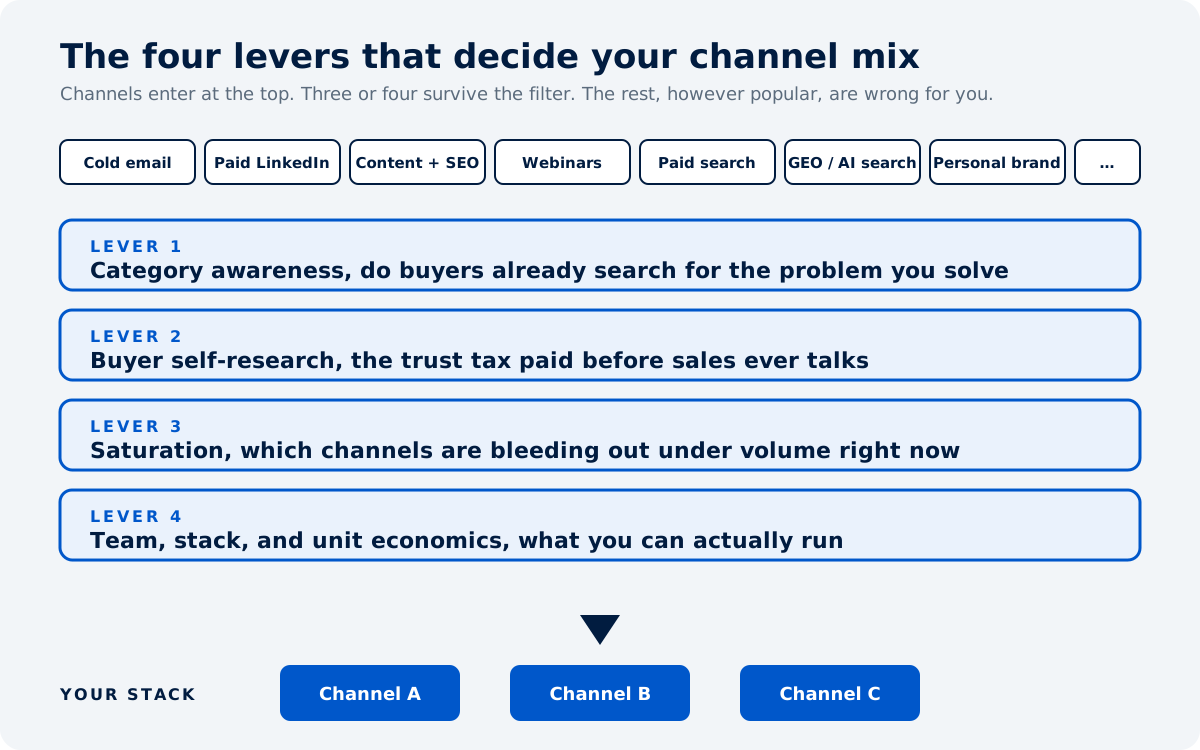
The honest answer to which demand generation channels should I prioritise is not a list of ten. It is a function of four levers, in order: how aware your category is, how your buyer self-researches, what is saturating in your space right now, and what your team and unit economics can actually run. Three or four channels survive that filter for any given company. The rest, however popular, are wrong for you.
Part of The Complete Guide to B2B Demand Generation Strategy.
The field is over-supplied with channel choices, not under-supplied. When we recently mapped the demand-gen technology footprint of 478 high-growth B2B companies, the scan returned 40,905 distinct tech signals normalised down to 112 demand-gen tools across thirteen jobs. The bottleneck for the median operator is not channel discovery. It is prioritisation, and prioritisation rarely yields to it depends on your context without an operating rule attached.
This piece is the operating rule. Four levers, the channels each one selects against, a deliberate decomposition of the lumped names ("LinkedIn", "email", "Reddit") that hide three decisions inside one, a treatment of AI search as a discrete channel rather than an SEO sub-discipline, and three named stacks at the close that show what an actual 2026 mix looks like in practice.
The four levers that actually decide your channel mix
Get the first lever wrong and the others compound the error. Pour spend into capture-now channels when the category is unknown, and you are paying to harvest demand that does not exist. Build educational content in a known category, and you are recreating wheels other vendors already won. Run channels that have lost the auction, and the price you pay for one qualified conversation makes the unit economics impossible. Run channels your team has no distribution muscle in, and the channel "does not work" for reasons that have nothing to do with the channel.
Gartner's research on the B2B buying journey frames this well by stepping away from the linear funnel entirely. The work breaks buying into four distinct jobs (problem identification, solution exploration, requirements building, supplier selection), each of which a different channel mix serves. The point is not that the funnel is dead. The point is that which channel depends on which job your buyer is doing this week, and which job they will do next.
Forrester's 2025 predictions add the trajectory. More than half of $1M-plus B2B transactions will run through digital self-serve channels this year, and more than half of younger buyers will pull in ten or more external influencers before signing. The buyer is moving. The mix has to move with them.
Lever 1, how much demand already exists in your category
This is the first cut, and it has a measurable answer. Channels that capture existing demand work when buyers already search for the problem you solve in the words you would recognise. Channels that create demand have to do the work when they do not, and the same channels reverse roles in the wrong market.
Branded and category-aware search volume tells you which world you are in. SparkToro's 332-million-query Datos panel study found that 44% of US Google searches are for branded terms; only 31% of unique keywords are branded, so branded queries pull disproportionate volume per keyword. An analysis of 21 leading SaaS sites by Content Strategy Insider cut harder: branded keywords are just 28% of the organic keyword pool but generate 59% of total traffic, with each branded keyword pulling 18 visits on average versus three for non-branded. If your branded search demand is rising, you are in a known category. If your category-level non-branded volume is flat or shrinking, you are still creating the market.
The unit economics shift dramatically across that line. Dreamdata's B2B-specific analysis of Google Ads spend found that B2B marketers put 82% of their search budget on non-branded keywords and earn 68% ROAS, while the 18% spent on branded keywords delivers 1,299% ROAS, a 19x gap. Read that the right way. Branded paid search is cheap because it captures demand the brand and the content estate already built. The expensive non-branded campaigns are paying to do work other channels should be doing for free.
In a recent engagement with a deep-tech operator selling a fundamentally new infrastructure approach, the real constraint was not sales execution. Buyers had not yet learned to want the category. The fix was a learning hub that did the foundational teaching before sales talked at all; reps stopped losing deals to I am not sure I have this problem and started having conversations about fit. In a different engagement with a banking-and-fintech intelligence company, the diagnostic inverted. The category was known, the positioning was sharp, the content estate was thin. Inside twelve months, the hub became the source of 65% of all site traffic, sales cycles compressed by 30 to 35%, and three to four million in influenced pipeline traced back to it. Same lever, opposite read, opposite stack.
Lever 2, how your buyer self-researches in 2026
The buyer arrives at sales already decided. Not as a rhetorical flourish, as a measurement. 6sense's 2025 Buyer Experience Report, based on 4,000+ global buyers, found that 94% of buying groups rank their preferred vendors in order before contacting any of them, and they buy from that preliminary favourite 77% of the time. The split between independent research and seller engagement shifted from 70/30 in 2024 to 60/40 in 2025. Buyers now contact sellers roughly six to seven weeks earlier than last year, but the decision is still locked before that contact happens. Buyers average 16 interactions with the winning vendor across that private journey, a number that has not budged.
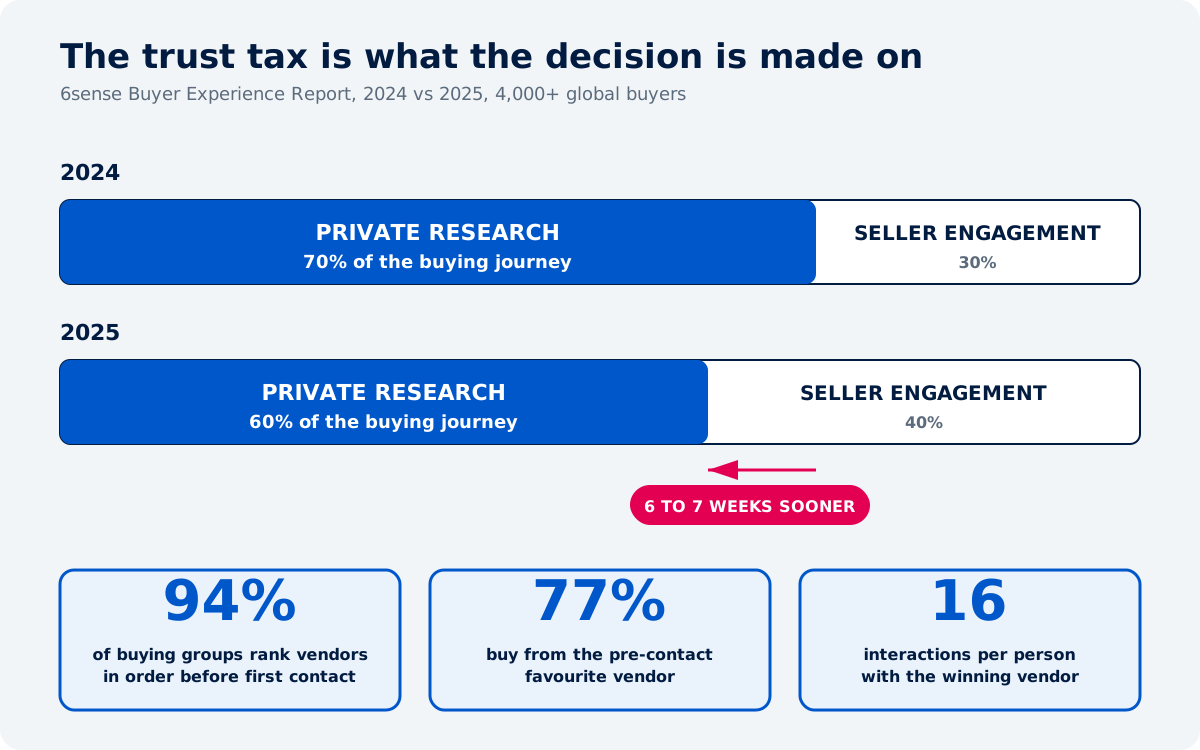
Call it the trust tax. You pay it in reputation, content, brand-search defence, and third-party citations before the buying group ever fills in a form. The classic Forrester 67% of the buying journey is complete before sales contact stat from 2019 reads quaint against this; the mechanism has changed, not just the number.
Gartner's research on the same question goes one layer deeper into where the decision actually happens. Buyers spend only 17% of their total purchase journey meeting with potential suppliers. The other 83% splits into independent research (22%), internal stakeholder meetings (37%), and what Gartner calls making sense of information (24%). The trust tax falls due in rooms you cannot enter. Your demand-gen budget either survives those rooms or it does not, and the spend that survives is the spend that built a recognisable brand-search line, a content estate the AI summarisation surfaces, and a set of communities and peers who name you before they Google you.
Two operating implications. Capture-now channels are working at the end of a longer dark funnel, not the start; treating a paid demo form as the first touch overstates capture and understates demand creation by months. And channels that build familiarity at low marginal cost (executive personal brand, original research, niche communities, narrow podcast sponsorships) are now structurally underpriced relative to the work they do.
Lever 3, which channels are quietly bleeding out
Some 2022 playbooks no longer work in 2026. Naming which is unfashionable, so most channel guides do not. The honest read matters because the wrong channel in the wrong year is the most expensive line on a marketing plan.
Cold email is the clearest casualty. KnowledgeNet.ai's analysis of 2.1 million outbound touches across 480 B2B teams (Q3 2025 through Q1 2026) puts the median cold email reply rate at 1.4%, down 33% year over year, while 62% of all replies are now AI-generated without human review. AI is replying to AI. That recursion is what saturation looks like at the mechanism level, and the deliverability filters built by Gmail and Microsoft are tuning themselves on the same signals. CopyCrest's synthesis of nine major outbound studies covering 65 million emails finds the same shape. The median sender now gets a 0.48% reply rate while the top 5% still hit 16.3%, an order-of-magnitude gap explained almost entirely by targeting precision, brevity, and deliverability infrastructure. Cold email is not dead. The median operator running it is bleeding, and the gap between the top sliver and the median is widening.
LinkedIn outbound is the under-told story on the other side. WarmySender's State of B2B Outreach 2026, based on 4.2 million emails and 100,000 LinkedIn messages, found median LinkedIn outreach response rates rose 14.8% year over year to 12.4%, while cold email response rates fell 6%. LinkedIn connection acceptance rose 8% in the same period. LinkedIn outbound currently still works, which is why outbound is dead is a sloppy framing. The same study projects LinkedIn rates plateauing in 2027 as adoption climbs and recipient fatigue catches up. The window is closing on a six-to-twelve-month horizon, not yesterday.
Where the under-pricing is. Original research, the single most defensible and AI-citable content asset, sits in only about 3 in 10 active-cohort sites across our cross-industry scans, and as low as 1 in 8 in some verticals. Executive personal brand on LinkedIn pulls warm pipeline at a fraction of paid CAC for teams that commit to it. Narrow community presence (niche Slack groups, specialist subreddits, the technical podcasts in your buyer's lane) produces no scale and disproportionate trust, exactly the trade the trust tax rewards.
Lever 4, what your team, your stack, and your CAC can actually run
The fourth lever stops the rubric from floating. The channels that survive the first three still have to fit what you can operate, what you can afford, and what is already in your stack.
What high-growth B2B companies actually run is far thinner than vendor marketing implies. Our scan of 478 high-growth B2B companies found only two near-universal layers: web analytics on 79% of sites and tag management on 79%. After that, the stack thins fast. LinkedIn Ads sits on 37% of companies (the unambiguous number-two paid channel after Google), Yoast SEO on 26% (a proxy for how much B2B content still ships on WordPress), Hotjar on 16% as the on-site behaviour analytics leader, Mailchimp on 14% as the email leader. Specialist tooling is rarer than the conference talks suggest. 6sense, the ABM category leader, sits on just 11% of sites; Segment, the modern-stack CDP staple, on 5%. 45% of these companies show no web-detectable CRM at all, and 8% run zero detectable demand-gen tooling.
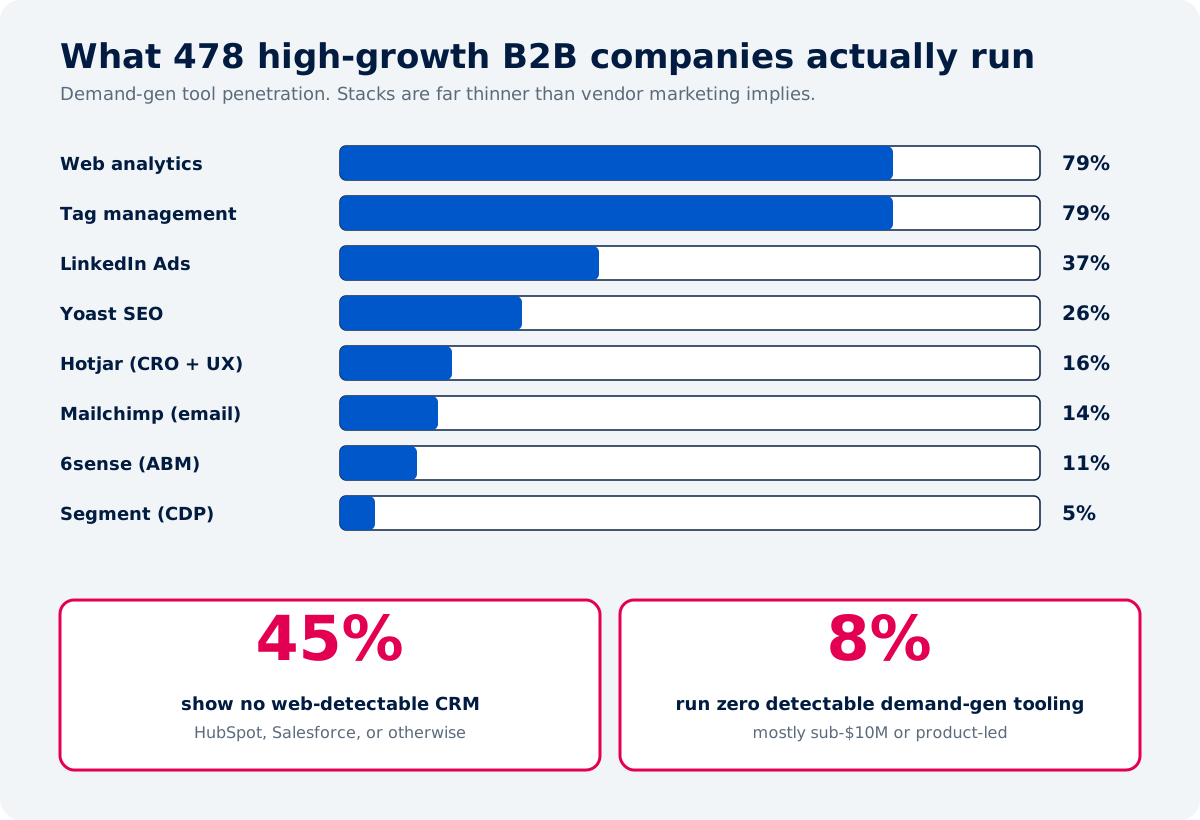
Read that the right way. You are not running the stack the keynote suggests; you are running three to five tools that ship pages, measure them, and capture leads through email and LinkedIn. Adding a fifth channel is a real operating decision, not a procurement one. Where compliance sign-off is part of that decision, our review of demand generation agencies for banks, lenders and insurers filters on it.
CAC by channel makes the trade-offs concrete. The Starr Conspiracy's B2B Marketing Effectiveness Study of 412 B2B SaaS marketing leaders indexes channels against paid search at 100: content and organic 38, partner and channel 71, paid social 142, outbound SDR 156, events and field 187. Content and partner channels acquire customers at roughly a third the cost of paid search; events and SDR-led outbound run nearly twice as expensive. Optifai's 2026 benchmark of 939 B2B companies gives absolute numbers: partner/referral $150 CAC, inbound $200, paid ads $350, outbound $400, events $500.
Channel | CAC index (paid search = 100) |
Content and organic | 38 |
Partner and channel | 71 |
Paid search | 100 |
Paid social | 142 |
Outbound SDR | 156 |
Events and field | 187 |
Two non-obvious nuggets sit under the headline numbers. Pavilion and Benchmarkit's 2025 SaaS Performance Benchmarks flag a multi-year consistent anomaly: products in the $10K-$50K ACV range are more expensive to acquire than $50K-$100K ACV products, against the smooth curve you would expect. Pricing into that band traps you in a CAC pocket where channels that should work do not. Separately, OpenView's 2024 benchmarks of 3,000 SaaS companies show GTM motion matters more than channel choice for blended cost. Product-led acquires at $0.61 per $1 of new ARR; sales-led runs $1.18, almost double. The same channel under the same conditions has different unit economics across motions. When resellers and integrators carry the motion, the partner channel stops being one line in the table and becomes the engine, and any outside team you bring in has to prove it can work through partners, which is the test behind our list of demand generation agencies for channel-led and partner-led companies.
What "LinkedIn" actually means as a channel, and why lumping kills the decision
Three names get used as if they were channels when they are not. "LinkedIn" is at least four channels with four ROI curves. "Email" is two. "Reddit" is two. Treating each as one is half of the bad decision before the rest of the rubric runs.
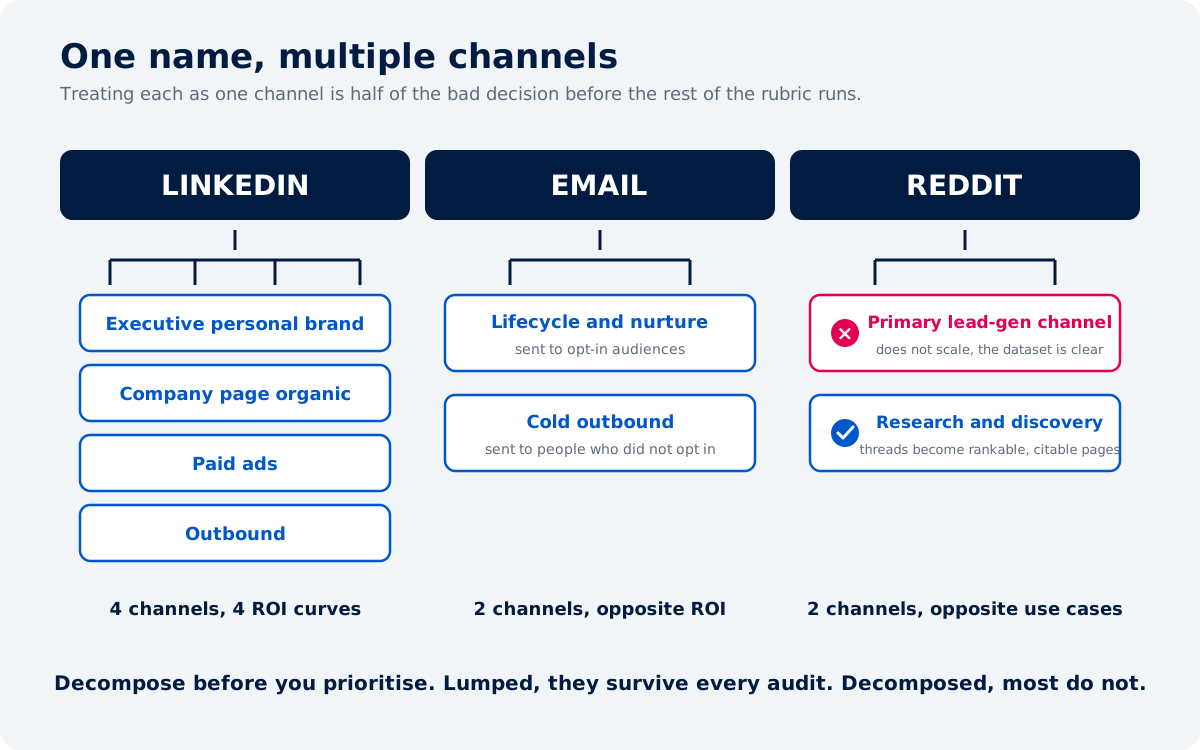
LinkedIn splits across executive personal brand (organic posting by founders and leaders), company-page organic (the brand's feed), paid ads (sponsored content and lead-gen forms), and outbound (connection requests, InMail, and the sales-nav layer). Our cross-industry data shows how differently these get adopted by the same cohort. Among active asset managers, LinkedIn organic presence sits at 64%, paid LinkedIn ads at about 13%, and Google ads at just 4%. Among fintech firms, only about 8% of active-cohort sites point paid LinkedIn at content distribution; most paid LinkedIn does direct demo asks. Same logo, four channels, four ROI shapes.
A pattern worth naming. LinkedIn personal brand often functions as a referral-warming channel rather than a lead source. The lead arrives through a referral, then checks the founder's posts, then lands on a call already half-sold. If you measure that channel by directly attributed leads, you under-count it by an order of magnitude. The fix is treating LinkedIn personal brand as part of the trust-tax payment, not as a capture engine.
Email decomposes the same way. Lifecycle and nurture email (sent to people who opted in) sits at a structurally different ROI than cold outbound email (sent to people who did not). Most cold-email benchmark studies measure the latter; the former, wired into a content estate, is one of the cheapest pipeline-acceleration plays still working. They are not the same channel. Reddit decomposes too. The platform is a poor primary lead-gen channel, the dataset on that is clear; it is a strong research and content-discovery channel where the questions threads reveal turn into pages on your site that rank, get cited, and pull intent.
The decision rule. Before you mark LinkedIn or email or Reddit on the channel mix, decompose it. Which of the underlying channels are you actually running, which is each best at in your context, and which of those pass Levers 1 through 4. Lumped, they survive every audit. Decomposed, three of the four usually do not.
GEO is now a discrete demand channel, here is the mechanism
AI search has stopped being an SEO sub-discipline. The mechanism is different, the source pool is different, the click-economics are different, and the owner inside a marketing team is different. Treating GEO (Generative Engine Optimisation) as a discrete demand channel is the only honest read on what 2026 looks like.
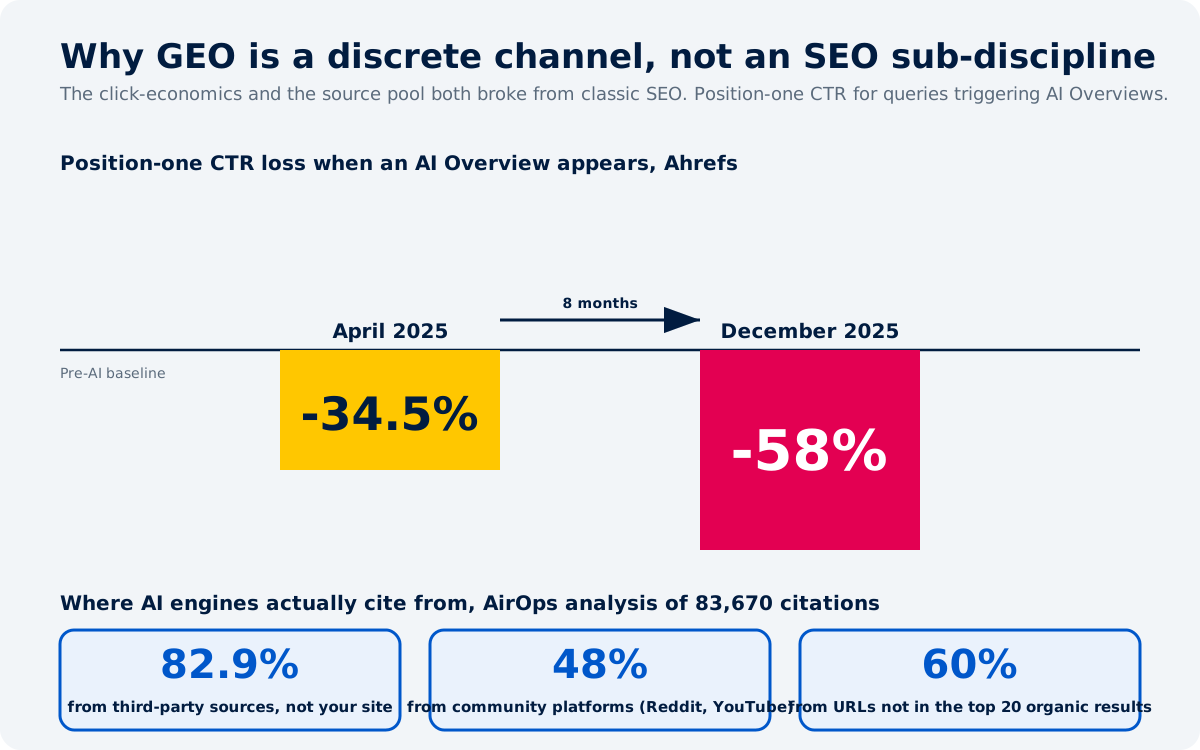
The click-economics are the easiest part to quantify. Ahrefs' updated December 2025 study of 300,000 keywords found that AI Overviews now reduce click-through rate for the position-one organic result by 58%, up from 34.5% in their April 2025 study. Position 2 is down 50.8%, Position 3 down 46.4%. Pew Research's behavioural panel of 900 US adults, as summarised by Analyze.ai, found that searchers click through on 8% of searches when an AI Overview is present versus 15% without one, and only 1% click a link inside the AI Overview itself. The classic SEO play of ranking and pulling clicks is now half-priced on the queries that matter.
The source pool AI engines actually cite explains the channel decomposition. AirOps' 54-day analysis of 83,670 AI citations across ChatGPT, Claude, and Perplexity found that 82.9% of AI citations come from third-party sources, not the brand's own website. ChatGPT cites brand websites for 13.5% of mentions; Claude is highest at 22.2% and still relies on external sources. 48% of citations come from community platforms (Reddit, YouTube), and 60% of AI Overview citations come from URLs not in the top 20 organic search results. Domain authority does not predict AI citation.
The B2B versus B2C split matters for channel design. Similarweb's 2026 Downstream Impact of AI Visibility report shows the citation pool inverts by segment. For Monday.com (B2B), Business Services (analyst content, software comparison platforms, integration documentation) account for 52.6% of citations, while E-commerce Brands account for 3.8%. For Nike (B2C), E-commerce Brands dominate at 37.3% and News and Publishers at 24.4%. The B2B GEO channel points at analyst pages, peer-review aggregators, technical documentation, and integration partner content, in roughly that order.
This is how we build for AI citation. EEAT baked into every post (real field stories, credible named authors, a distinct methodology the model cannot reproduce); a tool, calculator, or proprietary dataset on the page that competing sites cannot copy; structured chunking that maps to how engines actually lift answers (headings as the questions buyers ask, a self-contained answer in the first paragraph of each section). Then earned third-party coverage on the surfaces the source pool draws from, because 85% of brand mentions in AI answers originate on pages you do not own. GEO done well is a multi-channel motion with its own measurement (AI Overview presence, citation share, branded-search uplift), not a meta tag.
The three 2026 channel stacks that actually compound
A demand-gen mix is a stack, not a single bet. The three combinations below match the three contexts most B2B companies fall into. Each is told through a real engagement and the numbers behind it.
Stack A, new category and a content-strong team
For a sub-$30K ACV company in a category buyers do not yet search for, one flagship first-hand data asset, a GEO-structured hub, executive personal brand, and lifecycle email beat a thirty-page content calendar most of the time.
Lucid ran into the classic create-demand problem. Founder buyers in their category showed initial interest, then quietly disappeared; the outreach gave them no compelling reason to keep talking. The mechanism behind the disappearance was simple. The buyer did not yet have a frame in their head for what Lucid did or why it mattered.
We concentrated the entire effort into a single flagship industry data report, not a content hub. The dataset combined Lucid's proprietary product telemetry with a targeted survey of their ICP, producing findings no competitor could copy. That asset did three jobs at once. It gave the outbound a reason to exist (the email led with a number the buyer could not get anywhere else), it gave LinkedIn personal-brand posts content the audience cared about, and it gave AI engines a citation-worthy source from a company that otherwise had nothing they would index.
Reply rates rose from 3 to 4% to 14 to 18%, positive responses more than quadrupled, close rates rose roughly 40%, and cost per opportunity dropped materially. The stack worked because the problem was leverage, not discoverability. Lucid did not need a thousand articles; they needed one asset the rest of the channel mix could pivot around.
This is the shape for new-category, content-strong teams with limited operational capacity. Build the asset once, then point every other channel at it.
Stack B, known category and sales-led with technical buyers
For a $30K-to-$100K ACV company in a known category serving narrow-technical buyers, a content-led pre-sales education hub, branded-search defence, targeted LinkedIn ads for distribution (not lead-gen), and sales enablement built on the same content estate is the stack that compresses cycles without inflating CAC.
Westlab sold to laboratory operations leaders through manual research, cold calls, conferences, and lab visits. The motion worked in a sense; deals closed. It was also high-effort, high-CAC, and locked the company's real differentiator (acting as a discovery and consulting partner to labs) inside the sales team's heads.
We operationalised the locked-in sales expertise into a structured, problem-led content system and positioned education as the product through what we called the Zero Downtime Lab program. The content engine did the pre-sales teaching that previously depended on rep contact. Buyers arrived at first calls already partway through the buying journey, having absorbed the content that used to require three meetings to deliver.
Traffic rose 205% in a narrow technical niche, the program returned 869% on the content investment, and the cautious, price-sensitive buyer base started moving through the cycle faster because buyers paid the trust tax earlier and at lower marginal cost. Westlab did not replace the sales team; they multiplied them with a content layer that absorbed the repeatable work and let the team spend its hours on the strategic conversations.
This is the shape for sales-led teams whose differentiator is consulting depth. The expertise exists; the channel mix's job is to scale it.
Stack C, enterprise category and multi-stakeholder buying committees
For a $100K-plus ACV company with committee deals, flagship industry data, a webinar engine that engages the buying committee together, ABM-aligned distribution, and customer-led referrals is the stack that converts a founder's network into a scalable channel.
Aquanuity sold to utilities and municipalities on the founder's reputation, conferences, and in-person meetings. There was no marketing function. Pipeline lived in the founder's calendar, which capped it at human bandwidth.
We built a webinar engine. Seven sessions across six months at 70 to 90 attendees each, promoted into the existing network and target accounts so roughly 90% of attendees matched the ICP. The mechanic underneath. Invites sourced from inside the ICP, so the invitation itself functioned as the outbound and opened relationships (would you co-present this? gets a meaningfully higher response than would you take a call?). On registration, a Make workflow enriched each attendee through Perplexity and Apify into a short account brief, so the founder walked into every session knowing exactly which decision-makers were in the room.
Webinars now contribute to roughly 30 to 40% of sales-ready conversations and approximately $2.5M in influenced pipeline. About 20% of attendees book a demo because a webinar engages a whole buying committee at once, which short-circuits the multi-stakeholder problem. Average time from re-engagement to the next meaningful sales step fell by around 30%. The stack worked because committee deals close when you engage the committee, not the individual; for relationship-led founders with a real network, the webinar engine turns that network into a scalable channel rather than a calendar bottleneck.
This is the shape for enterprise-category companies whose existing sales motion lives on relationships. Do not replace the founder's authority; multiply it.
Knowing which channels matter is not the same as running the three that compound.
We build demand-gen stacks around the four levers in this piece, category awareness, buyer self-research depth, saturation, and your unit economics. Let's design your Content RevOps system.
Frequently Asked Questions
About the Author

Founder & CEO, Content RevOps
Stefan Kalpachev is the founder and CEO of Content RevOps, where he helps B2B SaaS companies transform their content into predictable pipeline. With a background in content marketing and revenue operations, Stefan has developed a unique methodology that bridges the gap between content creation and revenue generation.
Connect on LinkedIn