How to Promote a Webinar
Ready to turn webinars into predictable pipeline—not last‑minute blasts? Let’s talk.
Book a CallMost teams don’t have a webinar problem. They have a promotion and operating model problem.
They’ll spend weeks lining up a strong topic, a great speaker, and clean slides—then “promote” it with a rushed LinkedIn post and one generic email blast. Predictably, sign-ups come in late (or not at all), sales ignores it, and the webinar gets judged as a weak channel instead of a weak system.
A well-promoted webinar is decision infrastructure: it educates buyers, surfaces intent, and creates a natural moment for deals to move forward. The goal isn’t more registrants as a vanity metric—it’s getting the right people in the room with the least friction, then using that moment to influence pipeline.
This playbook focuses on three repeatable routes:
Route 1: Network effects (speakers, employees, customers, partners)
Route 2: Email (segmented, sequenced, revenue-aware)
Route 3: Ads + landing page (amplify, don’t rescue)
No “what is a webinar” basics. Just a practical approach you can reuse every time—plus benchmarks so you know what “good” looks like.
Route 1 – Network Effects: Turn People Into Your Primary Channel
Network effects are the fastest way to add credible reach without buying it. If you treat speakers, employees, customers, and partners as a coordinated distribution layer (not random “please share” requests), it’s realistic for these networks to drive 10–30%+ of registrations—and to keep paying off after the live event via replay, in line with how many B2B teams now treat webinars as an always-on lead engine rather than one-off campaigns.
A. Start with the right people
Put trusted faces out front. The point isn’t “a big name,” it’s someone your ICP already believes—a practitioner, operator, or expert who has earned attention in the exact niche you’re targeting. In other words: speakers aren’t just talent; they’re channels, which matches the way many B2B marketers now use webinars as a top influencer tactic for lead gen and credibility.
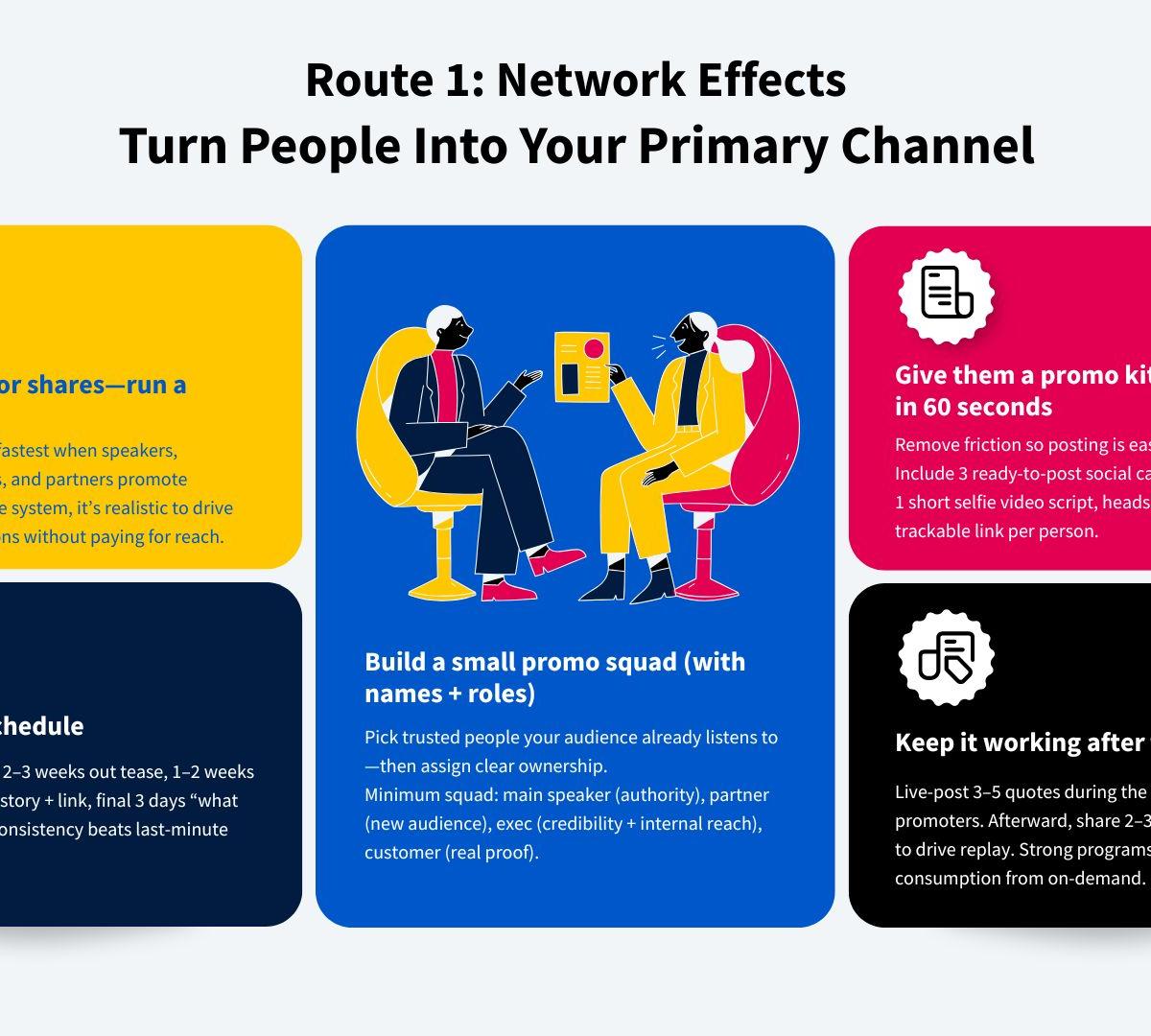
Then commit to a small, named promo squad with clear ownership. Minimum viable lineup:
Main speaker (the authority people are showing up for)
Partner/influencer (adjacent audience you want to borrow, similar to how influencer partners are activated as primary distribution in modern webinar programs)
Exec (adds credibility + internal distribution)
Customer advocate (social proof, not product hype)
B. Build a real promo kit (not a vague “please share”)
If you want consistent promotion, remove friction. Create the assets once, hand them to promoters, and make it easy to hit “post” or “send” in 60 seconds—very similar to how high-performing teams equip presenters with ready-made social images, copy snippets, and copy–paste–publish posts.
Your promo kit should include:
3 pre-written social posts per promoter (problem-first, outcome-focused, no product pitch)
1 short email blurb they can paste into a newsletter or personal note
1 × 20–30 second selfie video script (direct address: “If you’re a [role] dealing with [pain], here’s what you’ll walk away with…”)—this aligns with using short, speaker-led video snippets that regularly outperform static posts for webinar promotion
Trackable links (UTMs) per promoter so you know who is actually driving sign-ups
Speaker headshots + platform crops sized for LinkedIn, X, and email
C. Orchestrate timing and channels
Networks work best when you run them like a schedule, not a hope. Most webinar benchmarks show that a two-to-three-week promo window is now standard, with a meaningful chunk of registrations coming more than a week out, so this cadence fits how buyers actually respond.
T-21 to T-14: speaker + exec teaser post; launch a LinkedIn Event and have them invite directly
T-10 to T-7: partners/customers share why it matters (short story + link), mirroring how vertical and association partners often drive the most qualified registrations
T-3 to day-of: second wave with sharper “what you’ll learn” bullets
Also use owned channels to spotlight people, not your company: a short post introducing the speaker and the problem, plus a newsletter mention with a speaker quote, matches the way effective webinar landing pages and emails lead with expert names and specific outcomes rather than product.
D. Extend network promotion during and after the webinar
Assign someone to live-post 3–5 quotes/takeaways during the session, tagging speakers/partners and linking to registration or on-demand. Real-time “war room” style posting like this has become a staple in well-run virtual events because it doubles as live advertising and pulls in late joiners.
Afterward, reuse the same routes: post 2–3 highlight clips and quote graphics to drive replay views. This is where many teams miss the compounding effect, even though turning webinars into ongoing assets (blog recaps, short clips, gated replays) is one of the main ways B2B marketers extend webinar ROI well beyond the live date.
E. What “good” looks like
Benchmarks to aim for:
10–30% of registrations coming from speakers/partners when properly equipped—consistent with programs that treat influencers and internal experts as core distribution, not decoration
30–60% more total consumption coming from on-demand views after the event, driven by post-webinar network pushes and repurposed clips, which is now a common pattern in webinar-driven content programs
This is Content RevOps in practice: build the kit once, reuse it, measure what works, and turn “promotion” into a repeatable operating system—not a one-off scramble.
Route 2 – Email: Design the Primary Registration Engine
Accept that email is where most registrations come from
For B2B webinars, email is the main registration engine. Across many programs, it routinely drives 50%+ of total sign-ups, in line with industry benchmarks that show email as one of the top-performing webinar promotion channels for both registration volume and lead quality. It can influence real pipeline, not just attendance, especially when you treat webinars as a recurring, integrated part of your B2B marketing plan rather than one-off events.
The win is not “send more emails.” It’s building a system where each email has a job in your revenue motion:
Segmentation that matches buyer relationship and intent
Messaging that’s specific to that segment’s context
Sequencing that nudges people from “sounds interesting” to “I’m registered”
Segment by relationship, not just list
Stop blasting one invite to your entire database. Segment by how close someone already is to a decision, and where the webinar fits in your sales cycle (top-of-funnel lead gen versus mid-funnel acceleration).
Core segments (and what each one is for):
Cold outbound prospects: use the webinar as a value-first opener. Aim for replies, not clicks: “Would a focused 30-minute session on [pain] be useful? Reply ‘yes’ and I’ll send details.” This approach mirrors how high-performing webinar lead gen programs position the session as a high-value content offer, not a product pitch.
Stale / recycled leads: position the webinar as a sharper answer to the problem they previously cared about. Keep it short and link to a lightweight page with “here’s what’s changed,” especially if you’re pairing the webinar with new research or a fresh capability angle.
Open opportunities: frame it as decision support: “We’ll walk through the 3 pitfalls that slow down [outcome] and how teams avoid them.” B2B teams use this kind of mid/late-funnel webinar to de-risk decisions and move existing leads toward contract.
Existing customers: make it “advanced office hours,” a deep-dive, or pro tips. The goal is adoption + expansion signals + high-quality questions for follow-up, similar to how post-sale education webinars are used for ongoing engagement and upsell.
Build a simple, repeatable cadence
A baseline cadence that works across most cycles (and aligns with benchmarks showing that up to a third of registrations can happen more than 7 days out):
T-21 or T-14 (Launch): problem-first, outcome-specific. Speaker photo + 3 takeaway bullets + simple CTA.
T-10 (Agenda + proof): share the tight agenda, a case-study tease, and (if appropriate) who else is attending.
T-7 (Plain-text, from a person): short, conversational note from the host/AE with a one-click register link or a reply ask; mixing HTML and plain-text formats helps break inbox monotony and reach different reader preferences.
T-2 or T-3 (Outcomes reminder): “what you’ll walk away with,” plus any bonus (checklist/worksheet).
Day-before + 1-hour-before: reminders with calendar add and clear access instructions, which consistently lift live attendance rates into the 35–45% range.
Write for crowded inboxes and webinar fatigue
Your copy has to earn attention fast. Lead with the pain, then a concrete promise, and treat the headline/subject line as the primary promotion asset.
Use scannable structure and test subject lines like:
Contrarian: “Why your [common tactic] is quietly killing results”
Quantified: “Cut [metric] by 30% in 60 days? Live breakdown”
Question: “Are you overpaying for [outcome]?”
Speaker-led: “Live Q&A with [Name] on fixing [pain]”
This style lines up with proven hooks that emphasize concrete change, challenge common beliefs, and spotlight expert voices. Also remove time-cost objections: make the duration explicit (30–40 minutes), mention replay availability, and give a reason to join live (Q&A, live teardown, limited seats), since clarity and perceived educational value have a direct impact on registration and attendance.
Reduce friction and capture intent
Email only works if registration is effortless and intent is captured as a revenue signal. The wording carries a lot of that load, which is why we set out the webinar email templates that earn registrations separately.
Keep forms short (4–6 fields max) and pre-fill for known leads. Marketers consistently see higher conversion when gating is lightweight but still captures key qualification data.
Make the page mobile-first and fast, with a short, problem-led pitch and clear outcomes rather than a product-centric description.
Add a one-click calendar add on confirmation.
Tag registrants/attendees in your CRM and route follow-up by behavior (engaged prospects to SDRs, no-shows to nurture, customers to CS). Teams that treat webinar engagement as a scored signal in their demand engine get more out of each event than those that only report on attendance.
Benchmarks and what to track
Track performance by segment, not just overall, and use each webinar as an experiment to refine timing, messaging, and cadence.
Email drives 50%+ of registrations for many B2B programs
Email-to-landing-page conversion: 35–60%, depending on offer strength and friction
Live attendance: ~35–45%, improved by day-before and 1-hour reminders and by clearly communicating value and logistics in every email
Route 3 – Ads + Landing Page: Amplify Reach Without Burning Budget
A. Decide what paid media is for
Paid shouldn’t be the emergency button you hit when organic promotion underperforms. Treat it as part of a broader webinar program, not a one-off fix—webinars that are integrated into an ongoing campaign mix consistently outperform isolated events. Use it deliberately for one of two jobs:
Net-new reach: get in front of high-fit people who will never see your email list or speaker posts.
Retargeting: convert existing intent (site visitors, content engagers, past registrants, and ABM account lists) into registrations.
Tie this to a revenue outcome before you spend: is this webinar meant to fill top-of-funnel, activate ABM accounts, or accelerate open pipeline? The answer changes your targeting, creative, and what “good” performance looks like, and it also dictates whether you gate harder for lead gen or optimize more for reach and influence.
B. Build creative around the speaker and the problem
The fastest way to make paid work for webinars is to make the ad feel like a person, not a brand. In crowded virtual-event feeds, creative that looks like native, user-generated content reliably earns more attention and clicks than polished brand promos. Prioritize UGC-style speaker video: a 15–30 second vertical clip, direct to camera, calling out the exact role and pain.
A simple script that consistently performs:
“If you’re a [role] dealing with [pain], I’ll show you how to [outcome] in [time frame]. Join me [date].”
In many B2B tests, these speaker videos earn 1.5–3x higher click-through than static graphics, which mirrors how short, native-feeling clips outperform polished creatives in broader webinar and virtual-event campaigns. Still, keep statics as backup coverage: speaker headshot, strong outcome line, and date/time—built for feed legibility.
Create a small creative system you can reuse:
1–2 speaker video variants
3 static images
Copy angles: pain, result, and speaker quote
C. Choose channels and targeting that match B2B reality
For most B2B webinars, start with LinkedIn Sponsored Content and Lead Gen/Event ads, then use retargeting (LinkedIn and Meta) to harvest demand from warm audiences. Paid amplification on LinkedIn is a tried-and-true way to reach specific roles and industries when you have a clear value prop and credible experts front and center.
Targeting approach:
Start warm (site visitors, engagers, ABM lists) for higher conversion.
Then go cold with role + seniority + industry layers, which typically beats broad, generic targeting for cost per registration.
If possible, use “similar” audiences seeded from prior high-intent registrants to scale without losing relevance.
For paid traffic, reduce friction: either use LinkedIn Lead Gen Forms (and sync to CRM/nurture), or drive to a landing page built for fast mobile sign-up. Low-friction registration is especially important when you’re promoting to time-poor decision-makers who are already overwhelmed by event invitations.
D. Make the landing page do the heavy lifting
Your landing page is the conversion engine. Keep it short, problem-centric, and speaker-forward. High-performing webinar pages lead with the audience’s pain and promise of change, not the product or brand.
Must-haves:
Above the fold: clear title, speaker, date/time, and a short form
3–5 outcome bullets: “You’ll walk away knowing how to…”
Speaker credibility: why they’re worth listening to (one line)
Light social proof: logos, a short testimonial, or “built from X real projects”
Add-to-calendar after confirmation
Avoid the usual conversion killers: long forms (keep it 4–6 fields for cold), company/product chest-beating, and slow mobile performance. Overly product-centric positioning (“launch” or “demo” as the hero) consistently suppresses webinar registrations versus titles and abstracts centered on a pressing, recognizable problem.
E. Benchmarks and measurement
Realistic ranges to plan against, based on common B2B webinar programs:
Landing page conversion rate
20–45% overall
35–60% from retargeting/warm traffic
15–25% from cold paid
LinkedIn CPL (net-new): often $75–$200, with retargeting and ABM lists trending lower
These ranges align with broader findings that a substantial share of registrations come from multi-touch, multi-channel promotion over a couple of weeks, not from a single blast or ad set.
Measure beyond registrations. Use UTMs by creative type, audience, and channel, and track:
show-up rate by source
post-webinar opportunity creation
influenced pipeline
Webinars rank among the most effective B2B content and distribution channels when you connect these dots; treating them as pipeline assets (not just vanity-reg numbers) is how you prove ROI and secure more paid budget.
F. Keep promoting during and after the event
Refresh ads 3–5 days before the webinar with urgency (“Happening this week”). Keep ads running through the live session to capture last-minute registrants (and replay watchers); many programs see a meaningful spike in registrations in the final 24–48 hours when urgency is clear.
Afterward, switch to an on-demand set for 2–4 weeks:
use 10–20 second highlight clips
drive to an on-demand page or gated replay
Treat the replay like any other high-value content asset: repurpose it into short video snippets, quote graphics, and recap posts that continue to funnel people into your list and nurture streams. This is Content RevOps in practice: the webinar isn’t a one-time campaign—it’s a reusable system (ads, landing page, replay, clips) that keeps producing demand.
Conclusion: Turn Webinar Promotion Into a Repeatable Revenue System
Promoting a webinar is not about blasting more channels. It’s about orchestrating three routes that reliably create registrations and pipeline:
Network effects: speakers, sales, customers, and partners sharing with real credibility (and with a simple promo kit).
Email: segmented, sequenced sends tied to where each contact sits in your funnel.
Ads + landing page: paid amplification paired with a short, problem-first page that converts attention into qualified sign-ups.
Set expectations with benchmarks, then optimize from there. In many B2B programs, email drives roughly half (or more) of registrations, which lines up with broader findings that webinar promotion challenges are mostly about driving sign-ups, not running the event. When you actually enable your ecosystem, speaker/partner amplification can add 10–30% on top, mirroring what many B2B teams see when they treat influencers and thought leaders as a core distribution channel rather than a nice-to-have. For conversion math, look for landing pages around 20–45% overall (higher for warm traffic, lower for cold), a range that reflects common performance for short, problem-first pages, and plan for ~35–45% live attendance with strong reminders—well within typical B2B webinar attendance norms when registration and nurture are done well.
The real unlock is the operating model: reusable promo kits and creative, consistent UTM/CRM wiring, clear ownership, and shared attribution. Treat webinars as ongoing campaign assets mapped across your marketing calendar, not one-off stunts tucked into spare weeks. When each webinar plugs into that system, you stop running one-off campaigns and start building decision infrastructure that moves deals before, during, and after the live event—turning webinars into a predictable revenue lever, not a marketing experiment.
Is your webinar promotion actually moving revenue—or just filling a calendar?
Build a repeatable webinar promotion system (promo kits, segmented email, CRM/UTM wiring, and measurement) that creates intent, supports sales, and compounds over time.
Frequently Asked Questions
About the Author

Founder & CEO, Content RevOps
Stefan Kalpachev is the founder and CEO of Content RevOps, where he helps B2B SaaS companies transform their content into predictable pipeline. With a background in content marketing and revenue operations, Stefan has developed a unique methodology that bridges the gap between content creation and revenue generation.
Connect on LinkedIn