What makes one brand get cited in AI answers while a better-known competitor gets ignored?
Out-famous isn't a strategy. Want to know exactly why AI cites a competitor and not you? Get a free AI visibility audit.
Book a CallThere's a post in r/digital_marketing with a title that reads like a quiet panic attack: "my brand isn't cited by any AI model and i'm running out of ideas." Scroll the replies and you find the part that really stings — the people asking aren't unknown. They rank on Google. They have traffic, backlinks, a real reputation in their category. And yet when a buyer opens ChatGPT and asks for a recommendation, some smaller outfit nobody's heard of gets named instead.
That's the question worth answering, and almost nobody in the search results actually answers it. Type the query into Google and you'll get a dozen near-identical "how to get cited by AI" checklists — add schema, write FAQs, build authority. Useful enough. But they all quietly assume the bigger, better-known brand should win, and they never explain the thing practitioners actually keep hitting: why the underdog wins.
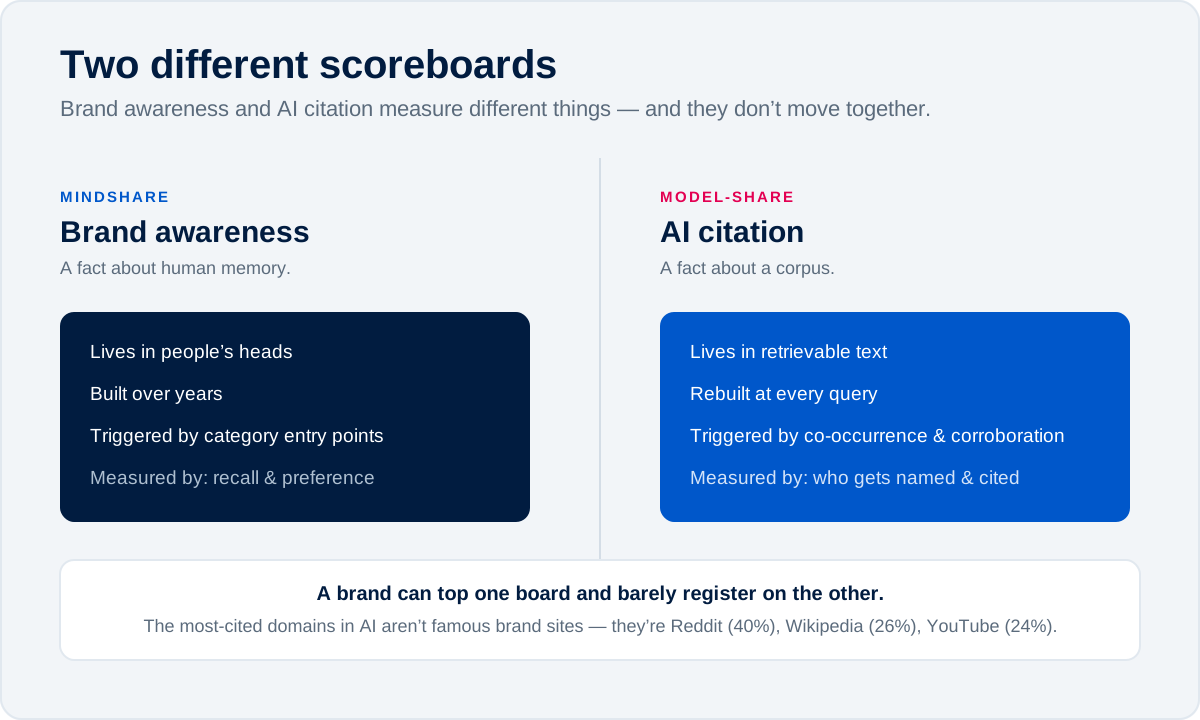
The short version is that you're keeping score on the wrong board. Brand awareness and AI citation look like the same thing — both are "does my brand come up?" — but they're measured by completely different systems, and the gap between them is exactly where a famous brand goes missing.
What Makes One Brand Get Cited in AI Answers While a Better Known Competitor Gets Ignored: Brand Awareness and AI Citation Are Two Different Scoreboards
Brand awareness is a fact about human memory. It's the probability that a person thinks of you when a need comes up — what the Ehrenberg-Bass Institute calls mental availability, built out of "category entry points," the specific situations and triggers that make a buyer recall a brand. It lives in people's heads, it's built over years, and it's why you can rattle off three brands in almost any category without trying.
AI citation is a fact about a corpus. When someone asks ChatGPT or Perplexity a question, the model doesn't consult its memory of how famous you are. It assembles an answer from text — training data plus, increasingly, documents it retrieves live at query time — and names the sources it can confidently stand on for that specific question. Fame is a weak signal in that process. What matters is whether your name sits next to the right words, in enough trusted places, in a form the model can lift cleanly.
Call it mindshare versus model-share. The reason this matters is that the two scoreboards don't move together. When Semrush analyzed more than 100 million citations across ChatGPT, Google AI Mode, and Perplexity, the most-cited domains weren't the famous brand sites — they were Reddit (40.1%), Wikipedia (26.3%), and YouTube (23.5%). AI engines have built their own trust hierarchy, and it doesn't mirror Google's top ten, let alone the rankings in a buyer's head. A brand can be enormously mentally available and still be nearly invisible on the board that decides AI answers.
This is the sibling problem to one we've written about before — why brands that rank on Google still go missing in ChatGPT and Perplexity. Google rank doesn't transfer to AI retrieval, and neither does brand fame. They're correlated, helpful, and not the same currency.
How retrieval actually picks a name
To see why a smaller brand can win, it helps to know roughly how the selection works, because the mechanism is the whole story.
When someone asks ChatGPT or Perplexity a question, those AI-generated answers are usually built by modern AI systems, not by answering the literal sentence as written. The model fans your prompt out into several narrower sub-queries, pulls candidate passages for each, and ranks them by semantic closeness — how well a chunk of text matches the meaning of the sub-query, not how authoritative the brand behind it is. Then large language models draft AI responses from the winning chunks and cite what they used. The unit of competition isn't your brand or even your page. It's a paragraph.
That detail quietly demolishes the assumption that the bigger brand should win. The most rigorous public study of this, the Princeton-led GEO research (presented at KDD 2024), tested nine content tactics across thousands of queries and found something telling: visibility in generative engines on platforms like ChatGPT, Perplexity, and Google AI Overviews is largely uncorrelated with traditional search rank. A source sitting in position five could be cited over the one ranked first, depending on how quotable and well-evidenced its passages were. The same study found that adding relevant statistics lifted visibility by around 40%, and adding quotations by roughly a quarter — content moves, not authority moves.
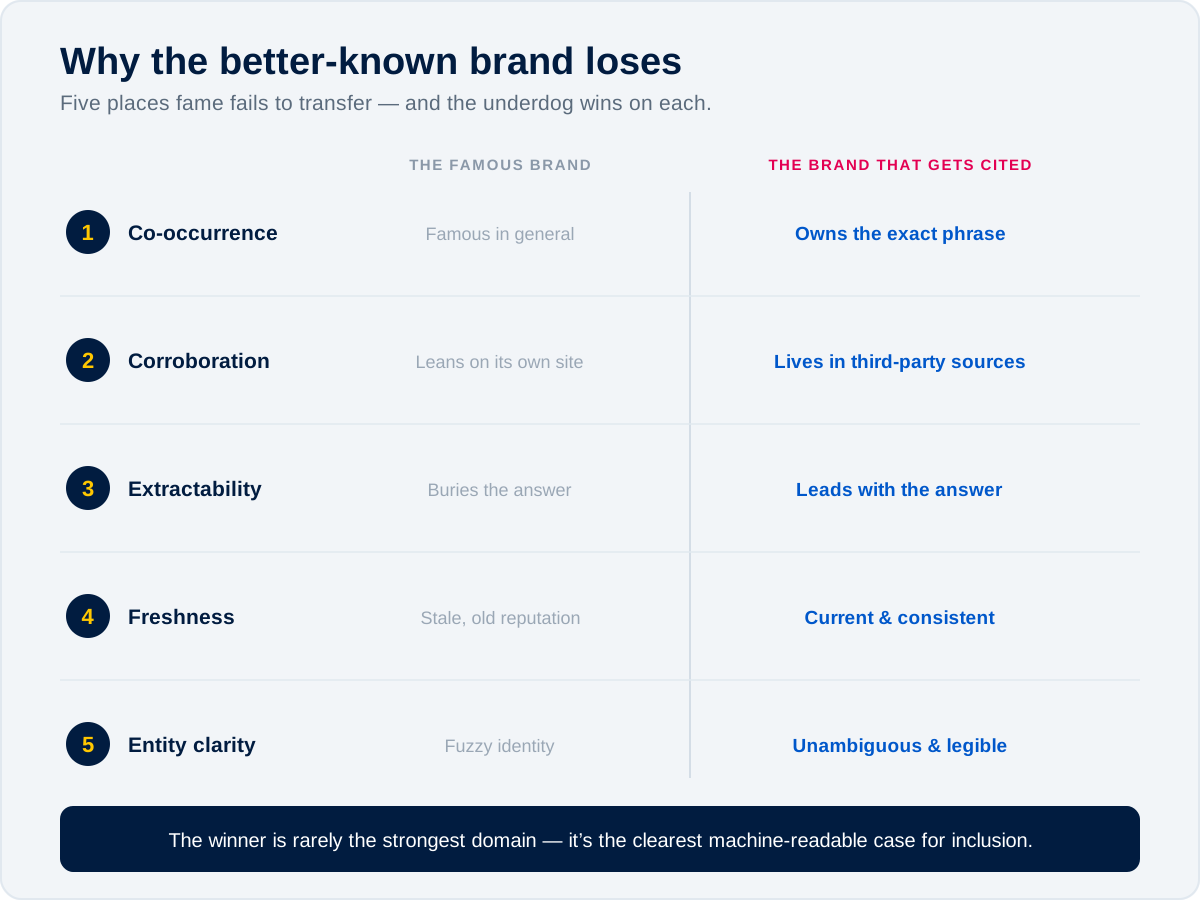
So the contest isn't "who's the biggest name in this category?" It's "whose paragraph is the cleanest match, the easiest to verify, and the easiest to lift?" Fame doesn't write that paragraph for you. Five specific things do, and when a better-known brand loses, it's almost always failing at one of them — which is exactly the shift from traditional SEO toward answer engine optimization.
The five reasons the better-known brand loses
It's famous in general; the underdog owns the exact phrase
LLMs work on co-occurrence — as SparkToro's Rand Fishkin puts it, the currency isn't links, it's "words that frequently appear near other words." A household name is associated with a whole category, broadly. A focused competitor has spent its whole existence appearing next to one narrow phrase — "HIPAA-compliant scheduling for dental groups," not "software." When the query is that specific, the specialist's name is sitting right there in the relevant text and the generalist's isn't. Breadth of fame is exactly the wrong shape for a narrow question.
It leans on its own website; AI search leans on everyone else's
This is the single biggest trap for established brands, because their own domain is usually their strongest asset and AI barely counts it: repeated mentions around one narrow phrase matter more than broad fame, so even brands with strong domain authority can be overlooked when category-language pairings are weak. Across studies, a brand's own site accounts for only a small slice of the citations it appears in — on the order of one in ten — while the overwhelming majority come from third-party sources. The effect is measurable: the same content earns a far higher citation rate when it lives on an independent publication than on the brand's own blog. A big brand with a thin off-site footprint is invisible exactly where the model is looking, which is one reason brands fail to get cited by AI. A smaller brand that's all over G2, Reddit threads, comparison posts, and industry roundups has built its presence on the 90% channel instead of the 10% one, so the brand cited on those exact questions is often the one using natural language phrasing that makes the association easier to retrieve and more likely to be cited in AI.
It buries the answer; the underdog leads with it
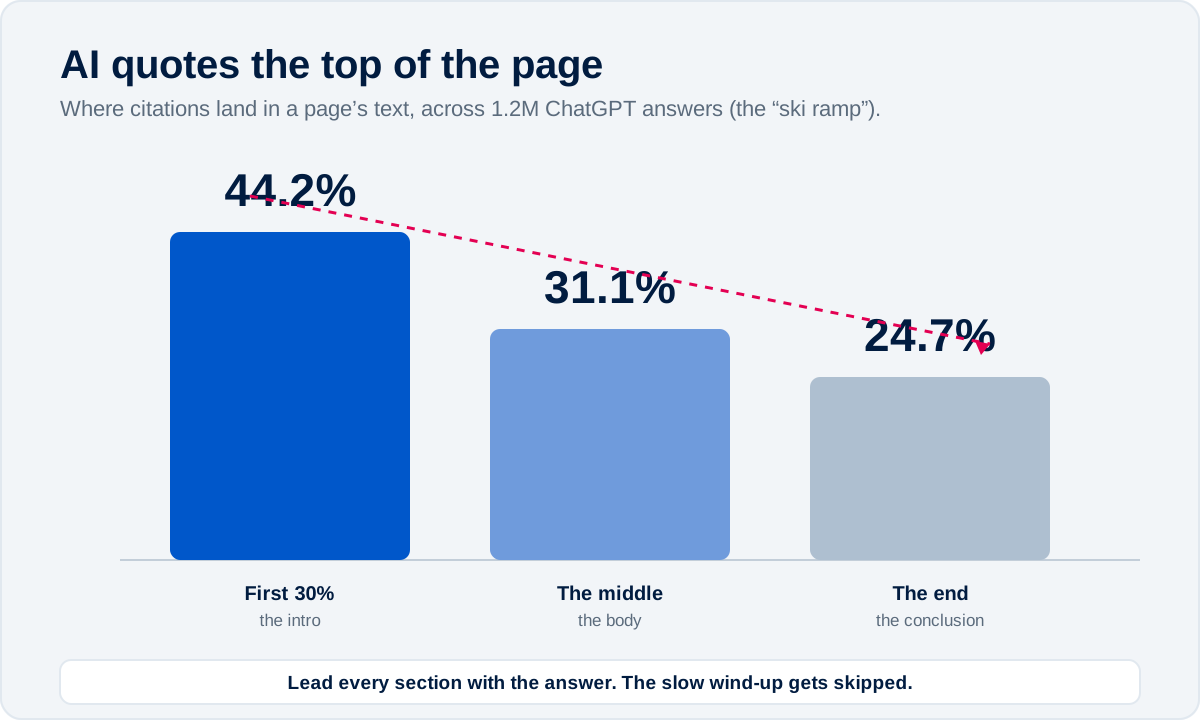
Because the unit of retrieval is the passage, where you put the answer decides whether it gets pulled, and a brand can have strong domain authority and still not get cited by AI if off-site corroboration is weak. Kevin Indig's analysis of 1.2 million ChatGPT answers found a stark "ski ramp": 44.2% of all citations came from the first 30% of a page's text, with the share falling off steadily after that. Big-brand content is often written to impress — a long narrative wind-up before the point. A leaner competitor writes the answer in the first sentence under each heading, sometimes with comparison tables that make the claim easy to lift and verify. One is built for human readers with time; the other is built for a machine that decides whether to get the brand cited in AI and moves on, which is one of the main ways brands fail in AI retrieval despite being well known.
Its corroboration is stale; AI rewards what's current and consistent
AI citations are volatile. SE Ranking's testing found only about 35% of cited domains repeat when the same prompt is run again, and the set of sources a model trusts shifts week to week. Fame built five years ago doesn't keep your name in the rotation; recent, consistent third-party reinforcement does. A brand coasting on an old reputation — last refreshed when its category was new — quietly drops out of the consideration set, while a hungrier competitor keeps showing up in this quarter's posts, reviews, and threads.
Its identity is fuzzy; the underdog is unambiguous
Models cite what they can pin down. If your name is generic, collides with other entities, or your positioning is described five different ways across the web, the model can't confidently say what you are — so it reaches for the source it candescribe in one clean line. We saw this directly when we analyzed 431 brands that ChatGPT recommended across 62 buying-intent prompts in manufacturing, life sciences, and edtech. The brands that got named weren't the most famous; they were the most legible. In manufacturing, recommended sites stated capabilities and certifications in plain text and averaged around 1,131 words of homepage copy. In life sciences, "regulatory" appeared explicitly on 67.9% of recommended sites. The winner was rarely the strongest overall domain. It was the brand that made the clearest machine-readable case for why it belonged in the answer.
How to tell if you're being cited in ai answers (or actually hurting you)
The five reasons need different fixes, so before you do anything, find out which board you're losing on. Run the diagnosis in order — it goes from cheapest to fix to most structural.
Start by asking the AI engines themselves. Take ten of the real prompts your buyers would use, run them in ChatGPT, Perplexity, and Google AI Mode, and read who gets named and what gets cited. AI agents favor brands they can unambiguously identify across ai platforms, and this single exercise usually tells you most of what you need about ai visibility.
If your competitors show up but you don't, look at the cited URLs. Are they third-party pages — roundups, review sites, Reddit, comparison posts? Then you have a corroboration problem (reason 2): the conversation is happening off your domain and you're not in it. If the cited pages are ones you could have written but didn't, and they lead with a crisp answer while yours buries it, that's an extractability problem (reason 3). This is also where ai tools and newer search engines often reward clean formatting because it makes evidence easier to lift into ai responses.
If nobody in your specific niche gets cited and the model gives a vague, brand-free answer, you're upstream of a co-occurrence problem (reason 1): the category-defining language doesn't yet attach to anyone, which is an opening to own it. If the model names you but describes you wrongly or hedges, that's an identity problem (reason 5) — the facts about you aren't clean or consistent enough to quote, and weak brand mentions make that worse. And if you were cited last quarter but aren't now, you're looking at freshness (reason 4): your corroboration has gone stale and needs feeding.
Most brands are losing on two or three of these at once. Naming them is the point — "go build authority" is not a fix, but "we get cited nowhere because every relevant page is on someone else's domain" is, and then you can make a more machine-readable case with schema markup supporting clearer identity and site structure.
The underdog's playbook for answer engine optimization (which works whoever you are)
Once you know the failure mode, the moves are concrete, and they're the same moves the smaller brand used to beat the bigger one: AEO targets AI-generated answers, unlike traditional search engine optimization.
Pick a narrow piece of territory and own its language. Don't try to out-famous the incumbent across the whole category; find the specific buying situation — the category entry point — where you're genuinely the best answer, and make your name co-occur with that exact phrasing everywhere you can. Specificity is the lever a smaller brand actually has.
Then get into the rooms the model reads. That means the third-party surfaces, not just your site: earn the review-platform listings, get added to the "best X for Y" roundups your competitor already sits in, and contribute real expertise to the Reddit and Quora threads in your niche — SE Ranking found brands with heavy community presence are several times more likely to be cited in ChatGPT. That's because ai models learn from authentic, repeated human judgment in places like Reddit, and ai thinks in patterns of corroboration more than brand size alone. When ai decides what to retrieve, a smaller brand that is frequently cited across trusted discussions can beat a bigger one with weaker niche proof. Adding your brand to a list that already names two rivals is a small editorial ask and a large retrieval win.
On your own pages, write for the machine that quotes the top. Lead each section with the answer, then support it — the inverted pyramid, not the slow build. This is where ai seo and generative engine optimization overlap in practice: structure pages so summaries are easy to extract, verify, and cite. And give the model something only you have. Our analysis of 5,761 AI citations across 800 B2B questions in Perplexity found that original data appeared on 47.1% of cited pages, and that long-form, structured educational content — not homepages or product pages — earned the overwhelming share of citations. Blog posts were 60.5% of all cited pages; product pages, 1.3%. Proprietary data is the one asset a competitor can't copy and a model loves to quote, which makes it the most durable citation advantage there is. AI-generated summaries can reduce organic click-through rates by 61%, which raises the stakes for appearing in the answer itself.
42% of B2B marketers are reallocating budgets to AEO content.
Finally, keep it fresh. Start by asking the AI engines themselves with the same prompts across AI platforms to assess answer engine optimization and visibility in ai generated answers. Read who gets named, what gets cited in ai answers, and which brand mentions recur across the cited sources and ai responses. Because the cited set churns, this isn't a one-time project; the brands that hold their place are the ones still showing up in this month's content, not last year's.
And if you're the better-known brand seeking ai visibility
The uncomfortable read on all of this: fame is a liability you have to actively convert. A big brand's instinct is to assume its reputation will carry into AI answers, so it keeps investing in the things that build human mindshare and neglects the things that build model-share — part of AI SEO, or generative engine optimization, for earning placement in AI-generated answers — and gets quietly out-cited by a competitor a tenth its size that simply did the retrieval homework. The advantage is real, but it only counts if you turn it into clean, well-corroborated, easy-to-lift text in the places the model actually reads, because being frequently cited across credible third-party sources is what turns fame into AI visibility. Awareness gets you remembered by people. It does not get you retrieved by machines. Those are two different jobs now: traditional SEO and search engine optimization chase rankings, while AI visibility depends on being cited.
Famous with people, invisible to the models?
We'll show you which of the five citation gaps is costing you AI answers — and build the content system that closes them.
Frequently Asked Questions
About the Author

Founder & CEO, Content RevOps
Stefan Kalpachev is the founder and CEO of Content RevOps, where he helps B2B SaaS companies transform their content into predictable pipeline. With a background in content marketing and revenue operations, Stefan has developed a unique methodology that bridges the gap between content creation and revenue generation.
Connect on LinkedIn