Video Marketing for Asset Managers: Turn the Input You Already Have Into a Distribution Engine
Not sure whether your firm's video is reaching the people who allocate? A content revenue audit shows you where it leaks and what it is worth.
Book a CallAlmost every asset manager already has video. Our 2026 review of 1,628 asset management firms found a video or YouTube presence at close to 90% of them, and Cerulli's 2023 research found 83% of the 30 largest institutional managers host audio and visual content. Yet an earlier study of the 100 largest global managers by Peregrine Communications found only 9% actually use video to communicate their brand and strategy. The channel is everywhere. The use is rare. Video marketing for asset managers pays only when you stop treating the clip as the deliverable and start wiring it as a distribution engine.
Part of Content Marketing for Asset Managers: The 2026 Playbook.
How many asset managers actually use video marketing?
Nearly all of them have a presence, and almost none of them run it as a programme. That is the honest answer, and the three numbers behind it come from three different studies, so hold them apart rather than blending them into one.
Our own 2026 analysis of 1,628 asset management firms put video or YouTube presence at roughly 90%. Cerulli, looking only at the 30 largest institutional managers, found 83% host audio and visual content across their site and social channels. Both measure the same thing: a camera has been pointed at someone, and the file is live somewhere.
Use is a different measurement. Peregrine's study of the 100 largest global managers found only 9% use video to communicate their brand and strategy, even though video drew the highest investor engagement of any format they tracked. That study is a few years old now, so treat the 9% as a marker rather than today's exact figure, but the shape has not changed in our 2026 data.
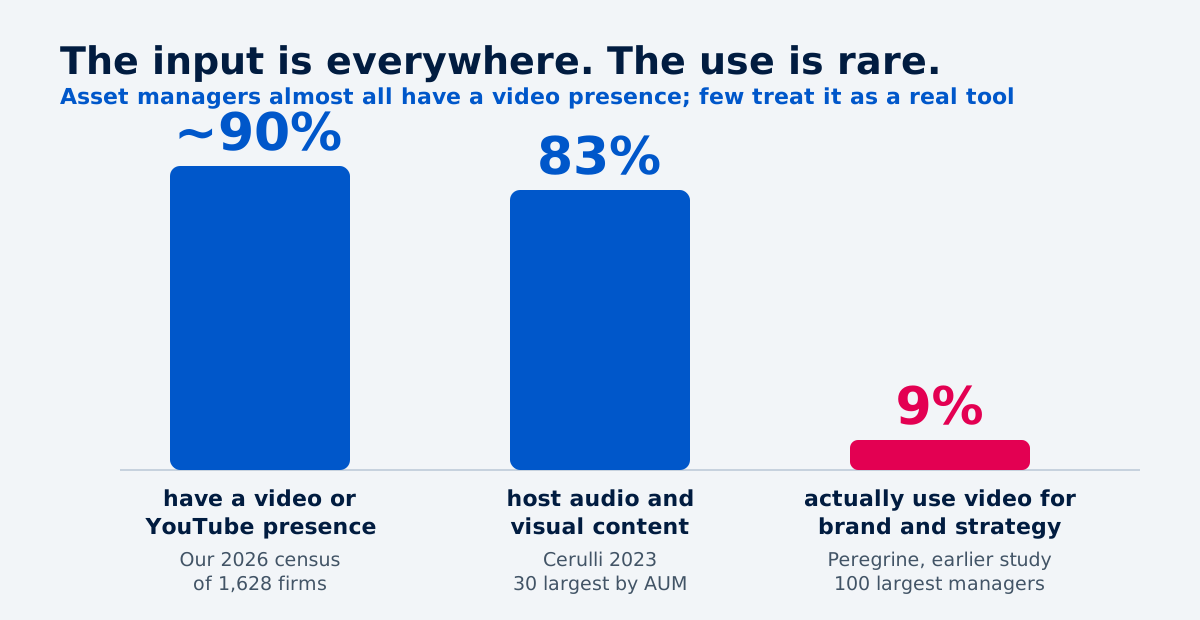
So when a buyer types "percent of asset managers who use video marketing," the useful answer is two-sided. The input is near-universal. The real, deliberate use sits closer to one firm in ten. The expensive part, the manager on camera, already exists at your firm. The cheap part, turning that footage into something that reaches a buyer and moves them, is what almost nobody does.
Why does video marketing underperform for most asset managers?
Because the leak is downstream of the camera, not at it. Most asset managers put real money into producing video and then publish it into a dead end.
Look at what happens after someone presses play. Across the firms we reviewed, 96.5% of content ends in a weak or dead-end call to action, only 4.7% capture a contact anywhere, and just 13.5% place a relevant next step inside the content itself. A video earns a view, and then it asks the viewer to do nothing.
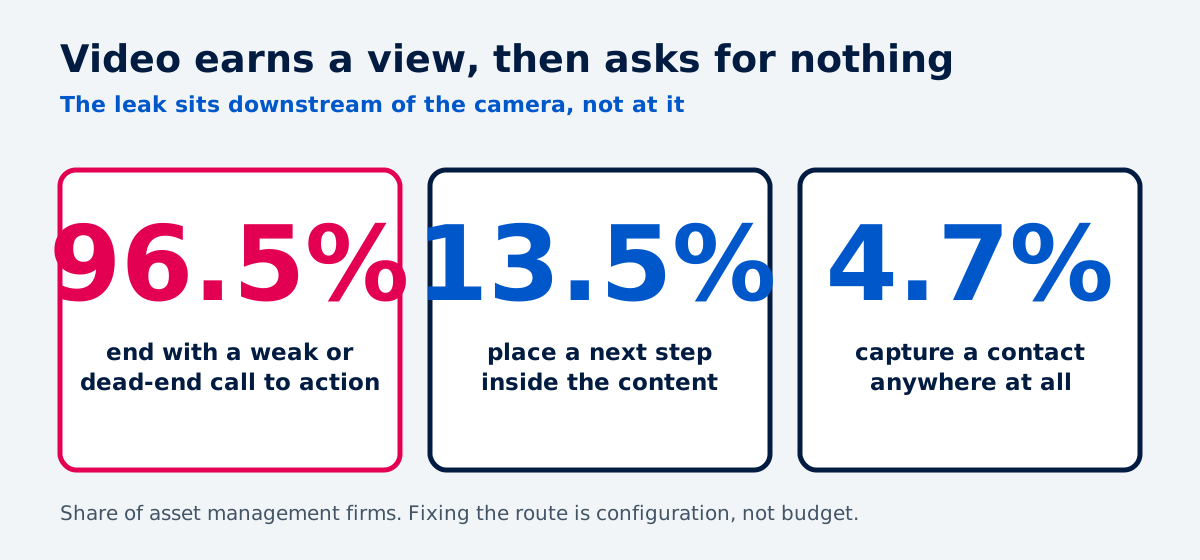
That is a distribution problem wearing a production costume. The field keeps treating video as a creative question, better lighting, a crisper script, a nicer set, when the thing that fails is the system around the file.
BCG's 2026 Global Asset Management Report makes the same point at the level of the whole business. It argues that distribution has replaced investment performance as the primary competitive advantage, and that most firms execute it as "a set of activities" rather than "a system," dependent on individuals instead of a repeatable engine. A one-off video shoot is exactly that: an activity. It does not compound.
The fix is giving the video you already make a job, a route, and a next step. The rest of this guide is how.
What does video marketing actually get an asset manager?
It gets you the attention of the person who signs off the allocation. That is the reason to bother, and it is enough.
Video agency Big Button, working with research firm Moving Image, studied how asset management content performed on LinkedIn and found that directors, VPs, heads of function, and C-suite leaders engage with video far more than with any other format. Documents and static images pulled more total views, but those audiences skewed junior. If your goal is influence rather than raw reach, video is the lever.
That matters because the senior buyer is persuadable and most firms give them nothing to be persuaded by. CoreData's 2025 research found 59% of institutional investors say thought leadership directly influences which manager they invest with. Yet only 5.8% of asset managers publish genuine thought leadership and 70.3% show no buyer proof at all, no case studies, no outcomes, nothing. Video is the format that carries that missing proof to the person who decides, in a way they will actually watch.
So the "is it worth it" question has a clean answer. If video reached everyone and moved no one, skip it. It does the opposite. It reaches the few people who matter and moves them. Build for that.
Which video formats should asset managers start with?
Start with the footage you already produce, then add formats in order of effort. You do not need a studio or a new budget line. You need to notice that your portfolio managers already talk to camera, and route that output.
Big Button's own finding is that asset management video underperforms not because of the format but because the content is formulaic and samey, office backdrops and leaders talking at the camera. That sameness is the opening. A small lift in clarity and intent stands out fast.
Here is the playbook, lowest lift first.
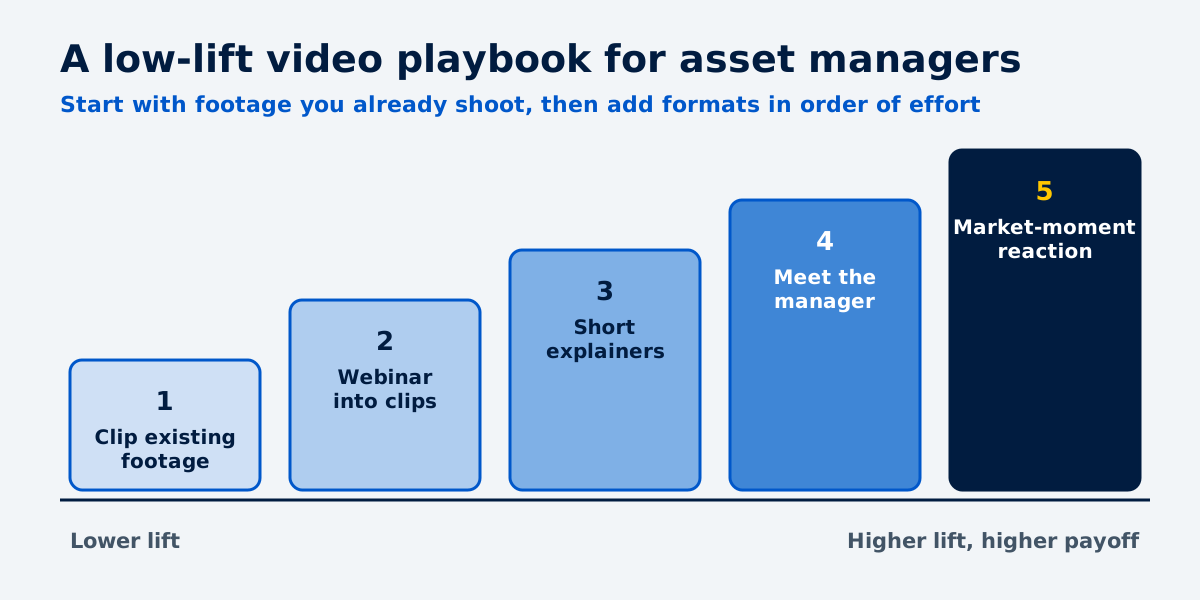
Clip the footage you already shoot
Your managers record market and fund commentary already. That is the expensive input. Cut each recording into short, single-idea clips for LinkedIn and your site before it goes stale. One shoot, several assets, no new production.
Turn the webinar you already run into video
Webinars are a natural source and a scarce one; only 3.1% of asset managers run them, while 76% of the largest institutional managers promote them. A single webinar becomes a highlights reel, three or four clips, and an on-demand recording. The recording keeps working after the live hour ends, which is why we build webinars as funnels, not one-off events.
Answer the questions buyers actually type
Short explainer videos that answer a real consideration-stage question ("what does this strategy do in a drawdown," "how does this fund handle duration") do the teaching your written pages skip. Video sitting on your own pages also carries search value, since YouTube is owned by Google and on-site video helps the page it lives on.
Put a face and a track record on camera
The "meet the manager" format is proven across firm sizes. Wellington Management runs a Meet the Manager series that became some of its best-performing content, and the same format runs at boutiques like W1M and at Schroders and Perpetual. It is the cheapest way to show the human judgment behind the numbers, which is the thing a buyer is really assessing.
React to the market moment
Timely commentary tied to a result, a rate move, or an event is where engagement spikes, because it has a reason to exist that day. BlackRock's Investment Institute runs a weekly to-camera market commentary on a fixed cadence, a named economist and a tight script. You do not need BlackRock's budget to copy the habit.
A boutique can do all of this. TwentyFour Asset Management, a fixed-income specialist, built its video approach iteratively from a small base; its head of marketing describes finding what "good" looks like by trying things, not by waiting for a studio budget.
How do you turn one asset management video into a distribution engine?
By getting many surfaces out of one shoot, and by making every surface route to a next step. This is the part that fixes the dead end, and it is mostly logistics, not creativity.
One shoot, many surfaces
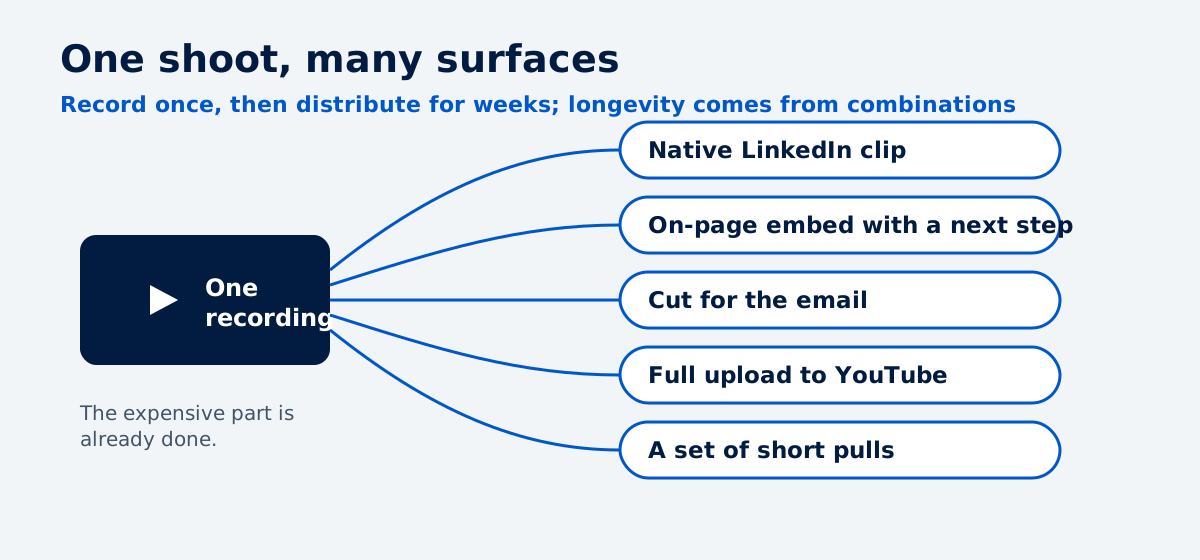
Treat each recording as a source, not a single post. The way we think about distribution is that longevity comes from combinations, not repetition: one canonical video becomes a native LinkedIn clip, an on-page embed, a cut for the email, a full upload to YouTube, and a set of short pulls. You record once and distribute for weeks.
Give every video a next step
A video with no next step is the 96.5% dead end in motion. Put the file on a page that has one primary purpose and a few sensible next steps, a related guide, a short download, a way to talk to someone, so the viewer who leaned in has somewhere to go. The way we plan a hub is never one page, one CTA; it is one page, one job, several doors.
Treat the view as the start, not the finish
The view is the top of the funnel, not the goal. Working with a client running a gated report campaign, Mango PD, we treated the download as the beginning: an automated nurture followed up with more value and warmed the lead toward a call, and a fast first follow-up did the heavy lifting, none of it depending on anyone remembering to chase by hand. Do the same with video. Capture the viewer who acts, then let a sequence carry them, because speed of first follow-up is the lever most firms leave on the floor.
How do asset managers handle compliance for video marketing?
As a workflow, not a wall. Compliance is the standard reason given for not using video, and it does not hold up, because compliance is universal and yet only about one asset manager in ten uses video. If the rules stopped video, they would stop it for everyone. They do not. The system does.
The two rules that govern it are workable. FINRA Rule 2210 treats video as a communication that must be fair and balanced, and the SEC Marketing Rule 206(4)-1 permits testimonials and endorsements with the right disclosures. Neither bans the format.
What works in practice is a pipeline, not a case-by-case fight. Standing content like a manager profile gets reviewed and approved once before it goes live. Timely commentary runs through a faster, pre-agreed review lane. Records are kept. Big Button, which specializes in finance, lays out the same compliance workflow for video and treats it as routine. Our asset management playbook covers the same review pipeline for written content.
The firms that already do this turn the compliance calendar into content. Among active asset managers, 22.2% publish regulatory thought leadership; they take the thing everyone treats as a brake and make it the subject.
How should asset managers measure video marketing?
Measure who watches, not how many. Raw views are the wrong scoreboard for a business where a single allocation can be worth more than a million views.
Start by accepting that the raw numbers will look small. An earlier industry analysis by Big Button and video platform TwentyThree found the typical asset management marketing video drew around 195 views, with only a sliver passing a thousand. Chasing that number is a losing game and the wrong one.
The useful signal is seniority. Big Button's profile-level analysis read the job titles of the people engaging with each format, which is how they found video pulls the senior audience. You can do a lighter version of the same thing: look at who watched, not how many did, and judge a video by whether the right kind of person leaned in.
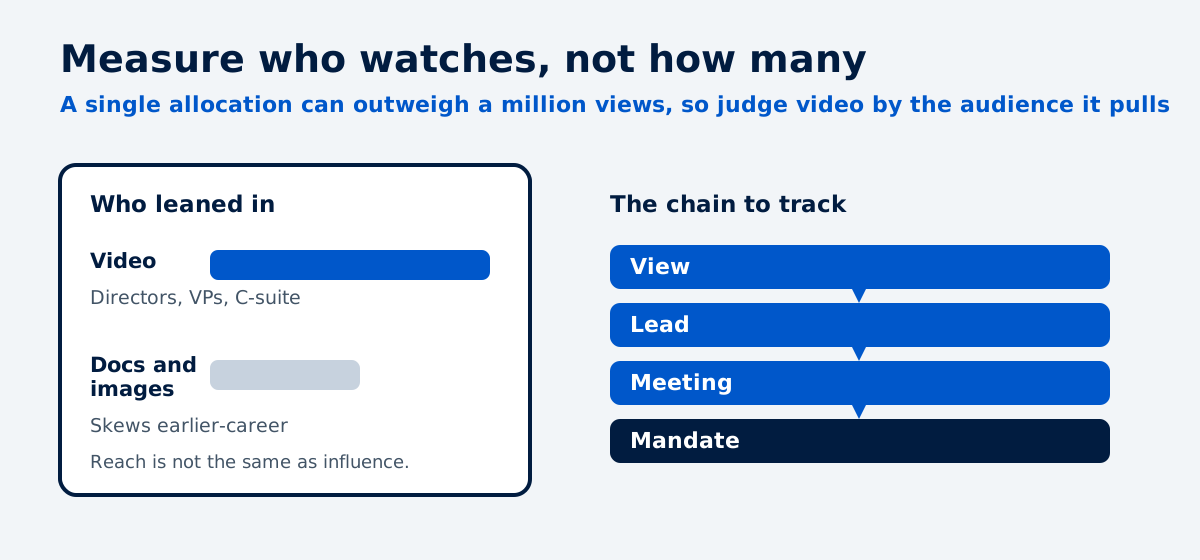
Then connect it to pipeline. This is the gap at most firms, where attribution and automation are rare and the median firm earns around 214 organic visits a month that it never acts on. B2B marketer Richard Good is running a public 90-day video experiment that tracks the line most firms never draw, engagement through to website traffic, form conversions, meetings, and new business. That is the chain to measure and report: view to lead to meeting to mandate, with video as one step in it.
Where should an asset manager start with video marketing?
Start small, from what you already have, and wire one path end to end before you scale.
Benchmark your channel coverage first. See where your video presence actually stands against the field with the asset management content benchmarking tool before you produce anything new.
Pick one format from footage you already shoot. Clip the next market update or webinar you run, rather than commissioning a new production.
Wire one capture path and one next step. Put the clip on a page that routes somewhere, and connect a follow-up, as in the distribution section above.
Measure who watches, not how many. Judge the first videos on the seniority of the audience, as in the measurement section above.
Repeat monthly. Systematic beats sporadic; only 3.5% of asset managers run content as a system, which is exactly why the firms that do stand out.
The firms cited by AI answers and found by buyers, the Vanguards, BlackRocks, and Fidelitys, win on video by treating it as a repeatable system, the same sequence our asset management content strategy guide lays out. You already own the hard part. Give it a job.
Want to see where your asset management firm's video and content sit against the field?
Our content revenue audit benchmarks your firm, finds where the pipeline leaks, and puts a number on the gap.
Frequently Asked Questions
About the Author

Founder & CEO, Content RevOps
Stefan Kalpachev is the founder and CEO of Content RevOps, where he helps B2B SaaS companies transform their content into predictable pipeline. With a background in content marketing and revenue operations, Stefan has developed a unique methodology that bridges the gap between content creation and revenue generation.
Connect on LinkedIn