Content Marketing for Asset Managers: The 2026 Playbook
Not sure whether your asset management content is building the business or just filling the site? A content revenue audit shows you what it is worth.
Book a CallSearch "asset management content marketing" and Google mostly hands you software for organizing files. The thing you actually need, content marketing that earns the trust of institutional allocators, financial advisors, and wealthy families before your sales team ever calls, barely has a clean answer online.
That gap is the whole problem. Most asset managers already publish. They run it as a press and brand exercise, so it sits on the balance sheet as cost. In our 2026 study of content marketing across the asset management industry, only about 1 in 28 firms runs content as a revenue system. The rest is brochure or noise.
This playbook covers what asset management content marketing is, why the press-function version fails, what the revenue-system version looks like, and how to place your own firm on the curve. It sits at the centre of our work with financial services firms.
What is asset management content marketing?
Asset management content marketing is the practice of publishing useful, credible material, market analysis, research, guides, and commentary, that attracts and educates the people who allocate capital, then routes their trust into pipeline and assets under management.
It is not the same as the software the search engine keeps surfacing. Digital Asset Management (DAM) and Marketing Asset Management (MAM) are tools for storing logos and files. They have nothing to do with winning a mandate. This page is about the second thing.
Who the content is for
Three audiences read an asset manager's content, and each one decides differently.
Institutional allocators. Pension, endowment, foundation, and insurance investment teams who run long, committee-led evaluations before they place a mandate.
Financial advisors and RIAs. The intermediaries who decide whether to recommend or allocate to your product for their own clients.
High-net-worth investors and family offices. Private buyers who research on their own and arrive already informed.
All three research through content before they speak to anyone. That is why content is not decoration for this industry. It is part of the buying decision.
Is content marketing the same as thought leadership?
"Thought leadership" is one output of content marketing, the expert point of view. It matters, and we come back to it. But a firm can produce excellent thought leadership and still have no system: no way to capture the reader, route them to sales, or connect any of it to assets raised. Content marketing is the whole operating model. Thought leadership is one part inside it, in the same way content strategy and content marketing are related but not interchangeable.
Why does most content marketing for asset managers fail to do its job?
Because most firms treat content as reputation, not revenue. They publish to look credible, not to move a buyer through a decision, so the content never connects to pipeline. The numbers on that are stark.
Almost nobody runs it as a system
Our industry study sorts firms by content maturity. Nearly six in ten (59.6%) show no real signs of content at all, running brochure sites with nothing to engage a buyer. Another 36.9% publish occasionally with no system behind it. Only 3.5%, about 1 in 28, run active, systematic content.
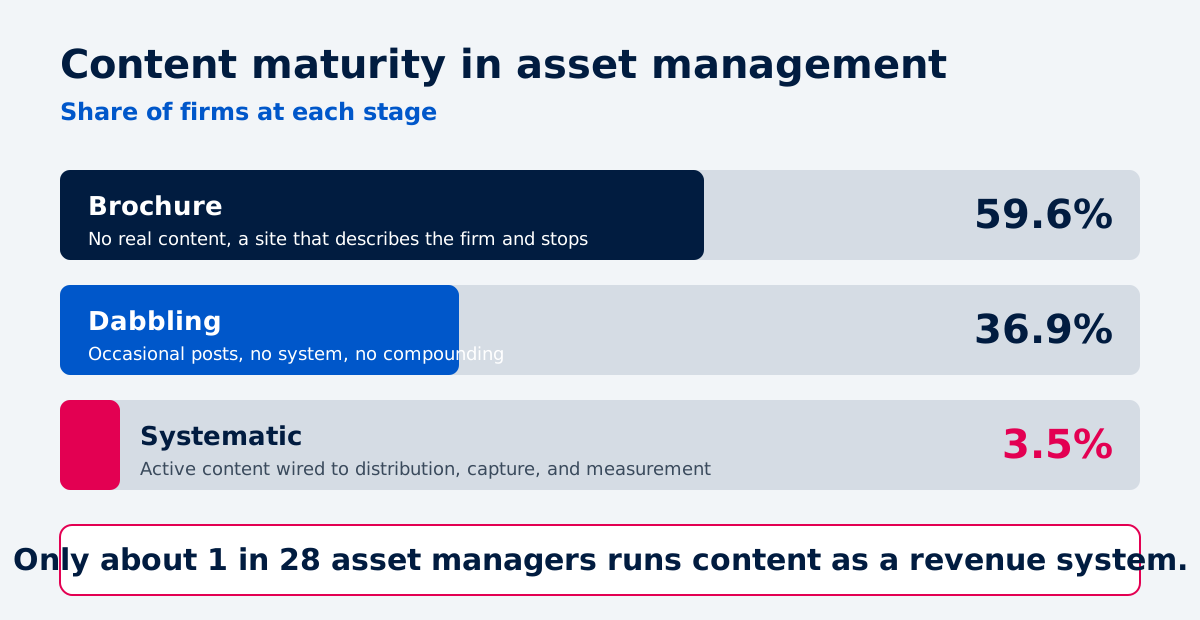
So the category does not have a content-quality problem. It has a content-as-a-system problem. Almost everyone is either absent or dabbling. The same pattern shows up across every vertical in our cross-vertical State of B2B Content Marketing report, but asset management sits near the bottom of it.
The content that exists is proof-free and commentary-heavy
When firms do publish, they publish the wrong things for a trust-led sale.
Seven in ten (70.3%) show no buyer proof at all, no case studies, data, or outcomes.
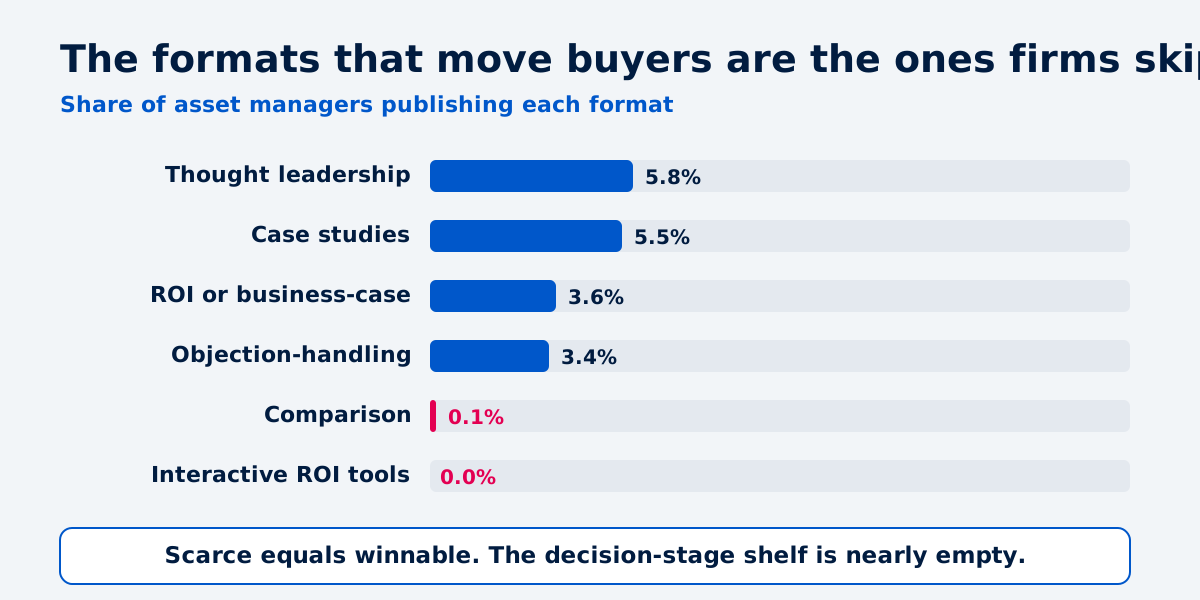
Case studies appear on just 5.5% of firms and genuine thought leadership on 5.8%.
Industry commentary sits at 14.9%, the most common format. Commentary is easy to produce and says nothing only your firm could say.
Comparison content is 0.1% and interactive ROI tools are 0.0%. Not a single firm in the study offers a tool that helps a buyer decide.
A committee choosing where to place a mandate wants evidence and a way to compare. The field gives them opinion.
External research says the same thing from the outside
This is not just our read. Peregrine Communications studied 100 asset managers' digital presence across the US and Europe and found only 14% of manager websites carry truly educational, varied content; 56% are mostly promotional and 62% lean on market commentary. Managers describe themselves with the same ten words, "global," "long-term," "innovative," "leading," and so on, so a buyer cannot tell them apart.
Peregrine's separate Global 100 report found 54% of the world's largest managers had stagnant or declining brand awareness for the fourth year running, and 81% had no positive coverage, or showed significant negative coverage, on the first page of Google for their own name.
As one asset management marketer, Jon Greene, put it plainly, most firms treat marketing as activity. Activity is not a system, and it does not compound.
What does content marketing look like when asset managers run it as a revenue system?
It looks like an operating system with five connected jobs: attract the right buyers in search and AI answers, educate them, capture the contact, route it to sales, and measure the whole thing to pipeline and assets raised. The press-function version leaks at every one of those joints. The revenue-system version closes them.
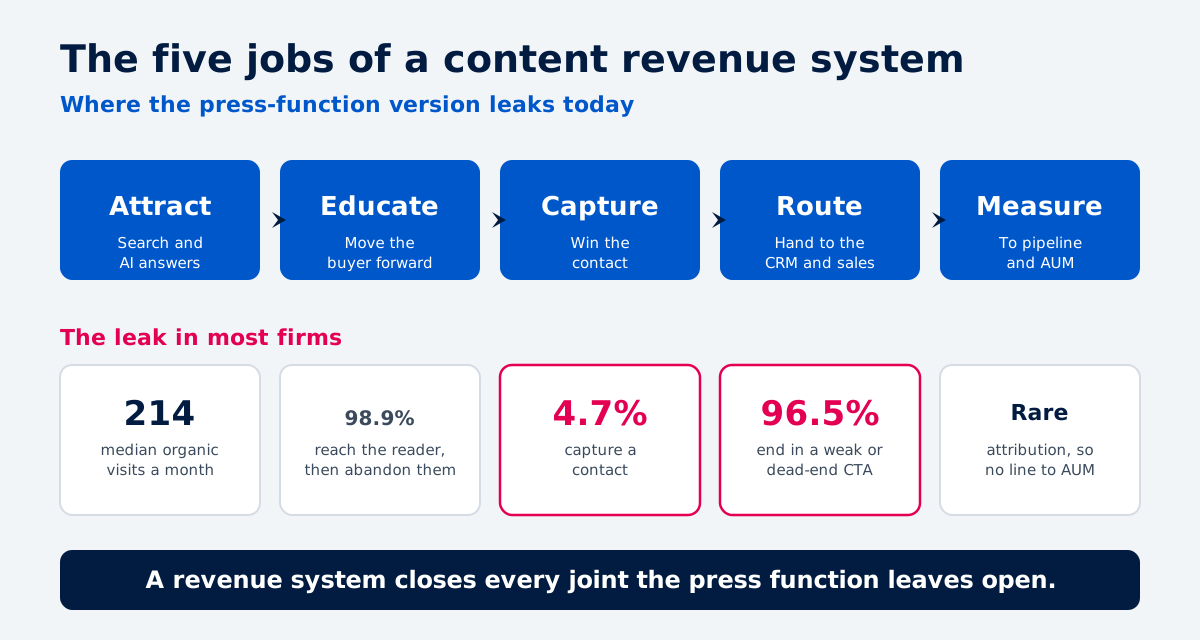
Here is where the leaks are, from our study, and what the system does instead.
Attract
The typical asset manager earns a median of 214 organic visits a month. That is presence without performance. Worse, 37.9% of the keywords firms rank for are their own brand name, so nearly four in ten of what little visibility exists is just people already looking for them. The search and traffic benchmarks break this down by firm size.
A revenue system points content at the non-branded demand, the 62.1% of category search that is winnable on the merits, and structures pages so AI answer engines can lift and cite them, the approach we lay out in the Ultimate AEO Guide. Right now only a small minority of firms surface in AI answers at all, and the citations concentrate on five giants: Vanguard, BlackRock, Fidelity, State Street, and J.P. Morgan Asset Management. The race below them is open, and what gets one brand cited over a better-known one is mostly structure and proof, not size. Ranking on Google is no guarantee either, which is why so many firms find they rank but do not show up in ChatGPT or Perplexity.
Educate
Coverage of the early buyer journey is not the problem. Consideration-stage topics reach 98.9% of firms. The educating content exists, much of it in what we call the informational layer.
The problem is that it educates and then abandons the reader. It answers the awareness question and offers nothing to do next.
Capture
This is the sharpest leak in the whole industry.
Lead capture is present on 4.7% of firms. Fewer than 1 in 20 collect a contact, so email and nurture have nothing to work with.
96.5% of content ends in a weak or dead-end call to action. Almost every page a buyer reads finishes with no meaningful next step.
In-content calls to action appear on 13.5% of firms, and only 5.2% use internal links to guide a reader toward converting.
A revenue system treats the page as the start of a relationship, not the end of a visit. Every asset earns a contact where the intent justifies it, then hands the reader something useful in return. That is the job of a conversion layer and a deliberate lead capture and qualification step, the same gap behind AI traffic that does not convert.
Route and measure
Attribution and marketing automation are rare across the field. Most firms measure traffic they never act on, and cannot connect a piece of content to a conversation or a dollar of AUM.
That is the difference between a press function and a revenue system. One counts views. The other wires content into the CRM and the sales motion, with a clear lead handover process, so a marketer can name which assets started which relationships. This is the operating-model shift, the same move that put finance on the cloud and sales on a CRM, applied to content. We describe how the pieces fit in our guide to building content as a system.
Which content actually moves institutional and advisor buyers?
The content that helps a buyer decide: original research and a real point of view, proof, decision and objection-handling material, and a structured place to find it all. The good news for any firm willing to build it is that these formats are exactly the ones the field skips.
Original research and a genuine point of view
Buyers reward firms that publish something only they could know, and they keep score over time. In CoreData Research's 2025 survey of 154 institutional investors and consultants overseeing roughly $4.9 trillion, 56% said they actively look back to see which managers were most accurate in their past insights and predictions, and 48% wanted more detailed evidence behind a manager's views. A 2020 institutional content survey found 73% ranked in-depth reports on the investment outlook as the single most influential content type.
Depth and proprietary data win. Yet genuine thought leadership sits on just 5.8% of firms, which is precisely why it works as a moat: scarce, hard to fake, and hard to displace once you own a theme.
Proof
Case studies and named outcomes appear on 5.5% of asset managers. In a purchase this high-risk, starving the buyer of proof is a strange choice, and it leaves an obvious opening. Publish the evidence, in a compliant form, that the other 94.5% will not.
Decision and objection-handling content
The field abandons the reader exactly where intent is highest.
ROI or business-case content: 3.6%. Almost nobody arms the internal champion with the case they need to sell your firm up the chain.
Objection-handling content: 3.4%. The hard questions get left to the sales call, where they are harder to win.
Both are decision-stage content, and both are wide open.
A structured resource hub
Scattered PDFs do not compound. A resource hub, the flagship content product, gives buyers one place to self-educate by problem and format, and it appears on just 3.7% of firms. Building one is how a set of disconnected assets becomes a system a buyer can navigate. We break down what goes into one in our work on core content assets, and getting it in front of buyers is a distribution strategy question as much as a production one.
Where the raw material comes from
None of this means inventing opinions. The strongest asset management content is the thinking your investment team already does, captured and made usable. The practical version is simple: record the investment meeting, pull the two or three real insights from it, and turn them into a piece, a process we call raw asset extraction. Dan Sondhelm describes the same habit for boutiques, a monthly "PM Perspectives" note drawn straight from the morning call. Larger firms do it at scale; J.P. Morgan has built data-driven, personalized marketing on top of the same principle. The insight is already in the building. A system gets it out.
How do asset managers handle compliance without going dark?
By treating compliance as a workflow the system absorbs, not a reason to stay silent. Compliance is real, and it is not the thing stopping most firms. Compliance is universal across the industry, yet only 3.5% run systematic content. So compliance is not what stops the other 96.5%. The missing thing is the system.
The rules, in plain terms
Two named rules govern most asset management marketing content, and both are workable.
The SEC Marketing Rule (Rule 206(4)-1), under the Investment Advisers Act of 1940, sets seven general prohibitions for registered advisers' advertisements: no untrue or misleading statements, claims you can substantiate, benefits balanced against risks, and any performance shown fairly and completely.
FINRA Rule 2210 (Communications with the Public) sorts communications into retail, institutional, and correspondence, requires all of them to be fair, balanced, and free of promissory or projected performance, and has a qualified principal approve retail communications before use.
Neither rule bans content. They ban careless content.
The workflow answer
Firms that publish steadily solve compliance once, in the pipeline, instead of fighting it piece by piece. That means building content from pre-cleared, modular blocks, standing disclosures, approved descriptions of a strategy, reusable data, so a new piece assembles mostly from parts legal has already seen. Review becomes a short step in a known process, not a fresh negotiation every time. The firms that go dark are the ones treating every post as a one-off legal event. Pharma faces the same problem under different regulators, and the review-ready content workflow we use there carries over almost one for one.
How do you measure content marketing in asset management?
Measure it against pipeline and assets raised, not clicks and impressions. The reason most content stays a press function is that it is measured like one. Traffic, followers, and engagement are the metrics of a brochure. They tell you a page was seen, not that it moved a buyer or raised a dollar.
That matters more in 2026 because the economics of the industry have tightened. Management fees have fallen 23% since 2010, and costs have outpaced revenues for over a decade, which is why BCG argues the advantage has shifted from investment performance to distribution. In its words, execution too often stays "dependent on individuals rather than on a system," and market insights sit "disconnected from CRM." Every marketing dollar is under a sharper light.
The real scoreboard
A revenue system measures content the way it measures any other growth channel, with the same discipline as any set of pipeline metrics worth tracking.
Qualified conversations started, not visits logged.
Pipeline influenced and sourced, tied back to the assets a reader first engaged with.
AUM attribution over the full cycle, because institutional decisions run long and the credit shows up months after the content did.
The point of measuring to pipeline and AUM is not tidier reports. It is that content you can price is content you can fund. When a marketer can show which assets started which mandates, content stops being a cost center and starts being an investment with a return. That is the case our own content ROI work is built to make, and our guide to reporting on content marketing success covers how to present it.
Content decides who makes the shortlist
The long cycle is exactly why content pays. Buyers use it to build a view of you long before any pitch. In CoreData's survey, 59% of institutional investors said their likelihood of investing with one manager over another is directly influenced by the manager's thought leadership, and 23% said content led them to a firm they had never heard of. Coalition Greenwich, interviewing roughly 500 institutional investors, found two-thirds treat thought leadership as a significant influence on manager selection. Among financial advisors, 75% said educational content had influenced a decision to invest or recommend.
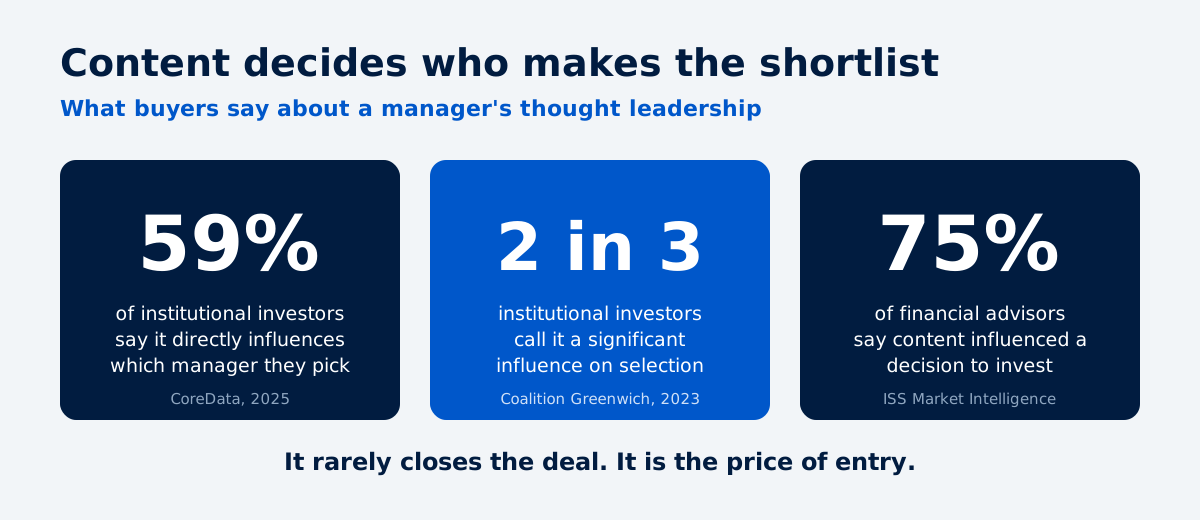
Content rarely closes the deal on its own. As one CIO told CoreData, thought leadership rarely clinches a deal but helps keep brands on the shortlist, which is most of the battle. CoreData's own conclusion is blunter: content is no longer optional for an asset manager, it is the price of entry. A firm that goes silent for a year does not hold its place; it compounds in reverse.
Where does your asset management firm stand today?
Most firms are further back than they think, and the gap is a system, not a headcount. Our content maturity model puts every firm in one of three groups.
Brochure (59.6%). No real content. A website that describes the firm and stops.
Dabbling (36.9%). Occasional posts, no system, no compounding.
Systematic (3.5%). Active content wired to distribution, capture, and measurement.
The odds of running a system rise with size, from 1.3% of firms with 11 to 50 employees to 13% of those with 501 to 1,000, because scale brings the budget and the mandate. But size is not the barrier the numbers make it look. The barrier is treating content as a press function. A focused smaller firm that builds the system can hold a theme that a larger, unsystematic competitor never claims.
What it costs to run
Budgets in our study scale with the traffic a program earns, not with firm size.
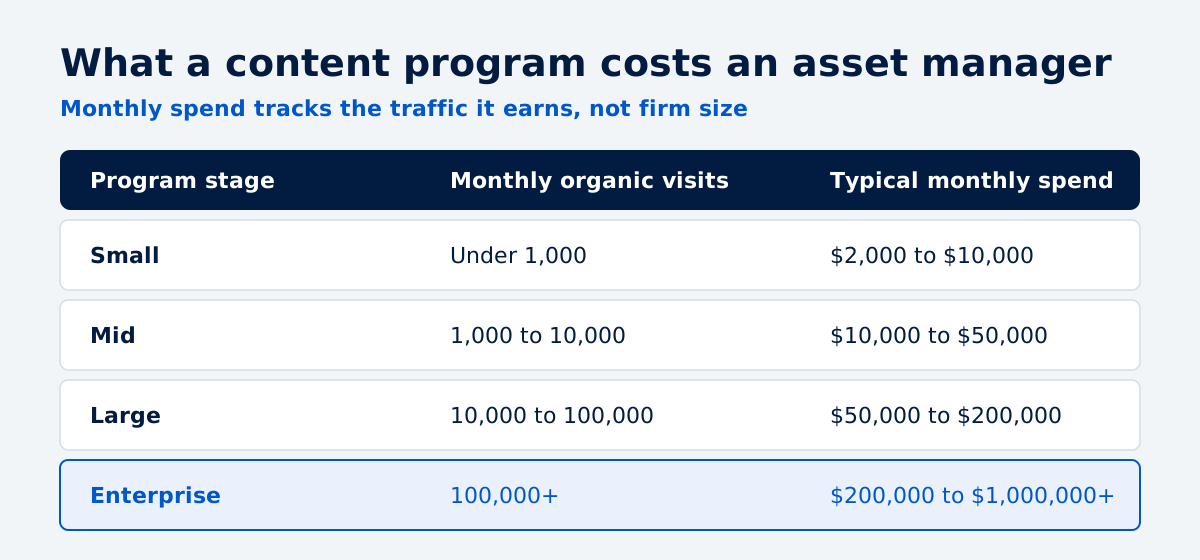
Program stage | Monthly organic visits | Typical monthly investment |
Small | Under 1,000 | $2,000 to $10,000 |
Mid | 1,000 to 10,000 | $10,000 to $50,000 |
Large | 10,000 to 100,000 | $50,000 to $200,000 |
Enterprise | 100,000+ | $200,000 to $1,000,000+ |
Place your own firm
You can size the gap in a few minutes. Put your own numbers next to the field: your organic visits against the median of 214, your content maturity against the three groups, your buyer proof and decision content against a field where 70.3% show none.
Read the full State of Content Marketing for Asset Managers 2026 for the complete picture.
See the content maturity, active-cohort, and search performance breakdowns.
Run your firm through the asset management content benchmarking tool to place yourself on the curve.
Almost no one in asset management runs content as a revenue system. That is the opening. The firm that builds one owns the category answer while everyone else is still publishing brochures.
Want to see where your asset management firm sits on the content maturity curve?
Our content revenue audit benchmarks your firm against the field, finds where pipeline leaks, and puts a number on the gap.
Frequently Asked Questions
About the Author

Founder & CEO, Content RevOps
Stefan Kalpachev is the founder and CEO of Content RevOps, where he helps B2B SaaS companies transform their content into predictable pipeline. With a background in content marketing and revenue operations, Stefan has developed a unique methodology that bridges the gap between content creation and revenue generation.
Connect on LinkedIn