Construction Marketing in the Slow Season
Not sure whether your construction marketing is set up to use the slow season or waste it? A content revenue audit shows you.
Book a CallWhen the phones go quiet, most construction firms do the same three things. They cut the marketing spend, they wait for spring, and they go hunting for side work. It feels responsible. It is the most expensive habit in the trade, and the one we see most often when we build content systems for construction firms.
Part of Content Marketing for Construction: The Complete 2026 Guide.
Construction seasonal marketing works backward from how most owners treat it. The slow season is not the time to disappear; it is the time to build. Content you publish in the quiet months is live, indexed, and maturing into authority by the time buyers come back, and it keeps working long after you stop paying for it. This guide is for the owners who run marketing without a marketing team, and the solo and small-team marketers who carry it alongside everything else. It answers the questions you actually have about the off-season, in order.
What months are slow for construction?
For weather-exposed construction, the slow season runs from late fall through winter into early spring. The U.S. Census Bureau is blunt about why. Its construction numbers swing on the weather, and it names the pattern directly as "the average January decrease in new home construction in the Northeastern region of the U.S. due to cold and storms." Frozen ground, short days, and storms stop site work, masonry, paving, and new exterior builds.
Trades feel it differently. Practitioners tracking seasonal contractor demand put the slowest window for heating and cooling work between January and March, the shoulder between the heating season and the spring rush. Interior work, service, repair, and warm-market firms barely feel a dip at all.
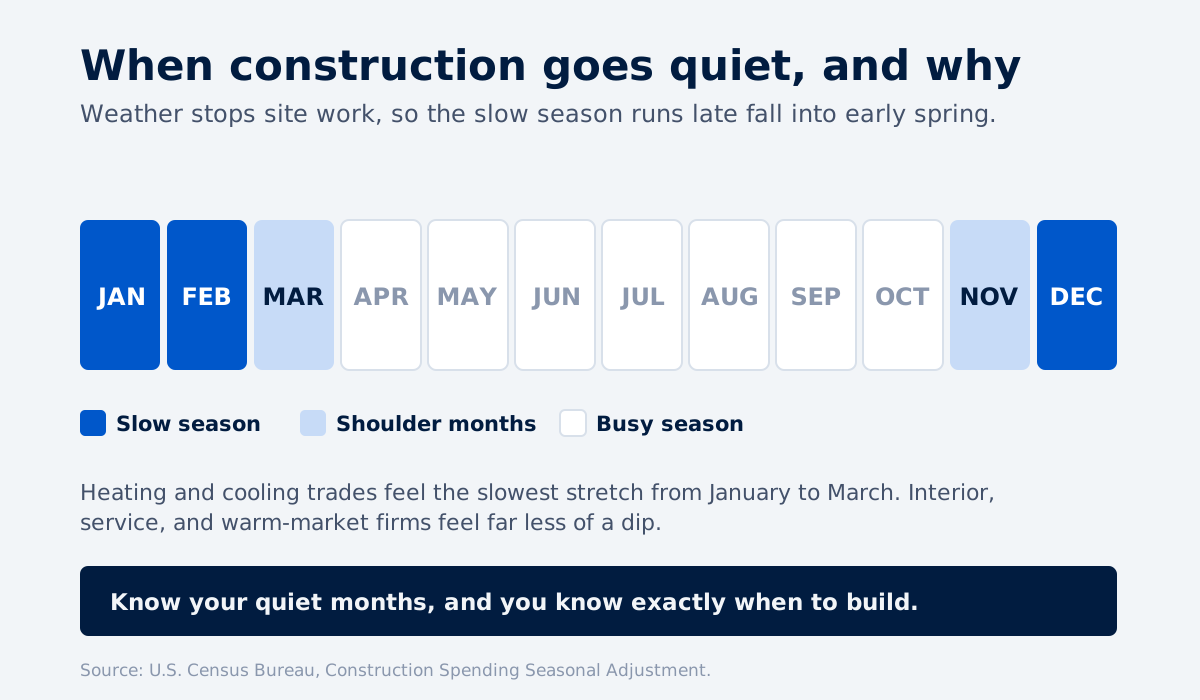
The reason this matters is not the calendar. It is what the calendar lets you plan. If you know your phones go quiet from December through February, you know exactly when to build the marketing that has to be live and already maturing before your buyers come back in spring. Work backward from your slow months, and the off-season stops being a gap to survive and becomes a window you scheduled on purpose.
Is your slow season a seasonal dip or a market slowdown?
These are two different things, and construction owners mix them up constantly. A seasonal dip happens every year on the same weather clock. A market slowdown is a change in demand itself.
In 2026 you can see both at once. U.S. housing starts sat around 1.24 million in mid-year, down about 13.5% from a year earlier, so residential demand really did soften. That is separate from the winter dip, which would have happened anyway.
Here is why you do not need to untangle them perfectly. The marketing move is the same either way. Whether the phones are quiet because it is January or because the market cooled, going dark makes it worse, and building demand is what pulls you out. So name which one you are in, then stop worrying about it and get to work.
Why going quiet in the slow season is the most expensive habit in construction
The instinct to pull back in the slow season is understandable, and it is what separates the firms that grow from the firms that tread water. The quiet months are when the disciplined minority pull away from everyone else.
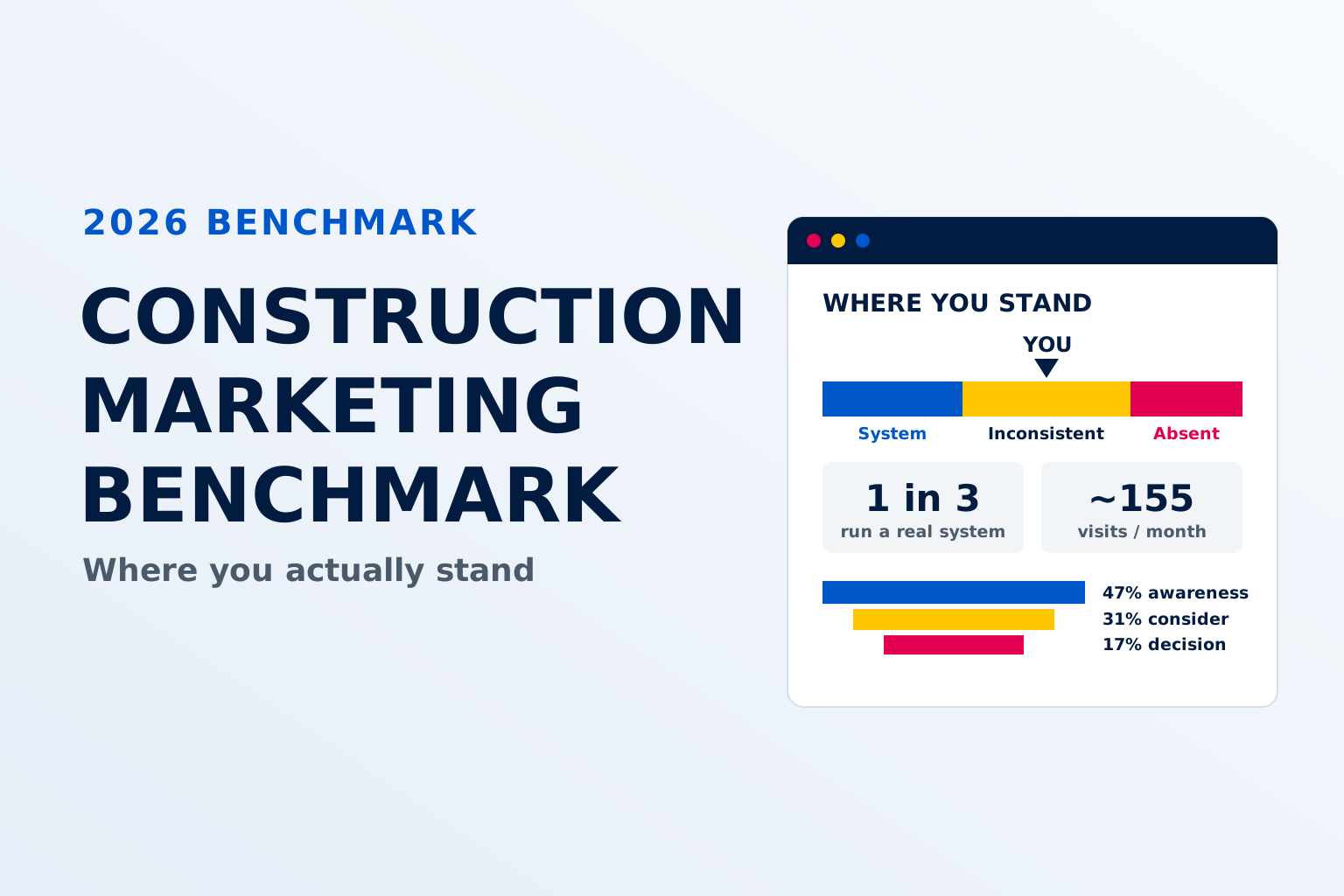
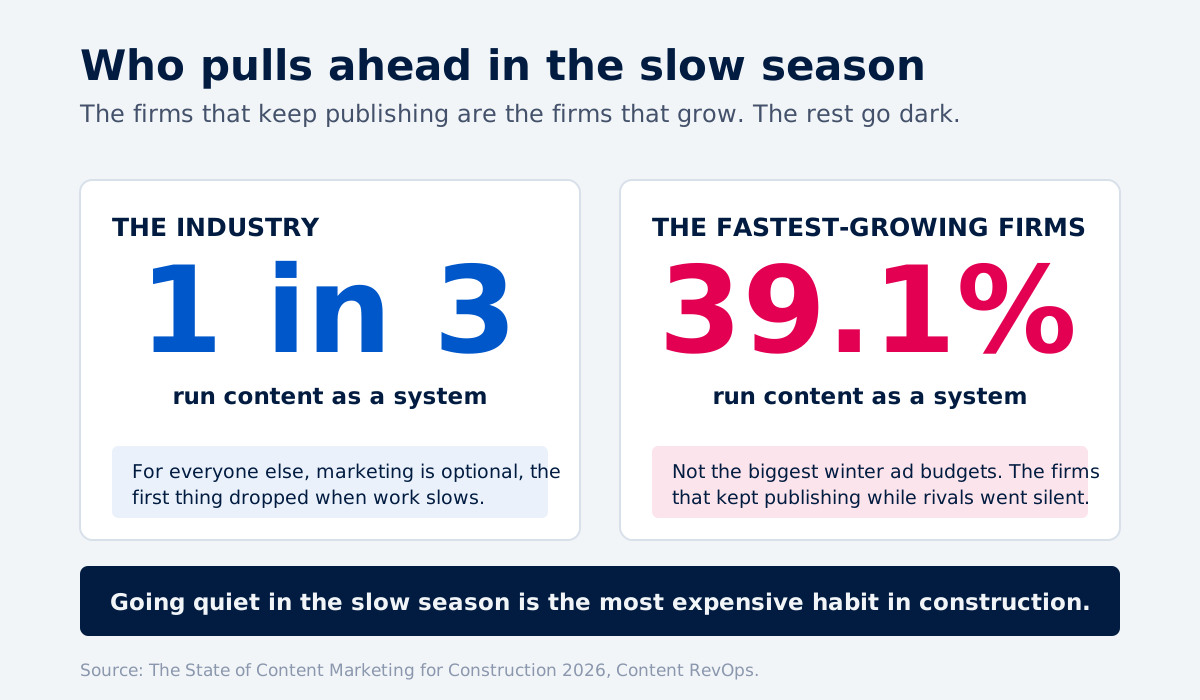
Our analysis of content marketing across the construction industry found that only one in three construction firms runs content as an actual system, something planned, published, and measured on purpose. For everyone else, marketing is still optional, the first thing dropped when work slows.
That gap tracks straight to growth. Among the fastest-growing construction firms, 39.1% run content as a system, a far higher share than the field as a whole. The firms pulling ahead are not the ones with the biggest winter ad budgets. They are the ones who kept publishing while their competitors went silent.
Think about what silence costs you. Your competitors go dark at the same time you do. The buyers who are still looking, the ones planning spring projects in January, find whoever is still there. If that is not you, it is the firm that decided the slow season was a build window instead of a break.
Can marketing actually help during the slow season?
Yes, and the reason is timing. Demand you create in the quiet months compounds, so the work you do while the phones are quiet is what fills the calendar once demand returns.
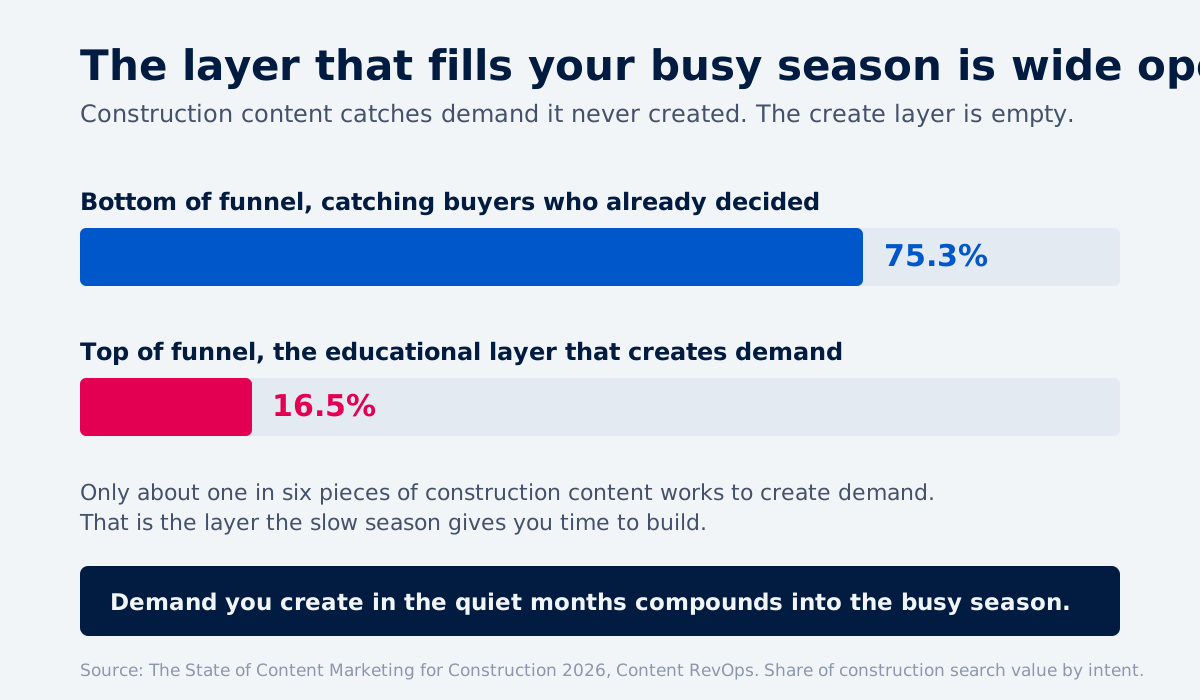
Most construction marketing does the opposite. The industry runs a demand-capture engine, not a demand-generation one. Roughly three-quarters of the search value in construction sits at the bottom of the funnel, where firms catch buyers who already decided they need the work. Only about one in six pieces of content targets the top of the funnel, the educational layer that actually creates demand. That layer is wide open, and the slow season is when you have time to build it.
The compounding is real, and it is documented. A California foundation-repair firm, Dalinghaus Construction, stopped chasing paid search and agency website rebuilds and started publishing honest answers to the questions buyers actually ask. The results built over time. A visitor who was not ready to buy today found them again when they were ready months later, and by then Dalinghaus was the name they trusted. Revenue climbed about 40% in a year, and at one point the firm sat on a 16-week backlog even after hiring extra crews. None of that came from a clever winter promotion. It came from content that kept working.
That is the mechanism. A piece you publish in the slow season does not expire when spring arrives. It sits there, ranking and getting found, doing the job of a salesperson who never takes a day off.
Should you cut your ad budget when the phones go quiet?
Cutting your ads to zero in the slow season is the wrong move, but so is treating cheaper ads as the whole plan. The smarter play is to spend less on renting demand and move the difference into owning it.
Off-season ads are genuinely cheaper. SearchLight by Hatch analyzed $14.9 million in ad spend across 816 roofing and home-services contractors and found non-branded cost per lead dropped 23% from January to March, from $145 down to $111, as competitors held back. Fewer firms bidding means cheaper clicks and, often, more of the attention to yourself when you are one of the only advertisers left in the auction.
So keep a base layer of ads running. Cheaper leads are still leads, and going fully dark also resets everything the ad platform learned about who converts.
The catch is that rented demand stops the moment you stop paying. Across construction, about 73% of firms run Google Ads, with estimated monthly spend running into the tens of thousands, and an average cost per click around $6.24. That is capture that switches off with the invoice. Content is named in only 13.6% of construction marketing roles, and search skills in just 7.5%, so almost nobody is building the owned asset that would earn that traffic for free.
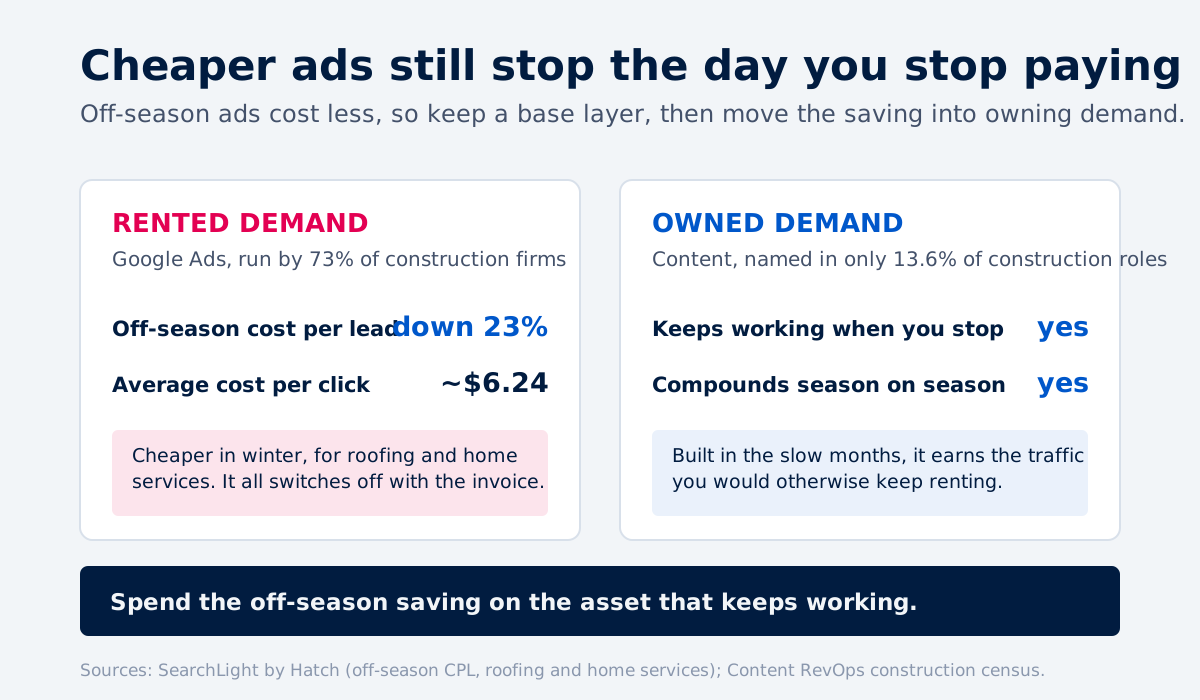
The move for the slow season is to take part of what you save on cheaper off-season ads and put it into content, SEO, and the answer layer, the things that keep working through the next quiet season and the one after that.
What should you build in the slow season?
Build the demand-creating content you never have time for when you are busy. The raw material is already sitting in your business, and the quiet months are when you finally get to use it.
Construction firms have a real advantage here that most other industries envy. Most active firms in the industry already publish genuine technical content, and a large share cover codes and regulations, a hard-to-fake edge. The expertise exists. It just sits unused. Original research and data, the single biggest lever to own a category, shows up on barely one in eight firms, so there is room to lead.
Here is what to prioritize in the slow months, in rough order of payoff.
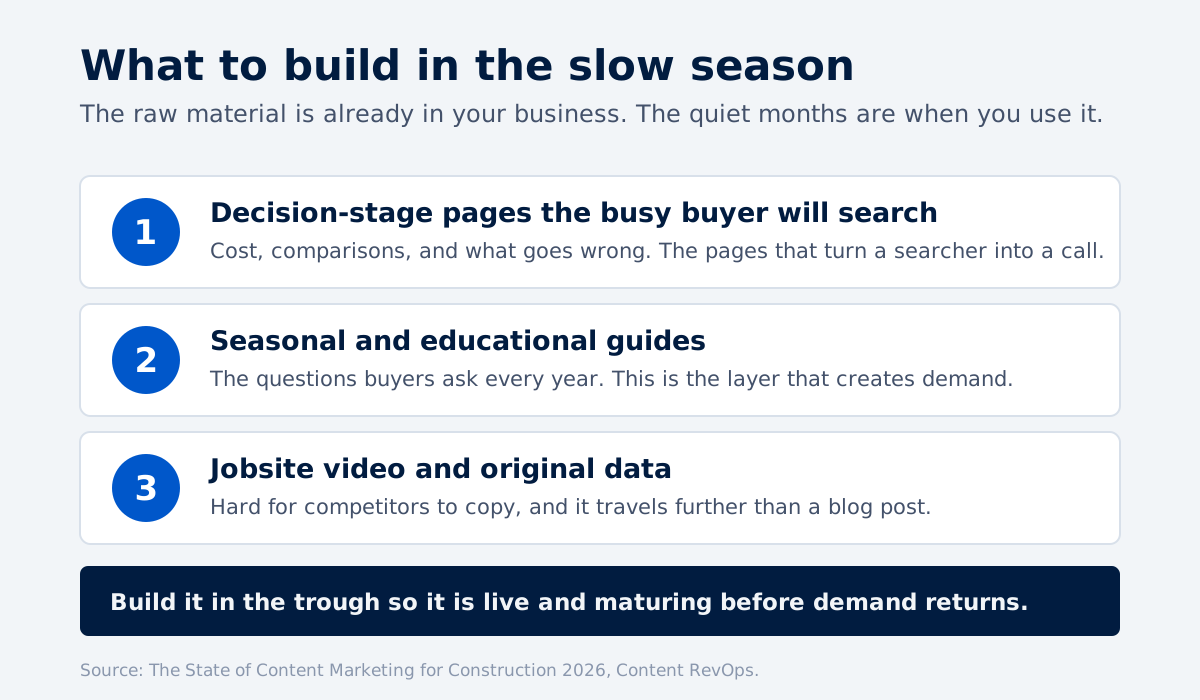
Decision-stage pages the busy buyer will search
Write the pages that answer the questions a buyer asks right before they hire. What a project costs, how you compare to the alternatives, what goes wrong and how you prevent it. These are the pages that turn a searcher into a call, and they take time to write well.
Seasonal and educational guides
Answer the questions your buyers ask every year. How to plan a spring build, what winter does to a foundation, when to book to hit a summer deadline. This is the educational layer that creates demand instead of just catching it.
Jobsite video and original data
Film the work while crews are wrapping up the season, and turn your own project numbers into a simple piece of research. Both are hard for competitors to copy, and both travel further than a blog post.
The calendar logic is the whole point. Content takes time to earn its rankings, so you want it live and maturing before demand returns, not scrambled together the week the phones start ringing. That is why the slow season, not the busy one, is when this work gets done.
Why is the slow season the cheapest time to win the AI answer layer?
Buyers no longer only search Google. They ask ChatGPT, Perplexity, and Google's AI answers who to trust, and construction firms are almost invisible there. Across the industry, brands surface in only about 2.5% of AI answers, and aggregators, forums, and regulators own the space that construction firms should. Almost nobody is hiring for it; answer-engine skills appear in a fraction of a percent of construction marketing roles.
That empty space is easiest to claim in the slow season, and freshness is the reason. When researchers analyzed 17 million AI citations, they found AI assistants cite content about 25.7% fresher than what ranks in normal search. Roughly half of all AI citations point to content published or updated in the previous 13 weeks. These systems re-check the web on every question, so recent, well-sourced content wins.
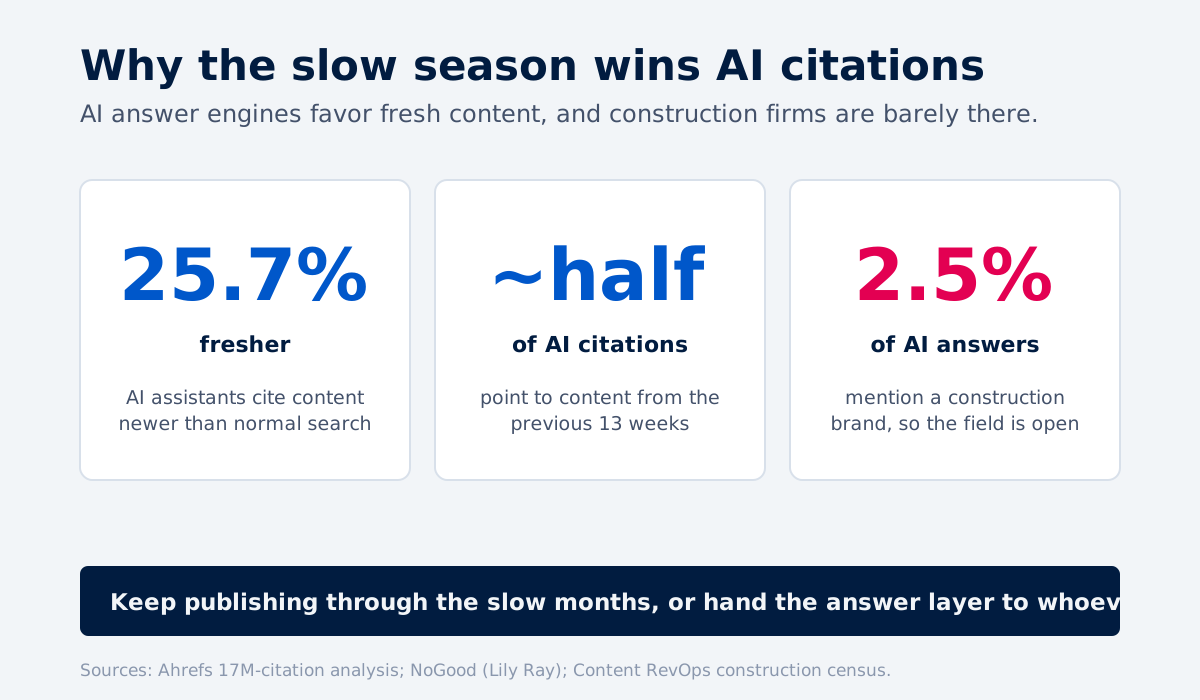
Two things follow for construction firms. Publishing steadily through the slow months keeps you in the fresh window competitors abandon when they go quiet. And content with original statistics gets cited more, which is exactly the kind of data you have time to produce in the off-season. Go dark for the winter, and you hand the answer layer to whoever kept publishing.
How do you tell you are doing slow-season marketing right?
You are doing it right when the quiet months produce assets that keep working, not when you simply stayed busy. Activity is not the test. Whether you built something that compounds is.
The clearest signal is a path from content to a sale. Only about a third of construction firms turn their content into a clear commercial next step; the rest publish into a polite dead end. If your slow-season work ends in a "contact us" and nothing else, you built awareness with no way to convert it.
A few plain checks tell you where you stand.
Did you publish on a schedule, or only when you felt like it? A system runs whether or not the phones are ringing.
Is the work still earning after the season turns? Content that ranks and gets found in June was built to last. A one-off winter promotion was not.
Does each piece give the reader a next step? A page that informs but never asks for the call is a leak.
Can you point to demand you created, not just demand you caught? The educational and decision content is what creates it.
If you want a straight read on where your firm sits against the rest of the industry, our construction marketing benchmarking tool scores your content against the field, and the wider construction industry breakdown shows what the firms pulling ahead do differently.
The point of construction seasonal marketing is not to survive the slow months. It is to use them. Content is revenue infrastructure, and the slow season is when you build it, so the quiet months stop being quiet.
Want to know what to build this slow season so it fills your busy season?
Our content revenue audit scores your construction content against the field, finds where demand leaks, and maps the off-season work that compounds.
Frequently Asked Questions
About the Author

Founder & CEO, Content RevOps
Stefan Kalpachev is the founder and CEO of Content RevOps, where he helps B2B SaaS companies transform their content into predictable pipeline. With a background in content marketing and revenue operations, Stefan has developed a unique methodology that bridges the gap between content creation and revenue generation.
Connect on LinkedIn