What Construction Business Owners Get Wrong About Marketing
Not sure whether your construction marketing is producing pipeline or just activity? A content revenue audit shows you which.
Book a CallMost construction business owners judge their marketing by how it looks and feels. There is a website. There are some posts. The work is good, and word gets around. That feels like marketing is handled. The only question that actually matters is different: how many booked jobs did it produce, and at what cost each? When you score marketing by activity and presence instead of by pipeline, you can look busy and still lose work you should have won. Our audit of 2,000 construction firms shows how common that swap is, and what it costs. Here are the six mistakes, and the fix for each.
Part of Content Marketing for Construction: The Complete 2026 Guide.
Mistake 1. Treating great work as a marketing plan
The most common belief in construction marketing is that good work markets itself. Do the job right, the thinking goes, and referrals will carry the business. Referrals are real and they matter, but they do not scale, and they do not reach the buyer who has never met you.
The data says most construction firms are running on that belief. In our study of 2,000 construction companies, about two-thirds are absent or superficial in content, and only one in three runs content as an actual system rather than something they touch once in a while. For most firms, marketing is not a plan. It is a website that sits there and a hope that the phone rings.
A contractor on Reddit put the belief in one line: many contractors think that "being licensed and doing professional level work is a sufficient marketing plan". It is not, because the buyer cannot see your work before they hire you. A homeowner in the same thread said it plainly: "I have no idea if you do great work or not if I've never worked with you before." The quality is the product. It is not the thing that gets you the chance to sell it.
The fix: treat the work and the marketing as two different jobs. The work earns the referral. The marketing earns the stranger. You need proof of your quality sitting where a buyer who has never met you can find it, before they ever call. Our list of construction marketing ideas that go beyond project photos shows what that proof can look like.
Mistake 2. Judging construction marketing by activity instead of pipeline
Posting on social, having a website, and "being out there" are activity. Booked jobs at a known cost are pipeline. Construction business owners who confuse the two end up spending on things that feel like marketing and produce nothing you can bank. Even social media for construction companies only earns its place once it is tied to a job.
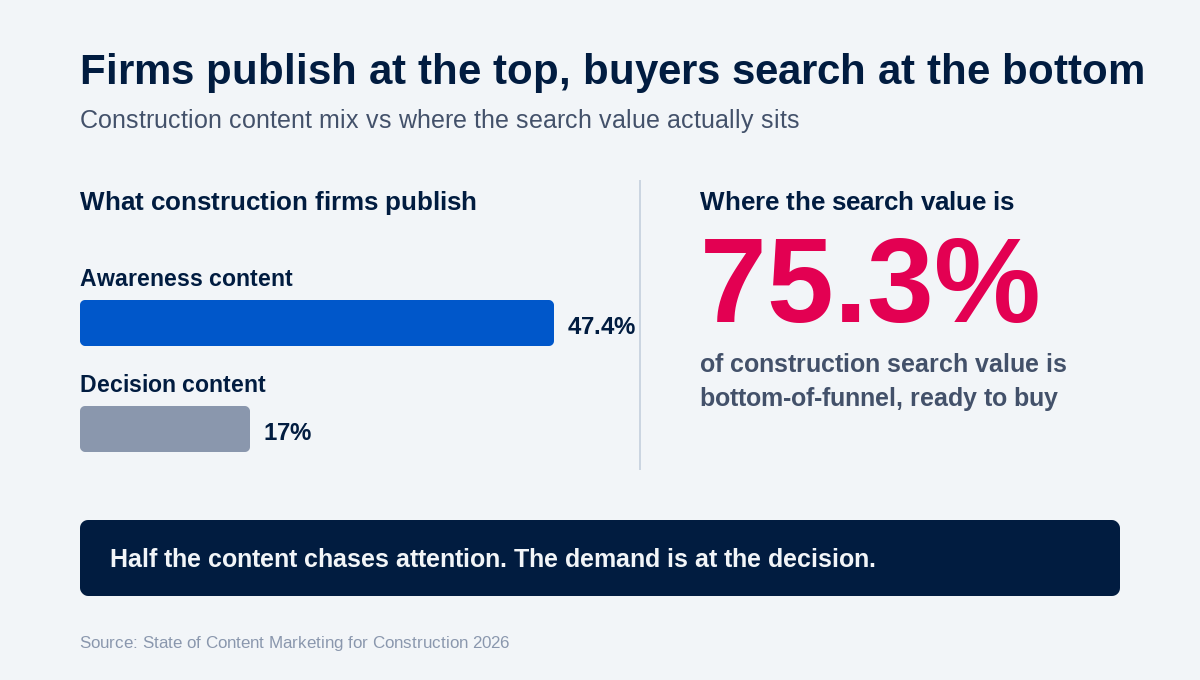
You can see the confusion in what construction firms actually publish. Nearly half of all construction content sits at the top of the funnel, aimed at awareness, while only 17% supports the moment a buyer is choosing who to hire. Meanwhile three-quarters of the search value in the category is bottom-of-funnel, the ready-to-buy searches. Firms make noise at the top and go quiet exactly where deals are won.
The most common piece of content on a construction site is the press release, the company talking about itself. Blogs exist almost everywhere and are tied to a buyer's decision almost nowhere. That is activity. None of it is measured against a job.
John Wilson, who runs a large home-services company, titled a whole talk "3 Marketing Mistakes That Keep Contractors Stuck Under $10M" for a reason. Marketing that is never scored against pipeline is what caps a construction business.
The fix: pick one number and judge everything by it, cost per booked job. Not clicks, not followers, not "brand awareness." When you know a channel produced four jobs last quarter at $600 each, you know what to do more of. The metrics worth tracking, and the vanity ones to drop, are a short list once pipeline is the scoreboard. Our guide to building a construction marketing strategy that generates pipeline turns that number into a plan.
Mistake 3. Blaming the price when you are losing on trust and being found
When a construction business owner loses a bid, the first explanation is almost always price. Sometimes that is true. Far more often, the buyer either could not find you or could not trust you yet, and price was the easy thing to blame.
Start with being found. The median construction site pulls about 155 organic visits a month, which is barely anyone, and ranks for only around 33 search terms, mostly its own name. In AI answers, where more buyers now start, construction brands surface in about 2.5% of responses, a gap we unpack in why construction brands almost never show up in AI answers. If the buyer is searching and you are not there, you never lost on price. You were never in the room.
Then trust. Most buyers check you out before they ever speak to you, and many rule you out in that step. Hinge Research found that over half of buyers in the built environment (51.6%) had ruled out a firm they were referred to without ever talking to it, after looking it up and not liking what they saw. The proof that would have reassured them, case studies, sits on only 38% of construction sites, and usually parked away from the decision instead of next to the ask.
The owner who assumes price is guessing. As one commenter told a contractor who had lost five bids in a month, "you've assumed the answer is price. But you won't know that unless you gather actual data."
The fix: make your quality visible before the bid, with named projects and real proof where buyers look, including AI search. Then ask your lost bids why you lost, and track the answers. If it really is price, you will know. Usually it is not. Our go-to-market strategy for construction firms shows how to put that proof in front of the buyers who are already deciding.
Mistake 4. Staffing for production, not for winning work
Look at who a construction firm hires when it decides to "do more marketing," and you see the mistake in the org chart. Firms hire hands to make things and people to show up in person. They rarely hire anyone whose job is to make the phone ring.
Across 557 marketing roles in construction, the number-one hire is events and field marketing at 69%, followed by brand and communications at 63% and design at 44%. The demand-generating skills sit far down the list: content is named in about 14% of roles, SEO in 7.5%, marketing automation in 7%, and answer-engine optimization in 0.4%. Construction firms staff for presence and production far more than for acquisition and measurement.
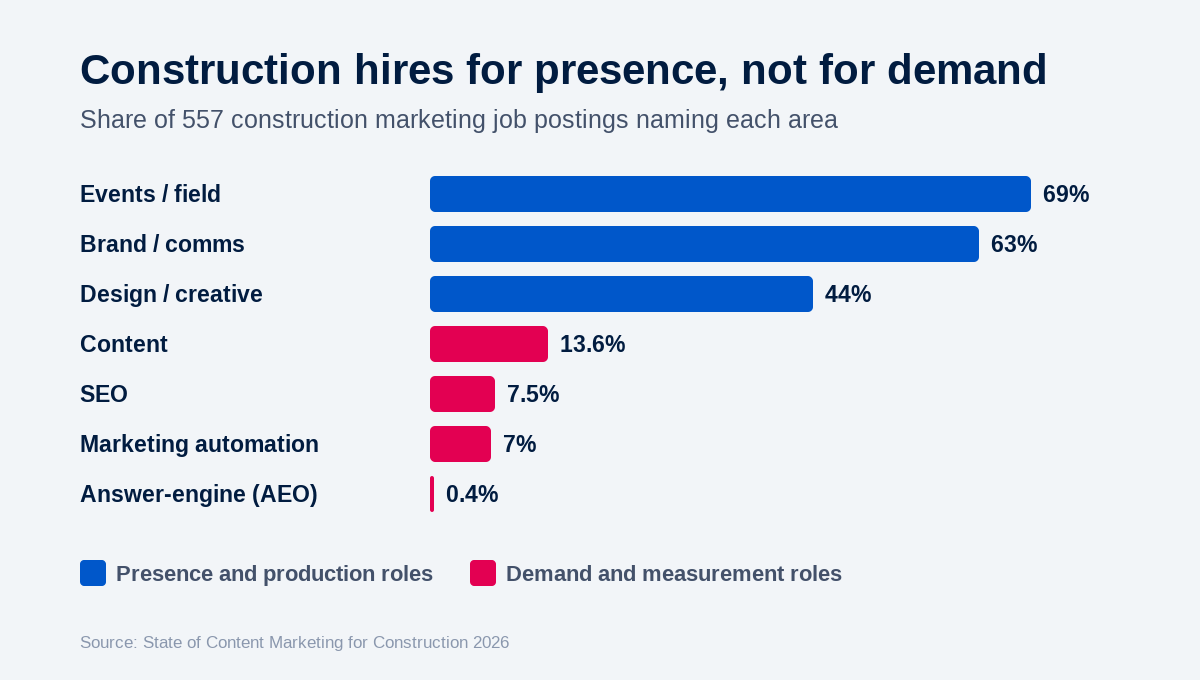
That is why the marketing budget produces brochures and booth graphics and not booked jobs. The people on the payroll were hired to make things look good, not to bring in work.
The fix: before the next production or presence hire, buy one acquisition capability. That can be a person, a fractional operator, or a partner, as long as their job is measured in leads and jobs, not in output shipped. Our comparison of in-house vs agency for construction marketing lays out which route fits which firm.
Mistake 5. Renting demand you could own
Most construction business owners who invest in marketing rent their demand. They pay for clicks every month and own nothing that keeps working after the invoice is paid. It feels like progress because the leads arrive while the card is charged. Stop paying, and it all stops.
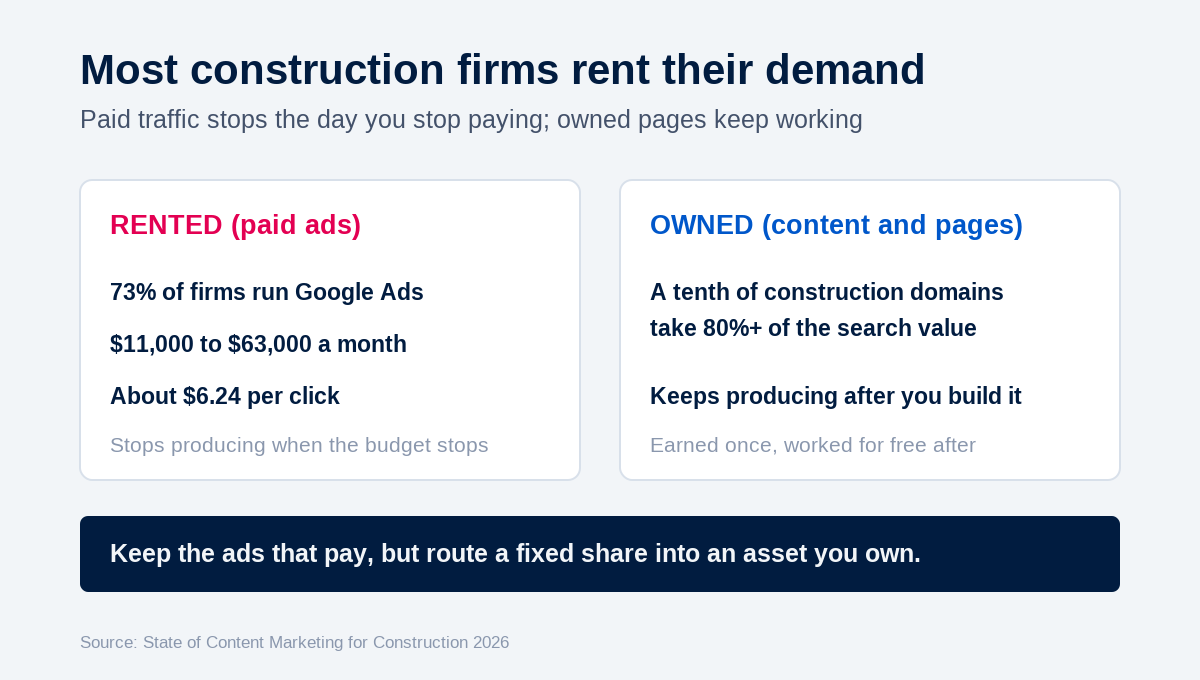
The spending is real. About 73% of construction firms pay for traffic through Google Ads, at roughly $11,000 to $63,000 a month, with clicks costing around $6.24 each. That is renting demand the right content would earn for free. And the market rewards the firms that own their presence: a tenth of construction domains capture more than 80% of the category's search value.
Bought leads are the sharpest version of the same trap. Opus Group, a US agency that runs ads for contractors, reports that shared marketplace leads close at 10% to 15% against 30% to 45% for a firm's own channels, which makes them far more expensive per booked job while training you to compete on price. The contractor coach Chuck the Contractor makes the same point about lead-reselling middlemen not being your main source.
The fix: keep the ads if they pay, but route a fixed share of the spend into an asset you own, ranked pages, an email list, real proof of work, that keeps producing after the budget stops. That is the difference between capturing demand and creating it. Our breakdown of how much a construction company should spend on marketing shows how to split that budget, and digital marketing for construction companies covers which channels earn the owned share.
Mistake 6. Paying for leads, then letting them leak
The most expensive mistake in construction marketing is not at the top, where you spend to get found. It is at the bottom, where the lead you already paid for dies from slow follow-up and no system to catch it.
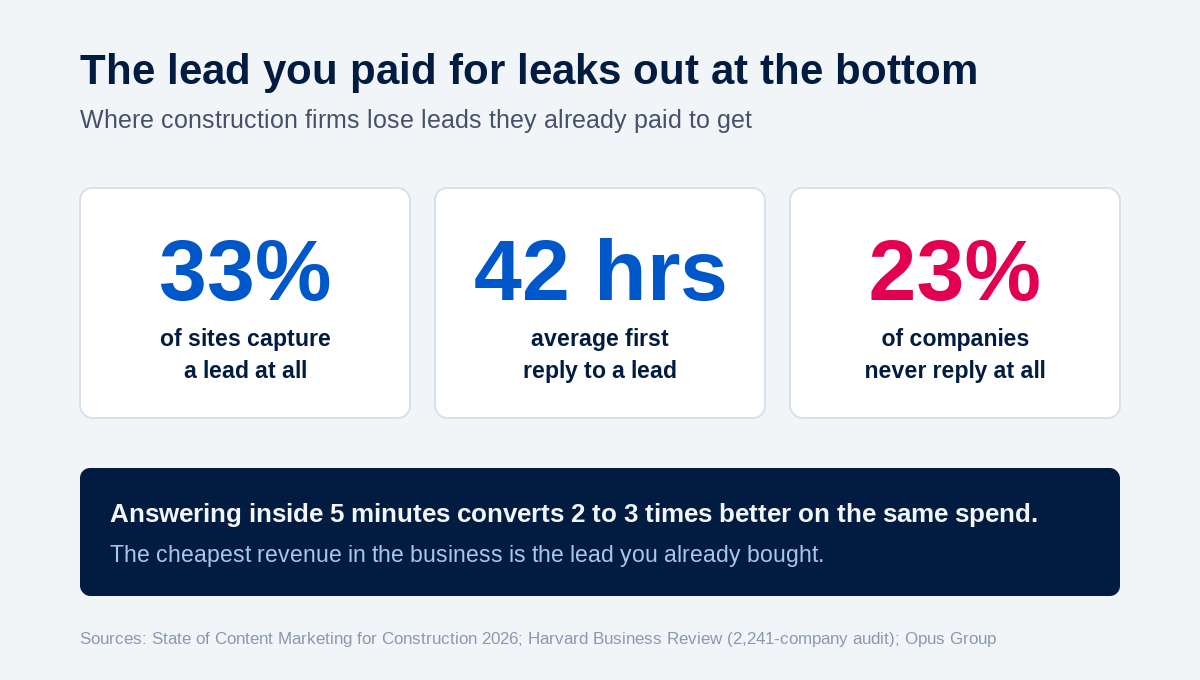
Only about a third of construction sites capture a lead at all, and usually with nothing more than a newsletter box. Two-thirds own a CRM but few wire their content into it, so the lead lands and no process picks it up. Real-time capture, like live chat, sits at 13%. High-intent buyers arrive on the page and meet a dead end, which is why so many construction websites get traffic but no leads.
Speed is the part owners underrate most. Harvard Business Review's audit of 2,241 companies found the average first response to an online lead was 42 hours, and 23% of companies never responded at all. Opus Group reports that answering inside five minutes converts two to three times better on the same spend, and that following up on unsold estimates is "the cheapest revenue in the business" because you already paid to get the lead.
A commenter on a contractor thread named the real problem: it "sounds like a systems issue... if it's easy to delay, ignore messages, or stay vague and still get high-quality work, most people will." The buyer responds to the structure you give them. Give them none, and they drift.
The fix: build a simple lead pipeline. One person owns the phone. Missed calls get a text within minutes. Every unsold estimate gets a short, scheduled follow-up. None of it costs much, and it saves the leads you already bought. Our notes on lead capture and qualification and the lead handover process show how that system is wired.
The one change that fixes all six
Every mistake here is the same swap, activity traded for pipeline. Great work stood in for a plan. Posting stood in for a booked job. Price stood in for trust. Production hires stood in for demand. Rented clicks stood in for an owned asset. A quote sent stood in for a lead caught.
Marketing stops being a cost the moment you give it a real job and hold it to that job, booked construction work at a cost you can name. That is when a website and a content library stop being decoration and start being revenue infrastructure for the business. The firms pulling ahead in construction are not the ones making the most noise. They are the ones who decided to measure.
To see which of the six apply to your firm, score yourself against our 2026 construction marketing benchmark, or put a number on it with the construction marketing benchmarking tool.
Want to know which of these six mistakes is costing your construction firm the most booked work?
Our content revenue audit maps your marketing against the buying decision, finds where booked jobs leak, and puts a number on the gap.
Frequently Asked Questions
About the Author

Founder & CEO, Content RevOps
Stefan Kalpachev is the founder and CEO of Content RevOps, where he helps B2B SaaS companies transform their content into predictable pipeline. With a background in content marketing and revenue operations, Stefan has developed a unique methodology that bridges the gap between content creation and revenue generation.
Connect on LinkedInRelated Articles
How Can I Tell Whether AI Citations Are Driving Real Pipeline or Just Vanity Mentions?
Nov 11, 2026
Which Prompts to Track to Know Whether Your AI Search Visibility Is Improving?
Nov 10, 2026
Marketing for Asset Management Firms: Where to Start
Oct 26, 2026